

Microsoft’s CVE-2026-26161 entry for the Windows Sensor Data Service reads like a classic local privilege-escalation advisory, but the detail that matters most is not the component name so much as the confidence signal attached to it. In Microsoft’s own framing, this metric measures how certain the vendor is that the vulnerability exists and how credible the known technical details are, which is a useful way to separate confirmed exploitation paths from more tentative research leads. That distinction matters because defenders often have to decide whether to patch immediately on vendor authority alone, or whether to wait for fuller technical corroboration. The answer here is straightforward: a Microsoft-listed EoP issue in a Windows service deserves prompt attention, especially when it touches a privileged, always-on subsystem like sensor handling.
The Security Update Guide exists precisely for cases like this, where Microsoft publishes vulnerability intelligence in a centralized format to help customers manage risk and prioritize remediation. Microsoft’s documentation repeatedly points security teams back to the guide as the authoritative source for CVE tracking, product mapping, and update planning, and that guidance is echoed across its Windows security resources. The sensor-data advisory therefore should be treated as part of the normal Windows servicing model, not as an isolated edge case. The operating assumption for defenders is simple: if the vendor says a Windows component can be abused for elevation of privilege, the blast radius is local but potentially severe.
Windows has a long history of privilege-escalation weaknesses in services and subsystems that were designed for convenience, compatibility, or hardware integration rather than hostile inputs. That pattern is visible across everything from kernel-mode bugs to user-mode brokers, and the Sensor Data Service fits squarely into that lineage. The service sits in a class of Windows components that often mediate access to device-generated signals, meaning they can become attractive targets once an attacker has any foothold at all. Even a low-privileged initial compromise can become much more serious if the attacker can chain into system-level execution.
Microsoft’s “confidence” or report-corroboration framing is especially relevant here because it affects how security teams interpret the advisory’s maturity. A high-confidence entry implies the vendor believes the issue is real and technically grounded, even if the public write-up remains sparse. That is not the same as a public proof-of-concept or a full root-cause disclosure, but it is enough to drive operational action. In practice, that means patch-management teams should not wait for a blog post, exploit demo, or third-party deep dive before moving the issue into the high-priority bucket.
For enterprise administrators, the most important question is not whether the flaw is glamorous or widely discussed; it is whether the affected service is present on their fleets and whether a patch can be validated quickly. Microsoft’s security model has shifted over the years from static bulletins to continuously updated advisories, and this format reflects a more dynamic threat landscape. The upside is better transparency and quicker update distribution. The downside is that defenders must make decisions with less narrative context than they often prefer.
In practical terms, the signal helps separate “interesting but uncertain” from “operationally actionable.” A low-confidence issue may still be important, but it usually demands more validation before teams commit scarce change windows or business risk to remediation. A higher-confidence issue, by contrast, is one that security teams should assume is real unless later evidence says otherwise. For a Windows EoP issue, that assumption is usually the right one.
The Sensor Data Service context matters because Windows services of this type are typically part of the system’s trust fabric. They are not peripheral add-ons that only matter in niche scenarios. If an attacker can coerce such a service into executing code in a higher integrity context, the impact is immediately more serious than a simple crash or information leak. That is why EoP flaws in Windows services remain evergreen priorities.
That broker role is exactly what makes the service sensitive. Whenever a Windows service sits between hardware-facing inputs and higher-privilege consumers, the attack surface expands beyond simple application logic. The service must parse, normalize, and route data reliably, and those are all classic places for memory-safety mistakes, logic flaws, or access-control errors to hide. If the attacker can supply malformed data or influence the service’s state machine, privilege boundaries may weaken.
The sensor stack’s documentation also shows that Microsoft prefers modern APIs over legacy COM-based interfaces, which suggests an ongoing effort to reduce complexity. That is a positive sign, but it does not eliminate risk. Legacy compatibility, device diversity, and backwards support all create room for flaws to persist. In a platform as old and broad as Windows, the existence of a modern API does not automatically mean the older pathway has vanished.
Microsoft’s advisory model reflects that reality. A local EoP may not be “internet exploitable,” but it can still be strategically devastating inside an enterprise. Once an attacker reaches the endpoint, local escalation can enable credential theft, persistence, defense evasion, and lateral movement. For many incidents, the escalation step is what transforms a nuisance into a breach.
For enterprises, the stakes are broader. Local EoP flaws can be chained with standard endpoint compromises, privileged service accounts, or vulnerable software deployment tools. In that environment, a single workstation becoming SYSTEM is often just the beginning. The more integrated the environment, the more valuable the bug becomes.
A few reasons local EoP bugs remain high value:
This is why Microsoft’s insistence on advisory-level tracking is so important. The company is effectively telling customers that the risk is concrete enough to patch now, even if the exploit path is not fully public. That is the correct reading for administrators: local does not mean minor.
The first step is determining which Windows SKUs and builds include the affected Sensor Data Service components. The second is confirming that the correct servicing update is installed and not superseded by a later cumulative package. The third is making sure rollback and restart planning do not delay the fix longer than necessary. In the real world, patching is a business process as much as a technical one.
For enterprises, the calculus is more complicated. Security teams have to balance uptime, driver compatibility, remote work constraints, and line-of-business software dependencies. That is where Microsoft’s advisory model is especially valuable, because it provides a shared reference point for IT, security operations, and endpoint engineering.
Key patching takeaways:
This approach is useful because it matches how actual defense teams work. Analysts routinely triage based on confidence, corroboration, and exploitability, not just on the existence of a CVE record. A nuanced advisory can reduce wasted effort and help teams focus on what is real. In that sense, Microsoft’s model is a security operations tool as much as a disclosure mechanism.
If teams read confidence as a substitute for impact, they may misrank important issues. If they read it as a substitute for urgency, they may underreact to real but sparsely documented flaws. The right approach is to treat confidence as one dimension of risk, not the whole picture. Severity, exposure, exploitability, and compensating controls still matter.
This is where Microsoft’s wider documentation ecosystem becomes relevant. The company points administrators to the Security Update Guide, the Windows security resources, and modern service documentation so that vulnerability data can be linked back to actual deployment contexts. That integrated model is helpful because it moves the discussion from “Is this CVE real?” to “Where does it live in my environment, and how fast can I eliminate it?” That is the correct operational question.
A few reasons the model works well:
For rivals, the lesson is mixed. On one hand, competitors can point to Windows’ scale as the reason it attracts so many disclosures. On the other hand, Microsoft’s ability to centralize advisories and ship cumulative fixes at global scale is a strong argument for enterprise customers who value predictability. Security transparency becomes part of the platform’s value proposition. A well-run advisory process is not just a defensive measure; it is product strategy.
A second implication is that local EoP vulnerabilities are no longer “small” issues in the old sense. Attack chains increasingly start with low-friction local execution and end with cloud compromise, identity theft, or ransomware. That means platform vendors are judged not only on whether they fix bugs, but on how quickly they communicate risk in a usable format. The market now rewards vendors that help customers act faster.
Important ecosystem takeaways:
The second thing to watch is whether this vulnerability sits alongside other March servicing items in a way that changes prioritization. Windows administrators rarely patch one issue in isolation, and cumulative updates often bundle several local escalation fixes together. That means the real-world response is about bundle management, not one CVE at a time. The better the inventory process, the less likely a single advisory gets lost in the noise.
CVE-2026-26161 is therefore best understood as a reminder that even ordinary-sounding Windows services can sit at highly sensitive trust boundaries. Microsoft’s confidence metric gives defenders a usable signal, and the Sensor Data Service context gives the signal operational weight. If organizations treat the entry as a real local privilege-escalation risk, validate the patch promptly, and confirm compliance across the fleet, they will have done exactly what the advisory was designed to enable.
Source: MSRC Security Update Guide - Microsoft Security Response Center
 Overview
The Security Update Guide exists precisely for cases like this, where Microsoft publishes vulnerability intelligence in a centralized format to help customers manage risk and prioritize remediation. Microsoft’s documentation repeatedly points security teams back to the guide as the authoritative source for CVE tracking, product mapping, and update planning, and that guidance is echoed across its Windows security resources. The sensor-data advisory therefore should be treated as part of the normal Windows servicing model, not as an isolated edge case. The operating assumption for defenders is simple: if the vendor says a Windows component can be abused for elevation of privilege, the blast radius is local but potentially severe.Windows has a long history of privilege-escalation weaknesses in services and subsystems that were designed for convenience, compatibility, or hardware integration rather than hostile inputs. That pattern is visible across everything from kernel-mode bugs to user-mode brokers, and the Sensor Data Service fits squarely into that lineage. The service sits in a class of Windows components that often mediate access to device-generated signals, meaning they can become attractive targets once an attacker has any foothold at all. Even a low-privileged initial compromise can become much more serious if the attacker can chain into system-level execution.
Microsoft’s “confidence” or report-corroboration framing is especially relevant here because it affects how security teams interpret the advisory’s maturity. A high-confidence entry implies the vendor believes the issue is real and technically grounded, even if the public write-up remains sparse. That is not the same as a public proof-of-concept or a full root-cause disclosure, but it is enough to drive operational action. In practice, that means patch-management teams should not wait for a blog post, exploit demo, or third-party deep dive before moving the issue into the high-priority bucket.
For enterprise administrators, the most important question is not whether the flaw is glamorous or widely discussed; it is whether the affected service is present on their fleets and whether a patch can be validated quickly. Microsoft’s security model has shifted over the years from static bulletins to continuously updated advisories, and this format reflects a more dynamic threat landscape. The upside is better transparency and quicker update distribution. The downside is that defenders must make decisions with less narrative context than they often prefer.
What the Advisory Signal Means
The credibility metric attached to CVE-2026-26161 is essentially a measure of how much trust to place in the report itself. Microsoft’s own explanation says the metric reflects the degree of confidence in the existence of the vulnerability and the credibility of the known technical details. That is a critical nuance, because it tells you whether a record is based on confirmed internal reproduction, strong external corroboration, or something more tentative.In practical terms, the signal helps separate “interesting but uncertain” from “operationally actionable.” A low-confidence issue may still be important, but it usually demands more validation before teams commit scarce change windows or business risk to remediation. A higher-confidence issue, by contrast, is one that security teams should assume is real unless later evidence says otherwise. For a Windows EoP issue, that assumption is usually the right one.
Why confidence matters to defenders
Security teams often over-focus on severity labels and under-focus on evidentiary quality. Microsoft’s confidence metric corrects that imbalance by giving defenders a clue about how mature the underlying technical claim is. That can shape triage, testing, and hunting priorities. It also helps explain why some advisories move faster than others even when the headline impact looks similar.- High confidence means the issue is more likely to be real and reproducible.
- Lower confidence suggests limited technical corroboration or incomplete details.
- Vendor acknowledgment is often the strongest practical signal available.
- Patch urgency should rise when confidence is high, even if the public write-up is brief.
- Exploitability assumptions should remain cautious until public proof emerges.
The Sensor Data Service context matters because Windows services of this type are typically part of the system’s trust fabric. They are not peripheral add-ons that only matter in niche scenarios. If an attacker can coerce such a service into executing code in a higher integrity context, the impact is immediately more serious than a simple crash or information leak. That is why EoP flaws in Windows services remain evergreen priorities.
The Sensor Data Service in the Windows Stack
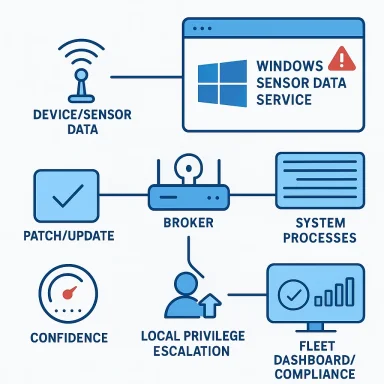
The Windows Sensor Data Service is part of the wider sensor and device telemetry ecosystem that Windows uses to interpret and expose hardware-generated data. Microsoft’s documentation for the sensor stack shows that the platform includes formal sensor APIs, data report objects, and sensor-specific fields such as activity state and confidence values. Even though the user-facing impact may seem mundane, the plumbing behind it is not. It is a brokered subsystem that translates device inputs into structured system data.That broker role is exactly what makes the service sensitive. Whenever a Windows service sits between hardware-facing inputs and higher-privilege consumers, the attack surface expands beyond simple application logic. The service must parse, normalize, and route data reliably, and those are all classic places for memory-safety mistakes, logic flaws, or access-control errors to hide. If the attacker can supply malformed data or influence the service’s state machine, privilege boundaries may weaken.
Why sensor-related services are attractive targets
Sensor frameworks are not as frequently discussed as file systems or networking stacks, but they are still valuable targets because they are deeply embedded and often run with system privileges. The attack surface is also harder for many organizations to observe, because sensor services are not always monitored as aggressively as domain controllers or internet-facing applications. That makes them quietly risky. A flaw in a supporting service can sit in plain sight while defenders focus elsewhere.- Brokered services are prime candidates for privilege-escalation defects.
- Hardware-adjacent code often processes complex, poorly normalized inputs.
- System-level privileges raise the impact of any successful abuse.
- Less-scrutinized components can linger with latent security issues.
- Local attack paths are still dangerous once an attacker lands an initial foothold.
The sensor stack’s documentation also shows that Microsoft prefers modern APIs over legacy COM-based interfaces, which suggests an ongoing effort to reduce complexity. That is a positive sign, but it does not eliminate risk. Legacy compatibility, device diversity, and backwards support all create room for flaws to persist. In a platform as old and broad as Windows, the existence of a modern API does not automatically mean the older pathway has vanished.
Why Local Privilege Escalation Still Matters
It is easy to underestimate a vulnerability that requires local access. In reality, local privilege escalation remains one of the most valuable bug classes for attackers because it converts a weak initial compromise into durable control. If malware, phishing, drive-by code execution, or a compromised service account gets a foothold, an EoP bug can be the bridge to administrator or SYSTEM-level control. That is why defenders treat these issues as part of the same kill chain rather than as standalone curiosities.Microsoft’s advisory model reflects that reality. A local EoP may not be “internet exploitable,” but it can still be strategically devastating inside an enterprise. Once an attacker reaches the endpoint, local escalation can enable credential theft, persistence, defense evasion, and lateral movement. For many incidents, the escalation step is what transforms a nuisance into a breach.
Enterprise and consumer impact differ, but both are real
For consumers, the main risk is that a single compromised app or malicious payload can gain much deeper control over a PC. That matters on personal systems because elevated access can expose passwords, browsers, tokens, and stored personal data. It can also disable protections and make the machine a more reliable platform for follow-on abuse.For enterprises, the stakes are broader. Local EoP flaws can be chained with standard endpoint compromises, privileged service accounts, or vulnerable software deployment tools. In that environment, a single workstation becoming SYSTEM is often just the beginning. The more integrated the environment, the more valuable the bug becomes.
A few reasons local EoP bugs remain high value:
- They often require only a modest foothold.
- They can bypass endpoint hardening if the service boundary is weak.
- They are useful in post-exploitation toolchains.
- They can be abused repeatedly across fleets if patching lags.
- They may be less visible to perimeter-focused defenses.
This is why Microsoft’s insistence on advisory-level tracking is so important. The company is effectively telling customers that the risk is concrete enough to patch now, even if the exploit path is not fully public. That is the correct reading for administrators: local does not mean minor.
Patch Management Implications
The immediate operational question for CVE-2026-26161 is not technical curiosity; it is patch orchestration. Microsoft’s advisory and the surrounding guidance model mean the issue should be folded into ordinary Windows update workflows, with special attention to asset inventory and remediation verification. That sounds simple, but in large environments it is often the hardest part of the process. You cannot patch what you have not accurately identified.The first step is determining which Windows SKUs and builds include the affected Sensor Data Service components. The second is confirming that the correct servicing update is installed and not superseded by a later cumulative package. The third is making sure rollback and restart planning do not delay the fix longer than necessary. In the real world, patching is a business process as much as a technical one.
A practical remediation sequence
- Identify exposed endpoints and servers that include the Windows Sensor Data Service.
- Map the advisory to the exact OS build and cumulative update level.
- Stage the patch in a controlled pilot ring before broad deployment.
- Validate the service state after reboot or servicing completion.
- Confirm no fallback channels can be used to reintroduce the vulnerable build.
- Document exceptions for machines that cannot be updated immediately.
- Recheck fleet compliance after the deployment window closes.
Consumer vs enterprise patching reality
For consumers, Windows Update generally makes this easier. Most home systems will receive the fix automatically, or at least with minimal intervention. The main risk is deferral—users postponing restarts or running outdated builds for too long.For enterprises, the calculus is more complicated. Security teams have to balance uptime, driver compatibility, remote work constraints, and line-of-business software dependencies. That is where Microsoft’s advisory model is especially valuable, because it provides a shared reference point for IT, security operations, and endpoint engineering.
Key patching takeaways:
- Pilot first, but do not over-delay a confirmed EoP fix.
- Treat restart coordination as a security task, not just an IT nuisance.
- Watch for supersedence in cumulative update chains.
- Use compliance reporting to catch stragglers quickly.
- Assume initial footholds exist and prioritize the escalation fix accordingly.
Microsoft’s Security Confidence Model in Context
Microsoft’s report-confidence concept is part of a broader industry shift toward evidence-weighted vulnerability intelligence. Rather than presenting every issue as equally mature, the vendor signals how certain it is about the finding and the details behind it. That helps customers make better prioritization decisions, especially when public disclosure is limited. It also recognizes that not all CVEs arrive with the same level of technical certainty.This approach is useful because it matches how actual defense teams work. Analysts routinely triage based on confidence, corroboration, and exploitability, not just on the existence of a CVE record. A nuanced advisory can reduce wasted effort and help teams focus on what is real. In that sense, Microsoft’s model is a security operations tool as much as a disclosure mechanism.
The signal is useful, but not perfect
The main advantage of the confidence metric is clarity. It tells defenders whether the advisory is a solid anchor for action or an early indicator that still needs validation. That is especially valuable when attackers, researchers, and vendors are all operating with different levels of visibility. But the system is only as good as the interpretation around it.If teams read confidence as a substitute for impact, they may misrank important issues. If they read it as a substitute for urgency, they may underreact to real but sparsely documented flaws. The right approach is to treat confidence as one dimension of risk, not the whole picture. Severity, exposure, exploitability, and compensating controls still matter.
This is where Microsoft’s wider documentation ecosystem becomes relevant. The company points administrators to the Security Update Guide, the Windows security resources, and modern service documentation so that vulnerability data can be linked back to actual deployment contexts. That integrated model is helpful because it moves the discussion from “Is this CVE real?” to “Where does it live in my environment, and how fast can I eliminate it?” That is the correct operational question.
A few reasons the model works well:
- It distinguishes confirmed risk from tentative research.
- It supports faster patch prioritization.
- It helps avoid false precision when technical detail is thin.
- It improves communication between security and IT teams.
- It keeps the vendor’s disclosure posture aligned with customer action.
Competitive and Broader Market Implications
Microsoft’s handling of advisories like CVE-2026-26161 also has competitive implications, even if they are indirect. Windows remains a vast ecosystem with enterprise, consumer, and OEM dependencies, so every security flaw becomes part of the platform trust story. When Microsoft demonstrates structured disclosure, quick servicing, and meaningful metadata, it reinforces the perception that Windows is a managed platform rather than a security free-for-all. That matters in a market where security posture influences procurement, deployment, and retention.For rivals, the lesson is mixed. On one hand, competitors can point to Windows’ scale as the reason it attracts so many disclosures. On the other hand, Microsoft’s ability to centralize advisories and ship cumulative fixes at global scale is a strong argument for enterprise customers who value predictability. Security transparency becomes part of the platform’s value proposition. A well-run advisory process is not just a defensive measure; it is product strategy.
Why this matters beyond one CVE
The broader industry trend is toward security metadata as an operational primitive. Customers want not only a patch, but also confidence, exploitability signals, affected product mapping, and practical rollout guidance. Vendors that deliver that stack reduce customer workload and increase trust. Microsoft has invested heavily in that model over the last decade, and advisories like this one show why.A second implication is that local EoP vulnerabilities are no longer “small” issues in the old sense. Attack chains increasingly start with low-friction local execution and end with cloud compromise, identity theft, or ransomware. That means platform vendors are judged not only on whether they fix bugs, but on how quickly they communicate risk in a usable format. The market now rewards vendors that help customers act faster.
Ecosystem effect on defenders
Defenders benefit from this transparency, but only if they use it well. Microsoft’s advisories can feed ticketing systems, SIEM enrichment, asset inventories, and patch dashboards. That creates an opportunity to move from reactive cleanup to governed risk management. It also means organizations can align their internal severity scoring with vendor confidence signals rather than inventing a separate taxonomy.Important ecosystem takeaways:
- Security metadata is becoming a platform feature.
- Cumulative servicing reduces fragmentation but demands discipline.
- Vendor confidence signals are now part of patch triage.
- Local EoP bugs have enterprise-scale consequences.
- Transparency is increasingly a competitive differentiator.
Strengths and Opportunities
The main strength of the CVE-2026-26161 advisory is that it gives defenders an actionable reason to move quickly even without a verbose public exploit narrative. Microsoft’s confidence framing, combined with the service’s position inside the Windows trust boundary, makes the issue easy to classify as a meaningful local EoP risk. That is exactly the kind of advisory structure security teams need when they are juggling hundreds of monthly fixes.- Clear vendor ownership of the vulnerability record.
- Useful confidence signaling for triage and prioritization.
- Fast alignment with Patch Tuesday workflows.
- Strong enterprise relevance because of the service’s privilege boundary.
- Good fit for automated compliance reporting and security dashboards.
- Opportunity to harden adjacent sensor and broker services.
- Potential to improve patch governance discipline across the fleet.
Risks and Concerns
The biggest concern with a local privilege-escalation issue is that organizations may underreact because it is not remote, wormable, or flashy. That would be a mistake. In a real compromise, local escalation is often the step that converts a foothold into a domain-impacting event, especially when credentials, tokens, or administrative tooling are in reach. That is why these flaws matter so much.- Underestimation of local-only impact in busy patch cycles.
- Delayed remediation because the public technical details are limited.
- Incomplete asset inventory leading to unpatched endpoints.
- Service-specific drift across Windows editions and managed devices.
- Potential chaining with other post-exploitation techniques.
- False confidence from partial patch compliance if superseded builds are not verified.
- Operational disruption if restart planning is not coordinated.
What to Watch Next
The next phase will be about whether Microsoft expands the public detail set, whether any independent researchers publish technical analysis, and whether defenders see the issue show up in post-patch validation or threat-hunting contexts. The most important near-term question is not academic root cause; it is whether organizations can convert the advisory into full remediation without delay. If the patch lands cleanly and quickly across fleets, the issue will remain a manageable local EoP event rather than a broader incident.The second thing to watch is whether this vulnerability sits alongside other March servicing items in a way that changes prioritization. Windows administrators rarely patch one issue in isolation, and cumulative updates often bundle several local escalation fixes together. That means the real-world response is about bundle management, not one CVE at a time. The better the inventory process, the less likely a single advisory gets lost in the noise.
Watch list
- Whether Microsoft adds more technical detail to the advisory over time.
- Whether third-party trackers confirm a specific weakness class.
- How quickly enterprise patch rings close the gap on affected systems.
- Whether the issue appears in exploit chaining scenarios.
- Whether related sensor or broker services receive follow-on hardening.
CVE-2026-26161 is therefore best understood as a reminder that even ordinary-sounding Windows services can sit at highly sensitive trust boundaries. Microsoft’s confidence metric gives defenders a usable signal, and the Sensor Data Service context gives the signal operational weight. If organizations treat the entry as a real local privilege-escalation risk, validate the patch promptly, and confirm compliance across the fleet, they will have done exactly what the advisory was designed to enable.
Source: MSRC Security Update Guide - Microsoft Security Response Center
Last edited:
