

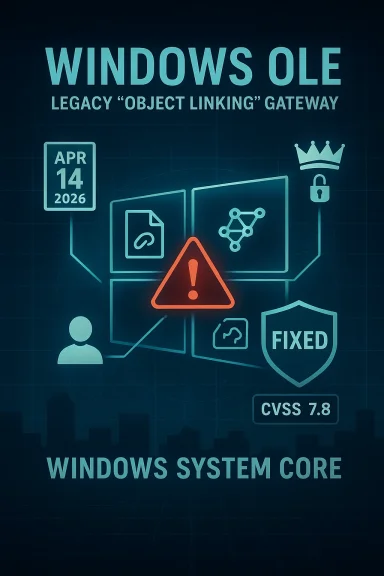
 CVE-2026-26162 and Why Microsoft’s Windows OLE Elevation-of-Privilege Fix Matters
Microsoft’s CVE-2026-26162 is a reminder that some of the most consequential Windows security bugs are not flashy remote exploits, but quieter local privilege escalation flaws buried deep in system components. In this case, the issue sits in Windows OLE, a longstanding part of the Windows platform, and the public description points to a type confusion problem that can let an authorized attacker elevate privileges locally. The timing matters too: Microsoft released a fix on April 14, 2026, and the vulnerability is already being tracked by security intelligence vendors with a CVSS 7.8 rating, which places it in high-severity territory. (feedly.com)Background
Windows OLE, or Object Linking and Embedding, is one of those foundational technologies that most users never think about until something breaks. It dates back to earlier eras of Windows computing, when document interoperability, rich content, and application automation were core design goals. That legacy matters because deeply integrated components often persist for decades, accumulating compatibility constraints, security hardening, and attack surface at the same time.Microsoft has dealt with OLE-related security problems before, and the historical pattern is instructive. In 2015, Microsoft shipped MS15-075 to address multiple OLE elevation-of-privilege issues, explaining that OLE could allow EoP when it failed to properly validate user input. The company’s own bulletin noted that those vulnerabilities were especially dangerous when paired with another flaw that enabled code execution, because they could be used to raise privileges after initial compromise.
That history shows why OLE bugs remain relevant in 2026. Even when a flaw is “only” local, it can be the final step in a more complex attack chain. An adversary who gets a foothold through phishing, malicious files, a browser exploit, or a weak service account may not need remote code execution in the OLE component itself if they can pivot into a privilege escalation path afterward.
Microsoft’s current security disclosure posture is also worth noting. Since the company expanded its transparency efforts and began publishing machine-readable CSAF files alongside the Security Update Guide, defenders have had better structured access to CVE data. That does not change the vulnerability itself, but it does improve how quickly organizations can triage and automate patching once Microsoft publishes the fix.
What makes CVE-2026-26162 notable is not just that it exists, but that the public record already gives defenders a useful first cut of the threat model. Security trackers describe it as a type confusion vulnerability in Windows OLE that can lead to local privilege escalation, with no evidence yet of a public proof-of-concept or exploitation in the wild. That combination usually means defenders have time to patch, but not the luxury of ignoring it. (feedly.com)
What Microsoft Has Said
Microsoft’s own Security Update Guide entry is the authoritative source for operational response, even when the underlying web app is difficult to scrape directly. The advisory link associated with CVE-2026-26162 points to a patch released on April 14, 2026, which means defenders should already be treating this as an active remediation item rather than a theoretical concern. The bug is in the category of Elevation of Privilege, which is often less visible than remote code execution but can be just as damaging once an attacker is inside the machine. (feedly.com)The practical significance of the disclosure
The public description matters because Microsoft did not frame this as a vague hardening fix. Instead, the wording reported by security sources emphasizes type confusion and incompatible types, which strongly suggests a memory-safety or object-state validation problem in the way OLE handles certain objects. In plain English, that means the component may be making assumptions about what kind of object it is dealing with, and those assumptions can be abused by a local attacker. (feedly.com)This is exactly the sort of flaw that can be underestimated in enterprise environments. If a vulnerability requires local access, some teams mentally downgrade it as “not internet-facing.” That is a mistake. Modern compromise chains often begin with a low-privilege user, a rogue script, or a planted payload, and the local escalation step is what turns a limited compromise into a full system breach.
Why the CVSS score should get attention
The reported CVSS v3.1 score of 7.8 is not subtle. Feedly’s summary lists the attack vector as local, attack complexity as low, privileges required as low, and user interaction as none, with high impacts to confidentiality, integrity, and availability. Those properties make the vulnerability especially useful to attackers who already have a foothold and want to move from ordinary user rights to SYSTEM-level control. (feedly.com)- Attack vector: Local
- Privileges required: Low
- User interaction: None
- Impact: High across confidentiality, integrity, and availability
- Patch status: Fixed by Microsoft on April 14, 2026 (feedly.com)
Why Windows OLE Still Matters
Windows OLE is not glamorous, but it is deeply embedded in the Windows ecosystem. It touches document workflows, legacy application interoperability, shell behavior, and the kind of object handling that older enterprise environments still depend on every day. When a vulnerability hits OLE, the blast radius can be larger than the branding suggests because the component sits at the intersection of old compatibility promises and modern security expectations.The reason this keeps happening is structural. Legacy Windows subsystems often cannot be ripped out without breaking workflows, so Microsoft has to harden them incrementally. That creates a familiar security pattern: components remain in place because they are business-critical, while attackers continue probing for boundary mistakes, object confusion, or unsafe assumptions inside the code paths.
Historical precedent
Microsoft’s earlier OLE bulletins show the same theme. In MS15-075, the company explained that OLE vulnerabilities could allow elevation of privilege only in conjunction with another code-execution bug, and that they were caused by improper input validation. That is not identical to CVE-2026-26162, but it is close enough to show a continuing class of risk: validation failures inside a legacy object model can turn into privilege escalation when chained with other compromises.This matters for defenders because a single component may appear in many workflows, but the exploitation path can differ dramatically. One local bug might be useful after phishing, another after malware persistence, and another after a supply-chain infection. The common denominator is that once a foothold exists, OLE can become a stepping stone to much higher privilege.
The enterprise angle
Enterprises are the most exposed because they tend to have the broadest mix of endpoints, old applications, and privileged support accounts. A local EoP flaw is especially dangerous on machines where helpdesk agents, developers, or automation tools already operate with elevated access. That is where “local” stops meaning “safe” and starts meaning “useful to attackers.”Consumer systems are still affected, but the practical risk profile is different. On a home PC, exploitation generally requires prior code execution or a compromised account. On a corporate endpoint, the same flaw may be the final step in a chain that turns a single infected user profile into a domain-adjacent incident.
Technical Interpretation
The key technical clue in the public reporting is the phrase type confusion. In security terms, that usually means the program believes it is handling one kind of object or data structure when it is actually handling another. In a component like OLE, where object relationships and serialization logic are complex, that kind of error can produce memory corruption, incorrect access control, or unsafe method invocation.Type confusion is especially dangerous because it often gives attackers some degree of control over program behavior. If they can influence how the software interprets an object, they may redirect execution flow, read or write unintended memory, or trigger a privilege boundary violation. That does not automatically mean a full arbitrary code execution primitive, but it often means the attacker can do damage with relatively modest prerequisites.
Why this is not “just another bug”
A local privilege escalation flaw can be more valuable than a noisy remote bug in some environments. Remote exploits draw attention, get filtered by perimeter controls, and often require hardened exploit chains. A local privilege escalation bug, by contrast, can be used quietly after the attacker already has access, which is exactly the kind of threat that endpoint detection struggles with if the attacker is careful.That makes CVE-2026-26162 a classic post-compromise accelerant. It may not be the first thing that gets a machine infected, but it can be the thing that turns a low-value foothold into a high-value breach. Security teams should treat that as operationally serious rather than academically interesting.
What defenders should infer
Because Microsoft has not, at least in the public summary, described a public exploit or active in-the-wild campaign, the immediate issue is exposure management rather than incident response. But defenders should still assume the bug is worth prioritizing because local privilege escalation flaws tend to get absorbed quickly into offensive toolchains once a patch is available and details circulate. The quiet ones are often the fastest to be weaponized.- Type confusion often points to memory or object-state errors.
- Local EoP bugs are valuable after initial compromise.
- Legacy components tend to be both hardened and brittle.
- Patch availability raises the urgency for mass remediation.
- Attackers often prefer low-noise post-exploitation primitives. (feedly.com)
Affected Systems and Exposure
Feedly’s aggregation suggests the vulnerability affects a wide swath of Windows releases, including Windows 10, Windows 11, and multiple Windows Server generations. That breadth is typical of core platform components like OLE, which are shared across consumer and enterprise builds. Even if not every SKU is equally exposed in practice, the list is broad enough that patching should be treated as a platform-wide priority. (feedly.com)The most important question for administrators is not whether their estate includes Windows, but whether any business-critical systems still run unpatched builds or delayed servicing rings. That includes workstations with elevated local accounts, jump boxes, admin workstations, terminal servers, and systems used by support staff or third-party vendors. Those machines are often the ones attackers hunt for after the initial breach.
Who is most at risk
The vulnerability is most relevant where an attacker can already execute code as a low-privilege user. That means shared endpoints, partially trusted contractor systems, and user workstations exposed to phishing or malicious downloads are all credible targets. If a device is also used for admin work, the risk compounds quickly.This is why least privilege is not a slogan but a mitigation layer. The fewer users and services that operate with local elevated rights, the smaller the set of accounts an attacker can abuse to trigger or benefit from an escalation flaw. Microsoft’s own summary, as relayed by security trackers, recommends limiting local system access and reducing low-level privileged accounts. (feedly.com)
Practical exposure checklist
- Identify systems that allow interactive local login by many users.
- Audit any shared admin workstations or jump hosts.
- Prioritize patching on endpoints that handle email attachments or document workflows.
- Review service accounts and scheduled tasks that run with elevated rights.
- Check whether endpoint controls detect abnormal token or privilege changes.
Patching Strategy
The good news is that Microsoft has already released a fix, which means this is not a waiting game. The challenge is speed and coverage, not uncertainty. Organizations should move this vulnerability into the same patch queue as other high-severity local privilege escalations that can turn a compromise into systemic control.Patch management for this kind of issue should be boringly disciplined. There is no reason to delay because of compatibility fear unless a vendor-specific regression is known, and even then the safer move is usually staged deployment rather than postponement. Windows OLE sits too close to user activity, document workflows, and administrative processes to tolerate long exposure windows.
Recommended deployment order
Prioritize systems in the following order:- Internet-facing or frequently exposed endpoints.
- Admin workstations and support laptops.
- File servers and application servers with interactive local access.
- Shared desktops and kiosk-style machines.
- Less exposed endpoints last, but still within the normal emergency patch window. (feedly.com)
Why emergency patching still makes sense
Some organizations reserve emergency patching for active exploitation only. That policy can be defensible for obscure issues with limited impact, but not here. A high-severity local EoP in a central Windows component is exactly the kind of flaw that should be patched on an accelerated schedule even before proof-of-exploit emerges.It is also worth remembering that local privilege escalation bugs can be chained with commodity malware. Once code execution exists, privilege escalation is often the missing piece that allows persistence, credential access, or lateral movement. Waiting for public exploitation is often the wrong bet.
Enterprise vs Consumer Impact
For consumers, the risk is real but usually bounded by the attacker’s need to obtain local code execution first. A home user who keeps Windows updated, avoids running untrusted software, and uses a standard account is in a much stronger position than a user with constant administrative rights. Still, if malware lands on the machine, a local privilege escalation bug can make cleanup much harder and data theft much worse.For enterprises, the story is more serious because local privilege escalation bugs can enable lateral consequences beyond the affected host. A compromised endpoint with administrative access can expose credentials, cached tokens, remote management tools, and access to sensitive shares. In a managed environment, one vulnerable machine can become a gateway into the broader network.
Consumer reality
Consumers rarely think in terms of privilege boundaries, but they should. If a browser exploit, malicious attachment, or rogue installer gets foothold on a PC, the difference between a normal user context and SYSTEM matters enormously. Windows hardening, automatic updates, and standard user accounts still do the heavy lifting here.Enterprise reality
Enterprises need more than patching. They need segmentation, attack surface reduction, device control, and strong identity hygiene because local EoP flaws assume some degree of foothold already exists. Once that assumption is met, the rest depends on whether the environment is designed to absorb the impact or amplify it.- Use standard user accounts wherever possible.
- Limit who can log on locally to sensitive systems.
- Separate admin workstations from daily-use machines.
- Reduce cached credentials on endpoints.
- Treat privilege escalation telemetry as a priority signal. (feedly.com)
The Security Ecosystem Response
Third-party vulnerability trackers were quick to classify CVE-2026-26162 as serious, but with no evidence of exploitation at the time of publication. That is an important combination: high severity, no known active abuse. It gives defenders a narrow window to get ahead of opportunistic attackers before exploit code appears in public repositories or commercial offensive tooling. (feedly.com)This is also where the modern vulnerability ecosystem is changing. Security teams no longer wait only for vendor bulletins; they monitor enrichment sources, threat intelligence feeds, and machine-readable advisory channels. Microsoft’s own move toward CSAF publishing helps with that, because structured data can be consumed by automated inventory and risk systems faster than manual reading.
Why enrichment matters
A raw CVE number tells you almost nothing operationally. An enriched record tells you severity, attack vector, required privileges, known exploit status, and patch availability. That context is what lets a SOC decide whether to accelerate patching, hunt for exposure, or monitor for signs of exploitation.The current public reporting on CVE-2026-26162 is already enough to make that decision. The flaw is local, but it is high impact, patchable, and associated with a central Windows subsystem. That is the sort of bug that deserves immediate queueing, even if the actual exploit path remains undisclosed.
Threat intelligence posture
Security teams should watch for the usual follow-on behavior after a patch release: exploit writeups, proof-of-concept demonstrations, post-exploitation tool updates, and adversary tradecraft notes. The first public exploit is often not the first real exploit. By the time code is posted, many attackers may already have begun testing internally.Strengths and Opportunities
The most encouraging part of this disclosure is that Microsoft appears to have moved quickly to ship a patch, which gives enterprises a clear remediation path. The advisory also lands in a period where Microsoft’s security transparency tools are more structured than they were a few years ago, making it easier to automate response and assign ownership. That combination is useful, even if it does not reduce the severity of the bug itself.- Patch is available now, reducing uncertainty.
- The vulnerability is clearly classified as a local EoP, helping prioritize response.
- No public exploitation has been documented in the available reporting.
- Security teams can fold the CVE into standard emergency patch workflows.
- Microsoft’s CSAF and advisory ecosystem can improve automation.
- The issue reinforces least-privilege and endpoint hardening efforts.
- It gives defenders a chance to patch before exploit commoditization. (feedly.com)
Risks and Concerns
The biggest concern is that local privilege escalation bugs are easy to underestimate until they are combined with a real intrusion. Once code execution exists anywhere on the host, a bug like this can dramatically raise attacker value and reduce the effort needed to reach SYSTEM-level control. That is exactly why these flaws often matter more in practice than their local-only label suggests.- Attackers with any foothold can potentially benefit from it.
- OLE is a longstanding component, so exposure may be widespread.
- High-severity local bugs often become post-exploitation staples.
- Enterprises with weak privilege separation are especially exposed.
- Delayed patching creates a dangerous window after disclosure.
- Legacy application dependencies may complicate remediation.
- Monitoring may miss privilege escalation if it is quiet and fast. (feedly.com)
Looking Ahead
The next phase will be less about the CVE record and more about how quickly the ecosystem digests the fix. If researchers publish technical details, or if exploit developers reverse engineer the patch, the urgency will climb further. Until then, the correct assumption is that this is a serious but manageable flaw that should already be in the patch queue.Organizations should also expect this disclosure to renew old conversations about legacy Windows components. OLE is not going away, and neither is the need to secure it. The real question is whether vendors and customers continue to treat these subsystems as core attack surfaces, or whether they keep rediscovering that fact only after each new advisory.
- Watch for exploit writeups and patch diff analysis.
- Verify that the April 14, 2026 update is deployed broadly.
- Check privileged endpoints and admin workstations first.
- Review alerting for suspicious token elevation behavior.
- Reassess how much local admin access still exists in the environment. (feedly.com)
Source: MSRC Security Update Guide - Microsoft Security Response Center
Last edited:
