

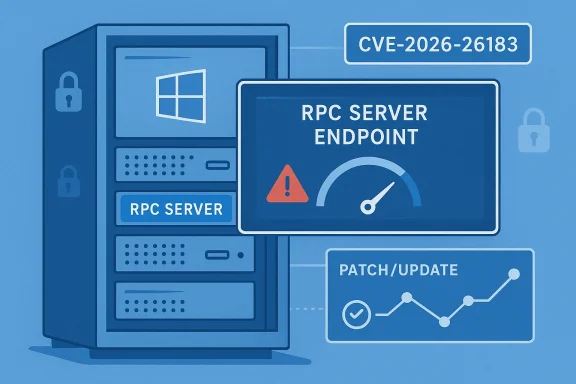
Microsoft’s entry for CVE-2026-26183 is the kind of advisory that looks terse on the surface but still carries meaningful operational weight. The public description identifies a Remote Access Management service/API (RPC server) Elevation of Privilege Vulnerability, and the surrounding guidance emphasizes Microsoft’s confidence signal: this metric reflects how certain Microsoft is that the vulnerability really exists and how credible the technical details are. In practical terms, that matters because a vendor-acknowledged flaw with a patchable path deserves a different response than an unverified rumor or a speculative finding.
Microsoft has long used the Security Update Guide to publish concise vulnerability records before, during, and after Patch Tuesday. For defenders, the important nuance is not just whether a flaw is listed, but how much confidence Microsoft places in it and how much technical detail is exposed. That confidence metric is especially useful for prioritization because it helps separate confirmed, actionable issues from weaker signals that still need corroboration.
The Remote Access Management service sits in a category of Windows infrastructure that enterprises often forget is part of the attack surface until something breaks. Services that expose management functionality through RPC are especially sensitive because they bridge user context, service context, and administrative workflows. When that bridge is flawed, the result is often a privilege boundary problem rather than a noisy crash or obvious remote takeover.
Historically, Microsoft RPC-related flaws have been treated seriously because the protocol family sits close to the operating system’s control plane. The company has spent years hardening this layer after earlier Windows service and RPC bugs showed how quickly a design flaw can become a broad privilege-escalation path. The lesson from that history is simple: local or authenticated vulnerabilities are not “less important” when they lead to SYSTEM-level access or service compromise.
The wording in the CVE title also matters. An Elevation of Privilege issue in a management service usually suggests that a user who already has some foothold, or some ability to interact with the service, may be able to cross into a higher trust boundary. That is often the difference between a nuisance and a major incident, because attackers rarely need full remote code execution if they can chain a lower-privilege foothold into admin control.
The technical detail level matters just as much. A sparse advisory does not mean the issue is unimportant; it usually means Microsoft is limiting the amount of exploit guidance exposed publicly. That balance is common in high-risk Windows advisories, where the vendor wants to help customers patch quickly without giving attackers a ready-made blueprint.
The danger in a service like Remote Access Management is that it may be reachable through administrative workflows, background agents, or service-to-service calls that defenders do not closely monitor. Once that surface exists, the attacker does not necessarily need to “break in” in the classic sense; they may only need to find a way to send a malformed or specially crafted request through an allowed path.
This is why privilege escalation bugs often receive outsized attention from enterprise teams. They are the glue that turns a low-impact foothold into a full compromise chain. In Windows environments, that chain can quickly expand from a single host to credential exposure, persistence, and lateral movement.
A few reasons these flaws matter so much:
In practice, an enterprise deployment may expose management functionality through local service accounts, domain credentials, or orchestration layers. If the RPC server behind Remote Access Management accepts requests in a way that can be abused, the flaw can become a bridge from ordinary user access to a far more powerful execution context. That is exactly the sort of issue defenders should prioritize.
This difference is crucial because enterprises tend to have the very conditions attackers need: many users, some delegated administration, and plenty of operational tooling. A flaw that looks niche on paper can become high-impact once it lands on a domain-joined server or a workstation with privileged tooling installed.
The operational lesson is that attack surface is contextual. A service that is dormant on one machine may be mission-critical on another. That is why inventory, exposure mapping, and role-based prioritization matter as much as patching itself.
What matters is the likely outcome. If the flaw is exploitable, an attacker may be able to perform actions as a higher-privileged identity than intended. In Windows terms, that can mean SYSTEM, service account access, or administrative control over the affected host.
Patching strategy should also recognize that privilege-escalation bugs can be chained. A low-privilege attacker who has already landed on a machine through phishing, stolen credentials, or another exploit may be able to use CVE-2026-26183 as the final step in a compromise chain. In other words, delay is not neutral here; delay increases the window for post-compromise escalation.
Defenders, meanwhile, should interpret the advisory as a signal to harden adjacent controls. If an attacker can potentially escalate in a management service, then least privilege, service isolation, and privileged access workflows become more important. Patch the flaw, yes — but also make sure the same class of exploit has less room to breathe next time.
That distinction is especially relevant here. A high-confidence EoP flaw in a service/API backed by RPC should be read as a patch-now item even if the public write-up is short. A concise advisory is not a weak advisory; it is often a deliberate choice to limit attacker enablement while still warning customers.
For this CVE, the correct stance is the middle ground: treat the issue as credible, actionable, and time-sensitive, while avoiding assumptions about exploit mechanics that Microsoft has not publicly confirmed. That is the disciplined response mature teams should prefer.
That means administrators need to think in terms of blast radius rather than just exposure. A service used only by IT staff may still be a crown jewel if it can raise privileges or grant access to trusted management paths. The more powerful the service, the lower the tolerance for delay.
This is one reason Microsoft’s internal confidence signals are useful. They let defenders separate the mere existence of a CVE from the credibility of the vendor’s underlying assessment. When the two line up, the response should be operational rather than speculative.
The lesson is not that Windows is uniquely fragile. The lesson is that high-privilege operating systems always accumulate these kinds of edge-case flaws, and the organizations that survive them best are the ones that build patch discipline around certainty, not hype.
The other thing to watch is whether the vulnerability maps to a broader class of RPC or management-service issues in the same code family. Windows privilege-escalation advisories often reveal patterns that matter beyond one CVE, especially when the affected component is part of a shared administrative substrate.
CVE-2026-26183 is not dramatic because it promises flashy remote compromise. It is important because it sits where Windows security is always most sensitive: in a privileged management path that, if misused, can hand an attacker a much higher rung on the ladder. The safest interpretation is also the simplest one — Microsoft has signaled a credible elevation-of-privilege issue in an RPC-backed service, and defenders should treat that as a real operational risk until the patch is everywhere and the surrounding controls are stronger.
Source: MSRC Security Update Guide - Microsoft Security Response Center
 Background
Microsoft has long used the Security Update Guide to publish concise vulnerability records before, during, and after Patch Tuesday. For defenders, the important nuance is not just whether a flaw is listed, but how much confidence Microsoft places in it and how much technical detail is exposed. That confidence metric is especially useful for prioritization because it helps separate confirmed, actionable issues from weaker signals that still need corroboration.The Remote Access Management service sits in a category of Windows infrastructure that enterprises often forget is part of the attack surface until something breaks. Services that expose management functionality through RPC are especially sensitive because they bridge user context, service context, and administrative workflows. When that bridge is flawed, the result is often a privilege boundary problem rather than a noisy crash or obvious remote takeover.
Historically, Microsoft RPC-related flaws have been treated seriously because the protocol family sits close to the operating system’s control plane. The company has spent years hardening this layer after earlier Windows service and RPC bugs showed how quickly a design flaw can become a broad privilege-escalation path. The lesson from that history is simple: local or authenticated vulnerabilities are not “less important” when they lead to SYSTEM-level access or service compromise.
The wording in the CVE title also matters. An Elevation of Privilege issue in a management service usually suggests that a user who already has some foothold, or some ability to interact with the service, may be able to cross into a higher trust boundary. That is often the difference between a nuisance and a major incident, because attackers rarely need full remote code execution if they can chain a lower-privilege foothold into admin control.
What Microsoft Is Signaling
Microsoft’s confidence language is not just bureaucratic metadata; it is a decision-making aid. When the vendor says it has high confidence in a flaw’s existence, defenders can treat it as a real patching event rather than an abstract possibility. That is particularly important for privilege-escalation bugs, which often become more dangerous once a real-world attack path is disclosed or independently reproduced.The technical detail level matters just as much. A sparse advisory does not mean the issue is unimportant; it usually means Microsoft is limiting the amount of exploit guidance exposed publicly. That balance is common in high-risk Windows advisories, where the vendor wants to help customers patch quickly without giving attackers a ready-made blueprint.
Why confidence metadata matters
A confidence score is a proxy for operational trust. It tells administrators how strongly they should believe the advisory, even if the root cause is not fully documented. In environments with thousands of assets, that can be the difference between immediate action and waiting for more proof.- High confidence usually means patch now, inventory later.
- Moderate confidence may justify faster validation before broad rollout.
- Low confidence often signals a candidate issue that still needs more evidence.
Why RPC Server Bugs Matter
RPC-based services have a long history of producing impactful Windows security issues because they often accept structured requests from code that is assumed to be legitimate. That assumption is exactly where things go wrong. If an attacker can manipulate request handling, authentication state, object lifetime, or parameter validation, the result may be privilege escalation rather than obvious data theft.The danger in a service like Remote Access Management is that it may be reachable through administrative workflows, background agents, or service-to-service calls that defenders do not closely monitor. Once that surface exists, the attacker does not necessarily need to “break in” in the classic sense; they may only need to find a way to send a malformed or specially crafted request through an allowed path.
The control-plane problem
Management services are control-plane components, and control-plane flaws are disproportionately dangerous. If an attacker can alter how the service authorizes or processes a request, they may inherit the privileges of the service itself. That can mean local admin, service account compromise, or broader system control depending on how the component is deployed.This is why privilege escalation bugs often receive outsized attention from enterprise teams. They are the glue that turns a low-impact foothold into a full compromise chain. In Windows environments, that chain can quickly expand from a single host to credential exposure, persistence, and lateral movement.
A few reasons these flaws matter so much:
- They often bypass traditional perimeter controls.
- They can be exploited after an initial foothold.
- They may live in trusted internal services that are rarely blocked.
- They can combine well with stolen credentials or token abuse.
- They frequently enable silent escalation before defenders notice.
Remote Access Management in Enterprise Environments
Windows management services are rarely isolated. They sit inside ecosystems that include remote administration tools, policy enforcement, automation, and endpoint management. That makes them attractive targets because compromising one privileged service can open a path to many more assets.In practice, an enterprise deployment may expose management functionality through local service accounts, domain credentials, or orchestration layers. If the RPC server behind Remote Access Management accepts requests in a way that can be abused, the flaw can become a bridge from ordinary user access to a far more powerful execution context. That is exactly the sort of issue defenders should prioritize.
Enterprise vs. consumer impact
For consumers, the immediate risk may be lower if the service is not actively used or exposed in a typical home setup. For enterprises, the story is different. Management services are routinely enabled, monitored, and integrated into broader administrative workflows, which increases both reachability and value to an attacker.This difference is crucial because enterprises tend to have the very conditions attackers need: many users, some delegated administration, and plenty of operational tooling. A flaw that looks niche on paper can become high-impact once it lands on a domain-joined server or a workstation with privileged tooling installed.
The operational lesson is that attack surface is contextual. A service that is dormant on one machine may be mission-critical on another. That is why inventory, exposure mapping, and role-based prioritization matter as much as patching itself.
What the Vulnerability Class Implies
An Elevation of Privilege issue in an RPC server usually points to one of several familiar bug patterns. Those patterns may include improper access checks, insecure object handling, insufficient validation of caller identity, or flawed assumptions about the integrity of request data. Microsoft’s advisory does not need to publish the root cause for defenders to understand the class of risk.What matters is the likely outcome. If the flaw is exploitable, an attacker may be able to perform actions as a higher-privileged identity than intended. In Windows terms, that can mean SYSTEM, service account access, or administrative control over the affected host.
Common EoP pathways
These are the mechanisms defenders usually worry about in this category:- A request is accepted from a less-trusted caller than intended.
- The service mishandles an authentication or impersonation boundary.
- A parser or handler uses attacker-controlled data in a privileged context.
- A race condition or memory-safety bug corrupts state across trust boundaries.
- A service returns or exposes data that can be leveraged for escalation.
Patch Management Implications
The most important thing defenders can do with a confirmed Microsoft EoP advisory is treat patching as a staged operational task, not a generic update event. That starts with identifying where the affected service is present, whether it is enabled, and what administrative roles depend on it. If the component is in broad use, patching should be accelerated across the estate.Patching strategy should also recognize that privilege-escalation bugs can be chained. A low-privilege attacker who has already landed on a machine through phishing, stolen credentials, or another exploit may be able to use CVE-2026-26183 as the final step in a compromise chain. In other words, delay is not neutral here; delay increases the window for post-compromise escalation.
Recommended rollout sequence
- Confirm exposure: identify systems running the Remote Access Management service or related RPC functionality.
- Prioritize privileged hosts: servers, admin workstations, and management nodes should go first.
- Apply the Microsoft update: use the official patch path rather than waiting for third-party validation.
- Validate service health: confirm remote management functions still operate as expected.
- Monitor for abuse: review event logs and privilege changes for suspicious activity after deployment.
How This Affects Attackers and Defenders
Attackers value privilege escalation bugs because they compress time. Instead of working around the operating system from a low-privilege account, they can pivot into a much more powerful context and complete their objective faster. That makes a confirmed Microsoft EoP advisory highly relevant even if it is not a remote wormable issue.Defenders, meanwhile, should interpret the advisory as a signal to harden adjacent controls. If an attacker can potentially escalate in a management service, then least privilege, service isolation, and privileged access workflows become more important. Patch the flaw, yes — but also make sure the same class of exploit has less room to breathe next time.
Defensive priorities around the flaw
- Tighten access to administrative interfaces.
- Reduce the number of accounts that can interact with management services.
- Separate admin workstations from everyday user systems.
- Log service execution and privilege transitions aggressively.
- Review whether the service is needed on every endpoint or server.
- Validate that endpoint protection and tamper protections are enabled.
Confidence, Severity, and Real-World Risk
One of the most valuable parts of Microsoft’s advisory model is that it distinguishes between severity and certainty. Severity tells you the theoretical impact if the vulnerability is exploited. Confidence tells you how strongly Microsoft believes the vulnerability exists and how much technical detail is trustworthy enough to publish.That distinction is especially relevant here. A high-confidence EoP flaw in a service/API backed by RPC should be read as a patch-now item even if the public write-up is short. A concise advisory is not a weak advisory; it is often a deliberate choice to limit attacker enablement while still warning customers.
Why the confidence metric changes response
The confidence metric helps security teams avoid two common mistakes. The first is overreacting to every vague headline without confirming whether the issue is real. The second is underreacting to a terse but confirmed vendor advisory because it lacks colorful detail.For this CVE, the correct stance is the middle ground: treat the issue as credible, actionable, and time-sensitive, while avoiding assumptions about exploit mechanics that Microsoft has not publicly confirmed. That is the disciplined response mature teams should prefer.
Strategic Lessons for Windows Administrators
Windows administrators should read CVE-2026-26183 as a reminder that older assumptions about “internal” management services no longer hold. Internal does not mean safe, and RPC does not mean obscure. The reality of modern enterprise compromise is that once an attacker gets one foothold, internal services become the most valuable stepping stones.That means administrators need to think in terms of blast radius rather than just exposure. A service used only by IT staff may still be a crown jewel if it can raise privileges or grant access to trusted management paths. The more powerful the service, the lower the tolerance for delay.
Practical hardening themes
- Minimize who can reach management services.
- Isolate administrative systems from ordinary user traffic.
- Audit service accounts for excessive privilege.
- Remove legacy RPC exposure where possible.
- Keep Windows servicing current across servers and workstations.
- Treat post-patch validation as part of the remediation, not an optional extra.
Why the Advisory Fits a Broader Pattern
CVE-2026-26183 also fits a familiar Microsoft pattern: a service or subsystem vulnerability is disclosed with enough detail to prompt action, but not enough to hand attackers a complete recipe. That pattern has become standard for high-value Windows components, especially when the vulnerable code sits in privileged infrastructure rather than a consumer-facing feature.This is one reason Microsoft’s internal confidence signals are useful. They let defenders separate the mere existence of a CVE from the credibility of the vendor’s underlying assessment. When the two line up, the response should be operational rather than speculative.
Pattern recognition matters
Security teams that track Windows advisories over time usually notice the same shape repeatedly. Trusted services, internal APIs, and privileged brokers often become escalation points when their authorization logic or request handling is imperfect. That is why these bugs show up in long-term patching patterns year after year.The lesson is not that Windows is uniquely fragile. The lesson is that high-privilege operating systems always accumulate these kinds of edge-case flaws, and the organizations that survive them best are the ones that build patch discipline around certainty, not hype.
Strengths and Opportunities
The good news is that Microsoft’s disclosure model gives defenders enough information to act decisively, even when the technical root cause is limited. A confirmed EoP in an RPC-backed management service is exactly the kind of issue that benefits from structured response and disciplined patch governance.- Confirmed vendor acknowledgment supports immediate prioritization.
- Privilege escalation impact means compromise chains can be cut short.
- Management service context makes asset inventory especially valuable.
- RPC surface visibility helps defenders map likely exposure points.
- Patchable nature means risk can be reduced quickly on supported systems.
- Enterprise hardening opportunity exists beyond the single fix.
- Monitoring improvements can be built into the remediation cycle.
Risks and Concerns
The biggest concern is that defenders may underestimate a privilege-escalation bug simply because it is not labeled remote code execution. That would be a mistake. In a Windows enterprise, local or authenticated escalation often becomes the final step in a high-impact intrusion.- Delayed patching leaves a foothold-to-admin path open.
- Overconfidence in internal trust can hide reachable attack paths.
- Service-account abuse may magnify the impact of exploitation.
- Sparse technical detail can lull teams into waiting too long.
- Large enterprise estates make rollout coordination difficult.
- Adjacent unpatched vulnerabilities can chain with this one.
- Inadequate logging can make abuse hard to detect afterward.
What to Watch Next
The next important question is whether Microsoft publishes more technical detail, whether exploitability guidance changes, or whether third-party vendors confirm an active attack pattern. Even without those developments, defenders should assume the issue is real and patch accordingly. If additional context arrives, it should be used to sharpen prioritization, not to justify delay.The other thing to watch is whether the vulnerability maps to a broader class of RPC or management-service issues in the same code family. Windows privilege-escalation advisories often reveal patterns that matter beyond one CVE, especially when the affected component is part of a shared administrative substrate.
Watch list
- Any Microsoft revision to the advisory’s confidence or severity language.
- Reports of exploitation in the wild or proof-of-concept analysis.
- Patch compatibility feedback from enterprise administrators.
- Indicators that other management services share similar trust issues.
- Follow-on advisories affecting adjacent RPC or remote-access components.
CVE-2026-26183 is not dramatic because it promises flashy remote compromise. It is important because it sits where Windows security is always most sensitive: in a privileged management path that, if misused, can hand an attacker a much higher rung on the ladder. The safest interpretation is also the simplest one — Microsoft has signaled a credible elevation-of-privilege issue in an RPC-backed service, and defenders should treat that as a real operational risk until the patch is everywhere and the surrounding controls are stronger.
Source: MSRC Security Update Guide - Microsoft Security Response Center
Last edited:
