

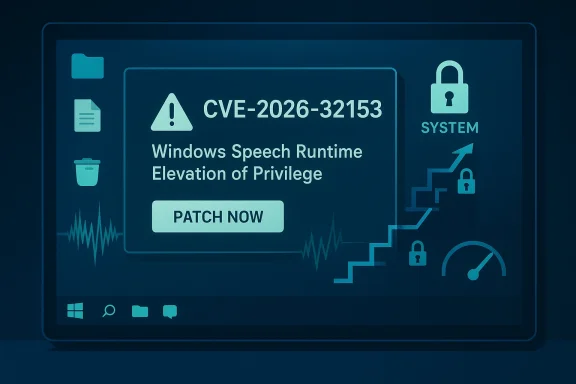
What makes this class of issue particularly important is that Windows Speech Runtime has a long history of elevation-of-privilege disclosures, and those bugs often sit in the category that can turn a modest foothold into full local compromise. Microsoft’s own language for the metric underscores that a higher confidence score reflects stronger validation and more reliable technical detail, which in turn changes how urgently defenders should patch. The public record around earlier Windows Speech Runtime flaws shows that the component has repeatedly been a target for memory-handling and privilege-escalation bugs, which gives this latest CVE extra weight.
Background
Windows security advisories are often more revealing in their structure than in their prose. Microsoft typically uses the Security Update Guide to announce the issue, identify affected products, and attach a remediation path, while withholding the exploit mechanics that would help attackers weaponize the flaw faster. The result is a tension familiar to anyone who tracks Windows vulnerabilities: enough detail to drive mitigation, not enough to train an exploit developer.
The Windows Speech Runtime is one of those Windows components most users never think about directly, but it exists in a broad trust boundary. Speech-related features need access to system services, user context, and system resources, which means a defect in the runtime can quickly become a privilege boundary problem. Historically, Microsoft has published multiple Windows Speech Runtime elevation-of-privilege CVEs, and the recurring theme has been memory handling or input processing that can be abused locally once an attacker already has code execution.
That pattern matters because the security value of an elevation-of-privilege bug is often underestimated outside enterprise operations teams. A local EoP flaw may not look as dramatic as remote code execution, but in the real world it is frequently the second stage of a broader intrusion. Attackers commonly use phishing, macro abuse, browser exploitation, or supply-chain compromise to gain a foothold, then chain a local privilege escalation to disable defenses, steal secrets, or move laterally.
Microsoft’s confidence scoring language is also part of the story. The metric you quoted is not just a label; it is an indicator of how much trust defenders should place in the advisory itself. When the vendor’s confidence is high, it usually means the issue has been validated internally or by a trusted report, and the technical risk is no longer theoretical.
Why confidence metrics matter
The report confidence concept is borrowed from CVSS temporal scoring, but Microsoft’s update guide uses it as an operational signal rather than a mathematical curiosity. A vulnerability may be described only broadly at first, but if the vendor confirms it through patch release or formal advisory language, the confidence increases and so does the priority to remediate. That distinction helps separate rumors from actionable defects.
In enterprise response terms, confidence affects triage. If the flaw is merely suspected, teams may monitor and wait for corroboration. If it is confirmed, the question becomes whether patching can be scheduled before attackers start using it.
- Confirmed issues usually mean vendors have validated the defect.
- Corroborated issues may have partial technical detail but not complete exploit evidence.
- Low-confidence reports can still justify monitoring, but not all deserve the same emergency response.
- Local EoP bugs often become critical when chained with another foothold.
- Repeated component history increases suspicion that the attack surface is already well studied.
The key takeaway is simple: a confidence signal changes the risk conversation. It is not just about whether the bug exists, but about whether defenders should assume attackers can realistically reproduce it.
Overview
CVE-2026-32153 sits in a long line of Windows privilege escalation issues tied to system components that were never meant to be directly exposed to end users. Windows Speech Runtime is particularly interesting because it blends accessibility functionality with privileged system behavior, and those sorts of interfaces often become rich bug-finding territory. Attackers like these bugs because they are durable; once a foothold is established, the exploit can be used repeatedly in many environments.
The public naming alone suggests a local escalation path rather than a network worm. That does not make it less dangerous. In modern intrusion chains, local privilege escalation is often the step that turns an ordinary malware infection into a full endpoint compromise, allowing credential theft, security tooling tampering, and persistence.
For defenders, the practical significance is not just the flaw itself but the component family. Microsoft has already had to address earlier Windows Speech Runtime issues, including CVE-2020-1521 and CVE-2021-28436, both of which were described as elevation-of-privilege problems involving improper memory handling. That history does not prove the same root cause in CVE-2026-32153, but it does suggest a well-known and persistent attack surface.
This is why the category matters more than the number in many environments. A Windows component that repeatedly produces EoP bugs becomes a standing concern for patch orchestration, exploit monitoring, and endpoint hardening. Even if the exploit details remain sparse, defenders should assume the issue fits into a broader family of local post-exploitation techniques.
What is still missing publicly
At the time of writing, the main public point is the advisory title and the confidence framing. That means several critical questions remain unresolved without the live update-guide entry itself or a later Microsoft revision.
- The exact affected products are not yet clear from the snippet alone.
- The public CVSS score may not be exposed in the limited view.
- The underlying bug class has not been confirmed in the details shown here.
- Microsoft has not, in the text you provided, described a workaround.
- The presence or absence of active exploitation is not established by the snippet alone.
That uncertainty should not be read as reassurance. It is instead the normal first phase of a Microsoft disclosure, where the advisory exists first and the fuller operational picture arrives later.
The Windows Speech Runtime Attack Surface
Speech-related Windows components are a natural candidate for privilege boundary mistakes because they interact with user inputs, accessibility layers, and system services. That combination creates opportunities for validation mistakes, memory corruption, and improper object lifetime handling. In a component like this, even a modest logic flaw can become a local escalation primitive.
The strongest clue from the broader historical pattern is that prior speech runtime bugs were described as memory handling failures. Memory bugs are dangerous because they are often both exploitable and hard to eliminate completely. Even when Microsoft patches one instance, the surrounding architectural complexity can leave similar patterns elsewhere in the component stack.
Why local privilege escalation is so valuable to attackers
A local EoP flaw is rarely the first thing an attacker uses. Instead, it appears after the initial compromise, when the attacker already has a user-level process or some other limited execution context. From there, the exploit becomes a ladder rung to SYSTEM-level access or another high-privilege context.
That matters because a successful local escalation can unlock a wide range of abuse.
- Disable or evade security controls.
- Dump credential material from memory.
- Install persistence in protected locations.
- Tamper with system services or scheduled tasks.
- Move laterally using harvested secrets.
The business impact is often disproportionate to the bug type. What looks like a “local only” issue can still become the fulcrum for domain compromise.
Historical precedent in Windows Speech Runtime bugs
Microsoft and third-party vulnerability databases have documented prior Windows Speech Runtime EoPs over several years. Those records show a recurring security pattern rather than a one-off defect. The most important implication is that exploit developers may already understand this component’s design philosophy, making future analysis faster than it would be for a totally novel subsystem.
That does not mean the current bug is easy to weaponize. But it does mean attackers are not starting from zero. Familiarity lowers the research burden, and familiar bug classes often become routine additions to post-exploitation toolkits once a working trigger is found.
Understanding Microsoft’s Confidence Signal
The confidence language attached to this CVE is not decorative. It is Microsoft’s way of telling defenders how much weight to put behind the disclosure while the rest of the advisory data matures. In practical security operations, that can influence whether a team treats the issue as a watch item or an immediate patch candidate.
The metric described in your prompt is essentially a measure of how certain the vulnerability is and how credible the technical details are. If Microsoft has acknowledged the flaw in a public update guide entry, that is already meaningful. If additional telemetry or patch metadata later confirms the issue, the advisory becomes even more actionable.
How confidence differs from severity
It is easy to confuse confidence with severity, but they are not the same thing. Severity asks how bad the impact could be if the issue is exploited. Confidence asks how sure we are that the issue exists and how much we trust the technical description. Those are related, but not identical.
A highly severe vulnerability with low confidence is harder to prioritize. A moderately severe vulnerability with high confidence can still demand faster action because it is more likely to be real, reproducible, and useful to attackers.
- Severity measures impact.
- Confidence measures certainty.
- Exploitability measures how hard it is to weaponize.
- Remediation availability measures how fast defenders can respond.
- Operational urgency depends on the combination of all four.
That distinction is especially important for local privilege escalation bugs. They are often not headline-grabbing until attackers are already inside a network.
Why vendors hold back details
Microsoft rarely publishes exploit mechanics up front for a reason. The company has to balance transparency for defenders against the risk of accelerating weaponization. That is why initial advisory wording is often broad and the technical trail is limited until patch day or later.
This is not a sign that the vulnerability is unimportant. If anything, it can signal that the vendor believes the flaw is serious enough to warrant controlled disclosure. The public message is designed to prompt action without handing over the recipe.
Enterprise Impact
For enterprise defenders, CVE-2026-32153 should be viewed through the lens of post-exploitation risk. Speech runtime issues are unlikely to be internet-facing initial access bugs, but they can become decisive inside a compromised environment. That means EDR, vulnerability management, and patch orchestration teams should coordinate rather than work in isolation.
The practical enterprise impact will depend on the affected product scope and whether servers are exposed to the same component path as desktops. If server SKUs are included, the priority rises because a single successful escalation on a server can have disproportionate consequences. If desktop-only systems are affected, the operational burden shifts toward breadth of deployment and endpoint fleet scale.
Why patch timing matters more than usual
Local privilege escalation patches are often delayed in the name of stability, but that can be a mistake. Once an exploit becomes public or is quietly circulating in the wild, the patch window closes fast. Even before public weaponization, privileged bugs are attractive to ransomware operators and hands-on-keyboard intruders who already have access.
A sensible enterprise response typically looks like this:
- Confirm affected Windows versions and device classes.
- Review Microsoft’s update mapping for the associated KBs.
- Prioritize internet-exposed, high-value, and admin-heavy endpoints.
- Test the patch on a representative pilot ring.
- Roll out broadly, then validate with vulnerability management tooling.
That sequence sounds obvious, but it is where many organizations lose time. The real danger is not the patch itself; it is the delay between publication and deployment.
Endpoint security implications
Security tooling should also be tuned to watch for privilege escalation behavior around the Speech Runtime path. Even if the exact exploit is not public, post-exploit behavior tends to leave signals. Suspicious token manipulation, service abuse, elevated child processes, and unusual DLL loading are all worth correlating against the advisory window.
- Watch for endpoint anomalies near the advisory date.
- Correlate local admin activity with user sessions.
- Review detections tied to privilege escalation chains.
- Look for repeated failures in speech-related components.
- Preserve memory and process telemetry if compromise is suspected.
The main enterprise lesson is that patching and detection are complementary. One without the other is incomplete.
Consumer Impact
For home users, the immediate threat is less about abstract vulnerability theory and more about the chain of events that usually precedes exploitation. A consumer rarely wakes up to a standalone local EoP attack. Instead, the machine is typically first infected through a malicious download, browser exploit, or fake installer, and then privilege escalation follows.
That makes consumer patching discipline critical. Windows Update is not optional when a local elevation bug is involved, because the endpoint’s ordinary user context is exactly what the attacker needs to convert into a stronger foothold. On personal PCs, these bugs often determine whether a minor malware infection stays contained or becomes a full system takeover.
What ordinary users should do
Consumers do not need to reverse engineer the vulnerability. They need to reduce the time between disclosure and installation of the fix. In practice, that means staying current with Windows Update, rebooting when required, and avoiding delay because the issue sounds “local.”
- Install the latest cumulative update promptly.
- Restart when Windows asks for one.
- Do not postpone optional security servicing indefinitely.
- Be cautious with unknown downloads and cracked software.
- Keep Microsoft Defender and SmartScreen enabled where possible.
A local EoP vulnerability becomes especially dangerous when users run untrusted software. The exploit may not arrive by itself; it often arrives as the second act.
Why accessibility components still matter to everyone
Some users assume speech and accessibility services are niche features. In reality, Windows components can be shared, loaded, or triggered in ways that extend beyond obvious use cases. Even if a user never deliberately uses speech features, the component may still exist on the machine and remain part of the attack surface.
That is one reason Microsoft’s advisory language is important. Vulnerabilities in overlooked system components often catch people off guard because they do not appear to affect day-to-day workflows. But for attackers, the presence of a loaded subsystem is enough.
Competitive and Broader Market Implications
Microsoft vulnerabilities do not exist in a vacuum. Every serious Windows disclosure affects the broader security ecosystem, from endpoint vendors to vulnerability intelligence firms and managed service providers. A confirmed Windows Speech Runtime EoP becomes one more data point in the ongoing race between patch cadence and attacker adaptation.
The market effect is twofold. First, defenders must update prioritization models. Second, intelligence vendors may build detections or risk scoring around the advisory before exploit code is public. That creates a short-term advantage for organizations that can respond quickly to vendor signals rather than waiting for exploit confirmation.
How security vendors will react
Vulnerability management platforms will likely classify the issue using Microsoft’s advisory, any accompanying CVSS data, and any subsequent exploit telemetry. Endpoint teams may create temporary detection logic around parent-child process relationships, unusual privilege transitions, or process injection patterns that follow the Windows Speech Runtime path.
This is one reason the confidence metric matters commercially as well as operationally. A higher-confidence vulnerability is easier for third parties to ingest into automated prioritization pipelines. That can influence everything from dashboard severity to patch SLAs.
- Risk scoring tools can elevate the issue automatically.
- EDR vendors may add behavior-based hunts.
- MSSPs may push urgent remediation notices.
- Asset teams may remap exposed devices faster.
- Incident response teams may increase monitoring windows.
In the broader market, Microsoft’s disclosure cadence also shapes expectations. Organizations have become accustomed to rapid monthly patch cycles and can generally absorb urgent Windows fixes, but only if the advisory is clear enough to drive action.
How attackers use the disclosure window
Attackers care less about the exact wording than about the gap between disclosure and universal patching. A local EoP advisory can be quietly useful even when details are sparse, because it tells adversaries where to focus reverse engineering. Once the patch lands, diffing can reveal the vulnerable logic.
That means the period between advisory publication and broad patch uptake is the most sensitive window. The bigger the installed base of unpatched Windows systems, the more attractive the bug becomes for criminal operators and advanced intruders alike.
Patch Management Considerations
Patch management for a vulnerability like CVE-2026-32153 is not just a matter of clicking “install updates.” It is a process problem involving validation, rollout rings, reporting, and exception handling. The right operational goal is fast enough deployment without creating avoidable outages.
Microsoft’s own update guide is designed to support that workflow by mapping vulnerabilities to remediation. Still, many organizations depend on secondary tools to translate the advisory into action items. That translation step is where errors creep in, especially if asset inventories are incomplete or device baselines are stale.
Recommended operational sequence
A practical patch response usually follows a disciplined path.
- Identify all Windows endpoints and servers in scope.
- Match the advisory to the exact monthly cumulative update or servicing stack requirements.
- Test on a small pilot set with representative workloads.
- Deploy in rings, starting with the most exposed or sensitive systems.
- Verify compliance and watch for post-patch anomalies.
This is the kind of procedure that looks slow in the abstract but actually shortens total risk exposure. Fast without verification is not truly fast; it is merely rushed.
Validation after deployment
Post-installation validation is just as important as patching itself. Organizations should confirm that the relevant KB is installed, that devices have rebooted, and that vulnerability scanners no longer flag the issue. In parallel, security teams should watch for help desk incidents that might hint at side effects.
- Confirm KB presence on targeted systems.
- Verify reboot completion where required.
- Re-scan exposed assets after rollout.
- Track failure rates and rollback candidates.
- Keep an incident log for any unusual endpoint behavior.
The best patch program is the one that can prove remediation, not just claim it.
Historical Pattern: Why Speech Runtime Keeps Reappearing
Repeated vulnerabilities in the same subsystem are rarely a coincidence. They often reflect a combination of legacy code, complex interfaces, and feature requirements that are difficult to simplify without breaking functionality. Speech Runtime appears to sit in that category.
The earlier CVEs in this family help explain why defenders should take the latest one seriously. Microsoft has already shown that the component can harbor elevation-of-privilege flaws, and the industry has already seen how local bugs can become turning points in intrusions. When a subsystem keeps producing serious bugs, that subsystem deserves a permanent place in threat modeling.
What this tells defenders about architecture
The lesson is not that speech features are uniquely dangerous. The lesson is that any system component with deep OS integration and long-lived code paths can become a repeated source of privilege escalation. Accessibility, input, media, printing, and networking layers have all shown similar patterns over time.
This is why the most useful response is not to overreact to one CVE, but to use it as a signal. If a component has a history of memory-safety or trust-boundary issues, it may deserve tighter monitoring, stricter patch SLAs, and more aggressive exploit telemetry review.
Strengths and Opportunities
Microsoft’s handling of CVE-2026-32153 has several strengths that defenders can use to their advantage. The most obvious is that the vulnerability is already named in an official update-guide context, which means there is a canonical reference point for remediation and internal tracking. That alone is a major advantage over undocumented bugs circulating only in rumor form.
- The advisory gives defenders a clear identifier to track.
- The confidence framing helps prioritize response.
- Microsoft’s update-guide process usually leads to patch mapping.
- Security teams can align vulnerability management and EDR workflows.
- Historical precedent makes this family easier to monitor.
- The issue likely fits existing local EoP response playbooks.
- Organizations can use the window to improve asset inventory accuracy.
The opportunity here is to treat the disclosure as a hardening exercise, not just a patch task. Teams that are already strong on endpoint telemetry, ring-based rollout, and compliance validation will handle this issue with less friction than those still relying on manual processes.
Risks and Concerns
The biggest concern is that local privilege escalation bugs are easy to underestimate until they are chained into a larger intrusion. A Windows Speech Runtime flaw may sound niche, but if attackers already have code execution, it can become the decisive step that turns an incident into a breach. That risk grows if patching is delayed or if the advisory turns out to be more serious than the initial public metadata suggests.
- Attackers can chain the flaw with phishing or browser compromise.
- Local EoP bugs can lead to credential theft and persistence.
- Partial public details may delay defensive urgency.
- Patch deferral in large fleets can leave broad exposure.
- Legacy endpoints may miss updates or reboot windows.
- Security tools may not flag privilege escalation fast enough.
- If the flaw is widely exploitable, weaponization could outpace rollout.
There is also a structural risk in the confidence model itself. If organizations misread the metric as a reassurance score rather than a certainty score, they may wait too long. The correct interpretation is the opposite: higher confidence means the issue is more credible, not less important.
Looking Ahead
The next meaningful update will likely come in one of three forms: a fuller Microsoft advisory, a patch mapping entry with exact KB guidance, or independent vulnerability intelligence that adds technical color. Any of those developments would sharpen the operational picture considerably. Until then, defenders should assume the vulnerability is real and act on the class of issue rather than waiting for a perfect public description.
The other thing to watch is whether Microsoft revises the advisory language over time. That happens often with Windows CVEs as customer feedback, test results, or field telemetry changes the picture. If the company later confirms exploitability, adds affected platform details, or changes the confidence language, that would be a strong signal to accelerate response.
What to monitor next
- Microsoft’s update-guide entry for affected products and KB mappings.
- Any revision to the confidence or exploitability language.
- Mentions in vulnerability intelligence feeds and enterprise security platforms.
- Signs of unusual local privilege escalation behavior in endpoint telemetry.
- Whether the bug becomes associated with active exploitation reports.
For defenders, the most important thing now is not to get distracted by the absence of exploit code in the public snippet. The combination of an official Microsoft CVE, a Windows Speech Runtime EoP label, and a confidence metric that implies credible validation is enough to justify patch planning immediately. The organizations that move first will be the ones that convert a vague advisory into a controlled maintenance event rather than a scramble after the fact.
Ultimately, CVE-2026-32153 is a reminder that not all serious Windows bugs arrive with dramatic proof-of-concept demos or sensational exploit chains. Some arrive as carefully worded vendor disclosures that ask you to trust the pattern, the component history, and the operational signal. In this case, that signal points toward a familiar but dangerous truth: local privilege escalation remains one of the most consequential stages in modern Windows compromise, and it is rarely safe to wait.