

CVE-2026-31449 is a reminder that some of the most consequential Linux kernel bugs are not flashy exploit chains, but narrow trust failures inside core filesystem machinery. In this case, the flaw sits in ext4’s extent-tree correction logic, where an unchecked pointer can drift past the end of an index buffer and trigger a slab-out-of-bounds read when metadata has been corrupted or intentionally crafted. The Linux kernel fix is deliberately surgical: validate the
That is exactly thnux storage maintainers treat with urgency. Filesystem metadata is not just ordinary data; it is the map that tells the kernel where every file, directory, and extent lives. If that map becomes untrustworthy, then read paths, write paths, and recovery paths all inherit the risk. The published CVE text specifically says the fix is to check the index pointer at both access sites and to return
There is also an important distinction bug and a disclosure bug. A slab-out-of-bounds read does not automatically mean remote code execution, but it does mean the kernel can be made to read memory it should not touch. In practice, that can lead to information leakage, kernel warnings, or a fault that takes the filesystem path down. The CVE record provided in Microsoft’s update guide aligns with the upstream kernel description and shows that the issue was introduced into the public vulnerability pipeline on April 22, 2026 .
For WindowsForum readers, this is also another example of whhow up in enterprise security workflows that are not “Linux-only.” Microsoft’s vulnerability portal has become one of the places where cross-platform operators discover kernel issues, even when the actual fix lives upstream in kernel.org. That matters because mixed estates increasingly rely on a shared view of vulnerability exposure, whether the affected system is a desktop, a container host, a virtual machine, or a storage appliance .
Ext4 is one of Linux’s most battle-tested filesystems, but “battlen “bug-free.” Its extent-based layout is designed to handle large files efficiently by grouping contiguous blocks into logical runs. That design is fast and mature, but it also depends on a deeply nested tree structure with internal consistency rules that have to hold across reads, writes, truncates, and recovery operations. When any one of those rules fails, the filesystem can start traversing metadata that is no longer aligned with the actual layout on disk.
The specific function mentioned in the CVE,
This is not a new category of problem for ext4 or for Linux generally. Filesystem code has always had data as adversarial when corruption is possible, and kernel maintainers routinely harden these paths after bugs are discovered in testing, fuzzing, or field reports. The difference in 2026 is that the vulnerability disclosure pipeline is now much more visible across ecosystems, so a fix in the Linux tree quickly becomes a tracked CVE with downstream impact in vendor advisories and enterprise dashboards.
There is also a practical security lesson here: not all dangerous bugs are about attackers taking over the machine. Some are about attackers or corrupt media causing the kernel to read, trust, or propagate invalid metadata. A malformed extent header can be enough to steer the kernel into a bad pointer path, and once a storage primitive like that is broken, the impact can range from a mount failure to a crash, from a data inconsistency to a possible memory disclosure. Those outcomes are often less dramatic than a remote shell, but for administrators they can still be operationally severe.
Finally, the fix’s choice of error code is telling. Returning
That detail matters because the bug is not in a random helper or a rarely used admin path. It is in the maintenance logic that helps ext4 keep at coherent after modifications. In other words, the function is supposed to preserve structure, but the structure itself may already be compromised. When that happens, a routine that was written to be conservative can become an unintended memory reader.
Why
The CVE description says the fix validates
The broader implication is that ext4 maintainers are not assuming metadata correctness just because a higher-level function already looked at the tree. That is a wis in storage code. Kernel parsers and recovery paths should verify their own invariants locally, even if an earlier function did a related check.
This is the sort of patch that often looks small from the outside and very large from the inside. One bounds check can close an entire class of invalid-state behavior. In filesystem code are often the most valuable because they preserve the existing design while removing undefined behavior.
This is especially relevant for storage devices and images that are not fully trusted. A corrupted disk image, a malicious loopback filesystem, or a compromised appliance snapshot can all become vectors for triggering the defect. The user does not need to “run” the malicious input in the traditional sense; they only need the kernel to mount, scan, or repair the filesystem in a way that reaches the vulnerable path.
There is also a strong analogy to previous kernel hardening work: when a parser or tree walker cannot safely prove its cursor is valid, it must fail closed. The ext4 fix follows that principle precisely. It refuses to infer correctness from a header field that may itself be the corrupted input.
The vulnerable function sits in the correction path that updates index entries after changes in a leaf. That is a normal part of filesystem housekeeping, but the code depends on the assumption that the tree structure is still internally coherent. When that assumption is broken, the tree-walking logic has to stop being optimistic and start being suspicious.
The Role of
This is one of those details that can be easy to miss if you only read the vulnerability summary. The code was not blindly indexing an array with user input in the classic sense. It was following an internal become untrustworthy because the underlying metadata could be wrong. In security terms, that distinction is important because it shows how internal assumptions can become attack surfaces once disk state is malformed.
That kind of repeated validation is a hallmark of defensive kernel programming. It acknowledges that metadata-driven loops are not always stable and that correctness can degrade as tree state is corrected or traversed. In a filesystem, that is not paranoia; it is a realistic response to the fact that the kernel must handle both honest corruption and adversarial input.
Ext4 in particular has benefited from years of hardening in its extent-handling paths. Those fixes are rarely headline-grabbing, but they matter because they reduce the chance that one bad structure can destabilize the whole parser. The current CVE fits neatly into that tradition: a narrow fix, a precise bounds check, and a clearly defined error return when the tree no longer makes sense.
The good news is that the kernel community tends to fix these problems in a disciplined way. The described patch does not overhaul the extent tree design, and that is a feature, not a bug. Surgical corrections are often safer than broad rewrites because they reduce regression risk while restoring the missing invariant.
The other lesson is that kernel maintainers continue to prioritize consistency over convenience. Returning
The practical upside for operators is that the patch is easy to reason about. There is no new feature flag to manage and no behavioral change for healthy filesystems. Only the outlier case changes, and that outlier is precisely the case that should be rejected.
Consumer risk is narrower but not zero. Most users will never manually mount a maliciously crafted ext4 volume, but consumer Linux systems do sometimes process external drives, backups, and VM images from less trusted sources. In those cases, a malformed filesystem can still reach the kernel path before any application-level sandbox comes into play.
There is also a visibility issue. Because NVD had not yet assigned a CVSS score at publication time, organizations may have to triage the bug from the technical description rather than from a numeric rating alone . That is not ideal, but it is common for freshly published kernel CVEs, and it reinforces the need for asset-aware patching rather than score-only prioritization.
From a vendor perspective, the competitive advantage is not that one distro is immune to bugs. It is that some vendors can ingest upstream fixes quickly, backport them cleanly, and explain the impact clearly. In a mixed estate, that documentation quality can be as important as the patch itself because it helps security teams verify whether their actual running kernel contains the fix.
This is why Microsoft’s vulnerability guide and similar aggregation points matter. They give enterprise teams a single place to notice that a Linux kernel issue exists, even if remediation happens elsewhere. In practice, that cross-platform visibility reduces the chance that a storage bug gets buried because it did not arrive through the most obvious vendor channel .
The opportunity for defenders is just as straightforward. This is a clean patch to track, a clearly described failure mode to test for, and a good reminder to review how filesystem corruption is handled in images, recovery workflows, and external media paths.
Another concern is the long tail of backports. A CVE being published does not guarantee that every vendor kernel has picked up the fix in the same way or on the same schedule, so administrators still need to verify the actual build they run.
Administrators should also watch for any follow-up advisories that clarify affected kernel ranges or package builds. When NVD enrichment is still in progress, the operational answer often comes from vendor release notes, stable-tree references, and the actual kernel version shipped in a distribution image rather than from the CVE page alone .
Source: NVD / Linux Kernel Security Update Guide - Microsoft Security Response Center
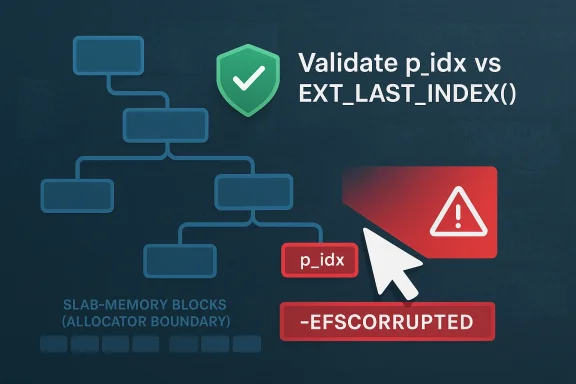
p_idx cursor against EXT_LAST_INDEX() before it is dereferenced, and return -EFSCORRUPTED if the tree state is no longer sane. That sounds modest, but in kernel terms it is the difference between rejecting bad metadata and reading beyond the allocator’s safety boundary ulnerability description is concise, but the implications are broader than a one-line patch note suggests. The affected routine, ext4_ext_correct_indexes(), walks upward through an extent tree to adjust index entries after the first extent in a leaf has been modified. Under normal conditions, that maintenance work keeps ext4’s metadata consistent and its block mapping reliable. Under corrupted on-disk conditions, however, the function previously assumed that path[k].p_idx was already valid, even when the enclosing extent header’s eh_entries value might have been manipulated or damaged, allowing a read past the allocated buffer .That is exactly thnux storage maintainers treat with urgency. Filesystem metadata is not just ordinary data; it is the map that tells the kernel where every file, directory, and extent lives. If that map becomes untrustworthy, then read paths, write paths, and recovery paths all inherit the risk. The published CVE text specifically says the fix is to check the index pointer at both access sites and to return
-EFSCORRUPTED when the pointer is out of range, which is consistent with ext4’s broader habit of treating malformed metadata as a corruption event rather than trying to continue blindly .There is also an important distinction bug and a disclosure bug. A slab-out-of-bounds read does not automatically mean remote code execution, but it does mean the kernel can be made to read memory it should not touch. In practice, that can lead to information leakage, kernel warnings, or a fault that takes the filesystem path down. The CVE record provided in Microsoft’s update guide aligns with the upstream kernel description and shows that the issue was introduced into the public vulnerability pipeline on April 22, 2026 .
For WindowsForum readers, this is also another example of whhow up in enterprise security workflows that are not “Linux-only.” Microsoft’s vulnerability portal has become one of the places where cross-platform operators discover kernel issues, even when the actual fix lives upstream in kernel.org. That matters because mixed estates increasingly rely on a shared view of vulnerability exposure, whether the affected system is a desktop, a container host, a virtual machine, or a storage appliance .
 Background
Ext4 is one of Linux’s most battle-tested filesystems, but “battlen “bug-free.” Its extent-based layout is designed to handle large files efficiently by grouping contiguous blocks into logical runs. That design is fast and mature, but it also depends on a deeply nested tree structure with internal consistency rules that have to hold across reads, writes, truncates, and recovery operations. When any one of those rules fails, the filesystem can start traversing metadata that is no longer aligned with the actual layout on disk.The specific function mentioned in the CVE,
ext4_ext_correct_indexes(), lives in the code that maintains those trees. When ext4 modifies the first extent in a leaf, it may need to walk back upward and fix index entries so parent nodes continue to point to the right child ranges. That makes the function part of the filesystem’s repair-and-maintain logic, which is exactly the kind of code where bounds checks matter most. If a cursor into the tree is off by even one structural assumption, the code can wander into memory that is not part of the intended index array .This is not a new category of problem for ext4 or for Linux generally. Filesystem code has always had data as adversarial when corruption is possible, and kernel maintainers routinely harden these paths after bugs are discovered in testing, fuzzing, or field reports. The difference in 2026 is that the vulnerability disclosure pipeline is now much more visible across ecosystems, so a fix in the Linux tree quickly becomes a tracked CVE with downstream impact in vendor advisories and enterprise dashboards.
There is also a practical security lesson here: not all dangerous bugs are about attackers taking over the machine. Some are about attackers or corrupt media causing the kernel to read, trust, or propagate invalid metadata. A malformed extent header can be enough to steer the kernel into a bad pointer path, and once a storage primitive like that is broken, the impact can range from a mount failure to a crash, from a data inconsistency to a possible memory disclosure. Those outcomes are often less dramatic than a remote shell, but for administrators they can still be operationally severe.
Finally, the fix’s choice of error code is telling. Returning
-EFSCORRUPTED is a way of saying that the kernel recognizes the tree as invalid and should stop trying to treat it as trustworthy. That is a healthy pattern in storage code because it prevents the kernel from converting one invalid state into a larger corruption event. In short, the patch is not just about a bounds check; it is about making corruption handling explicit and deterministic .The Vulnerable Path
At the center of the issue is thep_idx pointer, which tracks the current index entry being s up the extent tree. The vulnerability arises because ext4_ext_correct_indexes() dereferences path[k].p_idx->ei_block without first proving that p_idx is still within the valid range for that node. If eh_entries has been corrupted or otherwise crafted to misrepresent how many entries actually exist, the pointer can slide past the end of the allocated extent index array and land in adjacent memory .That detail matters because the bug is not in a random helper or a rarely used admin path. It is in the maintenance logic that helps ext4 keep at coherent after modifications. In other words, the function is supposed to preserve structure, but the structure itself may already be compromised. When that happens, a routine that was written to be conservative can become an unintended memory reader.
Why eh_entries Is So Sensitive
eh_entries is supposed to describe how many entries exist in the extent header. If it is wrong, then every subsequent tree navigation decision inherits that error. A too-large value is dangerous because it makes the kernel believe there are more valid entries than were actually allocated. That is the classic setup for an out-of-bounds read: the loop logic appears valid, but the underlying bounds are fiction.The CVE description says the fix validates
p_idx against EXT_LAST_INDEX() at both the access site before the loop and inside the loop itself. That redundancy is not overkill; it is defensive programming in a part of the kernel where state can shift as the tree is traversed. If a pointer can become invalid between checks, the check has to be repeated at the exact point of use .The broader implication is that ext4 maintainers are not assuming metadata correctness just because a higher-level function already looked at the tree. That is a wis in storage code. Kernel parsers and recovery paths should verify their own invariants locally, even if an earlier function did a related check.
What the Fix Changes
The new logic is simple in concept: ifp_idx is not within EXT_LAST_INDEX(), the function returns -EFSCORRUPTED instead of continuing. That means corrupted metadata gets rejected cleanly rather than being used to drive a read beyond the slab object. The goal is not merely to avoid a crash, but to ensure that invalid tree state cannot influence control flow past the boundary where it becomes unsafe .This is the sort of patch that often looks small from the outside and very large from the inside. One bounds check can close an entire class of invalid-state behavior. In filesystem code are often the most valuable because they preserve the existing design while removing undefined behavior.
Why This Is Security-Relevant
On paper, a read past the end of a buffer sounds less alarming than a write. In reality, it is still a memory safety problem, and in kernel space that means elevated stakes. A slab-out-of-bounds read can leak kernel data, trigger diagnostics, or expose internal state that should never be visible to unprivileged code. Even if exploitation is not straightforward, the presence of the bug in a filesystem parser means the attack surface includes any path that processes malformed metadata.This is especially relevant for storage devices and images that are not fully trusted. A corrupted disk image, a malicious loopback filesystem, or a compromised appliance snapshot can all become vectors for triggering the defect. The user does not need to “run” the malicious input in the traditional sense; they only need the kernel to mount, scan, or repair the filesystem in a way that reaches the vulnerable path.
Likely Impact Categories
- Information disclosure through an out-of-bounds read.
- Filesystem failure if the kernel detects corruption and aborts processing.
- Crash risk if the invalid access trips a fault or sanitizer.
- Recovery disruption when metadata validation stops a mount or replay path.
- Operational instability in environments that depend on corrupted or unclean media being processed.
There is also a strong analogy to previous kernel hardening work: when a parser or tree walker cannot safely prove its cursor is valid, it must fail closed. The ext4 fix follows that principle precisely. It refuses to infer correctness from a header field that may itself be the corrupted input.
Ext4 Extent Trees in Practice
Ext4’s extent trees are designed to avoid fragmentation overhead and scale well for modern files. Instead of storing each block individually, ext4 stores runs of blocks as extents and uses a hierarchical structure to locate them. That makes lookups efficient, but it also makes the code more delicate because parent and child nodes must agree on range boundaries at every level.The vulnerable function sits in the correction path that updates index entries after changes in a leaf. That is a normal part of filesystem housekeeping, but the code depends on the assumption that the tree structure is still internally coherent. When that assumption is broken, the tree-walking logic has to stop being optimistic and start being suspicious.
The Role of EXT_LAST_INDEX()
EXT_LAST_INDEX() is the guardrail that defines the final valid index entry in a node. In the fix described by the CVE, the kernel now checks path[k].p_idx against that boundary before accessing ei_block. That matters because pointer validity in a tree is not just about address arithmetic; it is about whether the pointer still maps to a legitimate logical entry in the current node state .This is one of those details that can be easy to miss if you only read the vulnerability summary. The code was not blindly indexing an array with user input in the classic sense. It was following an internal become untrustworthy because the underlying metadata could be wrong. In security terms, that distinction is important because it shows how internal assumptions can become attack surfaces once disk state is malformed.
Why Revalidation Matters
The patch checks the pointer both before the while loop and inside it. That is a sign that the function’s control flow can revisit the index more than once, and that the pointer may not remain safe across iterations. In other words, the code needed not just an initial gate but a persistent assertion that the cursor is still within range.That kind of repeated validation is a hallmark of defensive kernel programming. It acknowledges that metadata-driven loops are not always stable and that correctness can degrade as tree state is corrected or traversed. In a filesystem, that is not paranoia; it is a realistic response to the fact that the kernel must handle both honest corruption and adversarial input.
Historical Context
Linux filesystems have a long history of fixes that convert “assumed valid” metadata into explicitly checked metadata. That pattern has repeated across ext4, xfs, btrfs, f2fs, and other subsystems because storage code constantly sits at the boundary between trusted in-kernel logic and untrusted on-disk state. Every new optimization adds another place where the kernel can be surprised by invalid structure.Ext4 in particular has benefited from years of hardening in its extent-handling paths. Those fixes are rarely headline-grabbing, but they matter because they reduce the chance that one bad structure can destabilize the whole parser. The current CVE fits neatly into that tradition: a narrow fix, a precise bounds check, and a clearly defined error return when the tree no longer makes sense.
Why Filesystem Bugs Keep Coming Back
Filesystem code is hard because it must satisfy several conflicting requirements at once. It has to be fast, compact, crash-consistent, backward-compatible, and secure against malformed input. That means even careful developers sometimes end up with paths where a field is assumed to have already been checked, only to discover later that a second caller, a later iteration, or a crafted image violates that assumption.The good news is that the kernel community tends to fix these problems in a disciplined way. The described patch does not overhaul the extent tree design, and that is a feature, not a bug. Surgical corrections are often safer than broad rewrites because they reduce regression risk while restoring the missing invariant.
How This Fits the Current Kernel Pattern
CVE-2026-31449 also reflects a broader 2026 pattern in Linux vulnerability handling: small, highly technical fixes are being surfaced through mainstream CVE channels much more quickly than they used to be. That is beneficial for defenders because they can correlate the fix with stable branches, vendor backports, and package updates. It also means that administrators need to read the underlying technical description, not just the severity score, because NVD may not have an immediate CVSS rating for a newly published kernel CVE .What the Fix Tells Us About Kernel Quality
One of the strengths of the patch is its restraint. It does not add complicated new logic or attempt to infer more from damaged metadata than the code can safely know. It simplif the index pointer is out of range, the function stops. That is often the right answer in filesystem code because continuing after a boundary violation can compound the damage.The other lesson is that kernel maintainers continue to prioritize consistency over convenience. Returning
-EFSCORRUPTED is a clear statement that the tree should be treated as invalid rather than “best-effort” processed. That mindset is what keeps a bug from turning into a larger integrity issue later in the mount or repair flow.Engineering Principles on Display
- Validate at the point of use, not just at the function entry.
- Treat metadata as potentially hostile when it comes from disk.
- Prefer explicit corruption errors over undefined behavior.
- Preserve existing logic while tightening the unsafe boundary.
- Repeat checks when a loop can revisit mutable state.
The practical upside for operators is that the patch is easy to reason about. There is no new feature flag to manage and no behavioral change for healthy filesystems. Only the outlier case changes, and that outlier is precisely the case that should be rejected.
Enterprise and Consumer Impact
For enterprise administrators, the significance of CVE-2026-31449 depends on where ext4 is used. If ext4 backs desktops, file servers, cloud images, or appliance volumes, then the patch belongs in the normal kernel update cycle. If the environment processes untrusted images, removable media, or recovered disks, the risk is higher because the attack or trigger path is more plausible.Consumer risk is narrower but not zero. Most users will never manually mount a maliciously crafted ext4 volume, but consumer Linux systems do sometimes process external drives, backups, and VM images from less trusted sources. In those cases, a malformed filesystem can still reach the kernel path before any application-level sandbox comes into play.
Where Exposure Is Highest
The highest exposure is likely in systems that regularly parse external or inherited storage state. That includes:- Backup restore environments.
- Virtual machine host stacks.
- Forensic and recovery workstations.
- Embedded or appliance images with long patch cycles.
- Servers that ingest removable media or external disks.
There is also a visibility issue. Because NVD had not yet assigned a CVSS score at publication time, organizations may have to triage the bug from the technical description rather than from a numeric rating alone . That is not ideal, but it is common for freshly published kernel CVEs, and it reinforces the need for asset-aware patching rather than score-only prioritization.
Competitive and Ecosystem Implications
This CVE is not a market-moving event it it still says something useful about the Linux storage ecosystem. Kernel maintainers continue to harden mature filesystems, and that steady maintenance matters to enterprises choosing between Linux distributions, cloud images, and storage vendors. The health of a filesystem is measured not only by performance but by how cleanly it handles malformed state.From a vendor perspective, the competitive advantage is not that one distro is immune to bugs. It is that some vendors can ingest upstream fixes quickly, backport them cleanly, and explain the impact clearly. In a mixed estate, that documentation quality can be as important as the patch itself because it helps security teams verify whether their actual running kernel contains the fix.
Why This Matters Beyond Linux-Only Shops
Many enterprises that think of themselves as “Windows-centered” still run Linux in critical infrastructure roles. That includes hypervisors, CI/CD agents, container hosts, storage nodes, and cloud-native workloads. A Linux kernel CVE may never touch the desktop user directly, but it can still disrupt the platform layer that the business depends on.This is why Microsoft’s vulnerability guide and similar aggregation points matter. They give enterprise teams a single place to notice that a Linux kernel issue exists, even if remediation happens elsewhere. In practice, that cross-platform visibility reduces the chance that a storage bug gets buried because it did not arrive through the most obvious vendor channel .
The Broader Reliability Story
The strategic lesson is that storage security is increasingly about invariant management. As filesystems become more feature-rich, the cost of a missed bounds check or stale pointer goes up, not down. Vendors that can demonstrate stronackports, and rapid advisory mapping will continue to earn trust.Strengths and Opportunities
The strongest aspect of this fix is that it solves the problem at the right layer. It does not attempt to reinterpret corrupted metadata, and it does not expand the attack surface with new fallback logic. It simply enforces the boundary that was missing and makes the error path explicit, which is exactly what secure kernel code should do.The opportunity for defenders is just as straightforward. This is a clean patch to track, a clearly described failure mode to test for, and a good reminder to review how filesystem corruption is handled in images, recovery workflows, and external media paths.
- The fix is surgical and low risk for healthy filesystems.
- The corruption path is now explicitly rejected.
- The bug has a clear upstream description and fix trail.
- The issue is easy to map to kernel update windows.
- The change reinforces metadata trust boundaries.
- The patch improves defensive consistency in ext4’s extent logic.
- Security teams can validate exposure based on actual ext4 usage.
Risks and Concerns
The main concern is that bugs like this are often underestimated because they do not immediately look like a remote exploit. That can slow patch adoption, especially in environments where filesystem updates are bundled into broader kernel maintenance cycles and not treated as urgent security work.Another concern is the long tail of backports. A CVE being published does not guarantee that every vendor kernel has picked up the fix in the same way or on the same schedule, so administrators still need to verify the actual build they run.
- Older kernels may remain exposed longer than expected.
- Vendor backport differences can create version confusion.
- Storage appliances may lag behind upstream fixes.
- Corruption-triggered bugs are easy to miss in routine testing.
- A read primitive can still aid information disclosure.
- Recovery tools may encounter the bug more often than production workloads.
- Teams may misclassify the issue as mere stability noise.
Looking Ahead
The next thing to watch is how quickly stable kernels and downstream distributions incorporate the ext4 bounds check. Because the fix is narrow and the description is precise, it should be straightforward for maintainers to backport. The more interesting question is whether similar validation gaps exist elsewhere in the extent-tree maintenance code, because these kinds of bugs often appear in clusters rather than in isolation.Administrators should also watch for any follow-up advisories that clarify affected kernel ranges or package builds. When NVD enrichment is still in progress, the operational answer often comes from vendor release notes, stable-tree references, and the actual kernel version shipped in a distribution image rather than from the CVE page alone .
What to Watch Next
- Stable backports landing in distro kernels.
- Vendor advisories that map the fix to package versions.
- Any related ext4 extent-tree hardening patches.
- Regression notes for recovery and mount behavior.
- Evidence of similar validation gaps in adjacent metadata coway is reassuring: this looks like a focused hardening fix, not a sign that ext4 is structurally unsound. Mature filesystems live or die by the quality of these small corrections, and this one shows the kernel is still doing the unglamorous but essential work of turning malformed metadata into a clean error instead of a dangerous read. That is exactly the kind of maintenance that keeps a decades-old filesystem dependable in 2026 and beyond.
Source: NVD / Linux Kernel Security Update Guide - Microsoft Security Response Center
