

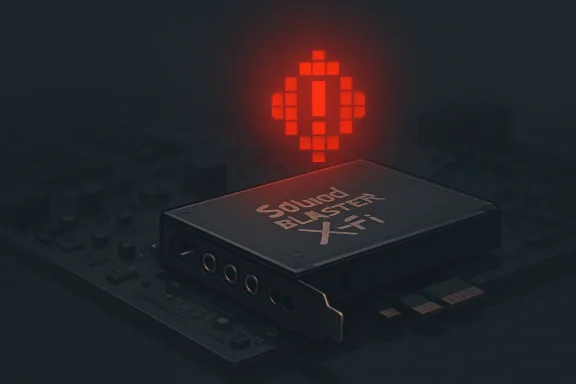
CVE-2026-31602 is a small-looking Linux kernel fix with a bigger lesson for anyone who runs older enthusiast hardware on modern systems. The issue sits in the ALSA ctxfi driver for Creative Sound Blaster X-Fi cards and stems from a mismatch between a long-ago scalability change and the way the hardware page-table logic actually works. The immediate fix is deliberately conservative: limit the device page table back to a single page and avoid a kernel page fault when aggregate playback allocations exceed the safe boundary. For WindowsForum readers, the key takeaway is simple: this is not a Windows audio-stack vulnerability, but it matters to dual-boot users, Linux desktop builders, audio hobbyists, and administrators who track Linux kernel CVEs through Microsoft’s security ecosystem.
The Advanced Linux Sound Architecture, better known as ALSA, is the low-level audio framework inside the Linux kernel. It provides the driver layer that lets applications, sound servers, and middleware such as PipeWire or PulseAudio ultimately talk to audio hardware. In most modern desktop Linux setups, users rarely interact with ALSA directly, but the kernel driver still determines whether a sound card initializes correctly, exposes the right playback devices, and survives unusual workloads.
The affected driver, snd_ctxfi, supports Creative Sound Blaster X-Fi cards based on the EMU20K1 and EMU20K2 families. These cards belong to an era when discrete PCI and PCIe audio hardware was a major enthusiast upgrade, especially for gamers, home theater PCs, and users who cared about hardware acceleration, surround output, or cleaner analog stages than many onboard codecs of the time. Linux support for this class of hardware has always required careful work because the driver has to bridge a sophisticated DSP-oriented design with kernel memory-management rules that have evolved substantially since the cards were introduced.
CVE-2026-31602 was assigned after the Linux kernel resolved a fault in the ctxfi virtual memory handling path. The vulnerable behavior traces back to a historical change that increased CT_PTP_NUM from one to four in order to support up to 256 playback streams. That expansion looked logical at the configuration level, but the driver’s mapping code continued to use page table entries from the first page-table page only.
The result was a classic kernel maintenance problem: a numeric capacity increased, while deeper assumptions stayed fixed. On AMD64 systems, one page table page covers 512 page table entries, corresponding to about 2 MB of mapped area in the described context. When aggregate playback memory allocations exceeded that limit, ct_vm_map() could walk past the allocated page-table page and trigger a page fault in kernel space.
That means the driver had a split-brain model:
This is why CVE-2026-31602 should not be dismissed merely because the patch is small. Small patches often mark the precise point where a broad assumption collapses. Here, the assumption was that increasing the number of page-table pages created usable mapping space. The implementation never completed that promise.
The practical security reading is more nuanced:
The distinction is especially important for mixed environments. A Windows 11 gaming PC with an old Sound Blaster X-Fi card is not exposed to this Linux kernel bug while booted into Windows. The same physical machine could become relevant if it dual-boots into Linux and loads snd_ctxfi.
Consumer scenarios worth noting include:
The enterprise question is not “Do we run Linux?” but “Do any Linux endpoints load this module?” Security teams should look for actual module usage before assigning urgency. If snd_ctxfi is not built, not installed, blacklisted, or never loaded, the practical risk falls sharply.
The bug emerges when aggregate allocations exceed what a single PTP page can describe. Because the driver code continues using the first page’s PTE area, the larger CT_PTP_NUM value does not create a safe second, third, or fourth page for the mapping routine. The result is an access beyond the allocated space.
A simplified sequence looks like this:
The architecture detail does not mean only AMD processors are relevant. In this context, AMD64 refers to the 64-bit x86 architecture used by both AMD and Intel PCs. For WindowsForum readers, that means the usual desktop-class x86-64 Linux machine is the reference environment.
This is exactly the kind of tradeoff maintainers face with legacy hardware:
For users, that breadth is a benefit. For maintainers, it creates a long tail of code paths that may be lightly tested compared with Wi-Fi, NVMe, GPU, or mainstream HDA audio drivers. CVE-2026-31602 is a reminder that legacy driver code can still interact with modern kernels in surprising ways.
Windows Subsystem for Linux also needs careful interpretation. Typical WSL environments do not expose a physical PCI Creative sound card through the Linux kernel’s ctxfi driver. Audio integration in WSL is mediated differently and does not normally involve loading snd_ctxfi against physical X-Fi hardware.
The scenarios separate cleanly:
A practical checklist looks like this:
Backporting is especially important for older long-term kernels. The vulnerable constant originated from an old scalability change, so the flawed assumption may exist across many maintained branches. Stable maintainers typically propagate compact fixes like this because the risk of the one-line correction is lower than the risk of leaving a known page fault path in place.
Administrators should track these layers separately:
For custom builds, the safest approach is to update the kernel source to a fixed stable point. If that is not possible immediately, disabling the driver can be a reasonable mitigation for systems that do not need Creative X-Fi support. Removing unused attack surface is still one of the most reliable security practices.
The practical requirements likely include:
A sensible interim classification would treat this as low-to-moderate urgency for most systems and higher priority for systems that actively use ctxfi hardware. That is not a contradiction. It is asset-aware security.
The downside is that the maintenance burden becomes collective. If a driver has an old internal assumption, it must be fixed in the kernel, assigned through modern CVE processes, and distributed through every relevant downstream channel. That can make Linux look noisier in vulnerability feeds even when the real-world exposure is narrow.
This creates a competitive contrast:
That layering matters. A desktop user may think in terms of “PipeWire audio broke,” while the root cause may be a page fault inside snd_ctxfi. The more complex the audio stack becomes, the more important it is to distinguish user-space routing bugs from kernel driver faults.
Use this order of operations:
If blacklisting is used, document it. Months later, someone may wonder why audio disappeared after a hardware swap or kernel update. Security mitigations that are not documented become future troubleshooting traps.
For distributions, the next step is clear: ship corrected kernels and make sure advisory metadata catches up. For users, the next step is even simpler: update, reboot, and verify. For Microsoft-focused administrators, the lesson is to fold Linux endpoints and Linux-based Microsoft products into vulnerability management without conflating them with Windows client exposure.
Watch these items over the next update cycle:
Source: NVD / Linux Kernel Security Update Guide - Microsoft Security Response Center
 Background
The Advanced Linux Sound Architecture, better known as ALSA, is the low-level audio framework inside the Linux kernel. It provides the driver layer that lets applications, sound servers, and middleware such as PipeWire or PulseAudio ultimately talk to audio hardware. In most modern desktop Linux setups, users rarely interact with ALSA directly, but the kernel driver still determines whether a sound card initializes correctly, exposes the right playback devices, and survives unusual workloads.The affected driver, snd_ctxfi, supports Creative Sound Blaster X-Fi cards based on the EMU20K1 and EMU20K2 families. These cards belong to an era when discrete PCI and PCIe audio hardware was a major enthusiast upgrade, especially for gamers, home theater PCs, and users who cared about hardware acceleration, surround output, or cleaner analog stages than many onboard codecs of the time. Linux support for this class of hardware has always required careful work because the driver has to bridge a sophisticated DSP-oriented design with kernel memory-management rules that have evolved substantially since the cards were introduced.
CVE-2026-31602 was assigned after the Linux kernel resolved a fault in the ctxfi virtual memory handling path. The vulnerable behavior traces back to a historical change that increased CT_PTP_NUM from one to four in order to support up to 256 playback streams. That expansion looked logical at the configuration level, but the driver’s mapping code continued to use page table entries from the first page-table page only.
The result was a classic kernel maintenance problem: a numeric capacity increased, while deeper assumptions stayed fixed. On AMD64 systems, one page table page covers 512 page table entries, corresponding to about 2 MB of mapped area in the described context. When aggregate playback memory allocations exceeded that limit, ct_vm_map() could walk past the allocated page-table page and trigger a page fault in kernel space.
What Actually Broke
The core bug is not that the card can play too many streams by itself. The problem is that the driver’s virtual memory abstraction advertised more page-table pages than the rest of the mapping path safely used. That distinction matters because it separates a dangerous accounting mismatch from a simple resource exhaustion issue.Page Tables, PTPs, and a False Ceiling
In the ctxfi driver, PTP refers to a device page table page used by the sound hardware’s virtual memory logic. The previous change raised the configured number of those pages from one to four, presumably to allow more buffer mapping space for many simultaneous playback streams. But ct_vm_map() still indexed into vm->ptp[0].area, regardless of the larger CT_PTP_NUM value.That means the driver had a split-brain model:
- The constant said four pages were available
- The mapping code effectively used one page
- The hardware initialization path did not fully wire independent pages
- Large aggregate allocations could cross the real boundary
- The failure mode was a kernel page fault, not a graceful refusal
Why a One-Line Patch Can Be Serious
The diff is tiny: a single constant changes from four back to one. But the security relevance comes from where that constant lives. In kernel drivers, a small size or count mismatch can translate directly into invalid memory access because drivers operate with high privilege and often manipulate DMA-facing data structures.This is why CVE-2026-31602 should not be dismissed merely because the patch is small. Small patches often mark the precise point where a broad assumption collapses. Here, the assumption was that increasing the number of page-table pages created usable mapping space. The implementation never completed that promise.
Why This Became a CVE
Linux kernel CVE assignment has changed in recent years. The kernel project now assigns CVEs more systematically to fixes that may have security implications, even when exploitation is not fully characterized at disclosure time. That policy creates more Linux kernel CVEs, but it also gives distributions and downstream vendors a consistent way to track fixes.Awaiting Enrichment Does Not Mean Awaiting Importance
At publication, CVE-2026-31602 was still marked as awaiting enrichment in vulnerability databases, with no NVD CVSS score provided. That does not mean the bug is harmless. It means the scoring, affected-product mapping, and formal weakness classification had not yet been completed by the enrichment process.The practical security reading is more nuanced:
- The affected component is a kernel driver
- The observed failure is a kernel page fault
- The trigger appears tied to local audio-device use
- The affected hardware is relatively narrow
- The most obvious impact is availability
- Privilege escalation is not established by the public description
The Microsoft Angle
The CVE appears in Microsoft’s security ecosystem because Microsoft now operates significant Linux-facing infrastructure and publishes vulnerability information beyond traditional Windows components. That can confuse Windows desktop users who see a Microsoft advisory page and assume the Windows audio subsystem is affected. In this case, the vulnerability is in the Linux kernel, not in Windows Audio, WASAPI, DirectSound, or Creative’s Windows driver stack.The distinction is especially important for mixed environments. A Windows 11 gaming PC with an old Sound Blaster X-Fi card is not exposed to this Linux kernel bug while booted into Windows. The same physical machine could become relevant if it dual-boots into Linux and loads snd_ctxfi.
Affected Users and Real-World Exposure
The affected audience is narrower than the average kernel CVE, but it is not nonexistent. Creative X-Fi hardware still appears in retro gaming rigs, audio hobbyist builds, Linux workstations, and repurposed desktops. The cards are old, but old hardware often persists precisely in systems maintained by enthusiasts who care enough to keep them alive.Consumer Impact
For consumers, the most likely symptom is a crash or kernel oops during unusual playback workloads. Ordinary desktop audio may never approach the aggregate allocation pattern needed to hit the boundary. But stress tests, many simultaneous playback clients, custom ALSA use, or misbehaving audio applications could push the driver harder.Consumer scenarios worth noting include:
- Dual-boot PCs using Linux for daily work and Windows for gaming
- Retro audio builds with PCI or PCIe Creative cards
- Home theater PCs configured for multi-channel playback
- Linux desktops running PipeWire with many virtual streams
- Users testing many simultaneous ALSA clients
- Older workstations upgraded to newer kernels
Enterprise Impact
Enterprise exposure is likely limited but should not be ignored automatically. Most servers do not contain Creative X-Fi cards, and many cloud kernels either omit consumer sound drivers or ship them as optional packages. However, enterprises often maintain fleets that include developer workstations, lab systems, kiosks, digital signage, media production machines, and hardware test benches.The enterprise question is not “Do we run Linux?” but “Do any Linux endpoints load this module?” Security teams should look for actual module usage before assigning urgency. If snd_ctxfi is not built, not installed, blacklisted, or never loaded, the practical risk falls sharply.
The Technical Path to Failure
The public description provides a clear call trace. The failure occurs during playback preparation, moving through ALSA PCM handling into ctxfi-specific preparation and then into the virtual memory mapping routine. That is a useful clue because it ties the vulnerability to buffer setup rather than arbitrary network input or a background kernel task.From Playback Prepare to Page Fault
The key path includes atc_pcm_playback_prepare(), ct_pcm_playback_prepare(), and ct_vm_map(). In normal operation, an audio application opens a playback device, configures parameters, and prepares buffers. ALSA then coordinates with the driver to map or allocate the resources needed by the hardware.The bug emerges when aggregate allocations exceed what a single PTP page can describe. Because the driver code continues using the first page’s PTE area, the larger CT_PTP_NUM value does not create a safe second, third, or fourth page for the mapping routine. The result is an access beyond the allocated space.
A simplified sequence looks like this:
- An application or audio stack prepares playback streams
- The ctxfi driver allocates or maps device-visible memory
- The mapping routine indexes page table entries
- The configured page-table count implies more space than is actually used
- Aggregate mappings exceed the first PTP page
- The driver touches invalid kernel memory and faults
Why AMD64 Is Called Out
The description specifically notes AMD64 behavior because the page table coverage is tied to architectural assumptions about entry count and mapped size. On the described systems, one PTP covers 512 PTEs, or roughly 2 MB. That gives maintainers a concrete threshold for understanding when the mismatch becomes visible.The architecture detail does not mean only AMD processors are relevant. In this context, AMD64 refers to the 64-bit x86 architecture used by both AMD and Intel PCs. For WindowsForum readers, that means the usual desktop-class x86-64 Linux machine is the reference environment.
Why the Fix Chooses Safety Over Ambition
The interesting engineering decision is what the patch does not do. It does not refactor the entire virtual memory allocator to support multiple independent PTP pages. It does not attempt to prove CT20K2 hardware behavior under every register path. It simply restores the page-table count to the model the driver already uses safely.Conservative Kernel Maintenance
That choice reflects a core principle of stable kernel maintenance: fix the bug with the smallest safe change. The CT20K2 hardware reportedly has multiple VMEM_PTPAL registers, but wiring them separately would require deeper refactoring. The public discussion indicates uncertainty about independent PTP support and concern that a broader rewrite would be risky.This is exactly the kind of tradeoff maintainers face with legacy hardware:
- A complete architectural fix may be cleaner
- A minimal revert may be safer
- Legacy hardware may be hard to test broadly
- Documentation may be incomplete or unavailable
- Regression risk matters more in stable branches
- Users need a fix now, not a research project
The Cost of Supporting Old Cards
Creative X-Fi cards are not mainstream 2026 hardware, yet they remain supported in the kernel. That is both a strength and a burden of Linux. The kernel carries drivers for enormous hardware diversity, and every driver brings assumptions from the time it was written.For users, that breadth is a benefit. For maintainers, it creates a long tail of code paths that may be lightly tested compared with Wi-Fi, NVMe, GPU, or mainstream HDA audio drivers. CVE-2026-31602 is a reminder that legacy driver code can still interact with modern kernels in surprising ways.
What Windows Users Should Understand
Because the user-facing source is Microsoft’s Security Update Guide, many readers will reasonably ask whether Windows is affected. The short answer is no, not by this Linux kernel driver bug. The longer answer is that Microsoft’s security perimeter now includes Linux in several ways, and advisory visibility does not always map to Windows client exposure.Windows, WSL, and Dual-Boot Distinctions
A standard Windows installation using a Creative X-Fi card relies on Windows drivers and the Windows audio stack. CVE-2026-31602 concerns snd_ctxfi, a Linux kernel module. These are separate driver implementations with separate memory-management paths.Windows Subsystem for Linux also needs careful interpretation. Typical WSL environments do not expose a physical PCI Creative sound card through the Linux kernel’s ctxfi driver. Audio integration in WSL is mediated differently and does not normally involve loading snd_ctxfi against physical X-Fi hardware.
The scenarios separate cleanly:
- Windows-only PC: not affected by this Linux driver flaw
- Dual-boot PC: affected only while running a vulnerable Linux kernel with ctxfi active
- Typical WSL installation: unlikely to be affected because the driver is not used for physical X-Fi access
- Linux VM with PCI passthrough: potentially relevant if the card is passed through and the module loads
- Azure or cloud server: generally unlikely unless a kernel package includes the module and unusual hardware exposure exists
- Lab or workstation fleet: should verify module presence and loaded-driver state
What to Check on a Linux System
Users who dual-boot or maintain Linux workstations can quickly reason about exposure. The relevant questions are whether the kernel includes the driver, whether the hardware is present, whether the module is loaded, and whether the kernel has received the stable fix.A practical checklist looks like this:
- Confirm whether Creative X-Fi hardware is installed
- Check whether the snd_ctxfi module is loaded
- Review the running kernel version and distribution advisories
- Apply the next stable kernel update from the distribution
- Temporarily blacklist snd_ctxfi if the card is not needed
- Avoid stress-testing many playback streams on unfixed kernels
- Reboot after kernel updates to ensure the fixed kernel is active
Distribution and Stable-Kernel Implications
The fix has already appeared in stable review and release flows for multiple kernel branches. That matters because Linux users rarely run the exact upstream mainline tree. They run Ubuntu, Fedora, Debian, Arch, openSUSE, Red Hat-family kernels, enterprise kernels, custom kernels, or embedded builds.Why Backports Matter
A CVE in a driver does not become operationally fixed until the relevant distribution ships the corrected kernel package. Upstream patch availability is only the first step. Distribution maintainers must evaluate the patch, backport it if necessary, build packages, test them, and publish advisories.Backporting is especially important for older long-term kernels. The vulnerable constant originated from an old scalability change, so the flawed assumption may exist across many maintained branches. Stable maintainers typically propagate compact fixes like this because the risk of the one-line correction is lower than the risk of leaving a known page fault path in place.
Administrators should track these layers separately:
- Upstream fix accepted
- Stable branch patch queued
- Stable kernel release published
- Distribution kernel package built
- Endpoint updated
- System rebooted into the fixed kernel
- Old vulnerable kernels removed or deprioritized
Embedded and Custom Kernel Builds
Embedded builders and custom-kernel users have a different problem. They may include CONFIG_SND_CTXFI without actively thinking about it because broad hardware support was enabled years earlier. If the driver is built as a module, exposure depends on whether it can be loaded. If it is built into the kernel, the patch still matters even if hardware is uncommon.For custom builds, the safest approach is to update the kernel source to a fixed stable point. If that is not possible immediately, disabling the driver can be a reasonable mitigation for systems that do not need Creative X-Fi support. Removing unused attack surface is still one of the most reliable security practices.
Security Severity and Threat Modeling
CVE-2026-31602 does not currently look like a headline-grabbing remote code execution vulnerability. It is more likely a local availability flaw in a specific hardware driver. But good threat modeling starts with actual conditions, not generic severity labels.Likely Attack Requirements
A plausible exploit path requires a system running a vulnerable Linux kernel with the ctxfi driver active and accessible audio playback interfaces. A local user or local process would then need to create conditions that push aggregate playback mappings past the safe one-page PTP limit. That is a narrower path than network-facing kernel bugs.The practical requirements likely include:
- Affected Linux kernel code
- Creative X-Fi compatible hardware or equivalent driver activation
- Loaded snd_ctxfi module
- Access to ALSA playback devices
- Enough aggregate allocation pressure to cross the mapping limit
- A kernel configuration that responds severely to the fault
Why No CVSS Score Yet Is Not the Whole Story
CVSS can be useful, but it often struggles with hardware-specific kernel bugs. The score must account for attack vector, privileges required, user interaction, scope, confidentiality, integrity, and availability. Until enrichment is complete, defenders should avoid inventing precision that the public record does not yet support.A sensible interim classification would treat this as low-to-moderate urgency for most systems and higher priority for systems that actively use ctxfi hardware. That is not a contradiction. It is asset-aware security.
Competitive and Ecosystem Implications
This CVE also says something about operating-system ecosystems. Windows, macOS, and Linux all carry legacy compatibility burdens, but they manage those burdens differently. Linux’s in-kernel driver model gives users broad hardware support without hunting for vendor installers, yet it also means old driver code remains part of the kernel security conversation.Linux Versus Vendor Driver Models
On Windows, older sound cards often depend on vendor driver packages, community-modified installers, or compatibility workarounds. On Linux, support often lives upstream in the kernel, which can be a major advantage for long-term usability. A card from the X-Fi era may still function on a modern kernel because the community maintained the driver.The downside is that the maintenance burden becomes collective. If a driver has an old internal assumption, it must be fixed in the kernel, assigned through modern CVE processes, and distributed through every relevant downstream channel. That can make Linux look noisier in vulnerability feeds even when the real-world exposure is narrow.
This creates a competitive contrast:
- Windows often depends on vendor lifecycle decisions
- Linux often preserves hardware through community maintenance
- Vendor drivers may hide issues from public review
- Open kernel drivers expose bugs to public audit
- CVE volume can reflect transparency, not necessarily worse security
- Legacy support is valuable but never free
PipeWire Does Not Eliminate Kernel Risk
Modern Linux audio has improved dramatically through PipeWire, better Bluetooth handling, and smoother desktop integration. But PipeWire sits above ALSA. It can manage policy, routing, latency, and application compatibility, but it cannot remove a bug inside a kernel hardware driver.That layering matters. A desktop user may think in terms of “PipeWire audio broke,” while the root cause may be a page fault inside snd_ctxfi. The more complex the audio stack becomes, the more important it is to distinguish user-space routing bugs from kernel driver faults.
Practical Mitigation Guidance
The best fix is to install a kernel update that contains the corrected ctxfi patch. If no update is available yet from a distribution, risk can still be reduced by disabling the affected module on systems that do not require it. Users should avoid copying upstream patches manually unless they already maintain custom kernels.Recommended Response Steps
For Linux users with possible exposure, the response should be structured rather than panicked. The vulnerability is specific enough that a few checks can quickly separate affected systems from unaffected ones. The presence of an MSRC page should not send Windows-only users searching for an unrelated Windows update.Use this order of operations:
- Identify systems with Creative Sound Blaster X-Fi hardware
- Check whether the Linux snd_ctxfi driver is present or loaded
- Install the latest kernel update from the distribution vendor
- Reboot into the updated kernel
- Confirm the old vulnerable kernel is not still running
- Blacklist snd_ctxfi on systems where the card is unused
- Monitor distribution advisories for final CVSS and package status
When Blacklisting Makes Sense
Blacklisting the module is a mitigation, not the preferred final fix. It makes sense for machines that do not need the card, lab systems where updates are delayed, or hardened endpoints where unused audio hardware should never be active. It does not help a user who actually relies on the X-Fi card for sound.If blacklisting is used, document it. Months later, someone may wonder why audio disappeared after a hardware swap or kernel update. Security mitigations that are not documented become future troubleshooting traps.
Strengths and Opportunities
CVE-2026-31602 is an example of the Linux kernel process doing something valuable: identifying a fragile driver assumption, correcting it conservatively, and pushing the fix through stable channels. It is also a chance for users and administrators to clean up assumptions about old audio hardware, module exposure, and what Microsoft security listings mean in a cross-platform world.- The fix is small and low-risk, reducing the chance of broad regressions.
- The affected hardware scope is narrow, making asset-based triage practical.
- The public technical detail is strong, allowing administrators to understand the trigger path.
- Stable-kernel backports are straightforward, because the change is a one-line constant correction.
- Users can mitigate by disabling unused hardware support, which is a sound hardening practice.
- The case improves awareness of Linux kernel CVE policy, especially for Windows-focused security teams.
- The incident reinforces the value of open driver review, where old assumptions can be found and corrected.
Risks and Concerns
The main concern is not that every Linux machine is suddenly at risk. The concern is that niche kernel-driver bugs are easy to overlook until they crash a real workstation. Systems with older enthusiast hardware often fall between consumer habits and enterprise controls, which means they may run modern kernels without the same patch discipline applied to servers.- Unpatched Linux workstations with X-Fi cards may be crashable by local workloads
- Users may misread MSRC visibility as a Windows client vulnerability
- No NVD CVSS score yet may cause inconsistent prioritization
- Legacy hardware users may delay kernel updates to avoid regressions
- Custom kernels may keep the vulnerable setting longer than distribution kernels
- Audio stack complexity can obscure the root cause during troubleshooting
- A narrow bug can still matter in kiosks, classrooms, studios, and shared systems
Looking Ahead
The immediate story is the stable fix, but the longer-term story is whether anyone revisits ctxfi virtual memory handling more deeply. The conservative patch restores safety, but it does not implement a full multi-PTP architecture. That may be perfectly acceptable for legacy hardware, especially if the practical demand for extreme playback-stream counts is low.For distributions, the next step is clear: ship corrected kernels and make sure advisory metadata catches up. For users, the next step is even simpler: update, reboot, and verify. For Microsoft-focused administrators, the lesson is to fold Linux endpoints and Linux-based Microsoft products into vulnerability management without conflating them with Windows client exposure.
Watch these items over the next update cycle:
- NVD enrichment and any eventual CVSS scoring
- Distribution advisories for Ubuntu, Debian, Fedora, Arch, SUSE, and Red Hat-family kernels
- Stable kernel releases that include the ctxfi correction
- Reports from users with Creative X-Fi Titanium and related cards
- Any follow-up patches that refactor ctxfi PTP handling more completely
Source: NVD / Linux Kernel Security Update Guide - Microsoft Security Response Center
