

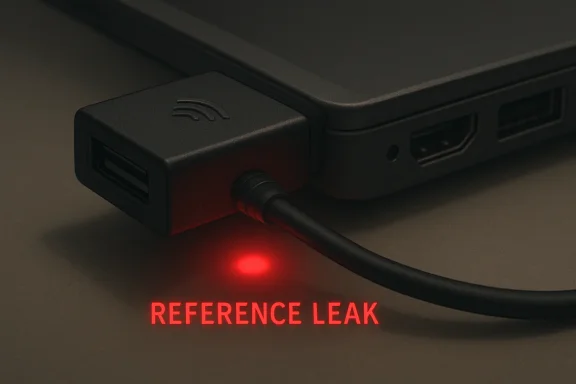
CVE-2026-31604 is a small Linux kernel fix with an outsized lesson: even mundane reference-counting mistakes in Wi-Fi drivers can become security-tracked vulnerabilities when they affect kernel resource lifetime. The issue sits in the Realtek rtw88 USB Wi-Fi driver, where a redundant USB device reference could leak during probe failure paths, including descriptor parsing errors. The National Vulnerability Database has published the record but has not yet enriched it with a CVSS score, which means administrators should treat the entry as a patch-management signal rather than a panic button. For WindowsForum readers, the key point is straightforward: this is primarily a Linux kernel driver issue, with indirect relevance to Windows users who dual-boot, run Linux hardware labs, manage Linux appliances, or maintain Microsoft-adjacent Linux estates.
Linux kernel CVEs have become far more visible since the kernel project formalized its role in vulnerability assignment. That shift means many bugs that previously appeared only as stable-tree commits now also show up in enterprise scanners, vulnerability dashboards, SBOM pipelines, and vendor security portals. CVE-2026-31604 fits that newer pattern: the vulnerability is not a flashy remote code execution flaw, but a resolved kernel correctness issue with potential resource-leak consequences.
The affected component is the rtw88 wireless driver family, which supports a range of Realtek Wi-Fi chipsets commonly found in budget laptops, USB adapters, mini-PCs, and embedded devices. Realtek wireless support in Linux has historically been a practical battlefield: users want inexpensive hardware to work out of the box, while kernel developers must integrate vendor-driven device behavior into the stricter lifecycle rules of the upstream kernel.
At the center of this CVE is the driver probe path. A probe is the moment when the kernel detects a device, binds it to a driver, initializes data structures, parses descriptors, allocates resources, and decides whether the hardware is usable. If anything fails halfway through, the driver must unwind cleanly, because the kernel cannot assume that failed hardware initialization is rare, harmless, or impossible to repeat.
The fix for CVE-2026-31604 removes an unnecessary USB device reference. The Linux driver core already holds references to the USB interface and parent device while the interface is bound, so the extra reference in the Realtek driver created an avoidable imbalance when initialization failed. In ordinary language, the driver was holding onto something it did not need, and in some error cases it failed to let go.
The practical security concern is resource exhaustion rather than data theft. A leaked device reference can keep kernel objects alive longer than intended and may contribute to memory pressure or stale lifecycle assumptions. In a high-churn environment where devices repeatedly fail probing, that can become operationally relevant.
Realtek Wi-Fi on Linux has improved over time, but the driver ecosystem still carries legacy complexity. The rtw88 stack supports multiple chips, buses, firmware paths, and feature combinations. That complexity increases the odds that initialization, suspend/resume, firmware loading, and disconnect paths will contain subtle edge cases.
For Windows users, Realtek hardware is familiar because many devices ship with Windows-first driver support. Linux support often follows a different model, where upstream kernel integration is preferred over vendor installer packages. That is good for long-term maintainability, but it means every resource-management rule must be expressed correctly inside the kernel.
Administrators should think in terms of exposure categories:
In this case, the rtw88 USB initialization code obtained a reference to the USB device during probe. That was redundant because the driver core already keeps the USB interface and parent USB device alive while the interface is bound to the driver. The extra reference was therefore not merely unnecessary; it created an additional cleanup obligation.
The problem emerges when probe does not complete successfully. If descriptor parsing or another early initialization step fails, the driver may exit through an error path that does not release the additional reference. The visible result is a device leak, meaning kernel-managed device resources remain pinned longer than intended.
For USB devices, descriptor parsing is especially important. USB descriptors tell the host what the device claims to be, what interfaces it provides, and how communication should be configured. If descriptor parsing fails, the driver should abandon initialization and unwind cleanly.
Key failure triggers can include:
The most realistic adversarial model would involve local or physical influence over USB hardware. A malicious, faulty, or repeatedly reattached USB Wi-Fi device could potentially trigger repeated failed probes. In theory, repeated leaks could contribute to memory pressure or require rebooting a system to fully recover resources.
That said, this should not be oversold. A single failed probe is unlikely to matter on a typical desktop. The risk becomes more interesting in unattended systems, kiosks, industrial deployments, shared labs, and automated test rigs where USB devices may be inserted repeatedly or hardware failures may go unnoticed.
A sensible interpretation is:
For everyday Windows users, the direct exposure is minimal. Windows uses its own Realtek drivers, not the Linux rtw88 driver, for native Wi-Fi operation. A Windows 11 laptop with a Realtek adapter is not affected by this Linux kernel bug simply because the hardware vendor name overlaps.
The nuance arrives with Windows Subsystem for Linux, Hyper-V, and dual-boot setups. WSL does not normally load Linux USB Wi-Fi drivers for the host’s physical adapter; networking is virtualized through Windows-managed plumbing. A full Linux VM also typically sees a virtual NIC unless USB passthrough is explicitly configured.
Practical exposure examples include:
The second question is whether affected systems are exposed to untrusted physical access. A Linux laptop used by a single employee has a different risk profile than a public kiosk, classroom machine, retail endpoint, or lab bench where USB devices are frequently swapped. Physical access changes the calculus for many USB driver issues.
The third question is operational resilience. Systems that must remain up for long periods without rebooting deserve more attention because leaked references and memory pressure become more meaningful over time. A short-lived developer machine is not the same as an unattended gateway in a remote location.
Useful triage signals include:
Small kernel patches are not automatically low impact. A one-line change in the wrong subsystem can alter concurrency, lifetime, or memory safety in ways that matter across millions of machines. In this case, however, the smallness is part of the argument: the driver did not need to own the extra reference in the first place.
The patch also reduces what kernel developers sometimes call cargo-culting. If one driver unnecessarily takes a reference, other drivers may copy that pattern without understanding whether it is required. Removing redundant ownership code makes real ownership requirements easier to see.
That distinction is subtle but important:
Administrators should avoid assuming that all kernels before or after a certain version are uniformly affected. Distribution kernels often carry backports, and stable trees may receive fixes independently across multiple supported branches. The vulnerability record lists multiple stable commit references, which is typical when the same fix is applied to several maintained kernel lines.
The safest operational route is to consult the distribution’s security advisory, package changelog, or kernel source package. If a scanner flags CVE-2026-31604, match the finding against the vendor’s kernel status rather than upstream assumptions alone. Backporting can make version strings misleading.
Users should be cautious with random out-of-tree Realtek driver packages. Third-party driver repositories sometimes solve one compatibility problem while reintroducing older lifecycle bugs or bypassing distribution QA. Mainline or distribution-supported drivers remain the best long-term path for most users.
Consumer checklist:
USB is especially challenging because it is hotpluggable, descriptor-driven, and widely accessible. A USB device can appear, disappear, misreport itself, stall, reset, or present unexpected interface combinations. Driver code must be defensive because the kernel cannot assume that hardware is honest or stable.
Wi-Fi drivers add another layer of complexity. They combine firmware loading, mac80211 integration, radio state, power management, regulatory handling, queues, interrupts, and sometimes USB transport quirks. A failure halfway through setup can leave many subsystems partially initialized unless cleanup is exact.
The lesson for kernel maintainers is clear:
For Microsoft, the rise of Linux CVEs inside security workflows reinforces a reality the company has embraced for years: modern enterprise computing is hybrid. Windows, Linux, containers, Azure services, developer tooling, and firmware all share the same operational risk dashboards. A vulnerability in a Linux Wi-Fi driver may not threaten Windows directly, but it still appears in the same management universe.
For hardware vendors, the message is equally sharp. Cheap Wi-Fi adapters are not exempt from security engineering. If a chipset is widely deployed, its driver paths will be scrutinized, fuzzed, backported, and tracked through CVE infrastructure.
The competitive implications include:
Distribution advisories will matter more than the raw CVE record. Watch for kernel updates from major Linux vendors and confirm whether the rtw88 USB fix is included. For enterprise distributions, the fix may arrive as a backport without a dramatic upstream version jump.
Things to monitor include:
CVE-2026-31604 is a reminder that security is often won in the unglamorous corners of systems engineering. A redundant reference in a USB Wi-Fi driver will not dominate headlines, but fixing it improves kernel correctness, reduces resource-leak risk, and clarifies ownership rules for future driver work. The right response is measured: patch affected Linux systems, verify whether Realtek USB Wi-Fi exists in the fleet, avoid overstating Windows exposure, and treat small driver CVEs as useful signals in the ongoing work of keeping mixed-platform environments resilient.
Source: NVD / Linux Kernel Security Update Guide - Microsoft Security Response Center
 Background
Linux kernel CVEs have become far more visible since the kernel project formalized its role in vulnerability assignment. That shift means many bugs that previously appeared only as stable-tree commits now also show up in enterprise scanners, vulnerability dashboards, SBOM pipelines, and vendor security portals. CVE-2026-31604 fits that newer pattern: the vulnerability is not a flashy remote code execution flaw, but a resolved kernel correctness issue with potential resource-leak consequences.The affected component is the rtw88 wireless driver family, which supports a range of Realtek Wi-Fi chipsets commonly found in budget laptops, USB adapters, mini-PCs, and embedded devices. Realtek wireless support in Linux has historically been a practical battlefield: users want inexpensive hardware to work out of the box, while kernel developers must integrate vendor-driven device behavior into the stricter lifecycle rules of the upstream kernel.
At the center of this CVE is the driver probe path. A probe is the moment when the kernel detects a device, binds it to a driver, initializes data structures, parses descriptors, allocates resources, and decides whether the hardware is usable. If anything fails halfway through, the driver must unwind cleanly, because the kernel cannot assume that failed hardware initialization is rare, harmless, or impossible to repeat.
The fix for CVE-2026-31604 removes an unnecessary USB device reference. The Linux driver core already holds references to the USB interface and parent device while the interface is bound, so the extra reference in the Realtek driver created an avoidable imbalance when initialization failed. In ordinary language, the driver was holding onto something it did not need, and in some error cases it failed to let go.
Why this became a CVE
The vulnerability record is awaiting further enrichment, so there is no official NVD severity score at publication time. That absence matters because scanners may temporarily display the item as unscored, unknown, or informational, depending on the tool. Unscored does not mean nonexistent, but it also does not automatically imply critical exposure.The practical security concern is resource exhaustion rather than data theft. A leaked device reference can keep kernel objects alive longer than intended and may contribute to memory pressure or stale lifecycle assumptions. In a high-churn environment where devices repeatedly fail probing, that can become operationally relevant.
Why rtw88 Matters
The rtw88 driver family is important because Realtek Wi-Fi chipsets are everywhere. They appear in consumer laptops, USB dongles, low-cost industrial systems, and secondary network adapters used in labs or field deployments. When Linux support works well, users barely notice; when it fails, the entire machine may appear unreliable because networking is foundational.Realtek Wi-Fi on Linux has improved over time, but the driver ecosystem still carries legacy complexity. The rtw88 stack supports multiple chips, buses, firmware paths, and feature combinations. That complexity increases the odds that initialization, suspend/resume, firmware loading, and disconnect paths will contain subtle edge cases.
For Windows users, Realtek hardware is familiar because many devices ship with Windows-first driver support. Linux support often follows a different model, where upstream kernel integration is preferred over vendor installer packages. That is good for long-term maintainability, but it means every resource-management rule must be expressed correctly inside the kernel.
The hardware footprint
The affected path concerns USB Wi-Fi support rather than every possible Realtek wireless configuration. That distinction is important because PCIe-attached laptop Wi-Fi and USB-attached adapters use different initialization paths. The CVE description specifically calls out the USB device reference taken during probe.Administrators should think in terms of exposure categories:
- Linux laptops using Realtek USB Wi-Fi adapters
- Desktop Linux workstations with plug-in Realtek wireless dongles
- Embedded systems that use USB Wi-Fi for provisioning or fallback networking
- Test labs that repeatedly attach and detach wireless hardware
- Dual-boot Windows/Linux machines where Linux uses the adapter directly
- Security appliances or kiosks built on commodity USB Wi-Fi hardware
The Bug: A Reference That Should Not Have Been Taken
The technical root of CVE-2026-31604 is a reference-counting mismatch. In kernel programming, references are ownership signals. If code obtains an extra reference to an object, it must release that reference on every path where the object is no longer needed.In this case, the rtw88 USB initialization code obtained a reference to the USB device during probe. That was redundant because the driver core already keeps the USB interface and parent USB device alive while the interface is bound to the driver. The extra reference was therefore not merely unnecessary; it created an additional cleanup obligation.
The problem emerges when probe does not complete successfully. If descriptor parsing or another early initialization step fails, the driver may exit through an error path that does not release the additional reference. The visible result is a device leak, meaning kernel-managed device resources remain pinned longer than intended.
Probe failure is not an exotic scenario
Probe failure sounds unusual, but it is a normal part of robust driver design. Devices can be defective, descriptors can be malformed, firmware can be unavailable, power sequencing can fail, and users can unplug devices at inconvenient moments. The kernel must treat all of those outcomes as normal possibilities.For USB devices, descriptor parsing is especially important. USB descriptors tell the host what the device claims to be, what interfaces it provides, and how communication should be configured. If descriptor parsing fails, the driver should abandon initialization and unwind cleanly.
Key failure triggers can include:
- Malformed or unexpected USB descriptors
- Unsupported Realtek device variants
- Firmware loading problems
- Interrupted initialization during hotplug
- Power-management timing issues
- Driver and device table mismatches
Exploitability: Low Drama, Real Operational Signal
There is no public indication that CVE-2026-31604 is being exploited in the wild, and the vulnerability description does not describe remote code execution, privilege escalation, or information disclosure. The plausible impact is a kernel resource leak caused by failed device probing. That makes this a maintenance and availability concern more than a classic attacker-takes-over-system scenario.The most realistic adversarial model would involve local or physical influence over USB hardware. A malicious, faulty, or repeatedly reattached USB Wi-Fi device could potentially trigger repeated failed probes. In theory, repeated leaks could contribute to memory pressure or require rebooting a system to fully recover resources.
That said, this should not be oversold. A single failed probe is unlikely to matter on a typical desktop. The risk becomes more interesting in unattended systems, kiosks, industrial deployments, shared labs, and automated test rigs where USB devices may be inserted repeatedly or hardware failures may go unnoticed.
What this is not
Security teams should resist the temptation to treat every kernel CVE as equal. This CVE does not currently read like a drive-by network exploit. It does not imply that nearby Wi-Fi attackers can compromise a Linux laptop over the air.A sensible interpretation is:
- Not currently scored by NVD
- No known public exploit signal in the provided record
- Likely local or physical trigger surface
- Availability-oriented risk profile
- Relevant mainly to systems using affected Realtek USB Wi-Fi paths
- Best handled through routine kernel updates
Microsoft and Windows Relevance
At first glance, a Linux Wi-Fi driver CVE might seem out of place in Microsoft’s security ecosystem. In practice, Microsoft tracks many non-Windows vulnerabilities because modern Microsoft environments include Linux workloads, Azure-hosted systems, developer workstations, container hosts, and security products that ingest broad CVE data. MSRC entries are often part of a larger vulnerability-management picture rather than a statement that standard Windows desktops are directly affected.For everyday Windows users, the direct exposure is minimal. Windows uses its own Realtek drivers, not the Linux rtw88 driver, for native Wi-Fi operation. A Windows 11 laptop with a Realtek adapter is not affected by this Linux kernel bug simply because the hardware vendor name overlaps.
The nuance arrives with Windows Subsystem for Linux, Hyper-V, and dual-boot setups. WSL does not normally load Linux USB Wi-Fi drivers for the host’s physical adapter; networking is virtualized through Windows-managed plumbing. A full Linux VM also typically sees a virtual NIC unless USB passthrough is explicitly configured.
Where WindowsForum readers should care
This CVE matters to WindowsForum readers who operate beyond a single consumer Windows installation. Many enthusiasts run Linux side by side with Windows, test kernels on spare hardware, or manage mixed estates at work. Those users should identify whether any Linux environment directly binds Realtek USB Wi-Fi hardware to rtw88.Practical exposure examples include:
- A dual-boot laptop that uses Linux with a Realtek USB adapter
- A Hyper-V or VMware Linux VM with USB Wi-Fi passthrough
- A Windows-administered lab containing Linux test machines
- Azure-adjacent Linux systems managed by Windows teams
- Developer workstations running native Linux on separate hardware
- Embedded Linux devices supported by a Windows-centric IT group
Enterprise Triage and Patch Prioritization
Enterprise teams should triage CVE-2026-31604 using asset context, not headline anxiety. The first question is whether any managed Linux system actually uses the rtw88 USB path. If the answer is no, the CVE can likely remain in the normal kernel patch queue.The second question is whether affected systems are exposed to untrusted physical access. A Linux laptop used by a single employee has a different risk profile than a public kiosk, classroom machine, retail endpoint, or lab bench where USB devices are frequently swapped. Physical access changes the calculus for many USB driver issues.
The third question is operational resilience. Systems that must remain up for long periods without rebooting deserve more attention because leaked references and memory pressure become more meaningful over time. A short-lived developer machine is not the same as an unattended gateway in a remote location.
A practical triage workflow
Security teams can use a straightforward sequence before escalating the issue:- Identify Linux systems with Realtek USB Wi-Fi hardware.
- Confirm whether the active kernel includes rtw88 USB support.
- Check whether the distribution has shipped the relevant stable kernel fix.
- Prioritize systems with public, shared, or uncontrolled USB access.
- Patch through the normal kernel update process and reboot where required.
Useful triage signals include:
- Kernel version and distribution kernel build
- Loaded modules related to rtw88 USB support
- Hardware inventory showing Realtek USB wireless devices
- Logs containing repeated probe failures
- Systems with known USB descriptor errors
- Environments where users bring their own adapters
Patch Mechanics: Why the Fix Is So Small
One reason CVE-2026-31604 is technically interesting is that the patch is tiny. The core change removes the call that increments the USB device reference count and removes the corresponding release in the deinitialization path. This is the kind of fix that looks almost trivial after the fact but requires deep confidence in driver-core lifetime rules.Small kernel patches are not automatically low impact. A one-line change in the wrong subsystem can alter concurrency, lifetime, or memory safety in ways that matter across millions of machines. In this case, however, the smallness is part of the argument: the driver did not need to own the extra reference in the first place.
The patch also reduces what kernel developers sometimes call cargo-culting. If one driver unnecessarily takes a reference, other drivers may copy that pattern without understanding whether it is required. Removing redundant ownership code makes real ownership requirements easier to see.
Driver-core ownership matters
The Linux driver core exists to centralize common device lifecycle responsibilities. When every driver invents its own version of object lifetime management, the kernel becomes harder to audit. The better model is to rely on the core where appropriate and add references only when a device structure must survive beyond normal binding or disconnect rules.That distinction is subtle but important:
- If the driver only needs the USB device while bound, the core reference is enough.
- If work continues after disconnect, an extra reference may be needed.
- If an extra reference is taken, every failure path must release it.
- If no extra reference is taken, cleanup code becomes simpler.
- If cleanup code is simpler, future auditing becomes more reliable.
Distribution and Fleet Impact
For Linux users, the patch will normally arrive through distribution kernel updates rather than manual source edits. Rolling distributions may pick it up quickly, while enterprise distributions may backport the fix into older kernel branches. The presence or absence of a particular upstream version number is less important than whether the vendor kernel contains the stable fix.Administrators should avoid assuming that all kernels before or after a certain version are uniformly affected. Distribution kernels often carry backports, and stable trees may receive fixes independently across multiple supported branches. The vulnerability record lists multiple stable commit references, which is typical when the same fix is applied to several maintained kernel lines.
The safest operational route is to consult the distribution’s security advisory, package changelog, or kernel source package. If a scanner flags CVE-2026-31604, match the finding against the vendor’s kernel status rather than upstream assumptions alone. Backporting can make version strings misleading.
Consumer Linux impact
For consumer Linux users, the best advice is boring and effective: install kernel updates when they are offered. If the machine uses a Realtek USB Wi-Fi adapter and has recently shown probe errors, failed initialization messages, or unstable hotplug behavior, the fix is more relevant. Otherwise, the issue can sit in the normal update cadence.Users should be cautious with random out-of-tree Realtek driver packages. Third-party driver repositories sometimes solve one compatibility problem while reintroducing older lifecycle bugs or bypassing distribution QA. Mainline or distribution-supported drivers remain the best long-term path for most users.
Consumer checklist:
- Update the distribution kernel through the official package manager.
- Reboot after the kernel update so the fixed driver is active.
- Avoid untrusted USB Wi-Fi adapters on sensitive systems.
- Check system logs if the adapter repeatedly fails to initialize.
- Prefer in-kernel drivers over abandoned vendor driver bundles.
The Bigger Kernel Security Pattern
CVE-2026-31604 belongs to a broader class of Linux kernel issues involving device lifetime, probe failure, disconnect handling, and cleanup ordering. These bugs are rarely glamorous, but they are central to kernel reliability. Hardware drivers sit at the boundary between untrusted physical behavior and privileged kernel code.USB is especially challenging because it is hotpluggable, descriptor-driven, and widely accessible. A USB device can appear, disappear, misreport itself, stall, reset, or present unexpected interface combinations. Driver code must be defensive because the kernel cannot assume that hardware is honest or stable.
Wi-Fi drivers add another layer of complexity. They combine firmware loading, mac80211 integration, radio state, power management, regulatory handling, queues, interrupts, and sometimes USB transport quirks. A failure halfway through setup can leave many subsystems partially initialized unless cleanup is exact.
Why boring bugs matter
The security industry tends to chase spectacular vulnerabilities, but mature attackers and serious defenders both care about reliability bugs. A reference leak may not grant code execution, yet it can weaken system availability. In chained scenarios, resource exhaustion can also amplify other failures.The lesson for kernel maintainers is clear:
- Probe paths must be audited as carefully as fast paths.
- Cleanup paths deserve test coverage, not just visual inspection.
- Hotplug drivers should assume repeated failure.
- Redundant ownership should be removed where the core already guarantees lifetime.
- Security labels increasingly attach to correctness fixes.
Competitive and Ecosystem Implications
Linux’s transparency is both a strength and a public-relations challenge. When a small driver leak receives a CVE, it can make the platform look noisy compared with closed ecosystems where similar bugs may be fixed silently inside cumulative updates. But visibility also gives administrators a clearer audit trail.For Microsoft, the rise of Linux CVEs inside security workflows reinforces a reality the company has embraced for years: modern enterprise computing is hybrid. Windows, Linux, containers, Azure services, developer tooling, and firmware all share the same operational risk dashboards. A vulnerability in a Linux Wi-Fi driver may not threaten Windows directly, but it still appears in the same management universe.
For hardware vendors, the message is equally sharp. Cheap Wi-Fi adapters are not exempt from security engineering. If a chipset is widely deployed, its driver paths will be scrutinized, fuzzed, backported, and tracked through CVE infrastructure.
Market pressure on driver quality
Driver quality increasingly affects purchasing decisions in enterprise and enthusiast communities. A device that works only through fragile out-of-tree drivers is less attractive than one supported cleanly upstream. This is particularly true for Linux fleets, where maintainability matters more than the sticker price of an adapter.The competitive implications include:
- Better upstream support becomes a hardware differentiator.
- Linux distributions gain value by backporting small reliability fixes quickly.
- Vulnerability scanners must improve context-aware prioritization.
- Microsoft-centric teams need better Linux inventory visibility.
- Hardware vendors face pressure to document device behavior more clearly.
- Open driver code enables faster correction and broader review.
Strengths and Opportunities
CVE-2026-31604 is not a blockbuster vulnerability, but it highlights several strengths in the modern open-source security pipeline. The issue was identified, corrected with a narrow patch, routed toward stable kernels, and assigned a CVE so downstream vendors and scanners can track remediation. That is exactly how routine kernel hardening should work.- Small, targeted fix reduces regression risk compared with broad rewrites.
- Stable-tree backports help distributions protect older supported kernels.
- Clear root cause makes the vulnerability easier to explain and audit.
- Driver-core alignment removes unnecessary ownership complexity.
- Public review helps other driver maintainers spot similar anti-patterns.
- Inventory-driven triage gives enterprises a practical path to prioritization.
- Cross-platform visibility helps Windows administrators understand Linux exposure in mixed fleets.
Risks and Concerns
The biggest risk around CVE-2026-31604 may be misclassification. Some organizations will overreact because the word “kernel” appears in the record, while others will dismiss it because there is no CVSS score yet. Both responses miss the point: this is a context-dependent driver vulnerability that should be patched, but prioritized according to actual exposure.- Alert fatigue may cause teams to ignore low-drama kernel CVEs.
- Missing CVSS data can confuse automated risk scoring.
- Version-string ambiguity may produce false positives when fixes are backported.
- Physical USB access can be underestimated in shared environments.
- Out-of-tree drivers may remain unfixed even after distribution kernels are patched.
- Long-lived embedded systems may lag behind stable kernel updates.
- Mixed Windows/Linux fleets may lack ownership clarity for Linux patching.
What to Watch Next
The most important next step is NVD enrichment. Once NVD assigns CVSS metrics, vulnerability tools will normalize severity and enterprises will have an easier time comparing this CVE against other Linux kernel issues. Until then, security teams should document their own assessment rather than waiting passively for a score.Distribution advisories will matter more than the raw CVE record. Watch for kernel updates from major Linux vendors and confirm whether the rtw88 USB fix is included. For enterprise distributions, the fix may arrive as a backport without a dramatic upstream version jump.
Things to monitor include:
- NVD CVSS scoring and CWE classification updates
- Linux distribution security advisories and kernel changelogs
- Scanner behavior for backported vendor kernels
- Reports of repeated rtw88 USB probe failures in system logs
- Any evidence of proof-of-concept triggering through crafted USB descriptors
CVE-2026-31604 is a reminder that security is often won in the unglamorous corners of systems engineering. A redundant reference in a USB Wi-Fi driver will not dominate headlines, but fixing it improves kernel correctness, reduces resource-leak risk, and clarifies ownership rules for future driver work. The right response is measured: patch affected Linux systems, verify whether Realtek USB Wi-Fi exists in the fleet, avoid overstating Windows exposure, and treat small driver CVEs as useful signals in the ongoing work of keeping mixed-platform environments resilient.
Source: NVD / Linux Kernel Security Update Guide - Microsoft Security Response Center
