

A Small Realtek Fix Carries a Larger Kernel Lesson
The description of CVE-2026-43176 is almost aggressively modest: “validate release report content before using for RTL8922DE.” That phrasing is typical of kernel CVEs in the post-2024 era, where many entries are not independent vulnerability write-ups so much as security labels attached to correctness fixes already accepted into the kernel. The relevant code lives in drivers/net/wireless/realtek/rtw89/pci.c, and the affected hardware family is Realtek’s RTL8922DE, part of the newer wave of Wi-Fi 7-era client adapters.
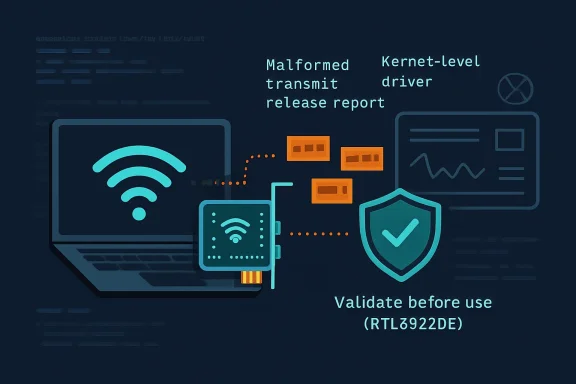
The kernel change follows an earlier fix that validated the sequence number of a transmit release report. In plain English, the driver receives a report from the device about transmitted packets, then uses fields in that report to decide which software bookkeeping structures to touch. If the report is malformed, and the driver trusts it too early, it can walk into bad memory or dereference something it should not.
That does not automatically mean an attacker can compromise a machine over Wi-Fi. The public description points to a crash-avoidance fix rather than a proven exploit chain. Still, security engineering has learned the hard way that “just a crash” in privileged kernel code deserves attention, especially when the input crosses a hardware/driver boundary.
The important point is not that every Linux desktop with Wi-Fi is suddenly at grave risk. It is that Realtek’s rtw89 driver is carrying a lot of new-device enablement, and the kernel is still tightening the guardrails around how those devices report state back to the operating system.
The Vulnerability Is About Trusting the Device Too Soon
Transmit release reports are part of the driver’s internal accounting. When a Wi-Fi device finishes handling transmitted frames, the driver needs to free or update the associated socket buffers, commonly called SKBs. The report from the hardware tells the driver what happened, and the driver uses that information to reconcile its transmit rings and packet queues.
CVE-2026-43176 exists because that report can apparently become malformed. The kernel description is unusually candid: there was no clear cause found. Rather than wait for the exact hardware or firmware path that produces the bad report, the patch adds defensive validation for RTL8922DE before the driver uses the data.
That is a sensible kernel posture. Hardware drivers sit at an awkward trust boundary: the device is local, but it is not the CPU; firmware may be opaque; bus traffic can be surprising; and the driver often runs with privileges that make a bad assumption expensive. The Wi-Fi stack is especially exposed to complex states because it responds to radio conditions, power management, firmware behavior, and fast packet churn.
The phrase “validate before using” can sound banal, but it is the entire story. Kernel bugs often emerge not because developers forgot that validation matters, but because a structure was assumed to be well-formed at a point in the code where earlier chips had behaved consistently. New hardware has a way of turning assumptions into crash reports.
Why RTL8922DE Is the Interesting Part
The Realtek rtw89 family has become familiar to Linux laptop users because Realtek chips appear in a wide range of consumer hardware. The driver covers multiple PCIe Wi-Fi devices, and support has expanded as vendors ship newer Wi-Fi 6, Wi-Fi 6E, and Wi-Fi 7 components. That breadth makes rtw89 both valuable and high-friction: it must support many adapters across many laptop platforms, firmware versions, suspend/resume states, and distribution kernels.
RTL8922DE matters because it is part of the newer hardware path. New chips tend to arrive with rapid enablement work: PHY tuning, MAC updates, power-management handling, firmware interactions, and incremental fixes as more real machines hit the code. That is not a scandal; it is how Linux hardware support matures. But it does mean early adopters of fresh wireless silicon often live closer to the edge of kernel development than they realize.
There is also a familiar WindowsForum angle here. Many users buy a laptop for Windows, then discover its wireless chipset only after installing Linux, dual-booting, or testing a live image. Intel Wi-Fi has long enjoyed a reputation for smoother Linux support, while Realtek hardware has a more uneven history in community troubleshooting threads. The in-kernel driver is far better than the old era of random out-of-tree ZIP files, but in-kernel does not mean bug-free.
CVE-2026-43176 is therefore less a consumer alarm than a signal about driver maturity. The fix says: this specific report path can fail in an unexpected way, so the driver now refuses to trust malformed content. That is exactly the kind of boring hardening users want from a platform driver.
The Missing CVSS Score Is Not the Same as Missing Risk
At publication time, the NVD entry is marked as awaiting enrichment, and no NIST CVSS 4.0, 3.x, or 2.0 score has been assigned. That creates a familiar problem for administrators: dashboards like numbers, but the most current vulnerability data often arrives before scoring catches up. In this case, the absence of a CVSS score should not be read as a declaration of safety.
It should also not be inflated into a crisis. The public record describes a crash scenario, not a remote exploit, privilege escalation, or information disclosure. The most responsible reading is that a malformed release report can cause the kernel driver to crash, and the kernel maintainers have accepted validation rules to avoid that outcome.
For most enterprise Linux fleets, the affected population is likely narrow. Servers generally do not depend on Realtek laptop Wi-Fi adapters. Cloud systems are irrelevant. Embedded systems may be affected only if they use the relevant Realtek wireless hardware and kernel versions. The practical exposure sits mostly with laptops, workstations, test devices, and possibly edge appliances using RTL8922DE.
That is why CVE triage cannot be reduced to severity labels. A medium-looking Wi-Fi driver crash may be irrelevant in a datacenter but disruptive on a fleet of Linux engineering laptops. Conversely, a scary-looking kernel CVE may not matter if the vulnerable driver is not built, not loaded, or not present in deployed hardware.
Kernel CVEs Have Become More Numerous, Not Always More Terrifying
The Linux kernel’s move into more systematic CVE assignment changed the shape of vulnerability feeds. Fixes that previously would have appeared as ordinary stability patches now often receive CVE IDs when they resolve memory safety, bounds checking, or crash conditions. That shift is good for transparency, but it makes the vulnerability stream noisier.
CVE-2026-43176 fits that modern pattern. It is a real kernel defect with a real patch, but the public description is essentially the commit message. There is no elaborate exploit narrative, no branded vulnerability name, and no marketing site counting down to patch Tuesday. The signal is smaller and more technical: a driver accepted data it should have checked first.
For IT teams, the temptation is to dismiss these entries as “just kernel churn.” That is too casual. The better approach is to sort kernel CVEs by reachability. Is the affected code built into your kernel? Is the driver loaded? Is the hardware present? Is untrusted input involved? Does the bug produce a crash, privilege escalation, data leak, or something still unknown?
This is where Linux patch management rewards boring inventory. If you know your wireless chipsets, kernel versions, and distribution backport policy, CVE-2026-43176 becomes a quick triage item. If you do not, it becomes another ambiguous row in a scanner report.
The Patch Is Defensive, and That Is the Point
The most revealing line in the description is that no clear cause was found. In a less mature engineering culture, that could lead to delay: reproduce it perfectly, identify the firmware path, isolate the chip condition, then fix it. Kernel development often takes a more pragmatic route when the failure mode is obvious enough: validate the data before it can hurt you.
That is not a workaround in the pejorative sense. Defensive programming in drivers is how operating systems survive imperfect devices. The kernel cannot always make hardware honest, but it can refuse to let a malformed report index into the wrong structure or release the wrong buffer.
The earlier related commit validated the sequence number of a transmit release report for existing chips. CVE-2026-43176 extends that thinking for RTL8922DE by adding rules ahead of use. The pattern is cumulative hardening: one chip family exposes a class of malformed report behavior, and the driver grows stricter as that class becomes better understood.
This matters because Wi-Fi drivers are full of asynchronous complexity. Packets are queued, DMA rings advance, firmware reports completion, power states change, and the operating system tries to keep the network stack coherent. When a report is malformed, the safe answer is rarely to soldier on optimistically. It is to reject, bound, or ignore the suspect data.
The Real-World Symptom Is Likely Instability, Not Intrusion
For users, the plausible symptom is a crash or driver failure around Wi-Fi activity. Depending on kernel configuration and failure path, that might show up as a kernel oops, a lockup, a lost wireless interface, or a system crash. The CVE text specifically says the new validation is intended to avoid a crash if the malformed condition happens.
That distinction matters. A vulnerability can be security-relevant without giving attackers a clean exploit primitive. Kernel crashes are denial-of-service conditions, and in some contexts denial of service is serious. A kiosk, a medical cart, a field laptop, or an industrial endpoint that loses connectivity at the wrong time can suffer real operational impact.
But home users should not read this as evidence that someone in the coffee shop can take over their Linux laptop through Realtek Wi-Fi. The public information does not support that leap. If later analysis demonstrates a stronger attack path, the risk assessment should change; until then, the grounded conclusion is that this is a kernel driver robustness fix with security tracking attached.
That is still worth patching. The kernel runs below almost everything else on the system. When a driver maintainer says a malformed device report can crash the machine, the right long-term answer is not to memorize a workaround; it is to take the fixed kernel when your distribution ships it.
Distribution Backports Will Matter More Than Mainline Version Numbers
The three kernel.org stable references attached to the CVE indicate that the fix has moved through stable channels. For users, however, the relevant question is not simply whether upstream Linux has the patch. It is whether Fedora, Ubuntu, Debian, Arch, openSUSE, RHEL derivatives, or a device vendor has shipped it in the kernel you are actually running.
This is where Linux version numbers become misleading. A distribution may backport the fix into an older supported kernel without changing the headline version in the way users expect. Another distribution may carry a newer kernel but delay a particular stable update for testing. Rolling distributions may receive the patch quickly, while long-term-support platforms may wait for their normal kernel update cadence.
The best practical check is hardware-aware. If your system does not have RTL8922DE hardware and does not load the relevant rtw89 module path, this CVE is probably not meaningful for that machine. If it does, the next step is to follow your distribution’s kernel update stream rather than trying to cherry-pick upstream commits manually.
Out-of-tree driver packages complicate the picture. Some Realtek users install DKMS versions of rtw89 to get newer chip support or work around distribution lag. That may solve one problem while creating another: if your driver comes from a third-party tree, you need to know whether that tree has incorporated the upstream validation fix. “The kernel has patched it” is not enough if you are not actually using the kernel’s copy of the driver.
Windows Users Are Mostly Watching the Linux Side of a Shared Hardware Story
The CVE is assigned to the Linux kernel, not to Windows. That should be obvious, but it is worth saying on a Windows-focused forum because the affected hardware may sit inside dual-boot laptops that spend most of their lives running Windows. Microsoft’s vulnerability guide can surface CVE records from broader ecosystems, but the technical fix here belongs to Linux.
Windows users with Realtek Wi-Fi hardware should not assume this specific CVE applies to their Windows driver. Different operating systems use different driver stacks, different firmware interactions, and different validation code. A malformed hardware report may be a shared concept, but the vulnerable code path described here is Linux’s rtw89 PCI driver.
The dual-boot implication is more practical. If your laptop uses a Realtek Wi-Fi 7 adapter and you boot Linux for development, testing, recovery, or privacy-sensitive work, keep that Linux kernel updated. A machine that is stable under Windows can still expose a Linux driver bug because the Windows and Linux drivers do not share the same code.
That divide is one reason hardware choice still matters. Enthusiasts often focus on CPU, GPU, display, and battery life, then treat the Wi-Fi card as an afterthought. On Linux, the Wi-Fi card can determine whether suspend works, roaming behaves, 6 GHz networks appear, and kernel logs stay quiet.
The Security Industry Still Struggles to Explain Driver CVEs
CVE-2026-43176 is the sort of vulnerability that security tools ingest faster than humans can contextualize. A scanner will eventually say some kernel package is affected. A vulnerability database will attach metadata. A dashboard may assign a severity once enrichment arrives. None of that automatically tells an administrator whether the bug matters on Tuesday morning.
Driver CVEs require a different mental model from application vulnerabilities. An application flaw usually starts with a service, a port, a file parser, or an identity boundary. A driver flaw starts with hardware presence and kernel configuration. If the code is unreachable, the risk collapses; if the code is reachable on thousands of laptops, a modest bug becomes operationally significant.
The Wi-Fi angle also distorts intuition. Wireless sounds remote, and remote sounds scary. But not every Wi-Fi driver bug is remotely triggerable by an attacker over the air. Some depend on device firmware behavior, local system state, rare hardware reports, or conditions that are difficult to induce externally.
That is why responsible coverage should avoid both extremes. It is wrong to wave away kernel crashes as unimportant because “it’s only Wi-Fi.” It is equally wrong to imply compromise where the public record only supports a malformed-report crash. The correct stance is narrower and more useful: patch affected Linux systems, prioritize machines with RTL8922DE hardware, and wait for further enrichment before making stronger claims.
The Quiet Risk Is Fleet Blindness
The most dangerous thing about small hardware-specific CVEs is not the bug itself. It is the number of organizations that cannot answer whether they are affected. Modern endpoint fleets are messy: procurement substitutions, regional laptop variants, repaired machines with replacement cards, developer-installed kernels, and dual-boot partitions all erode the clean inventory story.
A vulnerability like CVE-2026-43176 asks an inventory question masquerading as a security question. Which endpoints have Realtek RTL8922DE? Which ones run Linux kernels with rtw89 enabled? Which use vendor kernels, distribution kernels, or DKMS drivers? Which users are allowed to defer reboots for weeks?
For a small business or enthusiast, the answer may be as simple as running lspci and checking the loaded module. For an enterprise, it belongs in endpoint telemetry. Hardware IDs, loaded kernel modules, kernel package versions, and reboot compliance are all part of the same operational picture.
The irony is that the fix itself is probably small. The work around it is organizational: knowing where the hardware is, knowing which kernel branch contains the patch, and getting machines restarted into the corrected code. Security teams often obsess over exploit sophistication, but endpoint hygiene wins or loses on these mundane details.
The Patch Queue Tells Realtek Laptop Owners What To Do Next
There is no reason for ordinary users to panic, but there is also no prize for sitting on an old kernel when your wireless driver has received a crash-prevention fix. The practical response is straightforward: identify whether you have the affected hardware, use distribution-provided kernels where possible, and be cautious with third-party driver trees unless you can confirm they have absorbed the fix.
- Systems without RTL8922DE hardware are unlikely to have meaningful exposure to this specific CVE, even if they run Linux.
- Systems with RTL8922DE hardware should receive the patched rtw89 PCI driver through normal kernel updates from their distribution or vendor.
- The absence of an NVD CVSS score on May 6, 2026 does not mean the bug is harmless; it means formal enrichment has not caught up with the kernel disclosure.
- The public description supports a crash or denial-of-service reading, not a confirmed remote compromise claim.
- Users relying on DKMS or out-of-tree Realtek driver packages should verify those packages include the upstream validation change rather than assuming the installed driver matches the fixed kernel tree.
Hardware Enablement Is Security Work Now
CVE-2026-43176 will not be remembered as one of the great kernel vulnerabilities of 2026. It is too narrow, too driver-specific, and too plainly written for that. But it captures the direction of travel: laptop hardware enablement, especially around Wi-Fi, is now inseparable from security maintenance.
The old consumer view treated drivers as plumbing. If the adapter connected, the driver was “working.” That view is obsolete. A modern Wi-Fi driver is a complex kernel component parsing reports from sophisticated hardware and firmware, handling power transitions, juggling DMA rings, and feeding the network stack under constant timing pressure.
The correct lesson is not that Realtek is uniquely broken or that Linux Wi-Fi is unsafe. The lesson is that new hardware paths harden over time, and the hardening arrives as patches that may look boring until your machine is the one that crashes. Kernel users who want the newest wireless silicon must also accept the discipline of current kernels, clean driver sources, and prompt reboots.
CVE-2026-43176 is a small fix with a large moral: the safest driver is not the one that assumes the device behaved, but the one that checks before believing it. As Wi-Fi 7 hardware spreads through mainstream laptops, that habit of defensive validation will matter more, not less, and the users who keep their kernels current will be the ones least likely to notice when yesterday’s edge case becomes tomorrow’s solved problem.
References
- Security Update Guide - Microsoft Security Response Center NVD / Linux Kernel