

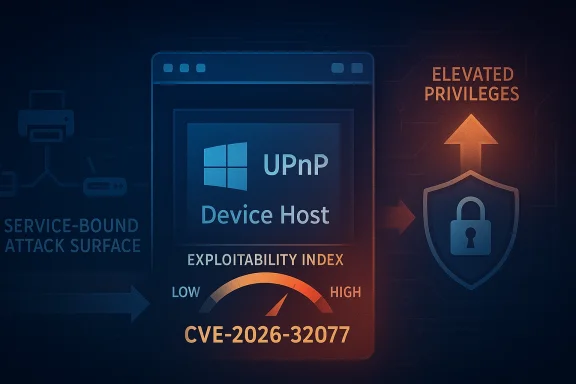
The Exploitability Index is Microsoft’s way of telling customers how much confidence it has that a vulnerability is real, technically understood, and likely to be turned into working exploit code. In the case of CVE-2026-32077, Microsoft’s Windows UPnP Device Host Elevation of Privilege Vulnerability carries the kind of framing that security teams watch closely because it sits at the intersection of local privilege escalation, service abuse, and the hard-to-predict reality of Windows hardening. That confidence metric matters because it shapes how urgently enterprises patch, how much defenders hunt for signs of exploitation, and how much attackers may already know about the flaw. Microsoft has long described the Index as a prioritization aid designed to estimate whether functional exploit code is likely to appear within roughly 30 days, not just whether a bug exists in theory.
Microsoft’s Security Response Center introduced the Exploitability Index to help customers sort through monthly patch releases and focus on the vulnerabilities most likely to matter first. The company’s own guidance makes clear that the rating is based on the probability that reliable exploit code will be developed, and that the assessment is tied to Microsoft’s understanding of the bug and what would be required to exploit it. That means the metric is not simply a severity score; it is a judgment about technical maturity, attack feasibility, and how much actionable knowledge exists for would-be attackers.
For a vulnerability like CVE-2026-32077, the service name is especially important. The UPnP Device Host component is part of Windows’ device and service discovery ecosystem, a legacy-adjacent area that often lives at the boundary between convenience and attack surface. Components in that space can be tricky because they may run with elevated privileges, process untrusted device or network metadata, and expose interfaces that were designed when local trust assumptions were less skeptical than they are today. Even without public technical detail, the combination of elevation of privilege and a host service immediately raises the stakes for defenders. If the affected code is reachable under realistic default configurations, the operational impact could be meaningful.
Microsoft’s public description of the metric also implies an important nuance: a vulnerability can be known with different degrees of certainty. Sometimes only the existence of a weakness is public, while the exact root cause is still being investigated. Sometimes researchers can corroborate the bug’s behavior and narrow where the flaw likely lives, but not fully reproduce it. And sometimes the vendor acknowledges the issue and the mechanics are understood enough that the attacker model becomes much more concrete. In practice, the confidence level helps answer a question defenders ask constantly: is this a theoretical concern, or a real bug with enough technical substance to drive exploitation?
That is why Microsoft’s monthly patch notes and monthly blog posts have historically used exploitability language alongside severity. The point is not just to classify a flaw as Important or Critical, but to help customers understand whether patching should happen first because an exploit is likely to follow quickly. Microsoft has repeatedly emphasized that the index reflects likelihood, not certainty, and that it exists because the security ecosystem needs more than a one-size-fits-all severity label to make patching decisions under time pressure.
Windows has spent years tightening this class of infrastructure, but legacy discovery and compatibility layers are hard to remove entirely. Enterprises still depend on a wide range of device workflows, and consumers still expect things to “just work” when a device appears on the network. The result is a persistent tension between usability and attack surface, especially in services that operate with privileges higher than the average desktop application.
Microsoft’s broader historical treatment of local privilege escalation issues shows how seriously it views this category. The company has long distinguished between remote code execution and elevation of privilege, while also recognizing that EoP bugs can be just as strategically important when attackers already have code running on a machine. That model has shaped Windows security for years, particularly as attackers increasingly favor multi-stage intrusions where initial access is followed by privilege escalation, credential theft, and lateral movement.
The public disclosure model also matters. Microsoft’s more recent security communication has increasingly emphasized transparency, including not only monthly patch guidance but also broader CVE and advisory practices across platforms and services. That reflects an industry-wide shift: defenders want earlier, clearer, and more actionable information, even when the vendor is still quantifying the technical risk. For a local Windows service like UPnP Device Host, that transparency can help defenders decide whether to treat the issue as a routine patch or a focused response item.
This matters because confidence drives urgency. A bug that is merely rumored or partially understood may not justify the same operational response as one that has been confirmed by the vendor, validated by researchers, or shown to have a plausible exploit path. For defenders, that confidence level often influences whether patching is scheduled during the next maintenance window or rushed into emergency change control.
Microsoft’s own historical explanation of the Exploitability Index helps clarify the logic. The company introduced the index specifically to estimate whether functional exploit code is likely to emerge, and it framed the assessment as a synthesis of Microsoft’s internal research, external review, and attacker feasibility. That means the index is not a verdict on exploit availability today; it is an informed prediction about how difficult the problem will be for attackers tomorrow.
In enterprise networks, the practical risk is less about an internet-facing gadget scenario and more about what an already-compromised local user might do next. A low-privileged account, a sandbox breakout, or even a malicious plugin can sometimes become the starting point for escalation when a service exposes a vulnerable path. That is why Windows EoP bugs are often treated as high-value “second-stage” vulnerabilities by adversaries.
The host service context also matters for defenders because policy controls can be uneven. Some organizations disable discovery components or segment them carefully; others leave defaults intact because they depend on device management or expect the OS to self-manage. That gap between assumed and actual exposure is exactly where many Windows privilege-escalation incidents begin.
The first question is whether the vulnerable path is enabled in your environment. The second is whether the component’s behavior is reachable from lower-privileged code or adjacent services. The third is whether existing hardening controls, such as application control, privilege separation, and attack surface reduction, are already reducing practical exposure. Those are the questions that turn a CVE entry into an operational decision.
In large environments, security teams should also examine whether the issue changes the blast radius of a compromise. If a standard user can pivot into elevated rights through this component, then the organization’s normal least-privilege assumptions may be weaker than expected. That is especially important in mixed environments where some devices are tightly managed and others remain partially consumer-like.
That evolution matters because the Windows ecosystem has changed. Attackers no longer need to rely only on dramatic remote exploits; they often prefer quieter local escalation paths that help them consolidate access after an initial intrusion. Microsoft’s security language has adapted accordingly, placing more emphasis on attack paths, exploit likelihood, and how researchers should interpret the vendor’s confidence.
The company has also repeatedly signaled that it wants customers to patch based on practical risk, not just headline severity. That is why older discussions of the Exploitability Index focused on how quickly exploit code tends to appear and how customers can use the index to prioritize. The logic remains relevant today: a vulnerability with high confidence and local privilege escalation potential can be a precursor to much larger compromise than its label might imply.
The issue also intersects with endpoint diversity. Managed fleets often include laptops, kiosks, VDI images, hardened developer workstations, and specialized line-of-business machines. A vulnerability in a Windows host service can behave differently across those contexts, so the same CVE may represent low risk on one subset and high risk on another.
Security teams should also think about response choreography. If the bug is judged highly credible, change management may need to treat it as a priority patch with accelerated validation, especially in environments with privileged users or sensitive admin tooling. The cost of delay rises sharply when the exploit path could convert an ordinary user compromise into administrative control.
The consumer angle is also shaped by convenience features. Many home systems leave discovery and device-hosting behaviors enabled because they improve printer, media, and smart-device compatibility. That convenience is exactly why local service vulnerabilities can remain relevant long after a feature’s original hype has faded. Attackers do not need a feature to be trendy; they only need it to be reachable.
For most consumers, the practical advice is straightforward: keep Windows fully updated, avoid running untrusted software as a local administrator, and be skeptical of anything that asks for elevated permissions without a clear reason. These are old rules, but EoP bugs prove why they still matter.
The opportunity for defenders is to use the disclosure as a forcing function for better privilege hygiene. A vulnerability in a service like UPnP Device Host is a reminder that convenience components should not be treated as harmless background noise. If organizations use the moment to audit service exposure and tighten least privilege, they may reduce risk well beyond this single CVE.
Another concern is false reassurance. Some organizations may see a local EoP flaw and assume it is only relevant after they are already compromised, which can lead to under-prioritization. But in modern intrusion chains, post-compromise bugs are often the very vulnerabilities that let attackers turn a low-severity entry into a major security event.
Finally, service-related bugs can be difficult to fully assess from the outside. Exposure may vary by edition, configuration, patch level, and device role. That means defenders who assume the CVE is irrelevant because it does not sound internet-facing may be underestimating the extent to which internal attack paths still matter.
The broader lesson is even more important than the individual CVE. Windows security continues to be shaped by the tension between legacy interoperability and modern least-privilege expectations. Every service that automates discovery or device interaction can become a test of how well the platform isolates trust, and every EoP bug reminds defenders that initial access is rarely the end of the story.
Source: MSRC Security Update Guide - Microsoft Security Response Center
 Overview
Microsoft’s Security Response Center introduced the Exploitability Index to help customers sort through monthly patch releases and focus on the vulnerabilities most likely to matter first. The company’s own guidance makes clear that the rating is based on the probability that reliable exploit code will be developed, and that the assessment is tied to Microsoft’s understanding of the bug and what would be required to exploit it. That means the metric is not simply a severity score; it is a judgment about technical maturity, attack feasibility, and how much actionable knowledge exists for would-be attackers.For a vulnerability like CVE-2026-32077, the service name is especially important. The UPnP Device Host component is part of Windows’ device and service discovery ecosystem, a legacy-adjacent area that often lives at the boundary between convenience and attack surface. Components in that space can be tricky because they may run with elevated privileges, process untrusted device or network metadata, and expose interfaces that were designed when local trust assumptions were less skeptical than they are today. Even without public technical detail, the combination of elevation of privilege and a host service immediately raises the stakes for defenders. If the affected code is reachable under realistic default configurations, the operational impact could be meaningful.
Microsoft’s public description of the metric also implies an important nuance: a vulnerability can be known with different degrees of certainty. Sometimes only the existence of a weakness is public, while the exact root cause is still being investigated. Sometimes researchers can corroborate the bug’s behavior and narrow where the flaw likely lives, but not fully reproduce it. And sometimes the vendor acknowledges the issue and the mechanics are understood enough that the attacker model becomes much more concrete. In practice, the confidence level helps answer a question defenders ask constantly: is this a theoretical concern, or a real bug with enough technical substance to drive exploitation?
That is why Microsoft’s monthly patch notes and monthly blog posts have historically used exploitability language alongside severity. The point is not just to classify a flaw as Important or Critical, but to help customers understand whether patching should happen first because an exploit is likely to follow quickly. Microsoft has repeatedly emphasized that the index reflects likelihood, not certainty, and that it exists because the security ecosystem needs more than a one-size-fits-all severity label to make patching decisions under time pressure.
Why confidence matters
A high-confidence vulnerability is usually more dangerous than an equally severe but uncertain one, because defenders can no longer count on ambiguity to slow attackers down. Once the bug class is understood, exploit writers can focus on reliability rather than discovery. In the Windows ecosystem, that difference often determines whether an issue stays confined to researchers or becomes part of real-world intrusion chains.Why service-level bugs are special
Service bugs tend to matter because services often run with elevated rights, handle automated inputs, and operate continuously in the background. That creates a path for local attackers to move from standard user context into administrative or SYSTEM-level execution. In enterprise environments, that can be the difference between a blocked foothold and a full endpoint compromise.- Confidence helps prioritize patching, not just rank severity.
- Service vulnerabilities can be especially valuable to attackers.
- EoP issues are often chained after an initial foothold.
- Technical certainty increases the chance of real-world abuse.
- The metric is meant to support faster operational decisions.
Background
The UPnP Device Host exists to support Windows’ discovery and interaction with network-connected devices that advertise themselves through Universal Plug and Play mechanisms. Historically, UPnP was built to reduce friction: printers, media devices, routers, and home-network appliances could expose capabilities and be discovered automatically. That convenience, however, came with a long-running security cost because auto-discovery systems often have to parse structured device data from less-trusted sources.Windows has spent years tightening this class of infrastructure, but legacy discovery and compatibility layers are hard to remove entirely. Enterprises still depend on a wide range of device workflows, and consumers still expect things to “just work” when a device appears on the network. The result is a persistent tension between usability and attack surface, especially in services that operate with privileges higher than the average desktop application.
Microsoft’s broader historical treatment of local privilege escalation issues shows how seriously it views this category. The company has long distinguished between remote code execution and elevation of privilege, while also recognizing that EoP bugs can be just as strategically important when attackers already have code running on a machine. That model has shaped Windows security for years, particularly as attackers increasingly favor multi-stage intrusions where initial access is followed by privilege escalation, credential theft, and lateral movement.
The public disclosure model also matters. Microsoft’s more recent security communication has increasingly emphasized transparency, including not only monthly patch guidance but also broader CVE and advisory practices across platforms and services. That reflects an industry-wide shift: defenders want earlier, clearer, and more actionable information, even when the vendor is still quantifying the technical risk. For a local Windows service like UPnP Device Host, that transparency can help defenders decide whether to treat the issue as a routine patch or a focused response item.
The Windows attack-surface problem
Windows services are prime targets because they run all the time and often expose protocol handlers, RPC interfaces, or parser logic. When a service is designed to be helpful and automatic, it may also become a reliable escalation target. Attackers like these targets because they often sit close to privilege boundaries without requiring user interaction.Why UPnP still matters
UPnP is not glamorous, but it is deeply embedded in device-discovery behavior across consumer and small-office environments. Even where organizations believe they do not use it directly, related dependencies can persist in the platform. That makes vulnerabilities in this area interesting to both attackers and defenders, especially when the bug affects a host service rather than an optional feature.- UPnP is a legacy convenience layer that still influences modern Windows use.
- Service-based vulnerabilities can be reachable without obvious user action.
- Local privilege escalation remains a favored attacker objective.
- Microsoft’s security posture has increasingly emphasized transparent prioritization.
- Compatibility pressure often slows removal of risky components.
What Microsoft’s Confidence Metric Actually Means
The wording attached to CVE-2026-32077 is revealing because it describes a metric for the degree of confidence in the existence of the vulnerability and the credibility of the known technical details. In other words, Microsoft is not only signaling whether the issue is severe, but whether the company believes the bug is real, reproducible, and technically grounded. That is a subtle but important distinction, especially in cases where a vulnerability has been observed but not fully reverse engineered.This matters because confidence drives urgency. A bug that is merely rumored or partially understood may not justify the same operational response as one that has been confirmed by the vendor, validated by researchers, or shown to have a plausible exploit path. For defenders, that confidence level often influences whether patching is scheduled during the next maintenance window or rushed into emergency change control.
Microsoft’s own historical explanation of the Exploitability Index helps clarify the logic. The company introduced the index specifically to estimate whether functional exploit code is likely to emerge, and it framed the assessment as a synthesis of Microsoft’s internal research, external review, and attacker feasibility. That means the index is not a verdict on exploit availability today; it is an informed prediction about how difficult the problem will be for attackers tomorrow.
Confidence vs. severity
Severity asks how bad the impact could be. Confidence asks how sure we are that the issue exists and can be weaponized. Those are different questions, and conflating them can lead to poor patch decisions. A medium-severity bug with high exploit confidence may deserve more attention than a more dramatic but less certain issue.Why attackers care
Attackers benefit when a vulnerability is technically well characterized because they can spend less time on discovery and more time on automation, reliability, and stealth. A bug inside a Windows host service also has potential value as a privilege-escalation step after phishing, malicious file execution, or another low-privilege foothold. That makes confidence a multiplier, not a footnote.- Severity and confidence are related, but not interchangeable.
- High confidence often means less attacker uncertainty.
- Vendor acknowledgement is a meaningful signal.
- Research corroboration can elevate operational urgency.
- Exploitability predictions are about future likelihood, not only present evidence.
Windows UPnP Device Host as an Attack Surface
The Windows UPnP Device Host is worth paying attention to because host services are often where routine convenience becomes privileged risk. A device-discovery component must accept and process device descriptions, state information, and service metadata, and that often means parsing inputs that are less trustworthy than local application data. If the code path mishandles memory, access control, or impersonation boundaries, the result can be an elevation of privilege.In enterprise networks, the practical risk is less about an internet-facing gadget scenario and more about what an already-compromised local user might do next. A low-privileged account, a sandbox breakout, or even a malicious plugin can sometimes become the starting point for escalation when a service exposes a vulnerable path. That is why Windows EoP bugs are often treated as high-value “second-stage” vulnerabilities by adversaries.
The host service context also matters for defenders because policy controls can be uneven. Some organizations disable discovery components or segment them carefully; others leave defaults intact because they depend on device management or expect the OS to self-manage. That gap between assumed and actual exposure is exactly where many Windows privilege-escalation incidents begin.
The value of local escalation
Local escalation is one of the most common stepping stones in real intrusions. Once an attacker gains higher privileges, they can dump credentials, tamper with security tooling, install persistence, and disable defensive controls. In other words, the EoP step is often where a nuisance turns into an incident.Why the component name matters
The component name tells defenders where to start reviewing exposure, logs, and mitigation options. It also hints at the class of bugs that may be involved, such as parser issues, token handling mistakes, or service interaction flaws. Even without a public root-cause explanation, the service context narrows the likely attack surface.- Host services are attractive because they run with more privilege than user apps.
- Discovery components often parse semi-trusted input.
- EoP is a classic second-stage objective after initial access.
- Service naming helps defenders map the likely exposure area.
- Default behavior often matters more than documentation assumptions.
How Defenders Should Read the Signal
Defenders should not treat the metric as a curiosity. The confidence language around CVE-2026-32077 is a cue to integrate the issue into patch prioritization, endpoint hardening, and threat-hunting workflows. Even when Microsoft has not published deep technical exploitation detail, the combination of a named Windows component and an elevation-of-privilege label is enough to justify action.The first question is whether the vulnerable path is enabled in your environment. The second is whether the component’s behavior is reachable from lower-privileged code or adjacent services. The third is whether existing hardening controls, such as application control, privilege separation, and attack surface reduction, are already reducing practical exposure. Those are the questions that turn a CVE entry into an operational decision.
In large environments, security teams should also examine whether the issue changes the blast radius of a compromise. If a standard user can pivot into elevated rights through this component, then the organization’s normal least-privilege assumptions may be weaker than expected. That is especially important in mixed environments where some devices are tightly managed and others remain partially consumer-like.
Patch triage logic
Patch triage should consider the exploitability confidence alongside the platform footprint. A flaw on a niche service can be less urgent than a bug in a broad default component, but the reverse is true if the niche service sits on a high-value server or endpoint class. In practice, the right question is not “how loud is the CVE?” but “how useful is it to an attacker in our environment?”Hunting and monitoring
Even without public exploit details, defenders can still watch for abnormal service behavior, unusual privilege transitions, and suspicious child processes originating from related Windows services. Log analysis should focus on post-exploitation patterns because an EoP bug often appears only after an attacker has already entered the machine by some other route. That means detections should emphasize privilege changes and follow-on activity.- Review whether the affected component is present on managed endpoints.
- Confirm whether the service is enabled by default in your build profile.
- Prioritize endpoints with sensitive data or admin access.
- Watch for privilege transitions after suspicious user-level activity.
- Assume chainability until proven otherwise.
Historical Context: Microsoft’s Evolving Security Messaging
Microsoft has spent years refining how it communicates vulnerability risk. The Exploitability Index emerged because severity alone was not enough to help customers decide what to patch first, especially when hundreds of CVEs could land in a single release cycle. Over time, Microsoft expanded its security communication to include more transparency around advisory updates, vulnerability chains, and service-side issues, reflecting the reality that modern risk is often distributed across platform layers.That evolution matters because the Windows ecosystem has changed. Attackers no longer need to rely only on dramatic remote exploits; they often prefer quieter local escalation paths that help them consolidate access after an initial intrusion. Microsoft’s security language has adapted accordingly, placing more emphasis on attack paths, exploit likelihood, and how researchers should interpret the vendor’s confidence.
The company has also repeatedly signaled that it wants customers to patch based on practical risk, not just headline severity. That is why older discussions of the Exploitability Index focused on how quickly exploit code tends to appear and how customers can use the index to prioritize. The logic remains relevant today: a vulnerability with high confidence and local privilege escalation potential can be a precursor to much larger compromise than its label might imply.
From bulletin-era ratings to modern guidance
Early Microsoft security bulletins were often consumed as static announcements, but modern guidance is more dynamic and contextual. Microsoft now blends CVE detail, security update guides, advisories, and broader research commentary to help defenders understand not just what was fixed, but how urgent the fix is. That shift has made vulnerability management more actionable, though also more complex.Why the confidence language persists
Confidence language persists because security teams still need a way to separate confirmed technical risk from speculative noise. A mature ecosystem needs both severity and certainty. In that sense, CVE-2026-32077 fits a long-running Microsoft pattern: communicate enough to drive action, but preserve the nuance needed for sound prioritization.- Microsoft’s messaging has moved toward actionable prioritization.
- Exploitability guidance helps separate hype from real risk.
- Modern intrusion chains favor quiet escalation over noisy exploits.
- Confidence metrics help defenders allocate scarce patch windows.
- Better context often matters more than bigger severity labels.
Enterprise Impact
For enterprises, CVE-2026-32077 is most important as a potential privilege-boundary issue. If the flaw can be reached from a standard user context, then a single compromised workstation may become a launch point for broader compromise. That is the classic enterprise pain point: the first foothold is annoying, but the escalation step is what threatens domain assets, credentials, and business continuity.The issue also intersects with endpoint diversity. Managed fleets often include laptops, kiosks, VDI images, hardened developer workstations, and specialized line-of-business machines. A vulnerability in a Windows host service can behave differently across those contexts, so the same CVE may represent low risk on one subset and high risk on another.
Security teams should also think about response choreography. If the bug is judged highly credible, change management may need to treat it as a priority patch with accelerated validation, especially in environments with privileged users or sensitive admin tooling. The cost of delay rises sharply when the exploit path could convert an ordinary user compromise into administrative control.
What enterprise defenders should review
Enterprises should examine whether the affected component is necessary on every endpoint, whether the service can be constrained through policy, and whether existing detection rules would catch suspicious follow-on behavior. If the answer is no, then the vulnerability becomes a stronger candidate for immediate remediation. The value is not only in fixing the bug, but in shrinking the opportunities an attacker would have after landing on the system.Operational consequences
Privilege escalation flaws can also complicate incident response. If defenders discover that a compromise may have moved from user space into elevated service context, they have to widen the trust boundary of their investigation. That changes containment, credential reset strategy, and the timeline for proving that a machine is clean.- High-value endpoints deserve accelerated validation.
- Admin workstations should be treated as especially sensitive.
- Privilege escalation can transform a small incident into a major one.
- Mixed device fleets create uneven exposure.
- Detection logic must look for post-compromise transitions.
Consumer Impact
Consumers will likely experience a different risk profile, but not a trivial one. Home users are less likely to face targeted privilege escalation campaigns than enterprises, yet they are often more exposed to opportunistic malware that takes advantage of weak local defenses. If the vulnerability can be chained after initial code execution, then any malicious download, script, or browser-based foothold becomes more dangerous.The consumer angle is also shaped by convenience features. Many home systems leave discovery and device-hosting behaviors enabled because they improve printer, media, and smart-device compatibility. That convenience is exactly why local service vulnerabilities can remain relevant long after a feature’s original hype has faded. Attackers do not need a feature to be trendy; they only need it to be reachable.
For most consumers, the practical advice is straightforward: keep Windows fully updated, avoid running untrusted software as a local administrator, and be skeptical of anything that asks for elevated permissions without a clear reason. These are old rules, but EoP bugs prove why they still matter.
Why consumers should care
Consumers often underestimate local privilege escalation because it does not sound as dramatic as a remote exploit. In reality, once malware is on the machine, higher privileges are the difference between easy cleanup and durable compromise. That is why Windows security updates matter even when no exploit is in the headlines.Practical household risk
Home networks are increasingly filled with connected devices, and Windows services that talk to them can become part of the exposure story. If a malicious actor gains a foothold through a browser, game cheat, cracked application, or fake utility, an EoP flaw can help them disable protection and persist. That makes patching a household security baseline, not an enterprise-only habit.- Keep Windows Update current.
- Avoid admin accounts for daily use.
- Treat device-discovery features as security-relevant.
- Be cautious with third-party utilities.
- Remember that post-compromise escalation is often the real danger.
Strengths and Opportunities
Microsoft’s handling of CVE-2026-32077, at least through the lens of the Exploitability Index language, has one major strength: it signals that the company is trying to tell defenders not just that a flaw exists, but how much trust to place in the surrounding technical picture. That kind of framing helps security teams make better choices under deadline pressure. It also gives enterprises a chance to align patching, hardening, and detection work around a specific trust level rather than a vague alert.The opportunity for defenders is to use the disclosure as a forcing function for better privilege hygiene. A vulnerability in a service like UPnP Device Host is a reminder that convenience components should not be treated as harmless background noise. If organizations use the moment to audit service exposure and tighten least privilege, they may reduce risk well beyond this single CVE.
- Clearer prioritization for patch teams.
- Better alignment between confidence and response urgency.
- An opportunity to audit Windows service exposure.
- Stronger least-privilege discipline across fleets.
- Improved detection of post-exploitation privilege changes.
- A reminder that legacy convenience features still matter.
- Chance to validate patch-testing and rollback procedures.
Risks and Concerns
The biggest concern is that high-confidence vulnerability language can encourage attackers as much as it helps defenders. Once a CVE is named and tied to a specific Windows service, adversaries know where to focus reverse engineering and exploitation attempts. Even if details are limited, the attack surface becomes easier to map, and that can accelerate weaponization.Another concern is false reassurance. Some organizations may see a local EoP flaw and assume it is only relevant after they are already compromised, which can lead to under-prioritization. But in modern intrusion chains, post-compromise bugs are often the very vulnerabilities that let attackers turn a low-severity entry into a major security event.
Finally, service-related bugs can be difficult to fully assess from the outside. Exposure may vary by edition, configuration, patch level, and device role. That means defenders who assume the CVE is irrelevant because it does not sound internet-facing may be underestimating the extent to which internal attack paths still matter.
- High-confidence CVEs can help attackers focus effort.
- Local EoP bugs are often chained into larger compromises.
- Exposure can vary across editions and configurations.
- Convenience services can remain enabled longer than expected.
- Underestimating internal attack paths is a common mistake.
- Patch delay can be costly even without public exploit code.
- Ambiguity is not a defense.
Looking Ahead
The key question now is whether CVE-2026-32077 becomes just another line item in the month’s patch roster or a meaningful case study in Windows service hardening. If Microsoft’s confidence metric reflects a well-understood exploit path, then defenders should expect the issue to matter less as a headline and more as a practical input into patch timing, endpoint policy, and monitoring. That is especially true if the vulnerable code sits in a broadly deployed default component.The broader lesson is even more important than the individual CVE. Windows security continues to be shaped by the tension between legacy interoperability and modern least-privilege expectations. Every service that automates discovery or device interaction can become a test of how well the platform isolates trust, and every EoP bug reminds defenders that initial access is rarely the end of the story.
What to watch next
- Microsoft’s eventual update-guide details for affected versions.
- Whether the vulnerability is assigned a clear exploitability rating.
- Any evidence of in-the-wild exploitation or proof-of-concept research.
- Clarifications about whether the issue requires prior local access.
- Follow-on guidance on hardening or mitigation for the UPnP service.
Source: MSRC Security Update Guide - Microsoft Security Response Center
