

Microsoft’s Quiet Wi-Fi Bug Carries a Loud Message
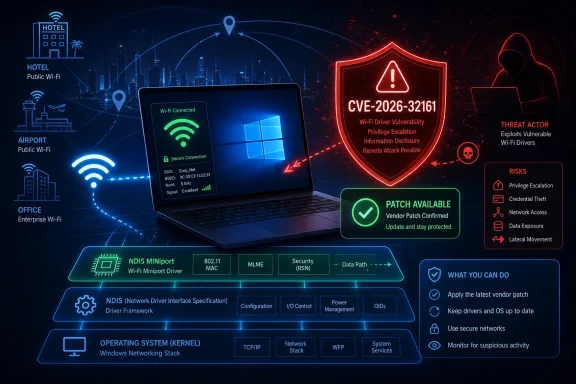
The Native WiFi Miniport Driver sits in the part of Windows most users never think about but nearly every mobile device depends on. It is plumbing: the software layer that helps Windows talk to wireless adapters and participate in Wi-Fi networks. When a vulnerability appears there, it does not need the theater of a flashy browser exploit to matter.
That is why CVE-2026-32161 deserves attention even if the public technical detail is thin. Microsoft’s advisory title identifies the affected component and the impact class: remote code execution. That combination tells administrators enough to prioritize investigation, because network-adjacent Windows components are exactly where exposure can be broader than a single application inventory suggests.
The user-facing lesson is simple: if Windows Update, WSUS, Intune, or another patching system offers a security update covering this CVE, this is not one to defer because “nobody uses that app.” Wi-Fi is not an app. It is a dependency.
Report Confidence Is the Hidden Severity Multiplier
The text attached to Microsoft’s entry describes the CVSS “report confidence” concept: how much trust defenders should place in the existence of the vulnerability and the published technical details. In practice, this metric often gets less attention than the base score, but for patch planning it can be just as important.
A vulnerability with uncertain details may still be dangerous, but it leaves defenders guessing. A vulnerability acknowledged by the vendor, assigned a CVE, and published in the official security guide moves into a different category. It becomes a real maintenance event, not a speculative threat-intel item.
For CVE-2026-32161, the MSRC publication itself is the decisive signal. Microsoft is not merely passing along third-party chatter; it is identifying a Windows component and classifying the impact. That raises the confidence level even if exploit mechanics, packet structure, crash behavior, or proof-of-concept code are not public.
The Absence of Exploit Detail Is Not Comfort
One recurring mistake in patch triage is treating missing exploit details as evidence of low risk. It may mean the opposite. Vendors often publish sparse advisories precisely because releasing deeper technical information too early would help attackers reverse-engineer the patch faster.
Windows Wi-Fi driver bugs are especially sensitive in this respect. A patch diff can reveal where Microsoft changed memory handling, validation, or state management. Skilled attackers do not need a vendor-authored exploit walkthrough if the update itself narrows the search area.
That does not mean every Wi-Fi RCE becomes wormable, mass-exploited, or practical in the wild. It does mean administrators should not wait for GitHub proof-of-concept code before acting. By the time a reliable exploit is public, the patch window has already become an incident-response window.
Remote Code Execution Does Not Always Mean Internet-Remote
The phrase “remote code execution” has a way of flattening nuance. In ordinary language, it sounds like an attacker anywhere on the Internet can immediately run commands on a target machine. In Windows driver advisories, the real exposure can be more conditional.
For a Native WiFi Miniport Driver flaw, the plausible attack surface is wireless networking rather than a public TCP service listening on a server. That matters. The risk profile for a domain controller in a locked rack is different from the risk profile for a laptop carried through airports, hotels, campuses, conference halls, and coffee shops.
This is where enterprise asset context matters more than generic severity labels. A fleet of Wi-Fi-enabled laptops is a meaningful exposure surface. A set of headless virtual servers without wireless adapters is probably not where defenders should spend their first hour.
Windows Laptops Are the Real Front Line
The systems most likely to matter are mobile Windows endpoints: corporate laptops, field devices, shared workstations, rugged tablets, and anything that routinely joins unfamiliar wireless environments. Those machines live in a hostile radio world. They listen before users authenticate, before VPN policies matter, and often before the person carrying the device has any idea what networks are nearby.
That does not automatically make exploitation trivial. Wireless attacks can require proximity, timing, crafted frames, driver-specific behavior, or target hardware compatibility. But proximity is not a comforting boundary in 2026. Offices, transit hubs, classrooms, hospitals, warehouses, and hotels all create dense wireless environments where an attacker can be near many targets without touching the corporate network.
The practical implication is that patch priority should follow mobility. If an organization must stage deployment, laptops and Wi-Fi-capable endpoints should move ahead of static systems with no wireless exposure.
The Driver Layer Is Where Small Bugs Become Big Outcomes
Driver vulnerabilities are unsettling because drivers operate close to the kernel. A memory safety flaw in a user application may give an attacker control inside a sandboxed process. A comparable flaw in a driver can become much more serious because of privilege and trust boundaries.
Native WiFi is not merely parsing a document after a user double-clicks a file. It participates in continuous communication with hardware and wireless network state. That makes validation failures, buffer handling mistakes, and malformed input handling especially consequential.
Microsoft’s advisory does not need to publish root-cause detail for defenders to understand the class of concern. Remote code execution in a Windows networking driver is the sort of bug that belongs in the “patch promptly and verify coverage” category, not the “wait for the monthly maintenance window if convenient” pile.
Attackers Read Patch Tuesday Differently Than Defenders Do
Defenders read advisories as work queues. Attackers read them as maps. A CVE title that names a component gives offensive researchers a starting point, and a security update gives them before-and-after binaries to compare.
That asymmetry is why quiet Microsoft advisories can become louder after release. The first day is about patch availability. The following days are about reverse engineering. If the changed code path is narrow enough, the advisory’s lack of public detail may stop mattering quickly.
This is not an argument for panic. It is an argument against complacency. Organizations that already have rapid Windows cumulative update deployment are in the best position; organizations that still treat endpoint patching as a quarterly hygiene exercise are the ones exposed to the gap between disclosure and exploit reproduction.
Home Users Should Let Windows Update Win
For home users, the best response is boring: install the relevant Windows security update and reboot. The Windows ecosystem has spent years training users to fear updates because of bad drivers, forced restarts, and occasional regressions. But security bugs in networking components are exactly why automatic update defaults exist.
The most exposed consumer devices are likely the same ones that travel: personal laptops, student machines, gaming notebooks, and tablets with Wi-Fi constantly enabled. Users who delay updates for weeks because the machine is “working fine” are making a bet that no one nearby will weaponize the bug.
That may be a good bet most days. It is still an unnecessary one.
Enterprise IT Has a Patch Management Problem, Not a Mystery Problem
For administrators, CVE-2026-32161 should trigger a straightforward workflow. Identify affected Windows versions, confirm update availability, prioritize Wi-Fi-capable endpoints, deploy through the normal channel, and verify installation. The hard part is not understanding the advisory; the hard part is proving that every roaming machine actually received the fix.
Remote and hybrid work make that harder. Devices may be off VPN, asleep during maintenance windows, throttled by metered connections, or stuck behind user-controlled restart behavior. A vulnerability in a wireless driver punishes exactly those gaps because the affected machines are often the most mobile and least predictable.
The right operational question is not “Do we have a patch?” It is “Which Wi-Fi-capable Windows systems have not installed it yet, and when will they be forced into compliance?”
The Wi-Fi Stack Keeps Reminding Windows That Local Airspace Is Hostile
Wi-Fi vulnerabilities occupy an awkward place in security planning. They are not usually Internet-scale in the way an exposed server flaw can be. They are also not purely local, because wireless proximity is a much weaker barrier than physical access.
That gray zone often leads to under-prioritization. A vulnerability requiring a nearby attacker may sound less urgent than one reachable from anywhere. But the modern Windows fleet spends much of its life in shared RF space, and attackers do not need to be on the corporate LAN to be physically near employees.
This is the security model defenders should use: wireless range is an attack surface. It may be smaller than the Internet, but it is much larger than the locked office.
The Concrete Read for WindowsForum Readers
CVE-2026-32161 is a reminder that Windows security is not only about browsers, Office documents, identity systems, and exposed servers. The endpoint’s hardware-facing layers remain a rich target, particularly where networking, drivers, and memory safety meet.
- Microsoft has confirmed CVE-2026-32161 as a Windows Native WiFi Miniport Driver remote code execution vulnerability through its Security Update Guide.
- The report-confidence framing matters because vendor acknowledgement gives defenders a stronger basis for action than rumor, scanner noise, or incomplete third-party claims.
- The most relevant systems are likely Wi-Fi-capable Windows endpoints, especially laptops and mobile devices that operate in shared or untrusted wireless environments.
- The lack of public exploit detail should not be treated as a reason to delay patching, because patch diffing can quickly improve attacker understanding after release.
- Enterprise teams should prioritize deployment verification, not just update approval, because roaming endpoints are often the devices most exposed and hardest to force into compliance.
The larger story is that Windows’ attack surface keeps moving below the user’s line of sight. A Wi-Fi driver vulnerability will not generate the same immediate reaction as a browser zero-day or a ransomware campaign, but it lives in a layer that users cannot harden by being careful. That makes the patch the story: not because every attacker can exploit CVE-2026-32161 today, but because confirmed code execution in a Windows networking driver is exactly the kind of flaw that rewards defenders who move before the exploit write-ups arrive.