

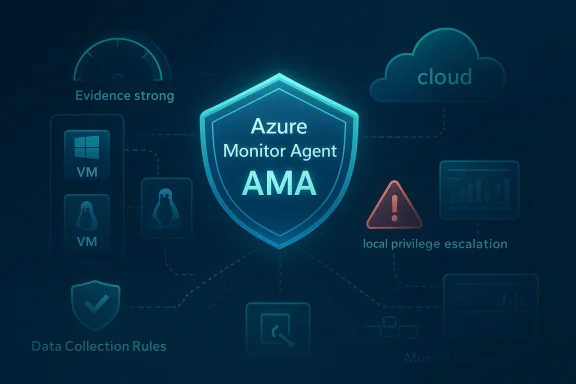
Microsoft’s Azure Monitor Agent vulnerability record for CVE-2026-32192 is a reminder that not every security advisory arrives with a full technical map attached. The core signal here is the confidence metric Microsoft uses to indicate how certain it is that the flaw exists and how credible the public technical details are, which in turn shapes how urgently defenders should act. Azure Monitor Agent itself is a broad, deeply embedded telemetry component that collects guest OS data for Azure Monitor and related services, so even a local privilege issue can matter well beyond a single workstation. Microsoft’s own guidance around the agent shows why: it is installed across Azure, hybrid, and on-premises environments and is used by data collection rules to gather logs, performance counters, and other operational signals Monitor Agent, often shortened to AMA, has become a foundational part of Microsoft’s modern monitoring stack. It replaced older log collection approaches for many scenarios and is now the supported agent for collecting guest operating system data in Azure Monitor. The agent runs on VMs in Azure, other clouds, and on-premises environments, and it can be deployed through VM extensions, Azure Policy, or services such as VM insights
That architectural re agent is not just “another service.” It sits in a privileged position close to logs, counters, configuration state, and other signals that enterprises rely on to understand their systems. In practice, that means the agent is both a management utility and a trust boundary. If a local attacker can elevate through the agent, the blast radius may extend into operations, diagnostics, and adjacent security controls rather than stopping at a narrow app boundary.
Microsoft has spent the last several years pushing more of its monitoring, automation, and cloud management ecosystem toward this agent model. The reason is straightforward: centralized collection is easier to operate, easier to scale, and easier to integrate with downstream services like Microsoft Sentinel and Microsoft Defender for Cloud. But that same operational convenience means a flaw in AMA is not a small bug in a niche tool. It is a defect in infrastructure glue.
The Security Update Guide and MSRC’s newer transparency work are relevant here because Microsoft has increasingly framed CVEs as more than simple on/off labels. The company now publishes machine-readable advisory data through CSAF as part of a broader transparency effort, reinforcing that vulnerability records are intended to communicate both existence and confidence, not just severity. That is especially important when the public technical detail is sparse, because defenders still need to decide whether to patch, monitor, or hunt immediately
CVE-2026-32192 sits in that gray zone wherar — elevation of privilege in Azure Monitor Agent — but the public depth is limited. In Microsoft’s own taxonomy, that makes the confidence signal more than a footnote. It becomes the operational cue that tells administrators how much weight to give the advisory before the exploit narrative is fully fleshed out.
The user-facing description attached to this kind of metric is easy to gloss over, but it is one of the most useful parts of Microsoft’s advisory model. It measures how confident the vendor is in the vulnerability’s existence and how credible the known technical details are. That means it is not just a proxy for severity; it is also a proxy for evidence quality and investigation maturity.
In practical terms, a high-confidence advisory tells defenders that Microsoft believes the bug is real and that the technical characterization is solid enough to warrant immediate attention. A lower-confidence advisory may indicate that the issue is still being validated, that details are incomplete, or that the public narrative is based on partial research rather than a fully confirmed root cause. For security teams, those differences affect prioritization, ticketing, and whether incident response teams start hunting on day one.
A confidence metric also implicitly reveals how much technical detail an attacker might have. If Microsoft can confidently characterize a flaw, then defenders should assume the same issue may also be understandable to serious offensive researchers. Even when the public page is thin, the existence of a vendor-tracked CVE means the issue is not merely theoretical.
That means the agent often has access to information that is riionally valuable and sensitive enough to be security relevant. Monitoring infrastructure often becomes a bridge between production workloads and cloud management planes, which is exactly why attackers like to target it. A successful privilege escalation here may not be flashy in the way a remote code execution bug is, but it can still be deeply disruptive.
That is particularly true for management agents. A host agent can expose configuration data, credentials, or pathways into broader cloud administration workflows. Even when it does not directly hold secrets, it can be used to persist, tamper with logs, or interfere with monitoring and detection.
Microsoft’s documentation makes clear that AMA is part of a larger data collection architecture defined by data collection rules. Those rules determine what data is collected, how it is processed, and where it is sent . The more central the agent becomes to observability, the more valuable it is as an at# What We Can and Cannot Verify Right Now
The public record for CVE-2026-32192 is still thin enough that it would be irresponsible to pretend we know more than we do. What we can verify is the classification: it is an Azure Monitor Agent Elevation of Privilege Vulnerability, and Microsoft’s disclosure model includes a confidence-oriented description designed to tell defenders how certain the vendor is about the flaw and the quality of the technical detail.
What we cannot reliably verify from the public material alone is the exact root cause, the specific exploitation path, whether it requires authenticated local access, or whether a patch version has been published with version-specific remediation guidance. Third-party trackers are already repeating a narrow interpretation of the issue, but those summaries are not as authoritative as Microsoft’s own advisory entry and should be treated cautiously unless and until they line up with official release notes.
A good defensive response to a sparse CVE record usually looks like this:
For enterprises, the story is much larger. AMA is exactly the kind of software that appears in large fleets, remote admin estates, cloud-hosted workloads, and hybrid environments where patch compliance can be uneven. If a vulnerability exists in a monitoring agent, enterprise defenders are the ones who feel it first and hardest.
The risk is not just that the agent may be vulnerable. It is that the agent may be everywhere.
Microsoft has previously documented vulnerabilities in related management technologies, and it has repeatedly emphasized automatic updates, agent version controls, and centralized patch deployment. The broader lesson is that management plane software is both indispensable and inherently high-value. The more powerful the agent, the more carefully it must be engineered and maintained.
The historical significance is twofold. First, these are not one-off freak bugs; they are part of a recurring class of issues in privileged management software. Second, every new advisory reinforces the need for robust inventory and automatic update discipline.
In the context of Azure Monitor Agent, the real danger is not just SYSTEM access on one machine. It is that a compromised monitoring process may also have visibility into sensitive host behavior, logs, and policy-driven collection workflows. That can distort detection, delay containment, or provide the attacker with better reconnaissance for lateral movement.
An attacker who lands on an endpoint through phishing, an exposed service, or a stolen password often does not stay at low privilege for long. They search for local escalation paths precisely because those paths are the shortest route to persistence and domain relevance. If the affected machine is a server with monitoring and admin tooling, the value of that escalation rises sharply.
Microsoft’s description of AMA’s role shows why this matters. The agent is installed where it can access local logs and performance data and then send that data to Azure Monitor for use by other services ge escalation may provide not just control, but control over the visibility layer that defenders depend on.
The first priority is inventory. If AMA is deployed in any form — directly, through Azure Policy, through Azure Arc, or through VM extensions — defenders need to know where it lives and what version is installed. The second priority is remediation planning. If a fixed build is available, it should be staged through standard change controls as quickly as possible.
If you operate a large hybrid estate, this is also a good moment to compare compliance data against actual installation data. Management agents are often assumed to be up to date because they are supposed to self-update or be centrally managed. That assumption is frequently wrong.
A second concern is operational delay. Enterprises often maintain careful change windows for agents because these components are tied to data collection pipelines and downstream analytics. That caution is understandable, but it can become a liability if it causes sluggish remediation after a confirmed advisory.
Security teams should also watch for whether third-party vulnerability databases converge on a consistent exploit narrative. That matters because fragmented interpretations can produce bad operational decisions. A consensus on attack vector, required privileges, and remediation scope would make it easier for defenders to prioritize correctly.
CVE-2026-32192 is not just another line in a vulnerability catalog. It is a reminder that the software used to watch your systems can itself become part of the problem. In an environment where telemetry, identity, and management are increasingly intertwined, the safest assumption is that any privileged agent deserves the same scrutiny as the workloads it helps protect.
Source: MSRC Security Update Guide - Microsoft Security Response Center
That architectural re agent is not just “another service.” It sits in a privileged position close to logs, counters, configuration state, and other signals that enterprises rely on to understand their systems. In practice, that means the agent is both a management utility and a trust boundary. If a local attacker can elevate through the agent, the blast radius may extend into operations, diagnostics, and adjacent security controls rather than stopping at a narrow app boundary.
Microsoft has spent the last several years pushing more of its monitoring, automation, and cloud management ecosystem toward this agent model. The reason is straightforward: centralized collection is easier to operate, easier to scale, and easier to integrate with downstream services like Microsoft Sentinel and Microsoft Defender for Cloud. But that same operational convenience means a flaw in AMA is not a small bug in a niche tool. It is a defect in infrastructure glue.
The Security Update Guide and MSRC’s newer transparency work are relevant here because Microsoft has increasingly framed CVEs as more than simple on/off labels. The company now publishes machine-readable advisory data through CSAF as part of a broader transparency effort, reinforcing that vulnerability records are intended to communicate both existence and confidence, not just severity. That is especially important when the public technical detail is sparse, because defenders still need to decide whether to patch, monitor, or hunt immediately
CVE-2026-32192 sits in that gray zone wherar — elevation of privilege in Azure Monitor Agent — but the public depth is limited. In Microsoft’s own taxonomy, that makes the confidence signal more than a footnote. It becomes the operational cue that tells administrators how much weight to give the advisory before the exploit narrative is fully fleshed out.
 Why the Confidence Metric Matters
The user-facing description attached to this kind of metric is easy to gloss over, but it is one of the most useful parts of Microsoft’s advisory model. It measures how confident the vendor is in the vulnerability’s existence and how credible the known technical details are. That means it is not just a proxy for severity; it is also a proxy for evidence quality and investigation maturity.In practical terms, a high-confidence advisory tells defenders that Microsoft believes the bug is real and that the technical characterization is solid enough to warrant immediate attention. A lower-confidence advisory may indicate that the issue is still being validated, that details are incomplete, or that the public narrative is based on partial research rather than a fully confirmed root cause. For security teams, those differences affect prioritization, ticketing, and whether incident response teams start hunting on day one.
What the Metric Really Signals
The most important thing about this confidence measure is that it helps distinguish confirmed risk from speculative noise. That matters because cloud and endpoint security teams are often flooded with alerts that look urgent but turn out to be incomplete, misclassified, or not directly exploitable in a given environment.A confidence metric also implicitly reveals how much technical detail an attacker might have. If Microsoft can confidently characterize a flaw, then defenders should assume the same issue may also be understandable to serious offensive researchers. Even when the public page is thin, the existence of a vendor-tracked CVE means the issue is not merely theoretical.
- Higher confidence means the vendor has stronger evidence the bug exists.
- Lower confidence suggests the public technical story may still be evolving.
- Publicly confirmed CVEs generally deserve faster remediation than unverified chatter.
- Sparse details do not mean low risk; they often mean less visibility.
- Attackers benefit when defenders delay because the page is “too vague.”
Azure Monitor Agent’s Role in the Attack Surface
AMA is important because it lives in a privileged, operationally sensitive part of the environment. Microsoft describes the agent as the supported mechanism for collecting guest OS data in Azure Monitor, and it can ingest local logs, performance counters, firewall logs, and other telemetry from Windows and Linux systemsThat means the agent often has access to information that is riionally valuable and sensitive enough to be security relevant. Monitoring infrastructure often becomes a bridge between production workloads and cloud management planes, which is exactly why attackers like to target it. A successful privilege escalation here may not be flashy in the way a remote code execution bug is, but it can still be deeply disruptive.
Why Local Privilege Escalation Still Matters in Cloud Management
An elevation-of-privilege issue requires some level of access first, but that does not make it benign. In modern enterprise environments, local access is often the result of phishing, malicious software, unsafe scripts, stolen credentials, or a previous foothold. Once an attacker has low-privileged code execution on a host, a local privilege escalation turns a contained incident into something much more dangerous.That is particularly true for management agents. A host agent can expose configuration data, credentials, or pathways into broader cloud administration workflows. Even when it does not directly hold secrets, it can be used to persist, tamper with logs, or interfere with monitoring and detection.
Microsoft’s documentation makes clear that AMA is part of a larger data collection architecture defined by data collection rules. Those rules determine what data is collected, how it is processed, and where it is sent . The more central the agent becomes to observability, the more valuable it is as an at# What We Can and Cannot Verify Right Now
The public record for CVE-2026-32192 is still thin enough that it would be irresponsible to pretend we know more than we do. What we can verify is the classification: it is an Azure Monitor Agent Elevation of Privilege Vulnerability, and Microsoft’s disclosure model includes a confidence-oriented description designed to tell defenders how certain the vendor is about the flaw and the quality of the technical detail.
What we cannot reliably verify from the public material alone is the exact root cause, the specific exploitation path, whether it requires authenticated local access, or whether a patch version has been published with version-specific remediation guidance. Third-party trackers are already repeating a narrow interpretation of the issue, but those summaries are not as authoritative as Microsoft’s own advisory entry and should be treated cautiously unless and until they line up with official release notes.
Reading Sparse Advisories Correctly
This is where many defenders go wrong: they assume a terse advisory means a low-priority one. In reality, the opposite can be true. The less public detail that is available, the more important it is to anchor decisions in vendor acknowledgment, affected-product scope, and the confidence signal itself.A good defensive response to a sparse CVE record usually looks like this:
- Confirm whether the software is installed anywhere in the estate.
- Identify the exact versions and deployment modes in use.
- Check whether Microsoft has published fixed builds or mitigation guidance.
- Reduce exposure of the affected service where possible.
- Monitor for unusual local privilege activity and service tampering.
- Prioritize patching as soon as the official remediation is available.
Enterprise Impact vs. Consumer Impact
For consumers, Azure Monitor Agent is usually invisible. Most home users will never knowingly install it, and if they encounter it at all it is likely because they are operating a managed device, a work-connected machine, or a virtual machine in a cloud environment. That means the immediate consumer blast radius is limited.For enterprises, the story is much larger. AMA is exactly the kind of software that appears in large fleets, remote admin estates, cloud-hosted workloads, and hybrid environments where patch compliance can be uneven. If a vulnerability exists in a monitoring agent, enterprise defenders are the ones who feel it first and hardest.
Why Enterprises Should Care More
Enterprise environments typically use AMA to standardize collection across Windows and Linux servers, Azure VMs, and Azure Arc-enabled machines. Microsoft’s own overview notes that the agent supports Azure, other clouds, and on-premises systems, with centralized configuration through DCRs . That broad footprint means patching is not a single-click affair; it often requires asset discovery, changeand rollout coordination.The risk is not just that the agent may be vulnerable. It is that the agent may be everywhere.
- Large server fleets make version tracking harder.
- Hybrid environments complicate remediation ownership.
- Monitoring agents are often treated as low-risk infrastructure.
- Privilege escalation flaws can enable deeper post-exploitation.
- Security tooling that is itself vulnerable creates trust problems.
Historical Context: Why AMA Vulnerabilities Keep Reappearing
This is not the first time Microsoft’s monitoring ecosystem has attracted serious scrutiny. Azure and Windows management components have repeatedly been implicated in privilege escalation, misconfiguration, and trust-boundary issues over the years. That pattern is not unique to Microsoft; it is common across endpoint management and cloud telemetry stacks because these tools necessarily sit close to the system core.Microsoft has previously documented vulnerabilities in related management technologies, and it has repeatedly emphasized automatic updates, agent version controls, and centralized patch deployment. The broader lesson is that management plane software is both indispensable and inherently high-value. The more powerful the agent, the more carefully it must be engineered and maintained.
What Previous Azure Monitoring Bugs Teach Us
Earlier Azure Monitor and related agent issues show a familiar pattern: local exploitation, privileged context, and reliance on version hygiene. Microsoft’s documentation for the agent extension shows that it is updated continuously and that support is limited to versions within a relatively recent window osoft already expects this component to evolve quickly and to require proactive maintenance.The historical significance is twofold. First, these are not one-off freak bugs; they are part of a recurring class of issues in privileged management software. Second, every new advisory reinforces the need for robust inventory and automatic update discipline.
- Monitoring agents often run with elevated service privileges.
- Hybrid deployment models expand the attack surface.
- Version drift increases exposure in distributed estates.
- Cloud services can hide vulnerable instances behind automation.
- Mature patching discipline is the real control, not wishful thinking.
Technical Significance of Elevation of Privilege Bugs
Elevation of privilege vulnerabilities are deceptively simple in their wording and often severe in their effect. They usually require some foothold first, but that foothold is often easier to obtain than people assume. In a post-compromise environment, EoP flaws are the tools attackers use to move from “user-level nuisance” to “system-level control.”In the context of Azure Monitor Agent, the real danger is not just SYSTEM access on one machine. It is that a compromised monitoring process may also have visibility into sensitive host behavior, logs, and policy-driven collection workflows. That can distort detection, delay containment, or provide the attacker with better reconnaissance for lateral movement.
Local Access Is Not a Comforting Limitation
Security teams sometimes downgrade local EoP issues because they are not remote. That instinct is dangerous. Local privilege escalation is often the second stage of a broader intrusion, and that stage is where real-world attacks start to scale.An attacker who lands on an endpoint through phishing, an exposed service, or a stolen password often does not stay at low privilege for long. They search for local escalation paths precisely because those paths are the shortest route to persistence and domain relevance. If the affected machine is a server with monitoring and admin tooling, the value of that escalation rises sharply.
Microsoft’s description of AMA’s role shows why this matters. The agent is installed where it can access local logs and performance data and then send that data to Azure Monitor for use by other services ge escalation may provide not just control, but control over the visibility layer that defenders depend on.
Defender Priorities Right Now
The 2026-32192 is to treat it as a real, vendor-tracked issue even if the public detail is still limited. Microsoft’s advisory framework exists precisely so customers can act before every technical nuance is public. That is the point of the confidence metric, and it is why the signal deserves operational attention.The first priority is inventory. If AMA is deployed in any form — directly, through Azure Policy, through Azure Arc, or through VM extensions — defenders need to know where it lives and what version is installed. The second priority is remediation planning. If a fixed build is available, it should be staged through standard change controls as quickly as possible.
A Practical Response Framework
Teams dealing with this advisory should move through a simple containment and validation sequence:- Confirm where Azure Monitor Agent is installed.
- Identify the exact agent version and deployment path.
- Check Microsoft’s advisory for fixed versions or mitigations.
- Review privileged service accounts associated with the agent.
- Look for unusual local admin escalation activity on managed hosts.
- Validate monitoring continuity after any upgrade.
- Reassess alerting if the agent changes behavior after patching.
If you operate a large hybrid estate, this is also a good moment to compare compliance data against actual installation data. Management agents are often assumed to be up to date because they are supposed to self-update or be centrally managed. That assumption is frequently wrong.
Strengths and Opportunities
The good news is that the ecosystem around AMA is already mature enough to support disciplined response, and Microsoft’s newer advisory transparency efforts give defenders more context than they used to have. The existence of a confidence metric is itself an improvement, because it helps teams separate real vendor-confirmed issues from vague rumors. More broadly, this is an opportunity to harden operational hygiene across the entire telemetry stack.- Centralized deployment makes it easier to identify affected machines once inventory is complete.
- Microsoft’s advisory model gives defenders a confidence signal, not just a severity label.
- Hybrid management tooling can be leveraged for faster rollout of fixes.
- Version-based support windows encourage regular maintenance instead of perpetual drift.
- Telemetry dependency mapping can expose hidden criticality in monitoring agents.
- Patch workflows can be improved by treating agents as first-class security assets.
- Observability teams and security teams can align more closely on service ownership.
Risks and Concerns
The biggest concern is that a monitoring agent vulnerability can undermine the very systems defenders rely on to notice compromise. If the agent is used widely and a local attacker can elevate privileges through it, then security monitoring, log trustworthiness, and incident response fidelity may all be affected. That makes the issue more than a patching exercise.A second concern is operational delay. Enterprises often maintain careful change windows for agents because these components are tied to data collection pipelines and downstream analytics. That caution is understandable, but it can become a liability if it causes sluggish remediation after a confirmed advisory.
- Delayed patching leaves a widely deployed trust anchor exposed.
- Incomplete inventory can hide vulnerable instances in hybrid estates.
- Monitoring blind spots may be created if attackers interfere with the agent.
- Service dependencies can complicate emergency updates.
- Version drift may leave older builds quietly vulnerable.
- Overreliance on vague public data can cause underreaction.
- False confidence in cloud-managed tooling can slow local validation.
Looking Ahead
The next thing to watch is whether Microsoft publishes fixed version guidance, revised metadata, or additional technical detail for CVE-2026-32192. If that happens, administrators will need to reconcile the new information with their existing deployment channels and patch baselines. If not, the advisory will remain a case study in how much value can be conveyed by a vendor confidence signal even before all the technical pieces are public.Security teams should also watch for whether third-party vulnerability databases converge on a consistent exploit narrative. That matters because fragmented interpretations can produce bad operational decisions. A consensus on attack vector, required privileges, and remediation scope would make it easier for defenders to prioritize correctly.
What to Watch Next
- Microsoft’s official remediation guidance for affected AMA versions.
- Any revision to the confidence metric or advisory text.
- Confirmation of whether the issue requires authenticated local access.
- Evidence of wild exploitation or proof-of-concept research.
- Updated agent extension versions in Microsoft Learn documentation.
- Correlation with other Azure agent advisories that may indicate a broader pattern.
CVE-2026-32192 is not just another line in a vulnerability catalog. It is a reminder that the software used to watch your systems can itself become part of the problem. In an environment where telemetry, identity, and management are increasingly intertwined, the safest assumption is that any privileged agent deserves the same scrutiny as the workloads it helps protect.
Source: MSRC Security Update Guide - Microsoft Security Response Center
