

Microsoft’s handling of CVE-2026-32631 highlights an important but often overlooked part of vulnerability management: the difference between a bug that exists in theory and one that is confirmed enough to justify immediate defensive attention. In this case, the advisory centers on GitHub-related repositories and a
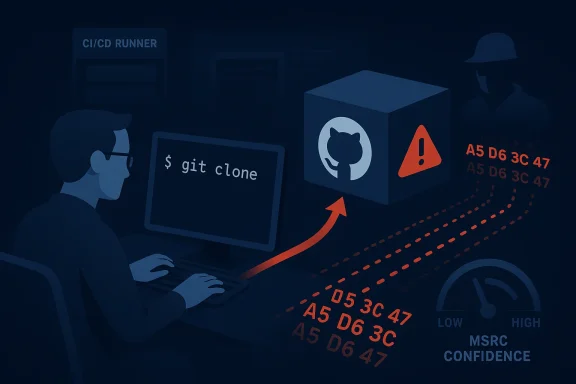
The core story herelone can be dangerous.” It is that a manipulated repository can induce a Windows host to reach out over NTLM-authenticated paths during ordinary developer activity, turning a routine clone into a potential credential disclosure event. That pattern fits a broader class of supply-chain-adjacent attacks where attackers do not need to execute code first; they just need to influence the way the target resolves paths, fetches resources, or renders repository content. The result is a deceptively mundane attack surface with very modern consequences.
This is also why Microsoft’s metric mattlow-confidence disclosure may merit watchlisting, while a high-confidence advisory should prompt immediate review of exposure, patch status, and compensating controls. In practice, defenders need to know whether they are dealing with a speculative warning or a vendor-validated issue with enough technical substance to anchor remediation. Microsoft’s framing is a reminder that severity and certainty are related but distinct questions.
The broader Git security landscape reinforces the relevance oit-related advisories increasingly involve repository content that affects downstream tools, submodules, helpers, and trust boundaries rather than just the Git core itself. GitHub’s advisory ecosystem explicitly focuses on curated advisories and references to primary sources, because the security impact often depends on the exact build artifact, the exact workflow, and the exact user action involved.
A leak of NTLM material is not just another information disclosure. NTLM hashes can be used in relay scenarios or cracked offline, and that makes the outcome materially more dangerous than a generic data leak. Windows defenders have spent years hardening against credential theft for exactly this reason: once authentication material leaves the trust boundary, the attacker may not need the original endpoint anymore.
What makes repository-triggered leaks that they often piggyback on legitimate workflows. Developers clone code every day, security teams mirror repositories, and automation systems ingest source trees at scale. A malicious repository can exploit that normality, and the attack may appear to be “just a clone” in logs until the network traces and authentication events tell a different story. That is the sort of threat that slips past intuitive risk models because it uses an expected action as its delivery mechanism.
In the Git ecosystem, that philosophy is especially important. Git itself is a tengine; the real risk often shows up in how downstream tools interpret repository metadata, file paths, submodules, hooks, and embedded references. GitHub’s advisory database is built around that reality, emphasizing curated advisories, primary references, and fix commits rather than vague labels alone. In other words, the ecosystem already assumes that repository content can carry security meaning beyond the code it contains.
That is why a CVE about cloning manipulated repositories deserves attention even if the initial technical note looks sparse. A clone is not a passive download in many environments; it is a structured operation that can trigger path resolution, helper invocations, and authentication attempts. If the process leaks NTLM credentials, the bug moves from “repository weirdness” into identity compromise territory, which is where enterprise security teams start paying much closer attention.
The Windows side of the house makes this more urgent. Mid multiple credential-theft mitigations over time, and products such as Credential Guard exist specifically because authentication material in memory is worth protecting aggressively. The fact that Microsoft’s own platform hardening measures isolate NTLM password hashes speaks volumes about the value of those secrets—and about the seriousness of any condition that can leak them during ordinary system use.
Enterprise Git usage compounds the risk. Build farms, CI runners, dev shells, and scripting environments often cess and credential context that a normal user workstation would not. If the clone operation triggers NTLM authentication in such an environment, the attacker may not just get a hash—they may get a hash from a machine that can be reused in more powerful follow-on attacks. That is the real danger: the vulnerability may be narrow, but the surrounding environment can make it much more consequential.
That distinction matters because defenders often have to make patching decisions before all public details are available. A low-confidence bug may justify monitoring a high-confidence issue can justify immediate exposure reduction, especially if the affected condition involves credentials or remote disclosure. Microsoft’s own wording implies that the score is meant to help administrators prioritize limited time and avoid chasing every advisory with the same intensity.
For security teams, this is a useful corrective to a familiar mistake: treating every CVE as if it has the same maturity. In reality, advisories occupy different points on a spectrum from “vendor-confirmed anublicly noted but still technically fuzzy.” The confidence metric is Microsoft’s way of making that spectrum visible, and in a fast-moving patch cycle, visibility is often the difference between timely action and delayed response.
That is why this CVE deserves attention even if the initial attack appears subtle. Credential material is one of the most reusable forms of compromise because it can enable impersonation, relay, and downstream access without requiring malware persistence on the original machine. Once the secret is in the attacker’s hands, the original vulnerability may no longer need to be exercised again.
The presence of Git in the attack chain adds another layer. Developer endpoints often sit closer to source code, secrets management systems, cloud credentials, and internal automation than ordinary employee laptops do. So a leaked hash from a dev box may carry more practical value than the same leak on a lightly provisioned cocation of the leak can matter as much as the leak itself.*
That framing helps explain why a manipulated repository can matter even when the repository itself does not contain an obvious executable payload. A clone can trigger parsing logic, path resolution, and network lookups, and any of those can become a side effect channel. The danger is not always the repository’s source code; sometimes it is the metadata and structure wrapped around that code. That is the sort of nuance that supply-chain defenders have to learn to treat seriously.
This is where the GitHub ecosystem is valuable as a warning system. By aggregating advisories and linking them to concrete version ranges or build artifacts, it encourages defenders to think in terms of which operation is vulnerable, not just which product is named. That difference is cruonments where Git is embedded inside larger developer platforms, custom automation, and proprietary tooling.
The impact is magnified when cloning is automated. Build systems may pull code on schedule, on event triggers, or as part of dependency refreshes, and those jobs are often less scrutinized than interactive user actions. That means a vulnerability that feels like a niche developer issue can become an operational concern for the entire engineering organization. Automation is a force multiplier for both productivity and exposure.
There is also a governance problem. Organizations frequently know which endpoints are domain-joined, but they do not always know which of those endpoints are cloning untrusted code, especially when temporary project workstations and build agents are involved. That makes inventory and workflow mapping just as important as patching. If you do not know where repository clones occur, you cannot know where the risk truly lives.
That said, ordinary home users may be less likely to encounter the exact trigger than developers or admins. The more important consumer-adjacent risk is the growing overlap between personal machines and semi-professional workflows—code editing, local test environments, hobby CI setups, and remote administration of cloud resources. A “home” machine can still carry serious credentials.
The second priority is hardening. Microsoft’s guidance around Credential Guard exists because isolating NTLM and Kerberos secrets materially raises the cost of extraction. Where feasible, that kind of protection should be part of the baseline, not an optional enhancement. Security teams should also revisit where NTLM is still permitted, since reducing NTLM reliance shrinks the value of many leak primitives.
The other thing to watch is whether enterprise teams use this as another catalyst to reduce NTLM dependence. That would be the healthiest long-term outcome. A vulnerability like this is often most useful when it changes habits, not just patch levels.
Source: MSRC Security Update Guide - Microsoft Security Response Center
git clone workflow that can leak NTLM hashes, which is exactly the kind of credential exposure that can have enterprise-wide consequences if it is triggered in a developer workstation, CI runner, or build pipeline. Microsoft’s Security Update Guide also uses a confidence metric to signal how certain the vendor is about the vulnerability’s existence and the credibility of the technical details, making the advisory itself as important as the CVE label. cords are not all equally mature when they first appear. Some are based on a confirmed code path, a vendor fix, or a public exploit narrative; others arrive with less detail and a lower degree of operational certainty. Microsoft’s confidence metric exists to help defenders interpret that gap, and the company’s own language says the score reflects both the likelihood that the bug truly exists and the strength of the technical evidence behind it. That is especially relevant for a credential-leak bug, because even a narrow leak can become a foothold for relay attacks, offline cracking, or lateral movement if the affected machine belongs to a domain environment.The core story herelone can be dangerous.” It is that a manipulated repository can induce a Windows host to reach out over NTLM-authenticated paths during ordinary developer activity, turning a routine clone into a potential credential disclosure event. That pattern fits a broader class of supply-chain-adjacent attacks where attackers do not need to execute code first; they just need to influence the way the target resolves paths, fetches resources, or renders repository content. The result is a deceptively mundane attack surface with very modern consequences.
This is also why Microsoft’s metric mattlow-confidence disclosure may merit watchlisting, while a high-confidence advisory should prompt immediate review of exposure, patch status, and compensating controls. In practice, defenders need to know whether they are dealing with a speculative warning or a vendor-validated issue with enough technical substance to anchor remediation. Microsoft’s framing is a reminder that severity and certainty are related but distinct questions.
The broader Git security landscape reinforces the relevance oit-related advisories increasingly involve repository content that affects downstream tools, submodules, helpers, and trust boundaries rather than just the Git core itself. GitHub’s advisory ecosystem explicitly focuses on curated advisories and references to primary sources, because the security impact often depends on the exact build artifact, the exact workflow, and the exact user action involved.
 Why credential-leak bugs are different
A leak of NTLM material is not just another information disclosure. NTLM hashes can be used in relay scenarios or cracked offline, and that makes the outcome materially more dangerous than a generic data leak. Windows defenders have spent years hardening against credential theft for exactly this reason: once authentication material leaves the trust boundary, the attacker may not need the original endpoint anymore.What makes repository-triggered leaks that they often piggyback on legitimate workflows. Developers clone code every day, security teams mirror repositories, and automation systems ingest source trees at scale. A malicious repository can exploit that normality, and the attack may appear to be “just a clone” in logs until the network traces and authentication events tell a different story. That is the sort of threat that slips past intuitive risk models because it uses an expected action as its delivery mechanism.
- Credential theft is a bridge, not the end goal.
- Nle relay or cracking.
- Normal developer workflows are ideal camouflage.
- Automation can magnify a single bad clone across many systems.
Background
Microsoft has been steadily teaching enterprise customers to think in terms of trust boundaries rather than isolated products. The Security Update Guide is part of that effort: it is not just a patch catalog, but also a triage tool that tells administrators how confident Microsoft is in each vulnerability record. That matters because a CVE may be public before the full technical story is complete, and the advisory metadata often determines whether organizations treat the issue as a watch item or a patch-now item.In the Git ecosystem, that philosophy is especially important. Git itself is a tengine; the real risk often shows up in how downstream tools interpret repository metadata, file paths, submodules, hooks, and embedded references. GitHub’s advisory database is built around that reality, emphasizing curated advisories, primary references, and fix commits rather than vague labels alone. In other words, the ecosystem already assumes that repository content can carry security meaning beyond the code it contains.
That is why a CVE about cloning manipulated repositories deserves attention even if the initial technical note looks sparse. A clone is not a passive download in many environments; it is a structured operation that can trigger path resolution, helper invocations, and authentication attempts. If the process leaks NTLM credentials, the bug moves from “repository weirdness” into identity compromise territory, which is where enterprise security teams start paying much closer attention.
The Windows side of the house makes this more urgent. Mid multiple credential-theft mitigations over time, and products such as Credential Guard exist specifically because authentication material in memory is worth protecting aggressively. The fact that Microsoft’s own platform hardening measures isolate NTLM password hashes speaks volumes about the value of those secrets—and about the seriousness of any condition that can leak them during ordinary system use.
Why Git workflows are attractive to attackers
Git workflows are attractive because they are both common and trusted. A malicious repository can be delivered through social engineering, supply-chain compromise, or a poisoned dependency reference, and the victim may never think of the clone itself as a sensitive act. That is precisely the kind of assumption attackers try to exploit: the more ordinary the action, the less likely it is to be scrutinized.Enterprise Git usage compounds the risk. Build farms, CI runners, dev shells, and scripting environments often cess and credential context that a normal user workstation would not. If the clone operation triggers NTLM authentication in such an environment, the attacker may not just get a hash—they may get a hash from a machine that can be reused in more powerful follow-on attacks. That is the real danger: the vulnerability may be narrow, but the surrounding environment can make it much more consequential.
- Git is trusted infrastructure, which makes it a tempting attack vector.
- Clone operations can have side effects beyond file download.
- Enterprise build systems may expose richer credentials than consumer PCs.
- Microsoft’s confidence metric helps distinguish rumor from actionable risk.
The MSRC Confidence Metric
Microsoft’s confidence metric is one of the more useful pieces of vulnerability metadata because it speaks to certainty, not just impact. The company defines it as a measure of how confident it is that the vulnerability exists and how credible the technical details are. In practice, that means a high-confidence entry should be read differently than an advisory built from weak evidence or incomplete reproduction.That distinction matters because defenders often have to make patching decisions before all public details are available. A low-confidence bug may justify monitoring a high-confidence issue can justify immediate exposure reduction, especially if the affected condition involves credentials or remote disclosure. Microsoft’s own wording implies that the score is meant to help administrators prioritize limited time and avoid chasing every advisory with the same intensity.
How to read confidence operationally
The most practical way to use the metric is to combine it with context. If the advisory points to a well-defined code path, a credible exploit meknowledgment, then the confidence score reinforces the urgency. If technical details are thin, the score tells you how much trust to place in the advisory while still waiting for broader corroboration. That makes it a triage signal rather than a replacement for judgment.For security teams, this is a useful corrective to a familiar mistake: treating every CVE as if it has the same maturity. In reality, advisories occupy different points on a spectrum from “vendor-confirmed anublicly noted but still technically fuzzy.” The confidence metric is Microsoft’s way of making that spectrum visible, and in a fast-moving patch cycle, visibility is often the difference between timely action and delayed response.
What the metric suggests about attacker knowledge
A second-order effect of confidence is attacker accessibility. If Microsoft is highly confident in the flaw, it usually means the technical conditions are not just rumored buugh to support exploitation reasoning. That does not mean every attacker can weaponize it instantly, but it does mean the bug is less likely to be a dead end for threat actors. In other words, confidence can be an indirect signal of exploitability maturity.- High confidence usually implies stronger technical evidence.
- The metric helps separate rumor from validated risk.
- Credential-related bugs deserve extra weight in prioritization.
- Confidence is a triage signal, not a replacement f
NTLM Hash Leakage and Why It Matters
NTLM hashes remain valuable to attackers because they can be abused even without revealing the plaintext password. Microsoft’s own Windows hardening guidance makes clear that Credential Guard is intended to protect secrets like NTLM password hashes and Kerberos tickets from theft, which underscores how sensitive those artifacts are in the first place. If a clone operation can coax a machine into leaking such material, the attacker has already crossed a significant boundary.That is why this CVE deserves attention even if the initial attack appears subtle. Credential material is one of the most reusable forms of compromise because it can enable impersonation, relay, and downstream access without requiring malware persistence on the original machine. Once the secret is in the attacker’s hands, the original vulnerability may no longer need to be exercised again.
From leak to lateral movement
The path from NTLM leak to enterprise impact is well understood. If the hash is captured, an attacker can attempt offline cracking, use relay opportunities, or target services that still accept NTLM-based authentication paths. That is why defenders treat credential leakents, not just workstation incidents. They create the possibility of reuse across systems, and reuse is what turns a local issue into a network problem.The presence of Git in the attack chain adds another layer. Developer endpoints often sit closer to source code, secrets management systems, cloud credentials, and internal automation than ordinary employee laptops do. So a leaked hash from a dev box may carry more practical value than the same leak on a lightly provisioned cocation of the leak can matter as much as the leak itself.*
- NTLM hashes are reusable security material.
- Relay and cracking are the main downstream risks.
- Developer machines can be higher-value targets than they look.
- Credential leaks often outlive the vulnerability that exposed them.
GitHub, Repositories, and Manipulated Content
GitHub’s advisory ecosystem exists precisely because repository content can be dangerous in ways that ordinary software scanning misses. The advisory database is built to surface CVEs and GitHub-originated advisories in a curated format, with primary-source references and fix commits where possible. That structure acknowledges an uncomfortable reality: code repositories are not just code; they can also be delivery vehicles for malformed paths, helper references, and edge-case behavior in tools that process them.That framing helps explain why a manipulated repository can matter even when the repository itself does not contain an obvious executable payload. A clone can trigger parsing logic, path resolution, and network lookups, and any of those can become a side effect channel. The danger is not always the repository’s source code; sometimes it is the metadata and structure wrapped around that code. That is the sort of nuance that supply-chain defenders have to learn to treat seriously.
The trust problem in repository tooling
Repository tools assume certain invariants: paths are sane, references behave as expected, and resources resolved during clone or checkout are under the user’s control. Attackers thrive when those assumptions are too generous. If the toolchain unwittingly fetches from a remote NTLM-sensitive path or follows a manipulated reference, the attacker can force an authentication event that was never supposed to happen.This is where the GitHub ecosystem is valuable as a warning system. By aggregating advisories and linking them to concrete version ranges or build artifacts, it encourages defenders to think in terms of which operation is vulnerable, not just which product is named. That difference is cruonments where Git is embedded inside larger developer platforms, custom automation, and proprietary tooling.
- Repositories can be security inputs, not just source code.
- Metadata and path resolution are often the attack surface.
- GitHub advisories help contextualize build-artifact exposure.
- The real trust boundary is the clone workflow, not the repository logo.
Enterprise Impact
For enterprises, this is the kind of issue that can quietly ripple through the software factory. A single bad repository can hit a developer workstation, a CI agent, a container build job, or a pre-production mirror. If the clone path leaks NTLM hashes, the impact may extend beyond the initial machine because enterprise environments often reuse credentials, trust relationships, or domain membership across multiple systems.The impact is magnified when cloning is automated. Build systems may pull code on schedule, on event triggers, or as part of dependency refreshes, and those jobs are often less scrutinized than interactive user actions. That means a vulnerability that feels like a niche developer issue can become an operational concern for the entire engineering organization. Automation is a force multiplier for both productivity and exposure.
Why IT teams should care even if developers “own” Git
It is tempting to say this is a developer problem, but that is too narrow. Security teams own credential protection, endpoint hardening, network monitoring, and incident response, all of which become relevant if a hash leak occurs. In practiceial disclosure is an identity event first and a developer inconvenience second.There is also a governance problem. Organizations frequently know which endpoints are domain-joined, but they do not always know which of those endpoints are cloning untrusted code, especially when temporary project workstations and build agents are involved. That makes inventory and workflow mapping just as important as patching. If you do not know where repository clones occur, you cannot know where the risk truly lives.
- CI/CD jobs can amplify exposure.
- Credential leaks are identity incidents, not just endpoint bugs.
- Developer tooling is still enterprise infrastructure.
- Asset inventory must include workflow inventory.
Consumer Impact
Consumer risk is often lower in absolute terms, but it should not be dismissed. A personal PC that clones ory can still leak NTLM material if the right conditions are present, and many consumer systems are tied into Microsoft accounts, home lab services, and sometimes work-related access. The boundary between consumer and enterprise is fuzzier than it used to be.That said, ordinary home users may be less likely to encounter the exact trigger than developers or admins. The more important consumer-adjacent risk is the growing overlap between personal machines and semi-professional workflows—code editing, local test environments, hobby CI setups, and remote administration of cloud resources. A “home” machine can still carry serious credentials.
Why home users should still pay attention
The biggest lesson for consumers is to treat unfamiliar repositories as potentially hostile, especially if cloning them is tied to anything that might authenticate to internal or cloud services. Security hygiene such as protected credentials, least privilege, and strong segmentation remains valuable even outside corporate environments. The point is not panic; it dern personal computing often intersects with enterprise identity in ways that older threat models never anticipated.- Home users may be exposed through personal plus work overlap.
- Developer hobby systems can still hold valuable credentials.
- Least privilege matters even on personal machines.
- The “consumer” category is often more enterprise-like than it appears.
Defensive Priorities
The first priority is straightforward: verify whether your environment clones untrusted or externally sourced repositories on Windows endpoints that still rely on NTLM-sensitive authentication flows. If the answer is yes, then the exposure is not hypothetical. You should assume the clone path deserves the same attention you would give to any other credential-touching workflow.The second priority is hardening. Microsoft’s guidance around Credential Guard exists because isolating NTLM and Kerberos secrets materially raises the cost of extraction. Where feasible, that kind of protection should be part of the baseline, not an optional enhancement. Security teams should also revisit where NTLM is still permitted, since reducing NTLM reliance shrinks the value of many leak primitives.
Immediate response checklist
- Identify which Windows systems clone repositories from outside trusted internal mirrors.
- Confirm whether Credential Guard or equivalent protections are enabled.
- Review whether NTLM is still required on developer endpoints and build agents.
- Audit automated clone jobs, especially CI runners and ephemeral build machines.
- Increase monitoring for unusual authentication attempts following clone activity.
- Treat manipulated repositories as a supply-chain threat, not merely a software delivery issue.
Hardening ideas that reduce blast radius
A strong defensive posture is not just about patching the vulnerable tool. It also includes constraining the account used for cloning, segmenting build infrastructure, and ensuring that sensitive tokens are not loaded on endpoints that do not need them. If a clone does try to provoke authentication, the environment should be as starved of reusable secrets as possible.- Enable Credential Guard where supported.
- Reduce or eliminate NTLM where possible.
- Limit secrets on clone-heavy systems.
- Monitor authentication events around repository activity.
- Treat CI agents as high-value identity assets.
Strengths and Opportunities
The advisory has a number of strengths from a defender’s perspective. It is grounded in Microsoft’s own security ecosystem, it aligns with long-standing Windows credential-hygiene priorities, and it helps teams think about certainty instead of only severity. Just as importantly, it gives administrators a reason to revisit the intersection of Git workflows and authentication hygiene, which is an area many organizations still under-document.- The confidence metric adds useful nuance to triage.
- The issue maps cleanly to known credential-theft risk.
- Windows hardening guidance already exists and can be applied.
- Organizations can fold this into broader supply-chain reviews.
- The bug may accelerate NTLM reduction efforts.
- Developer endpoint security can be aligned with identity protection.
- This is a chance to inventory clone-heavy workflows more carefully.
Risks and Concerns
The concern is not only that NTLM hashes may leak, but that the leak can happen during routine activity that teams do not normally instrument closely. That makes detection harder and response slower. The other major concern is scope creep: if one clone path can force authentication, related tooling may harbor similar assumptions, and organizations may not know until an incident forces the issue.- Routine developer activity can mask the attack.
- Hash leakage can enable relay or cracking.
- CI systems may spread impact beyond one endpoint.
- Related tooling may share the same trust assumptions.
- Under-instrumented clone events can delay detection.
- Organizations may overestimate the safety of internal-looking repositories.
- The attack surface may extend beyond GitHub-branded workflows.
Looking Ahead
What to watch next is whether Microsoft expands the advisory details or whether related GitHub tooling advisories appear that strengthen the technical picture around the clone path. If more corroboration arrives, the confidence metric will look less like metadata and more like an early warning system that proved its value. If the issue remains narrowly documented, the practical response is still the same: assume the condition is real enough to protect against.The other thing to watch is whether enterprise teams use this as another catalyst to reduce NTLM dependence. That would be the healthiest long-term outcome. A vulnerability like this is often most useful when it changes habits, not just patch levels.
- Watch for richer MSRC technical notes or patch guidance.
- Look for related GitHub advisory entries or downstream confirmations.
- Track whether NTLM usage declines in developer environments.
- Monitor whether CI/CD and build platforms add clone-specific protections.
Source: MSRC Security Update Guide - Microsoft Security Response Center
Last edited:
