

Overview
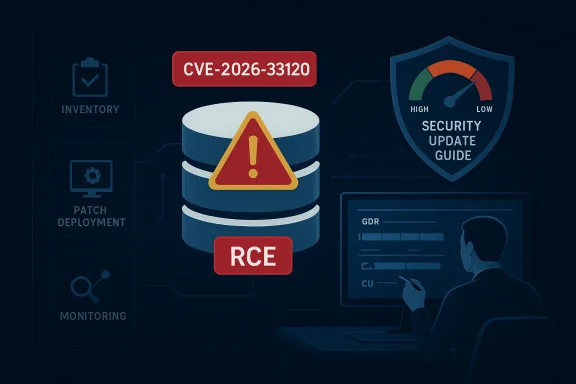
SQL Server remains one of Microsoft’s most operationally sensitive products because it sits underneath line-of-business applications, analytics platforms, and core enterprise workflows. A remote code execution issue in that stack is not a routine desktop concern; it is a potential foothold into databases, credentials, reporting systems, and adjacent application tiers. The public entry for CVE-2026-33120 is intentionally sparse, which is common when Microsoft wants to acknowledge a real issue without publishing enough detail to help attackers shortcut their own research.
That sparseness creates a familiar but uncomfortable security-management problem. When a vendor labels something Remote Code Execution, defenders know the impact class is high, but they still need to infer exposure from whatever context exists: service reachability, authentication assumptions, deployment topology, and whether the affected component is directly reachable over the network. Historically, Microsoft has used similarly concise language for SQL Server issues while later tying them to servicing guidance, vulnerability class, and build-specific updates. Security updates for SQL Server are usually linked to a CVE, and Microsoft explicitly notes that a security update in the SQL Server servicing model carries an associated CVE reference.
The confidence metric itself is a major signal. Microsoft’s Security Update Guide exists precisely to centralize that kind of information, giving the company room to publish CVE records, vulnerability tables, and update metadata in a machine-readable way. In practical terms, that means the advisory is part warning system, part disclosure mechanism, and part patch-routing map. The issue is not just “is there a bug?” but “how complete is the vendor’s understanding of the bug, and how much should administrators trust the public characterization?”
For SQL Server administrators, the consequence is immediate: even when technical details are scarce, a confirmed RCE-class record should be treated as a priority patching event. Microsoft’s own servicing guidance emphasizes that security updates must be matched to the exact SQL Server baseline, because not every GDR is a security update and not every CU path is interchangeable. That makes the operational response more complicated than simply clicking “install”; it requires version inventory, branch matching, and change control.
Why the confidence field matters
The confidence language is Microsoft’s way of saying how much of the story is known. A high-confidence record suggests the company believes the vulnerability exists, understands its general shape, and can stand behind the public classification. A lower-confidence record, by contrast, means the flaw may be real but the technical root cause is less fully pinned down. For defenders, that difference affects whether the page is treated as a strong signal or a provisional one.
Why SQL Server RCE is especially serious
SQL Server rarely lives in isolation. It often supports ERP platforms, reporting back ends, authentication workflows, BI tools, and custom applications that inherit database trust. If an attacker gains code execution in or around SQL Server, the blast radius can extend far beyond the database engine itself, especially in environments where service accounts are privileged and segmentation is weak.
Background
Microsoft has a long history of publishing SQL Server security fixes through its update ecosystem, and the servicing model matters as much as the vulnerability itself. Microsoft’s documentation explains that security fixes appear in GDRs and security updates that correspond to specific SQL Server branches, and administrators are expected to align the installed build with the proper remediation package. That structure is efficient for Microsoft, but it means defenders must know their exact version and servicing channel before they can patch correctly.
The company’s vulnerability disclosure process has also evolved. In recent years, Microsoft has expanded the Security Update Guide and added machine-readable CSAF publication to increase transparency and accelerate remediation. That shift signals a broader reality: the vendor is trying to give enterprise customers more structured data about vulnerabilities, but it is still balancing disclosure against the risk of helping adversaries. CVE records now often include just enough information to make remediation possible without spelling out exploit mechanics in full.
Historically, SQL Server vulnerabilities have ranged from elevation of privilege to code execution to injection-adjacent flaws, and Microsoft has often framed the severity in terms of how the software is typically deployed. The older bulletin language shows the same logic: severity is not just about code quality but about likely attack scenarios and deployment patterns. In other words, the same bug may be more or less dangerous depending on whether the database is internet-facing, internally segmented, or reachable only through application middle tiers.
That is why CVE-2026-33120 should be read as more than a standalone entry. It sits inside a broader pattern where Microsoft acknowledges a product-class weakness, attaches a confidence signal, and then expects enterprises to map the advisory back to their asset inventory. For teams that have already lived through Exchange, RDS, and SharePoint-style disclosure cycles, that pattern is familiar: sparse detail at first, then increasing operational urgency as patch windows narrow. The lesson is not that every advisory implies active exploitation. The lesson is that confirmed Microsoft infrastructure flaws tend to move quickly from theory to operational concern.
How Microsoft’s guidance has changed
The newer disclosure model is more structured than the old bulletin era. Instead of a static PDF-style bulletin alone, the Security Update Guide acts as a living record with CVE pages, metadata, and update associations. That makes the guidance better for automation, but it also means defenders are expected to be comfortable reading a more compact, data-heavy format.
What that means for administrators
Administrators should think in terms of inventory first, patch second. The key question is not whether SQL Server is present somewhere in the estate; it is which version, which CU or GDR branch, and which applications depend on it. That determines whether the fix can be applied quickly or requires staged validation.
What Microsoft Is Signaling
The core message in a confidence-bearing advisory is that Microsoft believes the vulnerability is real enough to publish, even if it is not yet telling the whole technical story. That is a subtle but important distinction. It means the company is confident enough to give defenders actionable guidance, but not necessarily ready to expose root-cause detail that could aid exploitation.
For a product like SQL Server, that usually translates into urgency. A remote code execution bug in a database engine can be chained with application-layer weaknesses, service account abuse, weak segmentation, or configuration drift. Even if the direct exploit path is narrow, the presence of code execution in a high-value infrastructure component tends to attract rapid attention from both defenders and attackers. Microsoft’s own history with SQL Server advisories shows that the company treats these issues as material because the impact can range from elevated privileges to full server compromise.
There is also a trust component. A higher-confidence record tells defenders that Microsoft has enough internal evidence to stand behind the classification. That matters because security teams often have to make decisions before all technical specifics are public. When the vendor signals certainty, patch prioritization becomes easier, even if exploit details remain limited. That does not mean every such issue is actively exploited, but it does mean teams should stop waiting for more information before they act.
Confidence versus exploitability
Confidence is not the same as exploitability. Microsoft may be highly confident a flaw exists while still knowing little about whether it is easy to weaponize or widely reachable. Conversely, a lower-confidence bug might still be dangerous if discovered in a widely deployed component. The metric is best understood as a vendor trust signal, not a full risk score.
Why sparse details are normal
Microsoft often publishes just enough to let enterprises patch and monitor without handing attackers a blueprint. That tradeoff is frustrating for researchers, but it is standard in coordinated disclosure. In practice, the absence of details should be treated as a reason to be cautious, not as a reason to wait.
- Treat confirmed RCE-class advisories as high-priority until proven otherwise.
- Assume limited public detail is deliberate, not accidental.
- Map the record to your exact SQL Server build before scheduling remediation.
- Watch for service-account exposure and lateral-movement paths.
- Do not confuse vendor confidence with immediate active exploitation.
Patch Mechanics and Servicing Reality
SQL Server patching has always been more complicated than patching client software. Microsoft documents that security fixes for SQL Server appear through GDRs and security updates tied to specific servicing baselines, while non-security GDRs can also exist. That means the remediation path for CVE-2026-33120 is not a generic “apply the latest update” instruction; it is a version-specific decision.
This is where many enterprise environments stumble. Large organizations often have a mix of standalone SQL Server instances, clustered deployments, reporting servers, and application-embedded databases. Those systems may not all be on the same branch, and some may have been intentionally held back because application compatibility was never fully validated. In other words, patch management is not hard because the update is inaccessible. It is hard because the environment is heterogeneous and the business logic above the database is brittle.
The risk is that a real RCE advisory can become a long-tail exposure if teams delay branch mapping. That delay is especially dangerous in SQL estates where service accounts have broad rights, linked servers exist, or the database engine sits close to identity systems and file shares. Once compromise occurs, database privilege often becomes environmental privilege.
GDRs, CUs, and why they matter
Microsoft’s SQL Server servicing guidance makes clear that the right update depends on the installed branch. A GDR may be security-related or non-security, and a CU path may be required for a particular version line. The patch decision is therefore a technical one, not just an administrative one.
What good patch discipline looks like
The best response is to identify the SQL Server build, confirm the servicing line, validate dependency impact, and deploy in a controlled window. That sounds routine, but for database platforms it is the difference between a manageable maintenance task and a production outage.
- Inventory every SQL Server instance and note the exact build.
- Map each instance to its supported servicing branch.
- Validate application compatibility before broad rollout.
- Prioritize internet-facing or externally reachable servers first.
- Confirm backups and rollback plans before applying updates.
- Recheck post-patch connectivity, jobs, and linked-server behavior.
Enterprise Exposure Versus Consumer Exposure
CVE-2026-33120 is fundamentally an enterprise problem. Most consumers do not administer SQL Server directly, and many never interact with it consciously at all. But consumers can still be affected indirectly through business services that rely on SQL Server on the back end, especially if those services are compromised or interrupted.
For enterprises, the exposure is more direct and more damaging. SQL Server often stores sensitive operational data, customer records, financial information, and application secrets. If an attacker gains code execution, they may not need to “break” the database in a traditional sense. They may simply use the server as a pivot point into the broader network. Microsoft’s older SQL Server advisory history shows that exploitability often depends on whether the attacker already has some level of access or can reach the service through adjacent compromise.
The consumer angle is still worth noting because modern services abstract infrastructure away from the user. If a SaaS vendor or internal business platform runs on affected SQL Server builds, end users may notice downtime, corruption, or account problems before they know anything about a CVE. That creates a gap between technical remediation and user experience, and it is why vulnerability response should include communications planning, not just patch deployment.
Internal versus external reachability
An externally reachable SQL Server instance is obviously the highest concern, but internal-only systems are not safe by default. Once an attacker gets a foothold anywhere in the network, database servers become attractive stepping stones because they often trust surrounding systems and carry meaningful credentials.
Why consumer impact is indirect but real
Even when consumers never see SQL Server itself, they rely on services that do. Payment systems, scheduling platforms, portals, and support systems often depend on database back ends. A server-side compromise can therefore surface as a consumer outage, a data exposure event, or a trust failure in the service layer.
- Enterprise risk is higher because SQL Server is core infrastructure.
- Consumer impact is usually indirect through dependent services.
- Shared hosting and application hosting can amplify blast radius.
- Credential reuse and service accounts can turn one flaw into many.
- Downtime can be as disruptive as direct data loss.
Historical Pattern and Competitive Implications
Microsoft’s handling of SQL Server vulnerabilities reflects a broader shift in the security market: vendors are expected to publish faster, say more with less, and provide data that can be consumed by automation. Microsoft’s update guide and CSAF work show that it is responding to that pressure. The upside is more structured information for defenders; the downside is that sparse disclosures can leave teams reading between the lines.
From a competitive standpoint, Microsoft is protecting more than SQL Server. It is defending the credibility of its enterprise platform story. If SQL Server advisories are clear, timely, and patchable, customers feel more comfortable continuing to standardize on Microsoft infrastructure. If they are confusing or delayed, rivals gain an argument about operational risk, cloud migration, and database modernization. That is why the confidence metric matters beyond the immediate CVE: it is part of Microsoft’s broader trust architecture.
There is also an important market signal in how Microsoft frames SQL Server updates. The servicing model assumes customers want predictable remediation paths, not ad hoc emergency replatforming. That makes Microsoft’s patch ecosystem competitive with open-source and cloud-native alternatives, which often market themselves as more transparent or more agile. In practice, though, every platform has tradeoffs. Microsoft’s advantage is integrated servicing; its challenge is making sure the pace of disclosure does not outrun customer comprehension.
Why transparency is now part of product strategy
Security disclosure is no longer just incident response. It is product positioning. Vendors use transparent, machine-readable guidance to show that they can support enterprise operations at scale. That is especially important in the database market, where trust and reliability carry commercial weight.
What rivals can point to
Competitors can argue that simpler patching, fewer version branches, or more cloud-managed update models reduce the burden on customers. Whether that is true in a given deployment is another question, but the argument itself is strengthened whenever a high-value product like SQL Server needs intricate branch matching.
Strengths and Opportunities
Microsoft’s handling of CVE-2026-33120 also shows several strengths. The company is using a structured vulnerability channel, pairing the CVE with a confidence signal and a servicing model that should make remediation possible once the correct build is identified. That is a meaningful improvement over older, vaguer disclosure practices, even if it does not eliminate urgency.
The opportunity for defenders is to turn this into better operational hygiene. SQL Server patching is already a mature discipline, and a high-confidence RCE entry is a good forcing function for better inventory, better segmentation, and better maintenance windows. Used well, the advisory becomes a catalyst for resilience rather than just another red ticket.
- Structured disclosure gives defenders a clearer signal than a one-line advisory.
- Version-specific servicing allows targeted remediation instead of guesswork.
- Confidence metadata helps prioritize urgent cases.
- Enterprise patch workflows can be tightened around database maintenance.
- Monitoring and segmentation can be improved while patching is staged.
- Security teams can use the advisory to justify backlog cleanup.
- Executives get a concrete example of why database patch governance matters.
Where organizations can improve fastest
The fastest gains usually come from asset inventory and ownership. Teams that know exactly which SQL Server builds they run can patch faster and with fewer surprises. Those that do not know often discover the problem only when a vulnerability like this appears.
Risks and Concerns
The biggest concern is that sparse public detail can lull teams into waiting for more context than they need. A confirmed RCE-class advisory on SQL Server is already enough to justify urgency, especially if the affected instance is exposed, privileged, or difficult to segment. Delays often happen not because the risk is unclear, but because the patching path is operationally inconvenient.
Another risk is that database teams may assume the blast radius is limited to the database engine itself. In reality, SQL Server often connects to applications, file systems, jobs, linked servers, and service identities that extend far beyond the database boundary. That means a single weakness can become a broader infrastructure event if the attacker gets a foothold and moves laterally.
There is also the issue of update friction. The GDR/CU model is sensible from an engineering standpoint, but it increases the chance of misapplied patches, incompatible baselines, or postponed maintenance windows. In a security emergency, complexity becomes a risk multiplier.
- Patch delay because teams wait for technical detail that may never arrive.
- Mis-scoped impact if administrators think only the database engine is affected.
- Lateral movement through service accounts and trusted integrations.
- Update complexity across GDR and CU branches.
- Legacy systems that cannot be patched as quickly as modern ones.
- Operational outages if updates are rushed without validation.
- Visibility gaps where unowned SQL Server instances remain forgotten.
Why legacy estates are vulnerable
Older SQL Server deployments are often the least visible and the hardest to update. They may support ancient applications, hidden business processes, or vendor packages that no one wants to disturb. Those are exactly the systems where a high-severity advisory can sit unaddressed the longest.
What to Watch Next
The next thing to watch is whether Microsoft expands the advisory with more concrete remediation or exploitability context. In many cases, the first disclosure is intentionally short, and later guidance fills in the operational gaps. If this CVE is serious enough to matter broadly, further detail may arrive through update revisions, servicing notes, or external security analysis.
It is also worth watching for correlation with patch-wave behavior. If security teams begin to treat this as a “patch now” item rather than a “patch this month” item, that will tell us the confidence signal is being read correctly. In the Windows and SQL ecosystem, the difference between those two responses often reflects whether administrators believe a bug is merely acknowledged or genuinely actionable.
Finally, defenders should watch asset exposure more than headlines. The practical question is not just whether CVE-2026-33120 exists. It is which SQL Server instances are reachable, which ones sit behind application tiers, and which ones have the privileges needed to turn code execution into real compromise. That is where the actual risk lives.
Key items to monitor
- Any Microsoft update guide revisions for CVE-2026-33120.
- New servicing notes or KB mappings for SQL Server builds.
- Signs of external scanning against exposed SQL Server instances.
- Evidence of post-compromise lateral movement in database-adjacent networks.
- Whether the advisory is later associated with active exploitation reporting.
Microsoft’s CVE-2026-33120 advisory should be read as a serious reminder that the hardest part of vulnerability response is often not the patch itself but the interpretation of the signal. A high-confidence SQL Server RCE record carries enough weight to demand immediate inventory, build mapping, and remediation planning even when the public details remain thin. If history is any guide, the organizations that move first will not be the ones with the most dramatic exploit theory; they will be the ones that already know exactly where their SQL Server instances live and how quickly they can be updated.