

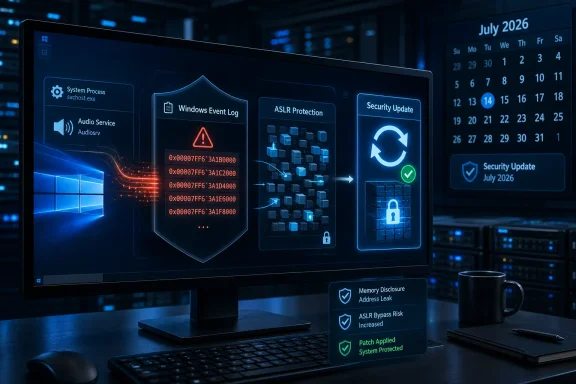
CVE-2026-34328 exposes Windows Event Log service memory addresses through the Windows Audio Service, giving a locally authenticated attacker information that could help defeat memory-protection defenses or support a larger exploit chain. Microsoft fixed the vulnerability in its July 14, 2026 security updates for supported Windows 10, Windows 11, Windows Server 2019, Windows Server 2022, and Windows Server 2025 systems.
Detailed in the Microsoft Security Response Center’s Security Update Guide, the flaw is rated Important with a CVSS 3.1 base score of 5.5. Microsoft says exploitation requires local access and low privileges, but no user interaction; the company assessed exploitation as less likely and reported no public disclosure or known exploitation when the advisory was published.
The practical response is straightforward: install the July 2026 cumulative update applicable to each affected Windows installation. There is no separate audio-service patch or configuration workaround that provides an equivalent fix.
Microsoft describes CVE-2026-34328 as an exposure of sensitive information to an unauthorized actor in the Windows Audio Service. A successful attacker can obtain memory addresses associated with the Windows Event Log service, rather than audio recordings, microphone data, passwords, or user documents.
That distinction matters. The vulnerability is not presented as a direct route to code execution, privilege elevation, or system disruption, and its CVSS vector records no integrity or availability impact. Its confidentiality impact is nevertheless rated high because disclosing process memory addresses can weaken assumptions made by exploit mitigations such as Address Space Layout Randomization.
ASLR makes exploitation harder by changing where executable code and other resources are placed in memory. If another vulnerability requires an attacker to know a useful address, an information leak can provide the missing piece. CVE-2026-34328 is therefore best understood as a potential exploit-chain component: limited on its own, but more useful when paired with a separate memory-corruption or privilege-escalation flaw.
The CVSS vector, CVSS:3.1/AV:L/AC:L/PR:L/UI:N/S:U/C:H/I:N/A:N, captures those boundaries. An attacker must already be able to run code or otherwise interact with the target locally under an authorized, low-privilege account. The attack does not need a user to open a file, play an audio stream, visit a website, or approve a prompt.
This also means the vulnerability is not remotely exploitable over the network under Microsoft’s published assessment. Organizations should not interpret the “Windows Audio Service” name as evidence that a malicious media file or voice call can trigger the issue from outside the machine.
The fixed build thresholds include:
Server Core installations of Windows Server 2019 and Windows Server 2025 are included in Microsoft’s affected configurations. The absence of a conventional desktop or visible audio controls does not establish that a server is safe; vulnerability exposure follows the installed Windows components and servicing baseline, not whether speakers are connected.
That is particularly relevant to administrators who remove or disable services as part of hardening. Microsoft has not published disabling Windows Audio as a workaround for CVE-2026-34328, and service state should not be treated as proof that the underlying vulnerable code has been remediated. Installing the cumulative security update remains the supported resolution.
This distinction is easy to lose when vulnerability feeds display “confirmed” next to exploitability data. Microsoft separately marked CVE-2026-34328 as not publicly disclosed and not exploited at the time of release. Its temporal score of 4.8 also reflects an official fix and the absence of established exploitation.
Those factors justify measured prioritization, not neglect. A local information leak with a 5.5 score normally sits behind actively exploited vulnerabilities, internet-facing remote-code-execution flaws, and security-feature bypasses. It should still be closed during the regular July update cycle because local footholds are common in ransomware and post-compromise activity, where attackers combine several modest weaknesses to increase access.
Shared Windows systems deserve closer attention. Remote Desktop Session Host servers, jump boxes, pooled virtual desktops, educational labs, and other multi-user environments give untrusted or lightly trusted accounts more opportunities to interact with local services. A vulnerability requiring low privileges has a different operational profile on those machines than on a locked-down single-user workstation.
Security teams should also resist building detections around ordinary Windows Audio or Event Log activity without further evidence. Microsoft’s public advisory does not provide indicators of compromise, exploit artifacts, or a documented event pattern specific to CVE-2026-34328. Broad alerts on normal service access are likely to generate noise rather than identify exploitation.
Administrators can verify the OS build with
Deployment teams must account for the broader contents of the July cumulative updates. Microsoft’s release notes document other security hardening and compatibility changes in the same packages, including enforcement affecting unregistered third-party TDI transports. Testing should therefore cover legacy networking software and business applications, but withholding the entire update indefinitely leaves CVE-2026-34328 and the month’s many other Windows vulnerabilities unresolved.
CVE-2026-34328 is not the headline emergency of July 2026 Patch Tuesday. It is a confirmed, locally exploitable information leak whose immediate damage is constrained, yet whose disclosure of Event Log service memory addresses could make another attack more reliable. Once affected machines reach the July 14 build levels—or a later cumulative baseline—the useful address leak is removed without administrators having to redesign audio or logging configurations.
Detailed in the Microsoft Security Response Center’s Security Update Guide, the flaw is rated Important with a CVSS 3.1 base score of 5.5. Microsoft says exploitation requires local access and low privileges, but no user interaction; the company assessed exploitation as less likely and reported no public disclosure or known exploitation when the advisory was published.
The practical response is straightforward: install the July 2026 cumulative update applicable to each affected Windows installation. There is no separate audio-service patch or configuration workaround that provides an equivalent fix.
 An Audio Flaw That Leaks Event Log Addresses
Microsoft describes CVE-2026-34328 as an exposure of sensitive information to an unauthorized actor in the Windows Audio Service. A successful attacker can obtain memory addresses associated with the Windows Event Log service, rather than audio recordings, microphone data, passwords, or user documents.That distinction matters. The vulnerability is not presented as a direct route to code execution, privilege elevation, or system disruption, and its CVSS vector records no integrity or availability impact. Its confidentiality impact is nevertheless rated high because disclosing process memory addresses can weaken assumptions made by exploit mitigations such as Address Space Layout Randomization.
ASLR makes exploitation harder by changing where executable code and other resources are placed in memory. If another vulnerability requires an attacker to know a useful address, an information leak can provide the missing piece. CVE-2026-34328 is therefore best understood as a potential exploit-chain component: limited on its own, but more useful when paired with a separate memory-corruption or privilege-escalation flaw.
The CVSS vector, CVSS:3.1/AV:L/AC:L/PR:L/UI:N/S:U/C:H/I:N/A:N, captures those boundaries. An attacker must already be able to run code or otherwise interact with the target locally under an authorized, low-privilege account. The attack does not need a user to open a file, play an audio stream, visit a website, or approve a prompt.
This also means the vulnerability is not remotely exploitable over the network under Microsoft’s published assessment. Organizations should not interpret the “Windows Audio Service” name as evidence that a malicious media file or voice call can trigger the issue from outside the machine.
The Affected Range Reaches Across Client and Server
Microsoft’s affected-product data spans several generations of Windows, including Long-Term Servicing Channel deployments that may remain in use on kiosks, industrial systems, virtual desktops, and application servers. Both x64 and ARM64 editions appear in parts of the client list, while Windows 10 also includes affected 32-bit configurations.The fixed build thresholds include:
- Windows 11 version 23H2 is protected at OS build 22631.7376, delivered through KB5099414.
- Windows 11 versions 24H2 and 25H2 are protected at builds 26100.8875 and 26200.8875 through KB5101650.
- Windows 11 version 26H1 receives the July security fixes through KB5101649.
- Windows 10 version 1809 and Windows Server 2019 are protected at build 17763.9020 through KB5099538.
- Windows Server 2022 is protected at build 20348.5386 through KB5099540.
- Windows Server 2025 is protected at build 26100.33158 through KB5099536.
Server Core installations of Windows Server 2019 and Windows Server 2025 are included in Microsoft’s affected configurations. The absence of a conventional desktop or visible audio controls does not establish that a server is safe; vulnerability exposure follows the installed Windows components and servicing baseline, not whether speakers are connected.
That is particularly relevant to administrators who remove or disable services as part of hardening. Microsoft has not published disabling Windows Audio as a workaround for CVE-2026-34328, and service state should not be treated as proof that the underlying vulnerable code has been remediated. Installing the cumulative security update remains the supported resolution.
“Confirmed” Describes Evidence, Not Active Attacks
The advisory’s report-confidence rating is Confirmed. In CVSS terminology, that means sufficiently credible technical evidence exists or Microsoft has confirmed the weakness; it does not mean attackers have confirmed exploitation in the wild.This distinction is easy to lose when vulnerability feeds display “confirmed” next to exploitability data. Microsoft separately marked CVE-2026-34328 as not publicly disclosed and not exploited at the time of release. Its temporal score of 4.8 also reflects an official fix and the absence of established exploitation.
Those factors justify measured prioritization, not neglect. A local information leak with a 5.5 score normally sits behind actively exploited vulnerabilities, internet-facing remote-code-execution flaws, and security-feature bypasses. It should still be closed during the regular July update cycle because local footholds are common in ransomware and post-compromise activity, where attackers combine several modest weaknesses to increase access.
Shared Windows systems deserve closer attention. Remote Desktop Session Host servers, jump boxes, pooled virtual desktops, educational labs, and other multi-user environments give untrusted or lightly trusted accounts more opportunities to interact with local services. A vulnerability requiring low privileges has a different operational profile on those machines than on a locked-down single-user workstation.
Security teams should also resist building detections around ordinary Windows Audio or Event Log activity without further evidence. Microsoft’s public advisory does not provide indicators of compromise, exploit artifacts, or a documented event pattern specific to CVE-2026-34328. Broad alerts on normal service access are likely to generate noise rather than identify exploitation.
Patch Verification Matters More Than Service Workarounds
For centrally managed estates, the useful compliance test is whether the machine has installed the July 14 cumulative update or a later superseding update. Microsoft’s monthly packages are cumulative, so subsequent supported Windows updates should also contain the correction.Administrators can verify the OS build with
winver, Get-ComputerInfo, inventory tooling, Microsoft Intune, Configuration Manager, Windows Server Update Services, or their existing vulnerability-management platform. Scanners should be checked carefully where they infer exposure from version names alone, especially on Windows Server Core and Windows 10 ESU devices.Deployment teams must account for the broader contents of the July cumulative updates. Microsoft’s release notes document other security hardening and compatibility changes in the same packages, including enforcement affecting unregistered third-party TDI transports. Testing should therefore cover legacy networking software and business applications, but withholding the entire update indefinitely leaves CVE-2026-34328 and the month’s many other Windows vulnerabilities unresolved.
CVE-2026-34328 is not the headline emergency of July 2026 Patch Tuesday. It is a confirmed, locally exploitable information leak whose immediate damage is constrained, yet whose disclosure of Event Log service memory addresses could make another attack more reliable. Once affected machines reach the July 14 build levels—or a later cumulative baseline—the useful address leak is removed without administrators having to redesign audio or logging configurations.
References
- Primary source: MSRC
Published: 2026-07-14T07:00:00-07:00
Security Update Guide - Microsoft Security Response Center
 msrc.microsoft.com
