

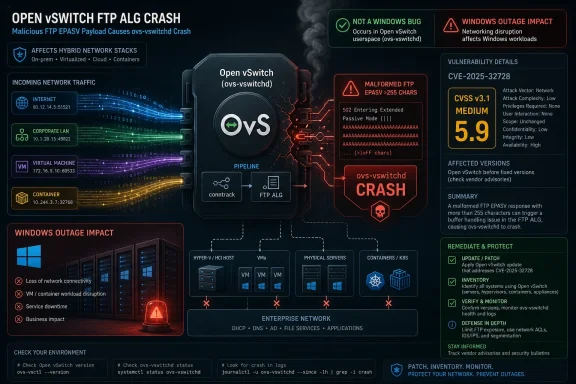
CVE-2026-34956 is a remote denial-of-service vulnerability in Open vSwitch, disclosed in spring 2026, that can crash affected userspace conntrack deployments when a malformed FTP EPASV command longer than 255 characters is processed by the FTP helper. The uncomfortable part is not that FTP has once again wandered into a security advisory; it is that a legacy protocol parser can still sit close enough to virtual network plumbing to interrupt modern workloads. Microsoft’s Security Update Guide entry gives Windows administrators a reason to care, even though the bug lives in Open vSwitch rather than in the Windows kernel. In mixed estates, cloud fabrics, lab clusters, and container platforms, “not a Windows bug” has never meant “not a Windows outage.”
The advisory lands with a CVSS 3.1 score of 5.9, which reads like a middle drawer item in the exhausting bureaucracy of vulnerability management. That number is not meaningless: exploitation requires a particular Open vSwitch configuration, specifically userspace connection tracking with FTP application-layer gateway handling. It is not a universal internet panic button.
But availability bugs have a way of embarrassing tidy severity labels. Confidentiality and integrity remain untouched in the published scoring, yet a crashed virtual switch can be the difference between a clean dashboard and a rack of unreachable virtual machines. For many administrators, the most expensive security event is not theft but downtime.
That is why the Microsoft angle matters. The company’s update guide tracks the vulnerability for customers who build, run, or depend on environments where Open vSwitch is part of the substrate. The advisory is a reminder that enterprise Windows reliability is now tied to a stack that often includes Linux networking components, hypervisor plumbing, Kubernetes overlays, and open-source packet processing code.
The risk is narrow, but the blast radius can be broad where the condition exists. A malformed FTP control stream is not glamorous, but neither is a bridge process falling over while workloads wait for packets that never arrive.
CVE-2026-34956 affects the userspace implementation of connection tracking when FTP helper logic is explicitly configured. The FTP helper exists because FTP is not a simple single-stream protocol. Its control channel negotiates data connections, and network devices that track state sometimes inspect those commands to permit related traffic.
That is precisely the old bargain that this vulnerability exposes. To make an awkward protocol work through stateful middleboxes, the network stack agrees to parse application-layer messages. Once a switch process becomes an application parser, it inherits a class of bugs that should feel familiar to anyone who has read decades of advisories about length fields, buffers, narrowing conversions, and malformed commands.
In this case, the malformed input is an EPASV command exceeding 255 characters. EPASV, or extended passive mode, is part of FTP’s vocabulary for negotiating connections. The vulnerability description points to a heap access error, and the Open vSwitch advisory discusses invalid memory access in the conntrack FTP ALG path.
The practical effect is blunt: under the right configuration, a remote attacker can send crafted FTP traffic that crashes the affected component. There is no requirement for authentication in the published vector. The high attack complexity reflects the environmental preconditions, not the harmlessness of the outcome.
That persistence matters because network devices often contain special-case logic for protocols that refuse to behave like clean client-server traffic. FTP is the canonical example. It has a control channel and a data channel, and passive-mode negotiation means middleboxes may need to understand the application conversation to keep stateful forwarding working.
Every time infrastructure parses more than it strictly needs to forward packets, it accepts a new attack surface. The vulnerability is not merely “FTP is old.” It is that the accommodation layer built around FTP can become the weak point, even when the FTP server itself is not the primary target.
For Windows-focused shops, this is the trap. An administrator may have no FTP server on a Windows host and still have virtual network infrastructure that inspects FTP-like traffic. The vulnerable code may be in a Linux-based appliance, a virtualization host, a network function, or a platform component several abstraction layers below the server owner’s daily view.
That makes asset discovery harder than patching. The question is not only whether a business still uses FTP. It is whether any bridge or flow table in the estate has been configured to help FTP work.
It also creates a subtler operational problem. The people responsible for vulnerability response may not be the people who wrote or inherited those flow rules. In a mature SDN environment, OpenFlow entries may be generated by controllers, orchestration systems, older deployment templates, or vendor integrations. A security team reading “only if FTP ALG is configured” still has to prove the negative.
The most useful immediate check is to inspect bridge flow rules for FTP ALG usage. Administrators can look for flows that include
This is why many vulnerability programs struggle with “conditional” flaws. Conditional does not mean irrelevant; it means the risk depends on configuration state. And configuration state is often the least reliable inventory field in the company.
There is also an uncomfortable incentive problem. Teams that know they do not use FTP helpers may deprioritize the advisory, while teams that are not sure may assume someone else would know. CVE-2026-34956 rewards the organizations that can answer boring infrastructure questions quickly.
But the boundary between Windows and everything around Windows has dissolved. Windows Server workloads run on virtualized fabrics. Azure Stack-style deployments, hybrid platforms, container hosts, network appliances, and third-party virtualization products may place Windows systems behind or atop open-source network components. An outage in that layer is still experienced by users as “the Windows server is down.”
This is the modern patch problem: the operating system is no longer the perimeter of responsibility. A Windows administrator may need to understand Linux datapaths, switch daemons, hypervisor networking, and container network interface behavior well enough to know when someone else’s CVE affects their service-level agreement.
The MSRC entry is therefore less a declaration of ownership than a signal of relevance. It says this vulnerability belongs in the same operational conversation as the rest of the month’s security work. That is especially true for organizations with Microsoft-heavy estates but open-source-heavy infrastructure beneath them.
In practice, Windows teams should not wait for a Windows patch if Open vSwitch is managed elsewhere. They should ask platform owners whether affected OVS versions and FTP ALG flows exist, whether packages have been updated, and whether compensating controls have been applied where patching is delayed.
The direct fix is to apply vendor updates or move to a known patched OVS build. For Linux distributions and platform vendors, the exact package version may not map cleanly to upstream numbering because patches are often backported. Administrators should therefore treat distro advisories and vendor errata as authoritative for their installed packages.
There is a mitigation: avoid using the FTP ALG. But the project itself cautions that attempting to mitigate that way may affect packet forwarding. That warning should be taken seriously. Removing an application-layer helper without understanding why it was configured can replace a security outage with a self-inflicted network outage.
For most organizations, the better sequence is clear. First, identify whether affected OVS versions are present. Second, determine whether userspace conntrack with FTP ALG flows is actually configured. Third, patch where exposed. Fourth, retire FTP helper usage where it is no longer necessary, but only after confirming operational dependencies.
That last step is where security becomes engineering rather than ticket closure. If a helper was added years ago for a legacy workload, the right answer may be to remove both the helper and the legacy FTP dependency. If it is still required for a business process, the answer may be a patched version plus monitoring for malformed traffic.
The bigger lesson is that protocol helpers are privileged parsers. They sit in the traffic path, consume attacker-controlled input, and make forwarding decisions for other systems. When they fail closed by crashing the switch process, everything depending on that path can fail with them.
This is not unique to Open vSwitch, and it is not an indictment of OVS as a project. It is a recurring pattern in network infrastructure. Firewalls, load balancers, intrusion prevention systems, NAT gateways, proxies, and virtual switches all become more complicated as they inspect deeper into traffic. Complexity is where reliability and security start negotiating with each other.
The industry has spent years pushing intelligence into the network. That gave administrators visibility, policy control, microsegmentation, and automation. It also created dense layers of parsing logic that are difficult to inventory and harder to reason about under malformed input.
CVE-2026-34956 is a modest advisory by score, but a useful case study by architecture. It asks whether the network fabric should still be helping FTP in 2026, and whether anyone knows where that help is enabled.
That creates a familiar organizational problem. The service owner sees the outage. The Windows administrator gets the ticket. The platform team owns the virtual switch. The security team owns the CVE. The vendor may own the appliance image. The fix crosses all those lines.
Good incident preparation means deciding now who can inspect OVS flows and who can restart or patch affected services. A denial-of-service bug is not only about prevention; it is about mean time to recovery. If
Monitoring should also look beyond traditional exploit signatures. Unexpected restarts of OVS processes, core dumps tied to conntrack FTP code paths, sudden loss of connectivity for workloads behind a specific bridge, and anomalously long FTP EPASV strings are all more actionable than a generic “CVE detected” flag.
The goal is not to turn every administrator into a packet archaeologist. It is to ensure that when availability disappears, the team can quickly distinguish a bad host, a bad workload, a bad underlay, and a vulnerable datapath parser being fed malformed traffic.
The right question for Windows administrators is not “Do I run Open vSwitch on my domain controllers?” Almost certainly not. The right question is “Can any service my Windows workloads depend on be disrupted by an affected OVS datapath?” That includes virtual desktop infrastructure, internal application clusters, test environments, and cloud-adjacent platforms.
There is also a documentation lesson. Network exceptions and protocol helpers should have owners, expiration dates, and business justifications. If an FTP helper exists because a vendor once required it in 2018, it should not survive indefinitely as an unowned line in a flow template.
CVE-2026-34956 gives administrators a concrete reason to audit those assumptions. It is easier to remove a legacy helper during a planned review than during an outage, when every change looks like both a fix and a new risk.
The vulnerability also belongs in tabletop exercises. Ask what happens if a virtual switch process crashes on a host carrying critical Windows workloads. Ask which alerts fire, which team is paged, which logs survive, and whether the recovery playbook assumes a hardware switch when the failing component is software.
The published vector gives this flaw network attackability, no privileges required, no user interaction, unchanged scope, and high availability impact. The high attack complexity is doing a lot of work in the final score. That complexity is real, because the vulnerable path requires specific OVS configuration.
But defenders should translate that into their own environment. If no affected configuration exists, the practical risk may be low. If a multi-tenant platform uses the vulnerable helper in a traffic path shared by important workloads, the business risk rises quickly.
The phrase “denial of service” can also flatten nuance. This is not a bandwidth flood where mitigation lives at the edge. It is a crafted-input failure in a component that may sit inside the trusted fabric. Traditional DDoS controls may not help if the malicious stream reaches the parser that crashes.
That distinction should shape response. Blocking or monitoring malformed FTP control traffic may be useful, but the durable fix is patched code or removal of the vulnerable helper path. Network-layer filtering is a seatbelt, not a recall repair.
Security teams should begin with their exposure management platform, but they should not stop at package detection. A scanner that says Open vSwitch is installed cannot always tell whether
Platform teams should review controller templates and automation, not just current bridge state. A vulnerable flow removed manually today can reappear tomorrow if an orchestration system believes it belongs there. Configuration drift works both ways: fixes drift away as easily as bugs drift in.
Developers and application owners should be pulled into the conversation when FTP dependencies surface. If a business process still requires FTP traversal through a stateful helper, the organization should decide whether that is acceptable in 2026. Sometimes the cheapest security control is finally retiring the thing everyone assumed had already died.
For incident responders, the key is readiness. A crash tied to this vulnerability may present as a networking problem long before it presents as a security alert. The faster teams can connect process restarts, flow configuration, and suspicious FTP traffic, the less time they will spend rebooting the wrong servers.
 A Medium Score Can Still Knock the Network Sideways
The advisory lands with a CVSS 3.1 score of 5.9, which reads like a middle drawer item in the exhausting bureaucracy of vulnerability management. That number is not meaningless: exploitation requires a particular Open vSwitch configuration, specifically userspace connection tracking with FTP application-layer gateway handling. It is not a universal internet panic button.But availability bugs have a way of embarrassing tidy severity labels. Confidentiality and integrity remain untouched in the published scoring, yet a crashed virtual switch can be the difference between a clean dashboard and a rack of unreachable virtual machines. For many administrators, the most expensive security event is not theft but downtime.
That is why the Microsoft angle matters. The company’s update guide tracks the vulnerability for customers who build, run, or depend on environments where Open vSwitch is part of the substrate. The advisory is a reminder that enterprise Windows reliability is now tied to a stack that often includes Linux networking components, hypervisor plumbing, Kubernetes overlays, and open-source packet processing code.
The risk is narrow, but the blast radius can be broad where the condition exists. A malformed FTP control stream is not glamorous, but neither is a bridge process falling over while workloads wait for packets that never arrive.
The Bug Hides in the Place Administrators Forget to Inventory
Open vSwitch is one of those technologies that many organizations rely on without thinking about it every day. It is a programmable virtual switch used in virtualization, cloud networking, software-defined networking, and container-adjacent infrastructure. If the physical network is the road system, OVS is often the complicated interchange underneath the platform’s more polished management plane.CVE-2026-34956 affects the userspace implementation of connection tracking when FTP helper logic is explicitly configured. The FTP helper exists because FTP is not a simple single-stream protocol. Its control channel negotiates data connections, and network devices that track state sometimes inspect those commands to permit related traffic.
That is precisely the old bargain that this vulnerability exposes. To make an awkward protocol work through stateful middleboxes, the network stack agrees to parse application-layer messages. Once a switch process becomes an application parser, it inherits a class of bugs that should feel familiar to anyone who has read decades of advisories about length fields, buffers, narrowing conversions, and malformed commands.
In this case, the malformed input is an EPASV command exceeding 255 characters. EPASV, or extended passive mode, is part of FTP’s vocabulary for negotiating connections. The vulnerability description points to a heap access error, and the Open vSwitch advisory discusses invalid memory access in the conntrack FTP ALG path.
The practical effect is blunt: under the right configuration, a remote attacker can send crafted FTP traffic that crashes the affected component. There is no requirement for authentication in the published vector. The high attack complexity reflects the environmental preconditions, not the harmlessness of the outcome.
FTP Is the Fossil That Still Has Teeth
FTP has been deprecated in spirit for years. Browsers dropped visible support, security teams discourage plaintext file transfers, and modern operations teams reach for SFTP, HTTPS, object storage, or managed transfer appliances. Yet FTP remains installed in industrial systems, vendor update channels, lab environments, old automation scripts, and the less fashionable corners of enterprise infrastructure.That persistence matters because network devices often contain special-case logic for protocols that refuse to behave like clean client-server traffic. FTP is the canonical example. It has a control channel and a data channel, and passive-mode negotiation means middleboxes may need to understand the application conversation to keep stateful forwarding working.
Every time infrastructure parses more than it strictly needs to forward packets, it accepts a new attack surface. The vulnerability is not merely “FTP is old.” It is that the accommodation layer built around FTP can become the weak point, even when the FTP server itself is not the primary target.
For Windows-focused shops, this is the trap. An administrator may have no FTP server on a Windows host and still have virtual network infrastructure that inspects FTP-like traffic. The vulnerable code may be in a Linux-based appliance, a virtualization host, a network function, or a platform component several abstraction layers below the server owner’s daily view.
That makes asset discovery harder than patching. The question is not only whether a business still uses FTP. It is whether any bridge or flow table in the estate has been configured to help FTP work.
The Configuration Gate Is Real, but It Is Not a Comfort Blanket
The Open vSwitch project’s advisory makes an important distinction: userspace ALG handlers are not automatically installed. They must be added as part of OpenFlow rules, such as flows that invoke connection tracking withalg=ftp. That fact keeps this from becoming a universal OVS emergency.It also creates a subtler operational problem. The people responsible for vulnerability response may not be the people who wrote or inherited those flow rules. In a mature SDN environment, OpenFlow entries may be generated by controllers, orchestration systems, older deployment templates, or vendor integrations. A security team reading “only if FTP ALG is configured” still has to prove the negative.
The most useful immediate check is to inspect bridge flow rules for FTP ALG usage. Administrators can look for flows that include
alg=ftp, but that simple search may need to be repeated across hosts, bridges, controller-managed environments, and golden images. It is a five-minute command in a lab and a week of coordination in a production estate.This is why many vulnerability programs struggle with “conditional” flaws. Conditional does not mean irrelevant; it means the risk depends on configuration state. And configuration state is often the least reliable inventory field in the company.
There is also an uncomfortable incentive problem. Teams that know they do not use FTP helpers may deprioritize the advisory, while teams that are not sure may assume someone else would know. CVE-2026-34956 rewards the organizations that can answer boring infrastructure questions quickly.
Microsoft’s Listing Is a Map of the Modern Dependency Problem
Microsoft publishing or tracking an advisory for a vulnerability in Open vSwitch can look odd at first glance. Open vSwitch is an open-source networking project with deep roots in Linux virtualization and cloud infrastructure. It is not a Windows desktop feature waiting for a cumulative update.But the boundary between Windows and everything around Windows has dissolved. Windows Server workloads run on virtualized fabrics. Azure Stack-style deployments, hybrid platforms, container hosts, network appliances, and third-party virtualization products may place Windows systems behind or atop open-source network components. An outage in that layer is still experienced by users as “the Windows server is down.”
This is the modern patch problem: the operating system is no longer the perimeter of responsibility. A Windows administrator may need to understand Linux datapaths, switch daemons, hypervisor networking, and container network interface behavior well enough to know when someone else’s CVE affects their service-level agreement.
The MSRC entry is therefore less a declaration of ownership than a signal of relevance. It says this vulnerability belongs in the same operational conversation as the rest of the month’s security work. That is especially true for organizations with Microsoft-heavy estates but open-source-heavy infrastructure beneath them.
In practice, Windows teams should not wait for a Windows patch if Open vSwitch is managed elsewhere. They should ask platform owners whether affected OVS versions and FTP ALG flows exist, whether packages have been updated, and whether compensating controls have been applied where patching is delayed.
The Patch Story Is Straightforward, Which Means the Inventory Story Is Everything
The Open vSwitch advisory identifies patched versions in the maintained branches: 3.3.9, 3.4.6, 3.5.4, 3.6.3, and 3.7.1. It also says the vulnerable condition dates back to userspace conntrack support for the FTP handler, introduced with Open vSwitch 2.8.0. That is a long tail.The direct fix is to apply vendor updates or move to a known patched OVS build. For Linux distributions and platform vendors, the exact package version may not map cleanly to upstream numbering because patches are often backported. Administrators should therefore treat distro advisories and vendor errata as authoritative for their installed packages.
There is a mitigation: avoid using the FTP ALG. But the project itself cautions that attempting to mitigate that way may affect packet forwarding. That warning should be taken seriously. Removing an application-layer helper without understanding why it was configured can replace a security outage with a self-inflicted network outage.
For most organizations, the better sequence is clear. First, identify whether affected OVS versions are present. Second, determine whether userspace conntrack with FTP ALG flows is actually configured. Third, patch where exposed. Fourth, retire FTP helper usage where it is no longer necessary, but only after confirming operational dependencies.
That last step is where security becomes engineering rather than ticket closure. If a helper was added years ago for a legacy workload, the right answer may be to remove both the helper and the legacy FTP dependency. If it is still required for a business process, the answer may be a patched version plus monitoring for malformed traffic.
The Crash Is the Symptom; Parser Privilege Is the Disease
Security advisories often focus on the trigger because triggers are concrete. Here, the trigger is a malformed FTP EPASV command longer than 255 characters. That is useful for detection and testing, but it is not the bigger lesson.The bigger lesson is that protocol helpers are privileged parsers. They sit in the traffic path, consume attacker-controlled input, and make forwarding decisions for other systems. When they fail closed by crashing the switch process, everything depending on that path can fail with them.
This is not unique to Open vSwitch, and it is not an indictment of OVS as a project. It is a recurring pattern in network infrastructure. Firewalls, load balancers, intrusion prevention systems, NAT gateways, proxies, and virtual switches all become more complicated as they inspect deeper into traffic. Complexity is where reliability and security start negotiating with each other.
The industry has spent years pushing intelligence into the network. That gave administrators visibility, policy control, microsegmentation, and automation. It also created dense layers of parsing logic that are difficult to inventory and harder to reason about under malformed input.
CVE-2026-34956 is a modest advisory by score, but a useful case study by architecture. It asks whether the network fabric should still be helping FTP in 2026, and whether anyone knows where that help is enabled.
Cloud and Virtualization Teams Own the First Response
The first responders for this vulnerability are not necessarily desktop administrators or even Windows Server owners. They are the teams that manage virtualization hosts, private cloud fabrics, network virtualization stacks, Kubernetes networking, NFV platforms, and Linux-based appliances. They are the people who can answer whether OVS is in use and how flows are programmed.That creates a familiar organizational problem. The service owner sees the outage. The Windows administrator gets the ticket. The platform team owns the virtual switch. The security team owns the CVE. The vendor may own the appliance image. The fix crosses all those lines.
Good incident preparation means deciding now who can inspect OVS flows and who can restart or patch affected services. A denial-of-service bug is not only about prevention; it is about mean time to recovery. If
ovs-vswitchd crashes repeatedly under crafted traffic, operators need to know what restarts, what fails over, and what customer traffic is interrupted.Monitoring should also look beyond traditional exploit signatures. Unexpected restarts of OVS processes, core dumps tied to conntrack FTP code paths, sudden loss of connectivity for workloads behind a specific bridge, and anomalously long FTP EPASV strings are all more actionable than a generic “CVE detected” flag.
The goal is not to turn every administrator into a packet archaeologist. It is to ensure that when availability disappears, the team can quickly distinguish a bad host, a bad workload, a bad underlay, and a vulnerable datapath parser being fed malformed traffic.
Windows Shops Should Treat This as a Hybrid Infrastructure Drill
For a WindowsForum audience, the most important move is to resist the instinct to classify this as someone else’s Linux problem. Many Windows environments now depend on Linux-based networking even when every visible workload is Microsoft-centric. Hyperconverged appliances, backup networks, lab clouds, developer platforms, and security sandboxes often hide heterogeneous plumbing.The right question for Windows administrators is not “Do I run Open vSwitch on my domain controllers?” Almost certainly not. The right question is “Can any service my Windows workloads depend on be disrupted by an affected OVS datapath?” That includes virtual desktop infrastructure, internal application clusters, test environments, and cloud-adjacent platforms.
There is also a documentation lesson. Network exceptions and protocol helpers should have owners, expiration dates, and business justifications. If an FTP helper exists because a vendor once required it in 2018, it should not survive indefinitely as an unowned line in a flow template.
CVE-2026-34956 gives administrators a concrete reason to audit those assumptions. It is easier to remove a legacy helper during a planned review than during an outage, when every change looks like both a fix and a new risk.
The vulnerability also belongs in tabletop exercises. Ask what happens if a virtual switch process crashes on a host carrying critical Windows workloads. Ask which alerts fire, which team is paged, which logs survive, and whether the recovery playbook assumes a hardware switch when the failing component is software.
The Severity Number Understates the Operational Stakes
CVSS is good at describing exploit mechanics and technical impact, but it is less good at describing business topology. A medium vulnerability in a central forwarding component can matter more than a high vulnerability in a forgotten lab service. Availability is contextual.The published vector gives this flaw network attackability, no privileges required, no user interaction, unchanged scope, and high availability impact. The high attack complexity is doing a lot of work in the final score. That complexity is real, because the vulnerable path requires specific OVS configuration.
But defenders should translate that into their own environment. If no affected configuration exists, the practical risk may be low. If a multi-tenant platform uses the vulnerable helper in a traffic path shared by important workloads, the business risk rises quickly.
The phrase “denial of service” can also flatten nuance. This is not a bandwidth flood where mitigation lives at the edge. It is a crafted-input failure in a component that may sit inside the trusted fabric. Traditional DDoS controls may not help if the malicious stream reaches the parser that crashes.
That distinction should shape response. Blocking or monitoring malformed FTP control traffic may be useful, but the durable fix is patched code or removal of the vulnerable helper path. Network-layer filtering is a seatbelt, not a recall repair.
The Sensible Response Is Boring, Which Is Why It Will Work
There is no need to dramatize CVE-2026-34956 into a universal crisis. There is also no virtue in ignoring it because it lacks remote code execution in the formal scoring. The sensible response is the unfashionable one: inventory, confirm configuration, patch, monitor, and clean up legacy protocol accommodations.Security teams should begin with their exposure management platform, but they should not stop at package detection. A scanner that says Open vSwitch is installed cannot always tell whether
ct(alg=ftp) is present in a live flow table. Conversely, a vendor package may be backported and safe even if its upstream-looking version number appears old.Platform teams should review controller templates and automation, not just current bridge state. A vulnerable flow removed manually today can reappear tomorrow if an orchestration system believes it belongs there. Configuration drift works both ways: fixes drift away as easily as bugs drift in.
Developers and application owners should be pulled into the conversation when FTP dependencies surface. If a business process still requires FTP traversal through a stateful helper, the organization should decide whether that is acceptable in 2026. Sometimes the cheapest security control is finally retiring the thing everyone assumed had already died.
For incident responders, the key is readiness. A crash tied to this vulnerability may present as a networking problem long before it presents as a security alert. The faster teams can connect process restarts, flow configuration, and suspicious FTP traffic, the less time they will spend rebooting the wrong servers.
The 255-Character FTP String Is a Small Clue With a Large Operational Shadow
The concrete lessons from this advisory are narrow enough to act on and broad enough to matter beyond this one CVE. The bug is about Open vSwitch, but the response pattern applies to every hidden protocol helper in a modern infrastructure stack.- Organizations should check whether Open vSwitch is present in virtualization, private cloud, container, lab, and network appliance environments that support Windows workloads.
- Administrators should inspect OpenFlow rules for FTP ALG usage, especially flows that invoke connection tracking with
alg=ftp. - Exposed systems should be updated to vendor-patched Open vSwitch packages or upstream fixed releases where appropriate.
- Teams should avoid removing FTP helper flows blindly, because disabling them can change packet forwarding behavior for workloads that still depend on them.
- Monitoring should include unexpected OVS process crashes, core dumps, repeated service restarts, and abnormal FTP control-channel strings.
- Legacy FTP dependencies should be treated as technical debt with an owner, a documented purpose, and a retirement plan.
References
- Primary source: MSRC
Published: 2026-05-20T01:39:54-07:00
Security Update Guide - Microsoft Security Response Center
 msrc.microsoft.com
- Related coverage: sentinelone.com
CVE-2026-34956: Open vSwitch FTP Helper DoS Vulnerability
CVE-2026-34956 is a denial of service vulnerability in Open vSwitch. Learn about its impact, affected versions, and mitigation methods.www.sentinelone.com
- Related coverage: app.opencve.io
Openvswitch CVEs and Security Vulnerabilities - OpenCVE
Explore the latest vulnerabilities and security issues of Openvswitch in the CVE databaseapp.opencve.io
