

Microsoft updated its Security Update Guide on June 4, 2026 for CVE-2026-35414, a Moderate OpenSSH flaw affecting versions before 10.3 and Microsoft’s Azure Linux 3.0 OpenSSH package, where certificate principal parsing can go wrong when comma characters meet authorized_keys principal restrictions. The bug is not another “SSH is broken” headline; it is a reminder that mature authentication systems still depend on tiny parsing assumptions. For WindowsForum readers, the practical story is less about panic and more about knowing whether your estate uses SSH certificates in the particular way this bug requires.
The uncomfortable part is that this is exactly the sort of vulnerability modern infrastructure teams are supposed to have designed their way into. SSH certificates, trusted user CAs, and principal mapping are the scalable alternative to sprawling key files and forgotten public keys. CVE-2026-35414 does not invalidate that model, but it does expose how brittle the boundary can become when authorization policy is expressed as text and then split by punctuation.
OpenSSH’s certificate model separates the fact that a key is trusted from the question of what identity that key may assume. A user certificate can carry one or more principals, and the server can decide whether those principals are acceptable for a given local account. That design is powerful because it lets an organization centralize issuance while still enforcing local authorization rules.
CVE-2026-35414 concerns the
The short version is that OpenSSH before 10.3 could mishandle a principal name containing a comma when comparing it against a comma-separated list. If the certificate authority issued a certificate with a principal such as a compound string containing a comma, vulnerable matching logic could interpret part of that string as a separate principal. In the wrong environment, that turns a carefully scoped certificate into one that may match an identity the issuer did not intend to grant.
That is why Microsoft’s entry describes “uncommon scenarios” and a CA that makes “certain use of comma characters.” The wording matters. This is not a drive-by remote exploit where any Internet-facing SSH daemon instantly yields a shell; it is a flaw in the policy interpretation layer of a specific certificate-based configuration.
But CVSS has always been a poor substitute for asset knowledge. A Moderate SSH authentication flaw on a lab host is routine patch debt; the same flaw on a bastion architecture using SSH certificates for production administration deserves faster attention. The score reflects exploit preconditions, not the value of the account that might be reachable if those preconditions line up.
The “high attack complexity” rating is doing a lot of work here. Microsoft’s description says successful exploitation depends on conditions beyond the attacker’s control and may require preparation, environmental knowledge, or other setup. In plain terms, an attacker probably needs to understand how the target’s SSH certificate authority issues principals, how the target server restricts them, and whether comma-bearing principal names exist or can be obtained.
That does not make the bug irrelevant. It makes it selective. The organizations most exposed are likely the ones mature enough to use SSH certificates and precise principal restrictions, which is an irony familiar to anyone who has watched enterprise security controls become their own attack surface.
That distinction is important for administrators who live in vendor-packaged reality rather than upstream version arithmetic. A distribution does not always jump to the newest OpenSSH release to fix a CVE; it may backport the patch into an older versioned package. In Azure Linux 3.0, the relevant action is therefore not “make the banner say 10.3,” but “install the package build Microsoft marks as fixed.”
For Windows administrators, the exposure path is more indirect but still real. Windows Server and Windows client systems can run Microsoft’s OpenSSH components, but this particular MSRC entry, as updated, calls out Azure Linux 3.0 rather than a Windows OpenSSH servicing vehicle. Mixed estates are where this becomes easy to miss: the vulnerable systems may be Linux hosts managed by Windows teams, Azure images maintained through cloud pipelines, or appliances whose SSH stack is inherited from a vendor base image.
The operational lesson is to inventory by behavior as well as by package. If you run SSH certificate authentication, audit where trusted user CAs are configured, where
The bug’s premise is almost embarrassingly small. A comma inside a principal name should remain part of the name. A comma between principal names should separate entries in a list. If the comparison logic blurs those two meanings, an authorization boundary becomes ambiguous.
That ambiguity is especially dangerous in identity systems because administrators often read policy the way humans read language. A person sees a principal string and understands the intent from context. Software sees delimiters, tokenization rules, and comparison functions; if those functions were borrowed from a different part of the codebase where commas always meant “next item,” the human intent may not survive execution.
This is why the fix matters even for teams that are not exposed today. Enterprise access control is increasingly a stack of small translations: cloud identity to certificate issuance, certificate principal to server account, server account to sudo role, and audit event back to identity provider. A parsing mistake at any layer can turn a well-designed chain into a set of assumptions nobody actually verified.
CVE-2026-35414 does not argue against SSH certificates. If anything, it argues for using them with the same rigor applied to TLS certificate issuance or Kerberos realm design. The certificate authority is not just a signing box; it is an authorization policy engine whose output must be predictable, constrained, and hostile to ambiguity.
The risky pattern is allowing arbitrary or loosely validated principal names to flow from identity systems into SSH certificates. A comma may look harmless in a directory display name, a service naming convention, or an automation label. In a certificate principal used by older OpenSSH authorization logic, it may become a structural character.
Administrators should therefore treat principal naming as a security control, not a cosmetic convention. If your SSH CA can issue names containing delimiters, whitespace, shell metacharacters, or application-specific separators, you have a class of audit work that extends beyond this single CVE. The safer posture is to define a strict principal grammar and reject anything outside it before a certificate is ever signed.
This matters because Linux patching in cloud environments often happens through image pipelines, container rebuilds, and fleet orchestration rather than the familiar monthly Windows cumulative update rhythm. A vulnerable OpenSSH package may live in a base image that was golden two months ago and forgotten after deployment. The fix may be available, but the operational question is whether the image factory, VM scale set, container host, or appliance pipeline actually consumes it.
Azure Linux users should verify that their package repositories are current and that deployed systems have moved to the fixed build. Where immutable infrastructure is in place, the answer should be a rebuild and redeploy, not a one-off hotfix that leaves the next rollout vulnerable again. Where mutable servers are still the norm, this is a good excuse to compare vulnerability scanner output with package manager state.
The cloud also complicates exposure analysis. A server that is not reachable from the public Internet may still be reachable from internal automation, build agents, jump hosts, or compromised workloads. Because this CVE is tied to authentication and authorization rather than packet parsing, the relevant boundary is not just the firewall; it is the trust path from certificate issuance to server login.
The first task is to identify whether SSH certificate authentication is actually in use. Most smaller environments still rely on ordinary public keys or identity-provider-mediated access through other agents. Those systems may have OpenSSH versions before 10.3 but lack the CA-and-principals configuration needed for this bug to matter.
The second task is to find the high-value choke points. Bastion hosts, deployment servers, CI/CD runners, production database administration hosts, privileged access workstations, and cloud management nodes deserve priority over miscellaneous development boxes. If those systems use trusted user CAs and principal restrictions, they should be patched or proven not to accept comma-bearing principals.
The third task is to review issuance policy. If a CA cannot issue a principal containing a comma, the exploit path becomes much less interesting. If the CA can issue such names under some workflow, then administrators should determine whether that ability is intentional, documented, and tested against every server-side authorization mechanism that consumes the certificate.
This is where security teams should resist the urge to turn the advisory into a binary vulnerable/not-vulnerable checkbox. The richer question is whether your access control scheme depends on parsers interpreting identity strings exactly the same way across systems. If the answer is yes, delimiter discipline should become part of your identity engineering standard.
That gap creates two predictable failure modes. One team will ignore the finding because the score is Moderate and the exploit path sounds exotic. Another will demand an emergency upgrade everywhere because “OpenSSH authentication bypass” sounds catastrophic. Both reactions dodge the real work.
The better response is tiered. Patch the packages where your vendor has shipped a fixed build, especially on Internet-facing or privileged systems. In parallel, inspect SSH configuration for certificate trust anchors and principal restrictions. Then audit the CA’s principal naming rules and recent issuance history for commas or other delimiter-like characters.
For Microsoft-oriented estates, this also means checking the service boundaries around Azure Linux. If Azure Linux is used as a base for workloads, the fixed package must be pulled into the relevant image or update channel. If the OpenSSH service is disabled or unreachable, document that fact, but do not let it become a permanent exception with no owner.
The June update does not transform CVE-2026-35414 into a new class of emergency. It does, however, put the issue into Microsoft’s official vulnerability workflow and makes it visible to organizations that key their processes off MSRC rather than OpenSSH mailing lists or Linux distribution trackers. For those shops, the advisory is the point at which a niche upstream bug becomes an enterprise ticket.
There is also a messaging problem here. Some public discussion of the flaw has emphasized dramatic outcomes such as privilege escalation to root, while the CVSS vector Microsoft lists is more restrained. The difference likely reflects configuration-dependent impact: if a principal parsing error lets a certificate match a more privileged local account in a permissive environment, the practical consequence can be severe even if the general CVE scoring remains Moderate.
That is why defenders should frame this as a policy bypass risk rather than a universal root bug. The phrase is less thrilling, but it is more useful. It tells administrators to look at authorization rules, identity issuance, and high-value accounts instead of merely counting exposed port 22 banners.
The hard half is discovering where the vulnerable feature combination exists. SSH configuration is famously local, composable, and sometimes inherited through configuration management that has outlived its original author. A host may use a global
Teams should search for
Logging deserves attention as well. If comma-bearing principals have been issued, authentication logs may show unusual certificate principal strings or unexpected account mappings. Absence of evidence is not evidence of exploitation, but it can help scope risk and prioritize hosts where the affected pattern is not theoretical.
Principal names, account names, group names, service identities, and certificate extensions should be designed with parsers in mind. The safest identity systems use constrained character sets, unambiguous serialization formats, and explicit escaping rules. The least safe ones let human-friendly labels leak into machine-enforced policy and hope every component interprets them the same way.
This is especially relevant as enterprises stitch together identity providers, just-in-time access brokers, secrets managers, SSH CAs, and cloud-native authorization systems. Each integration promises less standing privilege and better auditability. Each integration also creates another place where a string can be split, normalized, lowercased, decoded, or compared in a way the previous system did not anticipate.
The fix for this CVE belongs in OpenSSH, but the lesson belongs in architecture review. If a delimiter can change authorization meaning, it should not be allowed to appear unescaped in an identity field. If a CA signs arbitrary principal names, the CA is not enforcing policy; it is merely notarizing whatever policy mistake upstream hands it.
The uncomfortable part is that this is exactly the sort of vulnerability modern infrastructure teams are supposed to have designed their way into. SSH certificates, trusted user CAs, and principal mapping are the scalable alternative to sprawling key files and forgotten public keys. CVE-2026-35414 does not invalidate that model, but it does expose how brittle the boundary can become when authorization policy is expressed as text and then split by punctuation.
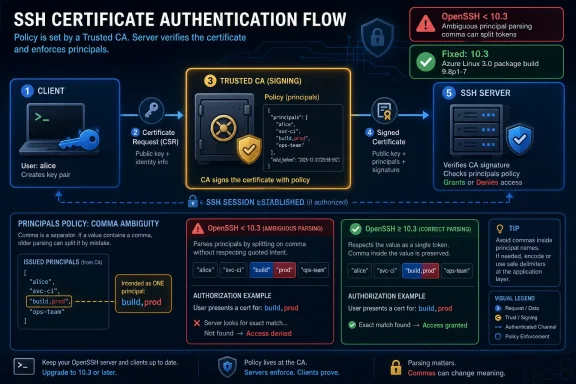 The Bug Lives in the Space Between Authentication and Authorization
OpenSSH’s certificate model separates the fact that a key is trusted from the question of what identity that key may assume. A user certificate can carry one or more principals, and the server can decide whether those principals are acceptable for a given local account. That design is powerful because it lets an organization centralize issuance while still enforcing local authorization rules.CVE-2026-35414 concerns the
authorized_keys principals option, not ordinary password logins and not the everyday case of a single public key pasted into a user’s file. The vulnerable path appears when a server trusts a certificate authority and also uses a principals list to constrain which certificate identities may authenticate. In that uncommon setup, comma characters become more than punctuation.The short version is that OpenSSH before 10.3 could mishandle a principal name containing a comma when comparing it against a comma-separated list. If the certificate authority issued a certificate with a principal such as a compound string containing a comma, vulnerable matching logic could interpret part of that string as a separate principal. In the wrong environment, that turns a carefully scoped certificate into one that may match an identity the issuer did not intend to grant.
That is why Microsoft’s entry describes “uncommon scenarios” and a CA that makes “certain use of comma characters.” The wording matters. This is not a drive-by remote exploit where any Internet-facing SSH daemon instantly yields a shell; it is a flaw in the policy interpretation layer of a specific certificate-based configuration.
A Moderate Score Can Still Hide a Dangerous Shape
Microsoft lists the CVSS 3.1 vector as network exploitable, high complexity, low privileges required, no user interaction, unchanged scope, and low confidentiality and integrity impact. The resulting score is 4.2, which lands in Moderate territory. On paper, that puts CVE-2026-35414 below the sort of emergency patch queue reserved for wormable services or unauthenticated remote code execution.But CVSS has always been a poor substitute for asset knowledge. A Moderate SSH authentication flaw on a lab host is routine patch debt; the same flaw on a bastion architecture using SSH certificates for production administration deserves faster attention. The score reflects exploit preconditions, not the value of the account that might be reachable if those preconditions line up.
The “high attack complexity” rating is doing a lot of work here. Microsoft’s description says successful exploitation depends on conditions beyond the attacker’s control and may require preparation, environmental knowledge, or other setup. In plain terms, an attacker probably needs to understand how the target’s SSH certificate authority issues principals, how the target server restricts them, and whether comma-bearing principal names exist or can be obtained.
That does not make the bug irrelevant. It makes it selective. The organizations most exposed are likely the ones mature enough to use SSH certificates and precise principal restrictions, which is an irony familiar to anyone who has watched enterprise security controls become their own attack surface.
OpenSSH 10.3 Is the Line in the Sand
The upstream fix is OpenSSH 10.3, with portable OpenSSH 10.3p1 serving the Unix-like ecosystem that most administrators actually deploy. Microsoft’s guidance identifies OpenSSH before 10.3 as affected, while the Microsoft product row visible in the Security Update Guide points to Azure Linux 3.0’sazl3 openssh 9.8p1-6 package and a fixed build of 9.8p1-7.That distinction is important for administrators who live in vendor-packaged reality rather than upstream version arithmetic. A distribution does not always jump to the newest OpenSSH release to fix a CVE; it may backport the patch into an older versioned package. In Azure Linux 3.0, the relevant action is therefore not “make the banner say 10.3,” but “install the package build Microsoft marks as fixed.”
For Windows administrators, the exposure path is more indirect but still real. Windows Server and Windows client systems can run Microsoft’s OpenSSH components, but this particular MSRC entry, as updated, calls out Azure Linux 3.0 rather than a Windows OpenSSH servicing vehicle. Mixed estates are where this becomes easy to miss: the vulnerable systems may be Linux hosts managed by Windows teams, Azure images maintained through cloud pipelines, or appliances whose SSH stack is inherited from a vendor base image.
The operational lesson is to inventory by behavior as well as by package. If you run SSH certificate authentication, audit where trusted user CAs are configured, where
cert-authority lines appear in authorized_keys, and where principals="..." restrictions are used. The vulnerable condition is narrow enough that a version scanner alone may generate more heat than light.The Comma Is the Oldest Enemy of Policy-as-Text
Security engineers love declarative policy until the parser gets a vote. Comma-separated values, colon-separated fields, glob patterns, shell quoting, JSON arrays, YAML indentation, and certificate extensions all eventually collide with the same problem: the machine has to know when a character is data and when it is syntax. CVE-2026-35414 is another entry in that long catalog.The bug’s premise is almost embarrassingly small. A comma inside a principal name should remain part of the name. A comma between principal names should separate entries in a list. If the comparison logic blurs those two meanings, an authorization boundary becomes ambiguous.
That ambiguity is especially dangerous in identity systems because administrators often read policy the way humans read language. A person sees a principal string and understands the intent from context. Software sees delimiters, tokenization rules, and comparison functions; if those functions were borrowed from a different part of the codebase where commas always meant “next item,” the human intent may not survive execution.
This is why the fix matters even for teams that are not exposed today. Enterprise access control is increasingly a stack of small translations: cloud identity to certificate issuance, certificate principal to server account, server account to sudo role, and audit event back to identity provider. A parsing mistake at any layer can turn a well-designed chain into a set of assumptions nobody actually verified.
Certificate Authorities Reduce Key Sprawl, But They Raise the Stakes
SSH certificates are popular in serious environments for good reasons. They allow short-lived credentials, centralized issuance, explicit principals, and easier revocation strategy than thousands of unmanaged public keys. They are one of the few answers to the problem every sysadmin knows: the key you forgot about is the key that still works.CVE-2026-35414 does not argue against SSH certificates. If anything, it argues for using them with the same rigor applied to TLS certificate issuance or Kerberos realm design. The certificate authority is not just a signing box; it is an authorization policy engine whose output must be predictable, constrained, and hostile to ambiguity.
The risky pattern is allowing arbitrary or loosely validated principal names to flow from identity systems into SSH certificates. A comma may look harmless in a directory display name, a service naming convention, or an automation label. In a certificate principal used by older OpenSSH authorization logic, it may become a structural character.
Administrators should therefore treat principal naming as a security control, not a cosmetic convention. If your SSH CA can issue names containing delimiters, whitespace, shell metacharacters, or application-specific separators, you have a class of audit work that extends beyond this single CVE. The safer posture is to define a strict principal grammar and reject anything outside it before a certificate is ever signed.
Microsoft’s Azure Linux Row Makes This a Cloud Hygiene Story
The Microsoft angle here is narrow but meaningful. The Security Update Guide ties the CVE to Azure Linux 3.0, Microsoft’s Linux distribution used in cloud and container scenarios, and identifies a fixed OpenSSH package build. That makes the advisory part of the broader reality that Microsoft is not merely a Windows vendor in modern infrastructure; it ships and services Linux components that sit under customer workloads.This matters because Linux patching in cloud environments often happens through image pipelines, container rebuilds, and fleet orchestration rather than the familiar monthly Windows cumulative update rhythm. A vulnerable OpenSSH package may live in a base image that was golden two months ago and forgotten after deployment. The fix may be available, but the operational question is whether the image factory, VM scale set, container host, or appliance pipeline actually consumes it.
Azure Linux users should verify that their package repositories are current and that deployed systems have moved to the fixed build. Where immutable infrastructure is in place, the answer should be a rebuild and redeploy, not a one-off hotfix that leaves the next rollout vulnerable again. Where mutable servers are still the norm, this is a good excuse to compare vulnerability scanner output with package manager state.
The cloud also complicates exposure analysis. A server that is not reachable from the public Internet may still be reachable from internal automation, build agents, jump hosts, or compromised workloads. Because this CVE is tied to authentication and authorization rather than packet parsing, the relevant boundary is not just the firewall; it is the trust path from certificate issuance to server login.
Windows Shops Should Look Past the Windows Logo
Many Windows-centric organizations now run SSH everywhere. Developers use it from Windows Terminal, administrators enable it for cross-platform automation, and security teams increasingly encounter it in Azure, Kubernetes, Git infrastructure, network appliances, and backup systems. Treating OpenSSH as “the Linux team’s problem” is no longer defensible.The first task is to identify whether SSH certificate authentication is actually in use. Most smaller environments still rely on ordinary public keys or identity-provider-mediated access through other agents. Those systems may have OpenSSH versions before 10.3 but lack the CA-and-principals configuration needed for this bug to matter.
The second task is to find the high-value choke points. Bastion hosts, deployment servers, CI/CD runners, production database administration hosts, privileged access workstations, and cloud management nodes deserve priority over miscellaneous development boxes. If those systems use trusted user CAs and principal restrictions, they should be patched or proven not to accept comma-bearing principals.
The third task is to review issuance policy. If a CA cannot issue a principal containing a comma, the exploit path becomes much less interesting. If the CA can issue such names under some workflow, then administrators should determine whether that ability is intentional, documented, and tested against every server-side authorization mechanism that consumes the certificate.
This is where security teams should resist the urge to turn the advisory into a binary vulnerable/not-vulnerable checkbox. The richer question is whether your access control scheme depends on parsers interpreting identity strings exactly the same way across systems. If the answer is yes, delimiter discipline should become part of your identity engineering standard.
Scanners Will Find Versions, Not Intent
Vulnerability management tools will inevitably flag OpenSSH versions before 10.3, and in many environments they should. But the scanner cannot always tell whether a backported vendor package is fixed, whether a server uses SSH certificates, whether the relevantauthorized_keys option is present, or whether comma-bearing principals can exist. This is the familiar gap between package detection and exploitability.That gap creates two predictable failure modes. One team will ignore the finding because the score is Moderate and the exploit path sounds exotic. Another will demand an emergency upgrade everywhere because “OpenSSH authentication bypass” sounds catastrophic. Both reactions dodge the real work.
The better response is tiered. Patch the packages where your vendor has shipped a fixed build, especially on Internet-facing or privileged systems. In parallel, inspect SSH configuration for certificate trust anchors and principal restrictions. Then audit the CA’s principal naming rules and recent issuance history for commas or other delimiter-like characters.
For Microsoft-oriented estates, this also means checking the service boundaries around Azure Linux. If Azure Linux is used as a base for workloads, the fixed package must be pulled into the relevant image or update channel. If the OpenSSH service is disabled or unreachable, document that fact, but do not let it become a permanent exception with no owner.
The Advisory’s Quiet Update Is the Real Signal
The MSRC page was released in early April 2026 and updated on June 4, 2026, with the latest revision marked as information published. That chronology is easy to overlook, but it is precisely why this advisory is worth writing about now. Security teams live in a world where upstream disclosures, distribution fixes, Microsoft guidance, and scanner plugins arrive on different clocks.The June update does not transform CVE-2026-35414 into a new class of emergency. It does, however, put the issue into Microsoft’s official vulnerability workflow and makes it visible to organizations that key their processes off MSRC rather than OpenSSH mailing lists or Linux distribution trackers. For those shops, the advisory is the point at which a niche upstream bug becomes an enterprise ticket.
There is also a messaging problem here. Some public discussion of the flaw has emphasized dramatic outcomes such as privilege escalation to root, while the CVSS vector Microsoft lists is more restrained. The difference likely reflects configuration-dependent impact: if a principal parsing error lets a certificate match a more privileged local account in a permissive environment, the practical consequence can be severe even if the general CVE scoring remains Moderate.
That is why defenders should frame this as a policy bypass risk rather than a universal root bug. The phrase is less thrilling, but it is more useful. It tells administrators to look at authorization rules, identity issuance, and high-value accounts instead of merely counting exposed port 22 banners.
The Patch Is Simple; The Inventory Is Not
For individual systems, the fix is straightforward: install a vendor-supplied OpenSSH update that contains the corrected handling, or move to OpenSSH 10.3 or later where appropriate. For Azure Linux 3.0, Microsoft identifies9.8p1-7 as the fixed build for the affected package line. That is the easy half of the work.The hard half is discovering where the vulnerable feature combination exists. SSH configuration is famously local, composable, and sometimes inherited through configuration management that has outlived its original author. A host may use a global
sshd_config, per-user authorized_keys options, included snippets, automation-managed files, or a vendor wrapper that obscures the underlying OpenSSH behavior.Teams should search for
cert-authority entries, trusted user CA configuration, AuthorizedPrincipalsFile, AuthorizedPrincipalsCommand, and principals= options. Not every one of those mechanisms is the exact affected path, but together they map the certificate-authentication surface. Once that surface is known, administrators can decide whether patching alone is sufficient or whether principal naming policy also needs tightening.Logging deserves attention as well. If comma-bearing principals have been issued, authentication logs may show unusual certificate principal strings or unexpected account mappings. Absence of evidence is not evidence of exploitation, but it can help scope risk and prioritize hosts where the affected pattern is not theoretical.
The Lesson Is to Treat Identity Strings Like Input
The security industry has spent decades teaching developers to sanitize web input, database queries, and command-line parameters. Identity strings often get a pass because they arrive from trusted systems. CVE-2026-35414 is a useful reminder that trusted input is still input.Principal names, account names, group names, service identities, and certificate extensions should be designed with parsers in mind. The safest identity systems use constrained character sets, unambiguous serialization formats, and explicit escaping rules. The least safe ones let human-friendly labels leak into machine-enforced policy and hope every component interprets them the same way.
This is especially relevant as enterprises stitch together identity providers, just-in-time access brokers, secrets managers, SSH CAs, and cloud-native authorization systems. Each integration promises less standing privilege and better auditability. Each integration also creates another place where a string can be split, normalized, lowercased, decoded, or compared in a way the previous system did not anticipate.
The fix for this CVE belongs in OpenSSH, but the lesson belongs in architecture review. If a delimiter can change authorization meaning, it should not be allowed to appear unescaped in an identity field. If a CA signs arbitrary principal names, the CA is not enforcing policy; it is merely notarizing whatever policy mistake upstream hands it.
The Comma Bug Leaves a Practical Checklist Behind
CVE-2026-35414 is narrow enough that most administrators should not spend the week in crisis mode, but concrete enough that it should not be waved away. The right response is targeted inventory, vendor patching, and a sober look at how SSH certificate principals are issued and consumed.- Organizations running OpenSSH before 10.3 should install vendor fixes, with Azure Linux 3.0 administrators verifying that the OpenSSH package has reached Microsoft’s fixed
9.8p1-7build or later. - Teams should prioritize systems that use SSH certificate authorities together with principal restrictions in
authorized_keysor related authorization mechanisms. - Certificate authorities should be reviewed to ensure they do not issue principal names containing commas or other delimiter characters unless every consuming system is known to handle them safely.
- Vulnerability scanner findings should be reconciled with distribution backports, because an older-looking OpenSSH version string may still contain a vendor fix.
- High-value SSH entry points such as bastion hosts, CI/CD runners, deployment servers, and privileged administration nodes should receive the first round of configuration review.
- Administrators should treat this advisory as an opportunity to document SSH certificate trust paths rather than as a one-line package upgrade ticket.
References
- Primary source: MSRC
Published: 2026-06-04T01:40:55-07:00
Security Update Guide - Microsoft Security Response Center
 msrc.microsoft.com
