

CVE-2026-38755 has put a fresh spotlight on a component that many administrators rarely see until it fails: BusyBox’s compact
BusyBox is often described as the “Swiss Army knife” of embedded Linux because it combines a large collection of Unix utilities into a single small executable. Instead of deploying separate binaries for commands such as
That design has made BusyBox indispensable in constrained devices. It appears in consumer routers, network gateways, industrial controllers, single-board-computer images, embedded recovery partitions, lightweight containers, appliance operating systems, and Linux initialization environments. It also appears in places administrators may not immediately associate with BusyBox at all, including firmware management interfaces and container base images.
That makes
The practical result is a fragmented patching picture. Some products may have adopted 1.38.0 directly, some may package a vendor-modified snapshot, and many widely deployed systems may remain on older BusyBox branches. A CVE naming a specific upstream version is therefore the beginning of an investigation, not the end of one.
For defenders, the relevant fact is not which portal displayed the item first. The urgent question is whether a deployed BusyBox build contains the vulnerable
In the case of CVE-2026-38755, the reported issue lies in
At the same time, a process crash inside a shell can be more consequential than it sounds. If
That history is precisely why the present CVE should be handled with two simultaneous principles:
The more important question is whether untrusted input crosses into shell evaluation. This can happen through poorly designed CGI handlers, diagnostic endpoints, remote management scripts, upload-processing workflows, provisioning data, DHCP or network-event hooks, job schedulers, and automation layers that construct command strings.
This CVE concerns a memory-safety flaw in the shell’s own handling of crafted input. An application can avoid classic command injection and still be exposed if it legitimately passes complex untrusted content to
That makes simple banner matching unreliable. Finding a BusyBox version string is useful triage information, but it is not conclusive proof that a specific device is vulnerable or safe.
If a web interface or backend service invokes
The seriousness is shaped by recoverability. A watchdog that automatically restarts a crashed process can reduce downtime, but it can also create a denial-of-service loop if an attacker can continuously deliver the triggering input. Devices requiring a physical power cycle or site visit create a substantially larger business impact.
That delay is why asset inventory and compensating controls are essential. Waiting for a universal fixed-firmware announcement is not a security strategy.
A build image may be vulnerable while a production runtime image is not. Conversely, a compact operational sidecar or init container might contain BusyBox even though the primary application uses a full Linux distribution. Dependency inventories should therefore include base images, helper images, embedded binaries, and copied static tools.
The concern is especially acute for shared runners. A crash may not compromise another tenant by itself, but it can consume runner capacity, disrupt queues, delay releases, and create a noisy incident that obscures other malicious activity.
Administrators should distinguish resilience from immunity. Restart policies are valuable, but they can transform a single process failure into chronic availability degradation if the root cause remains reachable.
The Windows relevance comes from heterogeneous infrastructure. Windows administrators increasingly manage Docker hosts, Kubernetes clusters, WSL environments, NAS appliances, network equipment, developer workstations, cross-platform build pipelines, and cloud services that rely on Linux components.
The key question is not whether WSL exists. It is whether a vulnerable BusyBox 1.38.0 build is installed and whether untrusted scripts, repositories, downloads, or automation inputs can reach
This is a familiar blind spot. Endpoint management tools may report that Windows is fully patched while the most important exposure is actually inside a container registry, a network appliance, or an embedded system that the Windows team administers but does not directly scan.
A vulnerability that spans a router, a container image, and a developer toolchain will not be handled well if each team assumes it belongs to somebody else. Cross-platform asset visibility is the practical security control that turns a CVE notice into an actionable response.
A device behind a firewall with management access limited to a dedicated administrator subnet is less exposed than a public-facing appliance. It is not necessarily safe, because lateral movement, compromised VPN credentials, or an internal attacker can change the threat model quickly.
Organizations should therefore add operational questions to vulnerability triage:
That absence should shape messaging. Security teams should avoid panic-driven statements, while also refusing the opposite error: treating a high-impact availability flaw in a ubiquitous embedded component as routine patch backlog. The proper response is targeted urgency.
The authoritative question is whether the vendor states that its build is fixed or unaffected, ideally supported by package changelogs, source-patch information, or a clear security advisory. Vulnerability scanners are useful for finding candidates, but their version matching can generate false positives and false negatives in heavily customized embedded ecosystems.
Input validation remains important, but it should not be presented as a complete substitute for patching. Shell input is difficult to sanitize safely when it is intentionally interpreted as shell syntax. The most robust design is to avoid passing untrusted data to a command interpreter at all.
Where
Security operations teams should add relevant process-crash events and device restarts to their monitoring views. Repeated failures involving
That architectural work will not be completed during an emergency patch cycle. Still, it should become part of the post-incident roadmap for appliance vendors and internal platform teams.
This is why organizations should push suppliers for precise answers: affected product models, affected firmware versions, fixed firmware versions, workaround guidance, and confirmation of whether
Likewise, a detailed patch diff can help security teams determine whether the vulnerable condition is likely to be reachable through their scripts and interfaces. Organizations with in-house firmware or custom BusyBox builds should be prepared to review and backport the relevant change rather than waiting for a packaged release.
The important consumer lesson is that a device can remain useful after its software support ends, but it no longer remains equally defensible. A low-cost appliance with no update path can become an outsized source of risk in a home office or small business network.
CVE-2026-38755 is a reminder that the smallest software components can hold large operational responsibilities. BusyBox
ash shell. The newly disclosed flaw is described as a heap overflow in evalcommand() within shell/ash.c in BusyBox 1.38.0, where crafted input can trigger a denial of service. Current public assessments characterize the immediate impact as high availability loss rather than confirmed code execution, but that distinction should not encourage complacency. BusyBox sits inside routers, embedded appliances, containers, recovery environments, Linux distributions, and Windows-adjacent development stacks; when its shell is reachable through a network-facing service or automated command pipeline, a crash can become a meaningful operational outage.
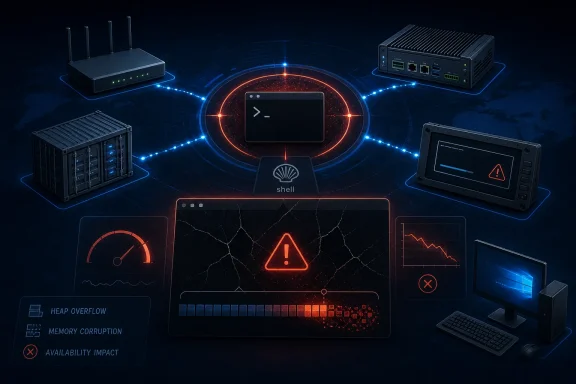 Background
BusyBox is often described as the “Swiss Army knife” of embedded Linux because it combines a large collection of Unix utilities into a single small executable. Instead of deploying separate binaries for commands such as sh, ls, grep, mount, tar, wget, and network-management tools, vendors can select the applets they need and build a much smaller operating environment.That design has made BusyBox indispensable in constrained devices. It appears in consumer routers, network gateways, industrial controllers, single-board-computer images, embedded recovery partitions, lightweight containers, appliance operating systems, and Linux initialization environments. It also appears in places administrators may not immediately associate with BusyBox at all, including firmware management interfaces and container base images.
The importance of BusyBox ash
The vulnerable code is in BusyBoxash, the project’s lightweight POSIX-oriented shell. The shell is not merely an interactive command prompt. It can parse shell scripts, expand variables, perform substitutions, assemble command arguments, manage redirections, and launch other programs.That makes
ash a control-plane component in many systems. A vendor might use it to run boot scripts, process DHCP hooks, drive firewall initialization, invoke maintenance routines, or execute web-interface actions. In a container image, it may be the default /bin/sh used by installation scripts and entrypoints.BusyBox 1.38.0 is a recent release
BusyBox 1.38.0 was announced on May 13, 2026, as an unstable release. That label matters. In BusyBox terminology, “unstable” does not necessarily mean unusable or experimental in the casual sense; it describes the project’s release-track conventions. However, it does mean administrators should avoid assuming that a newer upstream version has automatically become a standard supported package across every major Linux distribution or appliance vendor.The practical result is a fragmented patching picture. Some products may have adopted 1.38.0 directly, some may package a vendor-modified snapshot, and many widely deployed systems may remain on older BusyBox branches. A CVE naming a specific upstream version is therefore the beginning of an investigation, not the end of one.
The disclosure timeline requires careful reading
Public vulnerability trackers indicate that CVE-2026-38755 was published on July 16, 2026, while the supplied Microsoft Security Response Center entry carries a July 21, 2026 publication timestamp in Pacific time. At 07:42 UTC on July 21, that supplied timestamp converts to 08:42 UTC, which is one hour later than the current time. The mismatch is a useful reminder that vulnerability databases, vendor portals, and downstream trackers often update on different schedules.For defenders, the relevant fact is not which portal displayed the item first. The urgent question is whether a deployed BusyBox build contains the vulnerable
ash code path and whether untrusted input can reach it.What CVE-2026-38755 Means Technically
A heap overflow occurs when software reads from or writes to memory beyond the boundaries of a dynamically allocated memory region. The heap is used for memory allocated during program execution, often for strings, argument vectors, parser state, command substitutions, and other data whose size is determined at runtime.In the case of CVE-2026-38755, the reported issue lies in
evalcommand(), a function involved in evaluating a shell command after parsing and expansion stages have prepared it for execution. The published description says a crafted input can cause a heap overflow and result in denial of service.Why command evaluation is sensitive
A shell must transform text into actions. Even a seemingly simple command can require multiple stages:- The shell parses operators, quotes, redirections, assignments, pipelines, and command separators.
- It expands variables, command substitutions, arithmetic expressions, patterns, and positional parameters.
- It creates an argument list and determines whether a command is a built-in shell operation, a function, or an external program.
- It applies redirections and launches or evaluates the resulting command.
evalcommand() sits late enough in this process that it may receive complex state assembled from earlier stages. A bug there can be influenced by unusual combinations of expansions or command forms, even if the immediate fault is observed during command dispatch rather than initial parsing.A denial of service is still a security event
The available public description should be read narrowly: it identifies a crafted-input path to denial of service. It does not establish that arbitrary code execution is possible, and administrators should not inflate the claim beyond the evidence.At the same time, a process crash inside a shell can be more consequential than it sounds. If
ash runs a one-off local script, the result may be a failed task. If it backs an authenticated management endpoint, a provisioning worker, a login subsystem, a network bootstrap routine, or an appliance control service, repeated crashes can block legitimate administration or interrupt normal device behavior.Memory-safety bugs demand disciplined analysis
Heap overflows are historically associated with a spectrum of outcomes. Some are reliable crashes; some only appear under sanitizers or specific allocator behavior; some can corrupt adjacent state in ways that become exploitable under favorable conditions. Modern memory protections make exploitation more difficult in many environments, but they do not make it impossible.That history is precisely why the present CVE should be handled with two simultaneous principles:
- Treat the documented impact—denial of service—as the operational planning baseline.
- Avoid assuming that a crash-only classification permanently describes every build, compiler configuration, architecture, or downstream modification.
Why the Attack Surface Is Uneven
The phrase “crafted input” can create the misleading impression that every device with BusyBox is equally exposed. They are not. Exposure depends on how the shell is configured, whether theash applet is present, whether it processes attacker-controlled content, and what security boundaries surround that processing.Interactive shell access is not the only concern
A device that exposesash only through a local console has a much smaller remote attack surface than an appliance that feeds HTTP parameters into shell scripts. Yet even a locally accessible shell can matter in multi-user systems, shared build infrastructure, or devices where another vulnerability grants a low-privilege foothold.The more important question is whether untrusted input crosses into shell evaluation. This can happen through poorly designed CGI handlers, diagnostic endpoints, remote management scripts, upload-processing workflows, provisioning data, DHCP or network-event hooks, job schedulers, and automation layers that construct command strings.
Shell injection and shell parser vulnerabilities are different
CVE-2026-38755 is not simply another name for command injection. Command injection occurs when an application unintentionally lets an attacker add or alter shell syntax, often because the application concatenates untrusted strings into a command.This CVE concerns a memory-safety flaw in the shell’s own handling of crafted input. An application can avoid classic command injection and still be exposed if it legitimately passes complex untrusted content to
ash in a way that reaches the vulnerable logic. Conversely, a device may have BusyBox installed but remain unreachable if untrusted users cannot cause ash to process attacker-controlled commands or scripts.Compiled configuration changes the answer
BusyBox is configurable at build time. A firmware image may includeash, hush, both shells, or neither. It may invoke BusyBox applets through symbolic links, a single multicall binary, or a vendor wrapper. It may also carry a private patch set that changes source layout or behavior.That makes simple banner matching unreliable. Finding a BusyBox version string is useful triage information, but it is not conclusive proof that a specific device is vulnerable or safe.
The Significance for Embedded Devices
Embedded environments are the center of gravity for this issue. Many devices use BusyBox not because it is a convenience package but because it is foundational to the device’s operating environment. The same binary may support the boot process, administrative shell, scripts, networking, and recovery functions.Network equipment and edge appliances
Routers, firewalls, VPN appliances, cellular gateways, storage devices, and industrial edge systems frequently use lightweight Linux stacks. A device may expose management interfaces over HTTPS, SSH, serial console, proprietary management protocols, or cloud-mediated support channels.If a web interface or backend service invokes
ash to execute administrative actions, the relevant risk is not limited to a failed shell session. A crash may interrupt configuration changes, fail scheduled jobs, disable monitoring functions, or leave the management plane unavailable until a watchdog restart or manual intervention occurs.Reliability risks can become safety and business risks
Availability vulnerabilities are sometimes under-prioritized because they do not immediately imply data theft. That is a poor fit for operational technology, branch infrastructure, retail edge systems, and healthcare-adjacent devices. A repeatedly crashing gateway may break point-of-sale connectivity, isolate remote sites, interrupt telemetry, or prevent operators from applying other emergency changes.The seriousness is shaped by recoverability. A watchdog that automatically restarts a crashed process can reduce downtime, but it can also create a denial-of-service loop if an attacker can continuously deliver the triggering input. Devices requiring a physical power cycle or site visit create a substantially larger business impact.
Firmware age is the hidden multiplier
Embedded vendors often ship a BusyBox build and then maintain it for years. The visible product version may reveal nothing about the underlying BusyBox revision, and software bill of materials data may be incomplete or unavailable. Even when a vendor recognizes the issue, firmware qualification, regression testing, signing, staged deployment, and carrier or partner approval can slow remediation.That delay is why asset inventory and compensating controls are essential. Waiting for a universal fixed-firmware announcement is not a security strategy.
Container, Cloud, and DevOps Implications
BusyBox also has a substantial presence in containerized environments. Its small size makes it attractive for utility images, troubleshooting containers, init containers, CI runners, rescue environments, and minimal distributions. The impact here depends heavily on whether BusyBoxash is used as a shell entrypoint or script interpreter.Image inventory must go beyond package names
A container scanner may report a BusyBox package version, but that is only one part of the assessment. Teams need to know whether the affected binary is actually in a production image, whetherash is enabled, and whether the workload accepts untrusted data that is subsequently processed through shell execution.A build image may be vulnerable while a production runtime image is not. Conversely, a compact operational sidecar or init container might contain BusyBox even though the primary application uses a full Linux distribution. Dependency inventories should therefore include base images, helper images, embedded binaries, and copied static tools.
CI systems can amplify the blast radius
Continuous integration systems often execute shell fragments supplied by repositories, pull requests, package metadata, build descriptors, or generated scripts. Good CI design already treats those inputs as untrusted, but CVE-2026-38755 adds a memory-safety reason to avoid unnecessarily routing hostile or semi-trusted content through BusyBoxash.The concern is especially acute for shared runners. A crash may not compromise another tenant by itself, but it can consume runner capacity, disrupt queues, delay releases, and create a noisy incident that obscures other malicious activity.
Kubernetes does not remove the problem
Container orchestration can restart failed workloads automatically, but automatic restart is not remediation. If the triggering input persists in a queue, mounted configuration, request stream, or startup script, the system can enter a crash loop. That may prevent a deployment from becoming ready, block a node-level maintenance task, or exhaust capacity through repeated restarts.Administrators should distinguish resilience from immunity. Restart policies are valuable, but they can transform a single process failure into chronic availability degradation if the root cause remains reachable.
Windows and Windows-Adjacent Exposure
CVE-2026-38755 is a BusyBox and Linux ecosystem issue, not a native Windows operating system vulnerability. Windows users should not mistake the presence of a Microsoft Security Response Center entry for evidence that Windows itself ships a vulnerableash implementation as part of the base operating system.The Windows relevance comes from heterogeneous infrastructure. Windows administrators increasingly manage Docker hosts, Kubernetes clusters, WSL environments, NAS appliances, network equipment, developer workstations, cross-platform build pipelines, and cloud services that rely on Linux components.
WSL and local developer environments
A Windows device running WSL may contain a BusyBox package, custom root filesystem, embedded development image, or toolchain that uses BusyBox. In most cases, local developer exposure will be less urgent than a public-facing appliance, but it should still be included in engineering inventory.The key question is not whether WSL exists. It is whether a vulnerable BusyBox 1.38.0 build is installed and whether untrusted scripts, repositories, downloads, or automation inputs can reach
ash. Development machines that build firmware or container images deserve special attention because they can become a route for vulnerable binaries to enter production artifacts.Windows container and management ecosystems
Organizations operating Windows Server may use Linux containers alongside Windows containers. A BusyBox-based utility image can sit behind a Windows-managed Kubernetes environment, Azure-hosted workload, or CI platform without being visible in standard Windows patch reporting.This is a familiar blind spot. Endpoint management tools may report that Windows is fully patched while the most important exposure is actually inside a container registry, a network appliance, or an embedded system that the Windows team administers but does not directly scan.
Enterprise security teams need shared ownership
The right ownership model crosses traditional boundaries. Windows endpoint teams, Linux platform teams, network teams, product engineering groups, and security operations should agree on who inventories BusyBox-bearing assets and who tracks vendor remediation.A vulnerability that spans a router, a container image, and a developer toolchain will not be handled well if each team assumes it belongs to somebody else. Cross-platform asset visibility is the practical security control that turns a CVE notice into an actionable response.
Assessing Real-World Severity
Public scoring for CVE-2026-38755 currently places the issue at 7.5 under CVSS v3.1, with a vector indicating network reachability, low attack complexity, no privileges, no user interaction, unchanged scope, no confidentiality or integrity impact, and high availability impact. That is a serious rating, but CVSS should guide triage rather than replace local analysis.The network vector needs context
A network attack vector does not mean every BusyBox host is remotely exploitable from the public internet. It means the vulnerable component can potentially be reached through a network path without requiring local physical access. In practice, that path may be an appliance interface, a management service, a remote automation interface, or an application that submits data to a shell-backed workflow.A device behind a firewall with management access limited to a dedicated administrator subnet is less exposed than a public-facing appliance. It is not necessarily safe, because lateral movement, compromised VPN credentials, or an internal attacker can change the threat model quickly.
Availability impact is environment-specific
For a disposable container, a crash may be inconvenient but recoverable in seconds. For a remote industrial controller or branch router, the same crash may strand administrators, interrupt service, or force a truck roll. CVSS expresses the potential technical impact of the vulnerable component; it does not know the cost of downtime in a particular deployment.Organizations should therefore add operational questions to vulnerability triage:
- Can the relevant service restart automatically and cleanly?
- Can an attacker replay the triggering input indefinitely?
- Does a crash prevent remote management or recovery?
- Does the component run during boot, networking, authentication, or failover?
- Is a physical intervention required to restore reliable service?
No known exploitation claim should be overstated
As of the current disclosure information, the issue is described as a denial-of-service flaw. There is no basis to claim broad in-the-wild exploitation, a public weaponized exploit, or confirmed remote code execution solely from the CVE description.That absence should shape messaging. Security teams should avoid panic-driven statements, while also refusing the opposite error: treating a high-impact availability flaw in a ubiquitous embedded component as routine patch backlog. The proper response is targeted urgency.
Immediate Mitigation and Remediation
The first task is discovery. Because BusyBox is frequently embedded, an organization may not be able to query every affected asset with a conventional package manager. Firmware inventory, container registry inspection, software bill of materials records, vendor product matrices, and binary analysis may all be required.A practical response sequence
Administrators should approach CVE-2026-38755 in a defined order:- Identify systems that contain BusyBox, including appliances, firmware images, containers, recovery environments, and developer tooling.
- Determine the actual BusyBox build and configuration, with particular attention to BusyBox 1.38.0 and the presence of the
ashapplet. - Map input paths into shell execution, especially management interfaces, web handlers, automation jobs, remote support features, and CI workflows.
- Apply vendor-provided fixed packages, firmware, or backported patches once their applicability is confirmed.
- Reduce exposure while patching proceeds by restricting management access, segmenting devices, and disabling unnecessary shell-backed features.
- Test recovery behavior to ensure a crash or restart does not create persistent management loss or a repeated restart loop.
- Monitor advisories and telemetry for updated affected-version ranges, fixed releases, proof-of-concept publication, and vendor-specific exploitation guidance.
Do not rely solely on upstream version numbers
Linux distributions and appliance vendors regularly backport security fixes without changing the upstream-looking version in an obvious way. Conversely, a custom build may advertise a familiar version but include modifications that change the exposure.The authoritative question is whether the vendor states that its build is fixed or unaffected, ideally supported by package changelogs, source-patch information, or a clear security advisory. Vulnerability scanners are useful for finding candidates, but their version matching can generate false positives and false negatives in heavily customized embedded ecosystems.
Exposure reduction options
Where a patch is not yet available, defensive measures should focus on preventing untrusted users from feeding data into shell evaluation paths. That can include limiting web administration to a management VLAN, disabling WAN-side administration, enforcing VPN-only access, using allowlists, turning off unneeded diagnostic functions, and reviewing automation scripts that invokesh -c or equivalent shell evaluation.Input validation remains important, but it should not be presented as a complete substitute for patching. Shell input is difficult to sanitize safely when it is intentionally interpreted as shell syntax. The most robust design is to avoid passing untrusted data to a command interpreter at all.
Patch Validation and Operational Testing
Patching a compact system utility can create compatibility concerns because BusyBox serves many functions. A vendor firmware release that updates BusyBox may also alter applet behavior, shell edge cases, startup scripts, or packaging assumptions. That does not justify delaying a security update indefinitely, but it does make controlled validation sensible.Validate the service, not just the version
A successful update installation proves only that the package or firmware changed. It does not prove that the device remains operational under normal conditions. Teams should validate core functions such as boot completion, network connectivity, administrative access, scheduled automation, log collection, and failover behavior.Where
ash scripts are central to the system, testing should include vendor-supported management workflows and any organization-specific scripts. The goal is to catch both security regressions and operational regressions before wide deployment.Preserve crash evidence
If an organization observes unexplained BusyBoxash crashes, it should preserve logs, core dumps where appropriate, triggering request metadata, and firmware versions before rebooting or upgrading. This evidence can help distinguish CVE-2026-38755 from unrelated shell errors, memory pressure, filesystem damage, or application bugs.Security operations teams should add relevant process-crash events and device restarts to their monitoring views. Repeated failures involving
ash, appliance web-management processes, or script-runner services deserve investigation, especially when paired with unusual inbound requests or repeated authentication attempts.Strengths and Opportunities
CVE-2026-38755 is disruptive, but it also highlights several opportunities for organizations to improve durable security practices.- The issue is narrowly described. The currently documented impact is denial of service, allowing teams to prioritize availability protections without making unsupported claims about compromise.
- BusyBox’s centralization aids focused investigation. A single multicall binary can make it easier to identify relevant firmware components once the organization knows where to look.
- Network segmentation directly reduces practical risk. Restricting appliance administration and shell-adjacent services can sharply limit who can reach a vulnerable path.
- Container registries offer a controlled remediation point. Rebuilding and redeploying approved images can eliminate vulnerable components consistently across environments.
- The event encourages better SBOM coverage. Embedded and appliance inventory often trails server inventory; this CVE provides a concrete reason to close that gap.
- Crash-loop testing improves resilience beyond this CVE. Confirming watchdog and recovery behavior helps defend against many future availability failures, malicious or accidental.
A chance to reduce shell dependence
The broader engineering lesson is that shell execution is powerful but fragile as an application-integration layer. Systems that pass structured arguments directly to programs, use dedicated APIs, and separate privileged actions from untrusted input reduce both conventional injection risk and exposure to shell implementation flaws.That architectural work will not be completed during an emergency patch cycle. Still, it should become part of the post-incident roadmap for appliance vendors and internal platform teams.
Risks and Concerns
The greatest danger is not necessarily the overflow itself. It is the combination of incomplete inventory, vague version data, and devices that are difficult to patch.- Embedded assets are frequently invisible to standard endpoint tooling. A fully patched workstation fleet says little about routers, storage devices, industrial equipment, or vendor appliances.
- A visible BusyBox banner is not a definitive verdict. Build configuration and downstream patches can make simple version checks misleading.
- Automatic restarts can mask active abuse. A watchdog may restore service quickly while an attacker continuously forces outages.
- Unsupported appliances may never receive a fix. In those cases, segmentation, access reduction, and replacement planning may be the only sustainable answers.
- Maintenance interfaces are high-value targets. If an attacker can crash the management plane, defenders may lose the easiest channel for remediation.
- Unverified escalation claims can cause bad decisions. Teams should distinguish the documented denial-of-service impact from speculation about code execution while still treating memory corruption with appropriate caution.
Supply-chain ambiguity remains a challenge
BusyBox’s value comes partly from its broad reuse, but that reuse obscures provenance. A vendor may include BusyBox as a source snapshot, a static binary, a modified fork, or part of a larger build framework. The resulting asset may not show up under an obvious package name.This is why organizations should push suppliers for precise answers: affected product models, affected firmware versions, fixed firmware versions, workaround guidance, and confirmation of whether
ash is enabled and reachable. General statements that a vendor is “investigating” are not enough for high-consequence environments.What to Watch Next
The next phase of this vulnerability will be defined by patch clarity. Administrators should watch for BusyBox upstream maintenance activity, downstream distribution advisories, appliance-vendor firmware bulletins, container-base-image updates, and updates to CVE records that refine affected or fixed version ranges.The most important unanswered questions
Several details will materially change response priorities:- Whether BusyBox maintainers publish a dedicated fix and identify the precise vulnerable code change.
- Whether the issue affects only the 1.38.0 release or a wider range of development snapshots, stable branches, or vendor backports.
- Whether major Linux distributions classify their packaged BusyBox builds as affected, unaffected, or fixed.
- Whether appliance vendors identify exposed management or automation features that can reach
ash. - Whether public proof-of-concept material emerges and demonstrates reliable remote crash conditions.
- Whether any credible reports establish exploitation beyond denial of service.
Monitor for exploitability changes, not just new CVSS data
A numerical severity update can be useful, but it is not the only signal that matters. A vendor advisory explaining that a web-management function passes request data intoash could raise the real-world urgency for a specific appliance class far more than a small scoring change.Likewise, a detailed patch diff can help security teams determine whether the vulnerable condition is likely to be reachable through their scripts and interfaces. Organizations with in-house firmware or custom BusyBox builds should be prepared to review and backport the relevant change rather than waiting for a packaged release.
Consumers should focus on supported firmware
Home and small-business users are unlikely to compile BusyBox themselves. Their practical action is to check whether their router, NAS, firewall, or smart-device vendor has released updated firmware, apply it through the supported mechanism, disable internet-facing management, and replace devices that no longer receive security updates.The important consumer lesson is that a device can remain useful after its software support ends, but it no longer remains equally defensible. A low-cost appliance with no update path can become an outsized source of risk in a home office or small business network.
CVE-2026-38755 is a reminder that the smallest software components can hold large operational responsibilities. BusyBox
ash may occupy only a small footprint in a firmware image or container, yet it often sits at the point where text becomes action. The appropriate response is neither alarmism nor dismissal: identify the actual builds in use, constrain paths that deliver untrusted input to the shell, apply verified vendor fixes promptly, and use the incident to improve the asset visibility and recovery testing that will matter long after this particular CVE fades from the headlines.References
- Primary source: MSRC
Published: 2026-07-21T01:42:02-07:00
Security Update Guide - Microsoft Security Response Center
 msrc.microsoft.com
