

Microsoft’s Security Update Guide entry for CVE-2026-39882, published after the OpenTelemetry-Go advisory in April 2026, flags a denial-of-service flaw in the Go OTLP HTTP exporters that can let a malicious or intercepted collector response exhaust memory in instrumented applications. The bug is not a Windows kernel emergency, and it is not a classic remote-code-execution panic button. It is more awkward than that: a small observability assumption that can turn the software watching your service into the reason the service falls over.
That makes CVE-2026-39882 a useful stress test for modern infrastructure hygiene. OpenTelemetry has become the neutral plumbing layer for traces, metrics, and logs across cloud-native estates, including fleets that still begin and end their operational lives on Windows desktops, Windows Server workloads, Azure-hosted services, and mixed Kubernetes clusters. When the telemetry path can be weaponized against the application path, IT teams have to stop treating instrumentation as harmless background noise.
The vulnerable code sits in OpenTelemetry-Go’s OTLP HTTP exporters for traces, metrics, and logs. Before the patched releases, those exporters could read an HTTP response body from a collector endpoint into an in-memory buffer without enforcing a practical ceiling. If the collector endpoint was malicious, misconfigured, or reachable through a realistic man-in-the-middle position, the exporter could be made to allocate memory in proportion to an attacker-chosen response size.
That sounds almost too mundane to deserve a CVE. A client sends telemetry, a server replies, and the client reads the reply. But the missing guardrail matters because exporters run inside real processes, often the very services whose availability operators are trying to protect.
The advisory’s own framing is careful. This is not advertised as a remote denial of service against every default OpenTelemetry-Go deployment on the internet. The attack requires a hostile collector endpoint or a network position capable of tampering with the response. That condition narrows the field, but it does not make the bug academic.
The whole observability stack rests on a kind of operational trust: applications trust collectors to ingest, normalize, and forward telemetry, while collectors trust applications not to drown them in cardinality and volume. CVE-2026-39882 flips that direction. The collector, or something pretending to be one, becomes the source of resource pressure against the application.
For WindowsForum readers, the lesson is not “panic because OpenTelemetry exists.” It is that telemetry dependencies are dependencies. They need version tracking, threat modeling, TLS discipline, endpoint governance, and the same boring patch cadence that administrators already apply to web frameworks, database drivers, and authentication libraries.
CVSS is trying to compress multiple truths into one number. The confidentiality impact is none, the integrity impact is none, and the scope is unchanged. There is no credential theft, no data rewrite, no lateral movement primitive, and no obvious path to arbitrary code execution. From that angle, medium severity is reasonable.
Availability is the exception. The advisory describes a high availability impact: a malicious response can force large transient heap allocations and potentially crash the instrumented process. If that process is a low-priority batch worker, the blast radius may be modest. If it is an API gateway, an identity-adjacent service, a payment component, or an internal control-plane service, the operational impact can be serious.
This is where security scoring and production reality diverge. A vulnerability does not need to leak secrets to ruin a day. It only needs to make a service disappear at the wrong moment, and memory exhaustion is one of the most direct ways to do that.
The user-supplied MSRC description captures the stakes in availability terms: total loss of availability can mean an attacker fully denies access to resources in the impacted component, either while the attack continues or after the condition has been triggered. For this CVE, the most plausible scenario is sustained pressure: repeated or oversized responses that push the process into out-of-memory behavior.
That does not make the bug universally catastrophic. It makes it context-sensitive. Medium severity is the scoreboard; deployment topology is the game.
That matters because the vulnerable packages are not abstract. The affected HTTP exporters cover trace, metric, and log delivery paths. A Go service using OTLP over HTTP to send telemetry to a collector may carry this code even when nobody on the help desk has ever heard the acronym OTLP.
The Windows angle is less about whether the vulnerable package runs only on Windows and more about how Windows shops actually operate now. A typical enterprise may have Windows Server applications, Linux containers, Azure services, developer workstations running Windows, CI systems building Go binaries, and third-party tools that embed OpenTelemetry libraries. Vulnerability exposure follows the software supply chain, not the operating system brand on the procurement form.
That is why MSRC surfacing the CVE is notable even if the vulnerable code comes from the OpenTelemetry project rather than from a Windows component. Microsoft’s ecosystem is full of Go services, Azure-connected agents, containerized workloads, and developer tools. Security Update Guide entries increasingly function as a clearinghouse for risks that matter to Microsoft customers even when the code is open source and cross-platform.
There is also a cultural point here. Observability is often sold as a safety net: more telemetry, more context, faster incident response. CVE-2026-39882 is a reminder that the net has weight. Every exporter, collector, protocol handler, and backend integration is code in the reliability path.
In a well-designed deployment, applications export telemetry over authenticated TLS to collectors controlled by the organization or a trusted vendor. The collector endpoint is pinned by configuration, protected by network policy, and monitored like other service infrastructure. In that version of the world, CVE-2026-39882 is mostly a patch-management item.
Real deployments are not always that clean. Development clusters export to temporary collectors. Teams test observability vendors during migrations. Staging environments run with relaxed TLS settings. Internal networks are flatter than diagrams suggest. Legacy services carry configuration from old experiments long after the people who wrote it have moved teams.
The most credible attacker may not be some anonymous internet actor. It may be a compromised internal collector, a poisoned configuration source, a malicious endpoint in a test environment that later becomes production-adjacent, or a network adversary in a segment where telemetry traffic was assumed to be low-risk. The vulnerability rewards exactly the kind of corner-cutting that tends to accumulate around non-user-facing infrastructure.
This is also why “adjacent network” should not lull administrators to sleep. Adjacent does not mean physically standing in the server room with a hoodie and a laptop. In cloud and container environments, adjacency can be created by compromised workloads, permissive service discovery, shared namespaces, weak egress controls, or mesh misconfiguration.
The attack does not need to be elegant. A large enough HTTP response body, read without a cap, is a blunt instrument. Blunt instruments are popular because they do not require much choreography once the preconditions are met.
The affected OpenTelemetry-Go release line was patched in version 1.43.0 for the trace and metric HTTP exporters, while the log HTTP exporter package has its own versioning and was patched at v0.19.0. The release notes also tie the mitigation explicitly to excessive memory usage caused by a misconfigured or malicious server.
Four MiB is not magic; it is a boundary. The important change is that the exporter no longer lets the other side decide how much memory the client should spend reading a response. That distinction is central to secure protocol handling. Peers can provide data, but they should not get a blank check against local resources.
The fix also treats oversized responses as non-retryable. That matters because retry loops can turn a single malicious response into repeated resource pressure. A telemetry exporter that politely retries a pathological server response is not resilient; it is obedient in the wrong direction.
There is a broader software-engineering pattern here. Observability code often evolves under assumptions of friendly infrastructure. The collector is “ours,” the backend is “trusted,” the network is “internal,” and the response is “small.” Security work starts when those quotation marks are removed.
That is the tedious part. Go applications commonly compile dependencies into static binaries, which is excellent for deployment and occasionally maddening for asset inventory. The vulnerable package may not exist as a loose DLL or system library with an obvious file version. It may be inside an executable whose build metadata is incomplete or whose vendor SBOM is out of date.
Windows-heavy organizations are especially prone to this blind spot when Go tooling enters through the side door. A security team may have mature processes for Windows Update, Microsoft Defender, Exchange, SQL Server, .NET, and Office. Meanwhile, a fleet of Go-based agents, exporters, internal services, and vendor-supplied binaries hums along under the heading of “platform tooling.”
That does not mean every Windows administrator needs to become a Go module archaeologist overnight. It does mean vulnerability ownership needs to follow the application. If a business service ships as a Go binary and exports OTLP over HTTP, someone must know which OpenTelemetry-Go version is inside it.
For internal development teams, the answer is straightforward: update the affected modules and rebuild. For purchased software, the answer is less satisfying: ask vendors whether they use OpenTelemetry-Go OTLP HTTP exporters, whether vulnerable versions are present, and when patched builds will ship. For containerized workloads, image rebuilds may be necessary even when the base image has nothing to do with the issue.
The uncomfortable truth is that observability libraries are now part of the software bill of materials that auditors care about. They may not process customer secrets, but they process production behavior. That is enough to matter.
OTLP over gRPC is not the same code path as OTLP over HTTP, and this CVE specifically concerns the HTTP exporters. That distinction matters for triage. Teams should avoid broad claims such as “all OpenTelemetry is vulnerable” and instead identify the actual exporter packages and protocols in use.
There is also a difference between using OpenTelemetry instrumentation and using the affected exporters. Many applications create spans or metrics locally but hand them off through different exporters, agents, or SDK arrangements. Vulnerability management should be precise enough to avoid unnecessary emergency work, but not so narrow that it misses embedded exporter use.
The operational question is simple: can a party you do not fully trust control or tamper with the HTTP response received by your OTLP exporter? If the answer is yes, patching becomes urgent. If the answer is no, patching is still recommended, but it belongs in the normal dependency-maintenance lane.
This is not an argument for complacency. It is an argument for ranking the bug by architecture rather than by headline. A medium CVE in the wrong trust zone can outrank a critical CVE in unreachable code.
If an observability exporter can crash the application it observes, the telemetry path becomes part of the service’s attack surface. Not the confidentiality surface, perhaps, and not the privilege-escalation surface, but definitely the availability surface. That should change how teams review instrumentation libraries.
This is particularly relevant for highly instrumented microservice environments. Each service may emit traces, metrics, and logs. Each may carry a copy of the SDK or exporter. A malicious collector endpoint could therefore create correlated failures across many processes that share the same telemetry configuration.
That is not the same as saying CVE-2026-39882 will produce fleet-wide outages by default. The advisory does not support that level of alarmism. But it does expose a coupling that administrators should dislike: many applications relying on one telemetry path whose failure behavior was not designed with hostile responses in mind.
The better mental model is not “telemetry is dangerous.” It is “telemetry is production I/O.” Production I/O needs timeouts, size limits, authentication, retry discipline, backpressure, and isolation. When those controls are missing, observability stops being passive.
Still, MSRC’s listing matters because Microsoft’s customers do not live in a Microsoft-only universe. Azure workloads, GitHub-hosted development, Defender-integrated environments, Windows Server backends, and hybrid estates all consume open-source components. Microsoft has an incentive to surface vulnerabilities that affect the stack its customers actually run, not just the code it authors.
That also changes the job of the administrator. Patch Tuesday remains essential, but it is no longer the whole map. A modern Windows estate can be fully current on Microsoft patches and still vulnerable through a Go module compiled into a service binary deployed by an internal platform team.
This is where WindowsForum’s audience often has an advantage over narrower developer communities. Sysadmins are used to thinking in terms of inventories, ownership, maintenance windows, and blast radius. CVE-2026-39882 needs exactly that mindset. The hard part is extending it into application dependencies that were historically invisible to infrastructure teams.
The right conversation between security and engineering is not accusatory. It is practical. Which services use OTLP HTTP exporters? Which versions are built in? Which endpoints do they send to? Are those endpoints authenticated? Can any tenant, namespace, or compromised workload impersonate them? Those answers matter more than the abstract CVE score.
After that, the more valuable work is architectural. Exporters should talk to trusted collectors over authenticated channels. Collector endpoints should not be casually configurable by untrusted users or environment sources. Egress policies should make it difficult for a compromised workload to redirect telemetry to an arbitrary endpoint.
Administrators should also review whether telemetry failure can take down a service. Instrumentation should degrade gracefully. If the collector misbehaves, the application should continue serving users wherever possible. That principle is easy to endorse and harder to verify, especially when exporters run in-process.
Memory limits can help contain the blast radius, particularly in containers and service-hosting environments, but they are not a substitute for patching. A memory limit may turn uncontrolled allocation into a predictable crash. That is better for the host and worse for the process.
For Windows Server and IIS-adjacent environments that host Go services as Windows services, the same logic applies. Service recovery policies can restart crashed processes, but restart loops are not resilience. They are a symptom that a dependency is still able to dictate process health.
That design pattern should be everywhere in telemetry infrastructure. Receivers should cap request sizes. Exporters should cap responses. Agents should bound queues. Collectors should limit cardinality. Backends should resist unbounded labels, attributes, and payloads. Observability systems deal in volume by design, and volume is always one confused configuration away from becoming an attack.
CVE-2026-39882 is therefore a small bug with a large moral. The mistake was not exotic cryptography or an obscure race condition. It was trusting that a response body would be reasonable because the other side was supposed to be reasonable. The history of networked software is a long argument against that assumption.
For developers, the lesson is to treat even “internal” HTTP clients as hostile-input parsers. For administrators, the lesson is to ask whether internal protocols have external consequences. For security teams, the lesson is to tune severity by service criticality, not only by base score.
The patch solves the immediate defect. It does not solve the organizational habit of waving through observability changes because they are not “product code.” In 2026, the distinction is increasingly artificial.
That makes CVE-2026-39882 a useful stress test for modern infrastructure hygiene. OpenTelemetry has become the neutral plumbing layer for traces, metrics, and logs across cloud-native estates, including fleets that still begin and end their operational lives on Windows desktops, Windows Server workloads, Azure-hosted services, and mixed Kubernetes clusters. When the telemetry path can be weaponized against the application path, IT teams have to stop treating instrumentation as harmless background noise.
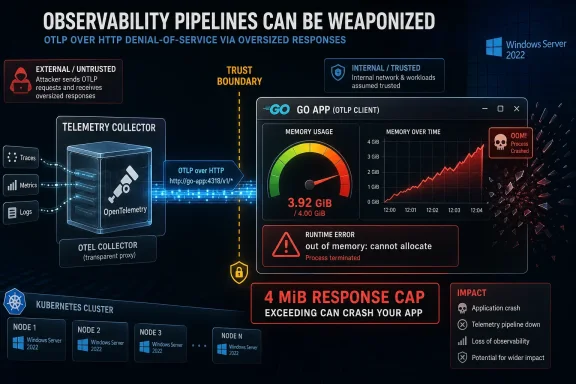 The Bug Lives in the Trust Boundary Everyone Forgets
The vulnerable code sits in OpenTelemetry-Go’s OTLP HTTP exporters for traces, metrics, and logs. Before the patched releases, those exporters could read an HTTP response body from a collector endpoint into an in-memory buffer without enforcing a practical ceiling. If the collector endpoint was malicious, misconfigured, or reachable through a realistic man-in-the-middle position, the exporter could be made to allocate memory in proportion to an attacker-chosen response size.That sounds almost too mundane to deserve a CVE. A client sends telemetry, a server replies, and the client reads the reply. But the missing guardrail matters because exporters run inside real processes, often the very services whose availability operators are trying to protect.
The advisory’s own framing is careful. This is not advertised as a remote denial of service against every default OpenTelemetry-Go deployment on the internet. The attack requires a hostile collector endpoint or a network position capable of tampering with the response. That condition narrows the field, but it does not make the bug academic.
The whole observability stack rests on a kind of operational trust: applications trust collectors to ingest, normalize, and forward telemetry, while collectors trust applications not to drown them in cardinality and volume. CVE-2026-39882 flips that direction. The collector, or something pretending to be one, becomes the source of resource pressure against the application.
For WindowsForum readers, the lesson is not “panic because OpenTelemetry exists.” It is that telemetry dependencies are dependencies. They need version tracking, threat modeling, TLS discipline, endpoint governance, and the same boring patch cadence that administrators already apply to web frameworks, database drivers, and authentication libraries.
A Medium Score Can Still Describe a Hard Outage
The published CVSS score is 5.3, which lands in the medium bucket. That number will tempt some vulnerability-management queues to bury the issue beneath louder, shinier bugs. In many environments, that may be defensible. In some, it will be exactly the wrong instinct.CVSS is trying to compress multiple truths into one number. The confidentiality impact is none, the integrity impact is none, and the scope is unchanged. There is no credential theft, no data rewrite, no lateral movement primitive, and no obvious path to arbitrary code execution. From that angle, medium severity is reasonable.
Availability is the exception. The advisory describes a high availability impact: a malicious response can force large transient heap allocations and potentially crash the instrumented process. If that process is a low-priority batch worker, the blast radius may be modest. If it is an API gateway, an identity-adjacent service, a payment component, or an internal control-plane service, the operational impact can be serious.
This is where security scoring and production reality diverge. A vulnerability does not need to leak secrets to ruin a day. It only needs to make a service disappear at the wrong moment, and memory exhaustion is one of the most direct ways to do that.
The user-supplied MSRC description captures the stakes in availability terms: total loss of availability can mean an attacker fully denies access to resources in the impacted component, either while the attack continues or after the condition has been triggered. For this CVE, the most plausible scenario is sustained pressure: repeated or oversized responses that push the process into out-of-memory behavior.
That does not make the bug universally catastrophic. It makes it context-sensitive. Medium severity is the scoreboard; deployment topology is the game.
OpenTelemetry Has Become Production Plumbing, Not Developer Decoration
OpenTelemetry began as a vendor-neutral way to instrument applications, but in 2026 it is no longer a boutique developer concern. It is the lingua franca for service traces, metrics, and logs across cloud providers, APM vendors, platform teams, and increasingly security operations. Go is heavily represented in infrastructure software, sidecars, agents, CLIs, control planes, and high-throughput services.That matters because the vulnerable packages are not abstract. The affected HTTP exporters cover trace, metric, and log delivery paths. A Go service using OTLP over HTTP to send telemetry to a collector may carry this code even when nobody on the help desk has ever heard the acronym OTLP.
The Windows angle is less about whether the vulnerable package runs only on Windows and more about how Windows shops actually operate now. A typical enterprise may have Windows Server applications, Linux containers, Azure services, developer workstations running Windows, CI systems building Go binaries, and third-party tools that embed OpenTelemetry libraries. Vulnerability exposure follows the software supply chain, not the operating system brand on the procurement form.
That is why MSRC surfacing the CVE is notable even if the vulnerable code comes from the OpenTelemetry project rather than from a Windows component. Microsoft’s ecosystem is full of Go services, Azure-connected agents, containerized workloads, and developer tools. Security Update Guide entries increasingly function as a clearinghouse for risks that matter to Microsoft customers even when the code is open source and cross-platform.
There is also a cultural point here. Observability is often sold as a safety net: more telemetry, more context, faster incident response. CVE-2026-39882 is a reminder that the net has weight. Every exporter, collector, protocol handler, and backend integration is code in the reliability path.
The Exploit Path Is Narrow, but Not Imaginary
The advisory’s exploit conditions are important. The attacker needs the configured collector endpoint to be attacker-controlled, or the attacker needs to tamper with traffic between the application and the collector. That is a higher bar than sending a packet to a public service port.In a well-designed deployment, applications export telemetry over authenticated TLS to collectors controlled by the organization or a trusted vendor. The collector endpoint is pinned by configuration, protected by network policy, and monitored like other service infrastructure. In that version of the world, CVE-2026-39882 is mostly a patch-management item.
Real deployments are not always that clean. Development clusters export to temporary collectors. Teams test observability vendors during migrations. Staging environments run with relaxed TLS settings. Internal networks are flatter than diagrams suggest. Legacy services carry configuration from old experiments long after the people who wrote it have moved teams.
The most credible attacker may not be some anonymous internet actor. It may be a compromised internal collector, a poisoned configuration source, a malicious endpoint in a test environment that later becomes production-adjacent, or a network adversary in a segment where telemetry traffic was assumed to be low-risk. The vulnerability rewards exactly the kind of corner-cutting that tends to accumulate around non-user-facing infrastructure.
This is also why “adjacent network” should not lull administrators to sleep. Adjacent does not mean physically standing in the server room with a hoodie and a laptop. In cloud and container environments, adjacency can be created by compromised workloads, permissive service discovery, shared namespaces, weak egress controls, or mesh misconfiguration.
The attack does not need to be elegant. A large enough HTTP response body, read without a cap, is a blunt instrument. Blunt instruments are popular because they do not require much choreography once the preconditions are met.
The Fix Is Small Because the Assumption Was Small
The upstream fix limits OTLP HTTP response bodies to 4 MiB for the affected exporters. Responses exceeding the limit are treated as non-retryable errors. In engineering terms, that is the sort of change that looks obvious after the fact and slightly less obvious before an incident or report forces the conversation.The affected OpenTelemetry-Go release line was patched in version 1.43.0 for the trace and metric HTTP exporters, while the log HTTP exporter package has its own versioning and was patched at v0.19.0. The release notes also tie the mitigation explicitly to excessive memory usage caused by a misconfigured or malicious server.
Four MiB is not magic; it is a boundary. The important change is that the exporter no longer lets the other side decide how much memory the client should spend reading a response. That distinction is central to secure protocol handling. Peers can provide data, but they should not get a blank check against local resources.
The fix also treats oversized responses as non-retryable. That matters because retry loops can turn a single malicious response into repeated resource pressure. A telemetry exporter that politely retries a pathological server response is not resilient; it is obedient in the wrong direction.
There is a broader software-engineering pattern here. Observability code often evolves under assumptions of friendly infrastructure. The collector is “ours,” the backend is “trusted,” the network is “internal,” and the response is “small.” Security work starts when those quotation marks are removed.
The Real Risk Is Hidden in Transitive Dependencies
Most administrators will not find this vulnerability by grepping production hosts for “CVE-2026-39882.” They will find it, if they are lucky, through software composition analysis, Dependabot-style alerts, container image scans, Go module inventories, or vendor advisories for products that embed OpenTelemetry-Go.That is the tedious part. Go applications commonly compile dependencies into static binaries, which is excellent for deployment and occasionally maddening for asset inventory. The vulnerable package may not exist as a loose DLL or system library with an obvious file version. It may be inside an executable whose build metadata is incomplete or whose vendor SBOM is out of date.
Windows-heavy organizations are especially prone to this blind spot when Go tooling enters through the side door. A security team may have mature processes for Windows Update, Microsoft Defender, Exchange, SQL Server, .NET, and Office. Meanwhile, a fleet of Go-based agents, exporters, internal services, and vendor-supplied binaries hums along under the heading of “platform tooling.”
That does not mean every Windows administrator needs to become a Go module archaeologist overnight. It does mean vulnerability ownership needs to follow the application. If a business service ships as a Go binary and exports OTLP over HTTP, someone must know which OpenTelemetry-Go version is inside it.
For internal development teams, the answer is straightforward: update the affected modules and rebuild. For purchased software, the answer is less satisfying: ask vendors whether they use OpenTelemetry-Go OTLP HTTP exporters, whether vulnerable versions are present, and when patched builds will ship. For containerized workloads, image rebuilds may be necessary even when the base image has nothing to do with the issue.
The uncomfortable truth is that observability libraries are now part of the software bill of materials that auditors care about. They may not process customer secrets, but they process production behavior. That is enough to matter.
Configuration Determines Whether This Is a Paper Cut or a Page
The most exposed deployments are those that send OTLP HTTP telemetry to endpoints outside a tightly controlled trust boundary. That can include third-party collectors, shared observability gateways, ephemeral development collectors, or internal endpoints reachable from many workloads. The risk increases if TLS validation is disabled, certificates are loosely managed, or egress policy allows services to send telemetry wherever configuration points them.OTLP over gRPC is not the same code path as OTLP over HTTP, and this CVE specifically concerns the HTTP exporters. That distinction matters for triage. Teams should avoid broad claims such as “all OpenTelemetry is vulnerable” and instead identify the actual exporter packages and protocols in use.
There is also a difference between using OpenTelemetry instrumentation and using the affected exporters. Many applications create spans or metrics locally but hand them off through different exporters, agents, or SDK arrangements. Vulnerability management should be precise enough to avoid unnecessary emergency work, but not so narrow that it misses embedded exporter use.
The operational question is simple: can a party you do not fully trust control or tamper with the HTTP response received by your OTLP exporter? If the answer is yes, patching becomes urgent. If the answer is no, patching is still recommended, but it belongs in the normal dependency-maintenance lane.
This is not an argument for complacency. It is an argument for ranking the bug by architecture rather than by headline. A medium CVE in the wrong trust zone can outrank a critical CVE in unreachable code.
Availability Bugs Are Security Bugs When the Dependency Is Everywhere
The industry still has a habit of treating denial-of-service flaws as second-class vulnerabilities unless they come with a spectacular amplification factor or a public exploit. That habit made more sense when the vulnerable component was obviously peripheral. It makes less sense when the component is embedded in the service process itself.If an observability exporter can crash the application it observes, the telemetry path becomes part of the service’s attack surface. Not the confidentiality surface, perhaps, and not the privilege-escalation surface, but definitely the availability surface. That should change how teams review instrumentation libraries.
This is particularly relevant for highly instrumented microservice environments. Each service may emit traces, metrics, and logs. Each may carry a copy of the SDK or exporter. A malicious collector endpoint could therefore create correlated failures across many processes that share the same telemetry configuration.
That is not the same as saying CVE-2026-39882 will produce fleet-wide outages by default. The advisory does not support that level of alarmism. But it does expose a coupling that administrators should dislike: many applications relying on one telemetry path whose failure behavior was not designed with hostile responses in mind.
The better mental model is not “telemetry is dangerous.” It is “telemetry is production I/O.” Production I/O needs timeouts, size limits, authentication, retry discipline, backpressure, and isolation. When those controls are missing, observability stops being passive.
Microsoft’s Listing Shows How Open Source Risk Enters the Windows Orbit
The presence of CVE-2026-39882 in Microsoft’s Security Update Guide may confuse readers looking for a Windows patch. The vulnerable code is in OpenTelemetry-Go, and the upstream fix is in OpenTelemetry-Go releases. There is no reason to wait for a monthly cumulative update if your exposure is an application dependency.Still, MSRC’s listing matters because Microsoft’s customers do not live in a Microsoft-only universe. Azure workloads, GitHub-hosted development, Defender-integrated environments, Windows Server backends, and hybrid estates all consume open-source components. Microsoft has an incentive to surface vulnerabilities that affect the stack its customers actually run, not just the code it authors.
That also changes the job of the administrator. Patch Tuesday remains essential, but it is no longer the whole map. A modern Windows estate can be fully current on Microsoft patches and still vulnerable through a Go module compiled into a service binary deployed by an internal platform team.
This is where WindowsForum’s audience often has an advantage over narrower developer communities. Sysadmins are used to thinking in terms of inventories, ownership, maintenance windows, and blast radius. CVE-2026-39882 needs exactly that mindset. The hard part is extending it into application dependencies that were historically invisible to infrastructure teams.
The right conversation between security and engineering is not accusatory. It is practical. Which services use OTLP HTTP exporters? Which versions are built in? Which endpoints do they send to? Are those endpoints authenticated? Can any tenant, namespace, or compromised workload impersonate them? Those answers matter more than the abstract CVE score.
Patch the Library, Then Audit the Assumption
The immediate remediation is to upgrade to patched OpenTelemetry-Go versions. For services usingotlptracehttp or otlpmetrichttp, that means moving to v1.43.0 or later. For otlploghttp, it means v0.19.0 or later. Teams should rebuild and redeploy affected applications, not merely update a central package cache.After that, the more valuable work is architectural. Exporters should talk to trusted collectors over authenticated channels. Collector endpoints should not be casually configurable by untrusted users or environment sources. Egress policies should make it difficult for a compromised workload to redirect telemetry to an arbitrary endpoint.
Administrators should also review whether telemetry failure can take down a service. Instrumentation should degrade gracefully. If the collector misbehaves, the application should continue serving users wherever possible. That principle is easy to endorse and harder to verify, especially when exporters run in-process.
Memory limits can help contain the blast radius, particularly in containers and service-hosting environments, but they are not a substitute for patching. A memory limit may turn uncontrolled allocation into a predictable crash. That is better for the host and worse for the process.
For Windows Server and IIS-adjacent environments that host Go services as Windows services, the same logic applies. Service recovery policies can restart crashed processes, but restart loops are not resilience. They are a symptom that a dependency is still able to dictate process health.
The Four-MiB Boundary Is a Warning Label for the Whole Telemetry Stack
The most interesting number in the fix is the 4 MiB response cap, not because every administrator should memorize it, but because it gives shape to the failure. Before the patch, the response size was effectively governed by the peer and available memory. After the patch, the client asserts a boundary and refuses to keep playing when the response crosses it.That design pattern should be everywhere in telemetry infrastructure. Receivers should cap request sizes. Exporters should cap responses. Agents should bound queues. Collectors should limit cardinality. Backends should resist unbounded labels, attributes, and payloads. Observability systems deal in volume by design, and volume is always one confused configuration away from becoming an attack.
CVE-2026-39882 is therefore a small bug with a large moral. The mistake was not exotic cryptography or an obscure race condition. It was trusting that a response body would be reasonable because the other side was supposed to be reasonable. The history of networked software is a long argument against that assumption.
For developers, the lesson is to treat even “internal” HTTP clients as hostile-input parsers. For administrators, the lesson is to ask whether internal protocols have external consequences. For security teams, the lesson is to tune severity by service criticality, not only by base score.
The patch solves the immediate defect. It does not solve the organizational habit of waving through observability changes because they are not “product code.” In 2026, the distinction is increasingly artificial.
The Collector Can No Longer Be Treated as Wallpaper
The practical response to CVE-2026-39882 is neither panic nor dismissal. It is a focused inventory and update cycle, followed by a sharper look at telemetry trust boundaries. The vulnerability is easiest to fix in first-party Go code and hardest to see in vendor binaries.- Services using OpenTelemetry-Go OTLP HTTP exporters for traces or metrics should move to v1.43.0 or later.
- Services using the OpenTelemetry-Go OTLP HTTP log exporter should move to v0.19.0 or later.
- Teams should prioritize workloads that export telemetry to third-party, shared, development, or otherwise less-trusted collector endpoints.
- Environments that disable TLS validation or allow loose telemetry egress deserve faster attention than tightly controlled internal deployments.
- Vendor-supplied Go binaries and agents should be checked through SBOMs, vendor advisories, or direct support channels.
- Telemetry failure should be tested as a production fault condition, not assumed to be harmless because it is “only observability.”
References
- Primary source: MSRC
Published: 2026-06-03T01:47:39-07:00
Security Update Guide - Microsoft Security Response Center
 msrc.microsoft.com
- Related coverage: securityvulnerability.io
CVE-2026-39882 : Memory Exhaustion Vulnerability in OpenTelemetry Go Implementation
Discover the vulnerability in OpenTelemetry Go prior to version 1.43.0 that risks memory exhaustion. Learn more about CVE-2026-39882.securityvulnerability.io - Related coverage: datacomm.com
- Related coverage: advisories.gitlab.com
opentelemetry-go: OTLP HTTP exporters read unbounded HTTP response bodies | GitLab Advisory Database (GLAD)
CVE-2026-39882 opentelemetry-go: OTLP HTTP exporters read unbounded HTTP response bodies: overview: this report shows that the otlp HTTP exporters (traces/metrics/logs) read the full HTTP response body into an in-memory …advisories.gitlab.com - Related coverage: resolvedsecurity.com
- Related coverage: cisco.com
- Related coverage: docs.redhat.com
Red Hat build of OpenTelemetry 3.9 Release notes for the Red Hat build of OpenTelemetry
PDF documentdocs.redhat.com
