

CVE-2026-40026 is the sort of vulnerability that rarely grabs headlines on first read, yet it matters precisely because it sits inside a file parser that may be used in forensic, recovery, and analysis workflows. Microsoft describes the issue as an ISO9660 SUSP extension reference out-of-bounds read in The Sleuth Kit, and the security impact language points to reduced performance or intermittent resource availability rather than a clean, total shutdown. That makes it a partial availability problem with enough operational weight to deserve attention, especially in environments that process untrusted disk images at scale. Sleuth Kit has long occupied an important niche in digital forensics and incident response. It is the kind of utility that many users never notice until they need to inspect a disk image, recover deleted content, or validate the contents of a suspect filesystem. Because it reads structures that are often partially damaged, intentionally malformed, or adversarially crafted, it lives on a very sharp trust boundary. That makes memory-safety bugs in its parsers especially relevant.
ISO9660 support is a particularly interesting part of that attack surface. The format was designed for optical media and long ago escaped its original context through images, backups, and embedded workflows. When a parser walks the metadata inside an ISO9660 image, it is reading fields that can influence offsets, lengths, and references. If those references are not checked carefully, the parser can be driven into reading beyond the intended bounds of memory.
The SUSP layer, or System Use Sharing Protocol, adds another wrinkle. It is used to store extended metadata in ISO9660 and is exactly the kind of feature that parsers tend to implement cautiously, because compatibility demands often collide with strict validation. The more extension logic a filesystem parser supports, the more chances it has to encounter inconsistent lengths, malformed record chains, or nonstandard references that trip a boundary check. That is why SUSP-related bugs have appeared before in forensic tooling and why the same class of issue keeps resurfacing.
Microsoft’s own vulnerability taxonomy is important here because it frames the issue in operational terms rather than dramatic ones. The wording supplied in the advisory indicates that exploitation may cause service degradation, but not a full and lasting denial of service. That dibut it tells defenders what kind of failure to expect: not a catastrophic wipeout, but an interruption that may be partial, intermittent, and annoying enough to affect availability planning.
At its core, CVE-2026-40026 is an out-of-bounds read in The Sleuth Kit’s handling of ISO9660 SUSP-related data. In practical terms, the parser is trusting reference metadata in a way that allows it to look beyond the memory region it should be reading. That does not always mean immediate code execution or a deterministic crash, but it does mean the process can read unintended memory and potentially stumble into unstable behavior.
The flaw appears to live in the SUSP parsing logic rather than in the broader filesystem engine. That matters because parser bugs in helper paths often survive longer than headline features; they are less visible in everyday testing, yet they still sit in the critical path when a suspicious image is opened. In this case, the risk is concentrated in a format-specific routine that must interpret nested metadata correctly every time it sees a crafted ISO image.
There is also a broader engineering lesson. File parsers routinely process hostile input because the file itself is the attack vector. That means every length field, offset, and reference must be treated as suspect until proven otherwise. When any one of those values is trusted too early, the parser can be tricked into reading memory it never intended to access. That is the classic shape of a parser trust-boundary failure.
That pattern is not unique to The Sleuth Kit. Any tool that must interpret compact binary structures from untrusted sources will accumulate sharp edges over time. The older the format, the more likely it is that modern code has to keep up with historical quirks, nonconforming images, and compatibility expectations that were never designed with hostile inputs in mind. In other words, these bugs are less a surprise than a recurring tax on compatibility.
There is also a workflow issue. Disk images are often handled in batches, by analysts, scripts, or investigative tooling that trusts the parser to fail safely. If the parser is only partially resilient, one malformed image may degrade the entire pipeline. That is why a seemingly modest read bug can become a meaningful operational problem in forensic labs and incident-response teams.
That distinction matters because many organizations still triage vulnerabilities with a binary mindset. If a bug is not a total outage, it can be mentally downgraded. But partial service loss is often exactly what causes real pain in production,affected component sits in a processing pipeline that other tools depend on. In practice, “only intermittent” can still mean lost analyst time, stalled jobs, and noisy support tickets.
There is also a downstream effect on confidence. If a forensic or recovery tool behaves unpredictably when reading crafted images, operators may stop trusting results or begin rerunning jobs defensively. That costs time and makes incident handling less efficient. Availability bugs in this class are not glamorous, but they can easily become workflow killers.
That makes the threat model familiar. Many parser vulnerabilities depend on a user or automated system handling a file that looks legitimate enough to pass initial checks. In forensic and recovery contexts, the input may be an image received from a third party, extracted from a case archive, or pulled from a compromised system. Any of those conditions can give a crafted file the chance it needs to hit the vulnerable path.
The issue is also attractive because it targets a trusted utility. Security tools are often granted a degree of operational confidence, which means they may run with elevated privileges, broad filesystem access, or in unattended jobs. Even when the bug is “just” a read error, that placement can turn a technical flaw into a real operational disturbance.
Consumer impact is narrower but not irrelevant. Most consumers do not knowingly use The Sleuth Kit, but they may encounter software that incorporates it indirectly. If an application reads ISO images for inspection, recovery, or indexing, the same parsing flaw can surface as a hang, a crash, or an error loop. The user may never know the root cause; they will just see a tool that behaves poorly on one file.
There is also the issue of provenance. In an enterprise setting, images often come from other teams, vendors, or incident responders, which means users may trust them too quickly. A file that appears to originate from a legitimate source can still be malicious or corrupted. That trust gap is exactly where parser bugs thrive.
The second step is to reduce exposure to untrusted images wherever possible. That does not mean banning all disk-image analysis; it means treating suspicious files as hostile input and isolating them in controlled environments. Sandboxing, dedicated analysis hosts, and controlled ingestion paths all help reduce the blast radius if a parser bug is triggered.
The other thing to watch is whether the issue encourages more defensive defaults in forensic tooling. If vendors and maintainers respond by tightening validation, improving sandboxing, and isolating parser execution, the CVE may end up having a positive spillover effect beyond the specific bug. In security work, that is often how real progress happens: one bounded flaw forces a better discipline around an entire category of inputs.
Source: MSRC Security Update Guide - Microsoft Security Response Center
ISO9660 support is a particularly interesting part of that attack surface. The format was designed for optical media and long ago escaped its original context through images, backups, and embedded workflows. When a parser walks the metadata inside an ISO9660 image, it is reading fields that can influence offsets, lengths, and references. If those references are not checked carefully, the parser can be driven into reading beyond the intended bounds of memory.
The SUSP layer, or System Use Sharing Protocol, adds another wrinkle. It is used to store extended metadata in ISO9660 and is exactly the kind of feature that parsers tend to implement cautiously, because compatibility demands often collide with strict validation. The more extension logic a filesystem parser supports, the more chances it has to encounter inconsistent lengths, malformed record chains, or nonstandard references that trip a boundary check. That is why SUSP-related bugs have appeared before in forensic tooling and why the same class of issue keeps resurfacing.
Microsoft’s own vulnerability taxonomy is important here because it frames the issue in operational terms rather than dramatic ones. The wording supplied in the advisory indicates that exploitation may cause service degradation, but not a full and lasting denial of service. That dibut it tells defenders what kind of failure to expect: not a catastrophic wipeout, but an interruption that may be partial, intermittent, and annoying enough to affect availability planning.
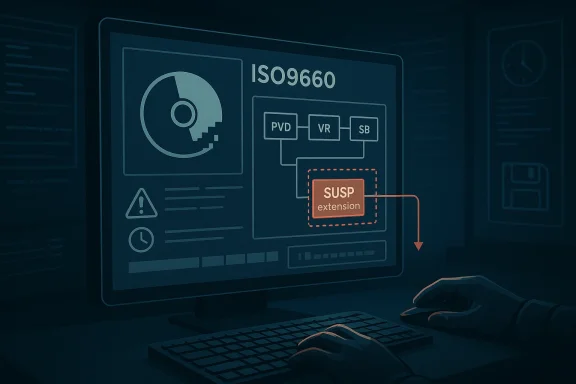 What the Vulnerability Actually Is
At its core, CVE-2026-40026 is an out-of-bounds read in The Sleuth Kit’s handling of ISO9660 SUSP-related data. In practical terms, the parser is trusting reference metadata in a way that allows it to look beyond the memory region it should be reading. That does not always mean immediate code execution or a deterministic crash, but it does mean the process can read unintended memory and potentially stumble into unstable behavior.The flaw appears to live in the SUSP parsing logic rather than in the broader filesystem engine. That matters because parser bugs in helper paths often survive longer than headline features; they are less visible in everyday testing, yet they still sit in the critical path when a suspicious image is opened. In this case, the risk is concentrated in a format-specific routine that must interpret nested metadata correctly every time it sees a crafted ISO image.
Why out-of-bounds reads matter
An out-of-bounds read is not just a “bug that might crash.” It can expose adjacent memory, trigger undefined behavior, or cause the application to make bad decisions based on garbage data. Even when the immediate effect is only a crash, that still becomes a denial-of-service concern in a workflow that depends on stable image parsing. The issue is especially relevant when the parser is used in automated pipelines or forensic suites that ingest many files in succession.There is also a broader engineering lesson. File parsers routinely process hostile input because the file itself is the attack vector. That means every length field, offset, and reference must be treated as suspect until proven otherwise. When any one of those values is trusted too early, the parser can be tricked into reading memory it never intended to access. That is the classic shape of a parser trust-boundary failure.
Why the SUSP layer is delicate
SUSP handling tends to be fragile because it is extension logic layered on top of a legacy filesystem format. Legacy compatibility means the parser may need to accept odd constructions or partial records that would be rejected elsewhere. That flexibility is useful in forensic work, but it also expands the room for malformed inputs to exercise edge cases. The result is a familiar tradeoff: better compatibility, larger attack surface.- The bug is in ISO9660 SUSP parsing, not a generic filesystem mount path.
- The primary impact is availability degradation rather than broad compromise.
- The dangerous condition is triggered by crafted metadata inside an image.
- The issue is more likely to matter where images are opened repeatedly.
- Defensive validation must happen before references are consumed.
Historical Context and Prior Art
This is not the first time the Sleuth Kit ecosystem has had to deal with ISO9660 parsing trouble. Historical records show earlier out-of-bounds read issues in related code paths, including SUSP-related parsing in older versions. That history does not mean every new CVE is the same bug repeated, but it does show that filesystem metadata handling is a long-running risk area for the project.That pattern is not unique to The Sleuth Kit. Any tool that must interpret compact binary structures from untrusted sources will accumulate sharp edges over time. The older the format, the more likely it is that modern code has to keep up with historical quirks, nonconforming images, and compatibility expectations that were never designed with hostile inputs in mind. In other words, these bugs are less a surprise than a recurring tax on compatibility.
Why forensic tools are especially exposed
Forensic utilities are unusual because they often process material that is intentionally broken. A normal consumer application can reject a malformed file and move on, but a forensic parser may need to continue as far as possible to recover evidence. That design requirement makes robustness harder to achieve and creates more opportunities for edge cases to become vulnerabilities. A parser that must be permissive can also become a parser that is easier to abuse.There is also a workflow issue. Disk images are often handled in batches, by analysts, scripts, or investigative tooling that trusts the parser to fail safely. If the parser is only partially resilient, one malformed image may degrade the entire pipeline. That is why a seemingly modest read bug can become a meaningful operational problem in forensic labs and incident-response teams.
What changed with CVE-2026-40026
The notable shift is not that parsers are suddenly fragile; it is that the vulnerability is now visible enough to be tracked separately and prioritized by downstream consumers. Microsoft’s Security Update Guide is explicitly designed to surface these issues in a way that helps customers sort and filter by product and vulnerability type. That makes the listing more than a simple notice; it becomes a triage signal forepend on Microsoft’s security ecosystem.- Older ISO9660 parser issues show this is a recurring attack surface.
- Forensic software tends to be more permissive than ordinary file readers.
- Compatibility pressure often collides with strict memory safety.
- Batch image processing can am single malformed file.
- Downstream visibility matters because many users encounter Sleuth Kit indirectly.
Microsoft’s Impact Language and What It Implies
Microsoft’s description for this CVE is unusually useful because it gives defenders a precise operational frame. The wording indicates that performance may be reduced or resources may become intermittently unavailable, but even repeated exploitation does not let the attacker completely deny service that means the defect is serious, yet bounded: a reliability and availability issue, not a full-service collapse.That distinction matters because many organizations still triage vulnerabilities with a binary mindset. If a bug is not a total outage, it can be mentally downgraded. But partial service loss is often exactly what causes real pain in production,affected component sits in a processing pipeline that other tools depend on. In practice, “only intermittent” can still mean lost analyst time, stalled jobs, and noisy support tickets.
Partial availability is still real risk
A system that is “mostly available” can be harder to defend than one that fails hard. Intermittent faults are often misdiagnosed as flaky storage, network errors, or user mistakes. That creates a long tail of operational confusion,ven if the vulnerability never becomes a dramatic exploit. In many enterprise environments, the hidden cost of unreliability is larger than the direct security impact.There is also a downstream effect on confidence. If a forensic or recovery tool behaves unpredictably when reading crafted images, operators may stop trusting results or begin rerunning jobs defensively. That costs time and makes incident handling less efficient. Availability bugs in this class are not glamorous, but they can easily become workflow killers.
Why Microsoft’s phrasing is worth reading closely
Microsoft’s wording is carefully chosen. It says the attacker can cause interruptions, but not a full and lasting denial of access. That suggests the flaw may be dependent on repeated triggers, a constrained code path, or some form of recovery after each failure. Inference is required here, but the language strongly points toward a bounded reliability problem rather than a persistent takeover scenario.- The advisory stresses reduced performance more than takeover risk.
- The impact is described as intermittent, not total.
- Repeated exploitation does not create a complete lockout.
- The defect still matters in high-volume or automated environments.
- Operational fatigue can make these issues harder to spot than crashes.
How Exploitation Would Likely Work
The most plausible attack model is simple: the victim opens or processes a malicious ISO9660 image containing crafted SUSP metadata. The parser then follows a reference that points beyond the expected bounds, which can cause the application to read unintended memory or enter a faulting state. Because the vulnerability sits in a content-parsing workflow, the attacker does not necessarily need to compromise a host first; the file itself becomes the delivery vehicle.That makes the threat model familiar. Many parser vulnerabilities depend on a user or automated system handling a file that looks legitimate enough to pass initial checks. In forensic and recovery contexts, the input may be an image received from a third party, extracted from a case archive, or pulled from a compromised system. Any of those conditions can give a crafted file the chance it needs to hit the vulnerable path.
Why crafted images are powerful
Crafted images are effective because they let attackers control both structure and content. Unlike a live network attack, where the target may drop malformed traffic early, a disk image is often treated as a thing to be opened, enumerated, and mined for details. That gives the attacker time to exercise edge cases in reference handling and bounds checking. If the parser assumes a field is valid because the surrounding structure looks credible, the attack can succeed.The issue is also attractive because it targets a trusted utility. Security tools are often granted a degree of operational confidence, which means they may run with elevated privileges, broad filesystem access, or in unattended jobs. Even when the bug is “just” a read error, that placement can turn a technical flaw into a real operational disturbance.
What the attacker gains
With an out-of-bounds read, the immediate gain is not necessarily a clean exploit chain. More often, the attacker gets instability, possible information leakage, or at least a denial-of-service-like interruption. That still matters, because file-parsing tools are often used in forensic contexts where the mere interruption of analysis can delay incident response. In a narrow sense, the vulnerability is about memory safety; in a broader sense, it is about trust in tooling.- The attacker likely needs to supply a malicious ISO image.
- The vulnerable path is triggered during SUSP parsing.
- The effect may be a crash, partial outage, or memory exposure.
- Automated workflows increase the chance of real impact.
- The bug is especially sensitive where privileged tooling handles untrusted media.
Enterprise Impact Versus Consumer Impact
For enterprises, the big question is not whether a desktop user notices the flaw. It is whether the affected parser is embedded in a workflow that processes untrusted images repeatedly and at scale. Forensics labs, incident-response teams, archival systems, and content-extraction pipelines are all plausible candidates. In those settings, even a partial interruption can create backlogs, delay evidence handling, or force manual retry logic.Consumer impact is narrower but not irrelevant. Most consumers do not knowingly use The Sleuth Kit, but they may encounter software that incorporates it indirectly. If an application reads ISO images for inspection, recovery, or indexing, the same parsing flaw can surface as a hang, a crash, or an error loop. The user may never know the root cause; they will just see a tool that behaves poorly on one file.
Why enterprises feel the pain first
Enterprise environments tend to magnify parser issues because they automate everything. One malformed image may be enough to interrupt a scheduled job, trigger retries, or poison a queue. The impact is not just one failed parse; it is the knock-on effect on downstream workflows that depend on stable file ingestion. That makes a “moderate” vulnerability feel much larger in practice.There is also the issue of provenance. In an enterprise setting, images often come from other teams, vendors, or incident responders, which means users may trust them too quickly. A file that appears to originate from a legitimate source can still be malicious or corrupted. That trust gap is exactly where parser bugs thrive.
Consumer exposure is usually indirect
For consumers, the issue is more likely to show up through bundled software than through The Sleuth Kit itself. That indirectness matters because it makes patch visibility worse. A vendor may quietly update the embedded dependency, or it may take time before the consumer-facing product advertises that it has inherited the fix. That lag is one reason downstream CVE awareness matters.- Enterprises are more exposed because they process many images.
- Consumer exposure is usually indirect through software bundles.
- Automation increases the odds that one bad file affects many jobs.
- Trust in incoming media is often higher than it should be.
- Incident-response environments are especially sensitive to parser failures.
Patch Prioritization and Remediation Strategy
The first remediation step is straightforward: identify whether any of your tools, appliances, or internal workflows use The Sleuth Kit 4.14.0 or earlier. The public advisory trail indicates the issue affects versions through 4.14.0, which makes version inventory the obvious starting point. If you are relying on a repackaged product, though, you may need to wait for the vendor’s own update stream rather than the upstream project alone.The second step is to reduce exposure to untrusted images wherever possible. That does not mean banning all disk-image analysis; it means treating suspicious files as hostile input and isolating them in controlled environments. Sandboxing, dedicated analysis hosts, and controlled ingestion paths all help reduce the blast radius if a parser bug is triggered.
Practical remediation checklist
- Inventory every product or script that can open ISO9660 images with Sleuth Kit components.
- Confirm versions and determine whether 4.14.0 or earlier is in use.
- Patch or upgrade to a fixed build from the upstream project or vendor.
- Isolate parsing workflows on dedicated hosts or sandboxes.
- Review automation that processes external or user-supplied images.
- Monitor for repeated failures that might indicate malformed inputs.
- Document the dependency so future image-handling tools are not overlooked.
Why downstream vendors matter
Microsoft’s inclusion of the CVE is a reminder that visibility drives action. Many defenders track Microsoft-adjacent advisories more closely than upstream project pages, so the Security Update Guide becomes a practical amplifier for third-party issues. That is especially valuable when the affected software shows up inside enterprise imaging tools or response products that are not obviously tied to the original upstream package.- Check whether 4.14.0 or older is present anywhere.
- Prefer sandboxed analysis for unknown images.
- Audit scripts that ingest files from external sources.
- Don’t forget appliances and bundled utilities.
- Treat repeated parser failures as a clue, not noise.
Strengths and Opportunities
The good news is that this appears to be a vulnerability with a clear remediation path and a limited, well-defined attack surface. Teams that already track filesystem parsers closely can likely contain the issue quickly, and vendors that package The Sleuth Kit should be able to roll fixes into their own releases without architectural upheaval. The incident is also a useful reminder that file-parsing hygiene can be improved with relatively modest process changes.- The flaw is narrowly scoped to ISO9660 SUSP parsing.
- The impact is primarily availability-related, which is easier to communicate internally.
- Upstream versioning gives defenders a clear place to start.
- Vendor packaging can deliver fixes to many downstream customers at once.
- The bug is a strong candidate for parser-hardening reviews.
- Sandboxing and input isolation are practical mitigations.
- Security teams can use the CVE to justify a broader dependency audit.
Risks and Concerns
The main risk is complacency. Because Microsoft describes the impact as partial rather than total, some teams may decide the issue is only a nuisance. That would be a mistake in environments that rely on disk-image parsing for incident response, recovery, or automated analysis, because even intermittent failures can create genuine operational friction.- Partial availability problems are easy to underestimate.
- Forensic and recovery tools often process hostile or corrupted input.
- Malformed images can interrupt batch workflows and delay response.
- Indirect exposure through bundled software makes inventory difficult.
- Repeated failures can look like ordinary stability issues rather than a security flaw.
- Legacy compatibility pressure makes parser code harder to harden.
- Downstream patch lag can extend the exposure window.
Looking Ahead
The next important development is whether downstream vendors publicly identify where The Sleuth Kit is embedded and how quickly they ship their own fixes. That will determine whether CVE-2026-40026 remains a narrow upstream advisory or becomes a broader ecosystem concern. Just as important will be whether organizations use this as a prompt to review other legacy image-parsing dependencies that may have similar trust-boundary issues.The other thing to watch is whether the issue encourages more defensive defaults in forensic tooling. If vendors and maintainers respond by tightening validation, improving sandboxing, and isolating parser execution, the CVE may end up having a positive spillover effect beyond the specific bug. In security work, that is often how real progress happens: one bounded flaw forces a better discipline around an entire category of inputs.
- Watch for vendor advisories that repackage the upstream fix.
- Check whether tools handling disk images add sandboxing by default.
- Monitor for additional filesystem-parser CVEs in adjacent code paths.
- Look for guidance on whether automated pipelines should quarantine unknown ISOs.
- Expect this CVE to appear in broader dependency-inventory discussions.
Source: MSRC Security Update Guide - Microsoft Security Response Center
