

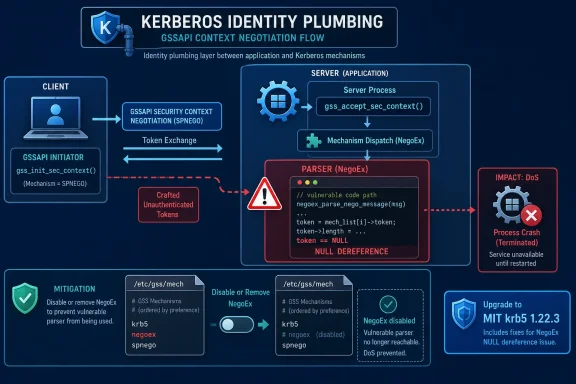
CVE-2026-40355 is a denial-of-service flaw disclosed in MIT Kerberos 5 before version 1.22.3, affecting systems where an application accepts GSSAPI security contexts and a NegoEx mechanism is registered in
Kerberos is one of those technologies that many users never knowingly touch and many administrators never stop relying on. In Windows environments, it is the protocol that quietly carries much of the trust model behind Active Directory logons, service tickets, constrained delegation, and the ordinary miracle of single sign-on. In Unix and mixed-platform estates, MIT Kerberos remains one of the canonical implementations that binds Linux, macOS, appliances, academic networks, research clusters, and enterprise services into the same authentication conversation.
CVE-2026-40355 sits in that second world: MIT krb5, not Windows’ own Kerberos implementation in the Local Security Authority or domain controller stack. That distinction matters, because a Microsoft Security Response Center listing can make any Kerberos-labeled bug look, at first glance, like a Windows emergency. This one is better understood as a supply-chain and interoperability problem that may touch Microsoft customers through Linux workloads, third-party appliances, cross-realm setups, developer tools, or services that use MIT krb5 libraries.
The vulnerability is in how MIT krb5 handles NegoEx parsing when an application calls
The failure mode is blunt. Under the vulnerable conditions, crafted unauthenticated input can trigger a NULL pointer dereference in
But availability-only does not mean harmless. A service that crashes before it can accept new authenticated sessions can be every bit as disruptive as a more glamorous vulnerability, especially when it sits in front of file access, remote login, web single sign-on, NFS, database access, or internal control planes. The business impact depends less on the CVSS label than on what process dies, whether it restarts cleanly, and how often an attacker can make it fall over again.
This is where security scoring and operations often talk past each other. CVSS is trying to describe the technical shape of the flaw. Administrators are trying to answer a colder question: “Can somebody keep users from working on Monday morning?” In some deployments, the answer will be no, because the required NegoEx registration is absent or the exposed service is not using MIT krb5 in the vulnerable path. In others, the answer may be “yes, but only for this one daemon,” which is still enough to ruin a maintenance window.
The attacker’s win condition is also modest but practical. They do not need to persist inside the environment. They do not need to steal anything. They only need to repeatedly deliver malformed negotiation traffic to a service and let the process supervisor, init system, load balancer, or human operator play whack-a-mole.
MIT krb5 added NegoEx support years after Kerberos itself became boring infrastructure. That is not a criticism; interoperability is a moving target, and identity stacks accumulate negotiation formats because real networks are messy. Enterprises do not run one operating system, one library, one browser, one reverse proxy, one application server, or one generation of authentication scheme.
The catch is that negotiation code handles untrusted input before the system has established much of anything. It is parsing tokens from clients that may not be authenticated yet. That makes it a dangerous place for assumptions, especially assumptions about lengths, offsets, vectors, and optional fields.
CVE-2026-40355 appears to be the simpler of two closely related NegoEx parsing fixes in MIT krb5. The relevant upstream change checks the result of a helper call before dereferencing it. That is exactly the sort of one-line defensive programming omission that sounds trivial after discovery and remains serious before discovery because the parser is reachable from the network in the right application path.
That chain of requirements is why this is not a universal Kerberos panic. Many Linux systems ship krb5 libraries without exposing a vulnerable acceptor service to arbitrary network clients. Many services use Kerberos through paths that never involve NegoEx. Many servers will not have the relevant NegoEx mechanism registered at all.
Still, “narrow” is not the same as “rare enough to ignore.” Mixed Windows and Unix estates are exactly where GSSAPI configurations become bespoke. Research institutions, universities, high-performance computing clusters, storage systems, internal web applications, and legacy enterprise middleware often keep authentication glue that nobody wants to disturb because it has worked for years.
The highest-risk systems are not necessarily the most visible systems. They are the ones where Kerberos-enabled services are reachable by large internal populations, where a crash prevents new sessions, and where service restarts are slow, stateful, or noisy. A public Internet exposure would be worse, but an internal denial-of-service path against identity-adjacent services is still a serious nuisance in a flat or lightly segmented network.
That is a healthy change, even if it complicates patch triage. A bug in MIT Kerberos can matter to Microsoft customers without being a Windows Kerberos vulnerability. Azure-hosted Linux workloads, cross-platform identity integrations, products that bundle open-source Kerberos libraries, and enterprise applications that rely on GSSAPI can all sit near Microsoft infrastructure without being authored by Microsoft.
For Windows administrators, the practical move is to avoid the reflexive overreaction and the reflexive dismissal. This is not evidence that every domain controller is remotely crashable via CVE-2026-40355. It is also not irrelevant merely because the vulnerable implementation is MIT krb5. The modern Microsoft estate is bigger than Windows Server, and the modern Windows shop usually has enough Linux in the basement to make open-source identity bugs worth reading.
The distinction also matters for patch ownership. If the affected component is part of a Linux distribution, the fix may arrive through Ubuntu, Debian, Red Hat, SUSE, Oracle Linux, or another vendor channel. If it is bundled inside an appliance, the vendor may need to rebuild. If it is statically linked into a product, the operating system package version may tell only part of the story.
The operational challenge is discovering where the vulnerable library is actually used. Package managers can identify installed krb5 versions, but they do not always reveal which long-running services are linked against the vulnerable library or whether those services have been restarted since an update. Containers add another layer, because the host may be patched while an old image continues to run with an older krb5 build.
Static linking and vendor packaging are the usual traps. A security scanner may report the host as clean while an application carries its own copy of krb5. Conversely, a scanner may report a vulnerable library on a machine that has no reachable GSSAPI acceptor path and no NegoEx registration. Both findings require judgment, not blind checkbox remediation.
The mitigation, where patching is not immediate, is also straightforward in concept: remove or disable the NegoEx mechanism registration if it is not required. That is not a casual change. Authentication negotiation mechanisms exist because some client or service may depend on them, and removing entries from
CVE-2026-40355 is a good candidate for a service-centered runbook. The first question is not simply “Do we have krb5 before 1.22.3?” It is “Which services accept GSSAPI contexts, are reachable, and would hurt if they crashed?” That framing pulls the vulnerability out of the package inventory spreadsheet and into the dependency map.
Administrators should look at Kerberos-enabled SSH configurations, web servers with GSSAPI modules, NFS deployments using Kerberos security modes, custom internal services, Java and native applications using GSSAPI, and proxy layers that bridge Windows identity into Unix services. The exact list will vary by environment, but the pattern is the same: any network service that accepts unauthenticated negotiation tokens before establishing a security context deserves scrutiny.
Monitoring also matters. A NULL pointer dereference is noisy in the right logs but easy to miss if restarts are automatic. Crash loops, sudden process exits, repeated defective token errors, and bursts of failed negotiation attempts can all be early signs that someone is probing the path. If the service supervisor masks the user-visible outage, the security team may still want to know that authentication parsing is being abused.
That pairing matters because it changes the narrative from “one missed NULL check” to “this parser had multiple edge-case failures.” It does not mean the sky is falling. It does mean that administrators should treat the 1.22.3 update as a parser hardening release rather than a cosmetic version bump.
Parsers are where mature codebases often rediscover humility. Kerberos itself is old, heavily studied, and central to enterprise authentication. NegoEx support is newer, less universally exercised, and more exposed to complex input structure. When old identity stacks absorb newer negotiation formats, the integration seams become the place to audit.
This is not unique to MIT krb5. The industry has seen the same pattern in TLS extensions, image codecs, archive formats, VPN negotiation layers, SAML parsers, and token libraries. The dangerous code is not always the cryptographic primitive. Often it is the pre-authentication parser that decides what kind of conversation the parties are about to have.
Those systems often use MIT krb5 or Heimdal Kerberos libraries to participate in a realm, accept service tickets, or negotiate authentication through GSSAPI. They may be joined to an AD domain through SSSD, realmd, Samba, or vendor-specific agents. They may expose services that Windows clients consume every day without anyone thinking of them as identity infrastructure.
That is why this class of vulnerability can be awkward to triage. The Windows team may understand the business impact of Kerberos outages, while the Linux team owns the packages, and the application team owns the service configuration. If nobody owns the cross-platform authentication boundary, a medium-severity CVE can sit unresolved until it becomes an outage story.
The practical answer is to map the boundary. Which non-Windows systems accept Kerberos authentication from Windows clients? Which ones use GSSAPI libraries from the OS? Which ones have custom
What administrators should not do is treat the mere presence of MIT krb5 before 1.22.3 as proof of imminent exploitation. The attack path depends on configuration and service behavior. A dormant library on a workstation is not the same risk as a Kerberos-enabled web gateway handling authentication for thousands of users.
At the same time, the “medium” label should not become an excuse to defer indefinitely. Availability bugs in authentication-adjacent services have a way of becoming political inside organizations because they produce visible disruption without the narrative clarity of a breach. Users cannot access files, applications stop accepting logons, batch jobs fail, and everyone asks why a “medium” vulnerability was still open.
The best security teams will fold this into normal hygiene. They will not launch a war room for every krb5 package. They will identify the subset of systems where NegoEx and GSSAPI acceptance intersect, apply the fix, and remove unneeded mechanisms. That is boring work, which is precisely why it is effective.
/etc/gss/mech, allowing an unauthenticated remote attacker to crash the process. The bug is not a credential theft story, not a domain takeover story, and not the kind of memory corruption that instantly becomes a late-night incident bridge for every Windows admin. It is something more mundane and, in many environments, more operationally annoying: a remote way to knock over authentication-dependent services if a narrow but real configuration is present. That makes it a useful reminder that identity infrastructure fails in layers, and the obscure compatibility layer is often where availability goes to die.
 Kerberos Gets Hit Where Administrators Least Like Ambiguity
Kerberos is one of those technologies that many users never knowingly touch and many administrators never stop relying on. In Windows environments, it is the protocol that quietly carries much of the trust model behind Active Directory logons, service tickets, constrained delegation, and the ordinary miracle of single sign-on. In Unix and mixed-platform estates, MIT Kerberos remains one of the canonical implementations that binds Linux, macOS, appliances, academic networks, research clusters, and enterprise services into the same authentication conversation.CVE-2026-40355 sits in that second world: MIT krb5, not Windows’ own Kerberos implementation in the Local Security Authority or domain controller stack. That distinction matters, because a Microsoft Security Response Center listing can make any Kerberos-labeled bug look, at first glance, like a Windows emergency. This one is better understood as a supply-chain and interoperability problem that may touch Microsoft customers through Linux workloads, third-party appliances, cross-realm setups, developer tools, or services that use MIT krb5 libraries.
The vulnerability is in how MIT krb5 handles NegoEx parsing when an application calls
gss_accept_sec_context(). That function name will not mean much to most desktop users, but it is familiar territory for anyone who has debugged GSSAPI-backed authentication. It is the acceptor side of a security context negotiation: the server-facing component that receives a token, processes it, and tries to establish a trusted authenticated session.The failure mode is blunt. Under the vulnerable conditions, crafted unauthenticated input can trigger a NULL pointer dereference in
parse_nego_message, causing the process to terminate. In other words, the attacker does not need a password, a ticket, or a foothold; they need network reachability to a service that exercises the vulnerable code path.The Severity Score Hides a Very Administrator-Shaped Problem
The published CVSS score for CVE-2026-40355 is 5.9, which lands in the familiar “medium” band that security teams often triage behind higher-scoring remote code execution and privilege escalation bugs. That score is defensible. The issue has high attack complexity, no confidentiality impact, no integrity impact, and an availability-only consequence.But availability-only does not mean harmless. A service that crashes before it can accept new authenticated sessions can be every bit as disruptive as a more glamorous vulnerability, especially when it sits in front of file access, remote login, web single sign-on, NFS, database access, or internal control planes. The business impact depends less on the CVSS label than on what process dies, whether it restarts cleanly, and how often an attacker can make it fall over again.
This is where security scoring and operations often talk past each other. CVSS is trying to describe the technical shape of the flaw. Administrators are trying to answer a colder question: “Can somebody keep users from working on Monday morning?” In some deployments, the answer will be no, because the required NegoEx registration is absent or the exposed service is not using MIT krb5 in the vulnerable path. In others, the answer may be “yes, but only for this one daemon,” which is still enough to ruin a maintenance window.
The attacker’s win condition is also modest but practical. They do not need to persist inside the environment. They do not need to steal anything. They only need to repeatedly deliver malformed negotiation traffic to a service and let the process supervisor, init system, load balancer, or human operator play whack-a-mole.
NegoEx Is the Compatibility Layer That Makes This More Interesting
The interesting word in this advisory is not Kerberos; it is NegoEx. The NEGOEX mechanism is part of the broader family of negotiation machinery used to decide which authentication mechanism two parties will use. In Windows-heavy environments, negotiation is the normal plumbing behind SPNEGO, Kerberos, NTLM fallback, and other authentication choices that users experience simply as “it logged me in” or “it prompted me again.”MIT krb5 added NegoEx support years after Kerberos itself became boring infrastructure. That is not a criticism; interoperability is a moving target, and identity stacks accumulate negotiation formats because real networks are messy. Enterprises do not run one operating system, one library, one browser, one reverse proxy, one application server, or one generation of authentication scheme.
The catch is that negotiation code handles untrusted input before the system has established much of anything. It is parsing tokens from clients that may not be authenticated yet. That makes it a dangerous place for assumptions, especially assumptions about lengths, offsets, vectors, and optional fields.
CVE-2026-40355 appears to be the simpler of two closely related NegoEx parsing fixes in MIT krb5. The relevant upstream change checks the result of a helper call before dereferencing it. That is exactly the sort of one-line defensive programming omission that sounds trivial after discovery and remains serious before discovery because the parser is reachable from the network in the right application path.
The Bug Is Narrow, but the Blast Radius Depends on Service Design
The advisory’s conditions are specific. A vulnerable system is running MIT krb5 before 1.22.3. An application must callgss_accept_sec_context(). A NegoEx mechanism must be registered in /etc/gss/mech. The attacker must be able to reach the service and send a token that causes the bad parse.That chain of requirements is why this is not a universal Kerberos panic. Many Linux systems ship krb5 libraries without exposing a vulnerable acceptor service to arbitrary network clients. Many services use Kerberos through paths that never involve NegoEx. Many servers will not have the relevant NegoEx mechanism registered at all.
Still, “narrow” is not the same as “rare enough to ignore.” Mixed Windows and Unix estates are exactly where GSSAPI configurations become bespoke. Research institutions, universities, high-performance computing clusters, storage systems, internal web applications, and legacy enterprise middleware often keep authentication glue that nobody wants to disturb because it has worked for years.
The highest-risk systems are not necessarily the most visible systems. They are the ones where Kerberos-enabled services are reachable by large internal populations, where a crash prevents new sessions, and where service restarts are slow, stateful, or noisy. A public Internet exposure would be worse, but an internal denial-of-service path against identity-adjacent services is still a serious nuisance in a flat or lightly segmented network.
Microsoft’s Presence Is a Signal, Not a Windows Panic Button
The source material comes from Microsoft’s Security Update Guide, which is why WindowsForum readers are right to pay attention. But the important nuance is that Microsoft’s advisory ecosystem now regularly tracks vulnerabilities outside the classic Windows codebase. Cloud services, Linux dependencies, open-source components, developer tooling, container images, and third-party packages all live inside Microsoft’s customer risk envelope.That is a healthy change, even if it complicates patch triage. A bug in MIT Kerberos can matter to Microsoft customers without being a Windows Kerberos vulnerability. Azure-hosted Linux workloads, cross-platform identity integrations, products that bundle open-source Kerberos libraries, and enterprise applications that rely on GSSAPI can all sit near Microsoft infrastructure without being authored by Microsoft.
For Windows administrators, the practical move is to avoid the reflexive overreaction and the reflexive dismissal. This is not evidence that every domain controller is remotely crashable via CVE-2026-40355. It is also not irrelevant merely because the vulnerable implementation is MIT krb5. The modern Microsoft estate is bigger than Windows Server, and the modern Windows shop usually has enough Linux in the basement to make open-source identity bugs worth reading.
The distinction also matters for patch ownership. If the affected component is part of a Linux distribution, the fix may arrive through Ubuntu, Debian, Red Hat, SUSE, Oracle Linux, or another vendor channel. If it is bundled inside an appliance, the vendor may need to rebuild. If it is statically linked into a product, the operating system package version may tell only part of the story.
The Fix Is Simple; Finding Every Copy Is Not
The upstream fix is in MIT krb5 1.22.3 and in the relevant source commit that hardens NegoEx message parsing. At the code level, the fix is unromantic: validate the pointer before dereferencing it, and treat malformed input as a defective token rather than letting the process crash. That is the right failure mode for authentication parsing. Reject the token, preserve the service.The operational challenge is discovering where the vulnerable library is actually used. Package managers can identify installed krb5 versions, but they do not always reveal which long-running services are linked against the vulnerable library or whether those services have been restarted since an update. Containers add another layer, because the host may be patched while an old image continues to run with an older krb5 build.
Static linking and vendor packaging are the usual traps. A security scanner may report the host as clean while an application carries its own copy of krb5. Conversely, a scanner may report a vulnerable library on a machine that has no reachable GSSAPI acceptor path and no NegoEx registration. Both findings require judgment, not blind checkbox remediation.
The mitigation, where patching is not immediate, is also straightforward in concept: remove or disable the NegoEx mechanism registration if it is not required. That is not a casual change. Authentication negotiation mechanisms exist because some client or service may depend on them, and removing entries from
/etc/gss/mech can have compatibility consequences. The right approach is to test the change against the affected service path, not to treat the file as a decorative registry of optional toys.Availability Bugs Deserve Better Runbooks
Security teams tend to build crisp runbooks for code execution vulnerabilities and fuzzier ones for denial-of-service bugs. That is backwards for many real organizations. A remote code execution flaw may be terrifying, but if it is not exploitable in your configuration, it remains theoretical. A denial-of-service flaw that crashes a revenue-critical internal service every ten seconds is an incident, even if no data leaves the building.CVE-2026-40355 is a good candidate for a service-centered runbook. The first question is not simply “Do we have krb5 before 1.22.3?” It is “Which services accept GSSAPI contexts, are reachable, and would hurt if they crashed?” That framing pulls the vulnerability out of the package inventory spreadsheet and into the dependency map.
Administrators should look at Kerberos-enabled SSH configurations, web servers with GSSAPI modules, NFS deployments using Kerberos security modes, custom internal services, Java and native applications using GSSAPI, and proxy layers that bridge Windows identity into Unix services. The exact list will vary by environment, but the pattern is the same: any network service that accepts unauthenticated negotiation tokens before establishing a security context deserves scrutiny.
Monitoring also matters. A NULL pointer dereference is noisy in the right logs but easy to miss if restarts are automatic. Crash loops, sudden process exits, repeated defective token errors, and bursts of failed negotiation attempts can all be early signs that someone is probing the path. If the service supervisor masks the user-visible outage, the security team may still want to know that authentication parsing is being abused.
The Companion Bug Makes the Parser Story Worse
CVE-2026-40355 was fixed alongside another NegoEx parsing vulnerability, CVE-2026-40356. The second issue involves an integer underflow and an out-of-bounds read of up to 52 bytes, again in a path reachable when an application callsgss_accept_sec_context() with NegoEx registered. Public descriptions indicate that exfiltration of the bytes read does not appear possible, with the main consequence again being possible process termination.That pairing matters because it changes the narrative from “one missed NULL check” to “this parser had multiple edge-case failures.” It does not mean the sky is falling. It does mean that administrators should treat the 1.22.3 update as a parser hardening release rather than a cosmetic version bump.
Parsers are where mature codebases often rediscover humility. Kerberos itself is old, heavily studied, and central to enterprise authentication. NegoEx support is newer, less universally exercised, and more exposed to complex input structure. When old identity stacks absorb newer negotiation formats, the integration seams become the place to audit.
This is not unique to MIT krb5. The industry has seen the same pattern in TLS extensions, image codecs, archive formats, VPN negotiation layers, SAML parsers, and token libraries. The dangerous code is not always the cryptographic primitive. Often it is the pre-authentication parser that decides what kind of conversation the parties are about to have.
Windows Shops Should Inventory the Unix Edge of Their Identity Plane
For a WindowsForum audience, the most useful lesson is not “patch Linux,” though that is certainly part of it. The better lesson is that Windows identity rarely stops at Windows anymore. Active Directory may remain the center of gravity, but the authentication plane extends into Linux servers, Kubernetes clusters, storage appliances, CI systems, developer workstations, SaaS connectors, and third-party gateways.Those systems often use MIT krb5 or Heimdal Kerberos libraries to participate in a realm, accept service tickets, or negotiate authentication through GSSAPI. They may be joined to an AD domain through SSSD, realmd, Samba, or vendor-specific agents. They may expose services that Windows clients consume every day without anyone thinking of them as identity infrastructure.
That is why this class of vulnerability can be awkward to triage. The Windows team may understand the business impact of Kerberos outages, while the Linux team owns the packages, and the application team owns the service configuration. If nobody owns the cross-platform authentication boundary, a medium-severity CVE can sit unresolved until it becomes an outage story.
The practical answer is to map the boundary. Which non-Windows systems accept Kerberos authentication from Windows clients? Which ones use GSSAPI libraries from the OS? Which ones have custom
/etc/gss/mech entries? Which ones are exposed beyond a trusted subnet? Those are not exotic questions. They are the identity-plane equivalent of knowing which servers terminate TLS.The Patch Queue Needs Context, Not Theater
The responsible response to CVE-2026-40355 is neither panic nor apathy. Patch where vendor updates are available. Disable unused NegoEx registrations where testing proves they are unnecessary. Restart affected services after library updates. Watch for repeated crashes or malformed negotiation traffic. Prioritize Internet-facing or broadly reachable internal services first.What administrators should not do is treat the mere presence of MIT krb5 before 1.22.3 as proof of imminent exploitation. The attack path depends on configuration and service behavior. A dormant library on a workstation is not the same risk as a Kerberos-enabled web gateway handling authentication for thousands of users.
At the same time, the “medium” label should not become an excuse to defer indefinitely. Availability bugs in authentication-adjacent services have a way of becoming political inside organizations because they produce visible disruption without the narrative clarity of a breach. Users cannot access files, applications stop accepting logons, batch jobs fail, and everyone asks why a “medium” vulnerability was still open.
The best security teams will fold this into normal hygiene. They will not launch a war room for every krb5 package. They will identify the subset of systems where NegoEx and GSSAPI acceptance intersect, apply the fix, and remove unneeded mechanisms. That is boring work, which is precisely why it is effective.
The Small Parser Bug That Belongs on the Big Identity Checklist
This vulnerability is concrete enough to act on and narrow enough to avoid drama. The details point to a familiar operational pattern: a pre-authentication parser, a specific optional mechanism, a crashable service path, and a patch that turns malformed input into a rejected token instead of a dead process.- Organizations should upgrade MIT krb5 to version 1.22.3 or a distribution-provided fixed build wherever affected packages are installed.
- Administrators should check whether
/etc/gss/mechregisters a NegoEx mechanism on systems that accept GSSAPI security contexts. - Teams should prioritize services that are network reachable and business-critical, especially SSH, web, storage, and custom applications using Kerberos or GSSAPI.
- Systems patched at the library level may still require service restarts before the fixed code is actually loaded.
- If NegoEx is not required, disabling its registration can reduce exposure, but the change should be tested because authentication negotiation failures can be subtle.
- Windows administrators should treat this as a cross-platform identity risk rather than a Windows Kerberos domain-controller emergency.
References
- Primary source: MSRC
Published: 2026-06-03T01:43:19-07:00
Security Update Guide - Microsoft Security Response Center
 msrc.microsoft.com
- Related coverage: indico.cern.ch
