

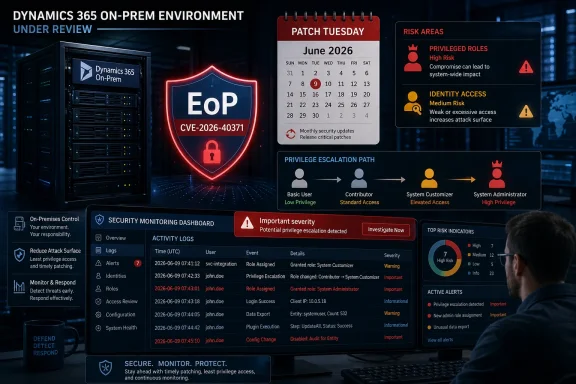
Microsoft’s Quiet Dynamics Bug Lands in a Noisy Patch Tuesday
June 2026 Patch Tuesday was not a small release. Microsoft shipped fixes across a sprawling product estate, with reporting around the release counting roughly 200 newly addressed flaws and several publicly disclosed zero-days. Against that backdrop, CVE-2026-40371 could easily disappear into the spreadsheet haze that every security team knows too well.
That would be a mistake. Dynamics 365 on-premises is not a consumer endpoint app or a forgettable optional component. In many environments, it is wired into sales, customer records, case management, finance workflows, authentication plumbing, custom plug-ins, reporting jobs, and internal line-of-business automation. A privilege boundary problem inside that kind of system is not just a software defect; it is a potential business-process compromise.
The most important word in Microsoft’s title is not “Important,” and it is not even “Elevation.” It is “on-premises.” Microsoft’s cloud-first messaging has trained much of the market to think of Dynamics as a service Microsoft operates. CVE-2026-40371 is a reminder that plenty of organizations still own the operational burden themselves, including the patch cadence, the internet exposure decisions, the database dependencies, and the identity assumptions that make or break a compromise.
Microsoft’s public advisory, at least at release time, gives defenders the official signal they need but not the kind of root-cause detail attackers would love. That asymmetry is normal for Patch Tuesday. It is also uncomfortable for admins who must decide whether an “Important” EoP in a major business platform should interrupt a maintenance calendar already crowded with Windows, Exchange, SQL Server, Azure, Office, and browser updates.
Report Confidence Is the Part Nobody Reads Until It Matters
The text supplied with the advisory points to a deceptively dry metric: confidence in the existence of the vulnerability and the credibility of the known technical details. In plain English, this is the field that helps distinguish rumor from vendor-confirmed reality. A vulnerability that exists only as a vague claim is different from one acknowledged by the affected vendor, assigned a CVE, placed in a security guide, and tied to a supported update.
For CVE-2026-40371, the practical answer is straightforward: this is a Microsoft-acknowledged vulnerability in a Microsoft product, not a speculative blog post. That does not mean the public has exploit code, root-cause analysis, or a proof-of-concept chain. It means the vendor has enough information to classify, publish, and patch it.
That distinction matters because defenders often confuse “low public detail” with “low reality.” The absence of a juicy write-up is not evidence that the flaw is imaginary or benign. It may simply mean Microsoft is withholding exploit-enabling detail while customers patch, or that the report came through a private disclosure path, or that the affected code is obscure enough that independent analysis has not yet caught up.
The report-confidence lens also works in the opposite direction. If a vulnerability is only rumored, security leaders may sensibly wait for corroboration before mobilizing scarce operations staff. Here, the calculus is different. The uncertainty is not whether the vulnerability exists; the uncertainty is how easily it can be reproduced, how attractive it is to attackers, and how it might interact with the messy customizations common in real Dynamics deployments.
Elevation of Privilege Is Often the Second Act, Not the Opening Scene
Elevation-of-privilege bugs are sometimes underrated because they sound less dramatic than remote code execution. That is an old trap. In enterprise intrusions, the first step is often phishing, credential theft, token abuse, password spraying, exposed VPN access, a compromised service account, or a vulnerable edge system. The damaging part comes later, when an attacker turns ordinary access into privileged access.
Dynamics 365 on-premises is especially sensitive to that pattern. The platform is designed to enforce business roles, security scopes, record-level permissions, custom workflows, and administrative boundaries. If an attacker can move from a lesser role to a greater one, the blast radius may include customer data, internal cases, workflow manipulation, plug-in deployment, or access to integrations that were never meant to be exposed to a low-privilege user.
That is why the phrase authorized attacker should not comfort anyone. Many Microsoft advisories use that language to mean the attacker needs some level of authentication or valid access before exploiting the issue. In a modern enterprise, authenticated access is not a high bar. It is the baseline condition attackers spend all day trying to obtain.
The real question for defenders is not whether CVE-2026-40371 allows a random person on the internet to instantly own a Dynamics server. The better question is whether a compromised help-desk account, overprivileged sales user, stale integration identity, or partner account could use the flaw to exceed its intended authority. That is the scenario where EoP vulnerabilities earn their keep.
On-Premises Dynamics Carries the Weight Microsoft’s Cloud Usually Hides
The on-premises edition of Dynamics 365 exists for reasons that are not going away: regulatory constraints, data-residency concerns, legacy integrations, customization depth, merger history, latency, and simple organizational inertia. Some deployments are well maintained, closely monitored, and properly segmented. Others are the archeological layers of a decade of CRM decisions.
Cloud services shift a portion of the security burden to Microsoft. On-premises software shifts it back. That includes not only installing patches, but also understanding how the application is exposed, which service accounts it uses, what database permissions it holds, what custom assemblies run inside it, and which identity providers or federation services sit nearby.
This is where Dynamics differs from a simple server role. A CRM platform tends to become a hub. It talks to SQL Server, Active Directory, reporting services, mail systems, web front ends, reverse proxies, third-party plug-ins, ETL jobs, customer portals, and internal APIs. Elevation of privilege inside such a hub can have consequences outside the product’s neat architectural diagram.
The uncomfortable truth is that many organizations know their Windows Server patch level better than they know the effective permission model inside Dynamics. They can report endpoint compliance by the hour, but they may not be able to quickly explain which users can customize workflows, register plug-ins, administer business units, impersonate other users, or trigger privileged integrations. CVE-2026-40371 should push that conversation out of the CRM team’s silo and into the broader security review.
“Important” Is Not a Synonym for “Later”
Microsoft’s severity labels are useful, but they are not a substitute for local risk. “Critical” usually gets emergency meetings. “Important” often gets routed into the next planned patch cycle unless there is evidence of exploitation. That habit makes sense at scale, but it can misfire when the affected product sits close to sensitive data or privileged workflows.
An Important-rated Dynamics privilege-escalation flaw on an isolated internal test instance is one thing. The same class of flaw on an externally reachable production CRM portal with custom code, legacy service accounts, and broad database access is another. Severity is a product-level abstraction; risk is environmental.
Security teams should also account for the Patch Tuesday reverse-engineering clock. Even when Microsoft publishes limited public detail, patches themselves can become clues. Researchers and attackers compare old and new binaries, inspect changed components, and look for permission checks or input-validation logic that moved. A quiet advisory can become much louder after the update is diffed.
That does not mean every Dynamics environment must be patched at panic speed with no testing. Dynamics is too business-critical for reckless change control. But it does mean “Important” should trigger a risk-based maintenance decision, not a shrug.
The Scarcity of Detail Is a Defensive Constraint, Not a Defensive Strategy
At publication, public information about CVE-2026-40371 is thin in the way many Microsoft business-application advisories are thin. The advisory name tells us the affected product family and impact class. The Patch Tuesday context tells us it was part of a broad June 2026 security release. The confidence signal tells us this is vendor-confirmed. What it does not provide is a convenient attacker narrative.
That lack of detail creates a familiar problem for defenders. They cannot write a precise detection rule for a root cause they cannot see. They cannot brief executives with a clean exploit chain. They cannot always map the vulnerability to one obvious port, file, service, or configuration setting from public information alone.
But that does not leave teams helpless. Most defensive work around an EoP in an application platform is not exploit-signature work. It is exposure reduction, account review, patch deployment, and monitoring for abnormal privilege use. Those are less glamorous than a perfect indicator of compromise, but they are also more durable.
The right operational response begins with inventory. If an organization cannot quickly identify which Dynamics 365 on-premises servers exist, which versions they run, whether they are internet-facing, and who owns them, CVE-2026-40371 is not the only problem. It is a symptom of a broader asset-management gap.
The Real Attack Surface Is the Customization Layer
Dynamics deployments are rarely vanilla. Organizations customize entities, forms, workflows, business rules, plug-ins, integrations, portals, reporting pipelines, and automation around the platform. That flexibility is one of the reasons Dynamics remains embedded in enterprise operations. It is also why privilege boundaries become hard to reason about over time.
A vulnerability in a platform with heavy customization does not land in a sterile lab. It lands in an environment where years of exceptions may have accumulated. A user who once needed elevated rights for a migration may still have them. A service account created for a reporting job may have broader permissions than the job requires. A plug-in registered for one workflow may run in a security context that no one has revisited since deployment.
This is why Dynamics administrators and security teams should resist treating CVE-2026-40371 as merely “apply the update and move on.” Patching is essential, but it should be accompanied by a review of privileged roles and customization rights. The most attractive exploit path for an attacker may depend less on the theoretical vulnerability and more on the permissions already scattered through the deployment.
There is also an audit problem. If an attacker abuses elevated access inside a business application, the trail may look like legitimate application activity unless logging is tuned and reviewed. New admin actions, role changes, workflow edits, plug-in registrations, unusual data exports, and suspicious impersonation patterns deserve attention after patching, not just before it.
Dynamics Is Where Identity, Data, and Workflow Collide
The security stakes around Dynamics are not limited to the CRM database. In many companies, Dynamics acts as a living map of customers, opportunities, disputes, support cases, contracts, and internal process state. It contains data that attackers can monetize, but it also contains levers attackers can pull.
A privileged user in a CRM system may be able to alter records, reassign ownership, change workflows, access restricted views, export sensitive data, or manipulate business logic that downstream systems trust. If integrations are loose, those changes may propagate into finance, support, marketing, or identity-adjacent systems. The application becomes both target and tool.
This is where the on-premises model again raises the stakes. Cloud-hosted SaaS services typically include vendor-side telemetry, centralized update mechanisms, and provider-run monitoring that customers may never see. On-premises deployments depend more heavily on the customer’s own logging, SIEM integration, patch testing, backup discipline, and incident-response muscle.
For WindowsForum readers, the lesson is broader than Dynamics. Microsoft’s enterprise stack is full of products that sit between identity and data: SharePoint, Exchange, SQL Server, Configuration Manager, Azure Arc-connected agents, and the various business applications that orbit Microsoft 365. Privilege-escalation bugs in these systems are not housekeeping items. They are lateral-movement opportunities wearing administrative clothing.
Patch Management Has to Respect the Business-Critical Reality
No responsible admin patches a heavily customized Dynamics environment blindly in the middle of a business day. The platform often supports revenue operations and customer-facing teams. A broken plug-in, failed workflow, or compatibility issue can create immediate business pain. That reality is why attackers like enterprise software: defenders must balance security urgency against operational fragility.
The answer is not delay by default. It is preparation. Mature Dynamics shops should have a staging environment that resembles production closely enough to validate security updates quickly. They should have tested backups, documented rollback plans, and a list of critical integrations to exercise after patching. They should know which business units must sign off and which maintenance windows can be accelerated when a security advisory warrants it.
CVE-2026-40371 should also prompt teams to look at isolation. If the Dynamics web front end is reachable from broad internal networks or the public internet, the patch priority changes. If administrative interfaces are accessible only from hardened management workstations or restricted network segments, the risk profile improves. Segmentation does not eliminate a privilege bug, but it can narrow who gets to try it.
The same applies to identity hygiene. Multi-factor authentication, conditional access, least-privilege roles, and periodic reviews of privileged Dynamics users are not generic security slogans here. They are controls that reduce the pool of accounts capable of reaching the vulnerability in the first place.
The Vendor Has Confirmed the Bug; Attackers Will Fill in the Blanks
One of the odder rituals of Patch Tuesday is the brief window when defenders and attackers have the same advisory but different incentives. Defenders want to know whether they can safely wait. Attackers want to know whether a patch diff can become an exploit. CVE-2026-40371 now sits in that window.
Microsoft’s acknowledgement raises confidence that the vulnerability exists, but limited detail lowers immediate public exploitability for anyone who has not done the work. That is not a permanent condition. The more valuable the affected product, the more likely someone will spend time understanding the fix.
The risk is not evenly distributed. Small organizations with a neglected on-prem Dynamics server may lack the staff to analyze the update. Large organizations may have better patch processes, but they also tend to have more customizations, more integrations, and more privileged users. Managed service providers and consultants may face an additional challenge: finding all customer deployments and coordinating downtime across environments.
Security teams should be wary of waiting for public exploit chatter as the trigger. By the time a proof of concept appears, the easy maintenance window may have passed. With vendor-confirmed EoP bugs in sensitive business systems, the more defensible posture is to patch after testing, tighten privileges immediately, and monitor for abuse before the internet finishes its homework.
Administrators Need to Look Beyond the CVE Row
The most useful response to CVE-2026-40371 is a small campaign, not a single checkbox. Start with the obvious: identify affected Dynamics 365 on-premises instances, read Microsoft’s advisory, obtain the relevant update, test it, and deploy it through the organization’s change process. Then do the work the advisory will not do for you.
Review who has administrative and customization privileges. Look for dormant accounts, inherited roles, service identities with interactive sign-in rights, and users whose permissions no longer match their job. Dynamics security models can become opaque over time, and an EoP flaw gives attackers a reason to search for those weak seams.
Examine exposure. If any Dynamics component is reachable from the internet, confirm whether that exposure is still required and whether it is protected by modern authentication and network controls. If access is internal only, check whether “internal” really means restricted, or merely “available to every compromised laptop on the corporate LAN.”
Finally, monitor the application layer. Operating-system logs matter, but so do Dynamics audit records, role-change events, workflow edits, plug-in activity, unusual exports, and failed access attempts. If the concern is privilege elevation inside a business application, the evidence may live above the Windows event logs.
The June Advisory Says More About On-Prem Risk Than One CVE
CVE-2026-40371 is a specific vulnerability, but its larger message is about the lingering security economics of on-premises enterprise software. Microsoft can publish the advisory and ship the fix. It cannot inventory every customer’s CRM server, untangle every custom workflow, rotate every stale service account, or decide which business unit owns the risk.
That division of responsibility is often blurred in the cloud era. Many executives hear “Microsoft” and assume a vendor-operated control plane. On-premises Dynamics is different. If the server is yours, the patch timing is yours. If the customization model is messy, the cleanup is yours. If the logging is insufficient, the blind spot is yours.
This does not make on-premises software inherently reckless. Some organizations run it for sound reasons and secure it well. But it does mean that every on-prem advisory carries a hidden question: does the organization still have the institutional knowledge to operate this platform safely? If the answer depends on one long-tenured admin, one undocumented consultant, or one change freeze that never ends, the CVE is only part of the risk.
Microsoft’s broader June release also reinforces a pattern: attackers do not need one perfect vulnerability when the enterprise stack offers many imperfect ones. Privilege escalation, spoofing, information disclosure, and remote code execution bugs all become more dangerous when chained. A Dynamics EoP may not be the opening shot, but it can be the step that turns access into authority.
The Practical Reading for Dynamics Shops
CVE-2026-40371 should be treated as a vendor-confirmed privilege risk in a sensitive business platform, not as an abstract Patch Tuesday footnote. The public details are limited, but the operational response is not mysterious. The organizations most exposed are the ones that cannot quickly answer where Dynamics runs, who can administer it, and how quickly a tested security update can move into production.
- Microsoft disclosed CVE-2026-40371 on June 9, 2026, for Microsoft Dynamics 365 on-premises as an elevation-of-privilege vulnerability rated Important.
- The vulnerability is vendor-confirmed through Microsoft’s security guidance, even though public technical detail is limited at release.
- The risk is greatest where Dynamics is internet-facing, heavily customized, poorly segmented, or administered through overprivileged user and service accounts.
- Security teams should patch after appropriate testing, but they should also review privileged roles, customization rights, service identities, and audit logging.
- Defenders should not wait for public exploit code before acting, because Patch Tuesday updates often give researchers and attackers enough material to reconstruct the underlying flaw.
The lesson from CVE-2026-40371 is not that every Dynamics server is suddenly doomed; it is that business applications have become privilege infrastructure, and privilege infrastructure deserves the same urgency as the operating systems beneath it. Microsoft has confirmed the flaw and provided the patch path, but the hard work now moves to the organizations still running Dynamics 365 on-premises: find the servers, test the update, reduce the privileges, and assume that someone else is already studying the same advisory for a very different reason.