

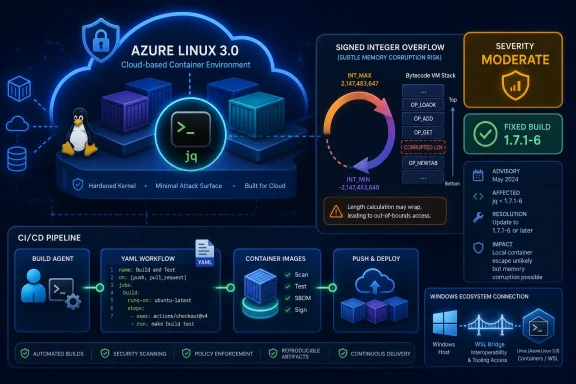
Microsoft’s jq Advisory Is Really an Azure Linux Supply-Chain Story
The interesting part of CVE-2026-41257 is not that jq has another memory-safety bug. jq is a compact, C-written utility that parses and transforms JSON, and tools written in C periodically turn arithmetic mistakes into memory problems. The interesting part is where Microsoft chose to surface it: in the Security Update Guide, under Azure Linux 3.0 packages.
That placement tells administrators how Microsoft now sees the boundary of its security responsibility. The company is not only shipping Windows cumulative updates, Defender intelligence, Edge fixes, and Office patches. It is also curating Linux packages for Azure workloads, container hosts, appliance-like cloud images, and the infrastructure layers that many Windows shops now operate without thinking of themselves as “Linux shops.”
The affected products listed by Microsoft are Azure Linux 3.0 jq packages, specifically package builds that are remediated to version 1.7.1-6. The severity is marked Moderate. That rating is sensible if the bug requires a crafted jq program or filter and enough stack growth to reach the vulnerable path, but “Moderate” should not be read as “irrelevant.” In infrastructure software, the boring middle of the severity scale is where a lot of real operational exposure lives.
jq’s role makes that especially true. It is rarely the product anyone bought, and almost never the component shown in an architecture diagram. It is the thing a release script uses to pull a version out of a manifest, the thing a sysadmin uses to normalize a cloud API response, or the thing a CI job uses to decide whether a deployment should proceed.
The Bug Hides in the Arithmetic Beneath a Familiar Tool
At the technical level, CVE-2026-41257 is a signed integer overflow in jq’s bytecode virtual machine stack reallocation logic. The vulnerable area, described as stack_reallocate, tracks the VM data stack allocation size using a signed integer. When deeply nested generator forks cause the stack to grow past roughly the one-gigabyte range, doubling arithmetic can wrap.
That wraparound is the hinge of the bug. A value intended to represent “larger than before” can become smaller, negative, or otherwise nonsensical once signed integer arithmetic overflows. If that wrapped value is then fed into memory allocation and movement routines, the program’s mental model of its buffer size diverges from reality.
This is the oldest class of modern software failure: a number used to protect memory becomes the thing that betrays memory. The machine does exactly what the type permits, while the programmer’s intent exists only as an assumption. In safe languages, many of these mistakes become exceptions or checked failures; in C, they often become memory corruption.
The public description points to realloc followed by memmove with attacker-influenced offsets. That does not automatically mean every jq invocation is one paste away from arbitrary code execution. It does mean the bug sits in a dangerous neighborhood: allocation sizing, copying, and offsets shaped by input or program structure.
The word stack here can also mislead casual readers. This is not merely a classic call-stack exhaustion issue where a process crashes after too much recursion. The advisory is about jq’s virtual machine data stack, the internal execution machinery used to run jq programs. That distinction matters because it moves the conversation from “the process might run out of stack” to “the interpreter may miscalculate memory and then move bytes into the wrong place.”
jq Became Critical Infrastructure by Being Too Useful to Notice
jq’s security posture matters because jq won the JSON command line. Cloud APIs speak JSON, Kubernetes speaks JSON, GitHub and Azure DevOps APIs speak JSON, package metadata speaks JSON, and modern configuration systems often smuggle policy through JSON whether or not humans enjoy reading it. jq became the tool administrators reach for because it is fast, portable, scriptable, and everywhere.
That ubiquity changes the risk calculation. A browser vulnerability usually has a clear exposure path. A server vulnerability usually maps to a listening service. A jq vulnerability requires asking messier questions: where is jq installed, who invokes it, whose JSON does it parse, who controls the filter, and whether the invocation is part of a privileged automation path.
For Windows administrators, the answer may be “more places than expected.” jq may be installed through Winget, Chocolatey, Scoop, Git Bash environments, WSL distributions, Dev Containers, container images, Azure Cloud Shell habits, or vendor-provided tooling. On servers, it may live inside deployment images rather than on the host OS. On developer workstations, it may be bundled invisibly in build scripts that nobody has audited since the last migration.
That is why the Microsoft listing matters despite naming Azure Linux rather than Windows. Modern Windows operations are hybrid by default. The same team that deploys Windows Server may also manage Azure Linux containers, AKS clusters, GitHub Actions runners, and PowerShell scripts that call out to Unix-like utilities.
The operational blind spot is not jq itself. The blind spot is assuming that small command-line tools are too small to deserve inventory. CVE-2026-41257 argues the opposite: small tools are often powerful precisely because they sit in privileged paths, consume untrusted data, and escape normal asset-management scrutiny.
“Moderate” Severity Can Still Mean High Leverage
Microsoft’s Moderate rating should calm panic, but it should not lull administrators into ignoring the update. Severity scores are a compressed language. They try to express exploitability, impact, privileges, user interaction, and environmental assumptions in a single label. That label often fails to capture where a component sits in a particular organization’s automation chain.
A jq flaw on a random analyst workstation may be low drama. A jq flaw inside a CI runner that processes pull-request-controlled files is more interesting. A jq flaw in a privileged automation job that parses artifacts from external tenants is more interesting still. Context turns commodity bugs into practical problems.
The exploit conditions here appear non-trivial. The stack must grow substantially through deeply nested generator forks, and a vulnerable invocation must process the crafted jq program or filter path that triggers the bad reallocation. That is not the same shape as a wormable network service, and it is not the same urgency as a remote unauthenticated flaw in an internet-facing daemon.
But local code execution and memory corruption bugs have a way of becoming more important when chained. Attackers do not need every vulnerability to be dramatic on its own. They need one bug to cross a boundary, another to gain code execution, another to move laterally, and another to persist. Tools that sit inside build and deployment pipelines are attractive because the boundary they cross may be the software supply chain itself.
There is also a cultural trap in the word “local.” In cloud and CI environments, “local” often means “inside the runner,” “inside the container,” or “inside the automation environment that has secrets.” That is not the same as sitting at a keyboard in front of a single-user PC. A local bug in the wrong automated context can have very remote consequences.
The Attack Surface Is the Filter, Not Just the JSON
Many administrators think of jq as a parser for JSON input, but jq is also a small programming language. A jq invocation combines data with a filter, and the filter can be as trivial as a dot or as elaborate as a miniature transformation program. CVE-2026-41257’s description points toward crafted jq programs or deeply nested generator behavior, which makes the filter side especially important.
That distinction matters for threat modeling. If your environment only runs fixed, administrator-authored jq filters against semi-trusted JSON, the risk is different from a service that lets users submit jq expressions. If a CI workflow runs jq filters stored in a pull request before code review, the trust boundary shifts again. If a platform product exposes jq-like filtering to tenants, the calculus changes entirely.
The common vulnerable pattern is not necessarily “we parse malicious JSON.” It may be “we let someone influence the jq expression.” That influence can be direct, such as a user-supplied filter, or indirect, such as a build script loaded from a branch, plugin, template repository, or downloaded artifact.
This is where Windows and Azure shops should be honest about their automation. A surprising amount of enterprise logic is now expressed in YAML pipelines that run shell fragments. Those fragments often invoke jq because JSON is the lingua franca of cloud control planes. The security boundary of such a system is not simply the OS image; it is the set of people, repositories, bots, and external services allowed to feed code-like input into the automation path.
The safer assumption is that jq filters are code. They should be reviewed, pinned, and treated as part of the trusted computing base when used in privileged jobs. That does not make jq uniquely dangerous. It makes jq normal in the way that Bash, PowerShell, Python one-liners, and templating engines are normal: convenient enough to become policy, flexible enough to become attack surface.
Azure Linux Makes Microsoft a Distributor, Not Just an Upstream Messenger
Microsoft’s update identifies Azure Linux 3.0 packages rather than pretending the upstream jq project is the only relevant actor. That is important. In open source security, upstream projects find and fix code, but downstream distributors decide when a particular environment actually becomes safe. Administrators consume distributions, not Git commits.
Azure Linux, formerly tied to the CBL-Mariner lineage, is Microsoft’s Linux distribution for cloud infrastructure scenarios. It appears in container hosts, internal platform components, and customer-facing Azure workloads. When Microsoft publishes a jq CVE through its Security Update Guide, it is doing the same job Red Hat, Debian, Ubuntu, and SUSE have long done: mapping upstream vulnerability information to supported package builds.
That mapping is the difference between “jq 1.8.1 and earlier have a problem” and “this Azure Linux package build is fixed.” The upstream version number alone may not be enough because distributions backport security patches. A fixed package can retain an older upstream version while carrying the relevant security change. Conversely, a newer-looking binary in an unmanaged path may not be patched at all.
For administrators, the practical question is therefore not “what is the newest jq release on GitHub?” It is “what does my supported distribution say is fixed?” In Microsoft’s case, the Security Update Guide points Azure Linux 3.0 users toward jq package build 1.7.1-6 as the fixed build for the affected Azure Linux packages.
That nuance is especially important in container-heavy environments. A host may be patched while old containers continue to carry vulnerable userland packages. A base image may be updated while application images remain stale because nobody rebuilt them. A CI runner may have one jq in the OS package database and another static binary earlier in the path.
The Windows Angle Is WSL, Containers, and the Admin Workbench
No one should read CVE-2026-41257 as a conventional Windows Patch Tuesday item. It is not a kernel-mode Windows vulnerability, not an NTFS bug, and not a flaw in Explorer or Defender. Yet the Windows angle is real because the Windows admin workbench has absorbed Linux tooling over the past decade.
WSL made Linux utilities ordinary on Windows desktops. Dev Containers made Linux userlands ordinary inside Visual Studio Code workflows. GitHub Actions and Azure DevOps made Ubuntu and container runners ordinary for teams whose production estate still includes Windows Server. PowerShell made object pipelines elegant, but cloud APIs made JSON unavoidable; jq filled the gap for anyone living between those worlds.
That creates a patch-management mismatch. Windows endpoints may be beautifully governed through Intune, Configuration Manager, WSUS, or Windows Update for Business, while the jq binary used by an engineer lives in a WSL distro that updates only when the user remembers. A container image may be scanned in the registry but not rebuilt. A self-hosted runner may be treated as cattle in theory and as a beloved snowflake in practice.
The fix is not to ban jq. That would be silly, and it would merely push people toward less reviewed shell improvisation. The fix is to inventory developer and automation tools with the same seriousness applied to production services. If a tool can process untrusted input in a privileged workflow, it belongs in the vulnerability-management conversation.
This is also where Microsoft’s own ecosystem could become more coherent. Security Update Guide entries for Azure Linux are useful, but many Windows administrators still think in KB numbers, cumulative updates, and product families. The more Microsoft builds and distributes Linux components, the more it must communicate Linux package risk in terms Windows-first teams can operationalize.
Memory Safety Keeps Returning Through the Side Door
CVE-2026-41257 is another small exhibit in the long-running case against unchecked C arithmetic. The vulnerability class, CWE-190 integer overflow or wraparound, is not exotic. It is a familiar failure mode where software stores a size in a type that cannot safely represent the sizes the program may reach, then performs arithmetic as if overflow were impossible.
The industry has spent years talking about memory-safe languages, and for good reason. Rust, Go, Swift, C#, Java, and other managed or checked environments do not eliminate all security bugs, but they make this exact genre harder to ship. They force developers to confront bounds, ownership, or runtime checks before memory corruption becomes the default consequence of a bad assumption.
jq, however, is written in portable C, with the virtues and liabilities that implies. It is small, fast, dependency-light, and available almost everywhere. Those qualities explain its success. They also mean its internals must be written with a level of defensive care that is easy to demand from the outside and difficult to sustain across years of volunteer and community maintenance.
The security discussion should resist the lazy conclusion that “C is bad” and therefore the case is closed. Rewriting mature infrastructure tools is expensive, risky, and often unrealistic. The more practical lesson is that C projects need aggressive fuzzing, sanitizers, safe allocation helpers, overflow-checked arithmetic, and conservative limits around adversarial input.
This is where open-source maintenance and enterprise consumption collide. Enterprises depend on small projects because they are excellent. Those projects, in turn, inherit enterprise-grade expectations without always receiving enterprise-grade support. A jq CVE in an Azure Linux advisory is not just a patch notice; it is a receipt for the hidden subsidy that open-source maintainers provide to the entire cloud economy.
The Real Patch Is Rebuilding the Places jq Disappears
For Azure Linux 3.0 systems, the immediate remediation path is straightforward: apply the available security update and confirm the jq package is at the fixed build. That is the easy part. The harder part is finding all the places jq exists outside the package manager’s field of view.
Static binaries are common. Developer tools often vendor utilities for convenience. Container images can carry multiple copies. Build agents may have jq installed by bootstrap scripts that predate the current base image. Some teams download jq directly during pipeline execution, which creates a different problem: the latest binary may be pulled without pinning, verification, or reproducibility.
The first pass should be package inventory. Query Azure Linux systems for installed jq packages, check the fixed build, and update through the normal distribution channel. The second pass should be filesystem and image inventory. Search container layers, runner images, developer environment definitions, and internal tool bundles for jq binaries.
The third pass is workflow review. Look for places where jq filters are influenced by users, repositories, pull requests, tickets, uploaded files, or third-party services. That is where a Moderate memory-corruption bug becomes more interesting. The question is not simply whether jq exists; it is whether someone untrusted can steer jq into the vulnerable execution path.
Finally, teams should rebuild artifacts after base-image updates. Updating the base image in a registry is not the same as updating every derived image in production. If your organization’s container lifecycle does not force rebuilds after security updates, jq is just one of many packages that can remain vulnerable long after the official fix exists.
Scanner Output Will Be Noisier Than the Truth
Security scanners will flag CVE-2026-41257 across Linux distributions, containers, and package inventories, but the findings will not all mean the same thing. Some will identify vulnerable upstream versions. Some will understand distribution backports. Some will treat jq 1.7.1 as vulnerable even when a vendor has patched the package. Others may miss static binaries entirely.
That noise is not a reason to distrust scanners. It is a reason to understand what they are actually measuring. A scanner that keys only on upstream version strings can be useful for triage but dangerous as a source of final truth. A scanner that understands distro package metadata is better, but it still may not see binaries copied into application directories.
This is especially true for Azure Linux and other enterprise distributions that backport fixes. The fixed package build matters more than the upstream marketing version. If a tool reports “jq 1.7.1 is vulnerable” but Microsoft’s package metadata says the Azure Linux build is fixed at 1.7.1-6, administrators need to reconcile the finding rather than blindly chase an upstream version.
False positives have a cost. They train teams to ignore vulnerability reports. False negatives have a larger cost. They leave exploitable components in build paths that everyone assumes are clean. The only sustainable answer is a vulnerability program that can ingest scanner data, vendor advisories, package metadata, and runtime context without flattening them into a single red badge.
CVE-2026-41257 is a good test case for that maturity. It is specific enough to fix, common enough to appear in many environments, and contextual enough that raw severity does not tell the whole story. If an organization cannot answer where jq runs and how it is updated, it has learned something useful even before patching the bug.
Microsoft’s Disclosure Language Is Sparse, and That Is Part of the Pattern
Microsoft’s advisory page is minimal. It gives the CVE, the title, the release and revision dates, the weakness classification, affected Azure Linux package rows, and the fixed build information. It does not provide an extended exploit narrative, proof-of-concept details, or a broad risk essay.
That sparseness is normal for a Security Update Guide entry, but it creates a gap for practitioners. Administrators must combine Microsoft’s package-level facts with upstream advisory language and their own environment knowledge. The official vendor page tells you what Microsoft ships and how it classifies the update; it does not tell you whether your CI templates allow untrusted jq filters.
There is a reasonable argument for restraint. Overly detailed advisories can accelerate exploit development, especially for memory-corruption bugs. But there is also a reasonable argument that infrastructure teams need more practical threat-model language, particularly when the vulnerable component is a small utility rather than a visible service.
Microsoft’s “as is” disclaimer, familiar from Knowledge Base and Security Update Guide pages, underscores the institutional boundary. The vendor provides information and updates, but customers must decide applicability, urgency, and operational response. That boundary has always existed, yet it becomes sharper when the affected component is open-source software distributed as part of Microsoft’s Linux estate.
For WindowsForum readers, the gap is where the work begins. The advisory is not a complete risk assessment. It is a trigger to examine where a tiny JSON processor has become part of a much larger trust chain.
The Fix Is Small; the Inventory Lesson Is the Point
The concrete response to CVE-2026-41257 is refreshingly ordinary: update the affected Azure Linux jq package, rebuild images, and reduce untrusted influence over jq filters. The broader response is more strategic: treat command-line utilities as software dependencies, not as harmless background texture.
Administrators should also resist the urge to overfit this incident. jq is not uniquely suspect, and this CVE does not imply that every JSON-processing script is an emergency. The pattern is bigger. Small tools become universal, universal tools become infrastructure, and infrastructure bugs matter in proportion to the privileges and trust boundaries around them.
That means the most useful output from this advisory may be an inventory improvement rather than a single patched package. If a team discovers five unmanaged jq copies while responding to CVE-2026-41257, it should assume the same pattern exists for curl, tar, openssl, yq, git, and language runtimes. The vulnerability is one item; the management model is the system.
The jq Stack Bug Leaves Administrators With Concrete Work
The practical reading of CVE-2026-41257 is narrow enough to act on and broad enough to justify a second look at automation hygiene. The advisory does not call for panic, but it does call for a more honest map of where JSON tooling runs.
- Azure Linux 3.0 systems using Microsoft-provided jq packages should be updated to the fixed package build identified by Microsoft.
- Container images and CI runner images should be rebuilt, not merely left to inherit a patched base image at some undefined future date.
- Teams should search for static or vendored jq binaries that package managers and ordinary vulnerability scanners may not see.
- Workflows that allow users, pull requests, plugins, or external services to influence jq filters deserve closer review than workflows using fixed administrator-authored filters.
- Scanner findings should be checked against distribution package metadata, because backported fixes can make upstream version comparisons misleading.
- Windows administrators should include WSL distributions, Dev Containers, GitHub Actions runners, Azure DevOps agents, and cloud images in the jq inventory rather than limiting the search to traditional Windows software lists.
CVE-2026-41257 will not be remembered as the vulnerability that changed the security industry, and it probably will not dominate emergency patch calls. Its value is quieter. It shows how Microsoft’s security perimeter now runs through Azure Linux packages, how Windows administrators inherit open-source tooling risk through automation, and how a signed integer in a small JSON processor can illuminate the sprawling dependency graph beneath modern IT. The next advisory may name a different utility, package, or platform, but the organizations that fare best will be the ones that used this one to make the invisible parts of their toolchain visible.
References
- CVE-2026-41257 jq: Signed-int overflow in `stack_reallocate` (jq VM stack) MSRC · 2026-06-03T01:49:36-07:00