

Microsoft’s Security Update Guide now lists CVE-2026-41256, a moderate-severity jq vulnerability published in May 2026 in which top-level jq filter programs loaded with
jq has earned its place in the administrator’s muscle memory because it does one thing extremely well: it turns JSON into something humans and scripts can actually use. On Windows, it shows up in Git Bash, WSL, developer workstations, container images, release pipelines, package scripts, cloud automation, and one-off PowerShell-adjacent workflows where JSON is the common language between services.
CVE-2026-41256 is a reminder that the security boundary in such tools is rarely where users think it is. The flaw concerns jq programs loaded from a file with the
That behavior sounds almost quaint, like a bug from the C programming basement rather than the cloud era. But the cloud era is mostly the C programming basement with orchestration on top. If a workflow reviews, signs, diffs, caches, or approves the full contents of a jq filter file, while jq later executes only a prefix of that file, the organization has a source-integrity mismatch.
That phrase matters more than the CVSS number. The issue is rated moderate, with local attack vector and user interaction in the published scoring, but the operational risk depends on where jq sits. A developer’s throwaway command is one thing; a jq filter used inside a deployment gate or artifact transformation step is another.
CVE-2026-41256 exists in that gap. jq can load a filter file as data that has a known length, but the compilation path reportedly converts that content into a form where
The proof-of-concept described in the upstream advisory is almost absurdly small: a filter beginning with
This does not mean every jq user is suddenly exposed to arbitrary remote code execution. It does mean that the truth of a jq program can differ depending on who is looking at it: a scanner, a code-review interface, a signing system, a repository diff, or jq itself. Security failures often begin exactly there, in disagreements between parsers.
But that distinction has been fading for years. Windows administrators now live in an environment where Microsoft’s platform is inseparable from Linux containers, GitHub-hosted dependencies, Azure automation, WSL, cross-platform CLIs, JSON-heavy APIs, and open-source package ecosystems. A Windows security bulletin can therefore matter even when the vulnerable code is not part of the traditional Windows servicing stack.
That is especially true for tools like jq, which often arrive indirectly. A developer may install it through a package manager. A container image may include it as a convenience dependency. A CI runner may inherit it from a base image. A Windows workstation may carry several copies: one in WSL, one in a Git distribution, one in a container, and one dropped into a project’s tools directory years ago.
For WindowsForum readers, the practical point is not “Microsoft shipped a broken jq.” It is that Microsoft’s security orbit now includes the open-source plumbing that Windows estates depend on. If your automation touches JSON at scale, jq may be part of your environment even if it never appears in your official software inventory.
The risk rises when jq filter files are supplied or influenced by someone other than the person running jq. That could mean a build system that pulls filters from a repository, a deployment pipeline that accepts transformation rules from project teams, a security scanner that runs jq logic from plugins, or an internal platform that treats jq filters as configurable policy.
In those settings, “local” is not especially comforting. Many supply-chain attacks are local at the point of execution. The attacker’s goal is not always to log into the runner interactively; it is to get a crafted file into the path of a trusted job and let automation do the rest.
The bug also has a subtle psychological advantage. A malicious or malformed suffix after a NUL byte may be visible to some tools, invisible to others, rendered strangely in a browser, or missed in review. When the attack surface is a text file that does not behave like text, the weakest link may be the review process rather than jq alone.
The more precise concern is that jq may run a different filter than the one the surrounding workflow believes it is running. If the trusted part before the NUL byte permits, transforms, or suppresses data in a way that benefits an attacker, the ignored suffix can be used to deceive humans or tooling about the file’s true behavior. The danger is semantic misdirection.
Imagine a review system that displays a jq file and flags suspicious constructs after the NUL byte, or an approval process that treats the entire file as the approved artifact. jq may compile only the prefix. Conversely, a file could be arranged so the executable prefix is innocuous-looking in one view while the surrounding system’s interpretation leads reviewers elsewhere.
That is why the integrity impact is the interesting part of the score. This vulnerability is about trust in source representation. It does not need to steal secrets directly to matter; it needs only to let one component approve one thing while another component executes another.
That should feel familiar to anyone who has managed enterprise patching. Security fixes often close the reported door while leaving adjacent doors ajar. Attackers and researchers then test the same conceptual weakness across every comparable code path: parser input, imported modules, file-loaded programs, command-line arguments, cache files, and internal representations.
For maintainers, the lesson is architectural. Once a program accepts counted buffers, it has to remain length-aware all the way down. A single conversion back to C-string semantics can reintroduce the very ambiguity the earlier fix was meant to remove.
For defenders, the lesson is procedural. Treat vulnerability families as more important than individual CVE identifiers. When a parser has one NUL-handling flaw, the useful question is not just whether that CVE is patched, but whether the software’s other paths have been audited for the same class of mistake.
Start with developer and automation environments. Look for jq in WSL distributions, Git-for-Windows-adjacent toolchains, MSYS2 and Cygwin environments, Chocolatey, Scoop, winget packages, Visual Studio Code dev containers, Azure DevOps agents, GitHub Actions self-hosted runners, and Docker base images used by Windows teams. The risk is not limited to interactive shells.
The next place to look is repositories. Search for committed
The third place is policy. If your organization allows teams to contribute jq filters to shared automation, the filters should be treated like code. That means review, provenance, byte-safe scanning, and tests that execute exactly what will run in production. “It’s just a JSON filter” is how small tools become privileged infrastructure without the controls privileged infrastructure deserves.
That split is normal in open-source security response. Upstream disclosure, GitHub advisory metadata, NVD enrichment, distribution backports, vendor bulletins, and scanner plugins do not always move in lockstep. A version string alone may not tell the whole story if a distribution has backported a fix without changing the upstream version number in the way a simple scanner expects.
This is where Windows-heavy shops often stumble. Teams accustomed to Windows Update’s relatively centralized servicing model may assume a vulnerable open-source component has a single obvious patch path. jq does not work that way across all environments. The jq you run in Ubuntu under WSL, the jq in a Debian-based container, and the jq in a Windows package manager may all have different maintainers, timelines, and package versions.
Administrators should therefore verify the actual package source and build context rather than merely asking, “Do we have jq?” The better question is, “Which jq binaries can be executed by our automation, which version or patched package do they represent, and who is responsible for updating each copy?”
That convenience creates a trust boundary. If jq filters are stored in the same repository as application code, a malicious change may be reviewed by developers who understand the app but not the quirks of parser behavior. If filters are stored in a shared automation repository, a compromise there can affect many downstream projects. If filters are generated by another tool, the NUL byte may never be seen by a human at all.
The bug’s requirement for user interaction is less reassuring in pipelines because the “user” is often the automation engine. A maintainer merges a pull request, a runner checks out code, and jq executes a file. Nobody is double-clicking a suspicious attachment; the workflow’s normal operation supplies the interaction.
This is why defenders should pair patching with input hygiene. Even after updating jq, it is sensible to reject embedded NUL bytes in jq filter files, configuration files, and other source artifacts that are supposed to be text. A byte that has no legitimate role in your policy language should not be allowed to drift through review and execution systems.
A stale jq binary in an abandoned developer folder may generate a ticket but pose little practical risk. A patched-looking jq package in a base image may still be accompanied by custom filter files pulled from untrusted sources. The scanner can identify software presence; it cannot fully map execution context.
The right triage model is simple: prioritize jq where
This is also a good moment to audit assumptions about text handling in your own tooling. If internal scanners, code-review bots, or approval systems can be confused by NUL bytes, jq is only the messenger. The deeper issue is whether your pipeline treats source files as byte sequences or as whatever a convenient string library happens to display.
Azure scripts call Linux containers. Windows developers run WSL. PowerShell consumes JSON from cloud APIs. GitHub Actions build Windows artifacts on runners that also use Unix-oriented tooling. Security teams collect SBOMs that include components no traditional Windows admin would have considered part of the endpoint.
jq sits at the center of that dependency gravity because it is small, useful, and easy to smuggle into workflows. Nobody holds a design review to add jq to a script. Someone just needs a JSON value, adds a command, and moves on. Years later, that command may be part of a release gate that the organization treats as trusted infrastructure.
The lesson is not to ban jq. That would be performative and counterproductive. The lesson is to stop treating command-line utilities as invisible once they enter automation paths. Small tools deserve ownership when they make decisions that matter.
The reason is specificity. This CVE has a narrow trigger, a clear affected behavior, and a plausible class of workflow where it matters. That makes it easier to triage than broad, speculative advisories. If you do not use
Moderate vulnerabilities also accumulate. jq has had a cluster of recent parser, runtime, and memory-safety-related advisories, and distribution trackers show multiple CVEs moving through the ecosystem. Any single issue may be manageable. The pattern should prompt teams to ask whether jq is being used in places where a more constrained or better-governed transformation step would be safer.
That does not mean jq is uniquely unsafe. It means jq is important enough that its bugs now have enterprise consequences. Popular tools get scrutinized, and scrutiny produces CVEs. Mature operations distinguish between “this tool has vulnerabilities” and “this tool is deployed without ownership.”
The organizational fix is broader. Treat jq filter files as executable logic. Store them where code is stored. Review them with the same suspicion applied to shell scripts. Test them in the same environment that will run them. Reject non-text bytes unless there is an intentional, documented reason to allow them.
This is also a good fit for pre-commit and CI checks. A simple policy that fails builds when
The cultural change is to stop dividing the world into “programs” and “configuration” too neatly. A jq filter is a program. A YAML workflow is a program. A JSON transformation rule can be a program if automation trusts its output. Attackers do not care what label your team puts on it.
For sysadmins, the target is automation. Search for
For security teams, this is a dependency-governance exercise masquerading as a parser CVE. The artifact to inventory is not just the jq executable. It is the combination of jq version, invocation style, filter provenance, execution privilege, and downstream effect.
For developers, the practical advice is simple: do not assume that because a file looks like text in a browser or editor, every tool will parse the same bytes. That assumption has failed for decades, and CVE-2026-41256 is its latest reminder.
-f can be silently truncated at an embedded NUL byte. The bug is not a Windows kernel emergency or a remote wormable flaw, but it lands squarely in the tooling layer that modern administrators trust far more than they usually inspect. Its real lesson is that the smallest Unix-era assumption can still undermine today’s CI jobs, scripts, containers, and cross-platform automation.
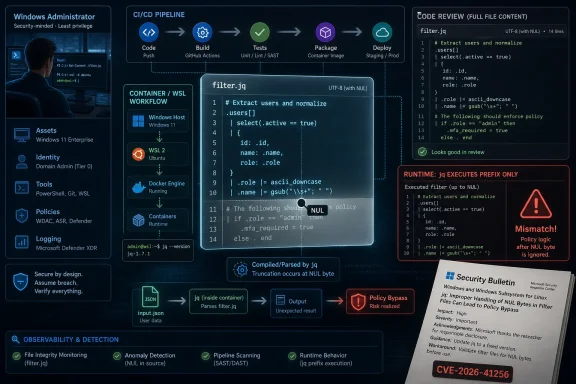 A Tiny Parser Bug Becomes a Supply-Chain Trust Problem
jq has earned its place in the administrator’s muscle memory because it does one thing extremely well: it turns JSON into something humans and scripts can actually use. On Windows, it shows up in Git Bash, WSL, developer workstations, container images, release pipelines, package scripts, cloud automation, and one-off PowerShell-adjacent workflows where JSON is the common language between services.CVE-2026-41256 is a reminder that the security boundary in such tools is rarely where users think it is. The flaw concerns jq programs loaded from a file with the
-f option. If that filter file contains an embedded NUL byte, jq can compile only the bytes before the NUL while ignoring what follows.That behavior sounds almost quaint, like a bug from the C programming basement rather than the cloud era. But the cloud era is mostly the C programming basement with orchestration on top. If a workflow reviews, signs, diffs, caches, or approves the full contents of a jq filter file, while jq later executes only a prefix of that file, the organization has a source-integrity mismatch.
That phrase matters more than the CVSS number. The issue is rated moderate, with local attack vector and user interaction in the published scoring, but the operational risk depends on where jq sits. A developer’s throwaway command is one thing; a jq filter used inside a deployment gate or artifact transformation step is another.
The NUL Byte Is Still Where Text Goes to Disappear
The underlying pattern is old enough to be boring and persistent enough to remain dangerous. In C-style strings, a NUL byte marks the end of a string. In modern file formats, byte buffers, and scripting tools, a NUL byte may simply be another byte in the file unless a layer incorrectly falls back to NUL-terminated string handling.CVE-2026-41256 exists in that gap. jq can load a filter file as data that has a known length, but the compilation path reportedly converts that content into a form where
strlen-style behavior decides where the program ends. The result is that a file can contain a visible or reviewable suffix after the NUL byte, while jq behaves as if the suffix does not exist.The proof-of-concept described in the upstream advisory is almost absurdly small: a filter beginning with
. followed by a NUL byte and then invalid trailing content. jq executes the identity filter and ignores the invalid suffix. That is the point. The bytes are on disk, but not in the program jq actually compiles.This does not mean every jq user is suddenly exposed to arbitrary remote code execution. It does mean that the truth of a jq program can differ depending on who is looking at it: a scanner, a code-review interface, a signing system, a repository diff, or jq itself. Security failures often begin exactly there, in disagreements between parsers.
Microsoft’s Listing Is Less About Windows Than About Windows Reality
At first glance, the appearance of a jq CVE in Microsoft’s Security Update Guide may feel odd. jq is not a native Windows component in the way Win32, Edge, Defender, or the Windows kernel are. It is an open-source command-line utility associated most strongly with Unix-like workflows.But that distinction has been fading for years. Windows administrators now live in an environment where Microsoft’s platform is inseparable from Linux containers, GitHub-hosted dependencies, Azure automation, WSL, cross-platform CLIs, JSON-heavy APIs, and open-source package ecosystems. A Windows security bulletin can therefore matter even when the vulnerable code is not part of the traditional Windows servicing stack.
That is especially true for tools like jq, which often arrive indirectly. A developer may install it through a package manager. A container image may include it as a convenience dependency. A CI runner may inherit it from a base image. A Windows workstation may carry several copies: one in WSL, one in a Git distribution, one in a container, and one dropped into a project’s tools directory years ago.
For WindowsForum readers, the practical point is not “Microsoft shipped a broken jq.” It is that Microsoft’s security orbit now includes the open-source plumbing that Windows estates depend on. If your automation touches JSON at scale, jq may be part of your environment even if it never appears in your official software inventory.
The Severity Score Understates the Places jq Actually Runs
The published CVSS vector frames the flaw as local, low-complexity, requiring user interaction, with high integrity impact but no confidentiality or availability impact. That is a reasonable generic assessment. It is also only the beginning of the risk conversation.The risk rises when jq filter files are supplied or influenced by someone other than the person running jq. That could mean a build system that pulls filters from a repository, a deployment pipeline that accepts transformation rules from project teams, a security scanner that runs jq logic from plugins, or an internal platform that treats jq filters as configurable policy.
In those settings, “local” is not especially comforting. Many supply-chain attacks are local at the point of execution. The attacker’s goal is not always to log into the runner interactively; it is to get a crafted file into the path of a trusted job and let automation do the rest.
The bug also has a subtle psychological advantage. A malicious or malformed suffix after a NUL byte may be visible to some tools, invisible to others, rendered strangely in a browser, or missed in review. When the attack surface is a text file that does not behave like text, the weakest link may be the review process rather than jq alone.
The Exploit Story Is Not “Run Anything,” It Is “Run Something Different”
Some vulnerability write-ups have described CVE-2026-41256 in terms that sound like straightforward arbitrary code execution. That framing is too loose for what has been publicly documented. jq is a filter language, not a shell, and the reported behavior is truncation of a jq program loaded with-f, not a universal escape into operating-system commands.The more precise concern is that jq may run a different filter than the one the surrounding workflow believes it is running. If the trusted part before the NUL byte permits, transforms, or suppresses data in a way that benefits an attacker, the ignored suffix can be used to deceive humans or tooling about the file’s true behavior. The danger is semantic misdirection.
Imagine a review system that displays a jq file and flags suspicious constructs after the NUL byte, or an approval process that treats the entire file as the approved artifact. jq may compile only the prefix. Conversely, a file could be arranged so the executable prefix is innocuous-looking in one view while the surrounding system’s interpretation leads reviewers elsewhere.
That is why the integrity impact is the interesting part of the score. This vulnerability is about trust in source representation. It does not need to steal secrets directly to matter; it needs only to let one component approve one thing while another component executes another.
The Post-Patch Echo of an Earlier jq Problem
The advisory explicitly connects CVE-2026-41256 to an earlier jq issue, CVE-2026-33948, which concerned a related prefix/full-buffer mismatch on the JSON parser side. The new bug is not merely “another null byte problem.” It is the kind of follow-on issue that appears when one parsing path gets fixed and a neighboring path retains the old assumption.That should feel familiar to anyone who has managed enterprise patching. Security fixes often close the reported door while leaving adjacent doors ajar. Attackers and researchers then test the same conceptual weakness across every comparable code path: parser input, imported modules, file-loaded programs, command-line arguments, cache files, and internal representations.
For maintainers, the lesson is architectural. Once a program accepts counted buffers, it has to remain length-aware all the way down. A single conversion back to C-string semantics can reintroduce the very ambiguity the earlier fix was meant to remove.
For defenders, the lesson is procedural. Treat vulnerability families as more important than individual CVE identifiers. When a parser has one NUL-handling flaw, the useful question is not just whether that CVE is patched, but whether the software’s other paths have been audited for the same class of mistake.
Windows Admins Should Look in the Boring Places First
The Windows exposure story is mostly about inventory. jq may not be centrally installed through Windows Update, and it may not announce itself in the usual enterprise management dashboards. That makes it the sort of dependency that survives because nobody owns it.Start with developer and automation environments. Look for jq in WSL distributions, Git-for-Windows-adjacent toolchains, MSYS2 and Cygwin environments, Chocolatey, Scoop, winget packages, Visual Studio Code dev containers, Azure DevOps agents, GitHub Actions self-hosted runners, and Docker base images used by Windows teams. The risk is not limited to interactive shells.
The next place to look is repositories. Search for committed
.jq files, scripts invoking jq -f, and automation that downloads jq filters from templates, artifacts, or remote sources. A jq binary sitting unused on a workstation is less interesting than a pipeline that runs file-loaded filters against production manifests.The third place is policy. If your organization allows teams to contribute jq filters to shared automation, the filters should be treated like code. That means review, provenance, byte-safe scanning, and tests that execute exactly what will run in production. “It’s just a JSON filter” is how small tools become privileged infrastructure without the controls privileged infrastructure deserves.
The Patch Situation Demands Version Awareness, Not Guesswork
As of the public advisory details, jq versions up to and including 1.8.1 were listed as affected, and the upstream advisory initially said no patched version was known, with current upstream HEAD still affected at the time of publication. Distribution trackers have since shown varying status by release, with some Debian branches marked fixed and others still vulnerable or awaiting distribution-specific security handling. Ubuntu’s tracker has listed the issue as medium priority with evaluation status across supported releases.That split is normal in open-source security response. Upstream disclosure, GitHub advisory metadata, NVD enrichment, distribution backports, vendor bulletins, and scanner plugins do not always move in lockstep. A version string alone may not tell the whole story if a distribution has backported a fix without changing the upstream version number in the way a simple scanner expects.
This is where Windows-heavy shops often stumble. Teams accustomed to Windows Update’s relatively centralized servicing model may assume a vulnerable open-source component has a single obvious patch path. jq does not work that way across all environments. The jq you run in Ubuntu under WSL, the jq in a Debian-based container, and the jq in a Windows package manager may all have different maintainers, timelines, and package versions.
Administrators should therefore verify the actual package source and build context rather than merely asking, “Do we have jq?” The better question is, “Which jq binaries can be executed by our automation, which version or patched package do they represent, and who is responsible for updating each copy?”
CI/CD Turns Local Bugs Into Organizational Bugs
The most important place for this CVE is the build system. jq is a favorite in CI/CD because JSON is everywhere: package metadata, cloud output, Kubernetes manifests, dependency reports, SBOMs, API responses, scanner results, and release notes. A filter file loaded with-f is a natural way to keep complex transformations readable.That convenience creates a trust boundary. If jq filters are stored in the same repository as application code, a malicious change may be reviewed by developers who understand the app but not the quirks of parser behavior. If filters are stored in a shared automation repository, a compromise there can affect many downstream projects. If filters are generated by another tool, the NUL byte may never be seen by a human at all.
The bug’s requirement for user interaction is less reassuring in pipelines because the “user” is often the automation engine. A maintainer merges a pull request, a runner checks out code, and jq executes a file. Nobody is double-clicking a suspicious attachment; the workflow’s normal operation supplies the interaction.
This is why defenders should pair patching with input hygiene. Even after updating jq, it is sensible to reject embedded NUL bytes in jq filter files, configuration files, and other source artifacts that are supposed to be text. A byte that has no legitimate role in your policy language should not be allowed to drift through review and execution systems.
Scanners Will Find jq, but They May Not Understand Your Risk
Vulnerability scanners are likely to flag CVE-2026-41256 wherever they can identify an affected jq package. That is useful, but it can create the usual two opposite errors: panic over irrelevant copies and complacency about untracked ones.A stale jq binary in an abandoned developer folder may generate a ticket but pose little practical risk. A patched-looking jq package in a base image may still be accompanied by custom filter files pulled from untrusted sources. The scanner can identify software presence; it cannot fully map execution context.
The right triage model is simple: prioritize jq where
-f is used, where filter files are not strictly controlled, where automation runs with write access to repositories or deployment targets, and where jq output drives security-sensitive decisions. A jq invocation that formats logs is not the same as a jq invocation that rewrites deployment manifests or selects artifacts for release.This is also a good moment to audit assumptions about text handling in your own tooling. If internal scanners, code-review bots, or approval systems can be confused by NUL bytes, jq is only the messenger. The deeper issue is whether your pipeline treats source files as byte sequences or as whatever a convenient string library happens to display.
The Microsoft Angle Is a Warning About Dependency Gravity
Microsoft’s publication of the CVE entry is part of a broader shift: the Windows security story now includes the dependencies that orbit Windows, not just the binaries that ship in the box. That is uncomfortable but accurate. Modern Windows estates are hybrid by default, even when nobody formally declared them hybrid.Azure scripts call Linux containers. Windows developers run WSL. PowerShell consumes JSON from cloud APIs. GitHub Actions build Windows artifacts on runners that also use Unix-oriented tooling. Security teams collect SBOMs that include components no traditional Windows admin would have considered part of the endpoint.
jq sits at the center of that dependency gravity because it is small, useful, and easy to smuggle into workflows. Nobody holds a design review to add jq to a script. Someone just needs a JSON value, adds a command, and moves on. Years later, that command may be part of a release gate that the organization treats as trusted infrastructure.
The lesson is not to ban jq. That would be performative and counterproductive. The lesson is to stop treating command-line utilities as invisible once they enter automation paths. Small tools deserve ownership when they make decisions that matter.
The Disclosure Also Shows Why “Moderate” Does Not Mean “Ignore”
Security teams are drowning in medium-severity findings, and many of them are indeed noise. CVE-2026-41256 should not displace active exploitation crises, exposed internet-facing services, identity-system flaws, or critical remote code execution bugs. But it should not be automatically buried either.The reason is specificity. This CVE has a narrow trigger, a clear affected behavior, and a plausible class of workflow where it matters. That makes it easier to triage than broad, speculative advisories. If you do not use
jq -f, or if all filter files are local, trusted, and patched jq packages are deployed, your risk is low. If you use jq filters as part of shared automation or approval workflows, the risk deserves attention.Moderate vulnerabilities also accumulate. jq has had a cluster of recent parser, runtime, and memory-safety-related advisories, and distribution trackers show multiple CVEs moving through the ecosystem. Any single issue may be manageable. The pattern should prompt teams to ask whether jq is being used in places where a more constrained or better-governed transformation step would be safer.
That does not mean jq is uniquely unsafe. It means jq is important enough that its bugs now have enterprise consequences. Popular tools get scrutinized, and scrutiny produces CVEs. Mature operations distinguish between “this tool has vulnerabilities” and “this tool is deployed without ownership.”
The Fix Is Technical, but the Control Is Cultural
A proper software fix is conceptually straightforward: jq’s compilation path needs to preserve explicit length information rather than relying on NUL-terminated string semantics. That is maintainers’ work. Administrators and developers do not need to patch C code themselves unless they are maintaining their own builds.The organizational fix is broader. Treat jq filter files as executable logic. Store them where code is stored. Review them with the same suspicion applied to shell scripts. Test them in the same environment that will run them. Reject non-text bytes unless there is an intentional, documented reason to allow them.
This is also a good fit for pre-commit and CI checks. A simple policy that fails builds when
.jq files contain embedded NUL bytes can prevent this specific ambiguity and catch a class of future surprises. The same check can be extended to other text-based policy and scripting files.The cultural change is to stop dividing the world into “programs” and “configuration” too neatly. A jq filter is a program. A YAML workflow is a program. A JSON transformation rule can be a program if automation trusts its output. Attackers do not care what label your team puts on it.
Where WindowsForum Readers Should Put Their Effort
For home users and enthusiasts, the immediate action is modest. If you installed jq directly, update it through the same package manager or release channel that installed it, and avoid running filter files from untrusted sources. If you only use jq interactively with one-line filters, this particular bug is unlikely to be your biggest concern.For sysadmins, the target is automation. Search for
jq -f in scripts, repositories, scheduled tasks, CI definitions, and container build files. Then identify who controls those filter files and whether the jq binary in that execution path has been updated or distribution-patched.For security teams, this is a dependency-governance exercise masquerading as a parser CVE. The artifact to inventory is not just the jq executable. It is the combination of jq version, invocation style, filter provenance, execution privilege, and downstream effect.
For developers, the practical advice is simple: do not assume that because a file looks like text in a browser or editor, every tool will parse the same bytes. That assumption has failed for decades, and CVE-2026-41256 is its latest reminder.
The Smallest Byte in the File Now Has the Loudest Message
CVE-2026-41256 is not a five-alarm Windows emergency, but it is a clean example of how modern infrastructure inherits old parser assumptions in places nobody bothers to threat-model.- jq versions up to and including 1.8.1 were identified as affected by the embedded-NUL truncation behavior in top-level programs loaded with
-f. - The publicly described behavior is a source-integrity mismatch, where jq compiles the prefix before the NUL byte and ignores later bytes in the filter file.
- The most relevant exposure is in CI/CD, shared automation, WSL distributions, containers, and developer toolchains where jq filter files are loaded from disk.
- The risk is highest when filter files are reviewed, signed, cached, downloaded, or approved based on their full contents but executed by jq as a truncated program.
- Administrators should prioritize instances that use
jq -f, verify distribution-specific patch status, and reject embedded NUL bytes in files that are supposed to be text. - Microsoft’s listing matters because Windows environments now depend heavily on open-source command-line plumbing that may sit outside traditional patch-management visibility.
References
- Primary source: MSRC
Published: 2026-06-03T01:50:09-07:00
Security Update Guide - Microsoft Security Response Center
 msrc.microsoft.com
- Related coverage: sentinelone.com
CVE-2026-41256: Jqlang Jq RCE Vulnerability
CVE-2026-41256 is a remote code execution vulnerability in Jqlang Jq. Learn about its impact, affected versions, and mitigation methods.www.sentinelone.com
- Related coverage: securityvulnerability.io
CVE-2026-32316 : Integer Overflow and Buffer Overflow in jq JSON Processor
Learn about the integer overflow vulnerability in jq JSON processor that affects multiple versions and how it can lead to heap corruption.securityvulnerability.io
