
Microsoft has disclosed CVE-2026-42897 as a Microsoft Exchange Server spoofing vulnerability in the May 2026 security cycle, with the advisory pointing administrators to Exchange Server as the affected product family and framing the issue as a confirmed security flaw rather than a speculative report. The important part is not merely that another Exchange CVE exists; it is that the bug sits in the trust boundary users interact with most casually: identity presentation in email and webmail. For defenders, spoofing is the class of vulnerability that too often looks “less critical” on a spreadsheet while doing very real work in phishing, fraud, and lateral movement campaigns. Exchange has taught administrators this lesson before: the severity label is only the beginning of the risk conversation.
Spoofing vulnerabilities occupy an awkward place in Microsoft’s security taxonomy. They are not the cinematic remote-code-execution bugs that dominate Patch Tuesday headlines, and they often do not promise instant domain compromise on their own. But in a mail system, spoofing can poison one of the most valuable signals an organization has: whether a message appears to come from someone the recipient trusts.
That distinction matters because Exchange is not an ordinary server role. It is both infrastructure and social machinery. It routes internal workflow, reset links, invoices, calendar invites, HR notices, executive approvals, and security alerts. When a flaw lets an attacker misrepresent origin, content, or identity inside that machinery, the result can be a cleaner path into the human layer of the network.
CVE-2026-42897 therefore deserves attention even if administrators are waiting for deeper technical write-ups. Microsoft’s advisory page identifies it as an Exchange Server spoofing vulnerability, and that label alone places it in a familiar Exchange pattern: flaws where the danger is not necessarily that the server immediately falls over, but that users or downstream systems can be made to believe something false.
The industry has spent years training users to inspect senders, banners, and login pages. A server-side spoofing bug undermines that training from the opposite direction. It says, in effect, that even the interface the user is trained to trust may be participating in the deception.
That matters here because vulnerability intelligence often arrives in stages. A bug can begin as a rumor, become a researcher’s partial finding, appear in a vendor advisory, and later receive a full proof of concept or exploitation write-up. Each stage changes the defensive calculus, not because the vulnerable code changed, but because the public and attacker knowledge around it did.
A confirmed vendor advisory compresses that uncertainty. Microsoft does not need to publish exploit mechanics for defenders to treat the issue as real. In fact, withholding technical detail is common when a fix is available and broad disclosure would hand attackers a recipe before patch adoption has caught up.
For Exchange administrators, this is the uncomfortable middle ground: enough information to know the issue exists, not always enough information to model every possible abuse path. That is precisely when mature patch programs matter. Waiting for exploit code before acting is not prudence; with Exchange, it has historically been the moment when the defender’s clock starts running against them.
CVE-2026-42897 appears in that modern disclosure style: concise, structured, and vendor-confirmed. The advisory tells defenders what class of bug they are dealing with, but it does not turn the page into a public exploit tutorial. This is responsible in one sense and maddening in another.
The frustration is especially acute for Exchange because patching is rarely as casual as updating a desktop application. Many organizations still run complex hybrid deployments, load-balanced client access, legacy connectors, transport rules, third-party gateways, and compliance journaling. An Exchange security update can be technically routine and operationally delicate at the same time.
Still, the alternative is worse. Exchange has repeatedly shown that the gap between advisory publication and attacker operationalization can be short. Sparse disclosure should not be read as low risk. It should be read as Microsoft trying to preserve defender advantage while expecting administrators to move.
Exchange sits at the point where technical identity and human identity meet. Headers, display names, Outlook rendering behavior, OWA behavior, transport processing, authentication context, and anti-phishing layers all contribute to the final story a recipient sees. A vulnerability in any one of those layers can distort the story.
This is why administrators should resist the instinct to treat spoofing as merely a user-awareness problem. Training helps when the attack depends on sloppy impersonation. It helps less when the platform itself gives the impersonation a veneer of legitimacy.
The more integrated the environment, the more valuable that veneer becomes. In Microsoft 365-connected organizations, Exchange artifacts can drive Teams conversations, calendar workflows, mobile notifications, and downstream security tooling. A spoofing flaw does not have to be spectacular to matter; it only has to make the wrong message look routine.
That history can distort risk in both directions. Some teams overreact to every Exchange CVE as if it were the next mass-exploitation event. Others, tired of emergency cycles, underreact unless the words “actively exploited” appear in the advisory. Neither posture is ideal.
The better lesson from Exchange’s last several years is that internet-facing mail infrastructure deserves a shorter patch runway than ordinary internal services. It handles untrusted input by design. It exposes authentication and web surfaces. It is a high-value target because it contains communications, credentials, and organizational context.
CVE-2026-42897 should be triaged inside that reality. If a spoofing flaw affects the way Exchange represents or validates sender identity, message content, or user-facing trust cues, then the business impact is not limited to the Exchange server. It extends to every workflow that assumes email identity is meaningful.
The right approach is not panic patching. It is disciplined acceleration. Organizations should verify affected versions, review Microsoft’s specific remediation guidance, stage the update where possible, confirm backup and recovery posture, and then move production systems through a controlled maintenance window. That is ordinary hygiene, but Exchange makes ordinary hygiene urgent.
The risk is greater for organizations that still expose Outlook on the web, Exchange admin endpoints, or legacy authentication-adjacent services broadly to the internet. Even when a particular spoofing flaw does not require direct unauthenticated exploitation, exposed Exchange infrastructure gives attackers more surface area for reconnaissance, chaining, and credential attacks.
Hybrid environments deserve special care. Exchange Server may no longer host every mailbox, but it often remains present for management, routing, relay, or coexistence. That residual footprint can be overlooked because the organization thinks it has “moved to the cloud.” Attackers do not care how the architecture is described in a migration deck; they care what servers still answer.
That is particularly true for widely deployed enterprise software. Exchange updates are not obscure. Security researchers and threat actors alike know that Exchange advisories often reward close inspection. If the patch changes how a message, request, header, or token is validated, that delta can become a roadmap.
For defenders, the lesson is not that every Exchange spoofing bug will be exploited at scale. The lesson is that the absence of public detail buys time, not immunity. A short, quiet window after disclosure is exactly when patching has the highest payoff.
This is also where the confidence metric becomes operationally useful. If a vulnerability is vendor-confirmed, the defender’s uncertainty should shift away from “is this real?” and toward “how quickly can we reduce exposure without breaking mail?” That is a healthier question.
The first contextual factor is exposure. Is OWA published externally? Are Exchange services behind a reverse proxy, VPN, or conditional access layer? Are there old namespaces still resolving publicly? Are there forgotten hybrid servers that have not been maintained with the same urgency as mailbox hosts?
The second factor is trust dependency. Does the organization use email approvals for finance, procurement, access requests, or incident response? Do employees receive security prompts or password reset communications through Exchange? Are executives and administrators frequent OWA users? The more business logic rides on email identity, the more spoofing matters.
The third factor is detection maturity. Some spoofing attacks are visible in headers, logs, transport events, or security gateways. Others are visible only after users report suspicious behavior. If the organization cannot quickly tell whether spoofing-like activity has occurred, patch priority should rise, not fall.
Next comes patch validation. Exchange security updates are cumulative-update dependent, and many failed patch cycles begin with servers that are already behind. A security update plan should include checking build numbers, confirming prerequisites, reviewing known issues, and ensuring that health checks pass before and after installation.
Then comes exposure review. If OWA or Exchange services are internet-facing, administrators should verify whether that exposure is still required and whether it is protected by modern controls. If a server exists only for hybrid management, its access profile should reflect that narrower purpose.
Finally, organizations should revisit anti-spoofing controls outside Exchange itself. SPF, DKIM, DMARC, inbound gateway policies, impersonation protection, display-name protections, and user-reporting workflows are not replacements for the vendor patch. But they can reduce the blast radius of identity deception while the patch rollout proceeds.
For WindowsForum readers managing their own labs, small businesses, schools, local governments, or enterprise estates, the practical interpretation is clear:
Source: MSRC Security Update Guide - Microsoft Security Response Center
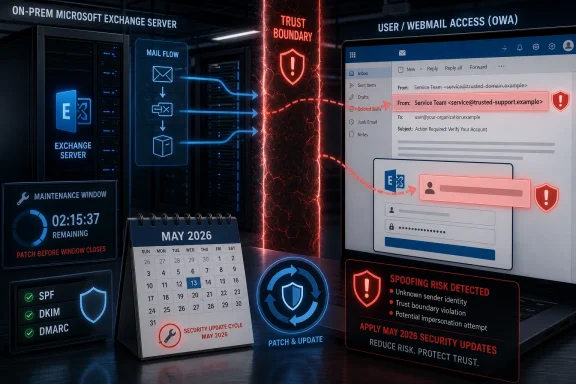 Exchange Spoofing Is Never Just a Cosmetic Bug
Spoofing vulnerabilities occupy an awkward place in Microsoft’s security taxonomy. They are not the cinematic remote-code-execution bugs that dominate Patch Tuesday headlines, and they often do not promise instant domain compromise on their own. But in a mail system, spoofing can poison one of the most valuable signals an organization has: whether a message appears to come from someone the recipient trusts.That distinction matters because Exchange is not an ordinary server role. It is both infrastructure and social machinery. It routes internal workflow, reset links, invoices, calendar invites, HR notices, executive approvals, and security alerts. When a flaw lets an attacker misrepresent origin, content, or identity inside that machinery, the result can be a cleaner path into the human layer of the network.
CVE-2026-42897 therefore deserves attention even if administrators are waiting for deeper technical write-ups. Microsoft’s advisory page identifies it as an Exchange Server spoofing vulnerability, and that label alone places it in a familiar Exchange pattern: flaws where the danger is not necessarily that the server immediately falls over, but that users or downstream systems can be made to believe something false.
The industry has spent years training users to inspect senders, banners, and login pages. A server-side spoofing bug undermines that training from the opposite direction. It says, in effect, that even the interface the user is trained to trust may be participating in the deception.
The Confidence Metric Is the Quiet Signal in the Advisory
The user-facing description attached to this vulnerability highlights a metric that security teams sometimes skim past: confidence in the existence of the vulnerability and the credibility of the known technical details. In CVSS language, this concept has historically been expressed as report confidence, and its practical meaning is straightforward. The more certain the vendor and community are that the vulnerability exists, the less room defenders have to rationalize delay.That matters here because vulnerability intelligence often arrives in stages. A bug can begin as a rumor, become a researcher’s partial finding, appear in a vendor advisory, and later receive a full proof of concept or exploitation write-up. Each stage changes the defensive calculus, not because the vulnerable code changed, but because the public and attacker knowledge around it did.
A confirmed vendor advisory compresses that uncertainty. Microsoft does not need to publish exploit mechanics for defenders to treat the issue as real. In fact, withholding technical detail is common when a fix is available and broad disclosure would hand attackers a recipe before patch adoption has caught up.
For Exchange administrators, this is the uncomfortable middle ground: enough information to know the issue exists, not always enough information to model every possible abuse path. That is precisely when mature patch programs matter. Waiting for exploit code before acting is not prudence; with Exchange, it has historically been the moment when the defender’s clock starts running against them.
Microsoft’s Sparse Disclosure Is a Feature and a Frustration
Microsoft’s Security Update Guide has become more standardized over the years, with CVE entries organized around affected products, impact, exploitability assessment, and remediation. That is useful for automation and patch triage. It is less satisfying for administrators who want to understand exactly what an attacker can do before scheduling downtime on a critical mail platform.CVE-2026-42897 appears in that modern disclosure style: concise, structured, and vendor-confirmed. The advisory tells defenders what class of bug they are dealing with, but it does not turn the page into a public exploit tutorial. This is responsible in one sense and maddening in another.
The frustration is especially acute for Exchange because patching is rarely as casual as updating a desktop application. Many organizations still run complex hybrid deployments, load-balanced client access, legacy connectors, transport rules, third-party gateways, and compliance journaling. An Exchange security update can be technically routine and operationally delicate at the same time.
Still, the alternative is worse. Exchange has repeatedly shown that the gap between advisory publication and attacker operationalization can be short. Sparse disclosure should not be read as low risk. It should be read as Microsoft trying to preserve defender advantage while expecting administrators to move.
Spoofing Bugs Exploit Trust Before They Exploit Code
The word “spoofing” undersells the operational value of the bug class. To a user, spoofing may look like a message that appears to come from a colleague. To an attacker, it can be a way to lower suspicion, trigger credential entry, approve a payment, seed a malicious link, or make a later intrusion step look like normal internal traffic.Exchange sits at the point where technical identity and human identity meet. Headers, display names, Outlook rendering behavior, OWA behavior, transport processing, authentication context, and anti-phishing layers all contribute to the final story a recipient sees. A vulnerability in any one of those layers can distort the story.
This is why administrators should resist the instinct to treat spoofing as merely a user-awareness problem. Training helps when the attack depends on sloppy impersonation. It helps less when the platform itself gives the impersonation a veneer of legitimacy.
The more integrated the environment, the more valuable that veneer becomes. In Microsoft 365-connected organizations, Exchange artifacts can drive Teams conversations, calendar workflows, mobile notifications, and downstream security tooling. A spoofing flaw does not have to be spectacular to matter; it only has to make the wrong message look routine.
Exchange’s History Makes Every New Advisory Louder
Exchange carries institutional memory that few other Microsoft server products can match. ProxyLogon, ProxyShell, emergency mitigations, web shells, hybrid trust issues, and repeated post-authentication flaws have all conditioned administrators to treat the product as both indispensable and perpetually exposed. Even when a new CVE is not technically related to those earlier incidents, it lands in the shadow they created.That history can distort risk in both directions. Some teams overreact to every Exchange CVE as if it were the next mass-exploitation event. Others, tired of emergency cycles, underreact unless the words “actively exploited” appear in the advisory. Neither posture is ideal.
The better lesson from Exchange’s last several years is that internet-facing mail infrastructure deserves a shorter patch runway than ordinary internal services. It handles untrusted input by design. It exposes authentication and web surfaces. It is a high-value target because it contains communications, credentials, and organizational context.
CVE-2026-42897 should be triaged inside that reality. If a spoofing flaw affects the way Exchange represents or validates sender identity, message content, or user-facing trust cues, then the business impact is not limited to the Exchange server. It extends to every workflow that assumes email identity is meaningful.
The Patch Decision Is Really a Business Continuity Decision
Administrators often talk about Exchange patching as a binary: install now or defer. In practice, it is a business continuity decision disguised as a security decision. A delayed Exchange patch can preserve uptime today while increasing the chance of a much more disruptive incident later.The right approach is not panic patching. It is disciplined acceleration. Organizations should verify affected versions, review Microsoft’s specific remediation guidance, stage the update where possible, confirm backup and recovery posture, and then move production systems through a controlled maintenance window. That is ordinary hygiene, but Exchange makes ordinary hygiene urgent.
The risk is greater for organizations that still expose Outlook on the web, Exchange admin endpoints, or legacy authentication-adjacent services broadly to the internet. Even when a particular spoofing flaw does not require direct unauthenticated exploitation, exposed Exchange infrastructure gives attackers more surface area for reconnaissance, chaining, and credential attacks.
Hybrid environments deserve special care. Exchange Server may no longer host every mailbox, but it often remains present for management, routing, relay, or coexistence. That residual footprint can be overlooked because the organization thinks it has “moved to the cloud.” Attackers do not care how the architecture is described in a migration deck; they care what servers still answer.
“No Exploit Details” Does Not Mean “No Attacker Interest”
One of the recurring mistakes in vulnerability management is confusing public exploit availability with attacker interest. A CVE can be valuable to attackers before a polished exploit appears on GitHub. Adversaries can diff patches, inspect binaries, test lab environments, and infer root causes from changed behavior.That is particularly true for widely deployed enterprise software. Exchange updates are not obscure. Security researchers and threat actors alike know that Exchange advisories often reward close inspection. If the patch changes how a message, request, header, or token is validated, that delta can become a roadmap.
For defenders, the lesson is not that every Exchange spoofing bug will be exploited at scale. The lesson is that the absence of public detail buys time, not immunity. A short, quiet window after disclosure is exactly when patching has the highest payoff.
This is also where the confidence metric becomes operationally useful. If a vulnerability is vendor-confirmed, the defender’s uncertainty should shift away from “is this real?” and toward “how quickly can we reduce exposure without breaking mail?” That is a healthier question.
Security Teams Should Look Beyond the CVSS Headline
CVSS is useful, but it is not a substitute for environmental judgment. A spoofing vulnerability in a lightly used internal application and a spoofing vulnerability in Exchange Server do not carry the same organizational risk, even if the numerical scores land in similar territory. Context changes everything.The first contextual factor is exposure. Is OWA published externally? Are Exchange services behind a reverse proxy, VPN, or conditional access layer? Are there old namespaces still resolving publicly? Are there forgotten hybrid servers that have not been maintained with the same urgency as mailbox hosts?
The second factor is trust dependency. Does the organization use email approvals for finance, procurement, access requests, or incident response? Do employees receive security prompts or password reset communications through Exchange? Are executives and administrators frequent OWA users? The more business logic rides on email identity, the more spoofing matters.
The third factor is detection maturity. Some spoofing attacks are visible in headers, logs, transport events, or security gateways. Others are visible only after users report suspicious behavior. If the organization cannot quickly tell whether spoofing-like activity has occurred, patch priority should rise, not fall.
The Administrator’s Job Is to Shrink the Ambiguity
Because Microsoft’s advisory does not provide a public exploit walkthrough, administrators have to manage ambiguity rather than eliminate it. That begins with asset inventory. Exchange Server 2016, Exchange Server 2019, and Exchange Server Subscription Edition estates should be checked against Microsoft’s current support and update requirements, including cumulative update prerequisites.Next comes patch validation. Exchange security updates are cumulative-update dependent, and many failed patch cycles begin with servers that are already behind. A security update plan should include checking build numbers, confirming prerequisites, reviewing known issues, and ensuring that health checks pass before and after installation.
Then comes exposure review. If OWA or Exchange services are internet-facing, administrators should verify whether that exposure is still required and whether it is protected by modern controls. If a server exists only for hybrid management, its access profile should reflect that narrower purpose.
Finally, organizations should revisit anti-spoofing controls outside Exchange itself. SPF, DKIM, DMARC, inbound gateway policies, impersonation protection, display-name protections, and user-reporting workflows are not replacements for the vendor patch. But they can reduce the blast radius of identity deception while the patch rollout proceeds.
The May 2026 Exchange Lesson Is Written in the Small Print
CVE-2026-42897 is not a reason to rediscover Exchange security from scratch. It is a reason to test whether the lessons of the last five years have actually become operational muscle memory. The advisory’s most important message is not hidden in exploit code; it is visible in the combination of product, impact, and vendor confirmation.For WindowsForum readers managing their own labs, small businesses, schools, local governments, or enterprise estates, the practical interpretation is clear:
- Microsoft has identified CVE-2026-42897 as a real Exchange Server spoofing vulnerability, so it should not be treated as rumor or scanner noise.
- The absence of detailed public exploit mechanics should be treated as a temporary defender advantage, not as evidence that the bug is harmless.
- Exchange Server deserves faster patch handling than ordinary back-office software because it is commonly exposed, heavily trusted, and historically attractive to attackers.
- Spoofing vulnerabilities can have serious business impact when email identity is used to drive approvals, credential actions, support requests, or executive communication.
- Hybrid and “mostly migrated” environments should still inventory and patch remaining Exchange servers because residual infrastructure remains attack surface.
- Anti-spoofing mail controls can reduce risk, but they do not replace the need to apply Microsoft’s Exchange security update.
Source: MSRC Security Update Guide - Microsoft Security Response Center
