

Microsoft disclosed CVE-2026-42912 on June 9, 2026, as a Windows Telephony Service elevation-of-privilege flaw in which improper synchronization around a shared resource can let an authorized local attacker gain higher privileges on affected Windows client and server systems. The dry language matters because this is not a rumor, a proof-of-concept teaser, or a speculative bug class. Microsoft’s own advisory assigns the vulnerability a confirmed-confidence posture, which means defenders should treat the existence and broad technical outline as settled even if exploit mechanics remain intentionally sparse. For Windows administrators, the story is less about telephony as a legacy feature and more about how long-lived Windows services keep turning into privilege-escalation footholds.
CVE-2026-42912 is the kind of vulnerability that does not need marketing theatrics to be serious. It is an elevation-of-privilege issue, not a wormable remote-code-execution bug, and that distinction will tempt some organizations to push it behind flashier patching work. That would be a mistake in the normal, unglamorous way Windows estates get compromised.
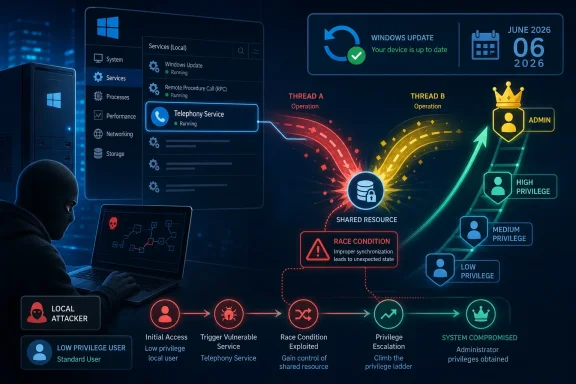
Local privilege escalation is rarely the first domino in an intrusion. It is the second or third, the step that turns a phished user, a compromised help-desk account, a browser escape, or a low-privilege foothold into something more durable. Once attackers have code running under a constrained account, bugs in privileged Windows services become the ladder.
The vulnerability description points to concurrent execution using a shared resource with improper synchronization, the family of mistakes usually filed under race condition. That is not a decorative CWE label. Race bugs are timing bugs, and timing bugs are often frustrating to reproduce, hard to reason about in code review, and especially dangerous in services that broker requests between user space and more privileged execution contexts.
Microsoft’s confidence signal is also worth dwelling on. The user-facing advisory text for this metric explains a spectrum: sometimes only the existence of a vulnerability is public, sometimes partial research hints at a root cause, and sometimes the vendor has enough knowledge to confirm both the bug and its technical character. CVE-2026-42912 sits in the latter camp. The public does not have every exploit primitive, but defenders do have enough to justify urgency.
The service, commonly associated with the Telephony API stack, exists to support telephony-related functionality and applications that depend on it. In many modern environments, few users knowingly interact with it. But attackers do not care whether a component is fashionable; they care whether it runs, what privileges it has, and what interfaces it exposes to authenticated users or local processes.
This is a recurring Windows security pattern. Mature components persist because compatibility is one of Windows’ core business promises. Enterprises run old line-of-business software, remote-access tools, call-center integrations, device-management agents, and vendor utilities that may still expect old plumbing to exist. Every preserved interface is a support victory and a security liability.
That does not mean Telephony Service should be treated as uniquely broken. It means it belongs to the vast middle layer of Windows services that are too established to remove casually and too privileged to ignore. Bugs there are not exotic; they are the expected cost of decades of compatibility meeting modern adversary tradecraft.
That makes CVE-2026-42912 different from a blunt memory corruption bug in the way defenders should think about it. A buffer overflow often suggests malformed input and crash-driven exploit development. A race condition suggests choreography. The attacker may need to repeatedly trigger operations, manipulate object lifetimes, or create contention until the service misorders trust and action.
Microsoft’s description says the attacker must be authorized and local. That is a meaningful boundary, but it is not a wall. “Authorized” can mean the attacker already has some valid account or execution context; “local” can mean the exploit is run after initial access has already been achieved. In enterprise breach chains, that is a common starting point rather than a comforting limitation.
The absence of public exploit details should not be overread either. Microsoft advisories often reveal enough for risk triage while withholding enough to avoid publishing a recipe. For defenders, the salient fact is that Microsoft has patched a race in a Windows service capable of enabling privilege escalation. Waiting for exploit code to become convenient is how Important-rated bugs become incident-report footnotes.
That distinction matters in patch meetings. A high-severity bug with uncertain details may be worth watching closely, especially if third-party claims are thin or contradictory. A confirmed vulnerability from the affected vendor begins from a different premise: the bug is real, the product owner acknowledges the affected technology, and the available description is credible enough to guide remediation.
For CVE-2026-42912, that means security teams should not spend their limited time debating whether the issue exists. The more useful questions are operational. Which Windows builds are exposed? Which systems are internet-adjacent but still susceptible to local post-exploitation? Which servers host many users, remote sessions, agents, or automation accounts that make local privilege escalation more attractive?
It also means exploit maturity should be treated carefully. If Microsoft marks exploitation as not detected or exploit code as not publicly disclosed, that is good news, not permission to drift. Race conditions can move from advisory text to working exploit slowly, then suddenly. Once a reliable technique is published, the patching window that felt generous tends to collapse.
The affected-version ranges reported by vulnerability trackers place patched builds above specific servicing baselines across Windows 10 1607, 1809, 21H2, and 22H2; Windows 11 23H2, 24H2, 25H2, and 26H1; and server lines including Windows Server 2012, 2012 R2, 2016, 2019, 2022, 23H2, and 2025. Some version listings vary slightly across downstream mirrors as Microsoft metadata propagates, so administrators should rely on Windows Update, WSUS, Intune, Configuration Manager, or the Microsoft Update Catalog rather than trying to hand-parse every build threshold from scraped feeds.
The practical point is simple: this is not a single abandoned SKU problem. It spans ordinary desktops, current Windows 11 deployments, and server installations that may sit at very different places in an organization’s patch process. That is exactly the kind of vulnerability that exposes the difference between “we patch Windows monthly” and “we know which machines actually received the right cumulative update.”
Server Core deserves special attention in that conversation. A minimal interface does not mean a minimal security obligation. If the vulnerable component is present and the relevant service code exists, the lack of a desktop shell is not a substitute for servicing. Core installations often live in places where downtime negotiations are more difficult, which is another way of saying attackers have learned to look there.
Elevation-of-privilege vulnerabilities are multipliers. They let an attacker escape the constraints that were supposed to make initial compromise survivable. A standard user becomes an administrator; a sandboxed process reaches the host; a service account becomes a platform for credential theft; a single workstation becomes a bridge into domain tooling.
CVE-2026-42912’s local requirement therefore makes it less of a perimeter emergency and more of an estate-hardening test. Organizations with strong application control, least privilege, credential isolation, and rapid endpoint patching can absorb this class of bug better. Organizations where every user is local admin, every server runs a zoo of agents, and patch compliance is measured by intention rather than telemetry have a larger problem than one CVE.
This is also why home enthusiasts should care, even if they are not running a call center stack or a Windows Server farm. Consumer attacks increasingly chain commodity malware with local privilege escalation to disable defenses, dump secrets, install drivers, or persist across cleanup attempts. A local EoP bug may not be the phishing email, but it can be what turns the phishing email into a system-level compromise.
That pattern cuts two ways. On one hand, repeated fixes can indicate healthy discovery: researchers and Microsoft engineers are finding and closing bugs in a component before broad exploitation becomes public. On the other hand, repeated bugs in the same service family suggest a surface that deserves architectural scrutiny rather than one-off whack-a-mole patching.
The Windows ecosystem has seen this movie before. Print Spooler, RPC-adjacent services, kernel drivers, and management subsystems have all taken turns as the unglamorous component suddenly thrust into the security spotlight. The painful lesson is that legacy service surfaces often contain enough complexity, privilege, and compatibility constraint to keep generating issues long after the first wave of patches.
For administrators, the right response is not panic-disabling every service with an old-fashioned name. It is inventory. Know where the Telephony Service is running, whether anything depends on it, how it is configured, and whether disabling it is safe in your environment. In some places the answer will be “leave it alone and patch”; in others, the answer may be “why is this enabled on this server at all?”
For a local privilege-escalation flaw, delay is especially seductive. Teams may reason that attackers need existing access, that no public exploit is available, or that the service is not obviously exposed. Each point may be true and still lead to the wrong operational conclusion. EoP bugs age badly because they become ingredients in exploit chains, and attackers are patient recipe collectors.
The right prioritization is contextual rather than theatrical. Domain controllers, jump boxes, RDS hosts, developer workstations, build servers, VDI pools, help-desk machines, and systems used by privileged administrators deserve faster attention than kiosk machines with tight controls. But broad client patching still matters because attackers often escalate on the least glamorous endpoint before moving toward the crown jewels.
Administrators should also remember that cumulative Windows updates are cumulative in both directions. Installing the current security update addresses many issues at once, but falling behind leaves a stack of old primitives available to an attacker. CVE-2026-42912 is the day’s subject; the unpatched machine is the larger subject.
If the Telephony Service is unnecessary, disabling it may reduce exposure, but only after dependency testing. Administrators should avoid reflexively changing service state across fleets without understanding downstream effects on dialer software, remote-access packages, communications tools, or specialized hardware integrations. The boring change-management step is what separates hardening from self-inflicted outage.
Least privilege helps more broadly. An attacker who cannot get code execution as a local user cannot directly run a local EoP exploit; an attacker who lands in a tightly governed environment has fewer chances to stage the timing games that race-condition exploits often require. Endpoint detection that watches suspicious service interaction, repeated failed exploitation patterns, abnormal process ancestry, or privilege-boundary probing may also catch activity before a full compromise.
Still, the center of gravity is patching. Microsoft did not publish a confirmed vulnerability so administrators could admire the metric taxonomy. The fix exists because the affected code path needed correction.
CVE-2026-42912 is a good example. “Concurrent execution using shared resource with improper synchronization” is technically meaningful but operationally incomplete. It tells us the bug class and affected component, not the exact interface, object, or call pattern. It says local authorized escalation, not which low-privilege accounts are best positioned to exploit it.
But the confirmed-confidence framing fills part of that gap. It says Microsoft is not merely relaying a vague third-party claim. It says the vulnerability’s existence and technical direction are credible enough for a security update. For most organizations, that should be the threshold for action, not the publication of a GitHub exploit.
There is a cultural problem here in parts of IT: patches are treated as optional until exploit code makes the risk legible. That reverses the defender’s advantage. The best time to patch a confirmed local privilege escalation is before it becomes a commodity post-exploitation module.
If your environment is currently dealing with browser exposure, Office macro risk, VPN credentials, exposed RDP, unmanaged developer tooling, or third-party endpoint agents, a Windows local EoP should move higher in the queue. It gives attackers a way to turn those first-stage weaknesses into administrative control. Security teams should patch not only according to the CVSS score, but according to what the bug enables in the environment they actually run.
There is also a monitoring implication. After patch deployment begins, teams should watch for systems that fail to install the relevant cumulative update, repeatedly roll back, or remain pinned to vulnerable build ranges. Those machines often become the exceptions attackers find first because defenders stop looking once dashboards cross an acceptable compliance percentage.
For smaller organizations and power users, the advice is more direct. Install the June 2026 Windows security updates, reboot when required, and verify the build number rather than assuming the update completed. Windows Update history is helpful, but the running build is the evidence that matters.
 Microsoft’s Quiet Wording Carries a Loud Operational Message
CVE-2026-42912 is the kind of vulnerability that does not need marketing theatrics to be serious. It is an elevation-of-privilege issue, not a wormable remote-code-execution bug, and that distinction will tempt some organizations to push it behind flashier patching work. That would be a mistake in the normal, unglamorous way Windows estates get compromised.Local privilege escalation is rarely the first domino in an intrusion. It is the second or third, the step that turns a phished user, a compromised help-desk account, a browser escape, or a low-privilege foothold into something more durable. Once attackers have code running under a constrained account, bugs in privileged Windows services become the ladder.
The vulnerability description points to concurrent execution using a shared resource with improper synchronization, the family of mistakes usually filed under race condition. That is not a decorative CWE label. Race bugs are timing bugs, and timing bugs are often frustrating to reproduce, hard to reason about in code review, and especially dangerous in services that broker requests between user space and more privileged execution contexts.
Microsoft’s confidence signal is also worth dwelling on. The user-facing advisory text for this metric explains a spectrum: sometimes only the existence of a vulnerability is public, sometimes partial research hints at a root cause, and sometimes the vendor has enough knowledge to confirm both the bug and its technical character. CVE-2026-42912 sits in the latter camp. The public does not have every exploit primitive, but defenders do have enough to justify urgency.
Telephony Is Legacy in Name, Not in Attack Surface
Windows Telephony Service sounds like an artifact from a different computing era, when modems, PBXs, dialers, and line devices sat closer to the center of the desktop experience. That framing is comforting and wrong. Windows is full of subsystems whose names reflect their origin more than their present security relevance.The service, commonly associated with the Telephony API stack, exists to support telephony-related functionality and applications that depend on it. In many modern environments, few users knowingly interact with it. But attackers do not care whether a component is fashionable; they care whether it runs, what privileges it has, and what interfaces it exposes to authenticated users or local processes.
This is a recurring Windows security pattern. Mature components persist because compatibility is one of Windows’ core business promises. Enterprises run old line-of-business software, remote-access tools, call-center integrations, device-management agents, and vendor utilities that may still expect old plumbing to exist. Every preserved interface is a support victory and a security liability.
That does not mean Telephony Service should be treated as uniquely broken. It means it belongs to the vast middle layer of Windows services that are too established to remove casually and too privileged to ignore. Bugs there are not exotic; they are the expected cost of decades of compatibility meeting modern adversary tradecraft.
Race Conditions Are Where Clean Architecture Meets Messy Reality
A race condition is not simply “two things happen at once.” It is a failure to protect an assumption while multiple threads, processes, or requests can change the state underneath it. In security terms, the attacker wins by nudging the system into a narrow timing window where a privileged component acts on data, handles an object, or trusts a state that is no longer what the code believes it to be.That makes CVE-2026-42912 different from a blunt memory corruption bug in the way defenders should think about it. A buffer overflow often suggests malformed input and crash-driven exploit development. A race condition suggests choreography. The attacker may need to repeatedly trigger operations, manipulate object lifetimes, or create contention until the service misorders trust and action.
Microsoft’s description says the attacker must be authorized and local. That is a meaningful boundary, but it is not a wall. “Authorized” can mean the attacker already has some valid account or execution context; “local” can mean the exploit is run after initial access has already been achieved. In enterprise breach chains, that is a common starting point rather than a comforting limitation.
The absence of public exploit details should not be overread either. Microsoft advisories often reveal enough for risk triage while withholding enough to avoid publishing a recipe. For defenders, the salient fact is that Microsoft has patched a race in a Windows service capable of enabling privilege escalation. Waiting for exploit code to become convenient is how Important-rated bugs become incident-report footnotes.
The Confirmed Metric Changes the Patch Conversation
The metric text supplied with the advisory is unusually useful because it explains what many vulnerability summaries flatten away. Confidence is not severity. It is not exploitability. It is a measure of how firmly the vulnerability’s existence and technical details are established.That distinction matters in patch meetings. A high-severity bug with uncertain details may be worth watching closely, especially if third-party claims are thin or contradictory. A confirmed vulnerability from the affected vendor begins from a different premise: the bug is real, the product owner acknowledges the affected technology, and the available description is credible enough to guide remediation.
For CVE-2026-42912, that means security teams should not spend their limited time debating whether the issue exists. The more useful questions are operational. Which Windows builds are exposed? Which systems are internet-adjacent but still susceptible to local post-exploitation? Which servers host many users, remote sessions, agents, or automation accounts that make local privilege escalation more attractive?
It also means exploit maturity should be treated carefully. If Microsoft marks exploitation as not detected or exploit code as not publicly disclosed, that is good news, not permission to drift. Race conditions can move from advisory text to working exploit slowly, then suddenly. Once a reliable technique is published, the patching window that felt generous tends to collapse.
The Affected Footprint Is Broad Because Windows Is Broad
CVE-2026-42912 affects a familiar spread of supported Windows client and server releases, including Windows 10, Windows 11, and multiple Windows Server generations. That breadth should not surprise anyone. Core services tend to be shared across editions, even when the user-facing features they support appear niche.The affected-version ranges reported by vulnerability trackers place patched builds above specific servicing baselines across Windows 10 1607, 1809, 21H2, and 22H2; Windows 11 23H2, 24H2, 25H2, and 26H1; and server lines including Windows Server 2012, 2012 R2, 2016, 2019, 2022, 23H2, and 2025. Some version listings vary slightly across downstream mirrors as Microsoft metadata propagates, so administrators should rely on Windows Update, WSUS, Intune, Configuration Manager, or the Microsoft Update Catalog rather than trying to hand-parse every build threshold from scraped feeds.
The practical point is simple: this is not a single abandoned SKU problem. It spans ordinary desktops, current Windows 11 deployments, and server installations that may sit at very different places in an organization’s patch process. That is exactly the kind of vulnerability that exposes the difference between “we patch Windows monthly” and “we know which machines actually received the right cumulative update.”
Server Core deserves special attention in that conversation. A minimal interface does not mean a minimal security obligation. If the vulnerable component is present and the relevant service code exists, the lack of a desktop shell is not a substitute for servicing. Core installations often live in places where downtime negotiations are more difficult, which is another way of saying attackers have learned to look there.
Elevation of Privilege Is the Breach Multiplier
Security headlines still overvalue initial access. That is understandable because the first entry point is narratively clean: a malicious attachment, an exposed VPN, an unpatched edge appliance. But professional intrusion response keeps showing the same lesson: the damage usually comes from what happens after the first foothold.Elevation-of-privilege vulnerabilities are multipliers. They let an attacker escape the constraints that were supposed to make initial compromise survivable. A standard user becomes an administrator; a sandboxed process reaches the host; a service account becomes a platform for credential theft; a single workstation becomes a bridge into domain tooling.
CVE-2026-42912’s local requirement therefore makes it less of a perimeter emergency and more of an estate-hardening test. Organizations with strong application control, least privilege, credential isolation, and rapid endpoint patching can absorb this class of bug better. Organizations where every user is local admin, every server runs a zoo of agents, and patch compliance is measured by intention rather than telemetry have a larger problem than one CVE.
This is also why home enthusiasts should care, even if they are not running a call center stack or a Windows Server farm. Consumer attacks increasingly chain commodity malware with local privilege escalation to disable defenses, dump secrets, install drivers, or persist across cleanup attempts. A local EoP bug may not be the phishing email, but it can be what turns the phishing email into a system-level compromise.
Windows Telephony Has Become a Repeat Visitor to Patch Tuesday
CVE-2026-42912 does not arrive in isolation. Windows Telephony Service has appeared repeatedly in recent Microsoft security updates, including other 2026 elevation-of-privilege entries involving different bug classes such as heap-based buffer overflow and use-after-free conditions. The exact vulnerabilities differ, but the pattern is hard to miss.That pattern cuts two ways. On one hand, repeated fixes can indicate healthy discovery: researchers and Microsoft engineers are finding and closing bugs in a component before broad exploitation becomes public. On the other hand, repeated bugs in the same service family suggest a surface that deserves architectural scrutiny rather than one-off whack-a-mole patching.
The Windows ecosystem has seen this movie before. Print Spooler, RPC-adjacent services, kernel drivers, and management subsystems have all taken turns as the unglamorous component suddenly thrust into the security spotlight. The painful lesson is that legacy service surfaces often contain enough complexity, privilege, and compatibility constraint to keep generating issues long after the first wave of patches.
For administrators, the right response is not panic-disabling every service with an old-fashioned name. It is inventory. Know where the Telephony Service is running, whether anything depends on it, how it is configured, and whether disabling it is safe in your environment. In some places the answer will be “leave it alone and patch”; in others, the answer may be “why is this enabled on this server at all?”
The Real Risk Lives Between Patch Availability and Patch Reality
Microsoft’s security model assumes that once a patch exists, the defender’s job is to deploy it. Enterprise reality is more complicated. Updates pass through rings, maintenance windows, application testing, reboot coordination, outage calendars, and executive exceptions that have a way of becoming permanent.For a local privilege-escalation flaw, delay is especially seductive. Teams may reason that attackers need existing access, that no public exploit is available, or that the service is not obviously exposed. Each point may be true and still lead to the wrong operational conclusion. EoP bugs age badly because they become ingredients in exploit chains, and attackers are patient recipe collectors.
The right prioritization is contextual rather than theatrical. Domain controllers, jump boxes, RDS hosts, developer workstations, build servers, VDI pools, help-desk machines, and systems used by privileged administrators deserve faster attention than kiosk machines with tight controls. But broad client patching still matters because attackers often escalate on the least glamorous endpoint before moving toward the crown jewels.
Administrators should also remember that cumulative Windows updates are cumulative in both directions. Installing the current security update addresses many issues at once, but falling behind leaves a stack of old primitives available to an attacker. CVE-2026-42912 is the day’s subject; the unpatched machine is the larger subject.
Mitigation Is Not a Replacement for Servicing
There will be environments where patching cannot happen immediately. That is not a moral failure; it is the reality of regulated systems, fragile workloads, and vendor-certified platforms. But mitigation should be framed as buying time, not solving the vulnerability.If the Telephony Service is unnecessary, disabling it may reduce exposure, but only after dependency testing. Administrators should avoid reflexively changing service state across fleets without understanding downstream effects on dialer software, remote-access packages, communications tools, or specialized hardware integrations. The boring change-management step is what separates hardening from self-inflicted outage.
Least privilege helps more broadly. An attacker who cannot get code execution as a local user cannot directly run a local EoP exploit; an attacker who lands in a tightly governed environment has fewer chances to stage the timing games that race-condition exploits often require. Endpoint detection that watches suspicious service interaction, repeated failed exploitation patterns, abnormal process ancestry, or privilege-boundary probing may also catch activity before a full compromise.
Still, the center of gravity is patching. Microsoft did not publish a confirmed vulnerability so administrators could admire the metric taxonomy. The fix exists because the affected code path needed correction.
The Advisory Says Less Than Defenders Want, and Enough to Act
One frustration with modern vulnerability advisories is that they are both too terse and too revealing. Defenders want exploit preconditions, affected functions, service call paths, and detection logic. Vendors want to avoid handing attackers a blueprint. The result is a compressed language that leaves everyone squinting.CVE-2026-42912 is a good example. “Concurrent execution using shared resource with improper synchronization” is technically meaningful but operationally incomplete. It tells us the bug class and affected component, not the exact interface, object, or call pattern. It says local authorized escalation, not which low-privilege accounts are best positioned to exploit it.
But the confirmed-confidence framing fills part of that gap. It says Microsoft is not merely relaying a vague third-party claim. It says the vulnerability’s existence and technical direction are credible enough for a security update. For most organizations, that should be the threshold for action, not the publication of a GitHub exploit.
There is a cultural problem here in parts of IT: patches are treated as optional until exploit code makes the risk legible. That reverses the defender’s advantage. The best time to patch a confirmed local privilege escalation is before it becomes a commodity post-exploitation module.
The Patch Queue Should Treat This as a Chain Component
The most useful way to rank CVE-2026-42912 is not as a standalone catastrophe. It is as a chain component that increases the value of any other foothold on the machine. That framing is more accurate and more actionable.If your environment is currently dealing with browser exposure, Office macro risk, VPN credentials, exposed RDP, unmanaged developer tooling, or third-party endpoint agents, a Windows local EoP should move higher in the queue. It gives attackers a way to turn those first-stage weaknesses into administrative control. Security teams should patch not only according to the CVSS score, but according to what the bug enables in the environment they actually run.
There is also a monitoring implication. After patch deployment begins, teams should watch for systems that fail to install the relevant cumulative update, repeatedly roll back, or remain pinned to vulnerable build ranges. Those machines often become the exceptions attackers find first because defenders stop looking once dashboards cross an acceptable compliance percentage.
For smaller organizations and power users, the advice is more direct. Install the June 2026 Windows security updates, reboot when required, and verify the build number rather than assuming the update completed. Windows Update history is helpful, but the running build is the evidence that matters.
The June Telephony Bug Leaves Administrators With Few Excuses
The practical message of CVE-2026-42912 is narrower than the anxiety it may generate, but it is still clear. Microsoft has confirmed a Windows Telephony Service race condition that can elevate privileges locally, and the fix belongs in the normal June 2026 security-update cycle rather than in a someday backlog.- CVE-2026-42912 is a confirmed Windows Telephony Service elevation-of-privilege vulnerability disclosed on June 9, 2026.
- The bug class is a race condition involving improper synchronization around a shared resource.
- The attack requires an authorized local attacker, which makes the flaw most useful after initial access rather than as a first point of entry.
- The affected footprint spans multiple Windows client and server generations, so administrators should verify update deployment by build and servicing status.
- Disabling the Telephony Service may be reasonable in some environments, but only after dependency testing and not as a substitute for installing the security update.
- The risk is highest on systems where a low-privilege foothold would quickly lead to valuable credentials, administrative tools, or lateral-movement paths.
References
- Primary source: MSRC
Published: 2026-06-09T07:00:00-07:00
Security Update Guide - Microsoft Security Response Center
 msrc.microsoft.com
- Related coverage: datacomm.com
- Related coverage: aha.org
- Related coverage: rapid7.com
Rapid7 Vulnerability Database
Rapid7's VulnDB is curated repository of vetted computer software exploits and exploitable vulnerabilities.www.rapid7.com - Related coverage: windowsforum.com
Patch Tuesday 2026: CVE-2026-25188 Telephony Service Heap Overflow Fix | Windows Forum
Microsoft's March 10, 2026 security update closes a high‑severity heap‑based buffer‑overflow in the Windows Telephony Service that Microsoft has catalogued...windowsforum.com - Related coverage: thewindowsupdate.com
- Related coverage: hivepro.com
- Related coverage: buildings.honeywell.com
The purpose of this document is to identify the patches that have been delivered by Microsoft® which have been tested against Pro-Watch
PDF documentbuildings.honeywell.com
- Related coverage: leakycreds.com
