
 A Small AMD Display Fix Lands in the Big Kernel Security Machine
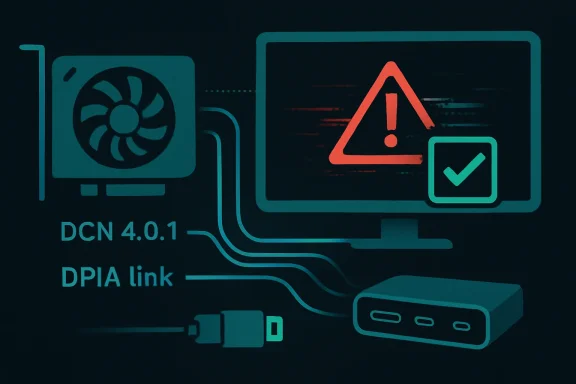
The official description of CVE-2026-43243 is almost comically brief: in the Linux kernel, the AMD display code has been fixed so that dcn401 get_phyd32clk_src checks the signal type before trying to access a link encoder. If the code tries to access a link encoder on a DPIA link, it can crash. That is the whole vulnerability, at least as the public record currently presents it.
But the brevity is deceptive. The affected area sits in drm/amd/display, the Direct Rendering Manager display subsystem used by AMD GPUs under Linux. This is not a peripheral user-space component that can be restarted like a tray app. It is kernel display infrastructure tied to monitor detection, link training, DisplayPort behavior, USB-C display routing, and the bring-up logic that decides how pixels get from the GPU to the panel in front of you.
The fix appears in stable kernel references rather than in a flashy vendor bulletin. That matters because the Linux kernel’s security story increasingly runs through a conveyor belt of upstream commits, stable backports, distribution kernels, and downstream advisories. By the time a CVE number appears, many users may already have received the fix, while others may be running an older long-term kernel that still carries the vulnerable path.
For desktop users, that can feel unsatisfying. There may be no dramatic exploit chain, no malware campaign, and no clear “click here to patch” button. For IT teams, however, the question is simpler: if your estate includes AMD-powered Linux desktops, laptops, workstations, kiosks, lab systems, or GPU-enabled developer boxes, this is one more kernel update that deserves to be tracked rather than dismissed.
The Crash Is the Symptom; the Display Stack Is the Story
At face value, CVE-2026-43243 is a denial-of-service problem. The driver assumes a link has a certain kind of encoder available, but a DPIA link does not fit that assumption. When the code walks into the wrong path, the kernel can crash.
That sounds mundane until you remember what DPIA represents. In AMD display terminology, DPIA is associated with DisplayPort-over-USB-C style routing, where the display path is not just a simple legacy connector soldered to a board. Modern laptops, docks, hubs, external monitors, KVMs, and USB-C adapters create display topologies that are dynamic, layered, and often opaque to the user.
The industry spent years turning the monitor cable into a tiny network of capabilities. A modern display link can negotiate bandwidth, lane counts, multi-stream transport, alternate modes, retimers, dock firmware quirks, power behavior, and hot-plug events. The result is wonderfully convenient when it works: one cable for power, display, data, and peripherals. The cost is that the kernel’s display driver now has to make correct decisions under constantly changing physical conditions.
That is why this CVE is more interesting than the advisory makes it sound. A missing signal-type check is not just a typo in a distant corner of the codebase. It is a failure to enforce a boundary between two classes of display link. The patch effectively says: do not treat a DPIA path like a link that has the encoder you were about to dereference.
For a user, the visible failure may simply be a system freeze, black screen, panic, or crash during display configuration. For an administrator, the operational question is whether a crash can be triggered predictably enough to disrupt shared workstations, public terminals, thin clients, GPU test rigs, or Linux machines that sit in reliability-sensitive roles.
NVD’s Empty Scoreboard Is Now Part of the Risk Assessment
NVD had not provided CVSS 4.0, CVSS 3.x, or CVSS 2.0 scoring at the time the record was published. The entry was marked as awaiting enrichment, which is now a familiar state for anyone who follows vulnerability feeds closely. The vulnerability has a CVE ID and a kernel.org source, but not the tidy numerical severity many dashboards are built around.
This is where vulnerability management gets awkward. Enterprises have spent years teaching tooling to sort work by CVSS score, exploit availability, known-exploited status, product name, and patch date. A kernel display crash with no NVD score does not fit cleanly into that machinery. It is too specific for panic, but too privileged to ignore.
The absence of an NVD score should not be mistaken for an absence of impact. It means the public enrichment process has not yet attached a standardized severity vector. In practical terms, the risk depends on factors NVD cannot infer from the short description: whether affected hardware is present, whether untrusted users can trigger display reconfiguration, whether systems are physically accessible, whether they run graphical sessions, and whether uptime matters.
That last point is important. A denial-of-service vulnerability on a developer laptop is an annoyance. The same class of bug on a shared GPU workstation, a Linux-based signage endpoint, a testing lab machine, or a workstation used for media production can turn into operational downtime. Severity is not just what the CVE says; it is where the bug lives in your environment.
The larger lesson is that defenders should stop treating “awaiting analysis” as a reason to defer thinking. The modern CVE pipeline often publishes identifiers before the surrounding metadata catches up. If your vulnerability process cannot cope with partially enriched records, it will lag precisely where kernel and open-source advisories move fastest.
Microsoft’s Appearance in the Story Is a Distribution Clue, Not a Windows Panic
The user-facing source here points to Microsoft’s Security Update Guide, which may initially look odd for a Linux kernel AMD display vulnerability. That does not mean Windows itself is suddenly affected by this Linux DRM bug. It means Microsoft tracks and republishes security information across a broader product and ecosystem surface than many users assume.
There are several plausible reasons this matters to Microsoft’s orbit. Microsoft ships Linux in various contexts, supports Linux workloads in Azure, documents vulnerabilities that may affect Microsoft-hosted or Microsoft-distributed environments, and operates security guidance infrastructure that often mirrors or references third-party CVEs. The presence of an MSRC page should not be read as evidence that a Windows AMD driver is vulnerable to this exact bug.
That distinction matters because CVE names are blunt instruments. “AMD display” can make desktop users think of Radeon Adrenalin drivers on Windows. “Microsoft” can make administrators think Patch Tuesday. “Linux kernel” can make Windows users tune out. CVE-2026-43243 sits at the intersection of those assumptions, and the safe reading is narrower: this is a Linux kernel AMD display issue fixed through kernel stable commits.
For WindowsForum’s audience, the relevance is still real. Many Windows users now live in hybrid computing environments. They dual-boot. They run Linux laptops for development. They use Proxmox or other Linux-based hosts. They maintain SteamOS-style gaming devices, home labs, NAS boxes with graphical output, or Azure Linux workloads. A vulnerability does not need to affect Windows Update to affect Windows people.
The better mental model is ecosystem exposure. If your hardware and operating systems cross vendor boundaries, your patch discipline has to cross them too. Microsoft showing the CVE does not convert it into a Windows emergency, but it does make it harder to pretend Linux kernel display vulnerabilities are someone else’s problem.
The Kernel Stable Process Did What It Was Supposed to Do
One comforting part of this case is that the fix exists in kernel stable references. The vulnerable behavior was identified, patched upstream, reviewed, signed off, and backported into stable lines. This is the unglamorous work that keeps Linux from becoming a museum of fixed-only-in-mainline bugs.
The patch itself appears to be small in concept: add a signal type check so the DCN 4.0.1 path does not access a link encoder when the link is DPIA. Small fixes are often the best kind in kernel land. They reduce the chance of regression, make the original defect easier to reason about, and allow stable maintainers to backport them with less risk than a sweeping refactor.
Still, small does not mean trivial. Display driver code is notoriously sensitive because users notice every regression immediately. A networking stack bug might sit hidden until a workload changes. A display bug announces itself by turning the screen black, breaking dock behavior, or making a laptop feel haunted every time a monitor is connected.
That is why distro timing matters. Rolling distributions may pick up the relevant stable kernels quickly. Enterprise distributions may take longer but provide curated backports. Appliance-like systems may require vendor firmware or image updates. The same CVE can be “already fixed” on one Linux machine and “still pending” on another sitting inches away on the same desk.
Administrators should resist the temptation to chase the individual commit manually unless they are already building kernels. The practical path is to determine which kernel streams your systems run, whether your distribution has incorporated the stable fix, and whether the affected AMD display hardware and USB-C/DisplayPort scenarios exist in your estate.
Local Bugs Still Matter When the Local Surface Is Physical
There is no public indication in the basic CVE record that CVE-2026-43243 is remotely exploitable. The likely impact is a crash triggered through display-link behavior, which suggests some degree of local, physical, or session-level interaction. In a world obsessed with internet-facing RCEs, that can sound low priority.
But local attack surface is not dead. It has merely moved into places where administrators are less comfortable modeling it. USB-C docks are shared. Conference-room machines are shared. Lab systems are touched by many users. Developer workstations often run privileged local workloads. Kiosk and signage devices expose display and USB ports in semi-public environments.
The exploitability question is not only “can a remote attacker weaponize this from the internet?” It is also “can a user, device, dock, adapter, or repeated hot-plug condition make this machine fall over?” If the answer is yes on systems that need to stay up, the issue deserves attention.
There is also the less dramatic but common failure mode: the bug might be encountered accidentally. Display stacks are full of edge cases caused by docks, cables, adapters, firmware revisions, monitor sleep states, and multi-monitor arrangements. A vulnerability fixed for security reasons may also remove a hard-to-diagnose reliability problem that users have been blaming on “Linux being weird with monitors.”
That dual identity is common in kernel CVEs. A crash bug can be both a security issue and a quality-of-life fix. Treating it solely as a hacker story misses half the benefit of patching.
AMD’s Linux Display Stack Carries the Weight of Modern Expectations
AMD’s open Linux graphics stack is one of the success stories of the last decade. Radeon users today generally expect accelerated desktops, Wayland sessions, high-refresh monitors, FreeSync, HDR work in progress, multi-monitor support, USB-C display output, and gaming workloads that would have seemed fanciful on Linux not so long ago. That expectation rests on a large and complex kernel driver.
The amdgpu and AMD display code must support a wide range of GPUs, display engines, connector types, laptop designs, docks, and monitors. DCN 4.0.1 refers to a display core generation path, and bugs in such generation-specific code can be both narrow and important. They may not affect every Radeon user, but they can hit the exact users who bought newer hardware and expect modern display behavior.
This is the trade-off of hardware enablement. The faster Linux supports new display blocks, the more code lands to handle new routing models. USB-C and DisplayPort evolution add more conditional paths. Multi-stream transport, high-bandwidth modes, and alternate-mode links create cases where one display link is not equivalent to another.
CVE-2026-43243 is therefore less a scandal than a systems-engineering artifact. A path assumed it could ask for a physical clock source through a link encoder. A DPIA link broke that assumption. The fix teaches the code to ask what sort of signal it is dealing with before proceeding.
That is exactly the kind of bug mature driver stacks discover and retire over time. The security relevance comes from the fact that the code runs in the kernel, and the stability relevance comes from the fact that display failures are user-visible and disruptive.
The Patch Priority Is Higher for Docks, Desktops, and Shared Linux Machines
For a single-user Linux laptop with AMD graphics and no external monitor, CVE-2026-43243 is probably not the first fire to extinguish. For a fleet of AMD laptops used with USB-C docks, it deserves more attention. The presence of DPIA in the advisory points administrators toward the real scoping question: where do AMD Linux systems use DisplayPort-over-USB-C style paths?
That includes more than the obvious developer laptop plugged into a dock. It can include workstations with USB-C display output, lab benches with rotating monitors, conference-room devices, and Linux machines used for testing hardware peripherals. It may also include systems where users frequently hot-plug monitors or adapters, creating the kind of changing topology that exercises driver edge cases.
The sensible enterprise response is inventory-driven. Find Linux systems running AMD GPUs. Check kernel versions and distro advisories. Pay particular attention to systems using external displays through USB-C, docks, or DisplayPort adapters. Then patch through the normal kernel update channel and reboot, because kernel driver fixes do not help much if the old kernel remains running for months.
Home users should be similarly pragmatic. If you run a rolling distro, update normally and reboot. If you run a long-term support distribution, watch your vendor’s kernel update stream. If you have seen unexplained crashes while connecting USB-C displays or docks on AMD hardware, this CVE is worth keeping in mind as a possible fix rather than merely a vulnerability.
The one thing not to do is treat the lack of a CVSS score as permission to forget it. Kernel display bugs live in a gray zone where the number may arrive late, but the patch can already be available.
Security Feeds Are Becoming Less Human-Readable at the Worst Possible Time
CVE-2026-43243 also illustrates a broader problem: vulnerability records are becoming simultaneously more numerous and less immediately informative. A record can arrive with a title, a terse kernel commit message, four stable references, no score, no CWE, and no plain-language operational guidance. Machines can ingest that. Humans still have to decide what it means.
This is particularly hard for cross-platform administrators. A Windows admin may see the MSRC source and wonder whether this belongs in the Patch Tuesday workflow. A Linux admin may see the kernel commit and know exactly where to look. A security analyst may see no CVSS and no exploit and leave it in the backlog. Each perspective is understandable, but none is complete by itself.
The industry has leaned heavily on enrichment layers to turn raw CVEs into priorities. NVD scores, EPSS probabilities, CISA KEV entries, GitHub advisories, vendor severity labels, and scanner plugins all help. The problem is that enrichment arrives asynchronously, and sometimes the first useful signal is the patch itself.
Kernel CVEs are especially prone to this mismatch. The Linux project fixes bugs continuously, then CVE records may later be generated for already-resolved flaws. Distribution backports can further blur the relationship between upstream version numbers and actual exposure. A system may be secure without appearing to run a “fixed” upstream version, because the vendor backported the patch into an older kernel.
That means defenders need a more nuanced process than “sort by score descending.” For kernel issues, the right questions are whether the subsystem is present, whether the hardware path exists, whether the affected code can be reached, whether the vendor kernel has backported the fix, and whether the machine’s role makes crashes costly.
The Useful Reading of CVE-2026-43243 Fits on One Admin Note
CVE-2026-43243 does not justify panic, but it does justify a clean entry in the patch queue. The narrowness of the bug is a strength for response: scope the hardware, identify the kernel streams, and update through supported channels.
- CVE-2026-43243 affects the Linux kernel’s AMD display driver code, not the ordinary Windows Radeon driver stack.
- The known failure mode is a crash caused by accessing a link encoder on a DPIA display link without the added signal-type check.
- Systems most worth checking are AMD Linux machines that use USB-C, DisplayPort, docks, adapters, or other dynamic external-display configurations.
- NVD had not assigned a severity score when the record was published, so teams should not wait for a number before doing basic exposure analysis.
- The fix is available through Linux kernel stable commits and should normally be consumed through distribution kernel updates rather than manual patching.
- The practical risk is denial of service and reliability disruption, especially on shared, physical, or uptime-sensitive Linux systems.
The Real Risk Is Letting Hardware Bugs Fall Between Team Boundaries
The most dangerous thing about a CVE like this is not that it will become the next mass-exploitation headline. It probably will not. The danger is that it falls between teams: too Linux-specific for Windows admins, too hardware-specific for security analysts, too small for executives, and too scoreless for dashboards.
That is how infrastructure bugs linger. Nobody owns the dock. Nobody owns the GPU path. Nobody owns the kernel on the lab workstation because it is “just a desktop.” Then the machine crashes during a demo, a build, a test run, a classroom session, or a production-adjacent workflow, and the root cause turns out to have been a known fixed bug sitting in a feed.
Modern endpoint security is no longer just about browsers, Office documents, and exposed services. The kernel’s relationship with hardware is now a real part of the risk surface, especially as USB-C turns physical connectivity into a negotiable software-defined event. Display drivers are not decorative; they are privileged code interpreting signals from an increasingly complicated outside world.
CVE-2026-43243 is a small patch with a larger message. The responsible response is measured: verify exposure, patch the affected Linux kernels, reboot the machines that need it, and keep an eye on distribution advisories as enrichment catches up. The forward-looking lesson is broader still: as PCs become more modular, docked, accelerated, and cross-platform, the bugs that matter will increasingly look like this one — not spectacular, not universal, but sitting exactly where hardware convenience meets kernel trust.
