

A Small Counter That Turns Into a Big Kernel Problem
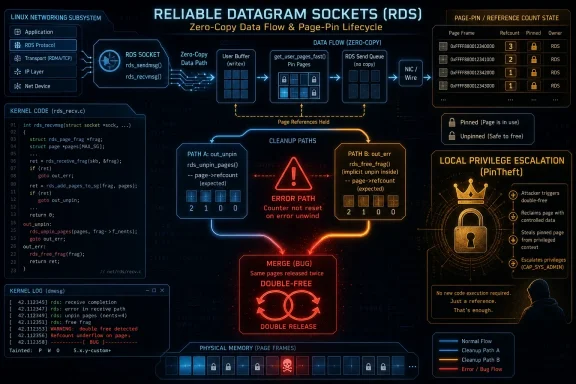
The vulnerability description reads like a minor cleanup bug: op_nents is not reset when iov_iter_get_pages2() fails inside rds_message_zcopy_from_user(). That is the sort of sentence that makes sense to kernel developers and almost nobody else. Yet the practical meaning is straightforward enough: the kernel pins pages for a zero-copy send, unwinds after an error, and later believes there are still entries to clean up.
That mistaken belief matters because memory ownership is the central religion of kernel programming. If a page is released once, the kernel’s accounting should agree that it has been released. If another cleanup path comes along and releases it again, the system has crossed from “bug” into “security primitive.”
The bug sits in Linux RDS, short for Reliable Datagram Sockets, a networking protocol originally associated with clustered database and high-performance environments. RDS is not the same thing as Microsoft Remote Desktop Services, a confusion that is inevitable on a Windows-heavy forum. This is Linux kernel networking code, not Windows Server’s RDS role.
The zero-copy detail is important because performance features often redraw the security boundary. Zero-copy networking tries to avoid copying data between user space and kernel space by pinning memory pages and letting the kernel operate on them more directly. That saves CPU cycles, but it also makes the bookkeeping unforgiving: if the reference count is wrong, the kernel may continue to act on memory after it should have stopped trusting it.
The CVE Record Understates the Shape of the Risk
NVD’s entry currently carries no CVSS score from NIST. That does not mean the bug is harmless, and it does not mean every exposed system is doomed. It means the vulnerability is new enough that enrichment, scoring, and distribution-level assessment are still catching up.
The public CVE text is conservative. It says the vulnerability has been resolved in the Linux kernel, explains the failed page-pin path, and points to a stable kernel commit. That is normal kernel-CVE language: terse, implementation-heavy, and allergic to drama.
The more alarming context comes from the oss-security discussion linking CVE-2026-43494 to PinTheft, a reported local privilege-escalation exploit for an RDS zero-copy double free. According to that discussion, the exploit idea is to drain page references through repeated failed RDS zero-copy sends, then combine that with io_uring fixed buffers to turn stale memory access into a page-cache overwrite. In the described proof of concept, overwriting page cache for a SUID-root binary becomes a path to root.
That chain matters because modern Linux exploitation is rarely about a single cinematic bug. It is about combining subsystems that were each designed for performance, flexibility, or backward compatibility. RDS supplies the reference-counting mistake; io_uring supplies a way to keep a useful stale relationship to a page; the page cache supplies the target surface.
PinTheft Is a Reminder That “Local” Does Not Mean “Low Priority”
Security teams often sort vulnerabilities by the first word in the access vector. Remote gets urgency; local gets a calendar invite. That instinct is understandable, but it is increasingly dangerous in environments where “local user” can mean a shell in a container, a compromised web app account, a CI runner, a developer VM, or a low-privilege foothold on a multi-tenant box.
A local privilege escalation is not the first step in an intrusion. It is the step that turns intrusion into ownership. Attackers who land as an unprivileged user still need to escape the limits of that user, and kernel bugs are among the most valuable ways to do it.
The PinTheft framing also lands at an uncomfortable moment for Linux administrators. The last several years have made it clear that page pinning, splice-like data paths, zero-copy I/O, and high-performance kernel interfaces are fertile ground for mistakes that look tiny in a diff and severe in a working exploit. The same design pressure keeps appearing: Linux keeps adding faster ways to move data, and attackers keep looking for places where “faster” means “less ceremonious about ownership.”
For Windows administrators, the analogy is not hard to find. The Windows kernel has its own history of local escalation bugs in graphics, file systems, drivers, and object lifetime management. The platform differs, but the operational pattern is familiar: a bug dismissed as “only local” becomes urgent when exploit code exists and ordinary user access is easy to obtain.
The Blast Radius Depends on RDS, Not on the CVE Name
The practical exposure question is whether the vulnerable RDS code is present, loadable, and usable on a given system. That is where this bug becomes more nuanced than a headline about “Linux kernel vulnerability” suggests.
RDS is not a default concern for many desktop Linux users. Some distributions build it as a module; some package it separately; some blacklist it; some enterprise configurations may omit it entirely. The oss-security discussion noted claims that Arch Linux had the required RDS kernel module by default among common tested distributions, while Fedora’s position was more complicated because RDS may be built as a module but packaged in kernel-modules-extra and subject to blacklist configuration.
That distinction is not trivia. A kernel configured with CONFIG_RDS=m is not the same exposure as a system where the module is installed, loadable by policy, and reachable by an unprivileged user. Conversely, “we do not use RDS” is not enough if the module is present and auto-load behavior or local privileges allow it to be pulled into the running kernel.
This is where administrators should resist both panic and complacency. The vulnerable code path is not equivalent to a remotely reachable OpenSSL bug listening on every interface. But kernel modules have a way of surprising estates that have accumulated years of vendor defaults, cloud images, special-purpose packages, and “temporary” configuration changes.
The important inventory questions are concrete. Is the RDS module installed? Is it loaded? Is it blacklisted? Is the system running a kernel that already includes the stable fix? Do any workloads actually require RDS? If the answer to the last question is no, disabling or preventing the module from loading is a defensible mitigation while waiting for distribution packages.
The Bug’s Mechanics Are Boring Until They Are Weaponized
At the code level, CVE-2026-43494 is an accounting error on an error path. That phrase should make experienced engineers wince. Error paths are where invariants go to die, especially in code that has to partially complete work, unwind, and coordinate with asynchronous cleanup.
The kernel function involved attempts to prepare a zero-copy RDS message from user memory. If page pinning fails partway through, the function releases pages it already pinned and clears a notifier pointer. The missing step is resetting the entry count that later cleanup code still consults.
That leaves two parts of the data structure disagreeing about reality. One field says the zero-copy notifier is gone; another says there are still entries to release. Later, rds_message_purge() walks that stale count and releases pages again.
A double free in user-space software is bad. A double free or reference-counting error in the kernel is worse because the kernel is the allocator, referee, and execution environment. If an attacker can steer what memory gets recycled into the freed space, the bug can become a write primitive, a use-after-free primitive, or a route to corrupting objects the kernel trusts.
The PinTheft discussion describes the attack as stealing references from a page and then using io_uring fixed buffers to keep leverage over memory after the kernel should have stopped treating it as the same object. That is the difference between a crash bug and a privilege escalation: not merely making memory accounting wrong, but making it wrong in a useful direction.
Zero-Copy Keeps Making the Kernel Faster and More Brittle
Zero-copy I/O is not a mistake. It is one of the reasons modern operating systems can push enormous amounts of data without burning wasteful CPU cycles on redundant memory copies. Databases, storage engines, proxies, packet processing stacks, and high-throughput services all benefit from designs that minimize data movement.
But zero-copy also erodes one of the oldest safety conveniences in systems programming: the copy as a boundary. When data is copied, ownership is clearer. When pages are pinned and shared across subsystems, the kernel has to maintain a precise story about who may touch them, who must release them, and when the underlying physical page can be reused.
That story becomes harder in the presence of partial failure. The happy path may be tested constantly in production because it is the path performance-sensitive users exercise. The error path may depend on page faults, allocation pressure, user memory layout, timing, and obscure feature combinations.
This is why CVE-2026-43494 is interesting beyond the RDS subsystem. It fits a broader pattern in which high-performance Linux features create powerful cross-subsystem interactions. io_uring, page pinning, network zero-copy, and page cache behavior are each legitimate technologies; together, they give exploit developers a larger grammar.
The uncomfortable lesson for kernel maintainers is that memory lifetime bugs no longer need to be obviously catastrophic in isolation. A stale count in a networking structure can become exploitable because another subsystem provides a way to preserve or weaponize the stale reference. Linux’s strength — a rich set of composable primitives — is also part of the attack surface.
Enterprise Linux Teams Need Distribution Answers, Not Just Upstream Commits
The CVE points to an upstream stable kernel commit, but most organizations do not run kernels straight from kernel.org. They run Red Hat Enterprise Linux, Ubuntu, Debian, SUSE, Oracle Linux, Rocky, AlmaLinux, Proxmox, Fedora, Arch, cloud-provider kernels, appliance kernels, or container-host variants maintained on their own cadence.
That means the immediate question is not merely “has Linux fixed it?” The question is whether your vendor has backported the fix into the kernel package you actually deploy. Backports often preserve older version numbers, so a kernel that looks “old” may contain the fix, while a self-built or niche kernel that looks “new” may not if it sits on the wrong branch.
Security scanners will eventually catch up, but early windows are messy. Tenable and other vulnerability tools have already begun tracking CVE-2026-43494, while NVD scoring remains unfilled. Distribution advisories may lag the CVE by hours or days, and package repositories may lag advisories depending on release engineering and testing.
Administrators should also watch for the difference between a kernel update and a running kernel. Linux systems commonly install patched kernels without rebooting into them. Live patching can cover some kernel bugs, but not every distribution or deployment uses it, and not every fix is necessarily suitable for live patch delivery.
In practical terms, a fleet may show “patched package installed” while still running a vulnerable kernel. That is not a paperwork problem. It is the difference between mitigation and wishful thinking.
Windows Shops Are Still in This Story
WindowsForum readers might reasonably ask why a Linux RDS bug deserves attention here. The answer is that Windows estates are rarely Windows-only anymore. Linux sits under Kubernetes nodes, developer workstations, WSL environments, NAS appliances, cloud images, build systems, security tools, and hypervisors that Windows admins are expected to understand when they break.
WSL deserves careful wording. The CVE is a Linux kernel vulnerability, and WSL 2 uses a Microsoft-provided Linux kernel rather than a distribution’s normal kernel package. Whether a specific WSL environment is exposed depends on Microsoft’s shipped kernel, its configuration, and whether the relevant RDS functionality exists and is reachable. That is a different update path from Ubuntu on bare metal or a Debian VM.
Containers are another common source of confusion. A container does not bring its own kernel; it shares the host kernel. If a containerized workload gains local code execution and can reach a vulnerable kernel interface exposed by the host, the host’s kernel security posture matters. Namespaces and capability restrictions may reduce exposure, but they do not make kernel LPEs irrelevant.
Virtualization cuts both ways. A vulnerable Linux guest can be compromised to root inside that guest without implying a host escape. But root inside a guest is still serious if the guest holds secrets, mounts shared storage, runs build infrastructure, or participates in production networks.
For Windows administrators managing hybrid estates, CVE-2026-43494 is a useful reminder that Linux patch management cannot be reduced to “the Linux team handles that.” The blast radius of a Linux kernel bug may cross into Active Directory secrets, CI/CD pipelines, cloud credentials, backup systems, and administrative jump boxes.
Mitigation Is About Removing Reachability While Patch Pipelines Move
The clean fix is a kernel containing the upstream correction: reset op_nents properly when the zero-copy page-pin operation fails. Everything else is risk reduction while waiting for that fix to arrive, be tested, and be booted.
If RDS is not required, disabling it is the obvious temporary move. That can mean blacklisting the module, ensuring it is not loaded, removing optional kernel module packages where appropriate, or using distribution-supported mechanisms to prevent auto-loading. Administrators should validate the result rather than assume a config file did what it was supposed to do.
The harder cases are systems that may actually use RDS. Some clustered database or specialized network workloads may depend on it. Those environments need vendor guidance, testing, and scheduled maintenance rather than a blanket blacklist pasted into a change window.
There is also a policy angle around unprivileged access. If exploitability depends on a local user reaching the relevant socket family and combining it with other kernel facilities, then reducing untrusted local code execution matters. That includes container capability hygiene, CI runner isolation, shell access policy, and avoiding multi-tenant assumptions on machines that were never hardened for hostile local users.
None of these mitigations should become a substitute for patching. Kernel module blacklists get lost. Workloads change. Images are rebuilt. The permanent answer is to run a fixed kernel or a vendor-backported equivalent and to retire temporary controls when they are no longer needed.
The Real Signal Is in the Patch, Not the Score
Security teams are trained to ask for CVSS, and CVSS is useful for triage at scale. But new kernel CVEs often have a period where the score is absent, disputed, or misleading. CVE-2026-43494 is currently in that awkward phase.
A missing NVD score should not push the item to the bottom of the queue when exploit discussion is public and the affected code is in the kernel. At the same time, the absence of universal exposure should prevent breathless claims that every Linux system is one command away from root compromise. The responsible position sits between those poles.
Kernel vulnerabilities need a different triage rhythm. Administrators should ask whether the subsystem is present, whether it is reachable, whether exploit code or a plausible exploit strategy exists, whether the bug crosses privilege boundaries, and whether a vendor-fixed kernel is available. CVSS is an input, not a verdict.
The open-source kernel process also means fixes can become public before every downstream advisory is ready. Attackers and defenders read the same commits. The CVE system helps attach a name to the issue, but the patch itself is often the first real signal.
That creates an uncomfortable race for distributions. Move too slowly and users remain exposed after public technical details exist. Move too quickly and kernel regressions can cause outages at a scale that makes security teams deeply unpopular. There is no magic in that tradeoff, only engineering discipline.
The Part of the Patch Cycle That Deserves Your Attention
The most useful response to CVE-2026-43494 is not a dramatic rebuild of every Linux system by sunset. It is targeted verification and fast hygiene on the machines where the vulnerable path is plausible.
- Systems that do not need Linux RDS should prevent the RDS module from loading while waiting for or validating fixed kernel packages.
- Systems that run optional or extra kernel module packages should be checked explicitly, because “not in the base image” is not the same as “not installed anywhere.”
- Container hosts, CI runners, shared development boxes, and multi-user Linux servers deserve higher priority than single-user lab systems because local privilege escalation is more valuable there.
- A patched kernel package does not protect a machine until the running kernel is actually replaced through reboot or a verified live-patching mechanism.
- WSL 2 and cloud-provider kernels should be tracked through their own update channels rather than assumed to match a distribution advisory.
- Security teams should treat the lack of an NVD score as temporary metadata, not as evidence that the issue is low impact.
The narrowness of CVE-2026-43494 is real, but it is not reassuring by itself. Modern infrastructure is built from narrow features stacked high, and attackers only need one neglected layer to turn a local foothold into control.
The fix for this bug is a small state reset, but the broader lesson is larger: performance paths are security boundaries now. Linux will keep adding faster networking and I/O machinery, Windows shops will keep depending on Linux in places they do not always inventory, and the next uncomfortable CVE will probably look just as obscure until someone shows how the obscure path becomes the shortest route to root.
References
- CVE-2026-43494 net/rds: reset op_nents when zerocopy page pin fails NVD / Linux Kernel · 2026-05-22T01:02:07-07:00