

On May 21, 2026, CVE-2026-43497 was published for a Linux kernel flaw in the
The vulnerable code sits in
The core issue is deceptively simple. The driver allowed framebuffer pages allocated with
That omission became dangerous when the framebuffer was reallocated through
In security language, that is a use-after-free. In plainer English, a process could retain read and write access to kernel pages after the driver believed those pages were gone.
That is a very kernel-flavored fix: less “block the attack” than “restore the missing lifecycle rule.” The driver now refuses to replace the framebuffer while another party still holds a live mapping to it. The old memory cannot silently become stale because the driver now knows the mapping exists.
This is also why the bug is interesting beyond the specific device class. The vulnerability does not depend on spectacular cryptography failure or a novel CPU side channel. It depends on a driver failing to participate fully in the virtual memory contract it implicitly entered when it handed framebuffer pages to userspace.
The kernel is full of these contracts. Filesystems, graphics drivers, character devices, accelerators, and virtualization components all expose memory to userspace under carefully choreographed assumptions. When those assumptions are incomplete, a local interface can become a kernel memory primitive.
The CVE description says the issue was tested with a proof of concept using
For enterprise IT, this distinction is important. A kernel use-after-free with a proof of concept deserves more attention than a speculative code smell, but the practical exposure still depends on whether vulnerable kernels load the affected driver and whether untrusted local users or devices can reach the relevant paths.
The affected driver is not a universal desktop dependency. Many servers will never load it. Many cloud workloads will never see a USB display adapter. But thin clients, Linux desktops, kiosks, workstations, test benches, and oddball embedded systems often have precisely the kind of hardware diversity that makes forgotten drivers relevant.
The framebuffer model is straightforward by design: expose a memory-backed display surface and let userspace draw into it. That simplicity was valuable when graphics stacks were less layered and local console access implied a different trust model. In 2026, that same simplicity lives inside systems with containers, hot-plugged peripherals, remote management tools, and much more aggressive adversaries.
CVE-2026-43497 is therefore less a shock than a symptom. Old subsystems do not become safe merely because they are boring. They can become less scrutinized, less frequently exercised by mainstream users, and more dependent on a shrinking pool of maintainers who understand the interactions among memory management, device removal, and userspace APIs.
This is the kind of bug that tends to produce a shrug until it appears in a chain. A local memory corruption bug in an obscure driver may not be catastrophic on its own. Combine it with user access, a device-triggered path, a sandbox escape requirement, or a misconfigured workstation fleet, and it becomes a useful rung on the ladder.
That is the wrong instinct here. A use-after-free in kernel memory management is a class of bug security teams already understand as dangerous. The more useful question is not “what is the official score today?” but “can this code run in my environment, and can an attacker reach it?”
A practical triage view starts with three facts. The vulnerability is in the Linux kernel. It involves a specific framebuffer driver. It requires conditions where userspace can map the framebuffer, trigger reallocation, and leave stale mappings around device teardown.
That makes it less broadly urgent than a remotely reachable kernel network flaw, but more serious than a cosmetic hardening patch. The absence of a score should slow automated panic, not justify ignoring it.
Still, exploitability is not guaranteed by the bug class alone. Kernel memory exploitation depends on reclaim behavior, object placement, available spraying techniques, hardening options, and the attacker’s ability to trigger the right sequence repeatedly. Modern kernels also carry mitigations that can make old-school exploitation harder, though not impossible.
There is also a privilege boundary question. If the vulnerable framebuffer device node is accessible only to trusted local users, the immediate risk is lower. If desktop sessions, kiosk users, containerized workloads with device passthrough, or untrusted lab users can interact with the device, the boundary becomes more meaningful.
USB emulation in the proof of concept also points toward testability rather than necessarily plug-and-own exploitation. A malicious device scenario may be plausible in a lab, but enterprise defenders should avoid both extremes: do not dismiss it because it is local, and do not treat it as a mass remote worm.
CVE-2026-43497 is exactly the kind of bug that punishes shallow inventory. If
The answer is not to hand-wave the ticket away. The answer is to attach driver context to the ticket. Security teams should know which endpoints load USB display drivers, which systems permit users to attach devices, and which kernel packages include the backported fix.
This is where Linux distributions matter. The upstream stable commits tell part of the story, but most production users consume vendor kernels from Ubuntu, Debian, Red Hat, SUSE, Fedora, Arch, or appliance vendors. The patch may arrive as a backport without changing the headline kernel version in an obvious way. Package changelogs and vendor advisories are the operational source of truth.
WSL is unlikely to be the main exposure path for this specific USB framebuffer issue, because hardware access and kernel composition differ from a general-purpose Linux desktop. But the larger lesson absolutely crosses platforms: peripheral-facing drivers are part of the endpoint attack surface, and they age unevenly. Windows has its own long history of printer, graphics, USB, and display driver bugs proving the same point.
For WindowsForum’s audience, the practical connection is mixed fleets. An enterprise that believes it is “mostly Windows” may still have Linux jump boxes, developer laptops, lab machines, signage systems, monitoring appliances, and virtualization hosts. Those systems often sit outside the most mature patching workflows.
The modern endpoint is not defined by the operating system logo on the login screen. It is defined by what code runs in kernel mode, what devices it trusts, and how quickly the organization can discover when a supposedly obscure driver becomes relevant.
The
Security engineers often talk about “attack surface” as if it were a list of ports. Kernel attack surface is more subtle. It includes the lifetime rules of mappings, reference counts, locks, teardown paths, hotplug behavior, and error handling.
That is why small fixes matter. A counter, a callback, and an
The vulnerable sequence in this CVE depends partly on that reality. Userspace maps framebuffer memory. The framebuffer backing buffer can be replaced. The device can disconnect. The driver frees memory while userspace still has mappings to the old pages.
That kind of race-adjacent lifecycle problem is hard to reason about because each individual operation looks reasonable in isolation. Mapping a framebuffer is normal. Changing screen information is normal. Disconnecting a USB device is normal. Freeing the old buffer is normal. The vulnerability appears in the gap between them.
The fix closes that gap by refusing reallocation while mapped. It is a conservative design choice, and conservative is exactly what kernel drivers need when userspace and hot-plugged hardware both have ways to disturb state.
Desktop Linux fleets should get the closest look, especially where USB peripherals are freely attached. Lab environments and hardware test rigs are also worth attention because they are more likely to use unusual USB devices, emulators, and permissive local access. Kiosks and signage systems deserve scrutiny because they often run old kernels quietly for years.
Server fleets are not automatically exposed just because they run Linux. If the affected driver is not available or never loaded, the risk profile is different. But the safest way to establish that is through configuration and package evidence, not assumption.
Security teams should also be cautious with compensating controls. Blacklisting a module may reduce exposure where the hardware is unnecessary, but it is not a substitute for a kernel fix on systems that need the driver. Access control on framebuffer devices helps, but the kernel should not rely on perfect local policy to defend against memory lifecycle bugs.
The missing pieces will come from distributions and downstream vendors. Which supported kernel streams are affected? Which have already received backports? Which enterprise kernels built
This is where vulnerability management becomes less about reading CVE pages and more about supply-chain literacy. The same upstream bug can be irrelevant, patched, exploitable, or blocked depending on the kernel tree and configuration in front of you.
The industry’s dependency on NVD scoring often hides that reality. Scores are useful for sorting large queues, but they are crude instruments for kernel bugs with configuration-sensitive reachability. A driver-specific use-after-free is exactly where local inventory beats generic severity.
udlfb framebuffer driver, where mapped DisplayLink-style USB framebuffer memory could remain accessible after the backing kernel pages were freed. The bug is narrow, technical, and not yet scored by NVD, but it lands in a part of the kernel where “narrow” is not the same as harmless. It is a reminder that the Linux graphics stack still carries older interfaces whose security properties were designed for a very different era of hardware, privilege boundaries, and hot-pluggable devices.
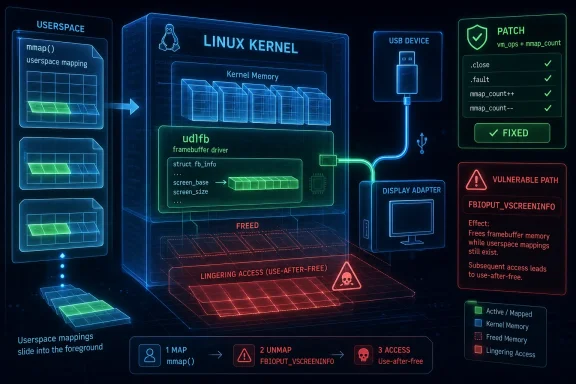 A Small Driver Bug Exposes a Large Kernel Assumption
The vulnerable code sits in fbdev, the older Linux framebuffer subsystem, and specifically in udlfb, a driver historically associated with USB display adapters. That location matters. This is not a browser sandbox escape or a remote network daemon listening on the internet; it is a kernel memory-management problem triggered through the messy intersection of userspace mappings, framebuffer resizing, and USB device teardown.The core issue is deceptively simple. The driver allowed framebuffer pages allocated with
vmalloc() to be mapped into userspace via remap_pfn_range(), but it did not attach vm_ops callbacks to the virtual memory area. Without those callbacks, the kernel driver did not maintain a reliable count of active memory mappings.That omission became dangerous when the framebuffer was reallocated through
FBIOPUT_VSCREENINFO. Existing userspace page-table entries could continue to point at the old backing memory. Later, when the USB device was disconnected and the driver destroyed its state, vfree() could release pages that userspace still had mapped.In security language, that is a use-after-free. In plainer English, a process could retain read and write access to kernel pages after the driver believed those pages were gone.
The Patch Does Not Add Glamour, It Adds Accounting
The fix is not exotic. The kernel change adds avm_operations_struct with open and close callbacks, then uses those callbacks to maintain an atomic mmap_count in the driver’s private data structure. When the framebuffer reallocation path runs, it checks that count and returns -EBUSY if userspace still has the buffer mapped.That is a very kernel-flavored fix: less “block the attack” than “restore the missing lifecycle rule.” The driver now refuses to replace the framebuffer while another party still holds a live mapping to it. The old memory cannot silently become stale because the driver now knows the mapping exists.
This is also why the bug is interesting beyond the specific device class. The vulnerability does not depend on spectacular cryptography failure or a novel CPU side channel. It depends on a driver failing to participate fully in the virtual memory contract it implicitly entered when it handed framebuffer pages to userspace.
The kernel is full of these contracts. Filesystems, graphics drivers, character devices, accelerators, and virtualization components all expose memory to userspace under carefully choreographed assumptions. When those assumptions are incomplete, a local interface can become a kernel memory primitive.
DisplayLink-Class Hardware Turns Local Bugs Into Physical-Attack Stories
For most WindowsForum readers, the word “USB” should sharpen the threat model. A bug in a USB display driver is not automatically remotely exploitable, but USB changes how local attack surfaces behave. A malicious peripheral, a lab setup using USB emulation, or a compromised process interacting with a real adapter can all move a bug from theoretical to operationally interesting.The CVE description says the issue was tested with a proof of concept using
dummy_hcd and raw_gadget, two tools used for USB device emulation and fuzzing-style workflows. That does not mean criminals are walking around with weaponized DisplayLink dongles today. It does mean the reporter validated the behavior in a controlled way rather than merely reasoning from source code.For enterprise IT, this distinction is important. A kernel use-after-free with a proof of concept deserves more attention than a speculative code smell, but the practical exposure still depends on whether vulnerable kernels load the affected driver and whether untrusted local users or devices can reach the relevant paths.
The affected driver is not a universal desktop dependency. Many servers will never load it. Many cloud workloads will never see a USB display adapter. But thin clients, Linux desktops, kiosks, workstations, test benches, and oddball embedded systems often have precisely the kind of hardware diversity that makes forgotten drivers relevant.
The Old Framebuffer API Keeps Haunting Modern Systems
Linux graphics has long since moved toward DRM/KMS as the modern display stack, butfbdev remains part of the kernel’s compatibility landscape. It survives because systems still boot, recover, render consoles, and support legacy devices through it. That persistence is useful, but it also keeps older assumptions alive.The framebuffer model is straightforward by design: expose a memory-backed display surface and let userspace draw into it. That simplicity was valuable when graphics stacks were less layered and local console access implied a different trust model. In 2026, that same simplicity lives inside systems with containers, hot-plugged peripherals, remote management tools, and much more aggressive adversaries.
CVE-2026-43497 is therefore less a shock than a symptom. Old subsystems do not become safe merely because they are boring. They can become less scrutinized, less frequently exercised by mainstream users, and more dependent on a shrinking pool of maintainers who understand the interactions among memory management, device removal, and userspace APIs.
This is the kind of bug that tends to produce a shrug until it appears in a chain. A local memory corruption bug in an obscure driver may not be catastrophic on its own. Combine it with user access, a device-triggered path, a sandbox escape requirement, or a misconfigured workstation fleet, and it becomes a useful rung on the ladder.
NVD’s Missing Score Is Not a Missing Risk
At publication, NVD had not assigned CVSS 4.0, 3.x, or 2.0 severity scores to CVE-2026-43497. That absence is not unusual for freshly published kernel CVEs, especially as vulnerability databases continue to process a heavy flow of records. But it creates a familiar problem for administrators: many dashboards treat “unscored” as if it were “unimportant.”That is the wrong instinct here. A use-after-free in kernel memory management is a class of bug security teams already understand as dangerous. The more useful question is not “what is the official score today?” but “can this code run in my environment, and can an attacker reach it?”
A practical triage view starts with three facts. The vulnerability is in the Linux kernel. It involves a specific framebuffer driver. It requires conditions where userspace can map the framebuffer, trigger reallocation, and leave stale mappings around device teardown.
That makes it less broadly urgent than a remotely reachable kernel network flaw, but more serious than a cosmetic hardening patch. The absence of a score should slow automated panic, not justify ignoring it.
The Exploitability Question Lives Between Userspace and USB
The CVE text describes the process retaining read/write access to freed kernel pages. That is the phrase that should make kernel engineers sit up. Freed pages may later be reused for other kernel objects, and stale access to reused memory can become a corruption primitive if the timing and allocator behavior cooperate.Still, exploitability is not guaranteed by the bug class alone. Kernel memory exploitation depends on reclaim behavior, object placement, available spraying techniques, hardening options, and the attacker’s ability to trigger the right sequence repeatedly. Modern kernels also carry mitigations that can make old-school exploitation harder, though not impossible.
There is also a privilege boundary question. If the vulnerable framebuffer device node is accessible only to trusted local users, the immediate risk is lower. If desktop sessions, kiosk users, containerized workloads with device passthrough, or untrusted lab users can interact with the device, the boundary becomes more meaningful.
USB emulation in the proof of concept also points toward testability rather than necessarily plug-and-own exploitation. A malicious device scenario may be plausible in a lab, but enterprise defenders should avoid both extremes: do not dismiss it because it is local, and do not treat it as a mass remote worm.
Linux Fleets Need Driver-Aware Vulnerability Management
The most common failure mode in Linux vulnerability management is treating the kernel as a single monolith. A scanner sees a kernel version, matches a CVE, and creates a ticket. The administrator then has to determine whether the affected subsystem exists, whether the vulnerable code is compiled in, whether the module is loadable, and whether policy permits the relevant device access.CVE-2026-43497 is exactly the kind of bug that punishes shallow inventory. If
udlfb is not present, not built, blacklisted, or never loadable on a given system, the exposure is different from a Linux desktop that supports arbitrary USB display adapters. Kernel CVEs are often fleet-specific in a way application CVEs are not.The answer is not to hand-wave the ticket away. The answer is to attach driver context to the ticket. Security teams should know which endpoints load USB display drivers, which systems permit users to attach devices, and which kernel packages include the backported fix.
This is where Linux distributions matter. The upstream stable commits tell part of the story, but most production users consume vendor kernels from Ubuntu, Debian, Red Hat, SUSE, Fedora, Arch, or appliance vendors. The patch may arrive as a backport without changing the headline kernel version in an obvious way. Package changelogs and vendor advisories are the operational source of truth.
Windows Shops Should Still Care About a Linux Framebuffer Bug
At first glance, this looks like a Linux-only story for Linux-only people. That would be too neat. Windows-centric organizations increasingly run Linux under WSL, in developer workstations, on CI runners, in appliances, in security tooling, in containers, and on management infrastructure that nobody remembers until it breaks.WSL is unlikely to be the main exposure path for this specific USB framebuffer issue, because hardware access and kernel composition differ from a general-purpose Linux desktop. But the larger lesson absolutely crosses platforms: peripheral-facing drivers are part of the endpoint attack surface, and they age unevenly. Windows has its own long history of printer, graphics, USB, and display driver bugs proving the same point.
For WindowsForum’s audience, the practical connection is mixed fleets. An enterprise that believes it is “mostly Windows” may still have Linux jump boxes, developer laptops, lab machines, signage systems, monitoring appliances, and virtualization hosts. Those systems often sit outside the most mature patching workflows.
The modern endpoint is not defined by the operating system logo on the login screen. It is defined by what code runs in kernel mode, what devices it trusts, and how quickly the organization can discover when a supposedly obscure driver becomes relevant.
The Security Lesson Is About Lifetimes, Not Just Framebuffers
Use-after-free bugs are lifecycle bugs. One part of the system believes an object is dead; another still has a reference to it. In ordinary application code, that can corrupt heap memory. In kernel code, the consequences can be more severe because the kernel arbitrates memory, devices, processes, and privileges.The
udlfb flaw is a clean example because the missing mechanism is visible. The driver mapped memory into userspace without giving the VMA the callbacks needed to track open and close events. Reallocation then invalidated the driver’s own assumptions but not the process’s page tables.Security engineers often talk about “attack surface” as if it were a list of ports. Kernel attack surface is more subtle. It includes the lifetime rules of mappings, reference counts, locks, teardown paths, hotplug behavior, and error handling.
That is why small fixes matter. A counter, a callback, and an
-EBUSY return can be the difference between a stale pointer and a refused operation. The patch is not dramatic because good kernel maintenance often is not dramatic; it is the slow removal of states that should never have existed.The Patch Also Shows Why Hot-Unplug Is Hard
Device removal is one of the nastier corners of driver security. A driver must handle userspace still holding file descriptors, memory mappings, ioctls in flight, and assumptions about hardware that may have vanished. USB makes this especially unforgiving because disconnect is normal behavior, not an exceptional crash.The vulnerable sequence in this CVE depends partly on that reality. Userspace maps framebuffer memory. The framebuffer backing buffer can be replaced. The device can disconnect. The driver frees memory while userspace still has mappings to the old pages.
That kind of race-adjacent lifecycle problem is hard to reason about because each individual operation looks reasonable in isolation. Mapping a framebuffer is normal. Changing screen information is normal. Disconnecting a USB device is normal. Freeing the old buffer is normal. The vulnerability appears in the gap between them.
The fix closes that gap by refusing reallocation while mapped. It is a conservative design choice, and conservative is exactly what kernel drivers need when userspace and hot-plugged hardware both have ways to disturb state.
The Right Response Is Boring, Which Is Why It Works
Administrators do not need to reinvent incident response for CVE-2026-43497. They need the unglamorous basics: identify exposure, apply patched kernels, reboot where necessary, and reduce access to device nodes that untrusted users should not touch. The hard part is making sure those basics include the forgotten Linux machines and not just the centrally managed servers.Desktop Linux fleets should get the closest look, especially where USB peripherals are freely attached. Lab environments and hardware test rigs are also worth attention because they are more likely to use unusual USB devices, emulators, and permissive local access. Kiosks and signage systems deserve scrutiny because they often run old kernels quietly for years.
Server fleets are not automatically exposed just because they run Linux. If the affected driver is not available or never loaded, the risk profile is different. But the safest way to establish that is through configuration and package evidence, not assumption.
Security teams should also be cautious with compensating controls. Blacklisting a module may reduce exposure where the hardware is unnecessary, but it is not a substitute for a kernel fix on systems that need the driver. Access control on framebuffer devices helps, but the kernel should not rely on perfect local policy to defend against memory lifecycle bugs.
The CVE Record Is the Beginning, Not the Whole Story
The newly published CVE record gives defenders enough to start triage, but not enough to finish it. It names the driver, describes the bug, explains the fix, lists stable kernel references, and states that NVD has not yet enriched the record with severity metrics. That is a useful starting point, not a complete operational advisory.The missing pieces will come from distributions and downstream vendors. Which supported kernel streams are affected? Which have already received backports? Which enterprise kernels built
udlfb as a module? Which appliance vendors shipped it in images that customers cannot easily inspect?This is where vulnerability management becomes less about reading CVE pages and more about supply-chain literacy. The same upstream bug can be irrelevant, patched, exploitable, or blocked depending on the kernel tree and configuration in front of you.
The industry’s dependency on NVD scoring often hides that reality. Scores are useful for sorting large queues, but they are crude instruments for kernel bugs with configuration-sensitive reachability. A driver-specific use-after-free is exactly where local inventory beats generic severity.
The Practical Signal Inside the Framebuffer Noise
CVE-2026-43497 is not the sort of vulnerability that should trigger broad public panic, but it is exactly the sort that good security programs should catch before it becomes part of a chain. The concrete actions are familiar, and that familiarity is the point.- Organizations should check whether their Linux kernels include or load the
udlfbdriver before treating the CVE as either urgent or irrelevant. - Systems that use USB display adapters, framebuffer console workflows, kiosks, lab hardware, or permissive local device access deserve priority review.
- Administrators should track distribution kernel updates rather than relying only on upstream commit references, because production kernels often receive backported fixes.
- Device-node permissions and module-loading policy can reduce exposure, but they should not be treated as permanent replacements for a patched kernel.
- Vulnerability dashboards should not downgrade the issue merely because NVD had not assigned a CVSS score at publication time.
- Mixed Windows and Linux environments should include developer workstations, test rigs, appliances, and “temporary” Linux boxes in the triage scope.
udlfb: modern systems are full of compatibility code, hot-plug paths, and memory-sharing shortcuts that only stay safe when every lifetime is tracked. The next serious kernel bug may not arrive through the subsystem everyone is watching; it may arrive through the driver everyone forgot was still there.References
- Primary source: NVD / Linux Kernel
Published: 2026-05-22T01:01:44-07:00
NVD - CVE-2026-43497
 nvd.nist.gov
- Security advisory: MSRC
Published: 2026-05-22T01:01:44-07:00
Original feed URL
Security Update Guide - Microsoft Security Response Center
 msrc.microsoft.com
- Related coverage: vulnerability.circl.lu
Vulnerability-Lookup
Vulnerability-Lookup - Fast vulnerability lookup correlation from different sources.vulnerability.circl.lu - Related coverage: cve.imfht.com
CVE-2026-31605: fbdev: udlfb: avoid divide-by-zero on FBIOPUT_VSCREENINFO - Vulnerability Platform
[-] Overview The Linux kernel udlfb driver directly uses for division operations when handling the FBIOPUT_VSCREENINFO ioctl. If is 0, it will cause a div cve.imfht.com
- Related coverage: git.amat.us
mmap.c « mm - linux - Linux kernel source tree
git.amat.us
- Related coverage: labs.cloudsecurityalliance.org
NVD Enrichment Triage: Enterprise Vulnerability Programs Must Adapt
PDF documentlabs.cloudsecurityalliance.org
- Related coverage: kernel.org
