

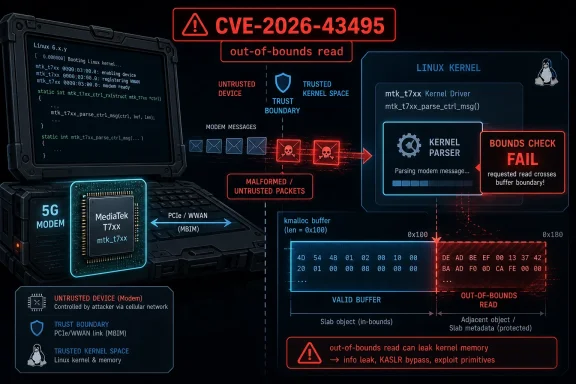
The Vulnerability Is Small, but the Trust Boundary Is Not
The flaw sits in the Linux kernel’s mtk_t7xx driver, the PCIe WWAN driver for MediaTek T7xx-series 5G modem hardware. That driver exposes the modem to Linux through the kernel’s WWAN framework, making cellular connectivity appear as network and control interfaces such as MBIM and AT-command ports. In plain English: it is the bridge between the operating system and a 5G modem that may be built into a laptop, tablet, Chromebook-style device, router, or embedded system.
CVE-2026-43495 is not a browser bug, not a Windows desktop bug, and not a generic Linux networking vulnerability. It lives in a particular corner of the kernel: the code that parses messages supplied by a modem during port enumeration and runtime feature discovery. The bug report says the driver trusted a modem-supplied port_count value as a loop bound without first proving that the message buffer actually contained that many port records.
That is the entire problem in one sentence, and it is also the entire modern hardware security problem in miniature. A device tells the host, “I have this much structured data,” and the host kernel believes it just long enough to read past the end of the buffer. When the host is the kernel, “just long enough” is where reliability bugs become security bugs.
The record describes a particularly blunt trigger: a modem can claim port_count=65535 in a 12-byte buffer, causing a slab out-of-bounds read of up to 262,140 bytes. That number is not a theoretical flourish; it follows from the code walking an array of port entries that the message does not actually contain. The patch adds the missing length validation before reading the port message header and again before iterating over the variable-length data.
Kernel Memory Bugs Still Begin With Boring Arithmetic
The technical failure here is familiar because most serious kernel bugs are built from familiar parts. A length field arrives from outside the trusted codebase. Another field says how many records follow. The parser advances an offset. A signed value meets an unsigned length. Someone assumes that because a protocol message is supposed to be well-formed, it probably is.
CVE-2026-43495’s description names two affected parsing paths. The first is t7xx_port_enum_msg_handler(), where port_count was used to walk port_msg->data[] without checking whether the incoming message had enough bytes for the requested number of entries. The fix adds a sizeof(*port_msg) check before accessing header fields and a struct_size() check after extracting port_count but before entering the loop.
The second is t7xx_parse_host_rt_data(), where the fix guards a runtime-feature header read with a remaining-buffer check before touching data_len. It also validates the feature data length against the actual remaining buffer to prevent out-of-bounds reads and signed integer overflow on the offset. That is the sort of patch note that looks dull until you remember that kernel parsers are often attacked precisely through dull offset mistakes.
The important detail is not merely that the driver read too far. It is that the offending data is described as modem-supplied. This is a device-to-host trust problem, not a user typing the wrong command at a shell prompt. If a modem, its firmware, or a path capable of influencing modem messages can send malformed data, the host kernel has to survive it.
There is no public NVD severity score yet. That absence matters, but it should not be mistaken for safety. NVD has not provided CVSS 4.0, 3.x, or 2.0 scoring for the record at publication time, and the practical risk will depend on hardware presence, driver configuration, distribution backports, and whether the relevant modem path can be reached by an attacker in a real deployment.
The Modem Is Inside the Machine, but It Is Still an External Input
For years, the average PC security model treated “inside the chassis” as nearly synonymous with “trusted.” That assumption has been eroding for a long time. Wi-Fi chips, Bluetooth controllers, SSD firmware, webcams, GPUs, Thunderbolt controllers, baseband processors, and cellular modems all exchange complex messages with the operating system, often across buses fast enough and privileged enough to make traditional perimeter thinking look quaint.
A WWAN modem is especially interesting because it is not just a passive peripheral. It is a networked computer with its own firmware, protocol stacks, radio behavior, and management surfaces. Even when the Linux host is patched and locked down, the modem remains a separate actor feeding structured data into kernel code. CVE-2026-43495 is a reminder that “device driver” often means “parser for a semi-trusted foreign computer.”
That does not mean every T7xx-equipped machine is on fire. It does mean administrators should resist the lazy classification of hardware-driver CVEs as unimportant simply because they are not exposed on TCP port 443. The attack surface is narrower, but the privilege boundary is high-value. A bug in a kernel driver may be reachable only under specific conditions, yet successful exploitation starts at the most privileged layer of the OS.
For WindowsForum readers, the Linux specificity is only half the story. The pattern applies across operating systems. Windows, Linux, and ChromeOS all depend on kernel-mode or highly privileged components to speak with modem hardware. The same engineering discipline applies everywhere: never let firmware-provided lengths, counts, or offsets drive host memory access without independent validation.
The Driver’s Niche Makes Triage Harder, Not Easier
One practical complication is that many users do not know whether they have a MediaTek T7xx modem. A laptop spec sheet might advertise “5G,” “WWAN,” or a carrier-ready module without putting the kernel driver name anywhere visible. Enterprise fleet inventories may track CPU, RAM, disk, and OS version while treating cellular modules as accessory hardware.
On Linux, the presence of the mtk_t7xx module or the CONFIG_MTK_T7XX kernel option is the first clue. The driver has been present in mainline Linux for multiple kernel generations and is associated with MediaTek PCIe 5G modem devices, including T700-class hardware. Systems without that hardware, without the driver built, or without the module loaded are not practically exposed through this code path.
That sounds reassuring, but it creates a common operational trap. Narrow hardware bugs often fall between teams. Security scanners may flag the CVE because the kernel source package is nominally affected. Endpoint teams may dismiss it because most desktops do not have cellular modems. Linux platform owners may wait for a vendor advisory. Meanwhile, the subset of machines that actually use WWAN in the field can be exactly the machines that are hardest to patch quickly: mobile workers, kiosks, industrial endpoints, and remote gateways.
The right response is boring and specific. Identify systems with the T7xx driver and hardware. Check whether your kernel vendor has shipped the stable fix or a backport. Prioritize machines where cellular connectivity is enabled, exposed, or operationally important. Do not spend three days arguing about a missing CVSS score while the affected fleet can be found with a few inventory queries.
NVD’s Blank Score Is a Signal, Not a Verdict
The NVD entry currently says the CVE has been received from kernel.org and included in the NVD dataset, but NVD has not yet supplied its own severity assessment. That is increasingly common in the modern vulnerability pipeline, where raw CVE publication and downstream enrichment do not always arrive together. For defenders, the gap is annoying but not surprising.
The absence of a score should change how the bug is communicated, not whether it is investigated. A CVSS number is useful for dashboards and service-level agreements, but it is not a substitute for asset context. A fleet with no T7xx hardware can safely deprioritize. A telecom-adjacent Linux deployment that depends on MediaTek WWAN modules should move faster.
There is also a risk of overcorrecting in the other direction. Out-of-bounds reads are serious, but the public description does not establish remote unauthenticated exploitation over the cellular network, privilege escalation from a local user, or reliable information disclosure at scale. The record describes a malformed modem message causing kernel memory reads beyond a slab object. That is enough to patch; it is not enough to invent a cinematic exploit chain.
This is where enterprise vulnerability management often breaks down. If a CVE has a frightening phrase like “kernel out-of-bounds read,” it may be escalated without regard for hardware reachability. If it lacks a CVSS score, it may be ignored despite affecting machines that actually carry the driver. Mature triage lives between those extremes.
The Patch Tells Us What the Original Code Assumed
The fix is instructive because it does not appear to redesign the driver. It adds checks that should have been there: verify that the fixed header is present, verify that the variable-length array fits, verify that runtime feature data length is bounded by what remains, and pass message length explicitly from the call sites. These are defensive parser rules, not exotic mitigations.
That matters because device-driver vulnerabilities often persist in the space between “the hardware normally behaves” and “the hardware must be treated as malicious.” A cooperative modem will not set port_count to 65,535 in a 12-byte buffer. But security work is not about cooperative peers. It is about the malformed packet, the corrupted firmware state, the compromised component, and the fuzz case nobody ran before shipping.
The explicit passing of msg_len from both call paths is also worth noting. Bugs like this often survive because a lower-level parser sees a pointer to a structure but not the authoritative length of the buffer behind it. Once the length is made part of the function contract, the code can make decisions grounded in reality instead of protocol expectations.
This is one reason kernel hardening has increasingly focused on API shape, not just individual bug fixes. If helper functions require a length, if array-size calculations use overflow-aware primitives, and if parsers are written around remaining-buffer accounting, whole classes of mistakes become harder to write. CVE-2026-43495 is a one-driver bug, but the design lesson is kernel-wide.
Windows Users Should Care About a Linux CVE for the Right Reason
At first glance, this story may look misplaced on a Windows-focused site. It is a Linux kernel CVE, with Linux function names, Linux stable commits, and Linux-specific driver paths. But WindowsForum’s audience has never been only about Windows as a desktop brand; it is about the systems Windows users and administrators actually operate, dual-boot, virtualize, secure, and compare.
The modern Windows environment frequently coexists with Linux. WSL puts Linux userlands on Windows workstations. Hyper-V hosts Linux guests. Developers dual-boot. Enterprises run Linux appliances beside Windows endpoints. Security teams triage CVEs across mixed fleets. The old habit of treating Windows and Linux vulnerability news as separate weather systems no longer matches how real infrastructure works.
There is a second reason Windows readers should care: the hardware boundary is shared. A 5G module in a business laptop may have a Windows driver on Monday and a Linux driver on Tuesday. The same modem family may appear across OEM designs, embedded products, and carrier-certified modules. Even when the bug is in Linux code, the architectural question belongs to everyone managing client hardware: what do privileged drivers believe when device firmware talks?
Microsoft has spent years moving parts of the Windows driver ecosystem toward stronger isolation, attestation, and update controls, but the fundamental challenge remains. Operating systems need drivers to translate hardware behavior into OS abstractions. Every driver is a parser. Every parser has to survive hostile input. That is the cross-platform lesson underneath this Linux advisory.
The Real Risk Lives in Fleets, Not Headlines
For home users, the advice is simple: take kernel updates when your distribution ships them, especially if you use a laptop or device with built-in 5G. Most consumer Linux users will not need to compile anything or chase stable-tree commits manually. Distribution maintainers and kernel vendors exist to absorb that work.
For administrators, the path is more deliberate. First, determine exposure. Query loaded modules, hardware inventories, distribution kernel versions, and vendor advisories. Machines with no T7xx hardware and no mtk_t7xx driver in use belong in a different bucket from mobile Linux endpoints actively using WWAN.
Second, watch for backports rather than raw upstream version numbers alone. Enterprise distributions often patch older kernel branches without changing to the latest mainline version. A vulnerable-looking kernel version may contain the fix, while a superficially newer custom kernel may not. The only reliable answer is the vendor’s changelog, package metadata, or direct inspection of the relevant patch.
Third, consider compensating controls only as temporary measures. If WWAN is not needed, disabling the module or the device can reduce exposure. If cellular connectivity is business-critical, disabling it may create more operational risk than it removes. The durable fix is a patched kernel, not a spreadsheet exception with a future review date nobody will remember.
The Cellular Laptop Is Becoming a Server With a Radio
The rise of built-in 5G changes the security assumptions around endpoints. A laptop with a cellular modem is not merely a laptop with another network adapter. It is a host connected to a second network stack, managed partly by firmware, sometimes provisioned by carriers, and often maintained on a different update rhythm than the operating system.
That complexity is manageable, but only if it is visible. Too many organizations still inventory WWAN as a procurement feature rather than an attack surface. The result is predictable: when a modem-driver CVE lands, the security team lacks the data to answer the first question. Which devices have this thing?
CVE-2026-43495 should push IT teams to improve that inventory. The answer does not need to be exotic. Endpoint management tools can capture PCI IDs, loaded kernel modules, BIOS device status, and network adapter classes. Linux fleets can report kernel configuration and module state. Procurement systems can map device SKUs to modem options. None of that is glamorous, but it beats triaging by guesswork.
There is a broader lesson for OEMs, too. If vendors sell cellular-enabled machines into enterprise fleets, they should make modem identity, firmware version, and driver dependency easy to audit. “5G optional” is not enough. Security teams need to know what silicon is present, what driver binds to it, and how fixes reach the system.
The Kernel Community Did the Right Thing, but the Ecosystem Still Has Work to Do
The upstream response appears straightforward: the flaw was identified, assigned a CVE, and fixed in stable kernel commits. That is the Linux security process doing what it is supposed to do. The problem is not that the vulnerability exists; the problem would be if it were invisible, unpatched, or impossible for downstream vendors to absorb.
Still, the incident highlights the maintenance burden around specialized drivers. WWAN drivers do not command the same attention as filesystem code, TCP/IP core logic, or GPU drivers in consumer headlines. They serve a narrower set of systems, but those systems often matter. Mobile enterprise endpoints, rugged devices, and embedded gateways can be operationally significant precisely because they rely on cellular connectivity.
This is where open source’s strengths and weaknesses sit side by side. The code can be inspected, fixed, and backported in public. But specialized subsystems depend on a small number of maintainers, hardware vendors, and users who can reproduce issues. When attention thins, parser bugs can remain until fuzzing, review, or an unlucky crash brings them forward.
The better future is not panic over every driver CVE. It is more systematic fuzzing of device-message parsers, more consistent use of length-aware APIs, and better vendor participation for hardware that ships into mainstream machines. A modem driver should be treated less like glue code and more like a network-facing parser with kernel privileges.
The Practical Reading for CVE-2026-43495 Is Narrow but Urgent
This vulnerability should not be inflated into a universal Linux emergency, but it should not be waved away as obscure kernel trivia either. It is a hardware-specific kernel memory-safety bug in a driver for cellular modem hardware, and the fix addresses concrete missing bounds checks in message parsing. That gives administrators enough information to act without waiting for a severity score.
The operational lesson is to triage by exposure, patch by vendor guidance, and improve inventory so the next hardware-driver CVE is not a scavenger hunt.
- Systems that do not include MediaTek T7xx-series WWAN hardware and do not load the
mtk_t7xxdriver are unlikely to be practically exposed through this flaw. - Systems that rely on T7xx-based cellular connectivity should receive the relevant kernel fix or distribution backport as soon as it is available.
- The missing NVD CVSS score means teams should avoid dashboard-driven assumptions and instead assess the bug against actual hardware and driver usage.
- The vulnerability is best understood as a device-to-kernel parser failure, where modem-supplied lengths and counts were not sufficiently validated before kernel memory access.
- Temporary mitigations such as disabling unused WWAN hardware may help in some environments, but patched kernel code is the real remediation.
CVE-2026-43495 is not the kind of vulnerability that will dominate mainstream security news, and that is precisely why it is worth paying attention to. The future of endpoint security will be shaped as much by quiet driver parsers as by famous browser bugs, because the modern PC is an assembly of small networked computers pretending to be one machine. The systems that age best will be the ones whose kernels distrust every one of them by default.
References
- CVE-2026-43495 net: wwan: t7xx: validate port_count against message length in t7xx_port_enum_msg_handler NVD / Linux Kernel · 2026-05-22T01:01:39-07:00