

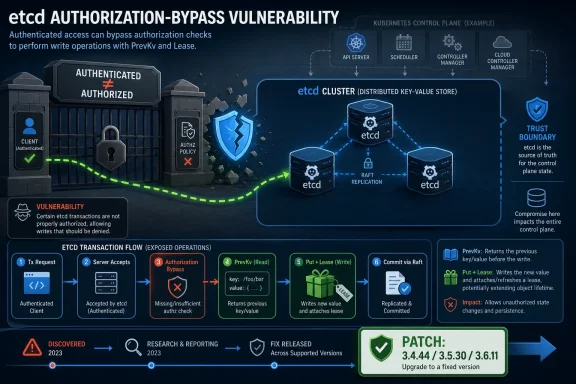
PrevKv or attach leases inside transaction-based Put requests. The bug is not another breathless “Kubernetes is broken” moment, and that distinction matters. It is instead a quieter infrastructure flaw: the kind that only bites organizations that have given etcd a direct security role and then assumed RBAC would behave uniformly across every API path. That makes it less dramatic than a remote-code-execution bug, but more interesting as a lesson in how distributed systems leak trust at their edges.
The Bug Lives in the Space Between “Authenticated” and “Allowed”
The most important word in this vulnerability is not PrevKv, and it is not even “transaction.” It is authenticated. CVE-2026-44283 does not describe a random attacker on the internet strolling into an etcd cluster with no credentials and walking away with secrets. It describes a user or component that can talk to etcd, but should not be able to read certain keys or perform certain lease-related actions, finding a path around those policy checks.
That distinction will probably keep the vulnerability out of the mainstream security panic cycle. It should not keep it out of maintenance windows. In real systems, “authenticated but not authorized” is where many of the ugliest failures happen, because teams are more likely to trust traffic that has already cleared the first gate.
etcd’s role makes that especially sensitive. It is a distributed key-value store used to hold the state of distributed systems, and in Kubernetes environments it is commonly discussed as the place where the cluster’s desired and observed state ultimately resides. Even outside Kubernetes, etcd tends to sit close to the machinery that decides what exists, what is healthy, and what configuration should be treated as true.
The flaw sits in transaction operations where Put requests can ask for previous key-value data through PrevKv, or attach leases in ways that should have been constrained by RBAC. Under affected versions, the authorization checks did not fully account for those features when nested inside transactions. A caller with enough access to invoke the relevant operation could reportedly obtain information or perform lease attachment that their assigned permissions should have denied.
That is not a collapse of the castle wall. It is a poorly guarded service corridor. In large infrastructure, service corridors are often where the real damage begins.
Microsoft’s Listing Is a Signal, Not the Center of Gravity
The item surfaced through Microsoft’s Security Update Guide, but the underlying issue is in etcd, an open-source project maintained outside Microsoft’s traditional Windows patch pipeline. That is an increasingly normal shape for security advisories in 2026. Microsoft’s ecosystem now stretches across Windows, Azure, containers, developer tools, open-source dependencies, Linux workloads, and managed infrastructure, so its vulnerability catalog often serves as an index of risks that are not “Windows bugs” in the old sense.
For WindowsForum readers, that matters because the old taxonomy is obsolete. A Windows shop may have no Linux desktops and still rely on Linux-based containers, Kubernetes operators, Go services, or vendor appliances that embed etcd somewhere below the management plane. A Microsoft advisory does not automatically mean Windows Update will fix the issue for you. It means the vulnerability has crossed into the universe of components Microsoft customers may encounter.
That is the right way to read CVE-2026-44283. If you administer Windows endpoints only, this is probably not your emergency. If you administer Azure-connected infrastructure, self-hosted Kubernetes, vendor control planes, lab clusters, edge appliances, or internal platforms that use etcd directly, it deserves inventory work.
The published fix path is straightforward: update etcd to 3.4.44, 3.5.30, or 3.6.11, depending on the release line in use. The harder part is not knowing the patched versions. The harder part is finding every place etcd exists, determining whether its built-in authentication and RBAC are actually used as an access-control boundary, and working out whether an appliance or platform team owns the upgrade.
The security industry likes bugs with clean ownership. This one is messier. It is exactly the kind of dependency flaw that sits between product teams, platform teams, and operations teams until someone asks the impolite question: who is responsible for patching the database that is not called a database in the asset register?
Kubernetes Gets a Pass, but Not Every Cluster Story Does
The etcd project’s advisory draws a clear line around typical Kubernetes deployments: Kubernetes does not rely on etcd’s built-in authentication and authorization for normal control-plane access. The Kubernetes API server handles authentication and authorization, and etcd is usually shielded behind that API layer. In that standard architecture, users do not talk directly to etcd, and Kubernetes RBAC is enforced before requests reach the storage backend.
That is an important correction to the inevitable shorthand. This is not, by default, a Kubernetes RBAC bypass. It is an etcd RBAC bypass. The difference is not pedantry; it determines whether the bug threatens your production cluster or merely appears in your scanner report.
But the comfort has limits. Kubernetes has a long tail of nonstandard deployments, debugging practices, administrative shortcuts, and vendor-specific control planes. If etcd client access has been exposed to operators, automation, tenants, or semi-trusted services, the neat architectural boundary begins to blur. A cluster that is “basically Kubernetes” can still have direct etcd access paths created for backup, monitoring, disaster recovery, migration, or break-glass administration.
The safer phrasing is this: ordinary Kubernetes users should not assume they are affected merely because Kubernetes uses etcd, but administrators should verify whether anyone or anything bypasses the API server and speaks to etcd directly. The bug is less about the brand name on the platform and more about the actual trust boundary in your environment.
That distinction also matters for managed services. In many hosted Kubernetes offerings, customers do not manage etcd at all. The provider owns the control plane, the storage backend, and the patch cadence. In self-managed clusters, especially long-lived clusters that have survived multiple upgrades and emergency fixes, the burden shifts back to the operator.
The real audit question is not “Do we use Kubernetes?” It is “Do we depend on etcd Auth to isolate users or components that we do not fully trust?” If the answer is yes, CVE-2026-44283 is no longer background noise.
A Low Score Can Still Describe a High-Value Mistake
One of the stranger details in the public advisory trail is the severity presentation. The GitHub advisory labels the issue low and shows CVSS metrics that, on their face, do not neatly capture the described confidentiality concern. Other vulnerability databases treat the issue as medium with a confidentiality impact. That discrepancy is not unusual in open-source vulnerability handling, but it is a reminder that CVSS is a map, not the territory.
For a consumer application, an authenticated user reading data they should not read may be one class of problem. For an infrastructure store, it can be another. The practical impact depends almost entirely on what keys are stored, how RBAC is used, whether tenants share the same etcd cluster, and how much trust the organization places in internal identities.
If etcd holds harmless coordination state in a tightly controlled network, the bug may be a routine patch. If etcd is part of a multi-tenant platform, a control system, a service registry, or a configuration plane containing credentials, endpoints, feature flags, or operational metadata, “read access” becomes a more serious phrase.
The lease side of the vulnerability is also worth not dismissing. Leases in etcd are used to associate keys with lifetimes, often supporting coordination patterns such as service discovery, locks, and ephemeral state. Unauthorized lease attachment may not sound as dramatic as secret disclosure, but distributed systems often use timing and liveness as part of their logic. If a component can influence when keys expire or persist, it may be able to create behavior that is difficult to diagnose.
This is why vulnerability scores often under-serve infrastructure bugs. They attempt to generalize impact, but infrastructure impact is contextual by design. The same primitive can be unimportant in one deployment and operationally meaningful in another.
For sysadmins and platform engineers, the right response is not to argue with the score. The right response is to ask what etcd protects in your estate, who can authenticate to it, and whether those identities were intended to be constrained by RBAC rather than merely identified by it.
The Transaction Path Is Where Security Assumptions Go to Die
The technical lesson in CVE-2026-44283 is familiar: authorization systems are easiest to reason about when operations are simple, and easiest to get wrong when features are composed. An ordinary read is obvious. An ordinary write is obvious. A transaction that embeds a write, asks for previous key-value data, and performs lease-related behavior is where policy must follow every side effect.
That is not unique to etcd. Databases, filesystems, message brokers, cloud APIs, and identity systems all have operations that look simple at the surface but carry secondary effects. Return the previous value. Include metadata. Attach a lease. Perform a compare-and-swap. Execute conditionally. Batch multiple operations. Nest one semantic layer inside another.
Every one of those features creates a chance for the authorization layer to check the headline operation while missing the payload. The caller may be authorized to write a key, but not to read its previous value. The caller may be authorized to modify one namespace, but not to attach lifecycle controls in another. The transaction mechanism becomes a tunnel through which additional capability rides.
This is why authorization bugs are so stubborn. Authentication tends to be binary: are you this identity or not? Authorization is relational: what can this identity do, to which object, through which operation, under which conditions, with which side effects? The more expressive the API, the harder it becomes to ensure that every path reaches the same policy decision.
In etcd’s case, PrevKv is a perfect example of a feature that is useful precisely because it exposes something adjacent to the requested write. Developers may want the previous value for auditing, synchronization, rollback, or application logic. Security policy, however, must treat that returned previous value as a read. If the authorization model fails to do so in a transactional context, a write-shaped request becomes a read-shaped leak.
That is the broader warning for platform builders. Capability does not always announce itself in the HTTP verb, gRPC method, or CLI command name. Sometimes the sensitive action is hidden in an option flag.
The Upgrade Is Simple Until It Meets Real Infrastructure
The remediation advice is refreshingly direct: move to etcd 3.4.44, 3.5.30, or 3.6.11. For teams already on a supported release line with tested automation, that is an ordinary patch exercise. For everyone else, etcd upgrades deserve more caution than a single-package bump in a disposable container.
etcd is a consensus system. It is usually deployed as a cluster. It may be backing a control plane whose availability matters more than the individual machines running it. Operators need to respect version compatibility, snapshots, quorum, member health, and rollback procedures.
The May patch releases also arrived with a reminder that the 3.4 line was scheduled to reach end of life in May 2026. That makes 3.4.44 a patch, but not a strategy. Organizations still on 3.4 should treat the security update as a near-term mitigation and the release line as a retirement problem.
For 3.5 and 3.6 users, the decision should be easier, though not necessarily painless. A rolling upgrade across etcd members still requires operational discipline. Backups should be verified, not merely scheduled. Cluster health should be checked before and after. Monitoring should be watched for leader election churn, latency spikes, database growth, and client reconnect storms.
The inconvenient truth is that many organizations only discover their etcd architecture during incidents. They know the platform name, but not the storage topology. They know the Kubernetes version, but not the etcd version. They know backups exist, but not whether anyone has restored one recently. A bug like this is a useful forcing function because it asks for facts that should already be available.
The patch is the visible fix. The inventory is the durable improvement.
Workarounds Are an Admission About Trust Boundaries
The official workaround advice, for teams that cannot upgrade immediately, is to reduce exposure by treating the affected RPCs as effectively unauthenticated in practice. That framing is unusually blunt and unusually helpful. It tells administrators not to lean on etcd RBAC as the sole barrier for these paths until the patch is applied.
The recommended mitigations are the old reliable controls: restrict network access to etcd server ports so only trusted components can connect, and require strong client identity at the transport layer, such as mutual TLS with tightly scoped certificate distribution. Those are not glamorous mitigations. They are also the controls that should have been in place before the CVE had a name.
This is where the vulnerability becomes a design review. If a semi-trusted user can reach etcd directly, why? If a service account has broad transaction capability, what is it meant to do? If certificates are shared across components, how would investigators attribute misuse? If firewall rules allow wide east-west access because the cluster lives on a “trusted” internal network, what else depends on that same assumption?
The phrase zero trust has been worn nearly meaningless by marketing, but this is one of the scenarios where its original instinct is useful. Internal networks are not magic. Authenticated clients are not automatically safe. A system storing control-plane state should not be reachable by every workload that can route to it.
The workaround therefore has two audiences. For the incident-minded operator, it is a temporary shield until patched versions are deployed. For the architect, it is evidence that etcd should sit behind layered controls even when its own Auth system is enabled.
If you cannot patch today, shrinking the set of clients that can reach etcd is not a second-best bureaucratic exercise. It may be the difference between a theoretical bypass and an exploitable one.
Windows Shops Should Look Past the Nameplate
A vulnerability in a Go-based distributed key-value store may look distant from Windows administration, but modern Windows estates are full of borrowed infrastructure. Dev teams run local Kubernetes distributions on Windows laptops. CI systems build containers on Windows Server or Windows-hosted runners. Enterprises manage hybrid environments where Microsoft identity, Azure networking, Linux nodes, and open-source control planes are all part of the same operational reality.
That means a WindowsForum reader should resist two bad instincts. The first is to dismiss the advisory because it is not a Windows kernel, Exchange, SharePoint, or Office bug. The second is to assume that Microsoft’s appearance in the advisory chain means Microsoft will patch every affected deployment through familiar tooling.
Neither assumption holds. Open-source infrastructure dependencies often enter organizations indirectly through vendor products, developer platforms, and internal engineering initiatives. They may not be visible in Microsoft Defender’s most obvious inventory view, and they may not be patched by WSUS, Windows Update for Business, or Configuration Manager.
The practical path is to query the places where etcd is likely to hide. Container images, Helm charts, Kubernetes control-plane nodes, vendor appliances, infrastructure-as-code repositories, backup scripts, and platform engineering documentation are all better starting points than a traditional endpoint software list. Security teams should also ask whether software composition analysis covers operational containers and not just application code.
For Windows-heavy organizations moving deeper into Azure Kubernetes Service, Arc-enabled infrastructure, or hybrid DevOps pipelines, this is the new normal. The security perimeter is no longer the operating system boundary. It is the dependency graph.
That does not mean every Windows admin must become an etcd expert. It does mean someone in the organization must know whether etcd is present, how it is exposed, and who owns its lifecycle. If nobody can answer those questions, the CVE has already done useful work.
The Previous-Key Leak Is a Reminder That Metadata Is Data
Security conversations often separate data from metadata as though the latter is automatically less sensitive. Distributed systems make that distinction fragile. A previous value, a lease, a revision, a key prefix, or an expiration pattern can reveal how a system is organized and how it behaves.
PrevKv is particularly revealing because it can turn a write operation into a historical observation. If an unauthorized caller can see what was there before, they may learn configuration values, service names, tenant identifiers, state transitions, or operational secrets that were never meant for them. Even when the values themselves are not credentials, they can provide reconnaissance.
Lease behavior carries a similar subtlety. In systems that use ephemeral keys to represent liveness, locks, sessions, or ownership, lease attachment is part of the control logic. Unauthorized influence over that mechanism can create confusion that looks like an application bug, a flaky network, or a race condition rather than a security issue.
This is why infrastructure security requires a more expansive view of confidentiality. The sensitive asset is not always a password-shaped string. Sometimes it is the state graph of the platform. Sometimes it is the ability to infer which services exist, which components are active, or which keys recently changed.
The best RBAC policies account for that reality. They do not merely prevent obvious reads of obvious secrets. They constrain introspection, historical views, wildcard prefixes, transactional side effects, and maintenance operations that can expose the same information through a different door.
CVE-2026-44283 is a narrow bug, but it points at a wide class of mistakes: treating API options as convenience features when they are also data-access paths.
The Real Fix Is Knowing Who Can Talk to etcd
The operational response to CVE-2026-44283 should be boring, but it should not be shallow. Patch the affected versions. Confirm exposure. Review direct etcd users. Tighten network access. Verify that Kubernetes deployments are not relying on unsupported direct-access patterns. Then document the result so the next advisory does not restart the same scavenger hunt.
That last step is often skipped. Teams close the ticket once the version number changes, while the structural uncertainty remains. The next etcd advisory, container runtime bug, ingress controller flaw, or service-mesh CVE then triggers the same emergency inventory process.
A better response treats this as a chance to map a critical dependency. Which clusters run etcd? Which are managed by a cloud provider? Which are self-managed? Which applications or automation tools authenticate directly? Which certificates or credentials do they use? Which firewall rules permit access? Which monitoring alerts would reveal misuse?
The answers do not need to become a 90-page architecture tome. They need to be accurate enough that the next security update can be triaged in minutes rather than days. The difference between a mature platform team and a lucky one is not that the mature team avoids every CVE. It is that the mature team knows where the CVE matters.
For organizations with compliance obligations, this also intersects with least privilege. If etcd Auth is used to separate users or services, then the policies should be testable. A regression test that verifies one identity cannot obtain previous key values through transactions is more useful than a spreadsheet asserting that RBAC exists.
Security controls that are not tested are aspirations. CVE-2026-44283 is what happens when an aspiration meets a composed API path.
A Small CVE With a Large Inventory Shadow
The concrete lesson from this advisory is not that etcd is uniquely fragile. It is that the most consequential infrastructure bugs often arrive as small mismatches between product features and policy assumptions.
- Organizations running etcd before 3.4.44, 3.5.30, or 3.6.11 should plan an update, with extra urgency if etcd Auth is used to control access by untrusted or partially trusted users.
- Typical Kubernetes deployments are not expected to be affected through Kubernetes RBAC, because the API server normally handles authorization before requests reach etcd.
- Teams should verify whether any users, automation, backup tools, monitoring agents, or vendor components communicate directly with etcd rather than through a higher-level control plane.
- If patching is delayed, etcd server ports should be reachable only by trusted components, and client identity should be enforced with tightly scoped mutual TLS.
- The 3.4 patch should not become an excuse to stay on an aging release line, because end-of-life pressure changes the risk calculation beyond this single vulnerability.
- Security teams should treat previous-value reads, lease attachment, and other transaction options as real authorization surfaces, not harmless implementation details.
The story of CVE-2026-44283 is ultimately the story of modern infrastructure security: the dangerous parts are no longer confined to the operating system, the patch does not always arrive through the platform you associate with the advisory, and the difference between “not affected” and “quietly exposed” is often one undocumented access path. The organizations that handle this well will not be the ones that panic over every low-rated CVE; they will be the ones that can quickly prove where etcd lives, who can reach it, what it protects, and how fast they can change that when the next small bug exposes a large assumption.
References
- CVE-2026-44283 etcd: Read access via PrevKv in etcd transactions may bypass RBAC authorization checks MSRC · 2026-05-26T01:38:43-07:00