

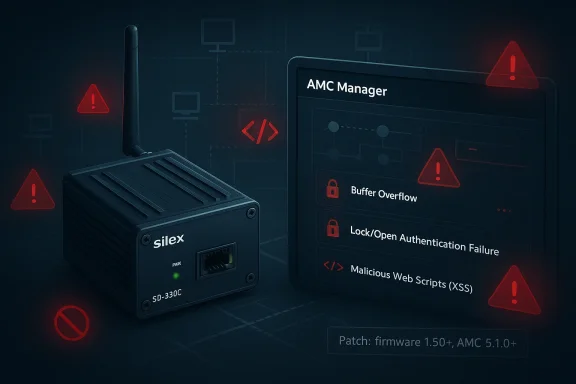
The newly disclosed Silex Technology SD-330AC and AMC Manager vulnerability set is a reminder that device-management software can be just as dangerous as the hardware it controls. CISA says successful exploitation could enable arbitrary code execution, denial of service, and unauthenticated configuration changes, and the affected versions are broad enough to matter to both enterprise administrators and industrial integrators. The advisory covers SD-330AC firmware 1.42 and earlier and AMC Manager 5.0.2 and earlier, with a long chain of CVEs spanning buffer overflows, authentication failures, XSS, CRLF injection, and weak defaults. rst thing to understand is that this is not a single bug. It is a cluster of flaws affecting a device family and its management layer, and that combination is what makes the disclosure so serious. The Silex SD-330AC is a wireless serial device server used in environments such as industrial automation, building automation, and medical devices, while AMC Manager is the management software used to configure and monitor Silex products remotely. When the control plane is compromised, the downstream device may become a much easier target than defenders expect.
JVN’s coordinated disclosure shows the full shape of the problem: stack-based and heap-based buffer overflows, missing authentication for a critical function, arbitrary file upload, MITM exposure, login bypass, temporary DoS, configuration tampering, browser-side script execution, and insecure default behavior. It also lists older vulnerabilities that remain relevant, including CVE-2015-5621 in embedded net-snmp components and CVE-2024-24487 for unauthenticated reboot behavior. The vendor fixes are straightforward in principle: SD-330AC firmware 1.50 or later and AMC Manager 5.1.0 or later.
That breadth matters because attackers do not need to choose only one path. In a real deployment, the easiest route is often the most embarrassing one: a weak default, an unauthenticated function, or a management interface left reachable from a trusted internal network. If a control appliance can be reached, coerced, or tricked into accepting hostile input, the result may be a foothold that is hard to notice and harder to unwind. That is the core lesson here.
Silex’s SD-330AC family sits in a very familiar part of the market: the industrial connectivity layer. These products exist to bridge legacy serial equipment, special-purpose devices, and modern IP networks. That kind of device is often invisible to mainstream IT teams because it is not a server, not a workstation, and not always owned by the central security group. Yet it can become highly trusted infrastructure, especially in hospitals, factories, and facilities networks.
AMC Manager is important because it turns a locally administered device into something that can be monitored and reconfigured at scale. The vendor describes it as software for remote monitoring, configuration changes, firmware update, and device rebooting. That convenience is attractive to operations teams, but it also creates a high-value target: if an attacker can abuse the manager or the device-management channel, they may gain the same leverage an administrator would have.
The timing of this disclosure also matters. JVN published the advisory on April 20, 2026, and CISA’s ICS advisory followed on April 21, 2026. That rapid escalation suggests the issue is not being treated as an abstract bug report, but as a genuine operational concern with clear exploitability. CISA specifically notes that no known public exploitation has been reported to the agency at this time, which is reassuring only in the narrowest sense: absence of known exploitation is not the same thing as absence of risk.
There is also a broader industry lesson here. Control devices and their management software increasingly inherit the security expectations of web applications, embedded Linux devices, and remote administration platforms all at once. That means the attack surface is layered and messy: web handlers, firmware maintenance functions, default credentials, third-party libraries, and browser interactions can all become part of the same chain. The Silex advisory is a textbook example of why defenders must stop thinking in terms of “one bug, one fix.”
The vulnerability list also includes browser-side code execution, which means the administrative web interface itself may expose operators to malicious content if they log in and browse a crafted page. That kind of issue is especially important because it shifts the problem from pure device security into administrator workstation risk. Security teams often scan for device compromise, but they may not think to protect the browser session that administers the device.
The CVSS score attached to CVE-2026-32956 in JVN is 9.8 under CVSS 3.1, which is a clear sign that the bug is considered remotely exploitable with no authentication required. That does not automatically mean exploit code is public, but it does mean defenders should treat the issue as urgent. High scores are not perfect predictors of real-world abuse, but when the score is paired with a device-management context, prudence is the only sensible posture.
There is also a practical enterprise wrinkle: many organizations do not inventory the management tools they use as carefully as they inventory servers. If AMC Manager is installed on an engineering workstation, an admin laptop, or a shared support jump box, the risk is not constrained to one obvious host. It becomes part of the ordinary tools of the trade, which makes it easier to overlook and harder to isolate.
The “missing authentication for critical function” label is equally serious because it implies that a sensitive operation, such as firmware maintenance, may be reachable without proving identity first. That is not a minor implementation bug; it is a direct violation of the trust model that keeps admin interfaces safe. If firmware can be pushed, adjusted, or abused without proper authentication, the device becomes a remote control point for an attacker.
These issues also reinforce why asset visibility matters so much in operational technology and device-support environments. A weak credential or unauthenticated function can sit dormant for years if nobody is looking for it. But once an attacker or pentester finds it, the exposure is immediate and often repeatable. That makes the remediation timeline much more urgent than the average “update when convenient” advice seen in routine software notices.
CRLF injection and redirect handling are similarly important because they often act as primitives for header manipulation, open redirects, cache confusion, or poisoned response behavior. On their own, these can look modest. In a management interface, though, they can assist phishing, session abuse, or content manipulation. The danger lies in how these weaknesses combine with trust.
A practical response is to minimize the number of humans who ever need to touch these interfaces. Fewer interactive admin sessions means fewer opportunities for a browser-driven exploit to matter. It also makes logging and change control easier, which is valuable when a device family has multiple serious vulnerabilities in the same release window.
The advisory’s mention of an embedded net-snmp issue is a good example of why SBOM-style thinking matters. If defenders know that the device includes old SNMP code, they can reason about exposure more clearly than if they only see a device model and a firmware version. In other words, component visibility turns vague risk into actionable inventory. Without that visibility, you are guessing.
That is one reason old vulnerabilities in embedded products often remain relevant even when the headline CVEs are fresh. Attackers do not care whether the flaw was introduced last month or ten years ago. They care whether it is still reachable, still exploitable, and still sitting on a network segment that defenders assumed was benign.
The remediation challenge is also organizational. Patching a server fleet is one thing; patching a distributed set of device controllers, admin PCs, and embedded appliances is another. These are the systems that tend to live outside normal endpoint management, which means the fix may require coordination between IT, OT, facilities, and vendor support. That is where delays happen.
There is also a certification and compliance dimension. Devices sold into regulated markets are often expected to support secure boot, authenticated firmware updates, and conservative network exposure. Silex markets security-oriented features on some product pages, which makes the advisory more consequential because buyers are already being asked to trust the security posture of the platform. If that posture is weakened by multiple disclosure-class flaws, confidence takes a hit.
The broader market implication is that buyers will increasingly ask harder questions of device vendors. They will want to know not just whether a product has remote management, but whether that management path is authenticated, segmented, and resilient against web-layer attacks. That pressure is healthy, because the old notion that embedded devices can be exempt from modern security expectations is no longer defensible.
Watch for these follow-ups:
Source: CISA Silex Technology SD-330AC and AMC Manager | CISA
JVN’s coordinated disclosure shows the full shape of the problem: stack-based and heap-based buffer overflows, missing authentication for a critical function, arbitrary file upload, MITM exposure, login bypass, temporary DoS, configuration tampering, browser-side script execution, and insecure default behavior. It also lists older vulnerabilities that remain relevant, including CVE-2015-5621 in embedded net-snmp components and CVE-2024-24487 for unauthenticated reboot behavior. The vendor fixes are straightforward in principle: SD-330AC firmware 1.50 or later and AMC Manager 5.1.0 or later.
That breadth matters because attackers do not need to choose only one path. In a real deployment, the easiest route is often the most embarrassing one: a weak default, an unauthenticated function, or a management interface left reachable from a trusted internal network. If a control appliance can be reached, coerced, or tricked into accepting hostile input, the result may be a foothold that is hard to notice and harder to unwind. That is the core lesson here.
 Background
Silex’s SD-330AC family sits in a very familiar part of the market: the industrial connectivity layer. These products exist to bridge legacy serial equipment, special-purpose devices, and modern IP networks. That kind of device is often invisible to mainstream IT teams because it is not a server, not a workstation, and not always owned by the central security group. Yet it can become highly trusted infrastructure, especially in hospitals, factories, and facilities networks.AMC Manager is important because it turns a locally administered device into something that can be monitored and reconfigured at scale. The vendor describes it as software for remote monitoring, configuration changes, firmware update, and device rebooting. That convenience is attractive to operations teams, but it also creates a high-value target: if an attacker can abuse the manager or the device-management channel, they may gain the same leverage an administrator would have.
The timing of this disclosure also matters. JVN published the advisory on April 20, 2026, and CISA’s ICS advisory followed on April 21, 2026. That rapid escalation suggests the issue is not being treated as an abstract bug report, but as a genuine operational concern with clear exploitability. CISA specifically notes that no known public exploitation has been reported to the agency at this time, which is reassuring only in the narrowest sense: absence of known exploitation is not the same thing as absence of risk.
There is also a broader industry lesson here. Control devices and their management software increasingly inherit the security expectations of web applications, embedded Linux devices, and remote administration platforms all at once. That means the attack surface is layered and messy: web handlers, firmware maintenance functions, default credentials, third-party libraries, and browser interactions can all become part of the same chain. The Silex advisory is a textbook example of why defenders must stop thinking in terms of “one bug, one fix.”
Why the CVE Bundle Matters
The most striking detail is the number of distinct weaknesses packed into a single product line. CVE-2026-32955 and CVE-2026-32956 are the headline memory-corruption bugs, but the rest of the list is almost more revealing because it shows a systemic hardening problem. When one product exposes unauthenticated functions, dangerous defaults, weak input handling, and recoverable secrets all at once, the right response is not only patching; it is architectural cleanup.The attack surface is layered
The advisory covers the sort of issues defenders dread because they can compose into chained exploitation. For example, an attacker might use a web-facing flaw to reach firmware maintenance, then exploit a configuration issue to plant a payload, then use an authentication bypass or default-password behavior to gain persistence. This is not speculation about a single exploit chain, but an inference from the fact that the disclosed issues touch multiple layers of trust. That is what makes the bundle feel worse than the sum of its parts.The vulnerability list also includes browser-side code execution, which means the administrative web interface itself may expose operators to malicious content if they log in and browse a crafted page. That kind of issue is especially important because it shifts the problem from pure device security into administrator workstation risk. Security teams often scan for device compromise, but they may not think to protect the browser session that administers the device.
Key takeaways from the CVE bundle
- Two memory corruption bugs can lead to arbitrary code execution on the device.
- Unauthenticated firmware and configuration paths create obvious remote abuse potential.
- MITM-sensitive traffic suggests the management channel may expose configuration data if transport protections fail.
- Browser-side script execution can turn administrators into the compromise path.
- Insecure defaults are especially dangerous in devices that ship into broad environments.
The Memory-Safety Problem
The most familiar software-security story here is the pair of buffer overflows. Silex and JVN identify both a stack-based buffer overflow in redirect URL processing and a heap-based buffer overflow in the same general area. In practical terms, that means attacker-controlled data is likely being copied or handled in a way that can overflow allocated memory, which is one of the classic routes to crashing software or steering execution.Why overflows still matter in 2026
It is tempting to treat buffer overflows as old news, but they remain relevant because embedded web and device-management code often inherits legacy parsing patterns. These interfaces are designed to be small, fast, and convenient, not necessarily hardened to the standard one would expect from a modern cloud service. When the same code also governs firmware update flows or device configuration, the consequences of a memory error can be severe.The CVSS score attached to CVE-2026-32956 in JVN is 9.8 under CVSS 3.1, which is a clear sign that the bug is considered remotely exploitable with no authentication required. That does not automatically mean exploit code is public, but it does mean defenders should treat the issue as urgent. High scores are not perfect predictors of real-world abuse, but when the score is paired with a device-management context, prudence is the only sensible posture.
Why the control plane is the real target
A memory bug in a user-facing application is bad enough. A memory bug in a management appliance is worse because the affected software often has privileged access to device settings, update routines, and reboot functions. Even if exploitation only yields code execution inside the management context, the attacker may then pivot into the device itself. That is where the operational risk jumps from nuisance to incident.There is also a practical enterprise wrinkle: many organizations do not inventory the management tools they use as carefully as they inventory servers. If AMC Manager is installed on an engineering workstation, an admin laptop, or a shared support jump box, the risk is not constrained to one obvious host. It becomes part of the ordinary tools of the trade, which makes it easier to overlook and harder to isolate.
Authentication and Default-Trust Failures
Some of the most concerning issues in the advisory are not memory-safety bugs at all. They are failures of trust, identity, and default configuration. JVN says the affected products contain missing authentication for critical function, device configuration changes without authentication, and a case where a device on the network with factory-default settings can be configured with the null string password. Those are the kinds of flaws that can bypass even careful perimeter defenses if the device remains reachable.Why default settings are so risky
Devices that ship with manageable defaults are convenient on day one and dangerous for the rest of their lifecycle. The moment a device enters a live network, the assumption should be that any default password, default port, or default service will be probed eventually. In this advisory, the default-password issue is especially alarming because it suggests the device may be vulnerable before an operator has even completed hardening.The “missing authentication for critical function” label is equally serious because it implies that a sensitive operation, such as firmware maintenance, may be reachable without proving identity first. That is not a minor implementation bug; it is a direct violation of the trust model that keeps admin interfaces safe. If firmware can be pushed, adjusted, or abused without proper authentication, the device becomes a remote control point for an attacker.
The business impact of bad trust assumptions
For an IT team, these are the flaws that force uncomfortable questions. Which devices are actually exposed? Which are sitting behind a firewall but still reachable from internal user subnets? Which engineering laptops are carrying old management software? Trust assumptions are easy to write down and hard to validate in production.These issues also reinforce why asset visibility matters so much in operational technology and device-support environments. A weak credential or unauthenticated function can sit dormant for years if nobody is looking for it. But once an attacker or pentester finds it, the exposure is immediate and often repeatable. That makes the remediation timeline much more urgent than the average “update when convenient” advice seen in routine software notices.
Web Security and Admin UX Exposure
Another cluster of vulnerabilities involves the web layer, which is where device management becomes especially slippery. JVN lists cross-site scripting, CRLF injection, and manipulation of redirect URLs. Those issues sound web-application-specific, but in a device ecosystem they matter because the web UI is often the only interface an administrator uses. A flaw there can translate directly into account abuse or malicious configuration changes.Why XSS on an admin console is dangerous
Cross-site scripting on an administrative console is not the same as XSS on a consumer website. The browser session belongs to an administrator, often a person with the ability to apply firmware, change passwords, or reboot devices. If an attacker can get script execution in that session, they may not need to defeat authentication at all; they can simply ride on the admin’s authority.CRLF injection and redirect handling are similarly important because they often act as primitives for header manipulation, open redirects, cache confusion, or poisoned response behavior. On their own, these can look modest. In a management interface, though, they can assist phishing, session abuse, or content manipulation. The danger lies in how these weaknesses combine with trust.
Operational consequences for admins
This section of the advisory is a reminder that browser hygiene and device hygiene are now intertwined. If administrators browse to a potentially vulnerable device UI, the browser becomes part of the attack surface. That means organizations should not only patch the device but also consider whether administrative access should happen only through hardened endpoints, isolated browser profiles, or restricted management networks.A practical response is to minimize the number of humans who ever need to touch these interfaces. Fewer interactive admin sessions means fewer opportunities for a browser-driven exploit to matter. It also makes logging and change control easier, which is valuable when a device family has multiple serious vulnerabilities in the same release window.
Embedded Components and Legacy Risk
One subtle but important detail in the advisory is the inclusion of CVE-2015-5621, tied to the device’s embedded net-snmp component. That tells you something about the lifecycle of embedded products: they are often held together by third-party building blocks that age more slowly than the rest of the industry. When those components are never refreshed, yesterday’s bug becomes today’s infrastructure problem.Why third-party code lingers
Embedded vendors frequently balance compatibility, certification, and stability against the cost of rebuilding their software stack. In regulated or industrial environments, the temptation is to freeze a working design and maintain it for as long as possible. That approach can make sense operationally, but it also means that old dependencies can survive long after the wider ecosystem has moved on.The advisory’s mention of an embedded net-snmp issue is a good example of why SBOM-style thinking matters. If defenders know that the device includes old SNMP code, they can reason about exposure more clearly than if they only see a device model and a firmware version. In other words, component visibility turns vague risk into actionable inventory. Without that visibility, you are guessing.
The hidden cost of longevity
Product longevity is often marketed as a strength, and in many cases it is. Silex explicitly promotes long-lived device support and secure networking features across its product line. But longevity only helps if the security maintenance matches the product lifetime. The moment a platform outlives its internal dependencies, the promise of durability starts to look like deferred risk.That is one reason old vulnerabilities in embedded products often remain relevant even when the headline CVEs are fresh. Attackers do not care whether the flaw was introduced last month or ten years ago. They care whether it is still reachable, still exploitable, and still sitting on a network segment that defenders assumed was benign.
Enterprise vs. OT and Consumer Impact
The impact profile for this advisory depends heavily on where the product is deployed. In enterprise IT, the concern is unauthorized configuration, device compromise, and lateral movement from a management workstation into infrastructure. In operational technology and regulated environments, the concern broadens to uptime, safety, and the integrity of connected equipment. For consumers, the exposure is narrower, but not nonexistent, because a vulnerable device can still sit on a home or small-office network as a bridge or print-connectivity layer.Enterprise risk
Enterprise environments are most vulnerable when the device-management software is installed broadly but reviewed narrowly. That can happen when support teams, engineers, and field technicians all use the same utility, but nobody owns it as a security product. If AMC Manager is reachable from corporate subnets, an attacker who gains internal access may find a surprisingly rich target with few compensating controls.The remediation challenge is also organizational. Patching a server fleet is one thing; patching a distributed set of device controllers, admin PCs, and embedded appliances is another. These are the systems that tend to live outside normal endpoint management, which means the fix may require coordination between IT, OT, facilities, and vendor support. That is where delays happen.
OT and regulated-environment risk
In OT and healthcare-like settings, availability may matter more than confidentiality, but this advisory threatens both. A denial-of-service on a device server may interrupt communications, while unauthorized reconfiguration can break workflows in ways that are expensive to diagnose. When a management tool can reboot devices, alter settings, or push firmware, the boundary between “IT issue” and “operations incident” gets very thin.There is also a certification and compliance dimension. Devices sold into regulated markets are often expected to support secure boot, authenticated firmware updates, and conservative network exposure. Silex markets security-oriented features on some product pages, which makes the advisory more consequential because buyers are already being asked to trust the security posture of the platform. If that posture is weakened by multiple disclosure-class flaws, confidence takes a hit.
Consumer or small-office exposure
Smaller deployments will likely feel this as a reliability issue first. A small business may not think of a serial device server as critical security infrastructure, but if the product sits between an application and a lab instrument, a payment device, or a point-of-service system, the outage can still be costly. Consumer-style networks also tend to have weaker segmentation, which means a management interface can be more exposed than the owner realizes.Mitigation and Response Strategy
The immediate fix path is not complicated, and that is a blessing. JVN states that the vendor has released SD-330AC firmware Ver. 1.50 or later and AMC Manager Ver. 5.1.0 or later. CISA’s recommended practices also emphasize reducing exposure, isolating control networks, and using firewalls or VPNs where remote access is necessary. Those are standard controls, but in this case they are especially relevant because the product’s role is administrative by design.Practical response steps
- Inventory every Silex SD-330AC and AMC Manager installation.
- Verify whether any instance is exposed beyond a tightly controlled management network.
- Upgrade to firmware 1.50+ or AMC Manager 5.1.0+ as applicable.
- Apply the vendor workarounds where immediate patching is not possible.
- Review logs, change history, and admin sessions for suspicious activity.
- Reassess whether the management UI needs to be reachable from ordinary user networks at all.
What the vendor and CISA say to do
The workaround list is quite specific. For the buffer-overflow and XSS-style issues, Silex/JVN recommends disabling the HTTP/HTTPS service when appropriate. For the fake-update and default-password concerns, setting a password on the settings web interface is advised. For the old SNMP issue, disabling SNMP is the recommended mitigation. CISA additionally warns organizations to place control systems behind firewalls and away from direct internet exposure.Response priorities by environment
- OT teams should first protect uptime and isolate management paths.
- IT teams should identify where AMC Manager is installed and who uses it.
- Security teams should focus on exposure, logs, and privileged accounts.
- Field engineers should validate firmware levels before next deployment.
- Help desk and support staff should be warned not to trust unexpected update prompts.
Strengths and Opportunities
The positive side of this disclosure is that it gives defenders a clear, actionable upgrade path and a fairly precise inventory target. Because the affected versions and fixed versions are well identified, organizations can move from vague concern to concrete remediation planning. CISA’s inclusion of mitigation guidance also helps teams that need a stopgap before a full rollout is possible.- The advisory names the affected product versions clearly.
- The vendor fix versions are easy to map to patch plans.
- The workaround guidance is practical rather than abstract.
- The issue can be used to improve segmentation around device-management traffic.
- Organizations can audit admin access patterns while patching.
- The event creates a useful trigger for asset inventory cleanup.
- Security teams can finally identify where legacy serial-device bridges still exist.
Risks and Concerns
The biggest risk is underestimation. Multiple CVEs in a single appliance family can look like a vendor housekeeping issue, but the combination of remote code execution, unauthenticated functions, and unsafe defaults makes this a serious exposure. If teams triage it as “just another firmware update,” they may leave a high-value management surface exposed longer than they should.- Some administrators will underestimate the risk because the device is niche.
- Management interfaces may be reachable from too many internal networks.
- Legacy SNMP or default-password behavior may survive in production.
- Browser-based admin workflows can expose operators to secondary compromise.
- Embedded devices are often harder to patch than servers.
- Asset inventories may miss standalone AMC Manager installations.
- A single vulnerable admin workstation can become a pivot into multiple devices.
Looking Ahead
The next important question is how quickly the vendor’s updated firmware and management software can be rolled out in real environments. For some organizations, especially those with change-control gates or regulated systems, the answer may be “not immediately,” which raises the value of segmentation and access restriction. For others, the issue will be less technical than procedural: the fix exists, but no one yet owns the deployment.The broader market implication is that buyers will increasingly ask harder questions of device vendors. They will want to know not just whether a product has remote management, but whether that management path is authenticated, segmented, and resilient against web-layer attacks. That pressure is healthy, because the old notion that embedded devices can be exempt from modern security expectations is no longer defensible.
Watch for these follow-ups:
- Vendor backport notes and firmware release details.
- Any proof-of-concept exploitation or post-advisory technical analysis.
- Security bulletins from downstream resellers or integrators.
- Evidence of real-world scanning for exposed SD-330AC interfaces.
- Internal enterprise audits that uncover forgotten AMC Manager installs.
Source: CISA Silex Technology SD-330AC and AMC Manager | CISA
