

Microsoft listed CVE-2026-45485 on June 9, 2026 as a Microsoft Office information disclosure vulnerability in its Security Update Guide, giving administrators a new Office-related confidentiality bug to assess during the June Patch Tuesday cycle. The important story is not only that Office can leak information; it is that Microsoft’s public record appears to offer limited technical color while still asserting enough confidence for defenders to act. That combination is familiar, frustrating, and operationally meaningful. In modern patch management, the absence of exploit details is not the same thing as the absence of risk.
CVE-2026-45485 is classified as an information disclosure vulnerability in Microsoft Office, which immediately puts it in a category that tends to be underestimated. Remote code execution bugs get the headlines, privilege escalation bugs get the red dashboards, and information disclosure bugs often get triaged into the “patch when convenient” bucket. That instinct can be dangerous.
Information disclosure is not one thing. It can mean a harmless-looking metadata leak, a path disclosure useful only to a local attacker, or the exposure of sensitive content, authentication material, document fragments, memory contents, or network-reachable data. The MSRC label tells us the broad impact class, but not the full blast radius.
That is where the user-provided metric description matters. It describes the confidence that a vulnerability exists and that the known technical details are credible. In other words, it is not merely measuring severity; it is measuring how much defenders and attackers can trust the public story about the bug.
This is an underappreciated part of vulnerability management. A vulnerability with confirmed existence but sparse technical detail creates a different kind of risk than a fully documented bug with proof-of-concept code. The former leaves defenders patching under uncertainty. The latter gives everyone — including attackers — a map.
But higher confidence does not always mean higher public exploitability. It means the vulnerability’s existence and basic technical claim are more credible. For defenders, that should move the issue out of the realm of speculative noise and into the patch queue.
The uncomfortable bit is that the same metric also hints at how much attackers may know. If public documentation includes enough technical detail, a motivated attacker can sometimes reconstruct the bug class, identify attack surfaces, and build a working test case. If the advisory is sparse, attackers may still use patch-diffing, Office file-format analysis, telemetry leaks, or related bug patterns to close the gap.
That is why “not much detail has been published” is not a reason to relax. It is a reason to avoid overclaiming while still treating the vulnerability as real. In enterprise security, uncertainty should narrow the window for complacency, not widen it.
That matters for any Office vulnerability, even one described only as information disclosure. Office files are often treated as business objects rather than executable content, but the history of the platform says otherwise. Office parsers, embedded objects, preview handlers, templates, macros, external links, and conversion pipelines all create opportunities for unexpected behavior.
The attack model for an information disclosure flaw may not require code execution to be useful. A crafted file might cause Office to disclose local information, retrieve a remote resource, expose document metadata, or leak data under conditions the user does not understand. Without Microsoft’s full technical description, defenders should avoid assuming a particular mechanism — but they should also avoid assuming the least harmful one.
Office is also deeply integrated into identity and cloud storage. A leak that would once have revealed a local path or username can now intersect with tenant names, SharePoint URLs, document classifications, or cached collaboration state. The value of disclosed information depends on the surrounding environment.
Information disclosure can turn guesswork into targeting. It can reveal software versions, internal filenames, user identities, network locations, document templates, or environmental details that make a later exploit more reliable. In phishing campaigns, even small pieces of internal context can make a lure more convincing.
For Office specifically, disclosure can also support social engineering. If an attacker can learn something about a document workflow, template path, or collaboration environment, they may be able to craft a more believable follow-up attack. A vulnerability does not need to pop a shell to advance an intrusion.
This is why defenders should ask a practical question: what would an attacker gain if the affected Office component behaved as Microsoft says it should not? If the answer is “only information,” the next question is whether that information helps them move closer to identity theft, lateral movement, data theft, or fraud.
There are good reasons for that restraint. Publishing too much detail on Patch Tuesday can accelerate exploit development before organizations have deployed updates. Microsoft also has to balance legal, engineering, and coordinated disclosure constraints.
Still, the result is a familiar Patch Tuesday asymmetry. Microsoft knows more than it says. Attackers may be able to learn more by diffing patches. Defenders are left to infer urgency from metadata, product exposure, exploitability ratings, and historical experience.
CVE-2026-45485 fits that pattern. The advisory name tells us the affected family and impact class. The confidence-related metric tells us the vulnerability is not merely hypothetical. The missing technical detail means administrators should resist both extremes: do not panic as if exploitation is confirmed, but do not dismiss the bug because the exploit path is not spelled out.
Office updates complicate that process. Some environments run Microsoft 365 Apps on Current Channel, others run Monthly Enterprise Channel, Semi-Annual Enterprise Channel, perpetual Office builds, or mixtures created by years of acquisitions and department-level autonomy. A single Office CVE can therefore translate into multiple update paths.
For home users and small businesses, the advice is simpler: keep Office and Microsoft 365 Apps current, and do not delay updates unless there is a known compatibility issue. For enterprises, the challenge is proving coverage. “We patch Office” is not enough if some endpoints are on stale channels, disconnected update mechanisms, or legacy Office editions.
The best security programs already know this. The hard part is not understanding that Office needs updates; it is finding the last 7 percent of machines that do not behave like the managed baseline.
Information disclosure vulnerabilities can be especially awkward in these environments because they may not produce the noisy telemetry associated with code execution. A failed exploit attempt against an RCE bug might crash a process or trigger detection logic. A successful information leak may look like normal document handling, network access, or file activity.
That does not mean CVE-2026-45485 is being exploited. Publicly available information does not establish that. But it does mean defenders should not rely solely on exploit alerts to validate urgency.
If an Office patch is available for affected builds, the operational question becomes boring but decisive: how quickly can the organization move from advisory awareness to measurable update compliance?
That does not imply CVE-2026-45485 is necessarily exploitable through a malicious attachment. The public label alone does not prove that. But Office’s role in user-driven workflows means administrators should examine their document handling controls while patching.
Protected View, Mark of the Web enforcement, Attack Surface Reduction rules, macro restrictions, file block policies, and cloud attachment scanning all matter. They do not replace vendor patches, but they reduce the number of ways a document can become a security event.
The most mature response is layered. Patch the vulnerable Office builds, reduce risky document behaviors, monitor unusual Office child processes or network activity, and review whether sensitive documents are overexposed through collaboration platforms.
This matters in meetings where patching competes with uptime, compatibility, and user disruption. Security teams are often asked, “Is this real?” With a vendor-published CVE in Microsoft’s Security Update Guide, the answer is effectively yes. The better debate is about exposure and timing.
The metric also helps separate two ideas that are often conflated: confidence and severity. A vulnerability can be real but modest in impact. Another can be severe but poorly documented. Decision-making improves when teams treat these dimensions separately.
For CVE-2026-45485, the confidence framing says defenders should not wait for a blog post, proof of concept, or scanner plugin to validate the issue. The vulnerability’s existence has crossed the threshold that matters for operational response.
But opacity also creates defender friction. Security teams need to know whether a bug is likely to be triggered through preview panes, full document opening, embedded content, network access, or local file interaction. Those distinctions affect mitigations and urgency.
When the advisory does not provide that clarity, defenders fall back on general hardening. That is not wasteful. General Office hardening is exactly what reduces the unknown unknowns around document-borne flaws.
The trade-off is unavoidable. Vendors should not hand attackers a recipe, but customers need enough specificity to prioritize. CVE-2026-45485 appears to sit in that uneasy middle, where the safest practical answer is to patch first and refine assumptions later.
The risk is not merely that old Office versions may lack the latest patch. It is that they often sit outside modern controls. They may not have the same cloud policy enforcement, telemetry, sandboxing posture, or update cadence as the mainstream fleet.
CVE-2026-45485 should therefore prompt more than a patch status query. It should prompt an inventory query. Which Office products are installed? Which channels are they on? Which machines are excluded? Which business units still depend on outdated add-ins or document formats?
Security teams win Patch Tuesday not by reading advisories faster, but by knowing their environment before the advisories arrive.
The danger for consumers is not usually a targeted exploit chain built around a single information disclosure CVE. It is the accumulation of stale software, risky attachments, and weak document hygiene. A patched Office installation removes one variable from that equation.
Users should also be careful with unsolicited Office files, especially those that ask them to enable editing, enable content, sign in again, or retrieve external material. Modern Office has added layers of protection over the years, but user consent remains a favorite attacker tool.
For small offices without dedicated IT, the rule is similar: verify that Office is updating, not just Windows. Those are related but not always identical update paths, and assuming coverage is how old builds linger.
That sounds mundane because good vulnerability management usually is. The excitement belongs to attackers; defenders need repeatability.
The specific compensating controls depend on the environment, but the strategic pattern is stable. Reduce document attack surface, restrict risky Office behaviors, inspect inbound attachments, and enforce identity protections that limit what an information leak can enable. If sensitive data is accessible through Office-connected workflows, review whether permissions are tighter than convenience has made them.
The most important point is that information disclosure should not be triaged solely by its label. A confidentiality bug in an Office component that handles untrusted documents can be more operationally relevant than a higher-scoring issue buried in an unreachable service.
For CVE-2026-45485, public discussion should be careful. If Microsoft has not stated active exploitation, defenders should not claim it. But they should also avoid turning the lack of confirmed exploitation into a reason for delay.
The timeline between patch release and exploit development has compressed for many classes of vulnerabilities. Attackers watch vendor updates, compare binaries, and test reachable surfaces. Office’s complexity gives them plenty of places to look.
The right phrase is not panic. It is exposure management. Patch the systems where Office handles untrusted content first, then finish the rest of the fleet before the advisory fades into next month’s backlog.
Information disclosure bugs are particularly corrosive because they turn routine interaction into quiet leakage. The user may not see a crash, a warning, or a ransom note. The organization may not know that something useful has slipped out.
That is why document security cannot be reduced to macro policy or antivirus scanning. It requires a broader view of how documents move, who can open them, what external resources they can contact, and how quickly vulnerable parsers are updated.
CVE-2026-45485 is one advisory, but it points at a recurring truth: the document remains one of the most important attack surfaces in Windows environments.
Immature programs react only to spectacle. Mature programs respond to verified vendor advisories, understand product exposure, and close the update gap before attackers make the issue fashionable. Office vulnerabilities deserve that treatment because Office remains everywhere that business happens.
The larger lesson is that Microsoft’s confidence signal should be read as a call to action, not a complete explanation. Defenders do not need every implementation detail to know that a confirmed Office information disclosure vulnerability belongs in the June patch plan. The next wave of Windows security will increasingly be fought in these gray zones, where the winners are not the teams with the loudest alerts, but the ones with the clearest inventories, the fastest update telemetry, and the least tolerance for quiet exposure.
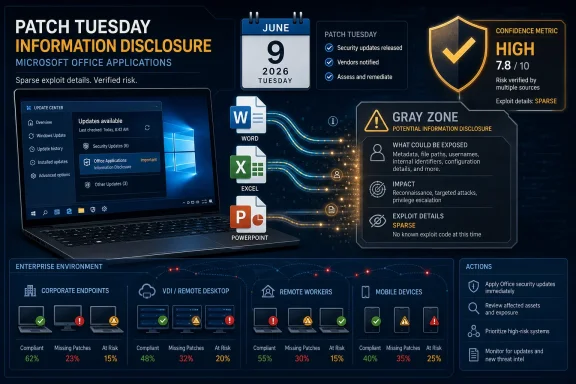 Microsoft’s Office Bug Lands in the Gray Zone Defenders Know Too Well
CVE-2026-45485 is classified as an information disclosure vulnerability in Microsoft Office, which immediately puts it in a category that tends to be underestimated. Remote code execution bugs get the headlines, privilege escalation bugs get the red dashboards, and information disclosure bugs often get triaged into the “patch when convenient” bucket. That instinct can be dangerous.Information disclosure is not one thing. It can mean a harmless-looking metadata leak, a path disclosure useful only to a local attacker, or the exposure of sensitive content, authentication material, document fragments, memory contents, or network-reachable data. The MSRC label tells us the broad impact class, but not the full blast radius.
That is where the user-provided metric description matters. It describes the confidence that a vulnerability exists and that the known technical details are credible. In other words, it is not merely measuring severity; it is measuring how much defenders and attackers can trust the public story about the bug.
This is an underappreciated part of vulnerability management. A vulnerability with confirmed existence but sparse technical detail creates a different kind of risk than a fully documented bug with proof-of-concept code. The former leaves defenders patching under uncertainty. The latter gives everyone — including attackers — a map.
The Confidence Metric Is a Signal, Not a Comfort Blanket
The metric described in Microsoft’s advisory context is essentially about evidentiary confidence. Sometimes a vulnerability is rumored, sometimes it is inferred, sometimes it is corroborated by external research, and sometimes it is explicitly acknowledged by the vendor. Each step increases confidence that the bug is real.But higher confidence does not always mean higher public exploitability. It means the vulnerability’s existence and basic technical claim are more credible. For defenders, that should move the issue out of the realm of speculative noise and into the patch queue.
The uncomfortable bit is that the same metric also hints at how much attackers may know. If public documentation includes enough technical detail, a motivated attacker can sometimes reconstruct the bug class, identify attack surfaces, and build a working test case. If the advisory is sparse, attackers may still use patch-diffing, Office file-format analysis, telemetry leaks, or related bug patterns to close the gap.
That is why “not much detail has been published” is not a reason to relax. It is a reason to avoid overclaiming while still treating the vulnerability as real. In enterprise security, uncertainty should narrow the window for complacency, not widen it.
Office Remains a Prime Target Because Documents Still Cross Trust Boundaries
Microsoft Office is not just a productivity suite. It is one of the most durable trust-boundary crossing machines in enterprise computing. Documents arrive by email, sync through SharePoint and OneDrive, get opened from Teams chats, pass through vendors and customers, and land on endpoints with wildly different policy postures.That matters for any Office vulnerability, even one described only as information disclosure. Office files are often treated as business objects rather than executable content, but the history of the platform says otherwise. Office parsers, embedded objects, preview handlers, templates, macros, external links, and conversion pipelines all create opportunities for unexpected behavior.
The attack model for an information disclosure flaw may not require code execution to be useful. A crafted file might cause Office to disclose local information, retrieve a remote resource, expose document metadata, or leak data under conditions the user does not understand. Without Microsoft’s full technical description, defenders should avoid assuming a particular mechanism — but they should also avoid assuming the least harmful one.
Office is also deeply integrated into identity and cloud storage. A leak that would once have revealed a local path or username can now intersect with tenant names, SharePoint URLs, document classifications, or cached collaboration state. The value of disclosed information depends on the surrounding environment.
Information Disclosure Is Often the First Domino, Not the Last
The security industry still has a severity bias problem. Confidentiality-only bugs are often treated as secondary unless they expose credentials or cryptographic secrets outright. That misses how attackers actually chain weaknesses.Information disclosure can turn guesswork into targeting. It can reveal software versions, internal filenames, user identities, network locations, document templates, or environmental details that make a later exploit more reliable. In phishing campaigns, even small pieces of internal context can make a lure more convincing.
For Office specifically, disclosure can also support social engineering. If an attacker can learn something about a document workflow, template path, or collaboration environment, they may be able to craft a more believable follow-up attack. A vulnerability does not need to pop a shell to advance an intrusion.
This is why defenders should ask a practical question: what would an attacker gain if the affected Office component behaved as Microsoft says it should not? If the answer is “only information,” the next question is whether that information helps them move closer to identity theft, lateral movement, data theft, or fraud.
Sparse Advisories Force Enterprises to Read Between the Lines
Microsoft’s Security Update Guide has become more structured over the years, but structure is not the same as narrative clarity. Administrators typically get a CVE, an impact category, affected products, severity and scoring fields, exploitability assessments, and update guidance. What they often do not get is a plain-English attack story.There are good reasons for that restraint. Publishing too much detail on Patch Tuesday can accelerate exploit development before organizations have deployed updates. Microsoft also has to balance legal, engineering, and coordinated disclosure constraints.
Still, the result is a familiar Patch Tuesday asymmetry. Microsoft knows more than it says. Attackers may be able to learn more by diffing patches. Defenders are left to infer urgency from metadata, product exposure, exploitability ratings, and historical experience.
CVE-2026-45485 fits that pattern. The advisory name tells us the affected family and impact class. The confidence-related metric tells us the vulnerability is not merely hypothetical. The missing technical detail means administrators should resist both extremes: do not panic as if exploitation is confirmed, but do not dismiss the bug because the exploit path is not spelled out.
The Patch Tuesday Calendar Turns Ambiguity Into Work
The June 9, 2026 timing matters because Patch Tuesday is not just a release date. It is a workflow. Security teams ingest advisories, compare them against asset inventories, prioritize deployment rings, test business-critical apps, and decide which risks justify accelerated rollout.Office updates complicate that process. Some environments run Microsoft 365 Apps on Current Channel, others run Monthly Enterprise Channel, Semi-Annual Enterprise Channel, perpetual Office builds, or mixtures created by years of acquisitions and department-level autonomy. A single Office CVE can therefore translate into multiple update paths.
For home users and small businesses, the advice is simpler: keep Office and Microsoft 365 Apps current, and do not delay updates unless there is a known compatibility issue. For enterprises, the challenge is proving coverage. “We patch Office” is not enough if some endpoints are on stale channels, disconnected update mechanisms, or legacy Office editions.
The best security programs already know this. The hard part is not understanding that Office needs updates; it is finding the last 7 percent of machines that do not behave like the managed baseline.
The Real Risk Lives in the Installed Base
Office vulnerabilities are never only about the newest supported build. They are about the installed base: laptops that only appear on VPN once a month, VDI images that lag behind, kiosk machines with odd maintenance windows, lab systems excluded from normal policy, and executives’ devices that somehow become exceptions to every rule.Information disclosure vulnerabilities can be especially awkward in these environments because they may not produce the noisy telemetry associated with code execution. A failed exploit attempt against an RCE bug might crash a process or trigger detection logic. A successful information leak may look like normal document handling, network access, or file activity.
That does not mean CVE-2026-45485 is being exploited. Publicly available information does not establish that. But it does mean defenders should not rely solely on exploit alerts to validate urgency.
If an Office patch is available for affected builds, the operational question becomes boring but decisive: how quickly can the organization move from advisory awareness to measurable update compliance?
Attackers Love Bugs That Users Help Deliver
Office bugs occupy a special place in attacker economics because delivery is easy. A malicious document can be attached to an email, linked from a cloud service, embedded in a collaboration thread, or wrapped in a business pretext. User interaction, when required, is not always a high barrier.That does not imply CVE-2026-45485 is necessarily exploitable through a malicious attachment. The public label alone does not prove that. But Office’s role in user-driven workflows means administrators should examine their document handling controls while patching.
Protected View, Mark of the Web enforcement, Attack Surface Reduction rules, macro restrictions, file block policies, and cloud attachment scanning all matter. They do not replace vendor patches, but they reduce the number of ways a document can become a security event.
The most mature response is layered. Patch the vulnerable Office builds, reduce risky document behaviors, monitor unusual Office child processes or network activity, and review whether sensitive documents are overexposed through collaboration platforms.
Report Confidence Changes the Threat Conversation
The confidence metric described in the prompt deserves more attention because it changes how defenders should talk about the vulnerability internally. A low-confidence report might justify monitoring and waiting for corroboration. A confirmed vendor advisory shifts the burden toward action.This matters in meetings where patching competes with uptime, compatibility, and user disruption. Security teams are often asked, “Is this real?” With a vendor-published CVE in Microsoft’s Security Update Guide, the answer is effectively yes. The better debate is about exposure and timing.
The metric also helps separate two ideas that are often conflated: confidence and severity. A vulnerability can be real but modest in impact. Another can be severe but poorly documented. Decision-making improves when teams treat these dimensions separately.
For CVE-2026-45485, the confidence framing says defenders should not wait for a blog post, proof of concept, or scanner plugin to validate the issue. The vulnerability’s existence has crossed the threshold that matters for operational response.
The Lack of Public Details Is a Feature and a Liability
Microsoft’s restraint protects customers in one sense. The less attack detail available on day one, the harder it may be for opportunistic actors to weaponize the advisory quickly. That is especially important for Office, where even moderately skilled attackers can test malicious documents at scale.But opacity also creates defender friction. Security teams need to know whether a bug is likely to be triggered through preview panes, full document opening, embedded content, network access, or local file interaction. Those distinctions affect mitigations and urgency.
When the advisory does not provide that clarity, defenders fall back on general hardening. That is not wasteful. General Office hardening is exactly what reduces the unknown unknowns around document-borne flaws.
The trade-off is unavoidable. Vendors should not hand attackers a recipe, but customers need enough specificity to prioritize. CVE-2026-45485 appears to sit in that uneasy middle, where the safest practical answer is to patch first and refine assumptions later.
Legacy Office Is the Shadow Inventory Problem That Never Dies
Every Office vulnerability reopens the old question of unsupported or semi-forgotten installations. Organizations that standardized on Microsoft 365 Apps may still have older Office builds for plugins, line-of-business macros, Access databases, document automation, or air-gapped workflows. Those systems are often treated as exceptions until a CVE turns them into liabilities.The risk is not merely that old Office versions may lack the latest patch. It is that they often sit outside modern controls. They may not have the same cloud policy enforcement, telemetry, sandboxing posture, or update cadence as the mainstream fleet.
CVE-2026-45485 should therefore prompt more than a patch status query. It should prompt an inventory query. Which Office products are installed? Which channels are they on? Which machines are excluded? Which business units still depend on outdated add-ins or document formats?
Security teams win Patch Tuesday not by reading advisories faster, but by knowing their environment before the advisories arrive.
Home Users Should Not Overthink the CVE, But They Should Update
For Windows enthusiasts and home users, the practical advice is straightforward. If Office updates are enabled through Microsoft Update or Microsoft 365’s normal update mechanism, let them install. If updates have been paused, resume them.The danger for consumers is not usually a targeted exploit chain built around a single information disclosure CVE. It is the accumulation of stale software, risky attachments, and weak document hygiene. A patched Office installation removes one variable from that equation.
Users should also be careful with unsolicited Office files, especially those that ask them to enable editing, enable content, sign in again, or retrieve external material. Modern Office has added layers of protection over the years, but user consent remains a favorite attacker tool.
For small offices without dedicated IT, the rule is similar: verify that Office is updating, not just Windows. Those are related but not always identical update paths, and assuming coverage is how old builds linger.
Enterprise IT Should Treat This as a Measurability Problem
The best enterprise response to CVE-2026-45485 is not a dramatic war room. It is a measured rollout with proof. Administrators should identify affected Office builds, deploy the relevant updates through their normal management stack, and monitor compliance until the long tail is gone.That sounds mundane because good vulnerability management usually is. The excitement belongs to attackers; defenders need repeatability.
The specific compensating controls depend on the environment, but the strategic pattern is stable. Reduce document attack surface, restrict risky Office behaviors, inspect inbound attachments, and enforce identity protections that limit what an information leak can enable. If sensitive data is accessible through Office-connected workflows, review whether permissions are tighter than convenience has made them.
The most important point is that information disclosure should not be triaged solely by its label. A confidentiality bug in an Office component that handles untrusted documents can be more operationally relevant than a higher-scoring issue buried in an unreachable service.
Security Teams Need Better Language for “Not Known Exploited”
Patch Tuesday coverage often leans heavily on whether a bug is known to be exploited in the wild. That is useful, but it can become a crutch. “Not known exploited” means exactly that; it does not mean “not exploitable,” “not interesting,” or “safe to ignore.”For CVE-2026-45485, public discussion should be careful. If Microsoft has not stated active exploitation, defenders should not claim it. But they should also avoid turning the lack of confirmed exploitation into a reason for delay.
The timeline between patch release and exploit development has compressed for many classes of vulnerabilities. Attackers watch vendor updates, compare binaries, and test reachable surfaces. Office’s complexity gives them plenty of places to look.
The right phrase is not panic. It is exposure management. Patch the systems where Office handles untrusted content first, then finish the rest of the fleet before the advisory fades into next month’s backlog.
The Office Security Story Is Really a Trust Story
Office sits at the intersection of human trust and machine parsing. A user trusts a sender, a workflow trusts a document, a tenant trusts a collaboration link, and an endpoint trusts that the application will safely interpret complex file formats. Vulnerabilities break those assumptions.Information disclosure bugs are particularly corrosive because they turn routine interaction into quiet leakage. The user may not see a crash, a warning, or a ransom note. The organization may not know that something useful has slipped out.
That is why document security cannot be reduced to macro policy or antivirus scanning. It requires a broader view of how documents move, who can open them, what external resources they can contact, and how quickly vulnerable parsers are updated.
CVE-2026-45485 is one advisory, but it points at a recurring truth: the document remains one of the most important attack surfaces in Windows environments.
The June Office Advisory Leaves Administrators With a Short, Concrete Checklist
The practical response to CVE-2026-45485 is not mysterious, but it does require discipline. Treat the sparse advisory as a starting gun rather than a complete dossier.- Administrators should verify which Microsoft Office and Microsoft 365 Apps builds are affected and confirm that the June 2026 security updates are deployed to those systems.
- Organizations should prioritize endpoints that routinely open external documents, including finance, HR, legal, sales, support, and executive users.
- Security teams should confirm that Office update channels are behaving as expected, especially on devices that are remote, intermittently connected, or excluded from standard patch rings.
- Defenders should keep Office hardening controls enabled, including Protected View, macro restrictions, attachment scanning, and Attack Surface Reduction rules where compatible.
- Teams should avoid claiming active exploitation unless Microsoft or another credible source confirms it, but they should not treat the absence of public exploit detail as a reason to postpone patching.
The Quiet Office Bugs Are the Ones That Test Patch Discipline
CVE-2026-45485 is not the kind of vulnerability name that automatically dominates a news cycle. It is not branded, not currently surrounded by public exploit drama, and not described in enough detail to produce instant certainty. That is precisely why it is a useful test of security maturity.Immature programs react only to spectacle. Mature programs respond to verified vendor advisories, understand product exposure, and close the update gap before attackers make the issue fashionable. Office vulnerabilities deserve that treatment because Office remains everywhere that business happens.
The larger lesson is that Microsoft’s confidence signal should be read as a call to action, not a complete explanation. Defenders do not need every implementation detail to know that a confirmed Office information disclosure vulnerability belongs in the June patch plan. The next wave of Windows security will increasingly be fought in these gray zones, where the winners are not the teams with the loudest alerts, but the ones with the clearest inventories, the fastest update telemetry, and the least tolerance for quiet exposure.
References
- Primary source: MSRC
Published: 2026-06-09T07:00:00-07:00
Security Update Guide - Microsoft Security Response Center
 msrc.microsoft.com
- Official source: microsoft.com
MSRC - Microsoft Security Response Center
The Microsoft Security Response Center is part of the defender community and on the front line of security response evolution. For over twenty years, we have been engaged with security researchers working to protect customers and the broader ecosystem.www.microsoft.com
- Related coverage: datacomm.com
- Related coverage: threats.kaspersky.com
Kaspersky Threats — KLA90925
threats.kaspersky.com
- Related coverage: sra.io
- Official source: learn.microsoft.com
Security Advisories and Bulletins | Microsoft Learn
learn.microsoft.com
- Related coverage: cvepremium.circl.lu
Vulnerability-Lookup
Vulnerability-Lookup - Fast vulnerability lookup correlation from different sources.cvepremium.circl.lu - Related coverage: api.urlscan.io

api.msrc.microsoft.com - urlscan.io
urlscan.io - Website scanner for suspicious and malicious URLs
api.urlscan.io
