

Microsoft disclosed CVE-2026-45489 on July 3, 2026, as a medium-severity spoofing vulnerability in Microsoft Edge, the Chromium-based browser for Windows and other platforms, with affected builds reportedly fixed by updating to Edge version 150.0.4078.48 or later. The short version is simple: this is not the kind of Edge bug that should trigger panic, but it is exactly the kind administrators should dislike. Spoofing flaws live in the gap between what software shows users and what is actually happening underneath. When that gap appears in a browser, the security boundary is not just code; it is trust.
Microsoft’s Security Update Guide is the authoritative source for the advisory, while vulnerability aggregators including SecurityVulnerability.io and CVEFeed have mirrored the key public details: a CVSS 3.1 score of 6.5, network attack vector, low attack complexity, no privileges required, and required user interaction. That combination matters. It suggests a flaw that cannot simply be sprayed across machines without a human in the loop, but also one that may be practical in phishing, social engineering, or web-content deception once an attacker understands the trick.
For years, browser vulnerability coverage has been dominated by memory corruption, sandbox escapes, and emergency patches for bugs already being exploited in the wild. Edge inherits much of that rhythm from Chromium, and Microsoft’s own Edge security release notes routinely distinguish between Chromium project fixes and Edge-specific security fixes. CVE-2026-45489 appears to belong to the latter world: not a generic Chrome bug wearing an Edge badge, but a Microsoft Edge issue tracked through MSRC.
That distinction is important because Chromium-based Edge is not merely Chrome with a different icon. Microsoft layers identity, enterprise policy, SmartScreen integration, Microsoft 365 hooks, sidebar features, syncing behavior, management controls, and Windows-specific affordances on top of the Chromium engine. Every one of those layers is useful. Every one also creates places where the browser can tell a user a slightly wrong story.
Spoofing vulnerabilities are often underappreciated because they lack the cinematic quality of remote code execution. No shell pops open. No ransomware payload is implied by the CVE label alone. But the browser is the place users are trained to judge authenticity: the address bar, permission prompts, login flows, certificate warnings, download banners, extension surfaces, and identity cues are all tiny trust contracts.
A spoofing bug means one of those contracts may be unreliable under specific conditions. Microsoft has not published enough public technical detail to say which Edge surface is implicated here, and responsible reporting should not invent one. The real point is broader: when the browser becomes the front door to work, banking, identity, and administration, a false front door is itself a security problem.
That would be the wrong reflex here. CVSS is useful, but it is a model, not a patching philosophy. A browser spoofing vulnerability with user interaction required can still be valuable to attackers because user interaction is not an obstacle in the phishing economy; it is the business model.
The public vector reflected by vulnerability databases indicates network attack vector, low attack complexity, no privileges required, and user interaction required. In plain English, that means an attacker would not need an account on the victim system, would not need to be adjacent on the same network, and would not need an especially fragile race condition to line up — but would need the user to do something. For consumer users, that “something” might be clicking a link. For enterprise users, it might be following a link from Teams, Outlook, a ticketing system, or an internal-looking page.
The interesting part of the score is not only what it says, but what it does not say. Public advisories do not describe active exploitation, do not disclose a proof of concept, and do not lay out a step-by-step attack chain. That keeps the immediate risk lower than a known exploited zero-day, but it also leaves defenders with an uncomfortable ambiguity: the vendor has acknowledged enough to assign and patch a CVE, while the technical community has not yet had time to fully map the blast radius.
That does not mean the world has full details. In fact, most browser advisories are intentionally sparse at first. Vendors routinely withhold exploit mechanics until users have had a reasonable opportunity to update, especially when the affected component is exposed to untrusted web content.
There is a tension here that security teams know well. The less detail Microsoft publishes, the harder it is for administrators to determine whether a given control, proxy, extension policy, or isolation strategy mitigates the issue. The more detail Microsoft publishes, the easier it becomes for attackers to reverse-engineer or rediscover the vulnerable path before update coverage is complete.
That is why the confidence metric matters. It tells defenders not that the exploit is understood, but that the vulnerability should be treated as real. In this case, the responsible position is not “we need more detail before acting.” It is “we have enough confirmation to update, and not enough detail to safely rationalize delay.”
That makes an Edge spoofing flaw operationally different from a similar issue in a niche application. A deceptive browser surface can become a stepping stone into Microsoft 365 credentials, Entra ID sessions, privileged admin portals, cloud dashboards, SaaS applications, or internal web apps that users trust because they arrive through managed channels. The browser is no longer a passive renderer; it is an identity mediator.
For sysadmins, the immediate task is to verify that Edge has updated across all channels and device classes. The reported fixed version threshold, 150.0.4078.48, gives administrators a concrete inventory target for stable channel systems if their management tooling exposes browser build numbers. Enterprises running Extended Stable, Beta, Dev, or Canary channels should check Microsoft’s channel-specific release information rather than assuming the same number maps cleanly across deployment rings.
The bigger lesson is that Edge update compliance deserves the same seriousness as Office and Windows cumulative updates. Many organizations still think of browsers as self-updating utilities rather than managed security assets. That was barely defensible a decade ago. In 2026, it is a category error.
Modern attack chains are built around interaction. The user clicks the link because the lure arrives in a real email thread. The user trusts the page because it resembles a Microsoft sign-in flow. The user approves the prompt because the workflow feels familiar. The user downloads the file because the browser experience suggests the origin is safe.
A spoofing flaw can sharpen those lures. It may let an attacker make one part of the browser or web experience appear more trustworthy than it should. Without technical detail from Microsoft, we cannot say whether CVE-2026-45489 involves address presentation, UI confusion, permission prompts, origin display, download identity, tab content, authentication cues, or another Edge-specific surface. But those are the kinds of trust signals that make spoofing vulnerabilities matter.
The best defense against a user-interaction bug is not a poster telling users to be careful. It is patching, reducing risky browser surfaces, tightening authentication flows, limiting credential replay, monitoring suspicious sign-ins, and making sure users are not asked to make impossible trust decisions dozens of times a day.
CVE-2026-45489 is a reminder that Chromium is not a security outsourcing contract. Edge-specific vulnerabilities can still emerge from Microsoft’s own integration work, product decisions, management features, or UI layers. The browser engine can be patched and hardened while the surrounding browser experience still contains a flaw that matters.
That is not an indictment of Edge specifically. Chrome, Safari, Firefox, and enterprise browsers all carry vendor-specific security surfaces. The more a browser becomes a platform for identity, payments, workspaces, AI assistants, sidebars, extensions, sync, and managed policy, the more “the browser” becomes a bundle of distinct trust decisions.
For WindowsForum readers, this is the practical distinction: keeping Chromium current is necessary, but it does not fully describe Edge security. Edge has its own advisories, its own release notes, and its own enterprise behavior. Treating it as “basically Chrome” is convenient until a Microsoft-specific CVE lands.
That is enough to act, but not enough to perform a nuanced compensating-control analysis. If an organization cannot quickly answer which Edge versions are installed, which update channels are in use, and which devices are lagging behind, the problem is no longer the lack of CVE detail. The problem is browser asset visibility.
This is where administrators should resist the temptation to wait for blog posts, proof-of-concept chatter, or exploit demonstrations. By the time a clean technical write-up appears, attackers may have had the same opportunity to study the patch. Browser patches are especially susceptible to this dynamic because code differences can point researchers toward the vulnerable behavior.
The answer is not blind alarm. It is disciplined hygiene. Confirm the version, push the update, validate the update, and look for exceptions. A medium spoofing advisory does not need a war room, but it does need a closed loop.
In enterprises, the patch gap is often self-inflicted. Organizations delay browser updates to protect line-of-business apps, test extensions, preserve kiosk workflows, or avoid unexpected UI changes. Those are legitimate operational concerns, but they come with a security cost. Browser vulnerabilities age badly because they are exposed to hostile content by design.
For CVE-2026-45489, the relevant question is not whether the bug is medium or critical. It is how many systems remain below the fixed Edge build after the advisory is public. Attackers do not need every machine; they need the machines where a useful target, a convincing lure, and an unpatched browser overlap.
That overlap is especially plausible in mixed environments. A fully managed Windows 11 fleet may update quickly, while older VDI images, lab machines, shared desktops, kiosks, or servers with Edge installed for administrative portals may lag behind. Security teams should look beyond primary user laptops.
Browsers spend enormous engineering effort making deception harder. Origins are isolated. Certificate errors are loud. Permission prompts are scoped. Password managers try to bind credentials to domains. Download warnings attempt to distinguish files and sources. Address bars compress and emphasize pieces of identity.
Yet the browser also has to be usable. It cannot display every security-relevant detail all the time. It hides complexity, shortens labels, groups permissions, renders embedded content, supports redirects, and allows sites to create rich application-like interfaces. Spoofing bugs live in those compromises.
That is why these vulnerabilities often feel less dramatic than they are. They exploit the browser’s role as a storyteller. If Edge tells the wrong story about where a user is, what they are approving, or who they are interacting with, the attacker may not need to break cryptography or memory safety. They only need the victim to believe the browser.
CVE-2026-45489 is a useful forcing function. It gives administrators a narrow, concrete task: make sure Edge is no longer below the vulnerable build. But it also points to a broader governance issue: browser configuration should be part of endpoint security baselines, not a convenience setting left to defaults.
That means update policies should be explicit. Extension installation should be controlled. Risky features should be reviewed in the context of organizational threat models. Multiple profiles and personal account sign-in should be considered carefully. Security teams should know whether SmartScreen, download protections, password manager policies, and site isolation-related controls are actually configured as intended.
None of those steps depends on knowing the exact CVE-2026-45489 exploit path. They are the difference between treating the browser as an app and treating it as infrastructure.
Defenders use the advisory metadata. They look at severity, attack vector, privileges required, user interaction, exploitability notes, affected products, and fixed versions. Attackers look at the same metadata, then compare binaries, study commits if available, and test edge cases around the product surface implied by the CVE title.
The side that moves faster often wins. If defenders wait for a full explanation, they surrender the advantage that coordinated disclosure is meant to provide. If attackers can reverse-engineer the patch before update coverage reaches the long tail, a medium bug can become operationally useful.
This is why the right response is boring. Update first, analyze second. For most organizations, there is little strategic value in knowing the precise spoofing mechanism before the browser fleet is current. Curiosity can wait; exposure cannot.
Users close laptops instead of restarting browsers. IT staff are away. Change windows are constrained. Monitoring queues get thinner. Attackers understand calendars as well as defenders do, and public vulnerability disclosures before quiet periods deserve prompt triage.
For home users, the answer is simple: open Edge’s About page, let the browser check for updates, and restart it. For managed environments, the answer is to verify through endpoint management and vulnerability tooling rather than assuming auto-update has completed. “Available” is not the same as “installed,” and “installed” is not always the same as “running the patched process.”
That last point matters. Browsers often stage updates before restart. A machine may show that an update package has arrived while active browser processes remain old. If the vulnerable code path lives in the running browser, the operational fix is not complete until Edge restarts into the patched build.
But proportional does not mean casual. The patch is small in the sense that updating Edge is routine. The lesson is larger because browser trust failures are exactly the vulnerabilities that fit today’s attacker playbook: credential theft, session abuse, malicious redirects, fake prompts, and plausible user deception.
Microsoft’s own release history shows Edge receiving frequent security updates, sometimes for Chromium vulnerabilities and sometimes for Edge-specific issues. That cadence is a strength only when organizations let it work. If updates are delayed, disabled, or invisible to IT, the cadence becomes background noise.
The right posture is to treat this advisory as both a patch item and a reminder. Edge is a security-sensitive application with its own CVEs, its own fixed builds, and its own administrative surface. It deserves measurement, enforcement, and periodic review.
Microsoft’s Security Update Guide is the authoritative source for the advisory, while vulnerability aggregators including SecurityVulnerability.io and CVEFeed have mirrored the key public details: a CVSS 3.1 score of 6.5, network attack vector, low attack complexity, no privileges required, and required user interaction. That combination matters. It suggests a flaw that cannot simply be sprayed across machines without a human in the loop, but also one that may be practical in phishing, social engineering, or web-content deception once an attacker understands the trick.
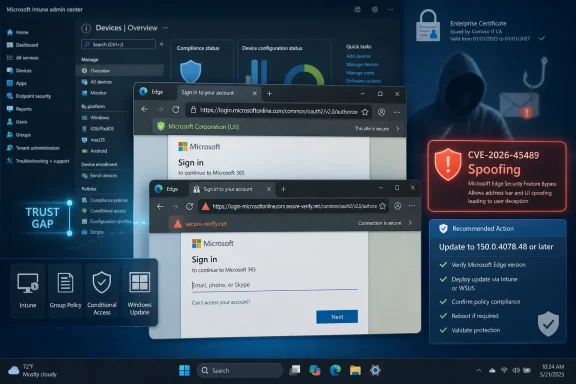 Microsoft’s Browser Security Story Has Become a Trust Story
For years, browser vulnerability coverage has been dominated by memory corruption, sandbox escapes, and emergency patches for bugs already being exploited in the wild. Edge inherits much of that rhythm from Chromium, and Microsoft’s own Edge security release notes routinely distinguish between Chromium project fixes and Edge-specific security fixes. CVE-2026-45489 appears to belong to the latter world: not a generic Chrome bug wearing an Edge badge, but a Microsoft Edge issue tracked through MSRC.That distinction is important because Chromium-based Edge is not merely Chrome with a different icon. Microsoft layers identity, enterprise policy, SmartScreen integration, Microsoft 365 hooks, sidebar features, syncing behavior, management controls, and Windows-specific affordances on top of the Chromium engine. Every one of those layers is useful. Every one also creates places where the browser can tell a user a slightly wrong story.
Spoofing vulnerabilities are often underappreciated because they lack the cinematic quality of remote code execution. No shell pops open. No ransomware payload is implied by the CVE label alone. But the browser is the place users are trained to judge authenticity: the address bar, permission prompts, login flows, certificate warnings, download banners, extension surfaces, and identity cues are all tiny trust contracts.
A spoofing bug means one of those contracts may be unreliable under specific conditions. Microsoft has not published enough public technical detail to say which Edge surface is implicated here, and responsible reporting should not invent one. The real point is broader: when the browser becomes the front door to work, banking, identity, and administration, a false front door is itself a security problem.
A Medium Score Does Not Mean a Minor Weakness
The public CVSS score for CVE-2026-45489 is 6.5, which lands in the medium range. That number is easy to file away as second-tier work after critical Windows, Exchange, SharePoint, or VPN flaws. In many patch queues, “medium” becomes a polite synonym for “later.”That would be the wrong reflex here. CVSS is useful, but it is a model, not a patching philosophy. A browser spoofing vulnerability with user interaction required can still be valuable to attackers because user interaction is not an obstacle in the phishing economy; it is the business model.
The public vector reflected by vulnerability databases indicates network attack vector, low attack complexity, no privileges required, and user interaction required. In plain English, that means an attacker would not need an account on the victim system, would not need to be adjacent on the same network, and would not need an especially fragile race condition to line up — but would need the user to do something. For consumer users, that “something” might be clicking a link. For enterprise users, it might be following a link from Teams, Outlook, a ticketing system, or an internal-looking page.
The interesting part of the score is not only what it says, but what it does not say. Public advisories do not describe active exploitation, do not disclose a proof of concept, and do not lay out a step-by-step attack chain. That keeps the immediate risk lower than a known exploited zero-day, but it also leaves defenders with an uncomfortable ambiguity: the vendor has acknowledged enough to assign and patch a CVE, while the technical community has not yet had time to fully map the blast radius.
The Confidence Metric Is the Quiet Clue
The user-supplied MSRC text points to an often overlooked dimension of vulnerability reporting: confidence in the existence of the vulnerability and credibility of the technical details. In vulnerability scoring language, this is the difference between a rumor, a partial analysis, and a vendor-confirmed flaw. CVE-2026-45489 sits on the more concrete end of that spectrum because Microsoft has published an advisory entry for it.That does not mean the world has full details. In fact, most browser advisories are intentionally sparse at first. Vendors routinely withhold exploit mechanics until users have had a reasonable opportunity to update, especially when the affected component is exposed to untrusted web content.
There is a tension here that security teams know well. The less detail Microsoft publishes, the harder it is for administrators to determine whether a given control, proxy, extension policy, or isolation strategy mitigates the issue. The more detail Microsoft publishes, the easier it becomes for attackers to reverse-engineer or rediscover the vulnerable path before update coverage is complete.
That is why the confidence metric matters. It tells defenders not that the exploit is understood, but that the vulnerability should be treated as real. In this case, the responsible position is not “we need more detail before acting.” It is “we have enough confirmation to update, and not enough detail to safely rationalize delay.”
Edge’s Enterprise Footprint Changes the Risk Calculation
Edge is not just a browser Microsoft ships because Windows needs a default. In managed environments, it is increasingly part of the Microsoft endpoint stack. It is governed through Group Policy, Intune, security baselines, update channels, enterprise sync, application guard concepts, profile separation, and identity-aware experiences.That makes an Edge spoofing flaw operationally different from a similar issue in a niche application. A deceptive browser surface can become a stepping stone into Microsoft 365 credentials, Entra ID sessions, privileged admin portals, cloud dashboards, SaaS applications, or internal web apps that users trust because they arrive through managed channels. The browser is no longer a passive renderer; it is an identity mediator.
For sysadmins, the immediate task is to verify that Edge has updated across all channels and device classes. The reported fixed version threshold, 150.0.4078.48, gives administrators a concrete inventory target for stable channel systems if their management tooling exposes browser build numbers. Enterprises running Extended Stable, Beta, Dev, or Canary channels should check Microsoft’s channel-specific release information rather than assuming the same number maps cleanly across deployment rings.
The bigger lesson is that Edge update compliance deserves the same seriousness as Office and Windows cumulative updates. Many organizations still think of browsers as self-updating utilities rather than managed security assets. That was barely defensible a decade ago. In 2026, it is a category error.
Required User Interaction Is Not Comforting in 2026
Security advisories often downgrade concern when user interaction is required. That makes sense mathematically: a no-click attack is usually more dangerous than one that needs a click. But it can mislead non-specialists into thinking “user interaction” means “unlikely.”Modern attack chains are built around interaction. The user clicks the link because the lure arrives in a real email thread. The user trusts the page because it resembles a Microsoft sign-in flow. The user approves the prompt because the workflow feels familiar. The user downloads the file because the browser experience suggests the origin is safe.
A spoofing flaw can sharpen those lures. It may let an attacker make one part of the browser or web experience appear more trustworthy than it should. Without technical detail from Microsoft, we cannot say whether CVE-2026-45489 involves address presentation, UI confusion, permission prompts, origin display, download identity, tab content, authentication cues, or another Edge-specific surface. But those are the kinds of trust signals that make spoofing vulnerabilities matter.
The best defense against a user-interaction bug is not a poster telling users to be careful. It is patching, reducing risky browser surfaces, tightening authentication flows, limiting credential replay, monitoring suspicious sign-ins, and making sure users are not asked to make impossible trust decisions dozens of times a day.
Chromium Gives Microsoft Scale, Not Immunity
Microsoft’s move to Chromium gave Edge compatibility, performance, and a share in the security investment of the larger Chromium ecosystem. It also means many Edge updates arrive as part of a shared browser-security cadence. Microsoft’s Edge release notes frequently state that new Stable Channel builds incorporate Chromium security updates, and in some cases Microsoft calls out Chromium bugs reported as exploited in the wild.CVE-2026-45489 is a reminder that Chromium is not a security outsourcing contract. Edge-specific vulnerabilities can still emerge from Microsoft’s own integration work, product decisions, management features, or UI layers. The browser engine can be patched and hardened while the surrounding browser experience still contains a flaw that matters.
That is not an indictment of Edge specifically. Chrome, Safari, Firefox, and enterprise browsers all carry vendor-specific security surfaces. The more a browser becomes a platform for identity, payments, workspaces, AI assistants, sidebars, extensions, sync, and managed policy, the more “the browser” becomes a bundle of distinct trust decisions.
For WindowsForum readers, this is the practical distinction: keeping Chromium current is necessary, but it does not fully describe Edge security. Edge has its own advisories, its own release notes, and its own enterprise behavior. Treating it as “basically Chrome” is convenient until a Microsoft-specific CVE lands.
Sparse Advisories Put More Pressure on Asset Inventory
The public advisory trail for CVE-2026-45489 is thin. Microsoft’s MSRC page is the root source, but like many Security Update Guide entries it exposes limited narrative detail to the public. Third-party vulnerability trackers repeat the headline facts: Microsoft Edge, spoofing, medium severity, CVSS 6.5, publication on July 3, 2026, and an affected version range below 150.0.4078.48.That is enough to act, but not enough to perform a nuanced compensating-control analysis. If an organization cannot quickly answer which Edge versions are installed, which update channels are in use, and which devices are lagging behind, the problem is no longer the lack of CVE detail. The problem is browser asset visibility.
This is where administrators should resist the temptation to wait for blog posts, proof-of-concept chatter, or exploit demonstrations. By the time a clean technical write-up appears, attackers may have had the same opportunity to study the patch. Browser patches are especially susceptible to this dynamic because code differences can point researchers toward the vulnerable behavior.
The answer is not blind alarm. It is disciplined hygiene. Confirm the version, push the update, validate the update, and look for exceptions. A medium spoofing advisory does not need a war room, but it does need a closed loop.
The Real Risk Is the Patch Gap
Microsoft Edge is designed to update frequently, and for unmanaged consumers that normally works well. The browser checks for updates, installs them, and applies them when the browser restarts. The weak point is the long-running session: laptops that sleep rather than reboot, users who keep dozens of tabs open for weeks, and environments where update controls are intentionally slowed.In enterprises, the patch gap is often self-inflicted. Organizations delay browser updates to protect line-of-business apps, test extensions, preserve kiosk workflows, or avoid unexpected UI changes. Those are legitimate operational concerns, but they come with a security cost. Browser vulnerabilities age badly because they are exposed to hostile content by design.
For CVE-2026-45489, the relevant question is not whether the bug is medium or critical. It is how many systems remain below the fixed Edge build after the advisory is public. Attackers do not need every machine; they need the machines where a useful target, a convincing lure, and an unpatched browser overlap.
That overlap is especially plausible in mixed environments. A fully managed Windows 11 fleet may update quickly, while older VDI images, lab machines, shared desktops, kiosks, or servers with Edge installed for administrative portals may lag behind. Security teams should look beyond primary user laptops.
Spoofing Is a Browser Problem Because Humans Are Part of the Boundary
The word spoofing can sound vague, and in CVE databases it covers a wide range of sins. It can mean impersonating a site, misrepresenting content, confusing an origin, faking a prompt, or causing the user to believe an action applies to one thing when it applies to another. The common thread is deception.Browsers spend enormous engineering effort making deception harder. Origins are isolated. Certificate errors are loud. Permission prompts are scoped. Password managers try to bind credentials to domains. Download warnings attempt to distinguish files and sources. Address bars compress and emphasize pieces of identity.
Yet the browser also has to be usable. It cannot display every security-relevant detail all the time. It hides complexity, shortens labels, groups permissions, renders embedded content, supports redirects, and allows sites to create rich application-like interfaces. Spoofing bugs live in those compromises.
That is why these vulnerabilities often feel less dramatic than they are. They exploit the browser’s role as a storyteller. If Edge tells the wrong story about where a user is, what they are approving, or who they are interacting with, the attacker may not need to break cryptography or memory safety. They only need the victim to believe the browser.
Admins Should Treat Edge as a Tier-One Security Dependency
There is a persistent mismatch between how organizations use browsers and how they govern them. In many environments, the browser is the most exposed application on the endpoint, the primary interface to cloud identity, the gateway to SaaS data, and the place where users encounter untrusted content all day. Yet browser update compliance is often less visible than operating system compliance.CVE-2026-45489 is a useful forcing function. It gives administrators a narrow, concrete task: make sure Edge is no longer below the vulnerable build. But it also points to a broader governance issue: browser configuration should be part of endpoint security baselines, not a convenience setting left to defaults.
That means update policies should be explicit. Extension installation should be controlled. Risky features should be reviewed in the context of organizational threat models. Multiple profiles and personal account sign-in should be considered carefully. Security teams should know whether SmartScreen, download protections, password manager policies, and site isolation-related controls are actually configured as intended.
None of those steps depends on knowing the exact CVE-2026-45489 exploit path. They are the difference between treating the browser as an app and treating it as infrastructure.
Microsoft’s Disclosure Model Helps Attackers and Defenders Race on Different Tracks
Microsoft’s MSRC process exists to get fixes into customer hands while limiting the amount of exploit-enabling detail released too early. That is a defensible model, particularly for browsers. But it creates an information asymmetry that both defenders and attackers exploit in different ways.Defenders use the advisory metadata. They look at severity, attack vector, privileges required, user interaction, exploitability notes, affected products, and fixed versions. Attackers look at the same metadata, then compare binaries, study commits if available, and test edge cases around the product surface implied by the CVE title.
The side that moves faster often wins. If defenders wait for a full explanation, they surrender the advantage that coordinated disclosure is meant to provide. If attackers can reverse-engineer the patch before update coverage reaches the long tail, a medium bug can become operationally useful.
This is why the right response is boring. Update first, analyze second. For most organizations, there is little strategic value in knowing the precise spoofing mechanism before the browser fleet is current. Curiosity can wait; exposure cannot.
The July 2026 Timing Should Focus Patch Discipline
The advisory landed on July 3, 2026, immediately before a holiday weekend in the United States. That timing is not proof of elevated danger, and it should not be dressed up as drama. But security operations teams know that long weekends create patch latency.Users close laptops instead of restarting browsers. IT staff are away. Change windows are constrained. Monitoring queues get thinner. Attackers understand calendars as well as defenders do, and public vulnerability disclosures before quiet periods deserve prompt triage.
For home users, the answer is simple: open Edge’s About page, let the browser check for updates, and restart it. For managed environments, the answer is to verify through endpoint management and vulnerability tooling rather than assuming auto-update has completed. “Available” is not the same as “installed,” and “installed” is not always the same as “running the patched process.”
That last point matters. Browsers often stage updates before restart. A machine may show that an update package has arrived while active browser processes remain old. If the vulnerable code path lives in the running browser, the operational fix is not complete until Edge restarts into the patched build.
The Patch Is Small; the Lesson Is Not
CVE-2026-45489 does not currently appear to be a five-alarm Edge emergency. There is no public evidence in the available advisory trail of active exploitation, no public proof of concept in the sources reviewed, and no detailed Microsoft write-up describing a catastrophic attack chain. A medium severity score with user interaction required should be handled proportionally.But proportional does not mean casual. The patch is small in the sense that updating Edge is routine. The lesson is larger because browser trust failures are exactly the vulnerabilities that fit today’s attacker playbook: credential theft, session abuse, malicious redirects, fake prompts, and plausible user deception.
Microsoft’s own release history shows Edge receiving frequent security updates, sometimes for Chromium vulnerabilities and sometimes for Edge-specific issues. That cadence is a strength only when organizations let it work. If updates are delayed, disabled, or invisible to IT, the cadence becomes background noise.
The right posture is to treat this advisory as both a patch item and a reminder. Edge is a security-sensitive application with its own CVEs, its own fixed builds, and its own administrative surface. It deserves measurement, enforcement, and periodic review.
The Version Number Is the Message This Time
For all the uncertainty around technical mechanics, CVE-2026-45489 gives defenders enough concrete action to avoid paralysis.- Microsoft disclosed CVE-2026-45489 on July 3, 2026, as a spoofing vulnerability in Chromium-based Microsoft Edge.
- Public vulnerability databases list the issue as medium severity with a CVSS 3.1 score of 6.5.
- The reported attack characteristics include network attack vector, low attack complexity, no required privileges, and required user interaction.
- Available public details point to Edge versions below 150.0.4078.48 as affected, making that build number the practical compliance line for Stable Channel systems where applicable.
- There is no need to wait for exploit code or a fuller technical breakdown before updating, because Microsoft’s advisory is sufficient confirmation that the vulnerability exists.
- Administrators should verify not only that the update is available, but that Edge has restarted into the patched version across managed endpoints, kiosks, VDI images, and secondary systems.
References
- Primary source: MSRC
Published: 2026-07-03T07:00:00-07:00
Security Update Guide - Microsoft Security Response Center
 msrc.microsoft.com
- Related coverage: securityvulnerability.io
CVE-2026-45489 : Spoofing Vulnerability in Microsoft Edge by Microsoft
Explore a spoofing vulnerability affecting Microsoft Edge. Learn more about CVE-2026-45489 and its implications for users.securityvulnerability.io - Official source: microsoft.com
MSRC - Microsoft Security Response Center
The Microsoft Security Response Center is part of the defender community and on the front line of security response evolution. For over twenty years, we have been engaged with security researchers working to protect customers and the broader ecosystem.www.microsoft.com
- Related coverage: datacomm.com
- Official source: learn.microsoft.com
Release notes for Microsoft Edge Security Updates | Microsoft Learn
Release notes for Microsoft Edge Security Updateslearn.microsoft.com - Related coverage: www2.gov.bc.ca
- Related coverage: hkcert.org
Microsoft Edge Multiple Vulnerabilities
Multiple vulnerabilities were identified in Microsoft Edg. A remote attacker could exploit some of these vulnerabilities to trigger remote code execution, denial of service condition, security restriction bypass, spoofing, cross-site scripting and sensitiwww.hkcert.org - Related coverage: cve.circl.lu
Vulnerability-Lookup
Vulnerability-Lookup - Fast vulnerability lookup correlation from different sources.cve.circl.lu - Related coverage: buildings.honeywell.com
The purpose of this document is to identify the patches that have been delivered by Microsoft® which have been tested against Pro-Watch
PDF documentbuildings.honeywell.com
