

Microsoft lists CVE-2026-45491 as a .NET tampering vulnerability in its Security Update Guide, but the public record available on June 9, 2026, appears thin: the advisory confirms the vulnerability class and vendor acknowledgement while leaving the deeper exploit mechanics largely undisclosed. That combination matters more than the label might suggest. A tampering bug in .NET does not automatically mean wormable remote code execution, but it does sit uncomfortably close to the trust boundaries that Windows developers, build engineers, and administrators rely on every day.
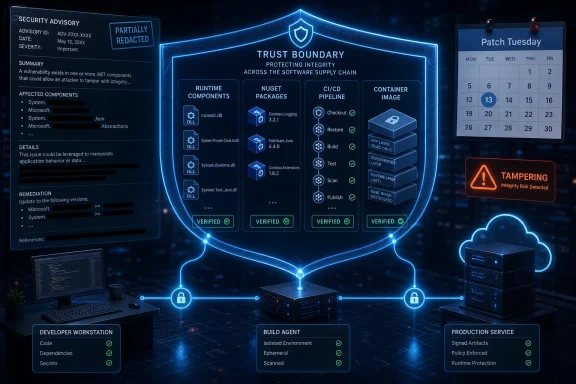
The temptation with a sparse CVE entry is to treat it as administrative noise — one more line item in Patch Tuesday’s endless table. That is the wrong instinct. The modern Windows estate is no longer just Windows clients and servers; it is application runtimes, developer workstations, CI/CD agents, container images, build tools, side-by-side SDKs, and production services. A .NET vulnerability is therefore not merely a runtime problem. It is a supply-chain problem waiting to be scoped.
The most important fact about CVE-2026-45491 is also the least satisfying one: Microsoft’s advisory acknowledges a .NET tampering vulnerability, but the available public detail does not yet tell defenders exactly how the tampering occurs. That places the vulnerability in a familiar middle zone for security teams. It is real enough to patch, but not transparent enough to model with confidence.
This is where the metric language supplied alongside the advisory becomes useful. The confidence metric is not asking whether administrators feel emotionally reassured. It is asking how strongly the vulnerability’s existence and technical details are supported. Vendor acknowledgement raises confidence that the flaw exists. Limited root-cause information lowers confidence in anyone’s ability to forecast exploitability from the outside.
That distinction is easy to miss. A confirmed CVE with sparse detail is not the same thing as a rumor, and it is not the same thing as a fully weaponized exploit write-up. It is a vendor-confirmed risk with an intentionally narrow public description. Microsoft often withholds technical specifics until patches have had time to propagate, especially when the affected component is broadly deployed.
For defenders, that means CVE-2026-45491 should not be evaluated only by the drama of its write-up. It should be evaluated by where .NET sits in the organization. If .NET is part of desktop line-of-business software, developer tooling, cloud services, web workloads, or build automation, then even a modest tampering issue can become operationally significant.
That is why tampering vulnerabilities are often more strategic than their severity label suggests. They can involve modified files, altered payloads, manipulated package contents, weakened validation, or trust decisions that fail under specially crafted input. The exact mechanics vary, and Microsoft has not publicly filled in all the blanks for this CVE. The category alone, however, tells administrators to think about trust rather than just crash behavior.
In the .NET world, trust is everywhere. Applications load assemblies. Tools resolve packages. Build systems restore dependencies. Desktop apps consume local and remote resources. Servers deserialize, validate, sign, hash, compile, and execute managed code in workflows that are often invisible to the help desk but critical to the business.
A tampering vulnerability in that ecosystem therefore raises a different class of concern from a simple denial-of-service flaw. The question is not merely whether an attacker can knock something over. The question is whether an attacker can cause a .NET component to accept, process, or preserve something it should have rejected.
Patch diffing is not theoretical. Once updates are released, motivated researchers and adversaries can compare old and new binaries, inspect changed behavior, and infer the vulnerable path. Sparse advisories may slow casual exploitation, but they do not prevent serious actors from learning. In some cases, they simply shift the technical disclosure from prose to binary analysis.
That is why waiting for a more detailed write-up can be a losing strategy. By the time public exploit details emerge, the vulnerability has often moved from “known to the vendor” to “understood by adversaries.” The safer operational posture is to assume the disclosure clock started when the patch shipped, not when a blog post appears.
For WindowsForum readers, the practical consequence is blunt: if your patch process ranks vulnerabilities only by headline severity or social-media heat, CVE-2026-45491 may be under-prioritized. The better ranking signal is exposure. Any machine that runs affected .NET components and handles untrusted files, packages, or application inputs deserves attention.
That sprawl is the reason .NET vulnerabilities can be awkward for administrators. Updating Windows may not update every runtime an application actually uses. Updating Visual Studio may not update a production container. Updating a server runtime may not rebuild an app image. The inventory problem is often harder than the patch itself.
Enterprises that treat .NET as a simple Windows component are therefore likely to miss pieces. The right question is not “Did Windows Update run?” It is “Which .NET runtimes, frameworks, SDKs, hosting bundles, developer tools, and application images are present, and which of them are affected?” That question requires software inventory, not vibes.
The consumer version of the same issue is simpler but still relevant. Windows PCs can accumulate .NET components through games, productivity apps, vendor utilities, and development tools. Most home users should rely on Windows Update and application updates. Power users and developers should also check installed SDKs and runtimes directly, especially if they build or test software locally.
Developers interact with untrusted input constantly. They clone repositories, inspect pull requests, restore packages, open sample projects, run test harnesses, and build artifacts that later move into production. If a tampering flaw can be triggered through crafted files or manipulated project assets, the developer environment becomes an attractive target even before production servers enter the picture.
This does not mean CVE-2026-45491 is known to be a developer-workstation exploit. The public details do not justify that claim. But it does mean developer exposure should be considered during triage. The absence of a fully public exploit chain is not a reason to ignore the machines that have the most tooling, the most trust, and often the least predictable configuration.
The same logic applies to build agents. CI runners are frequently treated as disposable, but they are also powerful. They pull dependencies, sign artifacts, access package feeds, and publish releases. If an attacker can influence what a build agent consumes, an integrity vulnerability in the runtime or tooling layer can have consequences beyond the individual machine.
That gap is why CVE management often feels unsatisfying. The CVE is global; the risk is local. Two organizations can read the same advisory and reach different priorities because one has a few managed desktops while the other has thousands of .NET services, developer endpoints, and CI workers exposed to partner-supplied code.
The confidence metric included in the prompt is useful precisely because it separates existence from detail. With Microsoft acknowledgement, defenders can be confident that the vulnerability is real. With limited public root-cause information, defenders should be cautious about making narrow claims. The right response is neither panic nor dismissal. It is disciplined remediation with an honest note that some exploitation details remain opaque.
That is also how security teams should brief leadership. “Microsoft has confirmed a .NET tampering vulnerability and released guidance; public technical details are limited; we are prioritizing systems based on .NET exposure and untrusted input paths” is a stronger statement than either “critical emergency” or “nothing to see here.” It maps uncertainty without hiding behind it.
That is a cultural shift for some Windows shops. Traditional endpoint patching grew up around operating-system updates and a handful of major third-party apps. Modern application platforms do not fit that shape. They live at the intersection of OS servicing, developer tooling, package management, and deployment pipelines.
For .NET specifically, the cleanup is often uneven. Servers may receive cumulative Windows updates but continue running application-local runtimes. Containers may be rebuilt only when application code changes. Developer machines may retain old SDKs because projects target older versions. Each exception is understandable in isolation. Together, they create a long tail of exposure.
CVE-2026-45491 is a reminder that the long tail matters. Tampering vulnerabilities are about whether systems can trust what they handle. The more runtimes and tools an organization carries forward, the more trust decisions it must keep patched.
That last clause is where many organizations stumble. .NET updates can be routine, but they can also touch business-critical applications with brittle dependencies. Administrators may face pressure to “just patch” from security teams and pressure to “not break anything” from application owners. The result is often delay disguised as process.
The healthier approach is to split environments by tolerance and exposure. Developer machines and test systems should move quickly. Internet-facing workloads and systems processing untrusted files should be prioritized. Legacy applications should be tested, but the testing window should be explicit, short, and owned by someone. “Waiting for app validation” is not a plan unless the validation has a date.
Home users and small offices have a simpler path. Keep Windows Update enabled, update Visual Studio or .NET SDKs if installed, and restart promptly. The risk calculus is less about bespoke inventory and more about not becoming the machine that still has last month’s runtime after everyone else moved on.
This is where Microsoft could do more without handing attackers a recipe. Better affected-component granularity, clearer notes on likely attack prerequisites, and stronger mapping between runtime families and update vehicles would help administrators act faster. Even a concise statement about whether exploitation requires local access, user interaction, crafted files, or network reachability can materially improve triage.
The industry has improved since the old bulletin era, but modern platform sprawl has raised the bar. A single .NET advisory can touch Windows servicing, standalone installers, Visual Studio, package feeds, and containers. Defender guidance needs to reflect that complexity. Otherwise, the burden shifts to every administrator to reconstruct the same risk model from fragments.
To be fair, customers also need to do their part. Microsoft cannot know every internal dependency graph. Organizations that lack runtime inventory will struggle no matter how polished the advisory is. CVE-2026-45491 is therefore not only a Microsoft disclosure story. It is a mirror held up to how well Windows estates understand their own application substrate.
The hardest part is avoiding false precision. Public information does not support confident claims about exploit code, attack chains, or real-world exploitation for CVE-2026-45491 unless Microsoft or another credible source publishes more detail. But it does support confidence that the vulnerability exists and that Microsoft considers it important enough to document through the Security Update Guide.
That is a familiar place for defenders: enough evidence to act, not enough evidence to narrate the entire attack. Mature patch programs are built for exactly that situation. They do not require a proof-of-concept video before they move. They use vendor confirmation, affected-product scope, exposure, and business criticality to set the clock.
The temptation with a sparse CVE entry is to treat it as administrative noise — one more line item in Patch Tuesday’s endless table. That is the wrong instinct. The modern Windows estate is no longer just Windows clients and servers; it is application runtimes, developer workstations, CI/CD agents, container images, build tools, side-by-side SDKs, and production services. A .NET vulnerability is therefore not merely a runtime problem. It is a supply-chain problem waiting to be scoped.
 Microsoft Has Confirmed the Bug, but Not the Story
The most important fact about CVE-2026-45491 is also the least satisfying one: Microsoft’s advisory acknowledges a .NET tampering vulnerability, but the available public detail does not yet tell defenders exactly how the tampering occurs. That places the vulnerability in a familiar middle zone for security teams. It is real enough to patch, but not transparent enough to model with confidence.This is where the metric language supplied alongside the advisory becomes useful. The confidence metric is not asking whether administrators feel emotionally reassured. It is asking how strongly the vulnerability’s existence and technical details are supported. Vendor acknowledgement raises confidence that the flaw exists. Limited root-cause information lowers confidence in anyone’s ability to forecast exploitability from the outside.
That distinction is easy to miss. A confirmed CVE with sparse detail is not the same thing as a rumor, and it is not the same thing as a fully weaponized exploit write-up. It is a vendor-confirmed risk with an intentionally narrow public description. Microsoft often withholds technical specifics until patches have had time to propagate, especially when the affected component is broadly deployed.
For defenders, that means CVE-2026-45491 should not be evaluated only by the drama of its write-up. It should be evaluated by where .NET sits in the organization. If .NET is part of desktop line-of-business software, developer tooling, cloud services, web workloads, or build automation, then even a modest tampering issue can become operationally significant.
“Tampering” Is the Quiet Integrity Failure
Security headlines are trained to chase remote code execution and privilege escalation. Tampering sounds dull by comparison, almost clerical. But in security terms, tampering is about integrity, and integrity is the property that tells a system whether the thing it is consuming is still the thing it believes it is consuming.That is why tampering vulnerabilities are often more strategic than their severity label suggests. They can involve modified files, altered payloads, manipulated package contents, weakened validation, or trust decisions that fail under specially crafted input. The exact mechanics vary, and Microsoft has not publicly filled in all the blanks for this CVE. The category alone, however, tells administrators to think about trust rather than just crash behavior.
In the .NET world, trust is everywhere. Applications load assemblies. Tools resolve packages. Build systems restore dependencies. Desktop apps consume local and remote resources. Servers deserialize, validate, sign, hash, compile, and execute managed code in workflows that are often invisible to the help desk but critical to the business.
A tampering vulnerability in that ecosystem therefore raises a different class of concern from a simple denial-of-service flaw. The question is not merely whether an attacker can knock something over. The question is whether an attacker can cause a .NET component to accept, process, or preserve something it should have rejected.
The Patch Is the Message
When Microsoft publishes a sparse advisory, the patch itself becomes the message. The vendor is effectively telling customers that enough is known internally to justify remediation, even if the public explanation remains controlled. This creates an asymmetry that defenders have learned to live with: Microsoft has the root cause; attackers may start diffing patches; administrators are left racing both.Patch diffing is not theoretical. Once updates are released, motivated researchers and adversaries can compare old and new binaries, inspect changed behavior, and infer the vulnerable path. Sparse advisories may slow casual exploitation, but they do not prevent serious actors from learning. In some cases, they simply shift the technical disclosure from prose to binary analysis.
That is why waiting for a more detailed write-up can be a losing strategy. By the time public exploit details emerge, the vulnerability has often moved from “known to the vendor” to “understood by adversaries.” The safer operational posture is to assume the disclosure clock started when the patch shipped, not when a blog post appears.
For WindowsForum readers, the practical consequence is blunt: if your patch process ranks vulnerabilities only by headline severity or social-media heat, CVE-2026-45491 may be under-prioritized. The better ranking signal is exposure. Any machine that runs affected .NET components and handles untrusted files, packages, or application inputs deserves attention.
.NET Is Not One Thing on One Machine
The phrase “.NET vulnerability” hides a messy deployment reality. Some systems carry the .NET Framework built into Windows servicing channels. Others run modern .NET runtimes installed side by side. Developer machines may have multiple SDKs. Servers may host ASP.NET Core apps. Containers may pin base images that lag behind patched host runtimes.That sprawl is the reason .NET vulnerabilities can be awkward for administrators. Updating Windows may not update every runtime an application actually uses. Updating Visual Studio may not update a production container. Updating a server runtime may not rebuild an app image. The inventory problem is often harder than the patch itself.
Enterprises that treat .NET as a simple Windows component are therefore likely to miss pieces. The right question is not “Did Windows Update run?” It is “Which .NET runtimes, frameworks, SDKs, hosting bundles, developer tools, and application images are present, and which of them are affected?” That question requires software inventory, not vibes.
The consumer version of the same issue is simpler but still relevant. Windows PCs can accumulate .NET components through games, productivity apps, vendor utilities, and development tools. Most home users should rely on Windows Update and application updates. Power users and developers should also check installed SDKs and runtimes directly, especially if they build or test software locally.
Developers Are Part of the Blast Radius
A .NET tampering vulnerability should make developer workstations part of the security conversation. Too many organizations still treat developer laptops as privileged snowflakes: heavily customized, lightly standardized, and full of secrets. That posture becomes dangerous when the vulnerability class involves integrity.Developers interact with untrusted input constantly. They clone repositories, inspect pull requests, restore packages, open sample projects, run test harnesses, and build artifacts that later move into production. If a tampering flaw can be triggered through crafted files or manipulated project assets, the developer environment becomes an attractive target even before production servers enter the picture.
This does not mean CVE-2026-45491 is known to be a developer-workstation exploit. The public details do not justify that claim. But it does mean developer exposure should be considered during triage. The absence of a fully public exploit chain is not a reason to ignore the machines that have the most tooling, the most trust, and often the least predictable configuration.
The same logic applies to build agents. CI runners are frequently treated as disposable, but they are also powerful. They pull dependencies, sign artifacts, access package feeds, and publish releases. If an attacker can influence what a build agent consumes, an integrity vulnerability in the runtime or tooling layer can have consequences beyond the individual machine.
The Security Update Guide Is Not a Threat Model
Microsoft’s Security Update Guide is a starting point, not a complete operational answer. It tells customers that a vulnerability exists, names affected products, provides severity and scoring metadata when available, and points toward updates. It does not know whether your organization has a legacy finance app pinned to an old runtime or a build farm restoring packages from a poorly governed internal feed.That gap is why CVE management often feels unsatisfying. The CVE is global; the risk is local. Two organizations can read the same advisory and reach different priorities because one has a few managed desktops while the other has thousands of .NET services, developer endpoints, and CI workers exposed to partner-supplied code.
The confidence metric included in the prompt is useful precisely because it separates existence from detail. With Microsoft acknowledgement, defenders can be confident that the vulnerability is real. With limited public root-cause information, defenders should be cautious about making narrow claims. The right response is neither panic nor dismissal. It is disciplined remediation with an honest note that some exploitation details remain opaque.
That is also how security teams should brief leadership. “Microsoft has confirmed a .NET tampering vulnerability and released guidance; public technical details are limited; we are prioritizing systems based on .NET exposure and untrusted input paths” is a stronger statement than either “critical emergency” or “nothing to see here.” It maps uncertainty without hiding behind it.
Patch Tuesday Has Become a Runtime Census
The operational lesson is that patching .NET is now part of asset management. It is not enough to know which Windows build is installed. Administrators need visibility into runtime versions, SDK versions, hosting bundles, Visual Studio installations, container base images, and application dependencies.That is a cultural shift for some Windows shops. Traditional endpoint patching grew up around operating-system updates and a handful of major third-party apps. Modern application platforms do not fit that shape. They live at the intersection of OS servicing, developer tooling, package management, and deployment pipelines.
For .NET specifically, the cleanup is often uneven. Servers may receive cumulative Windows updates but continue running application-local runtimes. Containers may be rebuilt only when application code changes. Developer machines may retain old SDKs because projects target older versions. Each exception is understandable in isolation. Together, they create a long tail of exposure.
CVE-2026-45491 is a reminder that the long tail matters. Tampering vulnerabilities are about whether systems can trust what they handle. The more runtimes and tools an organization carries forward, the more trust decisions it must keep patched.
The CVE Number Is Less Important Than the Exposure Map
Security teams love identifiers because identifiers create order. CVE-2026-45491 gives this issue a handle, but the handle is not the risk. The risk depends on where affected .NET components run, what they process, who can influence those inputs, and how quickly updates can be applied without breaking production.That last clause is where many organizations stumble. .NET updates can be routine, but they can also touch business-critical applications with brittle dependencies. Administrators may face pressure to “just patch” from security teams and pressure to “not break anything” from application owners. The result is often delay disguised as process.
The healthier approach is to split environments by tolerance and exposure. Developer machines and test systems should move quickly. Internet-facing workloads and systems processing untrusted files should be prioritized. Legacy applications should be tested, but the testing window should be explicit, short, and owned by someone. “Waiting for app validation” is not a plan unless the validation has a date.
Home users and small offices have a simpler path. Keep Windows Update enabled, update Visual Studio or .NET SDKs if installed, and restart promptly. The risk calculus is less about bespoke inventory and more about not becoming the machine that still has last month’s runtime after everyone else moved on.
Microsoft’s Sparse Disclosure Leaves Room for Better Defender Signals
Microsoft has good reasons to limit technical detail, but sparse CVE entries create real costs for defenders. Security teams must decide urgency without the full exploit narrative. Vulnerability scanners may flag the issue without enough context. Application owners may ask whether their specific workload is reachable, and the honest answer may be “we cannot tell from the advisory alone.”This is where Microsoft could do more without handing attackers a recipe. Better affected-component granularity, clearer notes on likely attack prerequisites, and stronger mapping between runtime families and update vehicles would help administrators act faster. Even a concise statement about whether exploitation requires local access, user interaction, crafted files, or network reachability can materially improve triage.
The industry has improved since the old bulletin era, but modern platform sprawl has raised the bar. A single .NET advisory can touch Windows servicing, standalone installers, Visual Studio, package feeds, and containers. Defender guidance needs to reflect that complexity. Otherwise, the burden shifts to every administrator to reconstruct the same risk model from fragments.
To be fair, customers also need to do their part. Microsoft cannot know every internal dependency graph. Organizations that lack runtime inventory will struggle no matter how polished the advisory is. CVE-2026-45491 is therefore not only a Microsoft disclosure story. It is a mirror held up to how well Windows estates understand their own application substrate.
The Practical Reading of CVE-2026-45491 Is Narrow but Urgent
The measured response to this advisory is not to declare every .NET application compromised. It is to close the gap between vendor-confirmed vulnerability and local exposure. That means patching supported components, removing obsolete runtimes where possible, rebuilding images, and confirming that developer and build environments are included in the rollout.The hardest part is avoiding false precision. Public information does not support confident claims about exploit code, attack chains, or real-world exploitation for CVE-2026-45491 unless Microsoft or another credible source publishes more detail. But it does support confidence that the vulnerability exists and that Microsoft considers it important enough to document through the Security Update Guide.
That is a familiar place for defenders: enough evidence to act, not enough evidence to narrate the entire attack. Mature patch programs are built for exactly that situation. They do not require a proof-of-concept video before they move. They use vendor confirmation, affected-product scope, exposure, and business criticality to set the clock.
The .NET Estate Needs a Trust Audit, Not Just a Patch Window
The concrete lesson from CVE-2026-45491 is that .NET security belongs in the same conversation as Windows servicing, developer hygiene, and software supply-chain control. Treat this advisory as a prompt to check whether the organization can actually answer the basic questions that a tampering flaw raises.- Organizations should verify which .NET Framework, modern .NET runtime, SDK, hosting bundle, Visual Studio, and build-tool versions are installed across endpoints, servers, and CI infrastructure.
- Administrators should prioritize systems that process untrusted files, restore packages, build code, host web applications, or run workloads exposed to external users.
- Developer workstations and build agents should be patched early because they often combine broad tooling, sensitive credentials, and routine exposure to outside code.
- Containerized .NET applications should be rebuilt from patched base images rather than assumed safe because the host operating system was updated.
- Security teams should document the current uncertainty around exploit details while still treating Microsoft’s acknowledgement as sufficient reason to remediate.
- Application owners should be given a short, explicit validation window instead of an open-ended exception that quietly becomes permanent risk.
References
- Primary source: MSRC
Published: 2026-06-09T07:00:00-07:00
Security Update Guide - Microsoft Security Response Center
 msrc.microsoft.com
- Official source: microsoft.com
MSRC - Microsoft Security Response Center
The Microsoft Security Response Center is part of the defender community and on the front line of security response evolution. For over twenty years, we have been engaged with security researchers working to protect customers and the broader ecosystem.www.microsoft.com
- Related coverage: stack.watch
- Related coverage: datacomm.com
- Related coverage: vulnerabilities.ncsc.nl
- Related coverage: cyber.gc.ca
Microsoft security advisory (AV26-489) - Canadian Centre for Cyber Security
Microsoft security advisory (AV26-489)www.cyber.gc.ca

- Related coverage: appsecure.security
CVE-2024-45491 | Critical Vulnerability in libexpat
Critical vulnerability in libexpat allows integer overflow. Immediate patching is necessary to mitigate high risks. Protect systems now.www.appsecure.security
- Related coverage: osv.dev

OSV - Open Source Vulnerabilities
Comprehensive vulnerability database for your open source projects and dependencies.
osv.dev
