

Microsoft published CVE-2026-45502 on June 9, 2026, as a Microsoft Exchange Server information disclosure vulnerability in the MSRC Security Update Guide, assigning Microsoft as the CNA and presenting the issue as a confirmed security flaw affecting Exchange administrators’ patch queues. The interesting part is not that Exchange has another CVE; that is now routine infrastructure weather. The interesting part is the metric Microsoft chose to expose: report confidence, the quiet field that tells defenders how much of the vulnerability story is known, trusted, and actionable. For Exchange shops, that small word — confirmed — matters because uncertainty is often where attackers buy time.
Security advisories tend to train the eye toward severity scores, exploitability labels, and whether a vulnerability is already being abused in the wild. That is understandable. A CVSS number gives managers a sorting mechanism, and “exploited” gives incident responders permission to interrupt everyone’s Tuesday.
But CVE-2026-45502 is a reminder that the less glamorous fields often tell the better story. Microsoft’s report confidence metric is not a measure of how bad the bug is. It is a measure of how confident the ecosystem should be that the bug exists and that the available technical description is credible.
That distinction matters because vulnerability management is not merely a patching exercise. It is a decision-making discipline under imperfect information. An advisory with low confidence asks defenders to watch a moving target; an advisory with confirmed confidence tells them the target is real, even if Microsoft withholds root-cause detail to avoid giving attackers a recipe.
The user-facing description of the metric is unusually plain: sometimes only a vulnerability’s existence is public, sometimes research narrows the likely cause, and sometimes the vendor or author confirms the issue. In the Exchange world, that last category is a flashing yellow light. It says, in effect: this is not rumor, not conjecture, and not just a scanner vendor trying to win attention.
It is identity-adjacent, internet-facing, business-critical, compliance-sensitive, and historically difficult to take offline. That combination is catnip for attackers. An Exchange server is not merely a mail relay; it is a directory-connected, authentication-aware, data-rich front door into an organization.
Information disclosure vulnerabilities are easy to underestimate in this context. They do not sound as dramatic as remote code execution, and they rarely produce the same immediate boardroom panic. Yet in a mature intrusion chain, disclosed information is often the difference between a noisy failed attempt and a clean follow-on compromise.
A leaked token, header, mailbox artifact, configuration detail, or internal identifier can become reconnaissance. Reconnaissance becomes targeting. Targeting becomes credential theft, privilege escalation, or lateral movement. Exchange’s value to attackers has always been less about any single bug class and more about its placement in the network.
There is a familiar pattern in patch meetings: somebody asks whether the bug is “real,” somebody else asks whether exploit code exists, and a third person asks whether the affected server is exposed. Those are all reasonable questions. But a confirmed report confidence metric removes one escape hatch: the organization can no longer treat the item as speculative noise.
That does not mean every Exchange server should be rebooted instantly without testing. It means the conversation should move from “is this legitimate?” to “how quickly can we validate exposure, stage the update, and monitor for related behavior?” In well-run environments, that difference is the boundary between vulnerability management and vulnerability theater.
The metric also gives attackers information, which is part of the unpleasant bargain of public disclosure. A confirmed advisory tells defenders the issue is real; it also tells adversaries that there is something worth reverse-engineering. Once updates ship, comparison work begins. Attackers can diff binaries, inspect changed components, and infer where the fault may have lived.
Exchange makes that ambiguity dangerous. The platform handles authentication flows, mailbox content, calendaring data, transport rules, address books, and administrative metadata. Even modest leakage can be useful when paired with phishing, business email compromise, password spraying, OAuth abuse, or exploitation of a second vulnerability.
The right mental model is not “can this bug compromise the server by itself?” It is “what does this bug reveal that the attacker should not know?” In real incidents, initial access and persistence are often built from small advantages. A supposedly narrow disclosure can help identify valid accounts, map internal topology, bypass assumptions in a monitoring rule, or craft more believable lures.
That is why Microsoft’s confidence language matters. It does not inflate the impact. It simply says defenders should trust that there is a real flaw behind the advisory. In Exchange security, that is enough to deserve attention.
For administrators, the clock measures testing windows, change approvals, backup verification, maintenance windows, and rollback plans. For attackers, it measures reverse-engineering time. If a patch modifies a recognizable Exchange component, the exploit-development process can move faster than many organizations’ internal approval chains.
That asymmetry is the hard lesson from the last several years of Exchange security. The industry learned it with ProxyLogon, ProxyShell, and a trail of other Exchange bugs that turned mail servers into beachheads. Even when a new advisory is not comparable in severity, the operational muscle memory remains: Exchange CVEs deserve prompt triage because the platform has repeatedly rewarded adversaries who move quickly.
CVE-2026-45502 lands in that context. It should not be sensationalized beyond what Microsoft has published. But it should not be filed away as a routine disclosure simply because the impact category lacks the words “remote code execution.” Attack chains are assembled, not born fully formed.
That transition does not erase old deployments. It creates a split-brain world in which some organizations are current, some are in paid extension arrangements, some are mid-migration, and some are simply exposed. Attackers do not care which budget cycle delayed the upgrade. They care whether the server still answers on the internet.
For WindowsForum readers, this is the practical heart of the issue. The vulnerability itself is important, but the environment around it may be more important. A confirmed Exchange flaw on a fully supported and well-maintained server is one kind of risk. The same flaw on an unsupported build, behind years of deferred cumulative updates, is another.
This is where patch management becomes architecture management. If your Exchange estate cannot absorb security updates without drama, the problem is no longer merely a missing patch. It is technical debt sitting on the public edge of the business.
But a mitigation service should not become an excuse for running brittle infrastructure. Emergency mitigations are designed to reduce immediate exposure, not to replace cumulative updates, security updates, and supported builds. They are also dependent on prerequisites, connectivity, and the server being modern enough to receive and apply the mitigation logic.
This is a subtle trap for organizations that treat Exchange as an appliance. Email keeps flowing, so the server appears healthy. Outlook connects, mobile devices sync, and the help desk is quiet. Meanwhile, the server may be missing years of hardening improvements, unsupported for security updates, or unable to benefit from newer mitigation mechanisms.
CVE-2026-45502 should therefore prompt a broader check than “did we install today’s patch?” Administrators should confirm build levels, support status, mitigation service health, external exposure, hybrid configuration, and monitoring coverage. The vulnerability is the trigger; the estate review is the real work.
But sparse disclosure is also a defensive choice. The more detail Microsoft publishes before customers have patched, the easier it becomes for less sophisticated attackers to reproduce the issue. That is particularly true for Exchange, where internet-facing targets are discoverable and the installed base includes organizations with uneven patch discipline.
The report confidence metric helps compensate for that lack of detail. It says: Microsoft is not giving you the whole technical map, but the company is confident enough in the report to publish and track it as a real vulnerability. That is not as satisfying as a full root-cause analysis, but it is enough to justify action.
The danger is that administrators interpret missing detail as missing urgency. In vulnerability management, absence of public exploit instructions is not evidence of safety. It may simply mean the reverse-engineering race has not yet played out in public.
That reality encourages delay. Teams wait for early adopter reports. They scan Reddit, vendor forums, and admin communities for installation failures. They look for complaints about transport issues, database mounting problems, Outlook behavior, or hybrid oddities. This caution is not irrational; a bad Exchange update can create its own outage.
But attackers exploit the same waiting period. The first 72 hours after disclosure are often defined by uncertainty. Defenders are asking whether the update is safe. Attackers are asking what changed. If the affected component is reachable and the patch diff is informative, the window between publication and deployment can become the highest-risk period.
The right answer is not reckless patching. It is disciplined readiness. Organizations that maintain test environments, standardize builds, document rollback paths, and keep Exchange supported can move faster without gambling. Organizations that treat every Exchange update as a bespoke rescue mission will continue to lose time when time matters most.
It is not enough, by itself, to claim widespread exploitation or catastrophic compromise. Unless Microsoft or credible responders report active abuse, administrators should avoid turning a confirmed vulnerability into an invented incident. Good security operations requires urgency without hallucination.
That balance is especially important for Exchange because the platform’s history can distort judgment. Every new Exchange CVE arrives in the shadow of old disasters. That history should sharpen triage, not replace it. The question is not whether this is the next ProxyLogon; the question is whether your environment is prepared to handle a confirmed Exchange vulnerability without improvising.
In practice, that means moving quickly through a short chain of decisions. Is the server affected? Is it supported? Is the update available and applicable? Is the server exposed to the internet? Are mitigations active? Are logs being retained and reviewed? Those are the questions that turn advisory text into risk reduction.
That does not mean the cloud is magically risk-free. Exchange Online has its own incidents, its own dependencies, and its own administrative failure modes. But the patching model is different. Customers are not individually diffing builds, scheduling server reboots, or wondering whether an old cumulative update blocks a security fix.
For organizations that must keep Exchange on premises, the lesson is not “give up.” It is “run it like critical infrastructure.” That means supported versions, current updates, monitored exposure, tested recovery, and a willingness to retire designs that made sense in 2016 but look fragile in 2026.
CVE-2026-45502 is small compared with that strategic shift. Still, it is one more data point in the same direction. The economics of on-premises email now include not just licensing and hardware, but the recurring cost of being your own security operations provider for a high-value target.
Still, the vulnerability offers several practical lessons for administrators and security teams watching the June 2026 patch cycle.
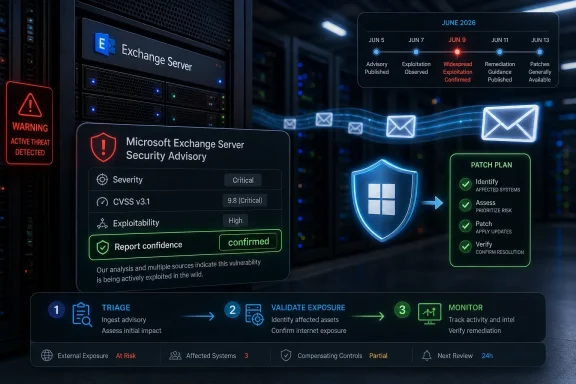 Microsoft’s Smallest Field Carries the Biggest Operational Message
Security advisories tend to train the eye toward severity scores, exploitability labels, and whether a vulnerability is already being abused in the wild. That is understandable. A CVSS number gives managers a sorting mechanism, and “exploited” gives incident responders permission to interrupt everyone’s Tuesday.But CVE-2026-45502 is a reminder that the less glamorous fields often tell the better story. Microsoft’s report confidence metric is not a measure of how bad the bug is. It is a measure of how confident the ecosystem should be that the bug exists and that the available technical description is credible.
That distinction matters because vulnerability management is not merely a patching exercise. It is a decision-making discipline under imperfect information. An advisory with low confidence asks defenders to watch a moving target; an advisory with confirmed confidence tells them the target is real, even if Microsoft withholds root-cause detail to avoid giving attackers a recipe.
The user-facing description of the metric is unusually plain: sometimes only a vulnerability’s existence is public, sometimes research narrows the likely cause, and sometimes the vendor or author confirms the issue. In the Exchange world, that last category is a flashing yellow light. It says, in effect: this is not rumor, not conjecture, and not just a scanner vendor trying to win attention.
Exchange Remains the Server Attackers Refuse to Ignore
Exchange occupies a strange place in Microsoft’s modern portfolio. Strategically, Microsoft would prefer many organizations to live in Exchange Online, wrapped in the company’s cloud control plane and telemetry. Operationally, a large population of businesses, governments, schools, and regulated environments still run Exchange Server on premises because email is not just another workload.It is identity-adjacent, internet-facing, business-critical, compliance-sensitive, and historically difficult to take offline. That combination is catnip for attackers. An Exchange server is not merely a mail relay; it is a directory-connected, authentication-aware, data-rich front door into an organization.
Information disclosure vulnerabilities are easy to underestimate in this context. They do not sound as dramatic as remote code execution, and they rarely produce the same immediate boardroom panic. Yet in a mature intrusion chain, disclosed information is often the difference between a noisy failed attempt and a clean follow-on compromise.
A leaked token, header, mailbox artifact, configuration detail, or internal identifier can become reconnaissance. Reconnaissance becomes targeting. Targeting becomes credential theft, privilege escalation, or lateral movement. Exchange’s value to attackers has always been less about any single bug class and more about its placement in the network.
The Word “Confirmed” Narrows the Room for Debate
When Microsoft marks report confidence as confirmed, it is doing more than closing a bookkeeping loop. It is telling administrators that the vulnerability’s existence has crossed a threshold of credibility. That should change how teams talk about the advisory internally.There is a familiar pattern in patch meetings: somebody asks whether the bug is “real,” somebody else asks whether exploit code exists, and a third person asks whether the affected server is exposed. Those are all reasonable questions. But a confirmed report confidence metric removes one escape hatch: the organization can no longer treat the item as speculative noise.
That does not mean every Exchange server should be rebooted instantly without testing. It means the conversation should move from “is this legitimate?” to “how quickly can we validate exposure, stage the update, and monitor for related behavior?” In well-run environments, that difference is the boundary between vulnerability management and vulnerability theater.
The metric also gives attackers information, which is part of the unpleasant bargain of public disclosure. A confirmed advisory tells defenders the issue is real; it also tells adversaries that there is something worth reverse-engineering. Once updates ship, comparison work begins. Attackers can diff binaries, inspect changed components, and infer where the fault may have lived.
Information Disclosure Is the Bug Class Everyone Regrets Dismissing
The phrase “information disclosure” has suffered from years of abuse. In some advisories, it means a low-value leak that is difficult to weaponize. In others, it means exposure of sensitive material that dramatically lowers the cost of attack. The label alone does not tell the full story.Exchange makes that ambiguity dangerous. The platform handles authentication flows, mailbox content, calendaring data, transport rules, address books, and administrative metadata. Even modest leakage can be useful when paired with phishing, business email compromise, password spraying, OAuth abuse, or exploitation of a second vulnerability.
The right mental model is not “can this bug compromise the server by itself?” It is “what does this bug reveal that the attacker should not know?” In real incidents, initial access and persistence are often built from small advantages. A supposedly narrow disclosure can help identify valid accounts, map internal topology, bypass assumptions in a monitoring rule, or craft more believable lures.
That is why Microsoft’s confidence language matters. It does not inflate the impact. It simply says defenders should trust that there is a real flaw behind the advisory. In Exchange security, that is enough to deserve attention.
Patch Tuesday Has Become an Intelligence Race
Modern Microsoft patch days are no longer simple maintenance events. They are intelligence races between vendors, defenders, exploit developers, ransomware crews, and vulnerability brokers. The publication of a CVE starts a clock, but that clock ticks differently for each audience.For administrators, the clock measures testing windows, change approvals, backup verification, maintenance windows, and rollback plans. For attackers, it measures reverse-engineering time. If a patch modifies a recognizable Exchange component, the exploit-development process can move faster than many organizations’ internal approval chains.
That asymmetry is the hard lesson from the last several years of Exchange security. The industry learned it with ProxyLogon, ProxyShell, and a trail of other Exchange bugs that turned mail servers into beachheads. Even when a new advisory is not comparable in severity, the operational muscle memory remains: Exchange CVEs deserve prompt triage because the platform has repeatedly rewarded adversaries who move quickly.
CVE-2026-45502 lands in that context. It should not be sensationalized beyond what Microsoft has published. But it should not be filed away as a routine disclosure simply because the impact category lacks the words “remote code execution.” Attack chains are assembled, not born fully formed.
The End-of-Support Hangover Still Shapes Exchange Risk
Exchange Server administrators are also dealing with a lifecycle transition that makes every new CVE harder to process. Exchange Server 2016 and Exchange Server 2019 reached end of support on October 14, 2025, pushing organizations toward Exchange Server Subscription Edition or Exchange Online. Microsoft offered limited transition mechanisms, but the message has been clear: the old on-premises cadence is over.That transition does not erase old deployments. It creates a split-brain world in which some organizations are current, some are in paid extension arrangements, some are mid-migration, and some are simply exposed. Attackers do not care which budget cycle delayed the upgrade. They care whether the server still answers on the internet.
For WindowsForum readers, this is the practical heart of the issue. The vulnerability itself is important, but the environment around it may be more important. A confirmed Exchange flaw on a fully supported and well-maintained server is one kind of risk. The same flaw on an unsupported build, behind years of deferred cumulative updates, is another.
This is where patch management becomes architecture management. If your Exchange estate cannot absorb security updates without drama, the problem is no longer merely a missing patch. It is technical debt sitting on the public edge of the business.
Emergency Mitigation Is a Safety Net, Not a Security Strategy
Microsoft’s Exchange Emergency Mitigation Service has become an important part of the on-premises Exchange story. It can apply temporary mitigations, often through IIS URL rewrite rules or related configuration changes, while administrators prepare proper updates. In a world where Exchange bugs can become active exploitation stories within days, that automation is valuable.But a mitigation service should not become an excuse for running brittle infrastructure. Emergency mitigations are designed to reduce immediate exposure, not to replace cumulative updates, security updates, and supported builds. They are also dependent on prerequisites, connectivity, and the server being modern enough to receive and apply the mitigation logic.
This is a subtle trap for organizations that treat Exchange as an appliance. Email keeps flowing, so the server appears healthy. Outlook connects, mobile devices sync, and the help desk is quiet. Meanwhile, the server may be missing years of hardening improvements, unsupported for security updates, or unable to benefit from newer mitigation mechanisms.
CVE-2026-45502 should therefore prompt a broader check than “did we install today’s patch?” Administrators should confirm build levels, support status, mitigation service health, external exposure, hybrid configuration, and monitoring coverage. The vulnerability is the trigger; the estate review is the real work.
The Public Advisory Withholds Details for a Reason
Security professionals often complain when advisories are sparse. They want affected components, root cause, exploit prerequisites, and examples of exposed data. Those requests are reasonable, especially for defenders trying to prioritize a crowded patch queue.But sparse disclosure is also a defensive choice. The more detail Microsoft publishes before customers have patched, the easier it becomes for less sophisticated attackers to reproduce the issue. That is particularly true for Exchange, where internet-facing targets are discoverable and the installed base includes organizations with uneven patch discipline.
The report confidence metric helps compensate for that lack of detail. It says: Microsoft is not giving you the whole technical map, but the company is confident enough in the report to publish and track it as a real vulnerability. That is not as satisfying as a full root-cause analysis, but it is enough to justify action.
The danger is that administrators interpret missing detail as missing urgency. In vulnerability management, absence of public exploit instructions is not evidence of safety. It may simply mean the reverse-engineering race has not yet played out in public.
Risk Lives in the Gap Between the CVE and the Change Window
For enterprise IT, the hardest part is not understanding that Exchange needs attention. The hardest part is translating that understanding into a change window that does not break mail flow. Exchange patching is notorious because updates can be cumulative, prerequisites can be unforgiving, and downtime is politically expensive.That reality encourages delay. Teams wait for early adopter reports. They scan Reddit, vendor forums, and admin communities for installation failures. They look for complaints about transport issues, database mounting problems, Outlook behavior, or hybrid oddities. This caution is not irrational; a bad Exchange update can create its own outage.
But attackers exploit the same waiting period. The first 72 hours after disclosure are often defined by uncertainty. Defenders are asking whether the update is safe. Attackers are asking what changed. If the affected component is reachable and the patch diff is informative, the window between publication and deployment can become the highest-risk period.
The right answer is not reckless patching. It is disciplined readiness. Organizations that maintain test environments, standardize builds, document rollback paths, and keep Exchange supported can move faster without gambling. Organizations that treat every Exchange update as a bespoke rescue mission will continue to lose time when time matters most.
Administrators Should Treat This as a Confidence Signal, Not a Panic Signal
CVE-2026-45502 does not need theatrical language to be taken seriously. Microsoft has described it as an Exchange Server information disclosure vulnerability, and the report confidence language indicates that the issue is confirmed. That is enough to put it on the operational board.It is not enough, by itself, to claim widespread exploitation or catastrophic compromise. Unless Microsoft or credible responders report active abuse, administrators should avoid turning a confirmed vulnerability into an invented incident. Good security operations requires urgency without hallucination.
That balance is especially important for Exchange because the platform’s history can distort judgment. Every new Exchange CVE arrives in the shadow of old disasters. That history should sharpen triage, not replace it. The question is not whether this is the next ProxyLogon; the question is whether your environment is prepared to handle a confirmed Exchange vulnerability without improvising.
In practice, that means moving quickly through a short chain of decisions. Is the server affected? Is it supported? Is the update available and applicable? Is the server exposed to the internet? Are mitigations active? Are logs being retained and reviewed? Those are the questions that turn advisory text into risk reduction.
Microsoft’s Cloud Argument Gets Stronger With Every On-Premises Scare
It would be naive to separate Exchange security from Microsoft’s broader product strategy. Every on-premises Exchange vulnerability, especially one that requires careful patching and estate hygiene, strengthens the case for Exchange Online. Microsoft does not need to make that argument loudly; the operational burden makes it on the company’s behalf.That does not mean the cloud is magically risk-free. Exchange Online has its own incidents, its own dependencies, and its own administrative failure modes. But the patching model is different. Customers are not individually diffing builds, scheduling server reboots, or wondering whether an old cumulative update blocks a security fix.
For organizations that must keep Exchange on premises, the lesson is not “give up.” It is “run it like critical infrastructure.” That means supported versions, current updates, monitored exposure, tested recovery, and a willingness to retire designs that made sense in 2016 but look fragile in 2026.
CVE-2026-45502 is small compared with that strategic shift. Still, it is one more data point in the same direction. The economics of on-premises email now include not just licensing and hardware, but the recurring cost of being your own security operations provider for a high-value target.
The Real Test Is Whether Exchange Shops Can Move Before the Differs Do
The concrete response to CVE-2026-45502 should be boring, because boring is what good infrastructure security looks like. Confirm the advisory, identify affected servers, apply the relevant Microsoft guidance, and monitor for suspicious behavior. The drama belongs in the threat model, not in the change process.Still, the vulnerability offers several practical lessons for administrators and security teams watching the June 2026 patch cycle.
- Treat Microsoft’s confirmed report confidence as a signal that the vulnerability is real, even if the public advisory does not explain the root cause in detail.
- Do not downgrade an Exchange information disclosure issue solely because it is not remote code execution; disclosed data can become a building block in a larger intrusion chain.
- Verify whether every Exchange server is on a supported version and capable of receiving current security updates or emergency mitigations.
- Use the advisory as a trigger to check Exchange Emergency Mitigation Service status, Health Checker output, internet exposure, and hybrid configuration assumptions.
- Move the internal conversation from “is this bug real?” to “how fast can we patch or mitigate safely, and what evidence would show attempted abuse?”
- Treat unsupported Exchange 2016 and 2019 deployments as business exceptions that need named owners, deadlines, and documented risk acceptance.
References
- Primary source: MSRC
Published: 2026-06-09T07:00:00-07:00
Security Update Guide - Microsoft Security Response Center
 msrc.microsoft.com
- Related coverage: tomsguide.com
Do you use Microsoft Exchange? Hackers are actively exploiting a new zero-day flaw | Tom's Guide
Microsoft warns of a new zero-day vulnerability that leaves Exchange open to hackers.www.tomsguide.com - Related coverage: ncsc.gov.ie
- Related coverage: ncsc.gov.bh
- Official source: learn.microsoft.com
Exchange Server build numbers and release dates | Microsoft Learn
Summary: Learn about build numbers and release dates for current and past versions of Exchange Server.learn.microsoft.com - Related coverage: video2.skills-academy.com
- Official source: techcommunity.microsoft.com
Released: March 2023 Exchange Server Security Updates | Microsoft Community Hub
We have released Security Updates for Exchange Server 2013, Exchange Server 2016, and Exchange Server 2019. techcommunity.microsoft.com
- Related coverage: helpnetsecurity.com
Exchange 2016, 2019 support ends soon: What IT should do to stay secure - Help Net Security
Learn what the Exchange Server 2016 and 2019 end of support means and how to prepare for migration. The deadline is approaching fast!www.helpnetsecurity.com - Related coverage: techtarget.com
Microsoft releases emergency Exchange Server mitigation tool | TechTarget
The Microsoft Exchange Emergency Mitigation tool was released Tuesday as part of September 2021 cumulative update for Exchange Server.www.techtarget.com - Related coverage: bleepingcomputer.com
Microsoft: Exchange 2016 and 2019 reach end of support in October
Microsoft has reminded admins that Exchange 2016 and Exchange 2019 will reach the end of extended support in October and shared guidance for those who need to decommission outdated servers.www.bleepingcomputer.com
- Related coverage: itps.co.uk
Exchange Server 2016 / 2019 End of Life
Exchange Server 2016/2019 end of life on 14 Oct 2025. Stay secure and compliant by migrating with ITPS to Exchange Server Subscription Edition.www.itps.co.uk - Related coverage: msdigest.net
Exchange Security Updates – March 2023 - MSDigest.net
It has been Patch Tuesday again and Microsoft has released a new set of important Exchange Security Updates, released earlier this week with the March 2023 Microsoft Updates. It is important to keep Your Exchange Servers up-to-date, see the blog post from the Exchange Team on this: Protect Your...www.msdigest.net - Related coverage: petri.com
PSA: Exchange Server 2016 and 2019 Support Ends in 6 Months
Microsoft has issued a reminder to administrators: Exchange Server 2016 and 2019 will officially reach end of support this October. The company is urging IT petri.com
- Related coverage: techradar.com
Microsoft extends support for Exchange, Skype business servers - here's how to keep access | TechRadar
Exchange and Skype for Business get a further lifelinewww.techradar.com - Related coverage: itpro.com
Microsoft Office 2016 and 2019 are heading for the scrapheap next month – but there could be a lifeline for those unable to upgrade | IT Pro
With the end of support deadline for Microsoft Office 2016 and 2019 approaching, the tech giant has urged users to upgrade – but there could be a lifeline.www.itpro.com - Related coverage: cirt.gy
