

On July 1, 2026, CISA added CVE-2026-45659, a Microsoft SharePoint Server deserialization vulnerability with evidence of active exploitation, to its Known Exploited Vulnerabilities Catalog, putting federal agencies and private operators of exposed SharePoint systems on a faster remediation clock. The entry is small in number and large in implication. It is another reminder that the most dangerous Windows-adjacent enterprise risks often live not on the desktop, but in the collaboration servers quietly trusted by everyone. SharePoint is once again where patch management becomes incident response.
CVE-2026-45659 is not being treated as just another monthly patch item anymore. CISA’s KEV catalog is reserved for vulnerabilities where exploitation is no longer theoretical, and that distinction changes how administrators should read the advisory. A vulnerability can sit in a scanner report for weeks as a risk score; once it enters KEV, it becomes evidence that someone, somewhere, has already found a way to use it.
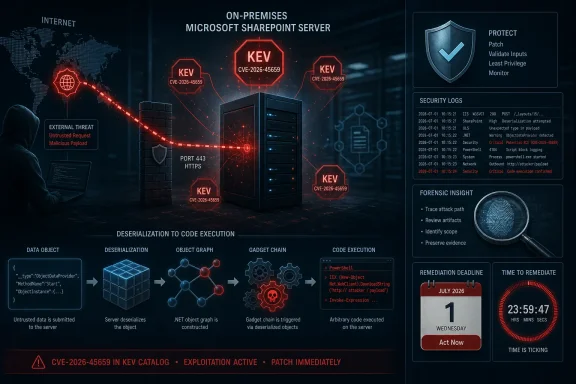
The vulnerability is described as deserialization of untrusted data in Microsoft Office SharePoint, allowing an authorized attacker to execute code over a network. In plainer terms, SharePoint can be tricked into rebuilding data into something more dangerous than the server should ever have accepted. The attacker needs some level of authorization, but the combination of network reachability, low attack complexity, and no required user interaction is exactly the kind of profile that keeps defenders awake.
That “authorized attacker” phrase should not lull anyone into comfort. In enterprise environments, valid credentials are not rare prizes; they are the normal byproduct of phishing, token theft, password reuse, over-permissioned service accounts, and dormant accounts nobody wants to disable because a workflow might break. A SharePoint flaw that begins after authentication can still be a practical initial-access or post-compromise accelerator.
The affected product family is the familiar on-premises SharePoint Server estate: SharePoint Server Subscription Edition, SharePoint Server 2019, and SharePoint Enterprise Server 2016. That is a telling list. It excludes SharePoint Online as a customer-managed patching problem, but it squarely lands on the environments where organizations chose, or were forced, to keep collaboration infrastructure under their own roof.
That shift matters because CVE-2026-45659 is almost tailor-made for the new risk language. It affects a collaboration server that is often reachable by remote users, partners, contractors, and hybrid infrastructure. It allows code execution. It is now in the KEV catalog. If a vulnerable instance is publicly exposed and exploitation can be operationalized at scale, this is the sort of bug that jumps the line.
For Federal Civilian Executive Branch agencies, the binding directive is not merely a suggestion to install the update eventually. It creates an obligation to prioritize high-risk vulnerabilities, especially KEV-listed flaws on publicly exposed assets that grant total control after exploitation. It also raises the bar from patching alone to asking whether the system was compromised before the fix arrived.
That last point is the most important cultural change. Patch management has long been treated as a maintenance workflow: approve the change, schedule the outage, install the package, confirm the version, close the ticket. CISA’s newer posture says that for certain exploited vulnerabilities, the patch is not the end of the story. It is the start of the forensic question.
That is why deserialization flaws so often produce remote code execution. The attacker is not simply submitting a malformed field or crashing a parser. They are attempting to steer the application into creating objects or invoking logic that should never be reachable from that input path. When the affected system is SharePoint, the result is especially concerning because SharePoint sits at the junction of identity, documents, workflows, search, and intranet applications.
The history around SharePoint makes the new KEV entry harder to dismiss. In recent years, on-premises SharePoint vulnerabilities have repeatedly drawn attention from defenders because these servers are high-value, externally reachable, and difficult to inventory cleanly. They often integrate with Active Directory, contain sensitive documents, and run customizations that make emergency patching feel risky.
Attackers understand that operational hesitation. They do not need every SharePoint server to be exposed or every exploit to be unauthenticated. They need enough organizations with enough lag between disclosure, patch testing, deployment, and detection. KEV listings are CISA’s way of saying that lag is now part of the adversary’s plan.
The enterprise identity perimeter has been under sustained pressure for years. Attackers steal browser tokens, abuse legacy authentication, phish help desks, buy credentials, and compromise vendors. Once inside, they look for systems where a low-privilege account can become something more valuable. A SharePoint remote code execution flaw that requires only limited access can become a privilege expansion path in the broader environment.
SharePoint permissions are also messy in the real world. Site membership sprawls. Temporary access becomes permanent. Legacy team sites survive long after the projects they supported. External collaboration, migration leftovers, and custom web parts create a permissions graph that few organizations can describe confidently.
That is why defenders should not read “authorized attacker” as “only a trusted insider.” In many breaches, the attacker is authorized in exactly the way the application can see: they have a valid account, a token, or access inherited from a compromised user. The difference between a nuisance account and server-side code execution is the difference between an incident and a domain crisis.
Patching SharePoint is rarely as simple as installing a desktop cumulative update. Farms have multiple servers, search components, service applications, custom solutions, and database dependencies. Administrators must think about build compatibility, configuration wizards, backups, failover, and whether a decade-old customization will survive the update. The operational friction is real.
But the exploitation clock does not slow down because a farm is complicated. If anything, complicated systems are exactly where attackers expect delays. The more fragile the environment, the more likely teams are to defer patches until the next maintenance window, and the more likely that maintenance window is measured in weeks rather than days.
CVE-2026-45659 exposes the uncomfortable bargain many organizations made with on-premises collaboration platforms. They gained control, customization, and locality. They also accepted responsibility for a server class that adversaries increasingly treat as a high-value target.
BOD 26-04’s framework points agencies toward a practical set of questions. Is the vulnerable asset exposed to the public internet? Is the vulnerability known to be exploited? Can exploitation be automated? Does successful exploitation give an attacker partial or total control? That is a better model than worshiping a CVSS number in isolation.
CVE-2026-45659 is a useful case study because its score alone does not tell the full story. A CVSS 8.8 vulnerability is high severity, but plenty of high-severity vulnerabilities compete for attention. The KEV listing is what changes the urgency. The asset context then decides whether the response is an emergency outage, an accelerated change, or a contained internal remediation.
That is the future of vulnerability management, whether private companies are formally bound by CISA or not. Security teams that still run patch queues by severity alone will keep losing time to vulnerabilities that are scary on paper while exploited edge systems sit unpatched. The new discipline is less about counting CVEs and more about knowing which systems can be reached, who can reach them, and what happens if they fall.
The investigation should begin with asset discovery. Many organizations have a primary SharePoint farm everyone knows about and a handful of forgotten systems maintained by business units, inherited through mergers, or parked behind obscure DNS names. The forgotten servers are often the most dangerous because they are least likely to be patched, monitored, or included in tabletop exercises.
Next comes exposure review. A SharePoint server available only through a VPN or private network is not risk-free, but it is in a different category from a server reachable from the public internet. Administrators should check reverse proxies, load balancers, publishing rules, firewall exceptions, and identity provider integrations. The question is not merely whether SharePoint is “external,” but whether an attacker with stolen credentials could reach it from outside.
Then comes compromise assessment. That means examining SharePoint logs, IIS logs, authentication events, unusual process creation, unexpected web files, suspicious scheduled tasks, anomalous outbound connections, and changes to service accounts or farm administrators. The exact indicators may evolve as public reporting improves, but the principle is stable: exploited RCE on a collaboration server warrants a hunt, not just a reboot.
Private-sector teams do not need to copy federal rules word for word to benefit from the model. They can use KEV status as a multiplier in their own prioritization systems. A medium or high vulnerability on an internet-facing server may deserve more attention than a critical vulnerability buried behind multiple compensating controls. That is not lowering standards; it is aligning work with attacker behavior.
For small and midsize organizations, the lesson is sharper. Many do not have dedicated SharePoint experts on staff, yet they may still run legacy farms because a business-critical workflow depends on them. Those environments should not wait for perfect internal analysis. If the affected version is present and the server is reachable, the safe assumption is that patching and review need to happen immediately.
Managed service providers have a role here, too. They should not merely forward the CISA alert to clients. They should map which customers run affected SharePoint versions, verify update status, identify internet exposure, and document whether logs are retained long enough to support a meaningful review. A KEV entry is precisely the moment when “we sent a notification” stops being enough.
SharePoint Server Subscription Edition was meant to modernize the on-premises story with a more continuous update model. But even a subscription-era server remains a server the customer must operate. The cloud may reduce some categories of security debt, but hybrid reality keeps plenty of critical infrastructure in the customer’s hands.
That makes Microsoft’s patch guidance necessary but insufficient. Vendors can release updates, publish advisories, and classify severity. They cannot force an organization to know where every farm is, to remove stale accounts, to retire unsupported customizations, or to collect logs before an attacker deletes them. The last mile belongs to the operator.
CISA’s KEV catalog exists partly because that last mile has repeatedly failed across the industry. Not because administrators are lazy, but because vulnerability volume is absurd, asset inventories are imperfect, and business systems punish downtime. KEV is a crude but effective way to say: whatever else is in the queue, this one has escaped the lab.
That is how modern vulnerability news often works. The alert is a small public artifact sitting on top of a much larger operational reality. Somewhere there is exploitation evidence strong enough for CISA to act. Somewhere there are servers that were not patched quickly enough. Somewhere there are defenders now trying to determine whether their SharePoint farm was a target or merely vulnerable.
The absence of public exploit detail should not be mistaken for absence of risk. Agencies and vendors often withhold technical specifics to avoid accelerating copycat exploitation. Attackers, meanwhile, do not wait for polished writeups. They reverse patches, trade proof-of-concept code privately, and scan for exposed systems while defenders are still negotiating emergency change approvals.
For WindowsForum readers, the message is familiar but worth repeating: the Windows security perimeter is bigger than Windows clients. It includes SharePoint, Exchange, SQL Server, identity infrastructure, update services, management servers, VPN appliances, and the web of integrations that make enterprise IT useful. The most damaging Windows incidents often begin with a server that ordinary users never see.
That is why CISA’s newer language around risk-based remediation is useful. It acknowledges that defenders cannot move every patch at the same speed. But it also removes a common excuse. When a vulnerability is known exploited, remotely reachable, and capable of giving attackers meaningful control, the organization has enough information to act.
SharePoint administrators have heard versions of this story before, and they will hear it again. The platform is too valuable, too integrated, and too widely deployed for attackers to ignore. The difference now is that the federal vulnerability-management machinery is becoming more explicit about what deserves immediate attention. CVE-2026-45659 is not just a SharePoint bug; it is a test of whether organizations can turn exploitation intelligence into operational movement before the next alert arrives.
 SharePoint Has Become the Place Where “Important” Turns Urgent
CVE-2026-45659 is not being treated as just another monthly patch item anymore. CISA’s KEV catalog is reserved for vulnerabilities where exploitation is no longer theoretical, and that distinction changes how administrators should read the advisory. A vulnerability can sit in a scanner report for weeks as a risk score; once it enters KEV, it becomes evidence that someone, somewhere, has already found a way to use it.The vulnerability is described as deserialization of untrusted data in Microsoft Office SharePoint, allowing an authorized attacker to execute code over a network. In plainer terms, SharePoint can be tricked into rebuilding data into something more dangerous than the server should ever have accepted. The attacker needs some level of authorization, but the combination of network reachability, low attack complexity, and no required user interaction is exactly the kind of profile that keeps defenders awake.
That “authorized attacker” phrase should not lull anyone into comfort. In enterprise environments, valid credentials are not rare prizes; they are the normal byproduct of phishing, token theft, password reuse, over-permissioned service accounts, and dormant accounts nobody wants to disable because a workflow might break. A SharePoint flaw that begins after authentication can still be a practical initial-access or post-compromise accelerator.
The affected product family is the familiar on-premises SharePoint Server estate: SharePoint Server Subscription Edition, SharePoint Server 2019, and SharePoint Enterprise Server 2016. That is a telling list. It excludes SharePoint Online as a customer-managed patching problem, but it squarely lands on the environments where organizations chose, or were forced, to keep collaboration infrastructure under their own roof.
CISA’s Catalog Is Now a Patch Queue With Teeth
The KEV catalog used to be easy to describe: if CISA says a vulnerability is being exploited, federal agencies have to remediate it by the listed due date, and everyone else should pay attention. BOD 26-04 makes the picture more nuanced and, in some ways, more demanding. The federal government is moving away from treating every high-severity vulnerability as equal and toward a model based on exposure, exploitation, automation, and post-exploitation impact.That shift matters because CVE-2026-45659 is almost tailor-made for the new risk language. It affects a collaboration server that is often reachable by remote users, partners, contractors, and hybrid infrastructure. It allows code execution. It is now in the KEV catalog. If a vulnerable instance is publicly exposed and exploitation can be operationalized at scale, this is the sort of bug that jumps the line.
For Federal Civilian Executive Branch agencies, the binding directive is not merely a suggestion to install the update eventually. It creates an obligation to prioritize high-risk vulnerabilities, especially KEV-listed flaws on publicly exposed assets that grant total control after exploitation. It also raises the bar from patching alone to asking whether the system was compromised before the fix arrived.
That last point is the most important cultural change. Patch management has long been treated as a maintenance workflow: approve the change, schedule the outage, install the package, confirm the version, close the ticket. CISA’s newer posture says that for certain exploited vulnerabilities, the patch is not the end of the story. It is the start of the forensic question.
Deserialization Bugs Keep Winning Because They Abuse Trust
Deserialization vulnerabilities have a dry name and a dramatic failure mode. Applications routinely serialize objects so they can be stored, moved, cached, or reconstructed later. The danger begins when software accepts serialized data from a place an attacker can influence and rebuilds it without enough validation. In vulnerable designs, data becomes behavior.That is why deserialization flaws so often produce remote code execution. The attacker is not simply submitting a malformed field or crashing a parser. They are attempting to steer the application into creating objects or invoking logic that should never be reachable from that input path. When the affected system is SharePoint, the result is especially concerning because SharePoint sits at the junction of identity, documents, workflows, search, and intranet applications.
The history around SharePoint makes the new KEV entry harder to dismiss. In recent years, on-premises SharePoint vulnerabilities have repeatedly drawn attention from defenders because these servers are high-value, externally reachable, and difficult to inventory cleanly. They often integrate with Active Directory, contain sensitive documents, and run customizations that make emergency patching feel risky.
Attackers understand that operational hesitation. They do not need every SharePoint server to be exposed or every exploit to be unauthenticated. They need enough organizations with enough lag between disclosure, patch testing, deployment, and detection. KEV listings are CISA’s way of saying that lag is now part of the adversary’s plan.
The Authentication Requirement Is a Speed Bump, Not a Wall
A vulnerability requiring authentication is meaningfully different from one that can be exploited by any anonymous internet user. It reduces the blast radius and can complicate mass scanning. But in modern intrusion chains, authentication is rarely a hard boundary. It is one step in a sequence.The enterprise identity perimeter has been under sustained pressure for years. Attackers steal browser tokens, abuse legacy authentication, phish help desks, buy credentials, and compromise vendors. Once inside, they look for systems where a low-privilege account can become something more valuable. A SharePoint remote code execution flaw that requires only limited access can become a privilege expansion path in the broader environment.
SharePoint permissions are also messy in the real world. Site membership sprawls. Temporary access becomes permanent. Legacy team sites survive long after the projects they supported. External collaboration, migration leftovers, and custom web parts create a permissions graph that few organizations can describe confidently.
That is why defenders should not read “authorized attacker” as “only a trusted insider.” In many breaches, the attacker is authorized in exactly the way the application can see: they have a valid account, a token, or access inherited from a compromised user. The difference between a nuisance account and server-side code execution is the difference between an incident and a domain crisis.
On-Premises SharePoint Is the Server Nobody Can Patch Casually
Microsoft 365 shifted much of the collaboration burden into Microsoft’s cloud, but on-premises SharePoint remains stubbornly present. Some organizations keep it for data residency, customization, integration with older line-of-business systems, regulatory constraints, or simple inertia. Those reasons may be valid, but they also mean the customer owns more of the security outcome.Patching SharePoint is rarely as simple as installing a desktop cumulative update. Farms have multiple servers, search components, service applications, custom solutions, and database dependencies. Administrators must think about build compatibility, configuration wizards, backups, failover, and whether a decade-old customization will survive the update. The operational friction is real.
But the exploitation clock does not slow down because a farm is complicated. If anything, complicated systems are exactly where attackers expect delays. The more fragile the environment, the more likely teams are to defer patches until the next maintenance window, and the more likely that maintenance window is measured in weeks rather than days.
CVE-2026-45659 exposes the uncomfortable bargain many organizations made with on-premises collaboration platforms. They gained control, customization, and locality. They also accepted responsibility for a server class that adversaries increasingly treat as a high-value target.
BOD 26-04 Pushes Agencies Toward Triage, Not Panic
The federal directive surrounding this KEV update is not simply “patch everything faster.” That would be a fantasy. Every large organization has too many vulnerabilities, too many assets, and too little change capacity. The real message is that defenders must distinguish between risk that is statistically severe and risk that is operationally immediate.BOD 26-04’s framework points agencies toward a practical set of questions. Is the vulnerable asset exposed to the public internet? Is the vulnerability known to be exploited? Can exploitation be automated? Does successful exploitation give an attacker partial or total control? That is a better model than worshiping a CVSS number in isolation.
CVE-2026-45659 is a useful case study because its score alone does not tell the full story. A CVSS 8.8 vulnerability is high severity, but plenty of high-severity vulnerabilities compete for attention. The KEV listing is what changes the urgency. The asset context then decides whether the response is an emergency outage, an accelerated change, or a contained internal remediation.
That is the future of vulnerability management, whether private companies are formally bound by CISA or not. Security teams that still run patch queues by severity alone will keep losing time to vulnerabilities that are scary on paper while exploited edge systems sit unpatched. The new discipline is less about counting CVEs and more about knowing which systems can be reached, who can reach them, and what happens if they fall.
The Real Work Begins After the Patch Installs
For administrators, the immediate job is obvious: identify affected SharePoint Server instances and apply the relevant Microsoft security updates. But a KEV entry should trigger a wider workflow. If the server was exposed before patching, defenders should assume they may be looking at a race they did not know had started.The investigation should begin with asset discovery. Many organizations have a primary SharePoint farm everyone knows about and a handful of forgotten systems maintained by business units, inherited through mergers, or parked behind obscure DNS names. The forgotten servers are often the most dangerous because they are least likely to be patched, monitored, or included in tabletop exercises.
Next comes exposure review. A SharePoint server available only through a VPN or private network is not risk-free, but it is in a different category from a server reachable from the public internet. Administrators should check reverse proxies, load balancers, publishing rules, firewall exceptions, and identity provider integrations. The question is not merely whether SharePoint is “external,” but whether an attacker with stolen credentials could reach it from outside.
Then comes compromise assessment. That means examining SharePoint logs, IIS logs, authentication events, unusual process creation, unexpected web files, suspicious scheduled tasks, anomalous outbound connections, and changes to service accounts or farm administrators. The exact indicators may evolve as public reporting improves, but the principle is stable: exploited RCE on a collaboration server warrants a hunt, not just a reboot.
Private-Sector IT Should Treat KEV as a Signal, Not a Government Niche
It is tempting for commercial organizations to file CISA directives under “federal compliance” and move on. That is a mistake. The KEV catalog has become one of the most useful public signals for real-world exploitation because it filters out the purely theoretical. When CISA adds a vulnerability, it is not predicting that attackers might care. It is saying the vulnerability has crossed into observed exploitation.Private-sector teams do not need to copy federal rules word for word to benefit from the model. They can use KEV status as a multiplier in their own prioritization systems. A medium or high vulnerability on an internet-facing server may deserve more attention than a critical vulnerability buried behind multiple compensating controls. That is not lowering standards; it is aligning work with attacker behavior.
For small and midsize organizations, the lesson is sharper. Many do not have dedicated SharePoint experts on staff, yet they may still run legacy farms because a business-critical workflow depends on them. Those environments should not wait for perfect internal analysis. If the affected version is present and the server is reachable, the safe assumption is that patching and review need to happen immediately.
Managed service providers have a role here, too. They should not merely forward the CISA alert to clients. They should map which customers run affected SharePoint versions, verify update status, identify internet exposure, and document whether logs are retained long enough to support a meaningful review. A KEV entry is precisely the moment when “we sent a notification” stops being enough.
Microsoft’s Hybrid Legacy Keeps Creating Security Debt
The broader Windows ecosystem has an architectural tension that will not disappear soon. Microsoft wants customers in cloud services where patching, monitoring, and service hardening can be centralized. Many customers still depend on on-premises servers where maintenance is local, change windows are political, and customizations are sacred. SharePoint sits directly in that tension.SharePoint Server Subscription Edition was meant to modernize the on-premises story with a more continuous update model. But even a subscription-era server remains a server the customer must operate. The cloud may reduce some categories of security debt, but hybrid reality keeps plenty of critical infrastructure in the customer’s hands.
That makes Microsoft’s patch guidance necessary but insufficient. Vendors can release updates, publish advisories, and classify severity. They cannot force an organization to know where every farm is, to remove stale accounts, to retire unsupported customizations, or to collect logs before an attacker deletes them. The last mile belongs to the operator.
CISA’s KEV catalog exists partly because that last mile has repeatedly failed across the industry. Not because administrators are lazy, but because vulnerability volume is absurd, asset inventories are imperfect, and business systems punish downtime. KEV is a crude but effective way to say: whatever else is in the queue, this one has escaped the lab.
The Signal Hidden in a One-Line Alert
The most striking thing about this CISA update is how short it is. One vulnerability, one product family, one catalog addition. No sprawling campaign narrative. No long list of affected vendors. No dramatic attribution to a named threat actor. And yet the practical meaning is substantial.That is how modern vulnerability news often works. The alert is a small public artifact sitting on top of a much larger operational reality. Somewhere there is exploitation evidence strong enough for CISA to act. Somewhere there are servers that were not patched quickly enough. Somewhere there are defenders now trying to determine whether their SharePoint farm was a target or merely vulnerable.
The absence of public exploit detail should not be mistaken for absence of risk. Agencies and vendors often withhold technical specifics to avoid accelerating copycat exploitation. Attackers, meanwhile, do not wait for polished writeups. They reverse patches, trade proof-of-concept code privately, and scan for exposed systems while defenders are still negotiating emergency change approvals.
For WindowsForum readers, the message is familiar but worth repeating: the Windows security perimeter is bigger than Windows clients. It includes SharePoint, Exchange, SQL Server, identity infrastructure, update services, management servers, VPN appliances, and the web of integrations that make enterprise IT useful. The most damaging Windows incidents often begin with a server that ordinary users never see.
The SharePoint Checklist That Actually Matters This Week
The practical response to CVE-2026-45659 should be narrow enough to execute and broad enough to matter. Organizations do not need a 40-page strategy memo before acting. They need a fast path from inventory to patching to detection.- Organizations should identify every on-premises SharePoint Server 2016, SharePoint Server 2019, and SharePoint Server Subscription Edition instance, including test, disaster recovery, and legacy farms.
- Administrators should apply the applicable Microsoft security updates and confirm the resulting build levels rather than relying only on change-ticket closure.
- Security teams should determine whether each affected SharePoint system was reachable from the public internet, partner networks, VPN users, or other semi-trusted access paths before patching.
- Exposed or high-value farms should receive compromise assessment, including review of web logs, authentication activity, suspicious files, process execution, and unexpected administrative changes.
- Organizations should treat KEV status as a prioritization trigger in vulnerability management tooling, especially when the vulnerable asset is externally reachable or tied to identity and document workflows.
- Teams that cannot patch immediately should reduce exposure, restrict access, increase monitoring, and document the residual risk until the update is complete.
The Calendar Is Now Part of the Threat Model
The important date is not only July 1, 2026, when CISA added CVE-2026-45659 to KEV. The more important date for each organization is the day its SharePoint server became patched, and whether that day came before or after exploitation attempts reached the environment. Vulnerability management has become a race measured less by disclosure cycles and more by adversary adoption.That is why CISA’s newer language around risk-based remediation is useful. It acknowledges that defenders cannot move every patch at the same speed. But it also removes a common excuse. When a vulnerability is known exploited, remotely reachable, and capable of giving attackers meaningful control, the organization has enough information to act.
SharePoint administrators have heard versions of this story before, and they will hear it again. The platform is too valuable, too integrated, and too widely deployed for attackers to ignore. The difference now is that the federal vulnerability-management machinery is becoming more explicit about what deserves immediate attention. CVE-2026-45659 is not just a SharePoint bug; it is a test of whether organizations can turn exploitation intelligence into operational movement before the next alert arrives.
References
- Primary source: CISA
Published: 2026-07-01T12:00:00+00:00
- Related coverage: helpnetsecurity.com
High-severity SharePoint RCE bug patched by Microsoft (CVE-2026-45659) - Help Net Security
A high-severity remote code execution vulnerability (CVE-2026-45659) in SharePoint may be exploited in low-complexity attacks.www.helpnetsecurity.com - Related coverage: sentinelone.com
CVE-2026-45659: Microsoft SharePoint Server RCE Vulnerability
CVE-2026-45659 is a remote code execution vulnerability in Microsoft SharePoint Server. Learn about its impact, affected versions, and mitigation methods.www.sentinelone.com
- Related coverage: blog.actipace.com
- Related coverage: thehackerwire.com
CVE-2026-45659 - High Vulnerability - TheHackerWire
TheHackerWire - Your daily source for cybersecurity news, CVE alerts, hacking tutorials, and security tool reviews. Stay ahead of cyber threats.www.thehackerwire.com
- Related coverage: windowscentral.com
Microsoft issues emergency SharePoint patches for ToolShell | Windows Central
Microsoft has issued emergency patches for two zero-day vulnerabilities.www.windowscentral.com

- Related coverage: itpro.com
CISA issues alert after botched Windows Server patch exposes critical flaw | IT Pro
A critical remote code execution flaw in Windows Server is being exploited in the wild, despite a previous 'fix'www.itpro.com - Related coverage: sra.io
</rdf:Alt> </dc:title> <dc:description> <rdf:Alt> <rdf:li xml:lang="x-default"/> </rdf:Alt> </dc:description> <dc:creator> <rdf:Seq> <rdf:li>Zoey Se
</rdf:Alt> </dc:description> <dc:creator> <rdf:Seq> <rdf:li>Zoey Selmansra.io
- Related coverage: ncsc.gov.uk
- Related coverage: hivepro.com
- Related coverage: insidegovernmentcontracts.com
CISA Releases Binding Operational Directive on Prioritizing Security Updates Based on Risk | Inside Government Contracts
On June 10, the Cybersecurity & Infrastructure Security Agency (CISA) released Binding Operational Directive (BOD) 26-04 on Prioritizing Securitywww.insidegovernmentcontracts.com - Related coverage: tlctc.net
CISA BOD 26-04: A Step in the Right Direction — But Still Not an Attack-Path Model | TLCTC
CISA's BOD 26-04 moves federal vulnerability management toward risk-based remediation — but it still lacks a cause-side attack-path grammar. TLCTC provides the missing layer.www.tlctc.net - Related coverage: nucleussec.com
What is CISA BOD 26-04? Prioritizing Security Updates Based on Risk
CISA BOD 26-04 directs federal agencies to prioritize vulnerability remediation based on exposure, exploitability, system control, and known exploitation. Learn what the directive requires and how it impacts agency vulnerability management.nucleussec.com - Related coverage: minimus.io
Understanding CISA BOD 26-04 - Minimus
CISA BOD 26-04 shifts vulnerability management toward risk-based prioritization. Here's what changed and what it means in practice.www.minimus.io - Related coverage: executivegov.com
CISA Orders Federal Civilian Agencies to Prioritize Vulnerability Patching by Risk
The Cybersecurity and Infrastructure Security Agency on Wednesday issued Binding Operational Directive 26-04, requiring federal civilian agencies to rethink their vulnerability management policies and remediate security flaws on timelines determined by risk rather than treating all...www.executivegov.com - Related coverage: afcea.org
CISA Issues Binding Directive on Security Updates to Federal Agencies
The agency aims to address high-risk cyber vulnerabilities.www.afcea.org - Related coverage: tonicsecurity.com
CISA’s New Directive Signals the End of Severity-Based Vulnerability Management - Tonic Security CISA BOD 26-04: The End of Severity-Based Vulnerability Management | Tonic Security
CISA's BOD 26-04 shifts vulnerability management from CVSS scores to risk-based prioritization focused on exposure, exploitability, and impact.www.tonicsecurity.com - Related coverage: cyberscoop.com
CISA directive orders agencies to prioritize vulnerability patching in a new way | CyberScoop
CISA has issued BOD 26-04, ordering federal agencies to prioritize software vulnerabilities using four new criteria to counter accelerating AI-driven threats.cyberscoop.com - Related coverage: hstoday.us
CISA Issues New Directive Improving How Federal Agencies Prioritize the Reduction of Cyber Vulnerabilities - HSToday
The Cybersecurity and Infrastructure Security Agency (CISA) has issued Binding Operational Directive 26-04: Prioritizing Security Updates Based on Risk, that requires federal civilian agencies to assess and align their vulnerability management policies to reduce cybersecurity risk across four...www.hstoday.us
