

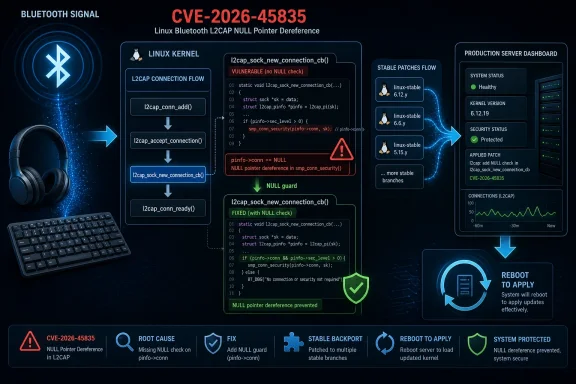
l2cap_sock_new_connection_cb() callback, with stable kernel patches already linked but no NVD severity score assigned yet. That dry description is easy to dismiss as another low-drama kernel CVE in a year already crowded with them. It should not be dismissed, because the bug sits in the part of the Bluetooth stack that turns wireless proximity into kernel control flow. The lesson is not that every Bluetooth crash is a catastrophe; it is that small defensive checks in old protocol plumbing remain one of the least glamorous, most consequential forms of platform security work.
A One-Line Guard Lands in a High-Trust Part of the Kernel
The fix for CVE-2026-45835 is almost comically small in concept: add the same NULL guard to l2cap_sock_new_connection_cb() that already existed in neighboring L2CAP socket callbacks. In ordinary application code, that would read like housekeeping. In the kernel’s Bluetooth stack, it reads like a reminder that old assumptions about object lifetime can survive for years until a fuzzer, a rare race, or an awkward connection path finally trips over them.
L2CAP, the Logical Link Control and Adaptation Protocol, is not the shiny layer users see when headphones pair or a keyboard wakes a laptop. It is the transport layer inside Bluetooth that multiplexes higher-level protocols and manages channels over an ACL link. When something goes wrong there, the failure is not a browser tab crashing; it can be a kernel fault in code that runs with the privileges of the operating system itself.
The CVE text does not describe remote code execution, data theft, or a privilege escalation chain. It describes a NULL pointer dereference, the classic bug class in which code attempts to use an object that is not there. In kernel space, that often means denial of service rather than direct compromise: a panic, a crash, or a forced reboot depending on configuration and environment.
That distinction matters. It keeps the story grounded. But it does not make the bug irrelevant, because availability is a security property, and because Bluetooth is one of the few attack surfaces that can be reached without a cable, without a web browser, and sometimes without meaningful user interaction.
Bluetooth Bugs Are Local, But Local Is Not Harmless
The word “Bluetooth” tends to shrink risk in the minds of administrators. Bluetooth feels personal, peripheral, and physically bounded. A bug in TLS sounds like the Internet; a bug in Bluetooth sounds like earbuds.
That intuition is only partly useful. Bluetooth attacks are generally constrained by radio range, device state, pairing behavior, and the target’s hardware. That makes them less attractive for mass Internet exploitation, but it does not make them theoretical. A laptop in a conference room, a kiosk in a lobby, a developer workstation in a co-working space, or a Linux-powered embedded controller in a warehouse may all expose Bluetooth in places where physical proximity is not a meaningful defense.
The practical risk of CVE-2026-45835 cannot be stated with the certainty that defenders often want. NVD has not assigned a CVSS score, and the public description does not lay out a proof-of-concept exploit or an attack recipe. The responsible reading is that this is a crash-class kernel bug in Bluetooth L2CAP, fixed upstream and pushed through stable channels, with exploitation details not yet enriched.
That uncertainty should shape response, not paralyze it. Enterprises should not treat this like a red-alert wormable flaw. They also should not ignore it just because the vendor text is short. The correct posture is boring and disciplined: identify Linux systems with Bluetooth enabled, track kernel updates from the distribution, and deploy fixes through the normal security maintenance window unless the system is exposed in a hostile physical environment.
The Kernel’s CVE Factory Is Working as Designed
CVE-2026-45835 is part of a broader pattern in modern Linux security: the kernel project is assigning CVEs to many small, already-fixed defects that previously might have lived and died as ordinary commits. That has created fatigue. Security teams see a steady stream of kernel CVEs with sparse descriptions, missing CVSS vectors, and patch references that require code-level interpretation.
There is a temptation to read that stream as evidence that Linux has suddenly become more fragile. The more useful interpretation is that the reporting machinery has become more explicit. A fixed kernel bug that can crash the system is now more likely to receive a CVE identifier, even when the public advisory does not include an exploit narrative or vendor-specific blast radius.
That shift is uncomfortable for patch triage. A CVE without a score is awkward for ticketing systems, vulnerability scanners, compliance dashboards, and managers who want a red-yellow-green answer. But a missing CVSS vector is not the same thing as a missing security impact. It means defenders need to look at subsystem, exposure, reachable attack surface, and patch availability rather than outsource judgment to a number that has not arrived.
In this case, the subsystem is Bluetooth, the bug class is NULL pointer dereference, and the fix is already present in multiple stable kernel commits. That combination points toward a vulnerability that is likely to be more operationally disruptive than strategically catastrophic. It is still the kind of issue that should move, because crashes in the kernel are not benign events on production systems.
A NULL Pointer Is Not a Punchline
Developers have been making NULL pointer mistakes for as long as C has been trusted with systems programming. The phrase can sound antique, almost quaint, next to memory tagging, speculative execution, and supply-chain compromise. Yet NULL dereferences remain stubbornly relevant because the kernel is an enormous state machine where objects appear, disappear, and change ownership under concurrency.
The Bluetooth stack is especially fertile ground for this class of bug. Connections are asynchronous. Workqueues run later. Callbacks fire after state has changed. Sockets can be detached, channels can be torn down, and error paths can cross code that was originally written with the happy path in mind. In that environment, “this pointer should always exist here” is not a proof; it is a bet.
The CVE description’s key phrase is that the patch adds a guard already present in l2cap_sock_resume_cb() and l2cap_sock_ready_cb(). That is not just trivia. It suggests the maintainers recognized a pattern: similar callbacks had already learned to treat the socket pointer as optional, while this one had not yet received the same defensive treatment.
That is how mature codebases age. They do not fail only because someone wrote reckless new code yesterday. They fail because neighboring assumptions drift out of alignment. One callback becomes hardened, another remains optimistic, and eventually a test case or malformed sequence finds the mismatch.
Stable Patches Matter More Than Advisory Poetry
The most important fact about CVE-2026-45835 is not that NVD is awaiting enrichment. It is that stable kernel patches exist. For administrators, that moves the problem out of the realm of speculation and into the realm of distribution maintenance.
Most Linux users should not be applying individual kernel commits by hand. The right answer is to consume the fixed kernel build from Debian, Ubuntu, Fedora, Red Hat, SUSE, Arch, Alpine, Android vendors, appliance vendors, or whichever distribution owns the system image. The commit links are useful for maintainers and security teams validating backports; they are not an invitation for every fleet admin to become a kernel integrator on a Wednesday afternoon.
This matters because kernel security is not a single upstream event. A fix lands in mainline or stable trees, then distributions backport it, test it, package it, sign it, and release it. Embedded vendors and appliance manufacturers may then pull it into their own schedules. The distance between “fixed upstream” and “fixed on the device in front of you” can be short on rolling distributions and painfully long on abandoned hardware.
That gap is where defenders need inventory. If a Linux box has no Bluetooth controller, no Bluetooth module loaded, and no plausible radio exposure, this CVE should not outrank urgent remotely reachable flaws. If a system ships with Bluetooth enabled by default and sits in a public or semi-public space, the calculus changes. The same CVE can be background noise in one environment and an avoidable outage risk in another.
The Windows Angle Runs Through Linux More Often Than It Used To
WindowsForum readers might reasonably ask why a Linux kernel Bluetooth CVE belongs in a Windows-oriented publication. The answer is that Windows environments are no longer purely Windows environments. They are mixed fleets, developer laptops, WSL-adjacent workflows, Hyper-V hosts, Linux build agents, container platforms, Android devices, network appliances, and IoT boxes that all end up inside the same operational perimeter.
This specific bug does not mean Windows’ own Bluetooth stack is vulnerable. It is a Linux kernel issue. A Windows 11 laptop using Microsoft’s Bluetooth stack is not suddenly exposed because CVE-2026-45835 exists.
But many Windows shops now depend on Linux in places that matter. Developers run Linux virtual machines. Security teams deploy Linux sensors. Infrastructure teams run Linux-based VPN concentrators, Wi-Fi controllers, kiosks, signage players, and management appliances. Even when the desktop standard is Windows, the operational reality is hybrid.
There is also a subtle WSL point worth making. WSL 2 uses a real Linux kernel, but it does not turn the Windows Bluetooth radio into a normal, directly exposed Linux Bluetooth stack in the way a native Linux laptop does. That means this CVE is not primarily a WSL panic button. The more relevant WSL lesson is administrative: do not let the word “Linux” push a vulnerability outside the Windows team’s field of view when that team owns the endpoints, update policy, and developer platform.
Bluetooth Is the Attack Surface Admins Love to Forget
Security baselines often treat Bluetooth as a convenience toggle rather than a risk decision. On managed Windows fleets, administrators may already restrict pairing, device classes, or radio use through policy. On Linux fleets, the picture is usually more uneven. Some systems have BlueZ installed and Bluetooth enabled because a desktop image inherited it. Others load kernel Bluetooth modules even when no one can explain why the service is running.
CVE-2026-45835 is a good excuse to revisit that sprawl. Not because this one CVE demands a dramatic lockdown, but because Bluetooth is one of those features that often survives by default rather than by business need. If a rack-mounted Linux server has Bluetooth enabled, that is not a feature; it is forgotten state.
The exposure question should be practical. Is there Bluetooth hardware? Is the controller enabled in firmware or the operating system? Are kernel Bluetooth modules loaded? Is the bluetoothd service running? Is the machine physically located where an untrusted person could get within radio range? These answers matter more than generic severity language.
For laptops and developer workstations, disabling Bluetooth may be unrealistic. People use keyboards, mice, headsets, phones, and lab hardware. In those cases, the better control is timely kernel patching and sensible pairing hygiene. For servers, kiosks, and appliances, the best Bluetooth hardening may simply be absence.
The Missing CVSS Score Is a Feature of the Moment, Not a Verdict
NVD’s “awaiting enrichment” status is becoming familiar. The database receives the CVE, records the upstream description, lists references, and leaves severity blank until analysis catches up. That creates a strange public limbo in which scanners may report a vulnerability before the ecosystem has agreed on how scary it is.
Vendors and security teams should resist two bad habits here. The first is inflating every unscored CVE into an emergency because uncertainty feels unsafe. The second is burying every unscored CVE because no number means no urgency. Both approaches are lazy.
The better path is contextual triage. A NULL pointer dereference in a local-only subsystem with unclear triggerability is usually less urgent than a remotely exploitable authentication bypass in an Internet-facing service. A NULL pointer dereference in a wireless protocol stack on devices deployed in hostile public spaces deserves more attention than the same bug on a headless VM with no Bluetooth hardware.
That kind of judgment is harder to automate, which is precisely why it is valuable. CVSS can help compare vulnerabilities once the facts are known. It cannot replace the asset-specific knowledge that determines whether Bluetooth is an exposed surface in your environment at all.
The Patch Says the Maintainers Found a Pattern
The most interesting technical clue in CVE-2026-45835 is not the callback name. It is the reference to existing guards in related functions. When a patch says it is adding the same NULL guard already present elsewhere, it tells us something about the maintainers’ mental model of the bug.
This was not a sweeping redesign of L2CAP socket lifecycle management. It was a targeted hardening change. The callback should not assume the socket pointer is valid, because other code paths in the same area already acknowledge that it may be absent.
That kind of patch tends to be low-risk and high-value, which is exactly why stable trees pick it up. It changes behavior only in an exceptional path: if the pointer is NULL, do not dereference it. The normal path continues. The crash path disappears.
There is a broader engineering lesson here for anyone maintaining C or C++ infrastructure. Consistency of defensive checks matters. If three sibling callbacks receive the same kind of object from the same subsystem, and two check it before use, the third should not be left as an exercise in optimism. Security often improves not through heroic invention but through boring uniformity.
Fuzzers Keep Dragging Old Protocol Code Into Daylight
Although the CVE record itself does not provide a full discovery narrative, Bluetooth L2CAP has long been a productive target for fuzzing and sanitizer-driven testing. That should surprise no one. Protocol stacks combine untrusted input, complicated state, concurrency, timers, and legacy compatibility. They are exactly where modern fuzzers earn their keep.
Kernel Address Sanitizer reports and syzkaller-style findings have changed the economics of these bugs. A rare timing path that once might have produced an unreproducible crash on one developer’s machine can now become a minimized reproducer and a patch. The result is a steady drip of CVEs that look small in isolation and significant in aggregate.
This can make the Linux kernel look noisier than platforms that disclose differently. Noise, however, is not the same as insecurity. A project that continuously finds and fixes crash bugs in obscure paths is doing maintenance in public. The cost is that administrators must learn to read those advisories without either panicking or tuning them out.
CVE-2026-45835 fits that public-maintenance model. There is no need to dress it up as a cinematic Bluetooth takeover. The real story is more mundane and more useful: a kernel callback trusted a pointer it should not have trusted, the stable trees now carry a guard, and downstream users need the fixed build.
Desktop Linux Users Should Patch, Not Improvise
For ordinary Linux desktop users, the advice is straightforward. Install the kernel updates provided by your distribution. Reboot into the new kernel. If you use Bluetooth heavily, confirm your devices reconnect after the update and keep an older known-good kernel available from the boot menu until you are confident the new build behaves.
That last sentence is not fearmongering. Bluetooth fixes sometimes travel alongside broader kernel changes, firmware updates, and driver adjustments. A security update that fixes one issue can still expose a regression in a specific adapter. The sensible desktop workflow is to patch promptly while preserving a rollback path.
Users should be wary of random workaround commands copied from forums unless they understand the tradeoff. Disabling Bluetooth may be acceptable on a server and maddening on a laptop. Blocking kernel modules can reduce exposure but also break input devices. Switching kernels outside the distribution’s packaging system can solve one problem while creating a worse maintenance problem later.
The safest answer for most users is boring: use supported kernels, install updates from trusted repositories, and reboot. Kernel patches do not protect a running system until the fixed kernel is actually loaded.
Enterprise IT Should Treat This as an Inventory Test
For enterprise IT, CVE-2026-45835 is less a crisis than a test of asset awareness. Can you identify Linux endpoints with Bluetooth hardware? Can you tell whether Bluetooth is enabled? Can your vulnerability management system distinguish a Linux VM with no radio from a Linux laptop in a public office? Can your patch process handle unscored kernel CVEs without waiting indefinitely for a CVSS vector?
Those questions matter beyond this one bug. Wireless attack surfaces are often poorly represented in server-centric vulnerability programs. A scanner may know that a package version is affected, but it may not know whether the relevant hardware exists or whether the vulnerable module is loaded. Conversely, an endpoint management tool may know the hardware but not map it cleanly to kernel CVEs.
The operational response should be tiered. Public-facing does not mean Internet-facing here; it means physically reachable. Linux kiosks, point-of-sale-adjacent systems, lab machines, conference-room devices, and shared workstations deserve earlier attention than isolated build VMs. Developer laptops deserve normal endpoint patch urgency because they move through airports, offices, coffee shops, and customer sites.
Administrators should also avoid overfitting policy to this one identifier. If the business does not need Bluetooth on a class of Linux systems, disable it as a baseline. If the business does need it, keep the kernel current and make sure Bluetooth is part of the threat model rather than an inherited default.
The Severity Debate Misses the Operational Point
Security discourse tends to flatten every CVE into a fight over severity. Is it high? Is it medium? Is it exploitable? Is it “just” a denial of service? Those are valid questions, but they are not the whole story.
A kernel denial-of-service bug in Bluetooth is not the same as a browser RCE. It probably will not drive mass exploitation campaigns across the open Internet. But in the wrong context, a reliable crash can be enough. A kiosk that reboots repeatedly is unavailable. A test rig that drops during a run loses data. A developer laptop that panics during travel costs time. A medical, industrial, or retail-adjacent Linux appliance that becomes unstable can create operational fallout larger than the elegance of the exploit.
That is why availability bugs deserve respect. Attackers do not need root shells to cause damage if the target’s job is to stay online. Even accidental triggers matter when the vulnerable code sits near complex wireless interactions.
The lack of public exploit detail should keep the response proportional. It should not become an excuse for indifference. The right mental category is not “catastrophe” or “nothing”; it is “patchable kernel crash risk in a proximity-reachable subsystem.”
Vendors Now Need to Finish the Last Mile
Upstream Linux has done its part by fixing the bug and publishing stable references. The last mile belongs to distributions, device vendors, and administrators. That is where many kernel CVEs either disappear cleanly or linger for years.
Rolling distributions tend to move quickly, sometimes so quickly that users see regressions before enterprise distributions have even published advisories. Long-term-support distributions move more deliberately, often backporting the fix without changing the visible kernel version in the way casual users expect. Appliance vendors may publish a firmware update, silently incorporate the patch, or leave users guessing.
This is where procurement and support contracts matter. If a device runs Linux and exposes Bluetooth, someone must be responsible for kernel maintenance. If no one can answer who ships the fixed kernel, the security problem is not CVE-2026-45835; it is the device lifecycle.
Administrators should pay close attention to vendor wording. “Not affected” should mean more than “we have not checked.” “Fixed” should map to a kernel build or firmware release. “Under investigation” should have a follow-up date. Sparse upstream CVEs put more burden on downstream vendors to communicate clearly.
Microsoft Shops Should Use This to Sharpen Hybrid Security
The modern Microsoft estate is a hybrid estate, whether the org chart admits it or not. Intune may manage Windows endpoints while Linux servers live in a separate tool. Defender may see some Linux workloads but not developer dual-boot machines. Azure may host Linux VMs while the endpoint team thinks in Windows build numbers.
CVE-2026-45835 is a useful forcing function because it does not fit neatly into old silos. It is a Linux bug, but it affects environments that Windows administrators increasingly help operate. It is a Bluetooth bug, but it may matter more for asset location and device class than for package version alone. It is a kernel bug, but remediation often depends on user reboot behavior, not just package installation.
A mature response connects those dots. Endpoint teams know which devices travel. Infrastructure teams know which systems are supposed to be headless. Security teams know which CVEs are being reported. Procurement knows which appliances are orphaned. When those views remain separate, a small Bluetooth crash bug becomes another example of why hybrid security fails in the gaps.
The Windows lesson is therefore not to confuse this with a Windows vulnerability. It is to recognize that Windows-centric organizations now need Linux kernel literacy in their routine patch process. That literacy includes knowing when not to panic.
The Practical Read on CVE-2026-45835
This CVE is small in code but useful in signal. It says Bluetooth L2CAP still has edge cases worth hardening, the kernel CVE process is surfacing fixed defects quickly, and defenders need to make exposure-based decisions before a severity score appears. The most concrete actions are not exotic.
- Systems running Linux kernels with Bluetooth enabled should receive the vendor’s fixed kernel update when it becomes available for their distribution or device firmware.
- Linux systems without Bluetooth hardware, without loaded Bluetooth modules, or without physical radio exposure should generally be prioritized below remotely reachable, actively exploited vulnerabilities.
- Administrators should verify that patch deployment includes a reboot, because a fixed kernel package does not protect a machine still running the old kernel.
- Organizations should disable Bluetooth on Linux servers, kiosks, appliances, and shared systems where there is no business need for it.
- Vulnerability teams should treat the missing NVD score as an input to triage, not as proof that the issue is either urgent or irrelevant.
- Windows-heavy shops should include Linux Bluetooth exposure in hybrid endpoint inventories rather than assuming Linux kernel CVEs belong to someone else.
The Bluetooth stack is not going away, and neither are the small kernel bugs that live in the spaces between callbacks, timers, sockets, and teardown paths. CVE-2026-45835 will likely be remembered, if at all, as a modest NULL guard added to a mature subsystem. But modest fixes are how operating systems stay trustworthy: one checked pointer, one stable backport, one rebooted fleet at a time.
References
- CVE-2026-45835 Bluetooth: L2CAP: Fix null-ptr-deref in l2cap_sock_new_connection_cb() NVD / Linux Kernel · 2026-05-28T01:05:43-07:00