

CVE-2026-45858 is a Linux kernel ext4 vulnerability disclosed by kernel.org and published by NVD on May 27, 2026, involving stale data exposure when unwritten extents are split and converted under a temporary space shortage. The bug is not a Windows vulnerability, but it matters to WindowsForum readers because ext4 sits underneath countless Linux servers, appliances, WSL-adjacent workflows, dual-boot machines, NAS boxes, and cloud images. Its lesson is simple: filesystems fail at the edges, and the edges are exactly where modern storage stacks now live.
At first glance, CVE-2026-45858 looks like the sort of kernel entry that only a filesystem maintainer could love. The description is dense with extent-splitting terminology, internal flags, and diagrams of unwritten and written ranges. There is no catchy exploit name, no public ransomware campaign, and no NVD score yet.
But the underlying flaw is easier to understand than the wording suggests. Ext4 can reserve disk space for a file before that space contains meaningful user data. Those reservations are tracked as unwritten extents: regions that exist in the file’s logical layout but should read as zeroes until real data is written. That distinction is one of the quiet safety rails preventing old disk contents from leaking into new files.
CVE-2026-45858 is about what happens when that safety rail bends during a complicated split. In one path, ext4 zeroes part of a range, marks too much of the extent as written, and then later splits the region again. The result can leave a portion of stale data visible where unwritten space should have remained protected.
That is not a flashy bug. It is worse in the way filesystem bugs often are worse: it sits in a correctness path that users rarely see, but whose violation can undermine the core promise that files contain only the data they are supposed to contain.
The complication is that an extent can be allocated without yet being initialized with user data. Preallocation, fallocate-style operations, delayed allocation, direct I/O, and large file workloads all benefit from separating “space has been reserved” from “this space contains valid file contents.” The filesystem must then be precise about when unwritten extents become written extents.
The vulnerable scenario arises when ext4 is working with a large unwritten extent and needs to initialize only the middle of it. In the CVE description’s simplified shape, there is a range from 0 to N, with valid data beginning at A and ending at B. The filesystem needs to convert the A-to-B region while leaving the surrounding areas safe.
The first split attempt at B can fail because of a temporary lack of space for metadata. That is not inherently fatal; filesystems are supposed to handle partial progress. The bug is that ext4’s fallback behavior zeroes B to N and marks the entire 0-to-N region as written. When a later split at A succeeds, the left-hand portion from 0 to A may now be treated as written even though it can contain stale data.
This is the kind of failure that makes storage engineers twitch. The filesystem did perform a zeroing operation, but it zeroed the wrong semantic boundary. It treated partial validity as entire validity, and in storage, those are not bookkeeping synonyms.
That may sound like a minor flag adjustment, but flags are how kernel subsystems encode invariants. In this case, the invariant is that zeroing B to N must not magically validate 0 to N. If only a subrange has meaningful data, the metadata must reflect only that subrange.
The CVE references several stable-kernel commits, which strongly suggests this fix is being carried into multiple supported stable branches rather than living only in mainline. That is important because ext4’s installed base is not concentrated on bleeding-edge distributions. Enterprise distros, NAS vendors, appliance builders, hypervisor hosts, embedded products, and cloud images routinely run older long-term kernels with selective backports.
The uncomfortable part is that NVD has not yet assigned CVSS scoring or a CWE classification. That does not mean the bug is harmless. It means the public vulnerability record is still awaiting enrichment, while the kernel fix and its stable backports already tell administrators what matters operationally: update the kernel when your vendor ships the patched build.
On a single-user workstation, that might mean old file fragments appear in a newly allocated region under rare conditions. On a multi-user server, container host, shared hosting node, database server, CI worker, or virtualized environment, the security interpretation gets sharper. Data that should have remained unreachable could cross a boundary between files, workloads, users, or tenants.
That does not automatically make CVE-2026-45858 a remotely exploitable disaster. The public description does not establish a network attack path, privilege-escalation primitive, or easy trigger. The vulnerable path involves specific ext4 extent operations, splitting behavior, unwritten extents, and a temporary metadata-space failure at a particular moment.
But filesystem confidentiality bugs do not need a logo to be worth patching. Their risk depends on workload shape. Systems doing heavy sparse-file manipulation, large preallocated files, direct I/O, virtualization images, database files, or high-volume temporary-file churn deserve more attention than a quiet desktop with a lightly used root filesystem.
The direct vulnerability is in the Linux kernel’s ext4 implementation. NTFS, ReFS, and Windows itself are not implicated by the CVE. A fully Windows-only machine that never mounts ext4 through Linux is not affected in the direct sense.
The indirect exposure is broader. WSL2 distributions use Linux kernels and Linux filesystems inside virtualized environments. Developer machines often mount project storage across Windows and Linux boundaries. Backup systems may ingest ext4 volumes. Forensics and recovery workflows may attach Linux disks to Windows-led environments. Small businesses often run Linux-based NAS appliances without thinking of them as “Linux servers.”
That does not mean every Windows admin should panic. It does mean the asset inventory question is not “Do we use Linux on the desktop?” The better question is “Where do we depend on ext4 for data separation, temporary storage, images, or shared workloads?”
Security teams should resist two bad instincts here. The first is treating an unscored CVE as automatically low priority. The second is inventing a worst-case score before the exploitability facts are known.
The better approach is to classify the bug by impact and exposure. The impact described is stale data disclosure, which points primarily to confidentiality. The exposure depends on whether untrusted or separated workloads can influence file allocation and readback on ext4 volumes. The likelihood depends on whether the required split failure can be reliably triggered under real conditions.
For many environments, that will put CVE-2026-45858 below remote code execution and actively exploited privilege-escalation bugs. For high-density multi-tenant Linux systems, CI runners, shared hosting, lab clusters, and storage appliances, it deserves faster movement.
NVD scoring will eventually make dashboards cleaner. It will not change the basic remediation path: identify affected kernels, track vendor advisories, and deploy patched builds.
Filesystems spend most of their time looking deterministic from above. Applications call write, fsync, fallocate, truncate, or rename; the filesystem does the right thing; life goes on. Underneath, however, storage code is full of conditional paths that depend on allocation state, fragmentation, journal capacity, extent tree depth, block-group layout, and crash-consistency rules.
CVE-2026-45858 is a reminder that resource pressure changes security posture. A nearly full filesystem, fragmented extent trees, large sparse files, or workloads that constantly split and convert extents can exercise code paths that ordinary testing may not hit. The bug does not merely require ext4; it requires ext4 doing a particular kind of surgery while short of room to make that surgery clean.
That is why “temporary lack of space” should not be dismissed as an edge condition. Production systems live in edge conditions. Build servers fill disks. Databases preallocate files. VM images grow. Log volumes churn. Backup targets run close to capacity. The obscure path becomes less obscure when the system is already stressed.
If ext4 says a range is unwritten, reads should return zeroes, not leftovers. If ext4 says a range is written, the kernel and applications are allowed to treat the backing blocks as containing valid file data. The vulnerability appears when that distinction is blurred after a failed split and subsequent conversion.
The presence of
Kernel filesystem bugs often look like this. A one-line or twelve-line change can close a serious hole because the danger was never the amount of code. The danger was a violated assumption in a path where correctness depends on exact state transitions.
That matters because kernel version numbers can mislead. A system running an older enterprise kernel may already contain the patch if the vendor backported it. A system running a newer-looking custom kernel may not contain it if it missed the relevant stable update. The only reliable answer is the vendor’s changelog, package advisory, or source package diff.
For unmanaged systems, the practical path is still straightforward: update to a stable kernel that includes the fix, reboot into it, and verify that the running kernel is the updated one. Kernel updates do not protect a system still booted into yesterday’s image.
Operators of storage-heavy systems should also look at capacity and fragmentation habits. The vulnerable path references a temporary lack of space during extent splitting. Patching is the fix, but chronically full filesystems remain an operational risk multiplier for many classes of bugs. A server running at 98 percent capacity is not merely inconvenient; it is more likely to exercise unpleasant code paths.
The vulnerability does not suggest that ext4 volumes are broadly corrupt or that users should abandon ext4. Ext4 remains one of the most tested filesystems in the world. The right lesson is narrower and more useful: mature filesystems still need prompt maintenance, especially when their bugs touch confidentiality semantics.
Consider a CI runner that repeatedly creates large temporary artifacts, disk images, or sparse files on an ext4 volume. Or a lab host that churns through VM images for testing. Or a multi-user machine where different accounts can create, expand, and read large files on the same filesystem. These environments are not exotic anymore.
Again, the public record does not prove that an unprivileged local user can reliably exploit CVE-2026-45858 on demand. But from a defensive standpoint, the shape of the bug aligns with environments where data separation matters. If stale data exposure occurs, the consequences are not limited to the application that triggered it.
The most conservative assumption is that shared Linux storage deserves priority. Single-purpose appliances and embedded systems also deserve attention, because their update cycles are often slower and their users may not even know ext4 is underneath the product interface.
WSL requires a little more care. WSL2 runs Linux distributions inside a lightweight virtual machine with a Microsoft-provided Linux kernel. Microsoft updates that kernel separately from many distribution packages, and users may also run custom kernels. The relevant question is not whether Ubuntu, Debian, or Fedora userland is current; it is whether the WSL kernel contains the ext4 fix if ext4-backed storage is in use.
Most home users do not need to perform forensic analysis of old files. They should install available kernel updates, reboot, and avoid running storage volumes perpetually near full capacity. If they run homelab servers, self-hosted Git platforms, Proxmox-style virtualization, or Linux-based NAS systems, they should treat those machines like production systems rather than hobby toys.
The broader Windows angle is less about direct compromise and more about operational blind spots. Many Windows-first users have Linux storage in their lives without labeling it as such. That is where CVEs like this can linger.
CVE-2026-45858 sits in the category that deserves neither hysteria nor neglect. It is not a browser zero-day. It is not a wormable Windows service flaw. It is also not harmless bookkeeping. Stale data exposure in a default Linux filesystem is exactly the kind of issue that becomes significant in the wrong deployment.
Security teams are increasingly forced to triage kernel CVEs before NVD enrichment catches up. That means reading the description, identifying the subsystem, mapping workload exposure, and watching vendor advisories. Automated scanners that simply say “no score available” are not enough.
The best organizations will handle this as part of normal kernel hygiene. They will not wait for a dramatic proof of concept. They will also not rip through emergency maintenance windows for every single ext4 fix without understanding the affected estate. Mature patch management lives between those extremes.
In practice, the priority list starts with shared Linux systems and storage-heavy hosts. Hypervisors, build farms, database nodes, multi-user shells, containers, backup targets, NAS devices, and appliances should come before lightly used personal laptops. Administrators should also check whether vendors have already shipped patched stable kernels under old-looking version numbers.
There is no public CVSS score from NVD yet, so organizations should not anchor triage solely to a dashboard severity field. The impact described by the kernel CVE record is stale data exposure, and that is enough to justify timely patching wherever ext4 protects boundaries between workloads or users.
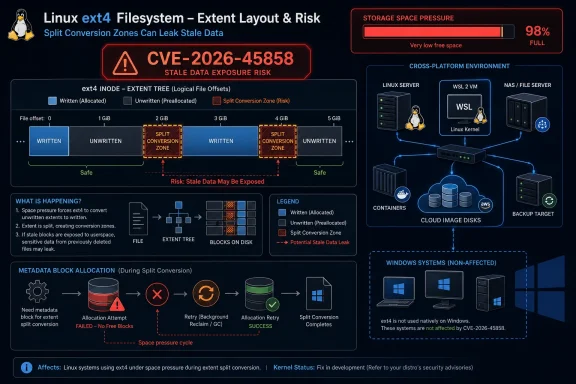 A Small ext4 Flag Becomes a Data-Exposure Story
At first glance, CVE-2026-45858 looks like the sort of kernel entry that only a filesystem maintainer could love. The description is dense with extent-splitting terminology, internal flags, and diagrams of unwritten and written ranges. There is no catchy exploit name, no public ransomware campaign, and no NVD score yet.But the underlying flaw is easier to understand than the wording suggests. Ext4 can reserve disk space for a file before that space contains meaningful user data. Those reservations are tracked as unwritten extents: regions that exist in the file’s logical layout but should read as zeroes until real data is written. That distinction is one of the quiet safety rails preventing old disk contents from leaking into new files.
CVE-2026-45858 is about what happens when that safety rail bends during a complicated split. In one path, ext4 zeroes part of a range, marks too much of the extent as written, and then later splits the region again. The result can leave a portion of stale data visible where unwritten space should have remained protected.
That is not a flashy bug. It is worse in the way filesystem bugs often are worse: it sits in a correctness path that users rarely see, but whose violation can undermine the core promise that files contain only the data they are supposed to contain.
The Vulnerability Lives in the Gap Between Allocation and Truth
Modern filesystems do not write files as simple chains of individual blocks. Ext4 uses extents, which describe ranges of contiguous blocks, because tracking every block individually would be inefficient for large files. That design is one reason ext4 remains fast, boring, and widely deployed.The complication is that an extent can be allocated without yet being initialized with user data. Preallocation, fallocate-style operations, delayed allocation, direct I/O, and large file workloads all benefit from separating “space has been reserved” from “this space contains valid file contents.” The filesystem must then be precise about when unwritten extents become written extents.
The vulnerable scenario arises when ext4 is working with a large unwritten extent and needs to initialize only the middle of it. In the CVE description’s simplified shape, there is a range from 0 to N, with valid data beginning at A and ending at B. The filesystem needs to convert the A-to-B region while leaving the surrounding areas safe.
The first split attempt at B can fail because of a temporary lack of space for metadata. That is not inherently fatal; filesystems are supposed to handle partial progress. The bug is that ext4’s fallback behavior zeroes B to N and marks the entire 0-to-N region as written. When a later split at A succeeds, the left-hand portion from 0 to A may now be treated as written even though it can contain stale data.
This is the kind of failure that makes storage engineers twitch. The filesystem did perform a zeroing operation, but it zeroed the wrong semantic boundary. It treated partial validity as entire validity, and in storage, those are not bookkeeping synonyms.
The Patch Is Tiny Because the Invariant Was Huge
The fix changes how ext4 passes validity information intoext4_split_extent_at(). Instead of allowing the first split path to convert the entire extent to written after zeroing part of it, the corrected behavior uses EXT4_EXT_DATA_PARTIAL_VALID1. That tells the split logic that only part of the extent should be considered valid, preserving the unwritten status where appropriate.That may sound like a minor flag adjustment, but flags are how kernel subsystems encode invariants. In this case, the invariant is that zeroing B to N must not magically validate 0 to N. If only a subrange has meaningful data, the metadata must reflect only that subrange.
The CVE references several stable-kernel commits, which strongly suggests this fix is being carried into multiple supported stable branches rather than living only in mainline. That is important because ext4’s installed base is not concentrated on bleeding-edge distributions. Enterprise distros, NAS vendors, appliance builders, hypervisor hosts, embedded products, and cloud images routinely run older long-term kernels with selective backports.
The uncomfortable part is that NVD has not yet assigned CVSS scoring or a CWE classification. That does not mean the bug is harmless. It means the public vulnerability record is still awaiting enrichment, while the kernel fix and its stable backports already tell administrators what matters operationally: update the kernel when your vendor ships the patched build.
Stale Data Is a Confidentiality Bug, Not Just a Filesystem Oddity
The phrase “stale data” can sound tame, as if the filesystem merely leaves behind untidy internal state. It is more serious than that. Stale data exposure means a process may be able to read bytes that were not intentionally written into the file it is reading.On a single-user workstation, that might mean old file fragments appear in a newly allocated region under rare conditions. On a multi-user server, container host, shared hosting node, database server, CI worker, or virtualized environment, the security interpretation gets sharper. Data that should have remained unreachable could cross a boundary between files, workloads, users, or tenants.
That does not automatically make CVE-2026-45858 a remotely exploitable disaster. The public description does not establish a network attack path, privilege-escalation primitive, or easy trigger. The vulnerable path involves specific ext4 extent operations, splitting behavior, unwritten extents, and a temporary metadata-space failure at a particular moment.
But filesystem confidentiality bugs do not need a logo to be worth patching. Their risk depends on workload shape. Systems doing heavy sparse-file manipulation, large preallocated files, direct I/O, virtualization images, database files, or high-volume temporary-file churn deserve more attention than a quiet desktop with a lightly used root filesystem.
Windows Shops Should Not Tune Out Because the Bug Says Linux
WindowsForum readers are not, by definition, Linux-only administrators. That is exactly why this CVE belongs here. Mixed estates are now the default: Windows endpoints, Linux servers, Hyper-V hosts, WSL development environments, container pipelines, backup appliances, and NAS devices all live in the same operational universe.The direct vulnerability is in the Linux kernel’s ext4 implementation. NTFS, ReFS, and Windows itself are not implicated by the CVE. A fully Windows-only machine that never mounts ext4 through Linux is not affected in the direct sense.
The indirect exposure is broader. WSL2 distributions use Linux kernels and Linux filesystems inside virtualized environments. Developer machines often mount project storage across Windows and Linux boundaries. Backup systems may ingest ext4 volumes. Forensics and recovery workflows may attach Linux disks to Windows-led environments. Small businesses often run Linux-based NAS appliances without thinking of them as “Linux servers.”
That does not mean every Windows admin should panic. It does mean the asset inventory question is not “Do we use Linux on the desktop?” The better question is “Where do we depend on ext4 for data separation, temporary storage, images, or shared workloads?”
NVD’s Empty Score Is a Warning About Process, Not Severity
The NVD entry currently lists the CVE as awaiting enrichment, with no CVSS 4.0, 3.x, or 2.0 score from NIST. That gap is common for newly received Linux kernel CVEs, especially as the kernel project’s CVE assignment stream continues to push large numbers of records into public databases.Security teams should resist two bad instincts here. The first is treating an unscored CVE as automatically low priority. The second is inventing a worst-case score before the exploitability facts are known.
The better approach is to classify the bug by impact and exposure. The impact described is stale data disclosure, which points primarily to confidentiality. The exposure depends on whether untrusted or separated workloads can influence file allocation and readback on ext4 volumes. The likelihood depends on whether the required split failure can be reliably triggered under real conditions.
For many environments, that will put CVE-2026-45858 below remote code execution and actively exploited privilege-escalation bugs. For high-density multi-tenant Linux systems, CI runners, shared hosting, lab clusters, and storage appliances, it deserves faster movement.
NVD scoring will eventually make dashboards cleaner. It will not change the basic remediation path: identify affected kernels, track vendor advisories, and deploy patched builds.
The Real Trigger Is Resource Pressure at the Worst Possible Moment
One reason this vulnerability is subtle is that it involves a failure path rather than the ordinary happy path. The first split at B fails due to a temporary lack of space. That matters because many bugs hide in fallback logic: the code that runs when metadata allocation, journaling, or extent manipulation cannot proceed exactly as planned.Filesystems spend most of their time looking deterministic from above. Applications call write, fsync, fallocate, truncate, or rename; the filesystem does the right thing; life goes on. Underneath, however, storage code is full of conditional paths that depend on allocation state, fragmentation, journal capacity, extent tree depth, block-group layout, and crash-consistency rules.
CVE-2026-45858 is a reminder that resource pressure changes security posture. A nearly full filesystem, fragmented extent trees, large sparse files, or workloads that constantly split and convert extents can exercise code paths that ordinary testing may not hit. The bug does not merely require ext4; it requires ext4 doing a particular kind of surgery while short of room to make that surgery clean.
That is why “temporary lack of space” should not be dismissed as an edge condition. Production systems live in edge conditions. Build servers fill disks. Databases preallocate files. VM images grow. Log volumes churn. Backup targets run close to capacity. The obscure path becomes less obscure when the system is already stressed.
The Fix Reinforces a Rule Storage Code Cannot Break
The corrected behavior is conceptually modest: do not mark the whole extent written when only part of it is valid. But that rule is foundational. Filesystem metadata is a contract between past writes, future reads, and crash recovery.If ext4 says a range is unwritten, reads should return zeroes, not leftovers. If ext4 says a range is written, the kernel and applications are allowed to treat the backing blocks as containing valid file data. The vulnerability appears when that distinction is blurred after a failed split and subsequent conversion.
The presence of
EXT4_EXT_DATA_PARTIAL_VALID1 is telling. The ext4 code already had machinery to describe partial validity. The bug was not that ext4 had no vocabulary for the state; it was that this particular path used the wrong semantic signal during a split. That makes the patch feel small, but the consequence of the wrong signal is not small.Kernel filesystem bugs often look like this. A one-line or twelve-line change can close a serious hole because the danger was never the amount of code. The danger was a violated assumption in a path where correctness depends on exact state transitions.
Administrators Need Vendor Kernels, Not Git Archaeology
For most administrators, the right response is not to cherry-pick commits from kernel.org. It is to follow the kernel packages from the distribution or vendor that owns the support contract. Red Hat, Canonical, SUSE, Debian, Arch, cloud image maintainers, NAS vendors, and appliance manufacturers all make their own backporting decisions and version-labeling choices.That matters because kernel version numbers can mislead. A system running an older enterprise kernel may already contain the patch if the vendor backported it. A system running a newer-looking custom kernel may not contain it if it missed the relevant stable update. The only reliable answer is the vendor’s changelog, package advisory, or source package diff.
For unmanaged systems, the practical path is still straightforward: update to a stable kernel that includes the fix, reboot into it, and verify that the running kernel is the updated one. Kernel updates do not protect a system still booted into yesterday’s image.
Operators of storage-heavy systems should also look at capacity and fragmentation habits. The vulnerable path references a temporary lack of space during extent splitting. Patching is the fix, but chronically full filesystems remain an operational risk multiplier for many classes of bugs. A server running at 98 percent capacity is not merely inconvenient; it is more likely to exercise unpleasant code paths.
The vulnerability does not suggest that ext4 volumes are broadly corrupt or that users should abandon ext4. Ext4 remains one of the most tested filesystems in the world. The right lesson is narrower and more useful: mature filesystems still need prompt maintenance, especially when their bugs touch confidentiality semantics.
Containers and VM Images Make the Edge Case More Relevant
Ext4’s unwritten extent machinery is especially relevant in the era of large image files and layered workloads. Virtual machine disks, container storage backends, database files, and build caches often involve sparse allocation, preallocation, and range conversion patterns. Those are precisely the kinds of operations where unwritten extents matter.Consider a CI runner that repeatedly creates large temporary artifacts, disk images, or sparse files on an ext4 volume. Or a lab host that churns through VM images for testing. Or a multi-user machine where different accounts can create, expand, and read large files on the same filesystem. These environments are not exotic anymore.
Again, the public record does not prove that an unprivileged local user can reliably exploit CVE-2026-45858 on demand. But from a defensive standpoint, the shape of the bug aligns with environments where data separation matters. If stale data exposure occurs, the consequences are not limited to the application that triggered it.
The most conservative assumption is that shared Linux storage deserves priority. Single-purpose appliances and embedded systems also deserve attention, because their update cycles are often slower and their users may not even know ext4 is underneath the product interface.
Dual-Boot and WSL Users Get a Smaller but Real Checklist
For individual Windows enthusiasts, the exposure is narrower. A typical dual-boot system with Windows on NTFS and Linux on ext4 would only be affected while Linux is running and using the vulnerable kernel. Windows itself does not become vulnerable merely because an ext4 partition exists on the disk.WSL requires a little more care. WSL2 runs Linux distributions inside a lightweight virtual machine with a Microsoft-provided Linux kernel. Microsoft updates that kernel separately from many distribution packages, and users may also run custom kernels. The relevant question is not whether Ubuntu, Debian, or Fedora userland is current; it is whether the WSL kernel contains the ext4 fix if ext4-backed storage is in use.
Most home users do not need to perform forensic analysis of old files. They should install available kernel updates, reboot, and avoid running storage volumes perpetually near full capacity. If they run homelab servers, self-hosted Git platforms, Proxmox-style virtualization, or Linux-based NAS systems, they should treat those machines like production systems rather than hobby toys.
The broader Windows angle is less about direct compromise and more about operational blind spots. Many Windows-first users have Linux storage in their lives without labeling it as such. That is where CVEs like this can linger.
The Kernel CVE Firehose Makes Judgment More Important
The Linux kernel now generates a steady stream of CVE records for bugs fixed upstream and in stable branches. Some are severe. Some are theoretical. Some affect obscure drivers. Some hit foundational subsystems like filesystems, networking, memory management, and virtualization.CVE-2026-45858 sits in the category that deserves neither hysteria nor neglect. It is not a browser zero-day. It is not a wormable Windows service flaw. It is also not harmless bookkeeping. Stale data exposure in a default Linux filesystem is exactly the kind of issue that becomes significant in the wrong deployment.
Security teams are increasingly forced to triage kernel CVEs before NVD enrichment catches up. That means reading the description, identifying the subsystem, mapping workload exposure, and watching vendor advisories. Automated scanners that simply say “no score available” are not enough.
The best organizations will handle this as part of normal kernel hygiene. They will not wait for a dramatic proof of concept. They will also not rip through emergency maintenance windows for every single ext4 fix without understanding the affected estate. Mature patch management lives between those extremes.
The Concrete Work Hides Behind a One-Line Summary
The operational response to CVE-2026-45858 is less glamorous than the vulnerability description. That is usually true of kernel filesystem bugs. The hard part is knowing where the affected code actually runs.In practice, the priority list starts with shared Linux systems and storage-heavy hosts. Hypervisors, build farms, database nodes, multi-user shells, containers, backup targets, NAS devices, and appliances should come before lightly used personal laptops. Administrators should also check whether vendors have already shipped patched stable kernels under old-looking version numbers.
There is no public CVSS score from NVD yet, so organizations should not anchor triage solely to a dashboard severity field. The impact described by the kernel CVE record is stale data exposure, and that is enough to justify timely patching wherever ext4 protects boundaries between workloads or users.
The Ext4 Bug That Rewards Boring Discipline
CVE-2026-45858 is not the sort of vulnerability that changes an architecture roadmap overnight, but it is the sort that rewards disciplined operators.- Systems using ext4 with shared, multi-user, containerized, virtualized, or storage-heavy workloads should be patched as soon as vendor kernels are available.
- Windows-only systems using NTFS or ReFS are not directly affected, but Windows-first environments may still rely on ext4 through Linux servers, WSL2, NAS appliances, or dual-boot setups.
- The absence of an NVD CVSS score should not be mistaken for proof of low risk, because the public record is still awaiting enrichment.
- The bug’s practical impact is stale data exposure, which makes confidentiality the main concern rather than remote code execution.
- Kernel version strings alone may not reveal exposure, because distribution vendors routinely backport filesystem fixes into older supported kernel branches.
- Reboot verification matters, because a patched kernel package does nothing until the machine is actually running it.
References
- Primary source: NVD / Linux Kernel
Published: 2026-05-28T01:11:10-07:00
NVD - CVE-2026-45858
 nvd.nist.gov
- Security advisory: MSRC
Published: 2026-05-28T01:11:10-07:00
Original feed URL
Security Update Guide - Microsoft Security Response Center
 msrc.microsoft.com
- Related coverage: lists.openwall.net
- Related coverage: kernel.googlesource.com
- Related coverage: mailweb.openeuler.org
- Related coverage: git.sceen.net
- Related coverage: lists.ubuntu.com
- Related coverage: righteousit.com
- Related coverage: kernel.org
