

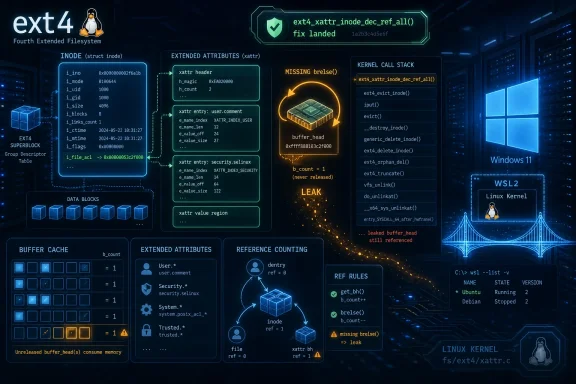
brelse() call in ext4_xattr_inode_dec_ref_all() can leak a buffer-head reference after an earlier extended-attribute hardening change. The bug is small enough to fit in a terse commit message, but it sits in one of Linux’s most trusted subsystems: the default filesystem for countless servers, appliances, cloud images, developer workstations, and embedded devices. That is why this CVE matters less as a dramatic “drop everything” exploit story and more as a reminder that filesystem security is often won or lost in the accounting details. In ext4, a forgotten release is not glamorous, but it is still kernel state that fails to return to zero.
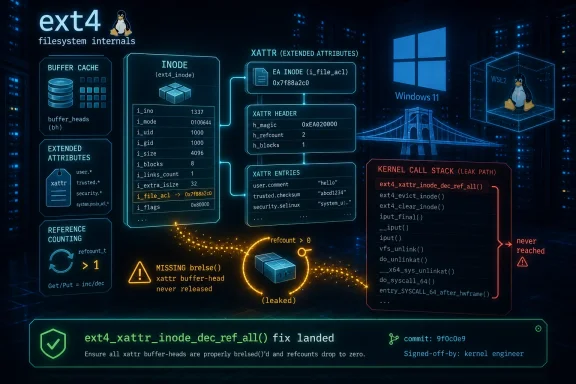 A One-Line Fix Lands in a Very Large Blast Radius
The headline fact about CVE-2026-46046 is almost comically narrow. The kernel’s ext4 code calls ext4_get_inode_loc() to locate inode metadata, receives a buffer head through iloc.bh, and in one path fails to release it with brelse(). That path occurs when block_csum is false inside ext4_xattr_inode_dec_ref_all(), a function involved in decrementing references for extended-attribute inodes.
If this sounds like a housekeeping bug, that is because it is. But kernel housekeeping is not the same as application housekeeping. A leaked userspace object usually means a process grows until it exits or gets killed; a leaked kernel reference can persist in a shared subsystem where the wrong workload pattern turns “minor leak” into degradation, warning splats, unmount weirdness, or denial-of-service territory.
The CVE record is still marked as awaiting NVD enrichment, which means the familiar severity score, vector string, and CWE classification were not yet assigned by NIST at the time of publication. That absence is important. It means administrators should resist the urge to over-rank or under-rank the bug based on the CVE number alone, because the public record currently tells us the root cause but not the final consensus severity.
The practical reading is straightforward: this is a fixed Linux kernel bug in ext4’s extended-attribute handling, and systems that expose ext4 filesystems to untrusted or semi-trusted local activity deserve attention. It is not, on the available public facts, a remote-code-execution panic button. It is also not “nothing,” because filesystems are precisely where boring invariants become operational reliability.
The Original Hardening Patch Created the Leak It Was Trying to Avoid
The irony in CVE-2026-46046 is that the regression came from a defensive change. The older commit identified in the CVE text, c8e008b60492, carried the plain-English intent “ext4: ignore xattrs past end.” That kind of patch is supposed to make parsing more conservative: if extended attributes appear to run past the expected boundary, the filesystem should stop trusting the malformed layout.
That is exactly the sort of code maintainers add after years of seeing filesystem parsers abused by corrupted disks, fuzzed images, malformed metadata, and edge cases nobody hit in ordinary production. Filesystem code has to parse on-disk structures that may be old, damaged, maliciously crafted, or generated by buggy tools. A robust parser says “no” early and often.
But defensive parsing often means adding early exits, alternate branches, and “ignore this malformed thing” behavior. Those are also the places where cleanup bugs breed. If one branch acquires a reference and another branch returns before releasing it, the security fix has just moved risk from bounds checking into lifetime management.
That is what makes this CVE a useful example rather than just another entry in the kernel CVE stream. Security work in mature codebases is not a clean march from unsafe to safe. It is a trade of failure modes, and every added guardrail has to preserve the lifecycle rules that were already there.
Ext4’s Extended Attributes Are Small Metadata With Big Responsibilities
Extended attributes, or xattrs, are the metadata fields that let files carry more than names, permissions, timestamps, and contents. On Linux, they are used for things like SELinux labels, POSIX ACLs, capabilities, user-defined metadata, and various system or application annotations. They are not exotic; on many systems they are part of the everyday security and policy fabric.
Ext4 stores xattrs either inside the inode when there is room or in separate storage when there is not. Newer ext4 configurations can also store large attribute values in external inodes when the relevant feature is enabled. That means xattr handling touches inode layout, block buffers, checksums, reference counts, and deletion paths.
CVE-2026-46046 appears in precisely that neighborhood. The affected function decrements references for xattr inodes, which is cleanup code rather than the glamorous read or write path. Cleanup code is where invariants are supposed to be restored after the interesting work is over.
The missing brelse() matters because buffer heads are an old but still central abstraction in Linux block-backed filesystems. If code gets a buffer head, it usually owns a reference that has to be released. Forgetting that release is not a data exfiltration primitive by itself, but it means the kernel’s internal view of resources is no longer balanced.
That imbalance is the story. Filesystems are built on exactness: every reference count, block pointer, checksum decision, and journal transition has to reconcile. When it does not, the visible failure may be far away from the line of code that caused it.
The CVE Is About Availability Before It Is About Intrusion
The public description points to a reference-count leak, not a privilege escalation, memory corruption overwrite, or arbitrary execution path. That puts CVE-2026-46046 in the family of bugs most likely to matter as an availability and reliability issue. A local workload that repeatedly triggers the leaky path could, in principle, consume kernel resources or leave filesystem state harder to unwind cleanly.
That “in principle” matters because the NVD record has not yet supplied an official CVSS vector. We do not have a canonical statement of attack complexity, required privileges, user interaction, scope, or impact. We also do not have public exploitation detail in the CVE text.
Still, there is a conservative operational model. If a system allows local users, containers, build jobs, backup tools, archive extractors, or filesystem-image processing to create and remove files with extended attributes on ext4, the affected path may be reachable. If the system only uses ext4 on a tightly controlled root filesystem with no untrusted local activity, the practical exposure is lower.
This is the distinction administrators should care about. CVE labels flatten nuance, but patch prioritization depends on workload. A single-user Linux desktop, a multi-tenant shell host, a Kubernetes node, a CI runner, and a forensic workstation mounting untrusted disk images do not have the same risk profile.
For WindowsForum readers, the bridge is obvious. Windows itself is not affected by ext4 kernel code, but Windows-adjacent environments increasingly run Linux kernels through WSL, Hyper-V guests, dual-boot systems, NAS appliances, containers, and cloud workloads administered from Windows endpoints. The perimeter of “your Windows environment” is no longer bounded by C:\.
The Missing Score Should Not Be Mistaken for Missing Risk
NVD’s “awaiting enrichment” state is a bureaucratic phrase with practical consequences. It means vulnerability scanners may show incomplete metadata, dashboards may sort the item oddly, and automated risk policies may not know whether to elevate or suppress it. In a modern patch program, missing fields can be almost as disruptive as high scores because they create ambiguity.
That ambiguity is especially common with kernel.org-sourced CVEs. The Linux kernel project’s modern CVE process has generated a much higher volume of identifiers for fixed bugs, many of which are real defects but not all of which are internet-shaking emergencies. The result is a stream of kernel CVEs that require more engineering judgment than the average compliance report likes to admit.
CVE-2026-46046 fits that pattern. The text is specific, the fix references are concrete, and the affected subsystem is important. But the record does not yet provide the severity framing that many patch dashboards use as shorthand for urgency.
The right response is not to wait passively for a number. Administrators should map the bug to their kernels, workloads, and exposure model. If the fix is already in the vendor kernel stream, take it through the normal kernel update process. If it is not, watch the relevant distribution advisories rather than assuming the upstream stable commit maps one-to-one to every enterprise kernel.
This is also where Windows-heavy shops running Linux workloads need to mature. If Linux exists only as “that VM under Hyper-V” or “the WSL image developers use,” it tends to fall outside traditional Windows patch governance. CVE-2026-46046 is not the scariest bug that will test that blind spot, but it is a useful rehearsal.
Stable Kernel References Tell Us the Fix Is Being Backported, Not Just Discussed
The CVE record lists multiple stable kernel commit references, which is a good sign. It means the issue is not merely a mailing-list theory; fixes have landed in maintained kernel branches. For administrators, that distinction matters more than the CVE prose.
Linux distributions rarely ship vanilla upstream stable kernels without modification. Ubuntu, Debian, Fedora, Red Hat Enterprise Linux, SUSE, Oracle Linux, Arch, Alpine, and appliance vendors all have their own kernel packaging, backport, and advisory practices. A fix may appear upstream under one commit ID and arrive downstream under a package changelog that does not expose the same hash prominently.
That is why the operational question is not “Do I have commit 097227f1?” but “Has my vendor shipped the ext4 xattr inode reference leak fix corresponding to CVE-2026-46046?” Those are different questions. The first is for kernel developers and people building their own trees; the second is for production patch management.
For self-managed kernel builders, the answer is more direct. Review the relevant stable branch, verify the ext4_xattr_inode_dec_ref_all() cleanup path, and ensure iloc.bh is released after ext4_get_inode_loc() in the affected branch. For everyone else, the safest course is to update through the distribution’s supported kernel packages once the fix is included.
This is not merely about correctness. Applying random upstream patches to vendor kernels can create support problems, ABI mismatches, and regression risk. Filesystem code is not a place for casual cherry-picking unless you already own the kernel lifecycle.
Filesystem Bugs Punish the Systems That Look Boringest
Ext4 has a reputation for being boring in the best possible way. It is mature, widely tested, and deeply familiar to Linux administrators. That reputation is earned, but it can also make teams underestimate the impact of subtle bugs in its maintenance paths.
The most exposed systems are not always the flashiest. Build servers churn through source trees and temporary files. Backup systems preserve ACLs and xattrs. Container hosts create and destroy layered filesystems at high velocity. Security-conscious Linux deployments rely on labels and capabilities that live in extended attributes. Developer machines pull archives and repositories from everywhere.
Those are ordinary workloads, but ordinary workloads at scale become fuzzers with payroll. A path that leaks one reference under a rare condition may be invisible on a laptop and meaningful on a busy multi-user host. The filesystem does not care whether the trigger was malicious or merely repetitive.
There is also the forensic and incident-response angle. Analysts often mount disk images, damaged filesystems, and untrusted evidence. They are intentionally feeding odd metadata to filesystem code. Bugs in “ignore malformed metadata” paths are particularly relevant in those environments because the job is to inspect the weird stuff safely.
That does not mean every ext4 user should treat CVE-2026-46046 as a crisis. It means the people running high-churn, multi-tenant, metadata-heavy, or untrusted-image workloads should patch sooner than the person with a home lab server that reboots monthly and exposes no local users.
Windows Shops Meet This Bug Through WSL, Virtualization, and Storage Habits
A Windows publication does not need to pretend this is a Windows kernel vulnerability to explain why it matters. The Windows ecosystem has spent years absorbing Linux as an operational dependency. Developers run WSL. Enterprises run Linux guests under Hyper-V. Azure estates mix Windows Server and Linux fleets. Security teams inspect Linux images from Windows workstations. NAS products and appliances quietly use Linux filesystems under web dashboards.
WSL deserves a careful distinction. WSL 2 uses a real Linux kernel, but Microsoft services that kernel through its own update channels, and the default Linux filesystem layout is usually inside a virtual disk rather than a raw ext4 partition mounted by Windows. Users should not assume that upstream kernel CVEs map instantly to their installed WSL kernel, nor should they assume WSL is irrelevant just because the Windows host is patched.
Dual-boot systems are another corner case. Windows may not natively mount ext4, but users often employ third-party drivers, shared external disks, or Linux rescue environments. The vulnerability described here is in Linux kernel ext4 code, so the risk attaches when a vulnerable Linux kernel processes the filesystem. The disk is not “infected” by the CVE; the parser and cleanup path are the vulnerable components.
Virtualization makes the boundary even blurrier. A Windows admin may patch the Hyper-V host religiously while leaving Linux guests to application teams. If those guests run ext4 and accept untrusted workloads, the unpatched kernel is still part of the business risk. Hypervisors do not magically erase guest-kernel vulnerabilities; they compartmentalize them.
The lesson is less about this one ext4 leak than about inventory. If your asset model records Windows devices but not the Linux kernels nested inside them, your vulnerability picture is incomplete. CVE-2026-46046 is another reminder that “Windows environment” now often means Windows plus a small Linux estate hiding in plain sight.
The Security Story Is Not the Same as the Reliability Story
Security teams tend to ask whether an attacker can exploit a bug. Storage teams ask whether the filesystem can be trusted to behave. CVE-2026-46046 sits between those disciplines, which is exactly where many kernel bugs cause friction.
From a pure intrusion perspective, the public facts do not describe code execution, privilege elevation, or data disclosure. That makes it easy to downplay. From a reliability perspective, a missing release in filesystem cleanup code is a correctness defect in a privileged subsystem. That makes it worth fixing even before anyone writes a proof of concept.
The best kernel patching programs do not wait for exploit kits to validate engineering risk. They categorize bugs by subsystem, exposure, workload, and fix availability. Filesystem bugs on production storage hosts generally deserve a shorter leash than obscure bugs in drivers for hardware the organization does not own.
There is also a monitoring challenge. A reference leak may not announce itself as “CVE-2026-46046 triggered.” It may surface as memory pressure, buffer-cache oddities, kernel warnings, hung unmounts, or noisy logs under specific workloads. By the time symptoms are visible, the clean answer is usually still the same: move to a fixed kernel.
That is why operational humility matters. If you run ext4 at scale and see unexplained filesystem behavior on kernels in the affected range, do not treat this CVE as proof of causation. Treat it as one plausible item on the checklist, alongside hardware health, journal errors, storage firmware, recent kernel updates, and workload changes.
The Patch Is Small Because the Invariant Is Simple
At the code level, the invariant is not complicated. If ext4_get_inode_loc() gives the function a buffer head, the function must release it when done. The missing brelse() is a violation of that contract.
The reason such bugs survive review is that the local rule is simple but the control flow is not. Filesystem functions often juggle feature flags, checksum states, journal handles, malformed metadata, inline data, external blocks, and compatibility behavior for old filesystems. A branch conditioned on block_csum can look harmless until someone traces the acquired references across every exit.
This is why kernel maintainers lean heavily on stable backports, fuzzing, static analysis, and years of community review. No single method catches everything. Static tools are good at spotting some lifetime mismatches, fuzzers are good at strange metadata, and human reviewers are good at intent. The gaps between those methods are where CVEs like this live.
The larger takeaway for developers is that cleanup paths need the same suspicion as input-validation paths. It is not enough for a hardening patch to reject malformed structures. It also has to leave every reference, lock, allocation, and journal state exactly as it found them.
In userspace, that lesson has led to RAII patterns, defer-style cleanup helpers, and structured unwinding. Kernel C has its own idioms, but the underlying problem is timeless. Complexity accumulates at the edges where error handling meets resource ownership.
The CVE Flood Is Forcing Administrators to Read More Carefully
Linux kernel CVEs have become more numerous, and that has changed how they should be consumed. In the old mental model, a CVE identifier implied a discrete security event with a widely understood severity. In the current kernel world, a CVE can identify a fixed correctness bug whose security impact depends heavily on reachability and workload.
That shift frustrates security teams because it increases triage load. It frustrates administrators because scanners may light up with findings whose real-world exploitability is unclear. It frustrates developers because a terse commit message can be stretched into an alarming vulnerability page by downstream databases.
But the alternative is not obviously better. Kernel bugs that affect resource lifetime, bounds checking, and malformed metadata handling can become security problems even when they do not look spectacular on day one. Assigning identifiers creates traceability across upstream commits, vendor advisories, scanners, and enterprise ticketing systems.
The burden now falls on interpretation. CVE-2026-46046 should not be inflated into a remote takeover story, but it should not be dismissed because it lacks a score. It should be handled as a fixed ext4 resource-management flaw whose urgency rises with local exposure, untrusted filesystem activity, and operational sensitivity.
That is a less satisfying answer than “critical” or “ignore.” It is also the answer mature vulnerability management increasingly requires.
The Admin Playbook Is Boring, Which Is Exactly the Point
For most organizations, the remediation path is the standard kernel update path. Track the vendor advisory, install the kernel package that includes the fix, reboot into it, and verify the running kernel rather than merely confirming that a package was downloaded. Kernel bugs are patched only when the machine actually runs the fixed kernel.
Live patching may eventually cover some environments, depending on vendor support and the exact kernel branch, but filesystem fixes are not something to assume into existence. If your estate uses live patching, verify coverage for this CVE or the corresponding ext4 fix rather than relying on generic “kernel livepatch enabled” status.
Administrators who build their own kernels should check the relevant stable commits and confirm the cleanup path manually. Administrators on enterprise distributions should resist the temptation to compare upstream version numbers directly. Enterprise kernels often carry backported fixes while retaining older version strings, which is good for ABI stability and bad for simplistic scanner logic.
The more interesting work is inventory. Find systems that run ext4, especially those handling untrusted local users, containers, build workloads, backups, security labels, or mounted disk images. That list is your priority order. The machine with public SSH access for many users is not the same as an isolated appliance with a read-mostly root filesystem.
WSL users should check the WSL kernel update mechanism rather than trying to patch a distribution kernel inside the guest. Linux VM owners should patch the guest OS. Appliance owners should wait for vendor firmware or OS updates unless the vendor explicitly supports manual kernel maintenance.
The Real Risk Is Letting “Minor” Kernel Bugs Pile Up
One CVE like this is manageable. A dozen deferred “medium,” “low,” or “awaiting analysis” kernel issues become a different story. The cumulative risk is not simply the sum of CVSS scores; it is the widening gap between your running kernel and the body of fixes upstream developers have already judged worth shipping.
That gap matters because attackers do not experience your vulnerability backlog as separate tickets. They experience it as a menu. A resource leak here, a use-after-free there, an information disclosure somewhere else, and suddenly the boring bugs are not so boring when chained or aimed at the right workload.
The same is true for reliability. Kernel storage bugs left unpatched can combine with heavy I/O, aging hardware, filesystem images from unknown sources, and operational stress. When incidents happen, teams rarely get the luxury of isolating one pristine root cause.
CVE-2026-46046 is therefore a good candidate for disciplined normalcy. Patch it through the supported channel. Prioritize exposed systems. Do not invent drama. Do not ignore it. That posture is less exciting than security theater and far more useful.
The Ext4 Lesson for This Week’s Patch Queue
The concrete guidance is short because the issue itself is specific. The hard part is not understanding the missing brelse(); it is placing that fact into the messy reality of mixed Windows and Linux operations.
- Systems running Linux kernels with ext4 filesystems should be checked against vendor updates for CVE-2026-46046 or the corresponding upstream ext4 xattr fix.
- Hosts with untrusted local users, container workloads, CI jobs, backup processing, or forensic mounting of disk images should move higher in the patch queue.
- Windows-only machines are not directly affected, but WSL, Hyper-V Linux guests, dual-boot environments, Linux appliances, and Azure Linux workloads may be part of the same operational estate.
- The absence of an NVD score on May 27, 2026 should be treated as incomplete metadata, not as evidence that the bug is harmless.
- Kernel package installation is not enough; administrators need to confirm that systems have rebooted or otherwise transitioned into the fixed running kernel.
- Self-built kernels should be reviewed for the ext4 cleanup change rather than judged only by broad version labels.
CVE-2026-46046 will probably not be remembered as a landmark Linux vulnerability, and that is precisely why it is useful. It shows the modern kernel security process at its most routine: a defensive ext4 change introduced a reference leak, maintainers fixed it, stable branches picked it up, and now administrators have to translate a tiny lifecycle bug into a sensible patch decision. The future of infrastructure security will be full of these unglamorous moments, and the organizations that handle them well will be the ones that treat kernel correctness not as background noise, but as one of the quiet foundations their Windows, Linux, cloud, and developer environments all share.
Attachments
References
- CVE-2026-46046 ext4: fix missing brelse() in ext4_xattr_inode_dec_ref_all() NVD / Linux Kernel · 2026-05-28T01:07:05-07:00