CVE-2026-45912 is a newly published Linux kernel ext4 vulnerability, received by NVD from kernel.org on May 27, 2026, involving stale extent-status caching during extent splitting that can lead to incorrect space accounting. It is not, at least from the public record so far, a remote-code-execution panic button. It is the sort of file-system correctness bug that looks quiet until it lands in the exact place modern infrastructure hates uncertainty: storage state. The lesson is not that ext4 is suddenly unsafe; it is that even mature file systems still depend on small invariants that administrators rarely see until they break.
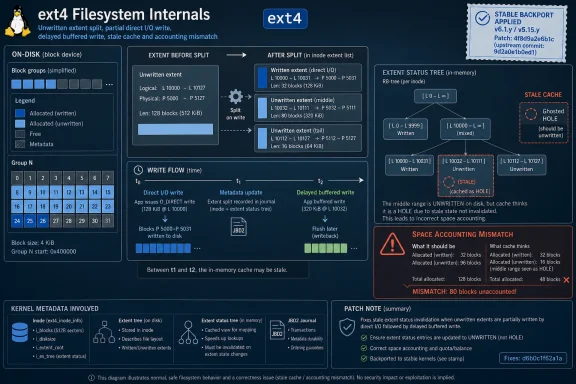
The vulnerability record is almost comically narrow at first glance. During an ext4 extent split, the kernel could cache extent information while the underlying extent was still being modified. Under a particular sequence involving an unwritten extent, direct I/O, and later delayed buffered writes, the extent status tree could retain a stale hole where the file system should have recorded a valid unwritten range.
That sounds like the kind of bug that belongs in a maintainer’s notebook, not in a CVE feed. But Linux file systems live in the kernel’s trust boundary. When the kernel’s view of allocated space diverges from reality, the consequences can move from “annoying accounting bug” to “possible corruption trigger,” depending on workload, mount options, and how other kernel paths react.
The public NVD entry is still awaiting enrichment, with no NIST CVSS score assigned for CVSS 4.0, 3.x, or 2.0. That matters. Security teams should resist the temptation to invent severity where the official record has not yet supplied it, but they should also avoid dismissing it merely because it lacks a score on day one.
The fix itself is blunt: do not cache extents that are in the middle of being split. In the patch series, the relevant code path sets a no-cache flag around the split operation, trading a tiny performance optimization for correctness. That is usually the right trade in a file system, and doubly so when stale metadata can outlive the operation that produced it.
But ext4 does not only keep on-disk structures. It also maintains in-memory state to speed up lookups. The extent status tree is one of those internal accelerators, giving the kernel a fast view of whether ranges are written, unwritten, delayed, or holes. It exists to avoid unnecessary trips through the extent tree and to make allocation decisions quicker.
CVE-2026-45912 lives in the gap between those two realities. The on-disk extent may be updated correctly, while the in-memory status cache can momentarily learn the wrong thing and then fail to unlearn it. In the bug description, the kernel can split an unwritten extent, shrink an existing cached status entry, and accidentally install a hole entry for the truncated range.
That stale hole is the poisonous part. Once the split completes, outer functions do not necessarily correct the status tree. Later, a delayed buffered write can reinsert delayed state over the affected range and upset space accounting. The kernel is not being tricked by a packet from the network; it is being misled by its own cache.
This is why the fix is conceptually clean. During modification, the cache should not be taught anything speculative. The file system code should finish rearranging the extent and only then let stable state become visible to the caching layer.
Unwritten extents are a normal part of modern file-system behavior. They allow ext4 to reserve space without immediately treating the contents as initialized data. Applications that preallocate files, databases that manage large files, and virtualization stacks that care about avoiding fragmentation can all lead the file system into these paths.
Direct I/O, or DIO, is also not exotic. Databases, hypervisors, backup systems, and storage-heavy services often use it to bypass parts of the page cache and manage their own I/O behavior. Buffered delayed allocation, meanwhile, is one of the mechanisms ext4 uses to improve placement and performance before committing allocation decisions.
The bug sits at the intersection of these optimizations. Each one is reasonable on its own. Together, they create a state machine where an extent can be in transition, the cache can observe an intermediate state, and later code can act as if that intermediate state was durable truth.
This is the story of many kernel bugs in mature subsystems. The failure is not in a flashy new feature but in the choreography between established mechanisms. File-system code is full of these moments, where a function that is safe in isolation becomes risky when called during another function’s half-finished mutation.
For defenders, that creates an uncomfortable middle period. Vulnerability scanners may ingest the CVE before they can rank it properly. Linux vendors may need time to map the upstream stable commits to their supported kernels. Operations teams may see a new CVE tied to ext4 and ask the obvious question: do we stop everything?
The sober answer is no, not without more evidence. There is no public indication from the supplied record that this is a remotely exploitable vulnerability or a turnkey privilege-escalation bug. The description focuses on stale extent status and space accounting errors, not arbitrary code execution or credential bypass.
But the equally sober answer is that storage-layer CVEs deserve respect. Bugs that alter allocation state can cause system instability, data-integrity problems, or future warning paths that become production noise. If a workload depends on ext4 under heavy direct I/O and delayed allocation patterns, this is not a purely academic patch.
The practical posture is to treat CVE-2026-45912 as a kernel maintenance issue with security tracking attached. It belongs in the same queue as other stable kernel correctness fixes: not necessarily an emergency reboot at 2 a.m., but not something to ignore until the next hardware refresh.
The patch is small, but small patches are often the ones administrators should like most. In the stable review mail, the change touches
That does not make it risk-free. Any file-system patch deserves testing, especially in environments with unusual storage stacks, old kernels, vendor backports, or appliances that carry customized ext4 code. But the nature of the fix suggests a targeted correction rather than a broad semantic shift.
It also tells us something about kernel engineering culture. The patch does not try to make caching smarter during a dangerous transition. It forbids caching in that moment. That is the kind of conservatism that keeps old file systems reliable: when a performance shortcut threatens correctness, remove the shortcut.
The CVE’s timing is also notable. The upstream patch activity predates the NVD publication, and the NVD record was created after kernel.org provided the vulnerability data. That sequence is increasingly common for Linux kernel CVEs: the fix may exist in stable channels before many enterprise dashboards have finished labeling the issue.
The most obvious exposure is WSL, especially WSL 2, which runs a real Linux kernel in a lightweight virtual machine. Most WSL users will not be hammering ext4 with database-grade direct I/O patterns, but WSL distributions commonly use Linux file systems inside virtual disk images. Developers running databases, build systems, containers, or test infrastructure inside WSL should still care about kernel updates.
The bigger exposure is server-side. A Microsoft-centric enterprise may still run Linux appliances for storage, monitoring, identity adjuncts, CI/CD runners, or container hosts. Those systems often sit adjacent to Windows workloads and can affect them when storage reliability degrades. A Linux file-system bug does not need to execute on a domain controller to disrupt a Windows estate.
There is also the virtualization angle. Ext4 appears inside guest operating systems, container hosts, cloud images, and embedded management layers. If an organization uses Linux VMs to host databases consumed by Windows applications, the business impact of file-system accounting errors is not confined to Linux administrators.
The right mental model is not “Windows versus Linux.” It is “which part of our environment trusts ext4 to keep state correctly under write-heavy workloads?” In 2026, the answer is often broader than the org chart suggests.
Its risk is more operational. A stale extent status tree can produce wrong assumptions inside the kernel about what parts of a file are holes, unwritten ranges, or delayed allocations. Once those assumptions affect accounting, administrators may see symptoms far removed from the root cause: warnings, allocation oddities, failed writes, filesystem errors, or unexplained behavior in high-I/O applications.
That makes it harder to triage. If a web server crashes after an obvious remote exploit, the path is visible. If a database workload encounters a storage anomaly after a complex sequence of direct and buffered writes, the path may look like a hardware problem, application bug, or unlucky corruption event.
This is also why the CVE label matters even for a correctness bug. It gives defenders a shared identifier for correlating vendor advisories, kernel updates, scanner output, and incident timelines. Without the CVE, the patch might be buried as a low-level ext4 fix whose importance becomes clear only after a painful postmortem.
At the same time, security teams should not overstate what is known. The public record describes a bug and a fix, not a weaponized exploit chain. The best article of faith here is neither panic nor complacency; it is disciplined patch management.
In many software systems, a stale cache is merely a performance issue. The application fetches fresh data, invalidates a key, or recomputes a result. In a file system, a stale cache can participate in allocation, journaling, writeback, and error handling. If the stale value is plausible enough, later code may happily build on it.
Ext4 has decades of design work behind it, but it is still a living subsystem. It continues to absorb fixes for DIO, iomap transitions, online defragmentation, delayed allocation, journaling interactions, and edge-case races. That is not a sign of weakness; it is what happens when a core file system is used at scale across workloads its original designers could not fully predict.
The uncomfortable truth is that file-system reliability is a moving target. New storage hardware, new application patterns, and new kernel infrastructure change the stress points. A bug like CVE-2026-45912 is therefore both narrow and representative: narrow in its trigger, representative in what it reveals about the cost of optimization.
The fix’s comment says not to cache extents being modified. That sentence could be read as a general rule for systems engineering. When truth is in transition, do not immortalize a snapshot of it.
Next comes kernel lineage. The NVD record lists multiple stable references, which means distributions will map the fix into their own advisories and kernel builds at different speeds. A mainline or stable-kernel commit hash is useful for engineers, but most production teams should consume this through their distribution’s supported kernel channel.
For enterprise Linux systems, the question is not simply “what upstream version contains the patch?” It is “has my vendor backported the fix into the kernel I am actually running?” Red Hat, SUSE, Canonical, Debian, cloud vendors, and appliance makers routinely backport fixes without changing to the same upstream version number that appears in kernel.org discussions.
Testing should focus on systems that mix direct I/O, fallocate-style preallocation, sparse or unwritten extents, and write-heavy workloads. Databases, virtualization platforms, storage gateways, and backup repositories deserve earlier attention than idle utility boxes. If those systems already have maintenance windows for kernel updates, this CVE is a good reason not to defer them.
For WSL users, the play is simpler: keep the WSL kernel current through the normal Microsoft update path and avoid treating Linux kernel updates as optional developer-machine housekeeping. The average WSL user is unlikely to reproduce this exact ext4 sequence, but modern developer workstations are increasingly miniature production environments.
The absence of NVD enrichment on publication day worsens that gap. Some tools will flag the CVE with unknown severity. Others may ignore it until a score appears. Still others may over-prioritize it because it is a kernel bug and therefore sounds inherently dangerous.
A more mature model would weight kernel CVEs by exposed subsystem, local attack surface, workload likelihood, and available vendor fix status. A remote network daemon bug and an ext4 accounting bug should not be queued the same way just because both have identifiers. But a file-system bug on a mission-critical database host should outrank a flashy vulnerability on a lab machine that is powered off.
This is where security and operations teams need to talk in specifics. The security team can identify the CVE and track advisories. The operations team knows which machines run ext4 under heavy write load. The application team knows which workloads use direct I/O or preallocation. None of those groups has the full picture alone.
The best vulnerability management programs already operate this way. They do not blindly chase scores; they translate flaws into asset-specific risk. CVE-2026-45912 is an excellent test of whether that muscle exists.
That is a big idea in a small diff. File systems depend on carefully sequenced updates: journal intent, modify metadata, expose state, complete writeback, recover safely if power fails. In-memory caches complicate that sequence because they can make intermediate states visible to later code paths even when the on-disk transaction eventually lands correctly.
The bug description also mentions future checks around extent caching that would trigger warnings if existing extents conflict. That detail is important. The fix is not only about today’s observed accounting error; it is also clearing a path for stricter internal validation tomorrow. Kernel developers often harden subsystems by first eliminating known false positives and ambiguous states.
This is how mature code gets safer. Not through one grand rewrite, but through hundreds of targeted corrections that make illegal states harder to represent. If a cache can learn something dangerous during a split, remove its opportunity to learn during the split.
That is less glamorous than a new file system or a storage accelerator, but it is the work that keeps Linux viable as the substrate under everything else.
 A Tiny ext4 Cache Decision Becomes a Security Record
The vulnerability record is almost comically narrow at first glance. During an ext4 extent split, the kernel could cache extent information while the underlying extent was still being modified. Under a particular sequence involving an unwritten extent, direct I/O, and later delayed buffered writes, the extent status tree could retain a stale hole where the file system should have recorded a valid unwritten range.That sounds like the kind of bug that belongs in a maintainer’s notebook, not in a CVE feed. But Linux file systems live in the kernel’s trust boundary. When the kernel’s view of allocated space diverges from reality, the consequences can move from “annoying accounting bug” to “possible corruption trigger,” depending on workload, mount options, and how other kernel paths react.
The public NVD entry is still awaiting enrichment, with no NIST CVSS score assigned for CVSS 4.0, 3.x, or 2.0. That matters. Security teams should resist the temptation to invent severity where the official record has not yet supplied it, but they should also avoid dismissing it merely because it lacks a score on day one.
The fix itself is blunt: do not cache extents that are in the middle of being split. In the patch series, the relevant code path sets a no-cache flag around the split operation, trading a tiny performance optimization for correctness. That is usually the right trade in a file system, and doubly so when stale metadata can outlive the operation that produced it.
The Bug Hides in the Difference Between Disk Reality and Kernel Memory
Ext4 uses extents to describe ranges of blocks belonging to a file. Instead of tracking every block one by one, it can say, in effect, that a continuous logical range maps to a continuous physical range. This is one of the reasons ext4 has remained viable across everything from small Linux appliances to large cloud servers: it is efficient, battle-tested, and usually boring in the best possible way.But ext4 does not only keep on-disk structures. It also maintains in-memory state to speed up lookups. The extent status tree is one of those internal accelerators, giving the kernel a fast view of whether ranges are written, unwritten, delayed, or holes. It exists to avoid unnecessary trips through the extent tree and to make allocation decisions quicker.
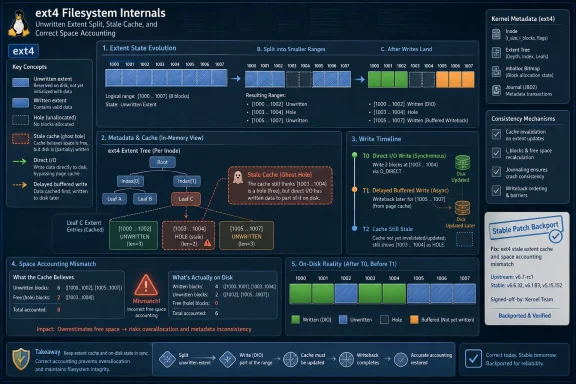
CVE-2026-45912 lives in the gap between those two realities. The on-disk extent may be updated correctly, while the in-memory status cache can momentarily learn the wrong thing and then fail to unlearn it. In the bug description, the kernel can split an unwritten extent, shrink an existing cached status entry, and accidentally install a hole entry for the truncated range.
That stale hole is the poisonous part. Once the split completes, outer functions do not necessarily correct the status tree. Later, a delayed buffered write can reinsert delayed state over the affected range and upset space accounting. The kernel is not being tricked by a packet from the network; it is being misled by its own cache.
This is why the fix is conceptually clean. During modification, the cache should not be taught anything speculative. The file system code should finish rearranging the extent and only then let stable state become visible to the caching layer.
Direct I/O and Delayed Writes Put Pressure on Old Assumptions
The vulnerable sequence described by kernel.org is not a generic “write a file and the sky falls” scenario. It involves an unwritten extent, direct I/O writing the first half, and a later delayed buffered write to the latter part. That combination matters because each piece is common in serious Linux deployments.Unwritten extents are a normal part of modern file-system behavior. They allow ext4 to reserve space without immediately treating the contents as initialized data. Applications that preallocate files, databases that manage large files, and virtualization stacks that care about avoiding fragmentation can all lead the file system into these paths.
Direct I/O, or DIO, is also not exotic. Databases, hypervisors, backup systems, and storage-heavy services often use it to bypass parts of the page cache and manage their own I/O behavior. Buffered delayed allocation, meanwhile, is one of the mechanisms ext4 uses to improve placement and performance before committing allocation decisions.
The bug sits at the intersection of these optimizations. Each one is reasonable on its own. Together, they create a state machine where an extent can be in transition, the cache can observe an intermediate state, and later code can act as if that intermediate state was durable truth.
This is the story of many kernel bugs in mature subsystems. The failure is not in a flashy new feature but in the choreography between established mechanisms. File-system code is full of these moments, where a function that is safe in isolation becomes risky when called during another function’s half-finished mutation.
The Absence of a CVSS Score Is Not a Clean Bill of Health
NVD’s “awaiting enrichment” status is easy to misread. It does not mean the vulnerability is low risk, high risk, exploitable, or non-exploitable. It means the record has been created and is waiting for additional analysis, including severity scoring and affected-product metadata.For defenders, that creates an uncomfortable middle period. Vulnerability scanners may ingest the CVE before they can rank it properly. Linux vendors may need time to map the upstream stable commits to their supported kernels. Operations teams may see a new CVE tied to ext4 and ask the obvious question: do we stop everything?
The sober answer is no, not without more evidence. There is no public indication from the supplied record that this is a remotely exploitable vulnerability or a turnkey privilege-escalation bug. The description focuses on stale extent status and space accounting errors, not arbitrary code execution or credential bypass.
But the equally sober answer is that storage-layer CVEs deserve respect. Bugs that alter allocation state can cause system instability, data-integrity problems, or future warning paths that become production noise. If a workload depends on ext4 under heavy direct I/O and delayed allocation patterns, this is not a purely academic patch.
The practical posture is to treat CVE-2026-45912 as a kernel maintenance issue with security tracking attached. It belongs in the same queue as other stable kernel correctness fixes: not necessarily an emergency reboot at 2 a.m., but not something to ignore until the next hardware refresh.
Stable Kernel Backports Tell Us This Was Worth Carrying
The references attached to the NVD record point to multiple kernel stable commits. That is a strong signal. The Linux stable process does not backport every interesting cleanup; it prioritizes fixes that maintainers judge relevant to supported kernels and real users.The patch is small, but small patches are often the ones administrators should like most. In the stable review mail, the change touches
fs/ext4/extents.c and adds a no-cache flag in the splitting paths. There is no sweeping redesign, no new feature gate, and no behavior change that should require application-level adaptation.That does not make it risk-free. Any file-system patch deserves testing, especially in environments with unusual storage stacks, old kernels, vendor backports, or appliances that carry customized ext4 code. But the nature of the fix suggests a targeted correction rather than a broad semantic shift.
It also tells us something about kernel engineering culture. The patch does not try to make caching smarter during a dangerous transition. It forbids caching in that moment. That is the kind of conservatism that keeps old file systems reliable: when a performance shortcut threatens correctness, remove the shortcut.
The CVE’s timing is also notable. The upstream patch activity predates the NVD publication, and the NVD record was created after kernel.org provided the vulnerability data. That sequence is increasingly common for Linux kernel CVEs: the fix may exist in stable channels before many enterprise dashboards have finished labeling the issue.
Windows Shops Still Have Linux File-System Exposure
A WindowsForum.com audience might reasonably ask why an ext4 kernel bug belongs here. The answer is that Windows environments are no longer Windows-only environments. Hyper-V hosts, WSL installations, dual-boot workstations, Linux-based NAS appliances, Kubernetes nodes, security tools, and backup targets all make Linux storage bugs relevant to Windows-heavy organizations.The most obvious exposure is WSL, especially WSL 2, which runs a real Linux kernel in a lightweight virtual machine. Most WSL users will not be hammering ext4 with database-grade direct I/O patterns, but WSL distributions commonly use Linux file systems inside virtual disk images. Developers running databases, build systems, containers, or test infrastructure inside WSL should still care about kernel updates.
The bigger exposure is server-side. A Microsoft-centric enterprise may still run Linux appliances for storage, monitoring, identity adjuncts, CI/CD runners, or container hosts. Those systems often sit adjacent to Windows workloads and can affect them when storage reliability degrades. A Linux file-system bug does not need to execute on a domain controller to disrupt a Windows estate.
There is also the virtualization angle. Ext4 appears inside guest operating systems, container hosts, cloud images, and embedded management layers. If an organization uses Linux VMs to host databases consumed by Windows applications, the business impact of file-system accounting errors is not confined to Linux administrators.
The right mental model is not “Windows versus Linux.” It is “which part of our environment trusts ext4 to keep state correctly under write-heavy workloads?” In 2026, the answer is often broader than the org chart suggests.
The Real Risk Is Operational, Not Cinematic
Security headlines tend to reward spectacle. Remote exploit, wormable bug, critical CVSS, proof-of-concept on GitHub: those are the terms that make patch teams sprint. CVE-2026-45912 is not that kind of story, at least not from the information currently public.Its risk is more operational. A stale extent status tree can produce wrong assumptions inside the kernel about what parts of a file are holes, unwritten ranges, or delayed allocations. Once those assumptions affect accounting, administrators may see symptoms far removed from the root cause: warnings, allocation oddities, failed writes, filesystem errors, or unexplained behavior in high-I/O applications.
That makes it harder to triage. If a web server crashes after an obvious remote exploit, the path is visible. If a database workload encounters a storage anomaly after a complex sequence of direct and buffered writes, the path may look like a hardware problem, application bug, or unlucky corruption event.
This is also why the CVE label matters even for a correctness bug. It gives defenders a shared identifier for correlating vendor advisories, kernel updates, scanner output, and incident timelines. Without the CVE, the patch might be buried as a low-level ext4 fix whose importance becomes clear only after a painful postmortem.
At the same time, security teams should not overstate what is known. The public record describes a bug and a fix, not a weaponized exploit chain. The best article of faith here is neither panic nor complacency; it is disciplined patch management.
File Systems Punish Half-Truths More Than Most Code
The kernel patch description uses a simple diagram: an unwritten extent before the write, then a split extent on disk, and finally a status tree that incorrectly records a hole. That diagram is doing more than explaining a bug. It is showing why file systems are uniquely intolerant of half-truths.In many software systems, a stale cache is merely a performance issue. The application fetches fresh data, invalidates a key, or recomputes a result. In a file system, a stale cache can participate in allocation, journaling, writeback, and error handling. If the stale value is plausible enough, later code may happily build on it.
Ext4 has decades of design work behind it, but it is still a living subsystem. It continues to absorb fixes for DIO, iomap transitions, online defragmentation, delayed allocation, journaling interactions, and edge-case races. That is not a sign of weakness; it is what happens when a core file system is used at scale across workloads its original designers could not fully predict.
The uncomfortable truth is that file-system reliability is a moving target. New storage hardware, new application patterns, and new kernel infrastructure change the stress points. A bug like CVE-2026-45912 is therefore both narrow and representative: narrow in its trigger, representative in what it reveals about the cost of optimization.
The fix’s comment says not to cache extents being modified. That sentence could be read as a general rule for systems engineering. When truth is in transition, do not immortalize a snapshot of it.
Patch Management Should Follow Workload Reality
Administrators should first identify where ext4 is actually in use. That sounds obvious, but many organizations have poor visibility into Linux file systems outside the central server fleet. Developer laptops, CI runners, lab machines, appliances, and cloud instances may all carry kernel exposure that does not show up in the same dashboards as Windows patching.Next comes kernel lineage. The NVD record lists multiple stable references, which means distributions will map the fix into their own advisories and kernel builds at different speeds. A mainline or stable-kernel commit hash is useful for engineers, but most production teams should consume this through their distribution’s supported kernel channel.
For enterprise Linux systems, the question is not simply “what upstream version contains the patch?” It is “has my vendor backported the fix into the kernel I am actually running?” Red Hat, SUSE, Canonical, Debian, cloud vendors, and appliance makers routinely backport fixes without changing to the same upstream version number that appears in kernel.org discussions.
Testing should focus on systems that mix direct I/O, fallocate-style preallocation, sparse or unwritten extents, and write-heavy workloads. Databases, virtualization platforms, storage gateways, and backup repositories deserve earlier attention than idle utility boxes. If those systems already have maintenance windows for kernel updates, this CVE is a good reason not to defer them.
For WSL users, the play is simpler: keep the WSL kernel current through the normal Microsoft update path and avoid treating Linux kernel updates as optional developer-machine housekeeping. The average WSL user is unlikely to reproduce this exact ext4 sequence, but modern developer workstations are increasingly miniature production environments.
The Security Industry Still Struggles With Kernel CVEs Like This
CVE-2026-45912 also exposes a weakness in vulnerability management tooling. Scanner-driven programs are good at ranking well-described package flaws with clear affected versions and CVSS vectors. They are less graceful with kernel fixes that arrive as upstream commits, stable backports, and distribution-specific advisories.The absence of NVD enrichment on publication day worsens that gap. Some tools will flag the CVE with unknown severity. Others may ignore it until a score appears. Still others may over-prioritize it because it is a kernel bug and therefore sounds inherently dangerous.
A more mature model would weight kernel CVEs by exposed subsystem, local attack surface, workload likelihood, and available vendor fix status. A remote network daemon bug and an ext4 accounting bug should not be queued the same way just because both have identifiers. But a file-system bug on a mission-critical database host should outrank a flashy vulnerability on a lab machine that is powered off.
This is where security and operations teams need to talk in specifics. The security team can identify the CVE and track advisories. The operations team knows which machines run ext4 under heavy write load. The application team knows which workloads use direct I/O or preallocation. None of those groups has the full picture alone.
The best vulnerability management programs already operate this way. They do not blindly chase scores; they translate flaws into asset-specific risk. CVE-2026-45912 is an excellent test of whether that muscle exists.
The ext4 Fix Is Small Because the Invariant Is Big
The patch’s apparent simplicity should not obscure the design principle behind it. The kernel is not merely adding a flag. It is preserving the invariant that cached extent status should not be derived from an extent while that extent is being rearranged.That is a big idea in a small diff. File systems depend on carefully sequenced updates: journal intent, modify metadata, expose state, complete writeback, recover safely if power fails. In-memory caches complicate that sequence because they can make intermediate states visible to later code paths even when the on-disk transaction eventually lands correctly.
The bug description also mentions future checks around extent caching that would trigger warnings if existing extents conflict. That detail is important. The fix is not only about today’s observed accounting error; it is also clearing a path for stricter internal validation tomorrow. Kernel developers often harden subsystems by first eliminating known false positives and ambiguous states.
This is how mature code gets safer. Not through one grand rewrite, but through hundreds of targeted corrections that make illegal states harder to represent. If a cache can learn something dangerous during a split, remove its opportunity to learn during the split.
That is less glamorous than a new file system or a storage accelerator, but it is the work that keeps Linux viable as the substrate under everything else.
The Patch Queue Should Notice the Quiet Storage Bug
This CVE does not demand theatrical incident response, but it does deserve a place in the next serious kernel review. The concrete facts are enough to guide action even before NVD assigns a score.- CVE-2026-45912 affects the Linux kernel’s ext4 code path for splitting extents while extent status caching is active.
- The public description centers on stale in-memory extent status, where a range can remain recorded as a hole after the on-disk extent has been split.
- The demonstrated sequence involves unwritten extents, direct I/O to part of the range, and later delayed buffered writes that can disturb space accounting.
- NVD published the record on May 27, 2026, and had not yet assigned CVSS severity metrics at the time of publication.
- The upstream fix prevents caching of extents while they are being modified, a targeted correctness change that has been carried through stable kernel references.
- Administrators should prioritize systems using ext4 with write-heavy, preallocation-heavy, database, virtualization, or storage workloads rather than treating every Linux endpoint as equally urgent.
References
- Primary source: NVD / Linux Kernel
Published: 2026-05-28T01:05:36-07:00
NVD - CVE-2026-45912
 nvd.nist.gov
- Security advisory: MSRC
Published: 2026-05-28T01:05:36-07:00
Original feed URL
Security Update Guide - Microsoft Security Response Center
 msrc.microsoft.com
- Related coverage: spinics.net
FAILED: Patch "ext4: don't cache extent during splitting extent" failed to apply to 6.12-stable tree (Linux Ext4)
Linux Ext4: FAILED: Patch "ext4: don't cache extent during splitting extent" failed to apply to 6.12-stable treewww.spinics.net - Related coverage: kernel.googlesource.com
- Related coverage: mirror.iscas.ac.cn
- Related coverage: android.googlesource.com
- Related coverage: lkml.indiana.edu
- Related coverage: mailweb.openeuler.org
- Related coverage: kernel.org
- Related coverage: righteousit.com