

CVE-2026-45940 is a Linux kernel networking flaw published by NVD on May 27, 2026, after kernel.org reported a resolved crash in the stmmac Ethernet driver when GMAC4 split-header receive handling miscalculates packet buffer length. The bug is not yet scored by NVD, but its shape is already clear enough for administrators to treat it as a kernel reliability issue with security implications. It is a reminder that modern network drivers are no longer thin hardware shims; they are performance engines where one bad descriptor assumption can turn routine packet handling into a kernel oops.
The first temptation with CVE-2026-45940 is to dismiss it because NVD has not yet assigned a CVSS score. That would be the wrong lesson. A missing score does not mean a missing bug, and in this case the upstream description is unusually concrete: the stmmac driver can oops while processing receive descriptors when split header mode is enabled on GMAC4 hardware.
That matters because an oops is not an abstract compliance finding. It is the kernel saying that code running in a privileged path tried to touch memory it should not have touched, or touched it in a way the architecture could not tolerate. On a desktop, that may mean a sudden network outage or a crash. On an embedded gateway, industrial controller, storage appliance, or lab board doing useful work in a corner, it can mean a device that silently stops doing the job it was installed to do.
The CVE text points to a specific failure mode in
The vulnerability has been marked “awaiting enrichment,” which is NVD’s way of saying the public record exists but the database has not yet completed its own classification work. For IT teams, the practical reading is simpler: upstream has fixed something real, the fix is in stable kernel references, and the absence of a severity badge should not be confused with a verdict of low severity.
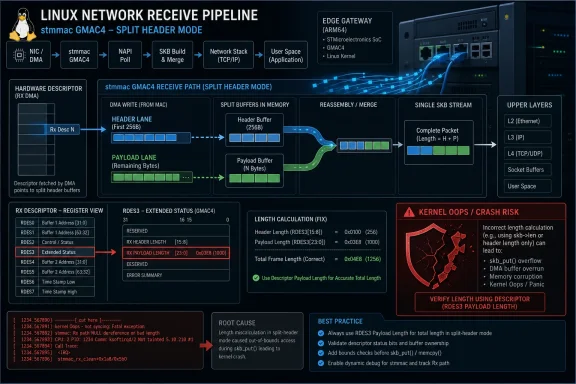
The affected area is GMAC4 receive processing with split header enabled. GMAC4 is a generation of the DesignWare Ethernet controller family, and split header support is a performance feature designed to separate packet headers from payloads. The idea is sensible: the networking stack often needs to inspect and manipulate headers much more urgently than it needs to copy or touch a full packet payload.
That performance trick, however, makes the driver more dependent on precise descriptor interpretation. A simple receive path can often treat a packet as one contiguous chunk of data and move on. A split receive path has to know which descriptor contains what, how much was actually filled by the hardware, and whether the assumptions made for one descriptor still hold for the next.
CVE-2026-45940 lives in that seam. The bug description says that in rare cases the hardware does not fill
The fix is telling. Instead of inferring buffer length from position in the descriptor chain, the patched logic uses the PL bit-field in the RDES3 register for all descriptors, whether or not the descriptor is the last one. That is a small code-level change with a large design message: when hardware tells you how much payload is present, believe the hardware field, not a shortcut based on what usually happens.
But every optimization changes the shape of failure. In ordinary language, split header mode says: put the header here, put the payload there, and let the software stitch meaning back together. That is great when every descriptor matches the model. It is much less forgiving when the hardware produces a legal or semi-legal edge case that the driver did not expect.
This is why performance work in network drivers tends to produce recurring bug classes. Offloads, checksum assistance, receive-side scaling, XDP, segmentation features, VLAN acceleration, and split buffers all exist to avoid wasting CPU cycles. They also expand the contract between the driver and the device. The more clever the fast path becomes, the more punishing a wrong assumption becomes.
CVE-2026-45940 is not the first time split header handling in this driver family has drawn attention. Past upstream work has adjusted split header behavior around XGMAC, XDP, Intel platforms, fragmented IPv4 packets, and VLAN-related handling. That history does not mean this feature is bad. It means the feature sits in a complicated part of the network stack where hardware behavior, descriptor formats, and Linux’s memory model all have to line up.
The uncomfortable truth is that many Linux users never consciously enable or disable features like this. They inherit defaults from kernels, device trees, distribution builds, board support packages, and vendor appliance firmware. A security advisory that says “when split header is enabled” may sound optional, but in practice the affected state can be buried several layers below the administrator’s normal interface.
Linux uses NAPI to make network receive processing efficient under load. Instead of taking an interrupt for every packet, the kernel can poll batches of packets and amortize the cost. This is one of the reasons Linux performs well as a router, hypervisor host, NAS, firewall, and appliance platform. It is also why a receive-path bug can be especially unpleasant: the vulnerable code may be exercised by ordinary traffic, not by a rare administrative operation.
The CVE description does not, by itself, prove remote code execution, privilege escalation, or reliable remote denial of service. It describes a kernel oops caused by incorrect buffer length calculation under rare hardware behavior. A responsible reading stops there unless further exploit analysis appears. Still, for a network-facing driver, an oops is enough to care about.
The distinction matters. Security teams sometimes sort advisories into neat buckets: exploitable, not exploitable, urgent, ignore. Kernel driver bugs often resist that neatness. A crash in packet receive handling may be difficult to trigger on demand, limited to specific hardware, and dependent on driver configuration. It can still be operationally serious if the affected device is a gateway, industrial node, edge appliance, or production host with network traffic patterns that happen to hit the edge case.
This is also why CVSS can lag the real-world triage process. A future score may classify the issue conservatively if the scope is narrow and exploitation is unproven. But administrators do not manage theoretical databases; they manage machines. If your machines run affected stmmac hardware with split header enabled, the right question is not “what is the score?” but “which kernel contains the fix, and how quickly can I deploy it safely?”
That kind of patch is easy to underestimate. It does not introduce a new mitigation framework. It does not add a sysctl that administrators will debate for years. It simply makes the driver calculate length from the descriptor field that is meant to describe the actual received payload.
The reason that matters is that descriptor-driven hardware requires humility from software. A driver may have a model of what the device usually does, but the descriptor is the contract. If the hardware sometimes leaves a buffer unfilled, the software has to handle that path even if it happens rarely and even if the old logic passed years of common traffic.
There is also a maintainability win in fixes like this. Future developers reading the receive path should not have to preserve an implicit assumption about descriptor fullness. They should see the length calculation tied directly to the descriptor’s reported payload length. In driver code, clarity is not just style; it is a defensive measure against the next bug.
For WindowsForum readers who spend most of their time in Windows fleets, this may sound like a Linux-only footnote. It is not. Many Windows shops also run Linux in routers, NAS boxes, Kubernetes nodes, WSL-adjacent development environments, security appliances, CI systems, and embedded devices that never show up in the endpoint dashboard. The Linux kernel is often infrastructure even in organizations that think of themselves as Windows-first.
The less comforting news is that
That makes asset discovery more important than panic. Administrators should identify systems using the stmmac driver, determine whether split header support is enabled or available, and map those systems to kernel versions or vendor firmware channels. The right response is not to reboot everything in sight; it is to find the subset of machines where the bug can actually exist.
On a Linux host, driver inventory can usually start with familiar tools such as
The distinction between upstream Linux and product firmware is crucial. Kernel.org can resolve the bug in stable trees, but that does not automatically patch a firewall, NAS, camera gateway, industrial controller, or carrier board running a heavily customized vendor kernel. In those environments, the security team’s job is to translate an upstream CVE into a vendor-specific remediation plan.
But the Linux kernel CNA flow has changed the rhythm of vulnerability disclosure. Kernel fixes increasingly become CVEs as part of upstream and stable maintenance, sometimes with terse descriptions that read more like commit messages than traditional advisories. That can frustrate defenders who want a polished severity narrative, but it also gives them early visibility into real fixes.
The operational trap is automation that treats “N/A” as “not important.” A vulnerability management platform may fail to prioritize an unscored CVE, even when the affected component is in a critical network path. Conversely, a generic “Linux kernel CVE” label may inflate concern on systems that do not use the affected driver at all. Both errors come from ignoring context.
For this issue, context is everything. The public facts point to a crash condition in a specific driver path. The immediate task is to identify exposure, not to argue over a preliminary severity rating that does not yet exist. Once NVD enriches the record, the score may help with reporting, but it will not replace the need to know which devices actually run the vulnerable code.
This is where mature IT shops separate themselves from checkbox security. They do not wait passively for a scanner plugin to tell them what matters. They maintain enough kernel, driver, and firmware inventory to know when a niche-looking upstream fix maps to a real device in their environment.
That does not mean every oops is a wormable catastrophe. It means the old taxonomy is too crude. A system that crashes on the wrong packet sequence may not leak secrets or execute attacker code, but it can still fail in a way that violates security expectations. Availability is part of security, and network-facing availability is often mission-critical.
For embedded systems, the gap between reliability and security is even smaller. A remote industrial device, building controller, or edge gateway may not have a local operator ready to restart it. A crash that would be an inconvenience on a lab workstation can become a site visit, a production interruption, or a blind spot in monitoring.
The CVE’s “rare cases” language should be read carefully. Rare does not mean irrelevant; it means the old assumption was usually right. High-volume networks have a way of turning rare cases into Tuesday afternoon. So do unusual traffic mixes, VLANs, fragmentation, offload interactions, and hardware-specific quirks.
The right mental model is not “someone found a scary exploit.” It is “upstream found a fragile assumption in a privileged receive path and corrected it.” That may be less dramatic, but for the people responsible for keeping systems alive, it is often the more useful story.
In Microsoft-heavy environments, Linux often arrives through the side door. Developers deploy Linux build runners. Security teams deploy Linux-based sensors. Storage vendors ship Linux-based appliances. Network teams install embedded boxes with web consoles. Cloud teams run Linux containers by default. None of these assets care whether the corporate identity strategy is Entra ID or Active Directory.
That mixed reality changes vulnerability management. A CVE like this may never touch a Windows laptop, but it may affect the box that routes traffic to it, stores its backups, terminates a VPN, or monitors its subnet. Treating Linux kernel CVEs as somebody else’s problem is an easy way to miss the devices that make the Windows environment work.
There is also a supply-chain angle. Many appliances do not expose the kernel version clearly, and some vendors backport fixes without changing the headline kernel version. Others ship old kernels with selective patches. That makes simplistic version matching unreliable. The most useful vendor advisory is not one that says “we run Linux,” but one that names the affected driver or commit lineage and states whether the relevant fix is included.
For administrators, the best move is to ask vendors precise questions. Does the product use the Linux stmmac driver? Does it use GMAC4 hardware with split header enabled? Has the fix corresponding to CVE-2026-45940 been backported? Which firmware release contains it? Those questions are harder to dodge than “are we vulnerable?”
This is where risk-based patching becomes practical rather than rhetorical. A lab board behind a firewall, used for experiments, may not justify emergency maintenance. An internet-adjacent gateway using the affected driver might. A production appliance with high packet volume and limited out-of-band recovery deserves more urgency than a dormant development kit in a drawer.
Administrators should also be careful with mitigations that sound easy but are not. Disabling split header mode might avoid the vulnerable path on some systems, but changing network driver features can affect performance, XDP behavior, offload assumptions, and vendor support boundaries. In many environments, the safer fix is the patched kernel or firmware, not a hand-edited workaround discovered in a mailing-list thread.
Testing matters because network driver patches can be deceptively sensitive. A fix that is logically correct still lives in a path where throughput, latency, packet loss, and offload behavior all matter. Production rollout should include traffic validation, not merely a boot test. If the device is an appliance, the vendor’s QA is part of the value you are supposed to be buying.
The patch pipeline also exposes a familiar imbalance. Mainline Linux can move quickly, stable trees can carry the fix, and distributions can publish updates, yet the most vulnerable real-world devices may be the ones least able to consume those updates directly. That is why procurement and security policy increasingly need to include firmware transparency and update commitments, not just feature checkboxes.
 A Kernel CVE With No Score Still Deserves Attention
The first temptation with CVE-2026-45940 is to dismiss it because NVD has not yet assigned a CVSS score. That would be the wrong lesson. A missing score does not mean a missing bug, and in this case the upstream description is unusually concrete: the stmmac driver can oops while processing receive descriptors when split header mode is enabled on GMAC4 hardware.That matters because an oops is not an abstract compliance finding. It is the kernel saying that code running in a privileged path tried to touch memory it should not have touched, or touched it in a way the architecture could not tolerate. On a desktop, that may mean a sudden network outage or a crash. On an embedded gateway, industrial controller, storage appliance, or lab board doing useful work in a corner, it can mean a device that silently stops doing the job it was installed to do.
The CVE text points to a specific failure mode in
stmmac_napi_poll_rx, the receive-side polling path used by the Linux networking stack. The reported call trace runs through DMA synchronization and cache invalidation before the oops, which is exactly the sort of place where a bad length calculation becomes more than bookkeeping. Network drivers live at the junction of hardware descriptors, CPU caches, DMA mappings, and packet buffers; they do not get many harmless mistakes.The vulnerability has been marked “awaiting enrichment,” which is NVD’s way of saying the public record exists but the database has not yet completed its own classification work. For IT teams, the practical reading is simpler: upstream has fixed something real, the fix is in stable kernel references, and the absence of a severity badge should not be confused with a verdict of low severity.
The stmmac Driver Is Small in Name Only
Thestmmac driver’s name does not advertise how widely relevant it can be. It supports Synopsys DesignWare Ethernet MAC implementations and related STMicroelectronics lineage, a family of IP blocks that has appeared across embedded Arm systems, development boards, SoCs, automotive-ish platforms, network appliances, and some Intel-connected designs. In other words, this is not merely a driver for one obscure card in one forgotten server.The affected area is GMAC4 receive processing with split header enabled. GMAC4 is a generation of the DesignWare Ethernet controller family, and split header support is a performance feature designed to separate packet headers from payloads. The idea is sensible: the networking stack often needs to inspect and manipulate headers much more urgently than it needs to copy or touch a full packet payload.
That performance trick, however, makes the driver more dependent on precise descriptor interpretation. A simple receive path can often treat a packet as one contiguous chunk of data and move on. A split receive path has to know which descriptor contains what, how much was actually filled by the hardware, and whether the assumptions made for one descriptor still hold for the next.
CVE-2026-45940 lives in that seam. The bug description says that in rare cases the hardware does not fill
buf2 of the first descriptor with payload, even though the driver’s previous logic effectively assumed that buf2 would be fully filled when the descriptor was not the last one. That assumption could make the driver calculate the length of buf2 in the second descriptor incorrectly, leading to the reported oops.The fix is telling. Instead of inferring buffer length from position in the descriptor chain, the patched logic uses the PL bit-field in the RDES3 register for all descriptors, whether or not the descriptor is the last one. That is a small code-level change with a large design message: when hardware tells you how much payload is present, believe the hardware field, not a shortcut based on what usually happens.
Split Header Was Built to Save CPU, Not to Simplify Life
Split header support has always been a bargain. It can reduce CPU work by avoiding unnecessary copying of packet payload data when the stack primarily needs the header, and earlier kernel discussions around the feature described precisely that kind of CPU-utilization benefit. For busy systems, especially embedded systems where spare CPU is scarce and thermal headroom is limited, that is not cosmetic.But every optimization changes the shape of failure. In ordinary language, split header mode says: put the header here, put the payload there, and let the software stitch meaning back together. That is great when every descriptor matches the model. It is much less forgiving when the hardware produces a legal or semi-legal edge case that the driver did not expect.
This is why performance work in network drivers tends to produce recurring bug classes. Offloads, checksum assistance, receive-side scaling, XDP, segmentation features, VLAN acceleration, and split buffers all exist to avoid wasting CPU cycles. They also expand the contract between the driver and the device. The more clever the fast path becomes, the more punishing a wrong assumption becomes.
CVE-2026-45940 is not the first time split header handling in this driver family has drawn attention. Past upstream work has adjusted split header behavior around XGMAC, XDP, Intel platforms, fragmented IPv4 packets, and VLAN-related handling. That history does not mean this feature is bad. It means the feature sits in a complicated part of the network stack where hardware behavior, descriptor formats, and Linux’s memory model all have to line up.
The uncomfortable truth is that many Linux users never consciously enable or disable features like this. They inherit defaults from kernels, device trees, distribution builds, board support packages, and vendor appliance firmware. A security advisory that says “when split header is enabled” may sound optional, but in practice the affected state can be buried several layers below the administrator’s normal interface.
The Crash Path Runs Through the Fastest Part of the System
The call trace in the CVE record is short, but it says a lot. The oops occurs after receive polling entersstmmac_napi_poll_rx, passes through DMA synchronization helpers, and reaches cache maintenance code. That is not a slow management daemon parsing a strange config file. It is the system’s high-throughput packet path doing what it does all day.Linux uses NAPI to make network receive processing efficient under load. Instead of taking an interrupt for every packet, the kernel can poll batches of packets and amortize the cost. This is one of the reasons Linux performs well as a router, hypervisor host, NAS, firewall, and appliance platform. It is also why a receive-path bug can be especially unpleasant: the vulnerable code may be exercised by ordinary traffic, not by a rare administrative operation.
The CVE description does not, by itself, prove remote code execution, privilege escalation, or reliable remote denial of service. It describes a kernel oops caused by incorrect buffer length calculation under rare hardware behavior. A responsible reading stops there unless further exploit analysis appears. Still, for a network-facing driver, an oops is enough to care about.
The distinction matters. Security teams sometimes sort advisories into neat buckets: exploitable, not exploitable, urgent, ignore. Kernel driver bugs often resist that neatness. A crash in packet receive handling may be difficult to trigger on demand, limited to specific hardware, and dependent on driver configuration. It can still be operationally serious if the affected device is a gateway, industrial node, edge appliance, or production host with network traffic patterns that happen to hit the edge case.
This is also why CVSS can lag the real-world triage process. A future score may classify the issue conservatively if the scope is narrow and exploitation is unproven. But administrators do not manage theoretical databases; they manage machines. If your machines run affected stmmac hardware with split header enabled, the right question is not “what is the score?” but “which kernel contains the fix, and how quickly can I deploy it safely?”
The Fix Is Boring in the Best Possible Way
Good kernel fixes often look underwhelming. There is no grand architectural rewrite here, at least based on the public CVE description. The resolution is to use the payload length field in RDES3 for all descriptors rather than assumingbuf2 is fully populated on non-final descriptors.That kind of patch is easy to underestimate. It does not introduce a new mitigation framework. It does not add a sysctl that administrators will debate for years. It simply makes the driver calculate length from the descriptor field that is meant to describe the actual received payload.
The reason that matters is that descriptor-driven hardware requires humility from software. A driver may have a model of what the device usually does, but the descriptor is the contract. If the hardware sometimes leaves a buffer unfilled, the software has to handle that path even if it happens rarely and even if the old logic passed years of common traffic.
There is also a maintainability win in fixes like this. Future developers reading the receive path should not have to preserve an implicit assumption about descriptor fullness. They should see the length calculation tied directly to the descriptor’s reported payload length. In driver code, clarity is not just style; it is a defensive measure against the next bug.
For WindowsForum readers who spend most of their time in Windows fleets, this may sound like a Linux-only footnote. It is not. Many Windows shops also run Linux in routers, NAS boxes, Kubernetes nodes, WSL-adjacent development environments, security appliances, CI systems, and embedded devices that never show up in the endpoint dashboard. The Linux kernel is often infrastructure even in organizations that think of themselves as Windows-first.
The Affected Population Is Narrower Than “Linux,” But Wider Than Comfort
The good news is that CVE-2026-45940 is not a universal Linux networking flaw. It is tied to thestmmac driver, GMAC4 behavior, and split header mode. If your systems use Intel igc, ixgbe, Mellanox/NVIDIA, Broadcom, Realtek desktop NICs, virtio-net, Hyper-V synthetic networking, or other unrelated drivers, this specific flaw is probably not in your packet path.The less comforting news is that
stmmac tends to appear in places that are easy to forget. Embedded Linux devices, Arm boards, vendor appliances, and SoC-based industrial systems may not be inventoried with the same rigor as domain-joined laptops or Azure VMs. They also may rely on vendor kernels that lag mainline or stable backports.That makes asset discovery more important than panic. Administrators should identify systems using the stmmac driver, determine whether split header support is enabled or available, and map those systems to kernel versions or vendor firmware channels. The right response is not to reboot everything in sight; it is to find the subset of machines where the bug can actually exist.
On a Linux host, driver inventory can usually start with familiar tools such as
ethtool -i, lspci -k, lsmod, dmesg, and /sys inspection. On appliances, the process may be less pleasant. You may need vendor release notes, SSH access, serial console output, or support confirmation to determine whether the device uses this driver family and whether the vendor has integrated the stable fix.The distinction between upstream Linux and product firmware is crucial. Kernel.org can resolve the bug in stable trees, but that does not automatically patch a firewall, NAS, camera gateway, industrial controller, or carrier board running a heavily customized vendor kernel. In those environments, the security team’s job is to translate an upstream CVE into a vendor-specific remediation plan.
NVD’s “Awaiting Enrichment” Label Is a Process Gap, Not a Safety Signal
NVD’s enrichment backlog and scoring delays have become part of modern vulnerability management reality. CVE-2026-45940 arrives with the familiar placeholders: no NVD CVSS v4.0 score, no CVSS v3.x base score, no CVSS v2 score, and no CWE listed at publication time. That leaves scanners, dashboards, and ticketing workflows with less metadata than they prefer.But the Linux kernel CNA flow has changed the rhythm of vulnerability disclosure. Kernel fixes increasingly become CVEs as part of upstream and stable maintenance, sometimes with terse descriptions that read more like commit messages than traditional advisories. That can frustrate defenders who want a polished severity narrative, but it also gives them early visibility into real fixes.
The operational trap is automation that treats “N/A” as “not important.” A vulnerability management platform may fail to prioritize an unscored CVE, even when the affected component is in a critical network path. Conversely, a generic “Linux kernel CVE” label may inflate concern on systems that do not use the affected driver at all. Both errors come from ignoring context.
For this issue, context is everything. The public facts point to a crash condition in a specific driver path. The immediate task is to identify exposure, not to argue over a preliminary severity rating that does not yet exist. Once NVD enriches the record, the score may help with reporting, but it will not replace the need to know which devices actually run the vulnerable code.
This is where mature IT shops separate themselves from checkbox security. They do not wait passively for a scanner plugin to tell them what matters. They maintain enough kernel, driver, and firmware inventory to know when a niche-looking upstream fix maps to a real device in their environment.
The Security Story Is Really a Reliability Story Wearing a CVE Badge
There is a larger pattern here: reliability bugs in privileged network paths keep becoming security advisories because the boundary between uptime and security has blurred. A kernel oops is a reliability failure. If it can be influenced by network input, even indirectly or unreliably, it becomes part of the security conversation.That does not mean every oops is a wormable catastrophe. It means the old taxonomy is too crude. A system that crashes on the wrong packet sequence may not leak secrets or execute attacker code, but it can still fail in a way that violates security expectations. Availability is part of security, and network-facing availability is often mission-critical.
For embedded systems, the gap between reliability and security is even smaller. A remote industrial device, building controller, or edge gateway may not have a local operator ready to restart it. A crash that would be an inconvenience on a lab workstation can become a site visit, a production interruption, or a blind spot in monitoring.
The CVE’s “rare cases” language should be read carefully. Rare does not mean irrelevant; it means the old assumption was usually right. High-volume networks have a way of turning rare cases into Tuesday afternoon. So do unusual traffic mixes, VLANs, fragmentation, offload interactions, and hardware-specific quirks.
The right mental model is not “someone found a scary exploit.” It is “upstream found a fragile assumption in a privileged receive path and corrected it.” That may be less dramatic, but for the people responsible for keeping systems alive, it is often the more useful story.
Windows Shops Still Have Linux Exposure in the Corners
A WindowsForum audience does not need to be convinced that Windows patching is operationally complex. The lesson from CVE-2026-45940 is that Linux patching is part of that same estate, even when the Linux systems are not labeled as endpoints. The network closet, the dev lab, the hypervisor cluster, the container host, and the appliance shelf may all be running Linux kernels with hardware-specific drivers.In Microsoft-heavy environments, Linux often arrives through the side door. Developers deploy Linux build runners. Security teams deploy Linux-based sensors. Storage vendors ship Linux-based appliances. Network teams install embedded boxes with web consoles. Cloud teams run Linux containers by default. None of these assets care whether the corporate identity strategy is Entra ID or Active Directory.
That mixed reality changes vulnerability management. A CVE like this may never touch a Windows laptop, but it may affect the box that routes traffic to it, stores its backups, terminates a VPN, or monitors its subnet. Treating Linux kernel CVEs as somebody else’s problem is an easy way to miss the devices that make the Windows environment work.
There is also a supply-chain angle. Many appliances do not expose the kernel version clearly, and some vendors backport fixes without changing the headline kernel version. Others ship old kernels with selective patches. That makes simplistic version matching unreliable. The most useful vendor advisory is not one that says “we run Linux,” but one that names the affected driver or commit lineage and states whether the relevant fix is included.
For administrators, the best move is to ask vendors precise questions. Does the product use the Linux stmmac driver? Does it use GMAC4 hardware with split header enabled? Has the fix corresponding to CVE-2026-45940 been backported? Which firmware release contains it? Those questions are harder to dodge than “are we vulnerable?”
The Patch Pipeline Is the Real Test
Kernel.org has done its part by associating the CVE with stable commit references. The next phase is distribution and vendor adoption. For rolling distributions and actively maintained server platforms, the fix may arrive through normal kernel updates. For embedded systems and appliances, the timeline depends on vendor integration, testing, and release habits.This is where risk-based patching becomes practical rather than rhetorical. A lab board behind a firewall, used for experiments, may not justify emergency maintenance. An internet-adjacent gateway using the affected driver might. A production appliance with high packet volume and limited out-of-band recovery deserves more urgency than a dormant development kit in a drawer.
Administrators should also be careful with mitigations that sound easy but are not. Disabling split header mode might avoid the vulnerable path on some systems, but changing network driver features can affect performance, XDP behavior, offload assumptions, and vendor support boundaries. In many environments, the safer fix is the patched kernel or firmware, not a hand-edited workaround discovered in a mailing-list thread.
Testing matters because network driver patches can be deceptively sensitive. A fix that is logically correct still lives in a path where throughput, latency, packet loss, and offload behavior all matter. Production rollout should include traffic validation, not merely a boot test. If the device is an appliance, the vendor’s QA is part of the value you are supposed to be buying.
The patch pipeline also exposes a familiar imbalance. Mainline Linux can move quickly, stable trees can carry the fix, and distributions can publish updates, yet the most vulnerable real-world devices may be the ones least able to consume those updates directly. That is why procurement and security policy increasingly need to include firmware transparency and update commitments, not just feature checkboxes.
The Practical Reading for CVE-2026-45940 Is Narrow but Urgent
The most concrete takeaway is that this CVE should be triaged by driver exposure, not by the broad phrase “Linux kernel.” A missing NVD score does not eliminate risk, but neither does a kernel CVE automatically apply to every Linux system in the estate. The intelligent response is targeted inventory, vendor confirmation, and disciplined patch rollout.- Systems using the Linux
stmmacEthernet driver on GMAC4-class hardware deserve the first look, especially if split header mode is enabled. - The known failure mode is a kernel oops in receive processing caused by incorrect payload length calculation across descriptors.
- NVD had not assigned CVSS scores or CWE data at publication time, so organizations should not wait for enrichment before beginning exposure checks.
- The upstream fix changes the receive logic to use the RDES3 payload length field for all descriptors rather than relying on an assumption about
buf2. - Appliances and embedded devices may need vendor firmware updates even if the corresponding fix is already present in upstream stable kernel references.
- Windows-first organizations should still assess Linux-based infrastructure devices, because this class of bug often lives in the network and appliance layer rather than on managed desktops.
References
- Primary source: NVD / Linux Kernel
Published: 2026-05-28T01:06:13-07:00
NVD - CVE-2026-45940
 nvd.nist.gov
- Security advisory: MSRC
Published: 2026-05-28T01:06:13-07:00
Original feed URL
Security Update Guide - Microsoft Security Response Center
 msrc.microsoft.com
- Related coverage: header-inspect.vercel.app
HTTP Header Inspector - Free Online HTTP Header Analysis Tool
Professional HTTP Header Inspector tool for developers, security professionals, and web administrators. Analyze HTTP headers, debug web applications, and understand server responses with our comprehensive analysis tool.header-inspect.vercel.app - Related coverage: lists.linaro.org
- Related coverage: lists.infradead.org
- Related coverage: lkml.indiana.edu
- Related coverage: mail-archive.com
[PATCH net-next v2 02/12] net: stmmac: Prepare to add Split Header support
www.mail-archive.com
- Related coverage: hstool.com
H&S Logo Vert_Black_CLIMAX_Co
</rdf:Seq> </dc:creator> </rdf:Description> </rdf:RDF> </x:xmpmeta>hstool.com
