

CVE-2026-46110, published by NVD on May 28, 2026 from a kernel.org record, fixes a Linux kernel NULL-pointer dereference in the stmmac Ethernet driver when receive-buffer memory allocation is exhausted. The bug is not a Windows vulnerability, but it matters to WindowsForum readers because it sits in the kind of embedded Linux networking stack that increasingly surrounds Windows clients, Hyper-V hosts, edge appliances, NAS boxes, industrial gateways, and lab hardware. Its lesson is larger than one driver: modern network reliability still depends on small pieces of state machinery behaving perfectly under pressure. When memory runs low, assumptions that are invisible in the happy path become crash bugs.
The stmmac driver is one of those pieces of Linux infrastructure most users never name but many devices quietly depend on. It supports Ethernet MAC hardware derived from the Synopsys DesignWare family and appears across system-on-chip platforms, embedded boards, industrial systems, and vendor appliances. That makes a crash in stmmac less like a desktop app failure and more like a sudden disappearance of the networked box you were counting on.
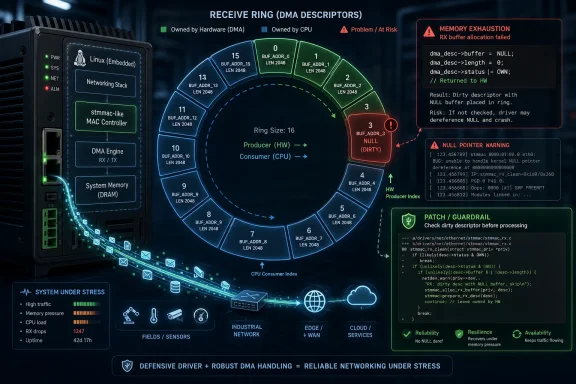
CVE-2026-46110 is rooted in the receive path, where packets arrive through DMA rather than by the CPU copying bytes one by one from hardware. The driver allocates buffers, hands them to the MAC, and later retrieves them after the hardware fills them with incoming frames. This is normal, high-performance kernel plumbing.
The fragile part is the shared ring of descriptors that coordinates ownership between CPU and hardware. Each descriptor points to a buffer and carries an ownership bit: the hardware owns it when it can write a frame, and the CPU owns it when the hardware has finished. The design is efficient because both sides walk the same ring in order, but that efficiency comes with a price: a single ambiguous state can poison the entire receive loop.
The vulnerability appears when memory allocation fails during refill. The driver has consumed a received packet, handed the buffer upward to the network stack, and then needs to allocate a fresh buffer so the descriptor can be returned to the hardware. If that allocation fails, the descriptor can remain in a state that looks, at first glance, like something the CPU should process — except its buffer pointer has already been cleared.
That is the crash. The receive loop checks ownership but does not sufficiently distinguish between a descriptor that contains a packet and a descriptor that is merely dirty because refill could not complete. Under sustained memory pressure, the cursor can catch up with these dirty descriptors and treat a NULL buffer as if it were valid. In kernel space, that does not produce a polite exception dialog. It produces an oops, and often a panic.
That distinction matters. CVE-2026-46110 is not a headline-grabbing remote takeover bug based on the public description. It is a crash condition in a driver’s receive path when RX memory is exhausted long enough for the bookkeeping error to surface. But in real infrastructure, a repeatable crash in network receive handling is still security-relevant because availability is a security property.
The record was still awaiting NVD enrichment at the time of publication, with no NVD CVSS score assigned. That absence should not be read as proof of low severity. NVD enrichment often lags the initial kernel.org CVE publication, especially for kernel bugs where exploitability depends heavily on hardware, configuration, and reachable traffic patterns.
The practical risk turns on three questions administrators can answer faster than a scoring database can. Is the affected driver built and loaded? Is the device using stmmac-backed Ethernet? Can an attacker or noisy network condition contribute to receive pressure while the system is memory constrained? If all three are true, the bug becomes more than an abstract kernel fix.
The public description points to memory starvation as the trigger condition. That does not mean the attacker must already control local memory allocation. Network receive load, system pressure, small embedded memory budgets, and driver-specific allocation behavior can combine in ugly ways. Embedded Linux failures are often not the result of one spectacular exploit step, but of ordinary stress applied to code that assumed ordinary recovery would happen quickly.
A descriptor can be empty and ready for hardware, with ownership set to the MAC and a valid buffer attached. It can be full, with ownership returned to the CPU and a valid buffer containing a received packet. Or it can be dirty: ownership is with the CPU, but the buffer pointer has been cleared because the old packet was consumed and a replacement allocation has not succeeded.
The bug is that the receive loop effectively treated “CPU-owned” as “processable.” That is safe only if every CPU-owned descriptor has a valid buffer. Once refill can fail, that assumption breaks.
The earlier fix referenced in the CVE attempted to prevent one form of the same ambiguity by limiting how far the loop could walk around the ring. That solved the case where the cursor circled all the way back to a descriptor it had dirtied during the same pass. CVE-2026-46110 shows why that was not enough: dirty descriptors can be left behind from a previous incomplete refill, so the cursor does not need a full lap to hit danger.
The new fix changes the logic from an indirect guardrail to an explicit check. Before advancing into the next receive descriptor, the driver checks whether the next entry is dirty and exits the loop if so. That is the kind of patch that looks modest in code review and profound in retrospect. It names the missing state.
The ownership bit was never meant to encode everything the software needed to know. It tells the CPU and MAC whose turn it is, not whether the CPU-side bookkeeping has completed. When refill fails, the descriptor is not ready for hardware, but it is also not a received packet. It sits between worlds.
That liminal state is where kernel bugs thrive. The code path is not obscure because it handles strange packet formats or a rare protocol extension. It is obscure because it is an error path that only matters when allocation fails at the wrong time and the ring cursors align badly afterward. Many production bugs live there: not in the algorithm everyone argues about, but in the cleanup path everyone assumes is “obvious.”
There is also a broader engineering lesson here for driver maintainers. A ring buffer is not just an array with wraparound. It is a state machine, and state machines punish informal state definitions. If a descriptor can be dirty, the code must represent that fact directly rather than hoping loop bounds, cursor distance, or implied ordering will keep the bad state out of sight.
The patch reportedly applies the same treatment to
Routers, firewalls, storage appliances, KVM boxes, building-control gateways, industrial controllers, lab boards, thin clients, and developer appliances often run vendor Linux builds. Many of those systems are ARM-based or SoC-based, precisely the terrain where stmmac-class Ethernet drivers appear. A vulnerability in that layer can take down the device Windows clients rely on without touching a Windows kernel at all.
This is especially relevant for small offices and industrial sites, where embedded devices stay in service long after the people who deployed them have moved on. The device may not advertise its kernel lineage in the management UI. It may receive firmware updates irregularly. It may be treated as “network equipment,” even though its risk profile is closer to a small Linux server with a web dashboard and a specialized NIC.
For enterprise IT, the immediate task is inventory, not panic. You need to know which appliances and boards use affected Linux kernels and whether their Ethernet path depends on stmmac. That information may come from SBOMs, vendor advisories, firmware release notes, kernel config files, boot logs, or support tickets rather than from a neat Windows-style update catalog.
The Windows angle is therefore indirect but real. A crash in an embedded Linux network driver can present to Windows users as dropped file shares, unreachable printers, missing gateways, broken industrial telemetry, intermittent DHCP failures, or mysterious VPN instability. The root cause may be below the level of tools most desktop support teams normally inspect.
Administrators should separate those timelines. A missing NVD score is a missing score, not a missing vulnerability. The real remediation signal comes from whether the relevant stable kernel trees and downstream distributions or vendors have incorporated the fix.
The CVE record lists multiple stable kernel commit references, which indicates that the fix was not treated as a mainline-only cleanup. It was important enough to be carried across stable lines. That usually means downstream Linux vendors, embedded BSP maintainers, and appliance makers will need to decide whether and how to pull it into their supported kernels.
There was also public stable-list traffic indicating at least one backport did not apply cleanly to the 6.1 stable tree at one point. That does not prove a final gap, but it does illustrate a mundane reality of kernel security maintenance: backports are work. Driver code changes over time, and a patch that lands cleanly in one branch may need adjustment in another.
This is why “we run an LTS kernel” is not a complete answer. Long-term support kernels reduce churn, but they still require active maintenance. If a device vendor froze an old branch and does not continuously reconcile stable fixes, the label “LTS” becomes more comforting than protective.
Attack preconditions remain important. The public description does not claim arbitrary code execution, privilege escalation, or data disclosure. It describes a kernel NULL dereference when RX memory is exhausted. That points toward denial of service and reliability failure rather than compromise.
But denial of service in embedded networking is not trivial. A crashed gateway can sever monitoring from physical systems. A crashed storage appliance can interrupt backups. A crashed router can isolate a remote office. A crashed lab controller can invalidate long-running tests. Security teams sometimes underrate availability bugs because they are not “shell obtained” bugs; operations teams rarely make that mistake twice.
The bug also has an uncomfortable asymmetry. The failing condition is local to the device, but the pressure can be environmental. Heavy inbound traffic, bursts, constrained memory, and slow refill recovery can create the conditions under which the receive loop meets a dirty descriptor. Whether that can be weaponized from the network will vary by deployment, but the failure mode sits on the network-facing path.
For cloud and virtualization teams, the direct exposure is narrower unless they manage ARM-based hosts or specialized appliances using this driver. For Windows desktop fleets, the direct exposure is usually nil. For anyone responsible for the mixed infrastructure those desktops depend on, the CVE belongs in the weekly triage pile.
Removing the old clamp is also notable. A cap of
This is the kind of change that often improves both correctness and readability. Future maintainers can see the condition that matters. Reviewers can reason about the state machine directly. The driver no longer relies on a loop limit to paper over a state it has not named.
The CVE description also mentions a related remaining issue in
That caveat is important because it separates crash prevention from perfect recovery. CVE-2026-46110 fixes the NULL dereference, but it does not magically make a memory-starved receive path healthy. Under severe allocation pressure, a system can still degrade, drop traffic, or stall until memory pressure clears or other recovery logic runs. The patch makes the driver safer; it does not repeal physics.
The second step is matching the device’s kernel to vendor updates. General-purpose Linux distributions will usually publish kernel advisories or roll the fix into routine kernel updates. Embedded vendors may publish firmware images without calling out every upstream CVE, or they may lag behind stable trees while validating board-specific changes.
The third step is deciding whether mitigations are possible while waiting. If the affected Ethernet interface is not used, disabling it may be reasonable. If the driver is a module and the hardware is nonessential, blacklisting could reduce exposure. But for many systems, stmmac is the primary network path, so the only real mitigation is a patched kernel or firmware.
The final step is testing under load, not merely confirming that the device boots. Because the bug lives in an RX exhaustion path, validation should include traffic bursts, memory pressure where safe, and monitoring for receive stalls or driver warnings. A security fix that prevents a panic but exposes a latent stall may still require operational tuning.
This is where Windows-heavy organizations often need better Linux observability. If your only monitoring signal for an embedded gateway is “Windows clients can ping it,” you will see this class of problem too late. Kernel logs, firmware versions, interface counters, and vendor support matrices belong in the same asset record as serial numbers and warranty dates.
Yet the operational blast radius can still be broad because embedded Linux is everywhere. The more organizations depend on small networked boxes, the more their reliability depends on kernel maintenance they do not directly control. A Windows shop can patch every PC on schedule and still be dragged down by a firmware image that ships a stale network driver.
The CVE also highlights a weakness in the way vulnerability consumers process kernel records. A newly published entry with no NVD score can look unfinished, and in a clerical sense it is. But the engineering facts may already be clear enough to act: a driver can dereference NULL under memory-starved RX conditions, the fix exists, and stable references are available.
There is a temptation to wait for the database to finish the paperwork. That is risky in environments where availability matters. CVSS is useful for prioritization, but it is not a substitute for knowing what hardware you run and which kernel paths are exposed.
The better posture is boring and disciplined. Track kernel-bearing assets. Know which drivers they use. Subscribe to vendor firmware advisories. Test updates before mass rollout. Treat network appliances as computers, not furniture.
Customers should push for that traceability. The Linux ecosystem gives vendors enormous flexibility, but that flexibility becomes opacity when firmware releases hide kernel deltas. If an appliance is critical enough to route, store, inspect, or translate traffic for Windows systems, it is critical enough to demand clear kernel security lineage.
This also strengthens the case for SBOMs and device attestation in ordinary IT procurement. Security teams do not need a philosophical debate about software supply chains every time a driver CVE appears. They need a searchable inventory that says which products include which kernel families and which drivers are enabled.
For homelab users and Windows enthusiasts experimenting with ARM boards, the advice is simpler. Update to a kernel or vendor image that includes the stable fix. If you build your own kernels, pull the relevant stable branch rather than cherry-picking blindly unless you are prepared to resolve backport conflicts. If the board is exposed to untrusted network traffic and cannot be updated, reduce its exposure.
CVE-2026-46110 will not be the last stmmac issue, and it will not be the last kernel CVE whose importance depends on obscure hardware details. That is the point. The infrastructure stack is now too heterogeneous for Windows administrators to ignore Linux kernel maintenance merely because the vulnerable code does not run on the desktop.
 A Kernel Panic Hiding in a Receive Ring
The stmmac driver is one of those pieces of Linux infrastructure most users never name but many devices quietly depend on. It supports Ethernet MAC hardware derived from the Synopsys DesignWare family and appears across system-on-chip platforms, embedded boards, industrial systems, and vendor appliances. That makes a crash in stmmac less like a desktop app failure and more like a sudden disappearance of the networked box you were counting on.CVE-2026-46110 is rooted in the receive path, where packets arrive through DMA rather than by the CPU copying bytes one by one from hardware. The driver allocates buffers, hands them to the MAC, and later retrieves them after the hardware fills them with incoming frames. This is normal, high-performance kernel plumbing.
The fragile part is the shared ring of descriptors that coordinates ownership between CPU and hardware. Each descriptor points to a buffer and carries an ownership bit: the hardware owns it when it can write a frame, and the CPU owns it when the hardware has finished. The design is efficient because both sides walk the same ring in order, but that efficiency comes with a price: a single ambiguous state can poison the entire receive loop.
The vulnerability appears when memory allocation fails during refill. The driver has consumed a received packet, handed the buffer upward to the network stack, and then needs to allocate a fresh buffer so the descriptor can be returned to the hardware. If that allocation fails, the descriptor can remain in a state that looks, at first glance, like something the CPU should process — except its buffer pointer has already been cleared.
That is the crash. The receive loop checks ownership but does not sufficiently distinguish between a descriptor that contains a packet and a descriptor that is merely dirty because refill could not complete. Under sustained memory pressure, the cursor can catch up with these dirty descriptors and treat a NULL buffer as if it were valid. In kernel space, that does not produce a polite exception dialog. It produces an oops, and often a panic.
The Bug Is About Exhaustion, Not Exotic Exploitation
The phrase “NULL dereference” can undersell the operational impact. On a hardened system, dereferencing NULL is not usually a direct code-execution primitive. It is, however, a clean path to denial of service when it happens inside kernel networking.That distinction matters. CVE-2026-46110 is not a headline-grabbing remote takeover bug based on the public description. It is a crash condition in a driver’s receive path when RX memory is exhausted long enough for the bookkeeping error to surface. But in real infrastructure, a repeatable crash in network receive handling is still security-relevant because availability is a security property.
The record was still awaiting NVD enrichment at the time of publication, with no NVD CVSS score assigned. That absence should not be read as proof of low severity. NVD enrichment often lags the initial kernel.org CVE publication, especially for kernel bugs where exploitability depends heavily on hardware, configuration, and reachable traffic patterns.
The practical risk turns on three questions administrators can answer faster than a scoring database can. Is the affected driver built and loaded? Is the device using stmmac-backed Ethernet? Can an attacker or noisy network condition contribute to receive pressure while the system is memory constrained? If all three are true, the bug becomes more than an abstract kernel fix.
The public description points to memory starvation as the trigger condition. That does not mean the attacker must already control local memory allocation. Network receive load, system pressure, small embedded memory budgets, and driver-specific allocation behavior can combine in ugly ways. Embedded Linux failures are often not the result of one spectacular exploit step, but of ordinary stress applied to code that assumed ordinary recovery would happen quickly.
The Three States the Driver Failed to See
The useful way to understand this CVE is not through the ownership bit alone, but through the lifecycle the descriptor really occupies. The hardware-facing model says there are descriptors owned by the MAC and descriptors owned by the CPU. The software reality has at least one more state.A descriptor can be empty and ready for hardware, with ownership set to the MAC and a valid buffer attached. It can be full, with ownership returned to the CPU and a valid buffer containing a received packet. Or it can be dirty: ownership is with the CPU, but the buffer pointer has been cleared because the old packet was consumed and a replacement allocation has not succeeded.
The bug is that the receive loop effectively treated “CPU-owned” as “processable.” That is safe only if every CPU-owned descriptor has a valid buffer. Once refill can fail, that assumption breaks.
The earlier fix referenced in the CVE attempted to prevent one form of the same ambiguity by limiting how far the loop could walk around the ring. That solved the case where the cursor circled all the way back to a descriptor it had dirtied during the same pass. CVE-2026-46110 shows why that was not enough: dirty descriptors can be left behind from a previous incomplete refill, so the cursor does not need a full lap to hit danger.
The new fix changes the logic from an indirect guardrail to an explicit check. Before advancing into the next receive descriptor, the driver checks whether the next entry is dirty and exits the loop if so. That is the kind of patch that looks modest in code review and profound in retrospect. It names the missing state.
A One-Bit Contract Was Doing Too Much Work
Descriptor rings are everywhere in network drivers because they map cleanly onto how hardware and software share work. They are fast, cache-friendly, and simple enough to reason about when the system is healthy. But CVE-2026-46110 is a reminder that simplicity at the hardware boundary can push complexity into driver invariants.The ownership bit was never meant to encode everything the software needed to know. It tells the CPU and MAC whose turn it is, not whether the CPU-side bookkeeping has completed. When refill fails, the descriptor is not ready for hardware, but it is also not a received packet. It sits between worlds.
That liminal state is where kernel bugs thrive. The code path is not obscure because it handles strange packet formats or a rare protocol extension. It is obscure because it is an error path that only matters when allocation fails at the wrong time and the ring cursors align badly afterward. Many production bugs live there: not in the algorithm everyone argues about, but in the cleanup path everyone assumes is “obvious.”
There is also a broader engineering lesson here for driver maintainers. A ring buffer is not just an array with wraparound. It is a state machine, and state machines punish informal state definitions. If a descriptor can be dirty, the code must represent that fact directly rather than hoping loop bounds, cursor distance, or implied ordering will keep the bad state out of sight.
The patch reportedly applies the same treatment to
stmmac_rx_zc(), the zero-copy receive variant whose structure mirrors the normal receive path. That detail matters because copy-paste divergence is a common source of partial fixes in drivers. When two paths share a design mistake, fixing one path is not a fix; it is a regression waiting for a different workload.Windows Shops Should Care Because Linux Is in the Walls
A Windows administrator may reasonably ask why a Linux stmmac CVE belongs on their radar. The answer is that few Windows environments are purely Windows environments anymore. The endpoints may run Windows 11, the identity stack may be Entra ID, and the virtualization host may be Hyper-V, but the network edge is full of Linux.Routers, firewalls, storage appliances, KVM boxes, building-control gateways, industrial controllers, lab boards, thin clients, and developer appliances often run vendor Linux builds. Many of those systems are ARM-based or SoC-based, precisely the terrain where stmmac-class Ethernet drivers appear. A vulnerability in that layer can take down the device Windows clients rely on without touching a Windows kernel at all.
This is especially relevant for small offices and industrial sites, where embedded devices stay in service long after the people who deployed them have moved on. The device may not advertise its kernel lineage in the management UI. It may receive firmware updates irregularly. It may be treated as “network equipment,” even though its risk profile is closer to a small Linux server with a web dashboard and a specialized NIC.
For enterprise IT, the immediate task is inventory, not panic. You need to know which appliances and boards use affected Linux kernels and whether their Ethernet path depends on stmmac. That information may come from SBOMs, vendor advisories, firmware release notes, kernel config files, boot logs, or support tickets rather than from a neat Windows-style update catalog.
The Windows angle is therefore indirect but real. A crash in an embedded Linux network driver can present to Windows users as dropped file shares, unreachable printers, missing gateways, broken industrial telemetry, intermittent DHCP failures, or mysterious VPN instability. The root cause may be below the level of tools most desktop support teams normally inspect.
The NVD Lag Is Not the Same as a Patch Lag
The NVD page for CVE-2026-46110 was marked as awaiting enrichment, and the CVSS fields were not yet populated. That is common for newly published Linux kernel CVEs. Kernel.org can publish a record and stable references before the vulnerability database ecosystem has finished assigning severity metadata.Administrators should separate those timelines. A missing NVD score is a missing score, not a missing vulnerability. The real remediation signal comes from whether the relevant stable kernel trees and downstream distributions or vendors have incorporated the fix.
The CVE record lists multiple stable kernel commit references, which indicates that the fix was not treated as a mainline-only cleanup. It was important enough to be carried across stable lines. That usually means downstream Linux vendors, embedded BSP maintainers, and appliance makers will need to decide whether and how to pull it into their supported kernels.
There was also public stable-list traffic indicating at least one backport did not apply cleanly to the 6.1 stable tree at one point. That does not prove a final gap, but it does illustrate a mundane reality of kernel security maintenance: backports are work. Driver code changes over time, and a patch that lands cleanly in one branch may need adjustment in another.
This is why “we run an LTS kernel” is not a complete answer. Long-term support kernels reduce churn, but they still require active maintenance. If a device vendor froze an old branch and does not continuously reconcile stable fixes, the label “LTS” becomes more comforting than protective.
Severity Depends on Where the Driver Lives
The highest-risk systems are not necessarily the biggest servers. They are the devices where stmmac is on the primary management or data interface, memory is constrained, and rebooting is operationally expensive. An industrial gateway on a factory floor may be a more interesting target than a developer board on a bench.Attack preconditions remain important. The public description does not claim arbitrary code execution, privilege escalation, or data disclosure. It describes a kernel NULL dereference when RX memory is exhausted. That points toward denial of service and reliability failure rather than compromise.
But denial of service in embedded networking is not trivial. A crashed gateway can sever monitoring from physical systems. A crashed storage appliance can interrupt backups. A crashed router can isolate a remote office. A crashed lab controller can invalidate long-running tests. Security teams sometimes underrate availability bugs because they are not “shell obtained” bugs; operations teams rarely make that mistake twice.
The bug also has an uncomfortable asymmetry. The failing condition is local to the device, but the pressure can be environmental. Heavy inbound traffic, bursts, constrained memory, and slow refill recovery can create the conditions under which the receive loop meets a dirty descriptor. Whether that can be weaponized from the network will vary by deployment, but the failure mode sits on the network-facing path.
For cloud and virtualization teams, the direct exposure is narrower unless they manage ARM-based hosts or specialized appliances using this driver. For Windows desktop fleets, the direct exposure is usually nil. For anyone responsible for the mixed infrastructure those desktops depend on, the CVE belongs in the weekly triage pile.
The Fix Draws a Boundary the Old Code Only Implied
The patch’s conceptual move is straightforward: do not process a descriptor unless the driver can tell it is actually processable. More specifically, the receive path must stop before stepping into a descriptor that refill left dirty. That prevents thecur_rx cursor from colliding with the dirty_rx ambiguity the previous loop clamp only partially avoided.Removing the old clamp is also notable. A cap of
dma_rx_size - 1 is a defensive workaround against one manifestation of the bug, but it does not express the true invariant. The real rule is not “do almost a full ring and hope.” The real rule is “do not cross into dirty territory.”This is the kind of change that often improves both correctness and readability. Future maintainers can see the condition that matters. Reviewers can reason about the state machine directly. The driver no longer relies on a loop limit to paper over a state it has not named.
The CVE description also mentions a related remaining issue in
stmmac_rx(): after the MAC marks the final descriptor complete, it may be unable to generate further DMA-complete interrupts until more empty descriptors are supplied. If refill keeps failing, the receive process risks an indefinite stall. The record says that is not a regression and can be addressed later.That caveat is important because it separates crash prevention from perfect recovery. CVE-2026-46110 fixes the NULL dereference, but it does not magically make a memory-starved receive path healthy. Under severe allocation pressure, a system can still degrade, drop traffic, or stall until memory pressure clears or other recovery logic runs. The patch makes the driver safer; it does not repeal physics.
Patch Management Starts With Finding the Silicon
For administrators, the first step is determining whether the affected code is in use. On Linux systems, stmmac often appears in boot logs under names such asstmmac, dwmac, or platform-specific variants. Kernel configuration may expose CONFIG_STMMAC_ETH, and loaded modules or built-in driver strings can provide clues. Appliances may hide all of that behind vendor firmware.The second step is matching the device’s kernel to vendor updates. General-purpose Linux distributions will usually publish kernel advisories or roll the fix into routine kernel updates. Embedded vendors may publish firmware images without calling out every upstream CVE, or they may lag behind stable trees while validating board-specific changes.
The third step is deciding whether mitigations are possible while waiting. If the affected Ethernet interface is not used, disabling it may be reasonable. If the driver is a module and the hardware is nonessential, blacklisting could reduce exposure. But for many systems, stmmac is the primary network path, so the only real mitigation is a patched kernel or firmware.
The final step is testing under load, not merely confirming that the device boots. Because the bug lives in an RX exhaustion path, validation should include traffic bursts, memory pressure where safe, and monitoring for receive stalls or driver warnings. A security fix that prevents a panic but exposes a latent stall may still require operational tuning.
This is where Windows-heavy organizations often need better Linux observability. If your only monitoring signal for an embedded gateway is “Windows clients can ping it,” you will see this class of problem too late. Kernel logs, firmware versions, interface counters, and vendor support matrices belong in the same asset record as serial numbers and warranty dates.
The Small Driver Bug That Explains a Big Maintenance Problem
CVE-2026-46110 is not spectacular, and that is precisely why it is instructive. The bug is a small state-machine error in a mature driver path. It was found, described, patched, and backported through the ordinary Linux security machinery. Nothing about it requires a grand theory of cyberwar or a cinematic exploit chain.Yet the operational blast radius can still be broad because embedded Linux is everywhere. The more organizations depend on small networked boxes, the more their reliability depends on kernel maintenance they do not directly control. A Windows shop can patch every PC on schedule and still be dragged down by a firmware image that ships a stale network driver.
The CVE also highlights a weakness in the way vulnerability consumers process kernel records. A newly published entry with no NVD score can look unfinished, and in a clerical sense it is. But the engineering facts may already be clear enough to act: a driver can dereference NULL under memory-starved RX conditions, the fix exists, and stable references are available.
There is a temptation to wait for the database to finish the paperwork. That is risky in environments where availability matters. CVSS is useful for prioritization, but it is not a substitute for knowing what hardware you run and which kernel paths are exposed.
The better posture is boring and disciplined. Track kernel-bearing assets. Know which drivers they use. Subscribe to vendor firmware advisories. Test updates before mass rollout. Treat network appliances as computers, not furniture.
The Real Signal Is Whether Your Vendor Can Answer
The most telling question for a vendor is not “are you vulnerable?” but “which kernel commit or stable release contains your fix?” A mature vendor can map CVE-2026-46110 to an upstream patch, a downstream kernel version, a firmware build, and an expected release date. An immature one will offer reassurance without traceability.Customers should push for that traceability. The Linux ecosystem gives vendors enormous flexibility, but that flexibility becomes opacity when firmware releases hide kernel deltas. If an appliance is critical enough to route, store, inspect, or translate traffic for Windows systems, it is critical enough to demand clear kernel security lineage.
This also strengthens the case for SBOMs and device attestation in ordinary IT procurement. Security teams do not need a philosophical debate about software supply chains every time a driver CVE appears. They need a searchable inventory that says which products include which kernel families and which drivers are enabled.
For homelab users and Windows enthusiasts experimenting with ARM boards, the advice is simpler. Update to a kernel or vendor image that includes the stable fix. If you build your own kernels, pull the relevant stable branch rather than cherry-picking blindly unless you are prepared to resolve backport conflicts. If the board is exposed to untrusted network traffic and cannot be updated, reduce its exposure.
CVE-2026-46110 will not be the last stmmac issue, and it will not be the last kernel CVE whose importance depends on obscure hardware details. That is the point. The infrastructure stack is now too heterogeneous for Windows administrators to ignore Linux kernel maintenance merely because the vulnerable code does not run on the desktop.
The Ring Buffer Lesson for This Week’s Patch Queue
The immediate story is narrow enough to be actionable: a Linux Ethernet driver mistook dirty receive descriptors for valid completed packets under memory pressure, and the fix makes that state boundary explicit. The larger story is that device reliability depends on driver error paths being as carefully engineered as the fast paths.- CVE-2026-46110 affects the Linux kernel stmmac Ethernet receive path, not Windows itself.
- The published bug condition is a NULL-pointer dereference when RX memory exhaustion leaves dirty descriptors behind.
- The practical impact is most likely denial of service through kernel crash or severe receive-path failure on affected systems.
- The most relevant assets are embedded Linux devices, ARM or SoC platforms, appliances, gateways, and boards using stmmac-backed Ethernet.
- Administrators should look for vendor kernel or firmware updates rather than waiting for NVD scoring to decide whether the bug exists.
- The fix prevents the crash condition but does not mean memory-starved networking will behave normally under all conditions.
References
- Primary source: NVD / Linux Kernel
Published: 2026-05-29T01:03:24-07:00
NVD - CVE-2026-46110
 nvd.nist.gov
- Security advisory: MSRC
Published: 2026-05-29T01:03:24-07:00
Original feed URL
Security Update Guide - Microsoft Security Response Center
 msrc.microsoft.com
- Related coverage: kernel.googlesource.com
- Related coverage: kernel.org

The Linux Kernel Archives
www.kernel.org
- Related coverage: cateee.net
- Related coverage: gitlab.com


- Related coverage: windowsforum.com
CVE-2026-31649: stmmac jumbo-frame integer underflow and DMA risk on embedded Linux | Windows Forum
CVE-2026-31649 is a newly published Linux kernel vulnerability that turns a small arithmetic mistake in the stmmac Ethernet driver into a potentially...windowsforum.com - Related coverage: cve.imfht.com
CVE-2026-31649: net: stmmac: fix integer underflow in chain mode - Vulnerability Platform
[CRITICAL 9.8] Overview The Linux kernel driver has an integer underflow vulnerability when processing jumbo frames in chain mode. When the linear portion of a packe cve.imfht.com
- Related coverage: isrc.iscas.ac.cn
- Related coverage: st.com
