

CVE-2026-45988 is a newly published Linux kernel vulnerability, disclosed by kernel.org and received by NVD on May 27, 2026, that fixes RxRPC handling of partially decrypted RESPONSE packets by discarding failed packets instead of requeuing them for another processing attempt. The short version is reassuring: this is not a Windows vulnerability, and it is not a mass-market desktop panic. The longer version is more interesting, because it shows how obscure kernel protocol code can become operationally relevant the moment it sits inside a cloud host, a file-service stack, a container estate, or a Windows shop that quietly depends on Linux.
The bug lives in RxRPC, a reliable remote procedure call transport in the Linux kernel that rides over UDP and is used most visibly by AFS-related workloads. The flaw is small enough to fit in a patch note, but the security lesson is bigger: cryptographic packet state is not a place where retry logic gets to be casual. When a packet can be half-transformed and then treated as if it were still pristine, the kernel has moved from “try again later” into the dangerous territory of try again with altered evidence.
The vulnerability description is almost aggressively unglamorous. If an RxRPC RESPONSE packet hits a temporary processing failure, the kernel may leave it partially decrypted and then requeue it for another attempt. The fix is blunt: discard that packet and let the protocol’s challenge-response machinery produce a new one.
That is the kind of change that looks like defensive housekeeping until you remember what layer we are talking about. RxRPC security negotiation depends on a server issuing a CHALLENGE and a client returning a RESPONSE. That exchange is supposed to establish trust for a connection; it is not supposed to become a replay lab inside the kernel’s receive queue.
The key engineering move in the fix is not to repair the half-processed packet. It is to refuse to preserve it. In security-sensitive parsing paths, especially those involving decryption, authentication, and state transitions, the safest object after a failed transform is often no object at all.
This is why CVE-2026-45988 deserves more than a shrug, even while its immediate blast radius appears limited. Modern vulnerability triage often rewards spectacle: remote code execution, public exploit code, ransomware adoption, cloud metadata theft. But many of the bugs that harden the kernel over time are less cinematic. They are the places where old assumptions about memory ownership, packet mutability, retries, and cryptographic state get corrected because the surrounding threat model has become less forgiving.
The Linux kernel documentation describes RxRPC as a two-layer protocol that provides reliable virtual connections over UDP, with a presentation layer conventionally handled using XDR. The Andrew File System is the canonical example of an application that uses it. That means the affected code tends to live near specialized file-service, research, academic, legacy, and infrastructure environments rather than in the daily workflow of a gaming PC or office laptop.
But infrastructure has a habit of making “specialized” code everybody’s problem. A Windows-first organization may still run Linux storage nodes, Linux identity-adjacent services, Linux appliances, Linux-based backup infrastructure, Linux containers, and WSL developer environments. The attack surface that matters is not the one printed on the endpoint inventory spreadsheet; it is the one reachable in the places where production work actually happens.
That is the uncomfortable WindowsForum angle. CVE-2026-45988 does not ask whether your help desk images Windows 11. It asks whether your estate contains Linux kernels that expose or use RxRPC functionality, whether those kernels came from a vendor that has backported the fix, and whether your vulnerability management process can see past Microsoft Patch Tuesday.
The old behavior, as described in the patch trail, allowed certain temporary failures to send the packet back to the queue. That is a common design pattern in networking code: memory pressure or transient unavailability can justify deferring work. But the pattern breaks when the work already performed is not cleanly reversible.
Imagine a mailroom clerk opening a sealed envelope, smudging half the contents while checking it, deciding the scanner is busy, and then putting the envelope back into the incoming pile as if it were unopened. The second clerk no longer sees the original artifact. They see an object that looks procedural but has already been touched by the procedure.
In kernel network code, that distinction matters because the next function in the chain may make decisions based on a packet’s assumed format, authentication status, or relation to a connection. The fix recognizes that a failed cryptographic-processing path cannot always be safely resumed. In this case, the protocol already has a better recovery mechanism: discard the tainted packet and elicit a fresh response through another CHALLENGE.
That is good security engineering. A complex local recovery path would need to prove that every partially processed packet can be restored, that every future code path respects the restoration boundary, and that no unusual allocation or timing failure can leave the object in an ambiguous state again. That is a lot of trust to place in code whose job is to handle hostile network input.
The protocol’s own semantics offer the cleaner answer. If a RESPONSE cannot be processed safely, throw it away and challenge again. If a CHALLENGE cannot be answered because generating a RESPONSE fails, throw that away too and let the server challenge again.
This is a small example of a larger kernel hardening pattern: when the state machine can self-heal through a clean new message, do not preserve suspicious intermediate state just to avoid a round trip. Performance matters, but not enough to keep a cryptographic corpse on the queue.
This is a recurring problem for kernel CVEs. The authoritative fix often arrives first in the kernel tree or stable series, while the vulnerability databases lag behind with severity, affected-version mapping, and vendor-specific advisories. Administrators who wait for every field to be populated can end up treating a patched kernel issue as theoretical simply because the metadata looks unfinished.
The absence of a score is particularly awkward for niche subsystems. CVSS has to answer questions about attack vector, privileges, user interaction, scope, confidentiality, integrity, and availability. For a protocol like RxRPC, the real-world answer depends heavily on whether the module is built, whether it can be loaded, whether an affected service is listening, whether relevant security options are enabled, and whether an attacker can reach the traffic path.
That is why a sane response starts with exposure, not panic. A public CVE with no score is still a public CVE. But for most Windows-heavy environments, the correct first move is not an emergency bridge call; it is finding the Linux kernels that matter and determining whether RxRPC is present, reachable, and patched.
That matters because defenders do not patch CVEs one by one in a vacuum. They patch subsystems. A cluster of fixes in the same corner of the kernel should change how teams think about priority, even if any single CVE looks under-enriched or narrowly applicable.
The pattern is not that RxRPC has suddenly become the new internet-wide disaster protocol. The pattern is that old, specialized kernel code is receiving new scrutiny under modern exploitation assumptions. Areas that once seemed unlikely to be exposed to malicious traffic now intersect with containers, cloud tenants, file-service gateways, build systems, and mixed operating-system fleets.
For security teams, clustering is a useful heuristic. If your scanners show several recent RxRPC or AFS-related kernel CVEs across the same fleet, the right conclusion is not “which one has the scariest score?” It is “why do these systems have this code enabled, who depends on it, and when can we move them to a kernel line carrying the whole batch of fixes?”
WSL puts Linux userlands on Windows endpoints. Azure, AWS, and private virtualization platforms host Linux workloads beside Windows workloads. Kubernetes estates routinely mix Windows worker nodes with Linux control planes and Linux-heavy system components. Security products, backup appliances, NAS devices, observability agents, and identity-adjacent services often run on Linux whether the corporate desktop standard is Windows or not.
CVE-2026-45988 is a reminder that kernel exposure is not governed by brand identity. If a Windows administrator is responsible for the availability of a service, the underlying kernel is part of the Windows administrator’s risk whether or not it boots into a Microsoft logo.
That does not mean every help desk needs to become a kernel engineering team. It does mean patch governance needs to include non-Windows infrastructure with the same seriousness applied to cumulative updates, Defender platform updates, and Exchange emergency fixes. The organizations that stumble are often not the ones with no Linux expertise. They are the ones where Linux exists, but nobody owns it with the same procedural discipline as Windows.
WSL 2 uses a real Linux kernel supplied and serviced through Microsoft’s WSL distribution mechanism, not a random upstream kernel compiled by the user. That makes its exposure different from a general-purpose Linux server. It also means the relevant question is not “does Ubuntu inside WSL have a patched package?” so much as “which WSL kernel is installed, and has Microsoft incorporated the upstream or equivalent fix?”
There is also the practical matter of attack surface. RxRPC is not typically the first thing one expects to be exposed from a developer’s WSL instance to an untrusted network. Most WSL risk comes from developer tooling, local file sharing boundaries, credentials, package ecosystems, and network services the user deliberately starts.
Still, WSL should not be a blind spot. Developer workstations often hold credentials that are more valuable than the workstation itself. If a Linux kernel component receives a security fix, the responsible posture is to let WSL update rather than freeze it because “it is only a dev box.”
Administrators should resist both extremes. It is lazy to declare every Linux host exposed because the CVE says “Linux kernel.” It is equally lazy to dismiss the issue because RxRPC sounds obscure.
A practical triage flow begins with asset classification. Systems running AFS clients or services, research computing environments, file-service gateways, custom RPC workloads, or kernels with RxRPC modules available deserve closer attention. General-purpose Linux servers with no RxRPC module loaded and no dependency on AFS-like functionality may fall into normal kernel maintenance rather than urgent mitigation.
Reachability matters too. A remotely triggerable path on a bound service is more urgent than dormant code that requires local module loading or a specialized configuration. But reachability should be assessed, not guessed. In cloud and container environments, what appears unreachable from the internet may still be reachable from neighboring workloads, build runners, test networks, or compromised internal hosts.
That is both a strength and a weakness of the ecosystem. The strength is that the fix is public, reviewable, and backportable across supported stable lines. The weakness is that enterprises often consume vulnerability intelligence through CVE records, not mailing list archaeology. By the time NVD receives and enriches the record, the people most capable of acting may already have moved on, while the people most dependent on dashboards may still be waiting for a number.
For IT teams, the lesson is not to monitor every kernel mailing list manually. That would be absurd. The lesson is to depend on vendors and distributions that do this work well, and to understand that distro advisories may be more actionable than bare NVD entries for kernel issues.
If your Linux fleet is mostly Ubuntu, Debian, Red Hat, SUSE, Amazon Linux, Oracle Linux, or a managed appliance vendor, the authoritative remediation path is likely the vendor kernel update, not a hand-applied upstream patch. The upstream commit tells you what changed; the distribution advisory tells you what package version your systems need.
Kernel CVEs create administrative drag. They require inventory, vendor mapping, reboot planning, workload failover, maintenance windows, and sometimes awkward conversations with appliance suppliers that expose a shell only when something has already gone wrong. The risk may be narrow, but the remediation process can still be broad.
This is where Windows administrators have an advantage if they apply their existing patch discipline. Windows shops are used to cumulative updates, reboot orchestration, test rings, and change windows. The trick is extending that muscle memory to Linux rather than treating Linux updates as artisanal maintenance performed by whichever engineer last touched the box.
A good kernel patch process should not depend on a CVE becoming famous. If an affected host is in a low-risk group, it can ride the next scheduled kernel update. If it is in a high-risk group, it gets accelerated. Either way, the decision should come from exposure and business impact, not from waiting for social media to decide whether the bug is interesting.
Retry behavior is a classic example. In a benign model, requeueing a packet after a temporary memory allocation failure is a resilience feature. In a hostile model, every transition from “untrusted bytes” to “parsed state” to “decrypted buffer” must be treated as a one-way door unless explicitly designed otherwise.
The kernel has spent years hardening these boundaries. Packet buffers are cloned, shared, linearized, fragmented, reassembled, decrypted, and passed across layers. Each optimization saves cycles until the day it confuses ownership or mutability. CVE-2026-45988 is small, but it belongs to that family of bugs where the dangerous object is not the packet alone; it is the kernel’s belief about what state the packet is in.
This is why defensive fixes often remove paths instead of adding them. A retry path is useful only if the object being retried is semantically unchanged. Once a packet has been partially decrypted, the code can either grow a complicated theory of safe restoration or admit that the packet should die. The patch chooses the latter.
That lesson applies beyond RxRPC. Authentication handshakes, TLS termination, VPN packet handling, storage replication, filesystem journaling, and identity protocols all have moments where a failed transform leaves behind an object that looks reusable. The safe design answer is often to burn it and ask the peer to retransmit or renegotiate.
This can feel wasteful. Dropping a packet creates extra traffic. Rechallenging a client adds latency. Discarding intermediate work can offend engineers trained to preserve every possible cycle. But reliability is not the same as persistence. A system can be more reliable because it refuses to continue with state it cannot trust.
For administrators, this is a useful way to evaluate vendor fixes. The strongest patches often simplify the state machine. They make the invalid path impossible or terminal. They do not merely add another conditional around a misunderstood object and hope no one finds the next path around it.
CVE-2026-45988 will probably not become a household name. It may never generate the kind of exploit branding that turns a bug into a logo, a scanner rule, and a board slide. But defenders should not confuse quiet with meaningless.
A low-noise kernel CVE can still be a useful test of organizational maturity. Do you know where your Linux kernels are? Do you know which ones are vendor-maintained? Do you know which appliances quietly embed them? Do your Windows and Linux patch calendars speak to each other, or do they exist in separate universes?
The bug lives in RxRPC, a reliable remote procedure call transport in the Linux kernel that rides over UDP and is used most visibly by AFS-related workloads. The flaw is small enough to fit in a patch note, but the security lesson is bigger: cryptographic packet state is not a place where retry logic gets to be casual. When a packet can be half-transformed and then treated as if it were still pristine, the kernel has moved from “try again later” into the dangerous territory of try again with altered evidence.
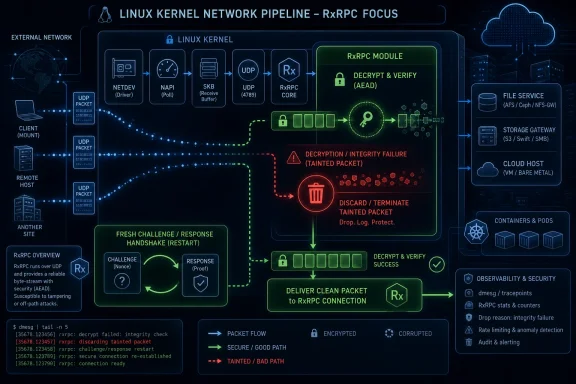 A Tiny Retry Bug Exposes a Large Kernel Truth
The vulnerability description is almost aggressively unglamorous. If an RxRPC RESPONSE packet hits a temporary processing failure, the kernel may leave it partially decrypted and then requeue it for another attempt. The fix is blunt: discard that packet and let the protocol’s challenge-response machinery produce a new one.That is the kind of change that looks like defensive housekeeping until you remember what layer we are talking about. RxRPC security negotiation depends on a server issuing a CHALLENGE and a client returning a RESPONSE. That exchange is supposed to establish trust for a connection; it is not supposed to become a replay lab inside the kernel’s receive queue.
The key engineering move in the fix is not to repair the half-processed packet. It is to refuse to preserve it. In security-sensitive parsing paths, especially those involving decryption, authentication, and state transitions, the safest object after a failed transform is often no object at all.
This is why CVE-2026-45988 deserves more than a shrug, even while its immediate blast radius appears limited. Modern vulnerability triage often rewards spectacle: remote code execution, public exploit code, ransomware adoption, cloud metadata theft. But many of the bugs that harden the kernel over time are less cinematic. They are the places where old assumptions about memory ownership, packet mutability, retries, and cryptographic state get corrected because the surrounding threat model has become less forgiving.
RxRPC Is Obscure, Not Irrelevant
RxRPC is not SMB, RDP, SSH, or HTTP. Most Windows administrators will never deliberately configure it, and most consumer Linux users will never know whether their distribution even builds the relevant pieces. That obscurity is real, but it is not the same as irrelevance.The Linux kernel documentation describes RxRPC as a two-layer protocol that provides reliable virtual connections over UDP, with a presentation layer conventionally handled using XDR. The Andrew File System is the canonical example of an application that uses it. That means the affected code tends to live near specialized file-service, research, academic, legacy, and infrastructure environments rather than in the daily workflow of a gaming PC or office laptop.
But infrastructure has a habit of making “specialized” code everybody’s problem. A Windows-first organization may still run Linux storage nodes, Linux identity-adjacent services, Linux appliances, Linux-based backup infrastructure, Linux containers, and WSL developer environments. The attack surface that matters is not the one printed on the endpoint inventory spreadsheet; it is the one reachable in the places where production work actually happens.
That is the uncomfortable WindowsForum angle. CVE-2026-45988 does not ask whether your help desk images Windows 11. It asks whether your estate contains Linux kernels that expose or use RxRPC functionality, whether those kernels came from a vendor that has backported the fix, and whether your vulnerability management process can see past Microsoft Patch Tuesday.
The Bug Is About State, Not Just Packets
The phrase “partially decrypted” should make any kernel engineer sit up straighter. Decryption is not simply a read operation. It can mutate buffers, advance state, consume metadata, and alter the meaning of the bytes that remain.The old behavior, as described in the patch trail, allowed certain temporary failures to send the packet back to the queue. That is a common design pattern in networking code: memory pressure or transient unavailability can justify deferring work. But the pattern breaks when the work already performed is not cleanly reversible.
Imagine a mailroom clerk opening a sealed envelope, smudging half the contents while checking it, deciding the scanner is busy, and then putting the envelope back into the incoming pile as if it were unopened. The second clerk no longer sees the original artifact. They see an object that looks procedural but has already been touched by the procedure.
In kernel network code, that distinction matters because the next function in the chain may make decisions based on a packet’s assumed format, authentication status, or relation to a connection. The fix recognizes that a failed cryptographic-processing path cannot always be safely resumed. In this case, the protocol already has a better recovery mechanism: discard the tainted packet and elicit a fresh response through another CHALLENGE.
The Patch Chooses Protocol Recovery Over Local Cleverness
The most interesting thing about the fix is its lack of cleverness. It does not add a new “partially decrypted” flag, invent a rollback buffer, or teach the retry path to distinguish safe from unsafe failures. It removes the retry behavior for these queued connection events and frees the packet after processing.That is good security engineering. A complex local recovery path would need to prove that every partially processed packet can be restored, that every future code path respects the restoration boundary, and that no unusual allocation or timing failure can leave the object in an ambiguous state again. That is a lot of trust to place in code whose job is to handle hostile network input.
The protocol’s own semantics offer the cleaner answer. If a RESPONSE cannot be processed safely, throw it away and challenge again. If a CHALLENGE cannot be answered because generating a RESPONSE fails, throw that away too and let the server challenge again.
This is a small example of a larger kernel hardening pattern: when the state machine can self-heal through a clean new message, do not preserve suspicious intermediate state just to avoid a round trip. Performance matters, but not enough to keep a cryptographic corpse on the queue.
NVD’s Empty Score Is a Signal, Not a Verdict
At publication time, NVD lists CVE-2026-45988 as awaiting enrichment, with no CVSS 4.0, 3.x, or 2.0 score assigned by NIST. That does not mean the bug is harmless. It means the public record has not yet been fully normalized into the scoring machinery that many dashboards rely on.This is a recurring problem for kernel CVEs. The authoritative fix often arrives first in the kernel tree or stable series, while the vulnerability databases lag behind with severity, affected-version mapping, and vendor-specific advisories. Administrators who wait for every field to be populated can end up treating a patched kernel issue as theoretical simply because the metadata looks unfinished.
The absence of a score is particularly awkward for niche subsystems. CVSS has to answer questions about attack vector, privileges, user interaction, scope, confidentiality, integrity, and availability. For a protocol like RxRPC, the real-world answer depends heavily on whether the module is built, whether it can be loaded, whether an affected service is listening, whether relevant security options are enabled, and whether an attacker can reach the traffic path.
That is why a sane response starts with exposure, not panic. A public CVE with no score is still a public CVE. But for most Windows-heavy environments, the correct first move is not an emergency bridge call; it is finding the Linux kernels that matter and determining whether RxRPC is present, reachable, and patched.
This Is Part of a Noisier RxRPC Season
CVE-2026-45988 did not appear in isolation. Recent kernel security chatter has included multiple RxRPC-adjacent fixes involving RESPONSE handling, challenge processing, packet mutability, and in-place decryption behavior. Some of those issues have been discussed in more dramatic terms than this one, especially where researchers and distributions have focused on exploitability chains and local privilege escalation scenarios.That matters because defenders do not patch CVEs one by one in a vacuum. They patch subsystems. A cluster of fixes in the same corner of the kernel should change how teams think about priority, even if any single CVE looks under-enriched or narrowly applicable.
The pattern is not that RxRPC has suddenly become the new internet-wide disaster protocol. The pattern is that old, specialized kernel code is receiving new scrutiny under modern exploitation assumptions. Areas that once seemed unlikely to be exposed to malicious traffic now intersect with containers, cloud tenants, file-service gateways, build systems, and mixed operating-system fleets.
For security teams, clustering is a useful heuristic. If your scanners show several recent RxRPC or AFS-related kernel CVEs across the same fleet, the right conclusion is not “which one has the scariest score?” It is “why do these systems have this code enabled, who depends on it, and when can we move them to a kernel line carrying the whole batch of fixes?”
Windows Shops Still Own Their Linux Kernel Risk
The phrase “Linux kernel CVE” can lull Windows administrators into thinking the issue belongs to somebody else. That was easier to believe fifteen years ago, when Windows servers, Linux servers, and network appliances lived in more clearly separated operational worlds. It is harder to defend now.WSL puts Linux userlands on Windows endpoints. Azure, AWS, and private virtualization platforms host Linux workloads beside Windows workloads. Kubernetes estates routinely mix Windows worker nodes with Linux control planes and Linux-heavy system components. Security products, backup appliances, NAS devices, observability agents, and identity-adjacent services often run on Linux whether the corporate desktop standard is Windows or not.
CVE-2026-45988 is a reminder that kernel exposure is not governed by brand identity. If a Windows administrator is responsible for the availability of a service, the underlying kernel is part of the Windows administrator’s risk whether or not it boots into a Microsoft logo.
That does not mean every help desk needs to become a kernel engineering team. It does mean patch governance needs to include non-Windows infrastructure with the same seriousness applied to cumulative updates, Defender platform updates, and Exchange emergency fixes. The organizations that stumble are often not the ones with no Linux expertise. They are the ones where Linux exists, but nobody owns it with the same procedural discipline as Windows.
WSL Is Probably Not the Center of This Story
For many readers, the first Windows-adjacent question will be WSL. Does CVE-2026-45988 affect Windows Subsystem for Linux? The safest answer is that WSL should not be assumed vulnerable merely because the CVE is in the Linux kernel, but WSL environments should still be kept current through Microsoft’s kernel update channel.WSL 2 uses a real Linux kernel supplied and serviced through Microsoft’s WSL distribution mechanism, not a random upstream kernel compiled by the user. That makes its exposure different from a general-purpose Linux server. It also means the relevant question is not “does Ubuntu inside WSL have a patched package?” so much as “which WSL kernel is installed, and has Microsoft incorporated the upstream or equivalent fix?”
There is also the practical matter of attack surface. RxRPC is not typically the first thing one expects to be exposed from a developer’s WSL instance to an untrusted network. Most WSL risk comes from developer tooling, local file sharing boundaries, credentials, package ecosystems, and network services the user deliberately starts.
Still, WSL should not be a blind spot. Developer workstations often hold credentials that are more valuable than the workstation itself. If a Linux kernel component receives a security fix, the responsible posture is to let WSL update rather than freeze it because “it is only a dev box.”
The Real Triage Starts With Build and Reachability
The most useful operational question is whether affected code is present and usable. Linux kernels are not monolithically identical across distributions, appliances, and cloud images. A vulnerability in a subsystem may be irrelevant on one machine, compiled as a loadable module on another, and built into the kernel on a third.Administrators should resist both extremes. It is lazy to declare every Linux host exposed because the CVE says “Linux kernel.” It is equally lazy to dismiss the issue because RxRPC sounds obscure.
A practical triage flow begins with asset classification. Systems running AFS clients or services, research computing environments, file-service gateways, custom RPC workloads, or kernels with RxRPC modules available deserve closer attention. General-purpose Linux servers with no RxRPC module loaded and no dependency on AFS-like functionality may fall into normal kernel maintenance rather than urgent mitigation.
Reachability matters too. A remotely triggerable path on a bound service is more urgent than dormant code that requires local module loading or a specialized configuration. But reachability should be assessed, not guessed. In cloud and container environments, what appears unreachable from the internet may still be reachable from neighboring workloads, build runners, test networks, or compromised internal hosts.
The Stable Kernel Machinery Did Its Job, But Slowly Enough to Notice
The fix associated with this vulnerability was already moving through stable kernel review before the NVD entry appeared. That sequence is typical. Linux security fixes often become visible first as commits, mailing list posts, stable queue entries, and distribution patches, with CVE records and scoring added later.That is both a strength and a weakness of the ecosystem. The strength is that the fix is public, reviewable, and backportable across supported stable lines. The weakness is that enterprises often consume vulnerability intelligence through CVE records, not mailing list archaeology. By the time NVD receives and enriches the record, the people most capable of acting may already have moved on, while the people most dependent on dashboards may still be waiting for a number.
For IT teams, the lesson is not to monitor every kernel mailing list manually. That would be absurd. The lesson is to depend on vendors and distributions that do this work well, and to understand that distro advisories may be more actionable than bare NVD entries for kernel issues.
If your Linux fleet is mostly Ubuntu, Debian, Red Hat, SUSE, Amazon Linux, Oracle Linux, or a managed appliance vendor, the authoritative remediation path is likely the vendor kernel update, not a hand-applied upstream patch. The upstream commit tells you what changed; the distribution advisory tells you what package version your systems need.
CVSS Will Not Capture the Whole Administrative Cost
When NVD eventually enriches CVE-2026-45988, the score may end up modest, medium, or more severe depending on how assessors interpret exploitability and impact. Whatever the number, it will not capture the most expensive part for many organizations: proving where the vulnerable code exists.Kernel CVEs create administrative drag. They require inventory, vendor mapping, reboot planning, workload failover, maintenance windows, and sometimes awkward conversations with appliance suppliers that expose a shell only when something has already gone wrong. The risk may be narrow, but the remediation process can still be broad.
This is where Windows administrators have an advantage if they apply their existing patch discipline. Windows shops are used to cumulative updates, reboot orchestration, test rings, and change windows. The trick is extending that muscle memory to Linux rather than treating Linux updates as artisanal maintenance performed by whichever engineer last touched the box.
A good kernel patch process should not depend on a CVE becoming famous. If an affected host is in a low-risk group, it can ride the next scheduled kernel update. If it is in a high-risk group, it gets accelerated. Either way, the decision should come from exposure and business impact, not from waiting for social media to decide whether the bug is interesting.
The Fix Also Says Something About Kernel Design Debt
The patch note references a very old foundation: secure RxRPC socket support added years ago for use by both user space and kernel consumers. That lineage matters. Many Linux kernel vulnerabilities are not newly introduced in the sense of “someone wrote bad code last week.” They are old assumptions colliding with newer code paths, newer security features, newer deployment models, and newer adversary attention.Retry behavior is a classic example. In a benign model, requeueing a packet after a temporary memory allocation failure is a resilience feature. In a hostile model, every transition from “untrusted bytes” to “parsed state” to “decrypted buffer” must be treated as a one-way door unless explicitly designed otherwise.
The kernel has spent years hardening these boundaries. Packet buffers are cloned, shared, linearized, fragmented, reassembled, decrypted, and passed across layers. Each optimization saves cycles until the day it confuses ownership or mutability. CVE-2026-45988 is small, but it belongs to that family of bugs where the dangerous object is not the packet alone; it is the kernel’s belief about what state the packet is in.
This is why defensive fixes often remove paths instead of adding them. A retry path is useful only if the object being retried is semantically unchanged. Once a packet has been partially decrypted, the code can either grow a complicated theory of safe restoration or admit that the packet should die. The patch chooses the latter.
Discarding Bad State Is the Security Story
The operational temptation is to reduce CVE-2026-45988 to a yes-or-no checklist: affected kernel, patched kernel, done. That is necessary, but it misses the durable lesson. The vulnerability exists because a failure path preserved state that should have been treated as contaminated.That lesson applies beyond RxRPC. Authentication handshakes, TLS termination, VPN packet handling, storage replication, filesystem journaling, and identity protocols all have moments where a failed transform leaves behind an object that looks reusable. The safe design answer is often to burn it and ask the peer to retransmit or renegotiate.
This can feel wasteful. Dropping a packet creates extra traffic. Rechallenging a client adds latency. Discarding intermediate work can offend engineers trained to preserve every possible cycle. But reliability is not the same as persistence. A system can be more reliable because it refuses to continue with state it cannot trust.
For administrators, this is a useful way to evaluate vendor fixes. The strongest patches often simplify the state machine. They make the invalid path impossible or terminal. They do not merely add another conditional around a misunderstood object and hope no one finds the next path around it.
The Patch Queue Is the Message
The close reading of this CVE is simple: update affected Linux kernels through your vendor, especially where RxRPC or AFS-related functionality is present. The broader reading is more strategic: Linux kernel subsystems once considered fringe are now part of enterprise attack-surface management because infrastructure has become heterogeneous by default.CVE-2026-45988 will probably not become a household name. It may never generate the kind of exploit branding that turns a bug into a logo, a scanner rule, and a board slide. But defenders should not confuse quiet with meaningless.
A low-noise kernel CVE can still be a useful test of organizational maturity. Do you know where your Linux kernels are? Do you know which ones are vendor-maintained? Do you know which appliances quietly embed them? Do your Windows and Linux patch calendars speak to each other, or do they exist in separate universes?
The Admin’s RxRPC Reality Check
For most WindowsForum readers, the right response is neither alarm nor indifference. Treat CVE-2026-45988 as a kernel maintenance and exposure-validation item, with priority rising sharply in environments that actually use RxRPC, AFS, or specialized Linux file-service infrastructure.- Systems running vendor-supported Linux kernels should receive the appropriate kernel updates through their normal distribution or appliance update channels.
- Hosts that use AFS, RxRPC, or related file-service workloads deserve higher priority than generic Linux servers with no evidence of the affected subsystem being present or reachable.
- WSL users should keep the WSL kernel current, but this CVE should not be treated as evidence of a broad Windows desktop compromise path.
- Security teams should avoid relying solely on NVD scoring because this record was published before NIST provided enriched CVSS data.
- Mixed Windows and Linux estates should handle this as a reminder to inventory Linux kernel exposure with the same discipline used for Microsoft cumulative updates.
References
- Primary source: NVD / Linux Kernel
Published: 2026-05-28T01:08:34-07:00
NVD - CVE-2026-45988
 nvd.nist.gov
- Security advisory: MSRC
Published: 2026-05-28T01:08:34-07:00
Original feed URL
Security Update Guide - Microsoft Security Response Center
 msrc.microsoft.com
- Related coverage: docs.kernel.org

RxRPC Network Protocol — The Linux Kernel documentation
docs.kernel.org
- Related coverage: kernel.org
- Related coverage: spinics.net
[PATCH net v5 20/21] rxrpc: only handle RESPONSE during service challenge — Linux Kernel
Linux Kernel: [PATCH net v5 20/21] rxrpc: only handle RESPONSE during service challenge www.spinics.net
- Related coverage: stack.watch


- Related coverage: kernel.googlesource.com
- Related coverage: windowsforum.com
CVE-2026-31676 RxRPC Linux Kernel Fix: What Windows Admins Should Do | Windows Forum
CVE-2026-31676 is not the kind of Linux kernel flaw that usually generates splashy headlines, but it is exactly the sort of subtle networking bug that...windowsforum.com - Related coverage: labs.cloudsecurityalliance.org
CSA research note dirty frag linux lpe zero day aiml infrastructure 20260508 csa styled 2
PDF documentlabs.cloudsecurityalliance.org
- Related coverage: docs.redhat.com
