

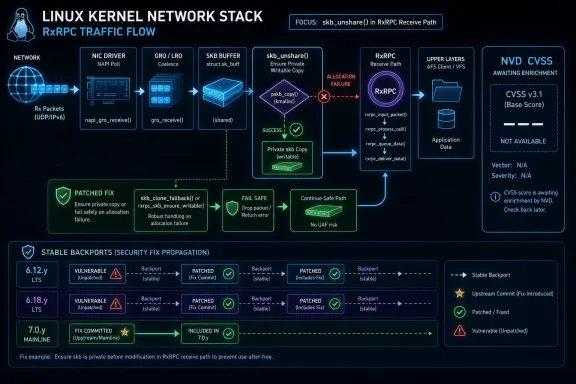
skb_unshare() fails during packet handling. The bug is not yet scored by NVD, and that absence of a CVSS number is the most important fact for administrators to understand rather than ignore. This is a small patch in a specialized subsystem, but it lands in the middle of a broader month of scrutiny around Linux packet-buffer handling, RxRPC, and fragment-related kernel fixes. The practical lesson is familiar: obscure kernel paths are still production attack surface when they ship in general-purpose distributions.
A Low-Drama CVE With a High-Value Lesson
The first temptation with CVE-2026-45998 is to dismiss it as another kernel housekeeping entry: a short commit message, no NVD score, no public exploit narrative, and a subsystem most desktop users have never knowingly touched. That would be too casual. Kernel vulnerabilities rarely announce their importance in the same language operators use to prioritize patch windows.
This one sits in RxRPC, the Linux implementation of the Remote Procedure Call protocol used by AFS-style networking. That is not the center of the modern WindowsForum reader’s daily life in the way SMB, RDP, WireGuard, or Hyper-V networking might be. But the Linux kernel is not a menu of only the features you actively use; it is a dense set of compiled, loadable, reachable, and sometimes indirectly exercised subsystems.
The immediate bug is technical and narrow. If the kernel tried to unshare a socket buffer and memory allocation failed, one caller could be left with a nullified packet pointer, while later tracing logic still expected a valid object. In kernel terms, that is the kind of lifetime-management stumble that can move from “oops” to “security issue” depending on timing, reachability, and surrounding code.
What makes CVE-2026-45998 interesting is not that it is obviously the next internet-burning emergency. It is that it shows how the Linux CVE pipeline is increasingly surfacing fixes that are already in stable trees before the vulnerability databases have finished assigning severity, affected-version metadata, or neat enterprise dashboards. The patch exists. The record exists. The risk score does not.
That gap is where real-world patch management lives.
The Bug Is a Pointer-Lifetime Failure, Not a Protocol Meltdown
At the center of the fix is skb_unshare(), a kernel helper used when packet data must be made private before modification. Linux network packets are represented by socket buffers, or sk_buff structures, and the kernel tries hard not to copy packet data unnecessarily. That efficiency is one of the reasons the network stack performs well, but shared packet memory makes ownership rules unforgiving.
The vulnerable path involved rxrpc_input_packet(), rxrpc_io_thread(), and later tracing through trace_rxrpc_rx_done(). According to the kernel description, if skb_unshare() failed because of an allocation failure, the skb pointer in the parent path could be set to NULL. The subsequent trace call could then trip over that expectation mismatch and oops the kernel.
That sounds like a denial-of-service bug on its face: induce the right memory-pressure condition, hit the right receive path, and the kernel may fall over. The CVE language calls it a potential use-after-free, which is a category administrators correctly treat with suspicion. A UAF can be merely crashy, or it can become a primitive in a more serious exploit chain.
There is no public NVD severity yet, and the record currently provides no NVD CVSS v4, v3, or v2 vector. That should keep people from inventing precision. It should not keep them from patching.
The fix itself is elegant in the way many good kernel fixes are elegant: do less work earlier. Rather than unsharing the packet at a higher level where later code still has to reason about multiple discard paths, the patch moves the unsharing closer to the point where rxrpc_input_call_event() calls rxrpc_input_call_packet(). In plain English, the kernel now waits until it knows the packet really needs that operation.
That matters because the original path included cases where DATA packets were ignored before they ever needed to be unshared. A call may already be complete. A packet may be irrelevant for another reason. Avoiding the unshare entirely in those cases is not just a performance cleanup; it reduces the number of places where ownership can be lost.
RxRPC Is Obscure Until It Is in Your Kernel
RxRPC is one of those subsystems that lives outside the attention economy of mainstream endpoint security. It does not get splashy product launches. It does not have consumer branding. Most administrators will encounter it only when a vulnerability scanner flags it, a kernel changelog mentions it, or a mitigation guide tells them to check whether the module is present.
That obscurity can be dangerous. Enterprises run Linux in places where the installed kernel configuration is inherited from a vendor, a cloud image, a storage appliance, a container host, or a distribution default. A feature does not need to be mission-critical to be included. It only needs to be compiled, loadable, reachable by local users, or exposed through a path an administrator did not know existed.
For Windows-centric shops, this matters because Linux is now infrastructure glue. It is the WSL instance on a developer workstation, the Ubuntu VM hosting CI runners, the appliance behind an identity product, the Kubernetes node under a Windows-heavy application stack, or the NAS that everyone forgets until it breaks. The old mental division between “Windows patching” and “Linux patching” has not matched reality for years.
RxRPC specifically is associated with AFS-style remote procedure call functionality. That narrows the set of environments where direct exposure is likely. But the module’s presence in general kernels means the right question is not “Do we knowingly run AFS?” The better question is “Is this code present, can it be loaded, and has our vendor already shipped the fix?”
That distinction is where many patch programs still stumble. Vulnerability management tools like crisp CPEs, ranked severities, and affected-product tables. Kernel exposure often looks messier: build options, backports, distribution patches, module availability, and whether a subsystem is compiled in or loadable.
NVD’s Empty Score Is Not an Empty Risk
The NVD entry for CVE-2026-45998 is marked as awaiting enrichment. That means the record is public, but the vulnerability database has not yet completed the work of attaching full scoring, weakness mapping, and product configuration metadata. This is common enough to be routine, but it creates a familiar operational failure mode: scanners shout less loudly when the score field is blank.
A missing CVSS number is not a severity rating of zero. It is a workflow state. The upstream kernel project has already treated the bug as worth fixing and assigning through the CVE process. Stable-tree references exist. The code change is available across multiple kernel lines.
Security teams should be especially careful with newly published kernel CVEs because the timeline usually does not align neatly with enterprise reporting. A patch can land upstream, then be backported, then appear in distribution errata, then get a CVE record, then receive NVD enrichment. Depending on the vendor, the package you need may be available before your scanner has a satisfying label for the risk.
That lag cuts both ways. It would be reckless to inflate CVE-2026-45998 into a confirmed remote-code-execution emergency without evidence. It would also be reckless to ignore it because the public database has not yet assigned a score. The correct posture is conditional urgency: identify exposure, track vendor kernels, and fold the fix into the next reasonable kernel update cycle unless your environment has reason to accelerate.
For many systems, the operational cost of a kernel update is higher than an application patch. Reboots, live-patching support, clustered failover, driver compatibility, and appliance certification all matter. But that is precisely why unscored kernel CVEs need early attention. If you wait for the score, you may be starting the change-control process after the fix has already been available for weeks.
Stable Backports Tell the Real Story
The references attached to CVE-2026-45998 point to multiple stable kernel commits, which is the strongest practical signal in the current record. The Linux stable process is not a press-release machine; it is a machinery for getting fixes into maintained kernel branches. When a vulnerability fix appears across those branches, administrators should look less at the glamour of the CVE page and more at whether their distribution has consumed the relevant backport.
Public stable-kernel mailings show the patch moving through recent kernel series, including 6.12, 6.18, and 7.0 update streams. The upstream commit was authored by David Howells, with stable handling by Greg Kroah-Hartman in the stable release flow. The bug is tied to an earlier receive-path simplification in RxRPC, which is typical of regressions in high-performance kernel code: a cleanup changes ownership assumptions, and a rare allocation-failure path exposes the sharp edge.
That origin matters. This is not described as an ancient bug hiding untouched since the dawn of AFS. It appears connected to recent receive-path changes. For administrators, that means affectedness is less about whether a system has used RxRPC for a decade and more about which kernel lineage and backports it is running.
Kernel versions in vendor distributions also complicate the picture. A Red Hat, Ubuntu, Oracle, Debian, SUSE, Proxmox, or appliance kernel may carry a version number that does not map cleanly to upstream stable status. Vendors routinely backport security fixes without moving to the latest upstream kernel. Conversely, a system with a newer-looking kernel might still require a specific vendor advisory to know whether this particular patch is present.
The only reliable answer is to check the vendor changelog or errata for the shipped kernel package. Grepping upstream versions is a start, not a conclusion.
The Failure Mode Is Memory Pressure Meeting Network Edge Cases
The phrase “allocation failure” can make a vulnerability sound theoretical. In normal operation, many servers have enough memory, and allocation failures are not supposed to be routine. But kernel security history has repeatedly shown that low-memory paths are security-relevant because they are under-tested, timing-sensitive, and full of cleanup code that runs when assumptions are already breaking down.
The receive path in a network stack is especially unforgiving. Packets arrive asynchronously. References must be dropped exactly once. Shared data must be copied only when needed. Tracing and accounting must observe state without changing object lifetimes. The fastest path is the one developers optimize, but the weirdest path is often the one attackers study.
CVE-2026-45998 is not, from the public record, a confirmed privilege-escalation exploit. But the ingredients are recognizable: packet buffers, ownership transfer, shared memory, allocation failure, and a later use site. Those are the ingredients that make kernel maintainers conservative.
The patch’s decision to move skb_unshare() later also reduces unnecessary work for packets that will be ignored. That is more than a correctness fix. It is a reminder that minimizing state transitions is a security strategy. Every premature transformation of a shared packet creates another path where cleanup code, tracing code, and caller expectations can diverge.
Kernel bugs often become serious not because any one line looks dramatic, but because several ordinary lines make incompatible assumptions. One function thinks it has consumed the packet. Another still wants to log it. A parent caller thinks its pointer still points to something meaningful. The system then discovers that “rare” and “impossible” are not the same thing.
The Dirty Frag Context Raises the Temperature
CVE-2026-45998 arrives in a month when RxRPC and packet-fragment handling have already attracted attention from researchers, distribution maintainers, and operators. Separate vulnerabilities and discussions around “Dirty Frag” and related fragment-sharing issues have made administrators more aware of the risks in kernel networking subsystems that previously sat below the noise floor.
It would be misleading to claim that CVE-2026-45998 is the same bug as those fragment issues. It is not described as the same vulnerability, and the NVD record is specific about the skb_unshare() failure path in RxRPC input handling. But it lives in the same neighborhood of kernel reality: shared packet buffers, assumptions about when data must be copied, and the consequences of getting ownership wrong.
That context changes how teams should read the CVE. A lone RxRPC crash fix might normally be a quiet maintenance item. A new RxRPC UAF-related CVE appearing amid broader concern about packet-buffer sharing deserves closer review, especially on multi-tenant Linux hosts, container infrastructure, developer workstations, and systems that allow untrusted local users.
The relevant question is not whether every RxRPC CVE becomes a weaponized exploit. Most will not. The relevant question is whether your organization has a process for recognizing when several medium-sized kernel fixes point to a class of assumptions worth hardening against.
This is where defense-in-depth becomes more than a slogan. If a subsystem is not needed, leaving it loadable everywhere is an unnecessary bet. If live patching is available, kernel CVEs with uncertain exploitability become easier to absorb. If kernel update reboots require weeks of negotiation, unscored CVEs accumulate into risk debt before anyone notices.
Windows Shops Should Care Because Linux Is Already Inside the Estate
WindowsForum readers do not need to pretend this is a Windows vulnerability to care about it. Modern Microsoft environments are full of Linux. Azure workloads, AKS nodes, GitHub Actions runners, WSL developer machines, network appliances, SIEM collectors, identity bridges, and backup infrastructure all bring Linux kernels into estates that may still be governed by Windows-first patch calendars.
That creates a cultural blind spot. Windows patching tends to be organized around Patch Tuesday, cumulative updates, KB numbers, and fairly consistent enterprise tooling. Linux kernel patching is more fragmented. It depends on distribution channels, cloud images, live-patch programs, container host ownership, and whether an appliance vendor treats the kernel as customer-visible.
CVE-2026-45998 is a good test case because it is not spectacular. If your asset inventory can only find Linux risk when a logo appears on a vendor blog, it will miss the ordinary kernel bugs that actually drive operational exposure. The boring CVEs are where patch discipline is proven.
Developers using WSL should not panic over RxRPC. But organizations that treat WSL images as unmanaged personal sandboxes should pay attention to the broader point. Kernel-adjacent development environments can sit outside normal server patching while still handling source code, credentials, SSH keys, package tokens, and internal network access.
Likewise, container operators should remember that containers share the host kernel. A kernel bug in a niche networking subsystem is not “inside the container” or “outside the container” in the way application teams often imagine. If the host kernel is exposed and an attacker can reach the triggering conditions, container boundaries may not be the comfort blanket people want them to be.
The Right Response Is Inventory First, Not Theater
The worst response to CVE-2026-45998 would be performative emergency. The second-worst response would be silence until a scanner assigns a number. The right response is inventory-led: determine which systems run kernels that include the vulnerable code, which vendors have shipped fixes, and whether RxRPC is present, loadable, or compiled in.
On many distributions, the practical action will be simple: install the latest vendor kernel update and reboot into it. That is boring, and it is exactly what should happen. Security maturity often looks less like dramatic incident response and more like not needing drama in the first place.
Where kernel updates cannot happen immediately, teams can review whether the RxRPC module is loaded or needed. If it is unused and loadable, module blacklisting or removal may reduce exposure, but such mitigations should be treated carefully. A module not currently loaded may still be auto-loadable. A feature compiled into the kernel cannot be removed with the same command. An appliance may not support local changes at all.
This is also a moment to check whether vulnerability tooling is mapping kernel CVEs correctly. Some scanners report upstream CVEs without understanding vendor backports. Others miss unscored CVEs until NVD enrichment completes. The result can be both false urgency and false calm, sometimes on adjacent systems running the same effective code.
Administrators should document the decision either way. If the patch is applied, record the kernel package and reboot state. If the risk is accepted temporarily, record why: vendor fix unavailable, subsystem absent, maintenance window scheduled, or compensating controls in place. Unwritten assumptions are how small kernel CVEs become audit findings months later.
The Patch Says More About Kernel Engineering Than the CVE Page Does
The code change behind CVE-2026-45998 is a classic example of why kernel security is difficult to communicate outside engineering circles. There is no flashy feature. No dramatic exploit chain is included in the record. The bug is buried in pointer-passing semantics, reference accounting, and a helper function that failed at an inconvenient time.
Yet this is exactly where serious operating-system reliability lives. The kernel’s networking stack is a maze of fast paths and exceptional paths. Maintainers constantly balance performance against safety, and a fix like this shows the value of revisiting not merely whether a pointer is checked, but whether an operation occurs at the right layer in the call chain.
By moving unsharing downward, the patch changes the shape of responsibility. The higher-level packet handler no longer needs to accept a pointer-to-pointer for the skb in the same way. That reduces the chance that a callee silently changes what the caller believes it owns. In C code running in kernel space, that is not academic neatness; it is survival.
The removal of now-unnecessary accounting around an “eaten” skb also tells a story. When code needs elaborate tracing for ownership transitions, it may be managing too many transitions. Good security fixes often remove states rather than add checks.
This is the quiet discipline behind stable-kernel maintenance. Users see a package update. Maintainers see an ownership model getting simpler.
The CVE Pipeline Is Becoming a Patch Feed, Not a Verdict Machine
Linux kernel CVE handling has changed the way administrators encounter bugs. More issues are being assigned CVEs directly from resolved kernel fixes, which means records can appear before traditional vulnerability databases have completed the work that enterprise dashboards expect. CVE-2026-45998 is a textbook example: the record contains the upstream description and stable references, while NVD scoring remains blank.
That is not a failure by itself. In some ways, it is healthier than the old model, where only the most public or dramatic kernel bugs received consistent attention. But it does require a different reading habit. The CVE record is no longer always a finished risk assessment. Sometimes it is a pointer to a fix and an invitation to do engineering-aware triage.
For security teams, that means the internal process must separate three questions that dashboards often collapse into one. Is there a fix? Are we affected? How urgent is deployment? CVE-2026-45998 already has a clear answer to the first question. The second depends on kernel lineage and configuration. The third depends on exposure, workload sensitivity, and tolerance for kernel crash risk.
This shift is uncomfortable for organizations that outsourced too much judgment to CVSS. A numerical score is useful, but it is not a substitute for understanding whether a bug sits in a local-only path, a network-reachable path, a container-host kernel, or a rarely loaded subsystem. CVSS can help prioritize after the facts are known. It cannot discover your architecture for you.
The future of vulnerability management will involve more of this, not less. As upstream projects automate and formalize CVE assignment, defenders will see more records that look incomplete in the old sense but actionable in the operational sense. The winners will be the teams that treat CVEs as data points in a patch intelligence workflow, not as final judgments handed down from a database.
The Small RxRPC Fix That Should Change This Week’s Patch Conversation
CVE-2026-45998 does not demand panic, but it does demand that Linux kernel patching be treated as a living process rather than a monthly archaeology exercise. The concrete actions are straightforward, and the uncertainty is manageable if teams resist the urge to wait for a perfect dashboard.
- Administrators should check whether their Linux vendors have shipped kernel updates containing the RxRPC
skb_unshare()failure fix. - Security teams should not treat the missing NVD CVSS score as evidence that the vulnerability is harmless.
- Operators should verify whether RxRPC is present, loadable, compiled in, or actually used on exposed Linux systems.
- Container and virtualization teams should remember that kernel vulnerabilities belong to the host risk model, not merely the guest or workload inventory.
- Change managers should prioritize patched reboot planning now, because kernel fixes often take longer to deploy than application updates.
- Vulnerability-management teams should confirm that their tools can track upstream kernel CVEs even before NVD enrichment is complete.
CVE-2026-45998 is the kind of vulnerability that separates mature operations from reactive ones: not a branding event, not a confirmed catastrophe, but a real kernel lifetime bug with stable fixes already in motion. The next phase of infrastructure security will be won by teams that can act on that kind of signal early, proportionately, and without waiting for the internet to decide whether the bug is famous.
References
- CVE-2026-45998 rxrpc: Fix potential UAF after skb_unshare() failure NVD / Linux Kernel · 2026-05-28T01:11:26-07:00