

 The Vulnerability Is Small, but the Boundary It Crosses Is Not
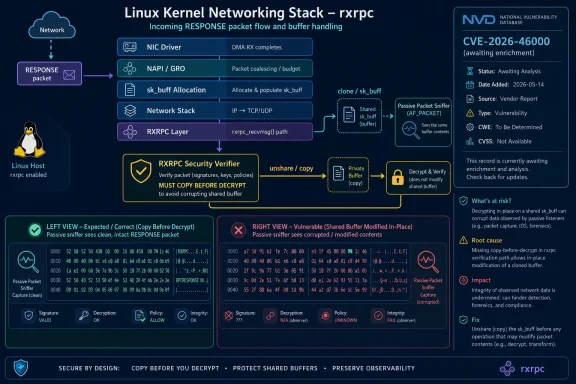
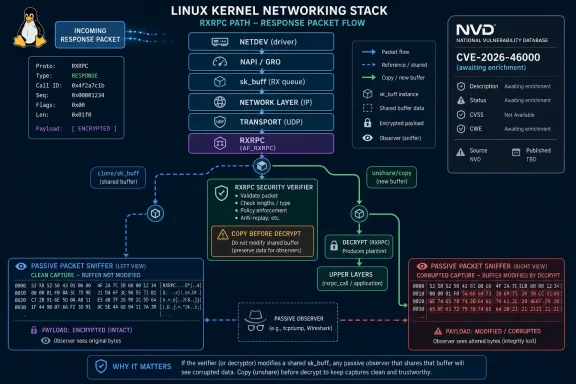
The core of CVE-2026-46000 is a familiar kernel pattern: one subsystem receives a packet, another subsystem wants to inspect or transform it, and everybody assumes the memory backing that packet belongs only to the current path. In this case, rxrpc security operations verifying RESPONSE packets decrypt part of the packet in place. That is safe only if the sk_buff is private to the verifier.
The problem is that the sk_buff may be cloned or otherwise shared, including with packet-sniffing paths. If the verifier mutates the shared buffer, another observer can see a packet that appears corrupt because it has already been partially decrypted. The kernel fix changes the handoff so that, when the packet is cloned, the security handler gets a copy instead of modifying shared packet storage.
That sounds like a data cleanliness bug, and in some environments that may be all it is. But in kernel networking, packet cleanliness is not cosmetic. Packet buffers are evidence, state, and sometimes attack surface; if one consumer can silently change what another consumer sees, the system has lost a boundary it thought it had.
NVD has not yet assigned CVSS 4.0, 3.x, or 2.0 scoring. That absence matters because automated vulnerability-management systems often treat “N/A” as “wait,” while kernel maintainers often treat the corresponding patch as “take it when your stable tree gets it.” The gap between those two cultures is where many Linux patching mistakes happen.
rxrpc Remains an Obscure Protocol With Real Deployment Consequences
The affected subsystem, rxrpc, is not a household name even among many Linux administrators. It is a remote procedure call transport in the Linux kernel, historically associated with AFS-style workloads and security mechanisms such as rxkad and newer rxgk paths. Most desktop Linux users will never knowingly configure it.
Obscure does not mean irrelevant. Kernel modules can be present even when the workload that justified them is not obvious, and enterprise Linux systems often inherit broad kernel configurations from general-purpose distributions. A protocol nobody in the change meeting recognizes can still be built, loadable, reachable under specific conditions, or dragged in by a dependency.
That is why advisories involving rxrpc often cause more confusion than their raw exploitability deserves. Administrators ask whether they use AFS, whether the module is loaded, whether blacklisting is safe, whether a container host changes the exposure story, and whether the issue is remote, local, or merely observable under tracing. Those are reasonable questions, but they are not answered by the CVE title alone.
The specific CVE-2026-46000 text points to shared packet buffers and packet sniffers, not a clean unauthenticated remote-code-execution story. It would be irresponsible to inflate it into one without evidence. Still, a kernel CVE in a network protocol handler deserves triage because the blast radius depends on configuration, module loading, packet paths, and distribution backports.
The Patch Is Really About Ownership, Not Encryption
The most important word in the fix is “unshare.” Linux networking leans heavily on sharing packet data to avoid needless copying. That is one reason the stack performs well: buffers can be cloned, referenced, queued, observed, and passed through layers without constantly allocating and copying memory.
But that model depends on discipline. If a code path only reads a shared buffer, sharing is efficient. If it writes to that buffer, it must first establish that the buffer is private or create a private copy. CVE-2026-46000 is the security-advisory version of violating that rule.
The encryption detail makes the bug easier to visualize. The packet is not merely being annotated or marked; the security handler decrypts bits of it in place as part of verification. If that work happens on storage also visible to a sniffer, the sniffer’s view becomes misleading. The packet on the wire was not corrupt in the same way the captured packet appears corrupt; the capture has been contaminated by later kernel processing.
For defenders, that distinction is important. Packet capture is often treated as a ground truth beneath application logs and security-agent interpretation. If the kernel can hand a capture path a buffer later modified by another path, the capture becomes less like a photograph and more like a document that was edited after filing.
Packet Sniffers Are Not Just Debugging Toys
The advisory’s mention of a packet sniffer may tempt some readers to downgrade the issue mentally. If the only visible effect is that tcpdump or another observer sees a strange packet, then surely this is a debugging nuisance rather than a vulnerability. That reading is too casual.
Packet sniffers sit inside incident-response workflows, IDS pipelines, observability platforms, regression tests, and compliance investigations. When they see corrupt-looking traffic, operators may chase ghosts. When they fail to see the original bytes accurately, investigators may miss the evidence they expected to preserve.
There is also a deeper integrity concern. Packet capture paths are often assumed to be passive. They observe traffic without changing it, and they are expected to receive a faithful representation of what crossed the interface or arrived at a protocol boundary. A shared sk_buff that gets modified after cloning breaks that mental model.
This does not automatically imply attacker-controlled capture forgery. The CVE text does not establish that. But security is full of bugs whose first public explanation sounds like “only observability is wrong,” until someone composes that wrongness with timing, shared memory, or another subsystem’s assumption.
Kernel CVEs Now Arrive as Patch Metadata Before Risk Is Fully Understood
CVE-2026-46000 also illustrates how modern Linux kernel CVEs increasingly appear: a commit lands in stable trees, a CVE record is generated, NVD receives it, and enrichment catches up later. The record may have a description and references but no NVD CVSS vector, no weakness mapping, and no tidy exploitation narrative.
That workflow is good for transparency but awkward for enterprise consumption. Security teams want severity, affected versions, exploitability, and compensating controls. Kernel maintainers provide a patch that says, in effect, “this was wrong; here is the correction.” Both are legitimate perspectives, but they operate on different clocks.
The CVE was received from kernel.org on May 27, 2026, according to the record supplied by the user, and NVD marked it as awaiting enrichment. That means downstream tools may not yet classify it consistently. Some scanners will show a blank score; others may infer severity from third-party feeds; some distribution trackers may lag until fixed kernel packages are published.
The practical answer is to follow distribution advisories and stable-kernel updates rather than waiting for NVD alone. NVD is a catalog and enrichment layer, not the authoritative patch channel for a running Ubuntu, Debian, Fedora, RHEL, SUSE, Arch, Proxmox, or appliance kernel.
The Stable Backports Tell Us This Was Not a One-Tree Cleanup
The references attached to the CVE point to multiple stable kernel commits. That usually means the fix was backported across supported branches, not merely cleaned up in the development tree. For administrators, that is a signal that maintainers considered the bug relevant enough to carry into maintained kernels.
Stable backports matter because many production systems are nowhere near mainline. A server might run a vendor kernel based on a long-term support series, with hundreds or thousands of patches applied on top. The commit hash in a CVE record is therefore less useful to most operators than the question of whether their vendor kernel includes the fix.
This is where Linux vulnerability management differs sharply from Windows servicing. Microsoft administrators are used to a relatively centralized Patch Tuesday model, even if the ecosystem around it is complex. Linux administrators live in a federated model: upstream stable, distribution maintainers, cloud images, container hosts, embedded vendors, and appliance builders all decide how and when a fix reaches the machine.
That decentralization is a strength when maintainers move quickly and a liability when inventory is weak. A kernel CVE with no NVD score can still be fixed in one distribution, pending in another, irrelevant in a custom build, or silently carried in a cloud provider’s hardened kernel.
This Is Not the Same as a Public Root Exploit, and That Distinction Matters
CVE-2026-46000 should not be casually folded into every recent rxrpc panic headline or “Dirty Frag” discussion. The Linux networking stack has seen multiple nearby issues involving sk_buff ownership, fragments, and rxrpc paths, and the names can blur together in social feeds. But vulnerability management gets worse when every adjacent bug becomes the same story.
The CVE supplied here specifically concerns connection-level RESPONSE packet handling and the need to unshare cloned RESPONSE packets before security verification mutates them. That is distinct from broader claims about page-cache write primitives, local privilege escalation chains, or public exploit code tied to other CVEs. The technical neighborhood may overlap, but the evidentiary record is not interchangeable.
That caveat protects both sides of the risk conversation. Understating a kernel networking bug because it lacks a score is sloppy. Overstating it as a proven universal compromise path is also sloppy. The responsible middle ground is to identify exposed systems, track fixed kernels, and avoid treating “awaiting enrichment” as “awaiting importance.”
For defenders, precision is not pedantry. It determines whether you reboot production hosts immediately, schedule the fix in the next kernel window, blacklist a module, update detection logic, or simply document non-exposure.
The Windows Angle Is WSL, Virtualization, and the Linux Underlay
For a WindowsForum audience, the obvious question is why a Linux kernel rxrpc CVE belongs here at all. The answer is that Windows estates are no longer purely Windows estates. They run WSL, Linux containers, Hyper-V guests, Proxmox clusters, NAS appliances, VPN concentrators, Kubernetes nodes, developer workstations, and cloud workloads whose Linux kernels are operational dependencies.
WSL is the first place many Windows users will think of, though exposure analysis should be careful. WSL 2 uses a Microsoft-supplied Linux kernel inside a lightweight virtualized environment, and its module configuration differs from a general-purpose distribution kernel. Whether rxrpc is present, loadable, or reachable in a given WSL deployment is an empirical question, not something to assume from the CVE title.
Virtualization hosts are more interesting. Many Windows shops run Linux-based hypervisors or storage appliances next to Windows servers, even when the business service is “Windows.” A Linux kernel flaw in a host, storage layer, or network appliance may matter more than the same flaw in a developer’s throwaway VM.
The same goes for security tooling. Packet capture sensors, Linux-based taps, IDS boxes, and forensic collectors often sit in environments dominated by Windows endpoints. A bug that can distort captured rxrpc packets may not threaten Active Directory directly, but it can affect the evidence pipeline defenders rely on when something else goes wrong.
The First Triage Step Is Inventory, Not Panic
The right response begins with a simple question: where do we run affected Linux kernels, and do those kernels include rxrpc? That sounds obvious, but many organizations still inventory operating systems by hostname and application owner rather than by kernel version, module set, and patch stream. CVEs like this punish that abstraction.
Administrators should check whether the rxrpc module is present and loaded, whether workloads use AFS or rxrpc-dependent functionality, and whether the distribution has shipped a kernel containing the relevant backport. On systems where rxrpc is unnecessary, module blacklisting may be a reasonable temporary control, but it should be tested rather than applied blindly to production images.
Kernel live patching may or may not cover this issue depending on vendor support. Networking subsystem fixes are not always ideal live-patch candidates, and even when a live patch exists, organizations should understand whether it changes the exact vulnerable path or merely addresses related code. A reboot into a fixed kernel remains the cleanest remediation in many environments.
The most important practical warning is old but still ignored: installing a fixed kernel package is not the same as running it. Linux hosts can sit for weeks with patched kernels on disk and vulnerable kernels in memory. If the mitigation plan ends at package deployment, it is incomplete.
CVSS Will Eventually Help, but It Will Not Replace Judgment
When NVD eventually enriches CVE-2026-46000, the score will become the number most dashboards display. That number will be useful, but it will also flatten the operational story. A low or moderate score could hide importance in forensic infrastructure; a higher score could exaggerate urgency on systems where rxrpc is absent.
CVSS is best at describing generic vulnerability properties, not local architecture. It cannot know whether a given host loads rxrpc, whether packet capture integrity is mission-critical, whether the system is internet-facing, or whether the relevant code path is reachable in a containerized workload. Those are site-specific facts.
This is one reason kernel CVEs are uncomfortable for risk committees. The same advisory may be irrelevant on one machine, moderately important on another, and urgent on a third because of what the machine does. Treating all Linux kernel CVEs as identical noise is how organizations miss the few that matter.
It is also how they burn out patch teams. The better practice is to group kernel CVEs by subsystem, exposure, workload, and vendor fix availability. CVE-2026-46000 belongs in the bucket of networking-buffer ownership bugs that deserve review even when the initial record looks sparse.
The Real Pattern Is Shared Memory Becoming a Security Boundary
CVE-2026-46000 is part of a broader pattern: high-performance kernels increasingly rely on shared memory, zero-copy paths, cloned buffers, and delayed ownership decisions, while security logic often wants to transform data as though it has exclusive access. When those assumptions collide, the resulting bugs are subtle and sometimes severe.
This pattern is not unique to Linux. Every modern operating system optimizes packet, file, and memory paths to reduce copies. Windows, Linux, BSD, and hypervisor stacks all pay a complexity tax for performance. The difference is that Linux’s development process exposes many of these corrections as public commits that then become CVEs.
There is a tendency to mock small kernel CVEs as bookkeeping. Sometimes that criticism is fair; not every memory-ordering fix or packet handling adjustment deserves a five-alarm response. But the bookkeeping is the security model. Who owns this buffer? Who can write to it? Who else can observe it? Has it been cloned? Is the copy linear? Are fragments shared? These are not implementation trivia when the implementation runs in kernel space.
The fix here is conceptually simple: copy before handing the packet to code that will mutate it. The fact that such a simple rule needs a CVE reminds us that performance-oriented systems make “simple” expensive, conditional, and easy to get wrong.
The Admin Work Is Boring, Which Is Why It Gets Missed
For most organizations, remediation will not involve exploit analysis. It will involve the unglamorous work of mapping systems to kernels, kernels to vendor advisories, and advisories to reboot windows. That is the part of security nobody wants to fund until a kernel bug becomes the postmortem’s first paragraph.
Administrators should resist the urge to make exposure binary too quickly. “We do not use AFS” is useful information, but it is not the same as “the affected code cannot be reached.” “The module is not loaded” is stronger, but module autoloading and vendor configuration still need consideration. “The fixed kernel is installed and booted” is the statement that closes the loop.
Security teams should also review whether packet capture or network-monitoring systems might encounter rxrpc traffic in specialized environments. Again, the likely answer for many shops is no. But the organizations for which the answer is yes are exactly the ones most likely to care about capture fidelity.
The sober read is that CVE-2026-46000 is not a reason to drop everything in a typical Windows-heavy office network. It is a reason to make sure Linux kernel patching is not treated as somebody else’s infrastructure problem.
The Patch Window Should Follow the Kernel, Not the Headline
The operational sequence is straightforward: identify affected Linux systems, check distribution advisories, deploy fixed kernels when available, reboot or otherwise activate the fix, and document systems where rxrpc is absent or disabled. That process should be driven by vendor kernel packages, not by copying upstream commit hashes into a spreadsheet and hoping they map cleanly.
Distribution maintainers may ship the fix under their own kernel version strings, and they may combine it with many other security and stability updates. That bundling is another reason not to triage CVE-2026-46000 in isolation. A kernel update that fixes this bug may also fix other networking, filesystem, driver, or memory-management issues that carry higher practical risk.
For appliances, the answer is less pleasant. Many storage systems, security sensors, and embedded products run Linux kernels whose patch cadence is controlled entirely by the vendor. If those systems expose or use rxrpc-related functionality, customers may have to press for a statement rather than self-remediate. The lack of an NVD score can make that conversation harder, but it should not prevent it.
Cloud environments add one more wrinkle. Managed services may abstract the kernel away, while self-managed instances and Kubernetes nodes remain the customer’s responsibility. If the workload runs on a Linux VM you administer, the CVE belongs on your patch list even if the cloud provider secures the physical host underneath.
The Concrete Read for CVE-2026-46000
The useful conclusion is neither alarmist nor dismissive: this is a kernel networking fix for a shared-buffer mutation bug in rxrpc RESPONSE packet verification, and it should be handled through normal kernel security-update channels with attention to module exposure and packet-capture integrity.
- CVE-2026-46000 was published by NVD on May 27, 2026, after being received from kernel.org, and the NVD record was still awaiting enrichment at publication time.
- The bug involves rxrpc security verification decrypting parts of RESPONSE packets in place when the underlying
sk_buffmay be shared with another observer such as a packet sniffer. - The fix is to provide a copy to the relevant security handler when the packet has been cloned, preserving the boundary between packet observers and packet-mutating verification code.
- Administrators should prioritize distribution kernel updates over upstream commit archaeology, because production exposure depends on vendor backports and the kernel actually booted on the host.
- Windows-centric environments should still inventory Linux kernels in WSL, virtualization hosts, appliances, containers, cloud nodes, and monitoring systems before assuming the CVE is irrelevant.
- The absence of a CVSS score should be treated as missing metadata, not as proof of low risk.
CVE-2026-46000 will probably not be remembered as the defining Linux kernel vulnerability of 2026, and that is precisely why it is useful. It shows how the security boundary keeps moving downward into implementation details that administrators rarely see but absolutely depend on: cloned buffers, packet ownership, and whether a supposedly passive observer receives the truth. The future of kernel security will not be won only by finding spectacular exploit chains; it will also be won by closing these small ownership gaps quickly, shipping the fixes broadly, and making sure the systems that quietly run our Windows-adjacent infrastructure are actually rebooted into the kernels we think they are.
Attachments
References
- CVE-2026-46000 rxrpc: Fix conn-level packet handling to unshare RESPONSE packets NVD / Linux Kernel · 2026-05-28T01:12:29-07:00