

CVE-2026-45997 is a Linux kernel storage-driver vulnerability published by NVD on May 27, 2026, after kernel.org assigned a CVE to a fixed SCSI disk error path that failed to release a gendisk reference when device registration failed. The bug is not the kind of headline-grabbing remote-code-execution flaw that sends patch teams sprinting through the night. It is, instead, a reminder that modern operating-system security often turns on the least glamorous parts of the kernel: reference counts, cleanup paths, and the awkward moments when hardware discovery goes wrong. For WindowsForum readers running Linux in servers, appliances, WSL-adjacent workflows, hypervisors, storage nodes, or mixed-platform labs, the practical lesson is simple: boring kernel fixes are still operational risk.
The vulnerability description is unusually terse, but it tells a complete kernel story. In the Linux SCSI disk driver, the
That is the bug: one object goes away while another object remains referenced. The fix is equally terse: call
This is the sort of change that looks almost insultingly small in a patch review. Yet kernel security has long been shaped by small asymmetries in lifecycle management. If the normal path increments a reference, the error path must drop it. If a device object owns a disk object during successful initialization, failed initialization must unwind those ownership claims in the reverse order. When that accounting goes wrong, the result may be a leak, a dangling relationship, a warning splat, or — in worse cases — exploitable memory corruption.
The NVD entry is still awaiting enrichment, which means there is no official NVD CVSS score, vector, or CWE mapping at the time of publication. That absence matters. It means defenders should resist the urge to sort this into “critical,” “medium,” or “ignore” purely by dashboard color. The vulnerability is real enough to have been assigned a CVE and fixed in stable kernel trees, but the public record does not yet say that it is remotely exploitable, trivially triggerable, or known to be under attack.
That ubiquity is why a niche-looking cleanup bug deserves attention. A failure in
The core technical issue is not that Linux “forgets a disk” in the ordinary sense. It is that an unsuccessful device-registration path does not unwind every reference it acquired along the way. In kernel code, that distinction matters because references are ownership claims. A missed release can keep an object alive longer than intended, obscure later cleanup, or create state that no longer matches the rest of the device hierarchy.
There is no public indication from the NVD text alone that CVE-2026-45997 lets an unprivileged local user take over a machine. But storage-driver bugs sit close to privileged kernel memory and hardware-facing pathways. Even when they are “just” leaks or lifecycle mismatches, they can destabilize systems that depend on predictable device discovery and teardown. For administrators, instability in the disk layer is not academic; it is the kind of failure domain that turns a minor maintenance window into an incident report.
That matters because the Linux stable process is conservative in its own particular way. Stable patches are expected to be small, obviously correct, and relevant to users of released kernels. A fix like this fits the pattern: it is narrow, it mirrors existing cleanup logic, and it addresses a real imbalance in a widely used subsystem. The fact that it has been carried into stable trees is a stronger operational signal than the current NVD placeholder.
The patch also follows a familiar kernel-security rhythm. A bug is identified in an error path, a small cleanup fix lands upstream or in stable review, and a CVE record is created afterward. By the time many vulnerability scanners notice the CVE, the fix may already be present in newer distro kernels or queued for vendor advisories. This creates a frustrating window for IT teams: the CVE exists, but the vulnerability intelligence around it is incomplete.
That window is where bad patch policy happens. Some organizations panic because the scanner says “new CVE.” Others ignore it because NVD says “N/A.” Neither reaction is ideal. The better response is to map the CVE to actual kernel packages and workloads, then let exposure drive priority.
Linux may be running the backup appliance, the NAS, the container host, the monitoring stack, the security sensor, the Kubernetes worker, the Proxmox node, the VMware-adjacent utility VM, the cloud image, the CI runner, or the developer workstation that quietly became production infrastructure. Even organizations that standardize on Windows endpoints often depend on Linux for storage and automation. A kernel storage bug can therefore sit under services that Windows users experience as “the file share is slow,” “the build agent vanished,” or “the backup target dropped offline.”
There is also a philosophical reason Windows administrators should pay attention. Windows and Linux differ radically in release engineering, driver architecture, and servicing models, but they share the same operational truth: hardware discovery is an attack surface and a reliability surface. Device enumeration, teardown, reference counting, and driver error handling are not implementation trivia. They are part of the system’s security boundary because they decide what the kernel believes exists.
Microsoft has spent years hardening Windows driver behavior, tightening signing requirements, and pushing more isolation into parts of the platform. Linux, meanwhile, leans on open review, rapid stable backports, and distribution packaging. CVE-2026-45997 is a Linux story, but the broader lesson travels: when the kernel’s view of a device becomes inconsistent, the rest of the operating system inherits that inconsistency.
For security teams, that creates an uncomfortable classification problem. Vulnerability-management platforms often depend on CVSS as a sorting mechanism, but CVSS is not the vulnerability. It is a model applied to a vulnerability after analysis. When the model is absent, the underlying bug does not disappear.
At the same time, an unscored CVE should not automatically be promoted to emergency status. The public description does not describe network reachability, privilege escalation, known exploitation, or data disclosure. It describes a missing
The sensible middle ground is to treat the CVE as a kernel maintenance item whose urgency depends on where Linux storage hotplug and device churn matter. A laptop that rarely attaches unusual block devices is not in the same risk class as a storage-heavy virtualization host. A lab system used for driver fuzzing is not the same as a quiet appliance running a vendor-managed kernel. Context matters more than the eventual score alone.
That testing problem is not unique to Linux, but Linux’s scale makes it especially visible. The kernel supports a huge range of storage hardware, virtual devices, transport layers, and architectures. A path that is rarely hit on a developer’s workstation may matter on a server with thousands of hotplug events, a flaky external enclosure, or a hypervisor test rig.
CVE-2026-45997 is almost a textbook case. The driver already had cleanup logic in a neighboring error path: when
That kind of symmetry is boring, and boring is exactly what kernel cleanup code must be. The more clever an error path is, the more likely it is to be wrong. The patch’s strength is that it does not invent new behavior; it aligns one failure path with another.
When reference counting breaks in one direction, the kernel may leak memory or leave stale objects around. When it breaks in the other direction, the kernel may free an object while code can still reach it, producing a use-after-free condition. The public description of CVE-2026-45997 centers on a missing release of the
Kernel objects are not passive data bags. They are linked into registries, exposed to sysfs, connected to block-layer state, and visible to udev and userspace tooling. A cleanup imbalance in device registration can produce weird secondary effects: unexpected references, delayed cleanup, confusing device state, or hard-to-reproduce failures during repeated probing and removal.
This is also why small storage bugs can be difficult for vulnerability databases to summarize. The meaningful impact may depend on call ordering, configuration, privileges needed to trigger the path, and whether attackers can force the relevant failure. A short CVE description cannot encode all of that. Administrators should read “missing
This is where Linux kernel CVEs can be confusing. The upstream stable commit may exist before a distribution advisory. A distribution may already carry the fix under a different package version. A vendor may decide that a supported enterprise kernel is not affected because the relevant code path differs. Another may backport the patch without bumping to the upstream kernel version users expect.
For enterprise admins, the right workflow is therefore inventory-first. Identify affected Linux systems, their kernel package versions, and their vendor advisory status. Then prioritize hosts with heavy SCSI/block-device activity: virtualization nodes, storage servers, backup targets, SAN-connected machines, removable-media gateways, and systems exposed to untrusted hardware or tenant-driven virtual disk attachment.
For home-lab users, the advice is simpler: update to your distribution’s next kernel when it lands, especially if the machine is a NAS, hypervisor, or storage test box. The bug does not justify reckless rebooting in the middle of an array resilver or production backup cycle. It does justify not skipping kernel maintenance indefinitely because the CVE looks obscure.
But lack of exploit drama is not lack of significance. Storage-driver correctness is foundational. A cleanup bug in a disk-probe failure path may be most visible to kernel developers and fuzzers today, yet the same class of bug has historically produced real-world crashes, leaks, and privilege-boundary surprises in many operating systems.
The honest risk framing is narrower and more useful. This is a kernel flaw in a common storage subsystem, likely requiring local conditions or device-management scenarios to trigger. It has been fixed in stable kernel lines. Systems with dynamic storage, virtual disk attachment, hotplug behavior, or untrusted hardware exposure should absorb the fix as part of normal kernel patching. Systems with vendor-managed kernels should wait for vendor packages unless there is a specific operational reason to do otherwise.
That may sound less exciting than a severity score, but it is how mature vulnerability management works. The job is not to be scared by every CVE. The job is to know which obscure CVEs sit under infrastructure you cannot afford to destabilize.
This sequencing creates noise. Security teams receive alerts with no score, no vendor package mapping, and no clear exploitability guidance. Operations teams ask whether they need an emergency reboot. Risk teams ask whether the item counts against SLA. The vulnerability-management system, designed to impose order, instead becomes another source of uncertainty.
Linux kernel CVEs are especially prone to this because kernel.org has moved toward assigning CVEs for many fixed vulnerabilities in upstream and stable trees. That is good for transparency, but it changes the meaning of a kernel CVE feed. Not every entry is a blockbuster. Many are precise bug-fix records for code paths that matter deeply to some systems and barely at all to others.
The industry’s tooling has not fully caught up. Too many dashboards still behave as if a CVE is either a red siren or background noise. CVE-2026-45997 belongs in the space between: a concrete kernel bug, fixed upstream, awaiting scoring, operationally relevant for storage-heavy Linux systems, and probably not a reason for everyone to halt business.
The systems least likely to need special handling are static Linux machines with vendor-supported kernels and routine maintenance cycles already in place. If they receive the fix in the next scheduled kernel update, that may be entirely appropriate. The absence of a current NVD score gives teams room to make that judgment rather than forcing an emergency classification.
There is one caveat: appliances can hide Linux kernels behind polished web interfaces. A storage product, backup system, firewall, hypervisor, or monitoring appliance may not expose kernel package details cleanly to the administrator. In those cases, the vendor’s advisory process matters. If the device handles disks, virtual disks, or removable storage, CVE-2026-45997 is worth watching even if the product is not marketed as “Linux.”
The same applies to cloud images and managed platforms. Users may not control the host kernel in many cloud services, but they may control guest kernels in IaaS deployments. If your Linux guests attach and detach volumes frequently, kernel patch cadence still matters. If your provider manages the underlying storage host, the responsibility shifts — but the class of bug does not vanish.
The value of a CVE is not only in naming catastrophe. It is in making a fixed security-relevant defect traceable across ecosystems. A tiny upstream patch may need to travel through stable trees, enterprise kernels, appliance firmware, cloud images, and scanner databases. Without a CVE, the trail is harder to follow. With a CVE, the trail exists — even if the risk conversation remains nuanced.
CVE-2026-45997 is therefore a useful artifact. It gives administrators a handle for a real kernel fix. It gives vendors a record to map against their supported kernels. It gives scanners something to detect, even if enrichment lags. And it gives the rest of us another reminder that kernel security is not only about spectacular exploitation; it is also about disciplined cleanup after failure.
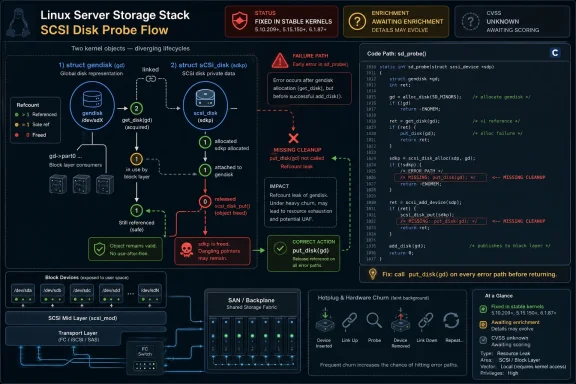 A One-Line Cleanup Bug Earns a CVE Because Kernel Objects Outlive the Happy Path
The vulnerability description is unusually terse, but it tells a complete kernel story. In the Linux SCSI disk driver, the sd_probe() path allocates and registers objects that represent a disk to the kernel and, ultimately, to userspace. If device_add(&sdkp->disk_dev) fails, the existing cleanup path calls put_device(), which runs scsi_disk_release() and frees the scsi_disk structure. The problem is that the related gendisk object still has a reference outstanding.That is the bug: one object goes away while another object remains referenced. The fix is equally terse: call
put_disk(gd) in that failure path, mirroring the cleanup already used by the device_add_disk() error path.This is the sort of change that looks almost insultingly small in a patch review. Yet kernel security has long been shaped by small asymmetries in lifecycle management. If the normal path increments a reference, the error path must drop it. If a device object owns a disk object during successful initialization, failed initialization must unwind those ownership claims in the reverse order. When that accounting goes wrong, the result may be a leak, a dangling relationship, a warning splat, or — in worse cases — exploitable memory corruption.
The NVD entry is still awaiting enrichment, which means there is no official NVD CVSS score, vector, or CWE mapping at the time of publication. That absence matters. It means defenders should resist the urge to sort this into “critical,” “medium,” or “ignore” purely by dashboard color. The vulnerability is real enough to have been assigned a CVE and fixed in stable kernel trees, but the public record does not yet say that it is remotely exploitable, trivially triggerable, or known to be under attack.
The Storage Stack Is Where Edge Cases Go to Become Production Problems
SCSI in 2026 is not a museum piece. It is the abstraction underneath a sprawling amount of Linux storage, including SATA disks behind SCSI translation layers, USB mass-storage devices, virtual disks, multipath configurations, SAN-attached storage, and countless server boot and data volumes. Thesd driver is the “SCSI disk” layer that gives Linux many of the block devices administrators recognize as /dev/sdX.That ubiquity is why a niche-looking cleanup bug deserves attention. A failure in
device_add() is not the everyday path when a healthy disk appears on a quiet workstation. It is more likely to surface under pressure: memory constraints, device-model collisions, hotplug churn, virtualization oddities, misbehaving hardware, driver probing races, or carefully constructed fault-injection tests. But the storage layer is precisely where rare conditions accumulate. Servers do not just boot once and sit forever; disks fail, HBAs reset, USB devices misbehave, virtual disks are attached and detached, and cloud hosts are live-migrated under workloads their owners rarely see.The core technical issue is not that Linux “forgets a disk” in the ordinary sense. It is that an unsuccessful device-registration path does not unwind every reference it acquired along the way. In kernel code, that distinction matters because references are ownership claims. A missed release can keep an object alive longer than intended, obscure later cleanup, or create state that no longer matches the rest of the device hierarchy.
There is no public indication from the NVD text alone that CVE-2026-45997 lets an unprivileged local user take over a machine. But storage-driver bugs sit close to privileged kernel memory and hardware-facing pathways. Even when they are “just” leaks or lifecycle mismatches, they can destabilize systems that depend on predictable device discovery and teardown. For administrators, instability in the disk layer is not academic; it is the kind of failure domain that turns a minor maintenance window into an incident report.
The Real Signal Is the Stable-Tree Backport
The most important clue in this CVE is not the missing CVSS score. It is the presence of multiple stable kernel references. Kernel.org did not merely record a theoretical defect; the fix appears in stable commit references for maintained kernel lines.That matters because the Linux stable process is conservative in its own particular way. Stable patches are expected to be small, obviously correct, and relevant to users of released kernels. A fix like this fits the pattern: it is narrow, it mirrors existing cleanup logic, and it addresses a real imbalance in a widely used subsystem. The fact that it has been carried into stable trees is a stronger operational signal than the current NVD placeholder.
The patch also follows a familiar kernel-security rhythm. A bug is identified in an error path, a small cleanup fix lands upstream or in stable review, and a CVE record is created afterward. By the time many vulnerability scanners notice the CVE, the fix may already be present in newer distro kernels or queued for vendor advisories. This creates a frustrating window for IT teams: the CVE exists, but the vulnerability intelligence around it is incomplete.
That window is where bad patch policy happens. Some organizations panic because the scanner says “new CVE.” Others ignore it because NVD says “N/A.” Neither reaction is ideal. The better response is to map the CVE to actual kernel packages and workloads, then let exposure drive priority.
Windows Shops Should Not Dismiss a Linux SCSI CVE as Somebody Else’s Problem
A publication called WindowsForum could be forgiven for treating a Linux SCSI disk bug as out-of-scope. That would be a mistake. Modern Windows estates are rarely Windows-only estates.Linux may be running the backup appliance, the NAS, the container host, the monitoring stack, the security sensor, the Kubernetes worker, the Proxmox node, the VMware-adjacent utility VM, the cloud image, the CI runner, or the developer workstation that quietly became production infrastructure. Even organizations that standardize on Windows endpoints often depend on Linux for storage and automation. A kernel storage bug can therefore sit under services that Windows users experience as “the file share is slow,” “the build agent vanished,” or “the backup target dropped offline.”
There is also a philosophical reason Windows administrators should pay attention. Windows and Linux differ radically in release engineering, driver architecture, and servicing models, but they share the same operational truth: hardware discovery is an attack surface and a reliability surface. Device enumeration, teardown, reference counting, and driver error handling are not implementation trivia. They are part of the system’s security boundary because they decide what the kernel believes exists.
Microsoft has spent years hardening Windows driver behavior, tightening signing requirements, and pushing more isolation into parts of the platform. Linux, meanwhile, leans on open review, rapid stable backports, and distribution packaging. CVE-2026-45997 is a Linux story, but the broader lesson travels: when the kernel’s view of a device becomes inconsistent, the rest of the operating system inherits that inconsistency.
“Awaiting Enrichment” Is Not the Same as “Low Risk”
The NVD page currently marks CVE-2026-45997 as awaiting enrichment, with no NVD-provided CVSS 4.0, 3.x, or 2.0 score. This is increasingly common. The CVE pipeline is faster than the enrichment pipeline, and kernel.org CVEs can appear before NVD analysts have assigned vectors or weakness categories.For security teams, that creates an uncomfortable classification problem. Vulnerability-management platforms often depend on CVSS as a sorting mechanism, but CVSS is not the vulnerability. It is a model applied to a vulnerability after analysis. When the model is absent, the underlying bug does not disappear.
At the same time, an unscored CVE should not automatically be promoted to emergency status. The public description does not describe network reachability, privilege escalation, known exploitation, or data disclosure. It describes a missing
put_disk() call in a SCSI disk probe failure path. That points toward a lifecycle-management flaw with likely reliability and resource-management implications, not an obvious internet-facing compromise route.The sensible middle ground is to treat the CVE as a kernel maintenance item whose urgency depends on where Linux storage hotplug and device churn matter. A laptop that rarely attaches unusual block devices is not in the same risk class as a storage-heavy virtualization host. A lab system used for driver fuzzing is not the same as a quiet appliance running a vendor-managed kernel. Context matters more than the eventual score alone.
The Bug Lives in the Error Path, Where Testing Is Always Hardest
Kernel programmers obsess over error paths because error paths are where invariants go to die. The normal path is exercised constantly: boot the system, find the disk, create the block device, mount the filesystem, run the workload. The failed path may require an allocation failure, a registration failure, an unusual device state, or a deliberately injected fault.That testing problem is not unique to Linux, but Linux’s scale makes it especially visible. The kernel supports a huge range of storage hardware, virtual devices, transport layers, and architectures. A path that is rarely hit on a developer’s workstation may matter on a server with thousands of hotplug events, a flaky external enclosure, or a hypervisor test rig.
CVE-2026-45997 is almost a textbook case. The driver already had cleanup logic in a neighboring error path: when
device_add_disk() fails inside sd_probe(), the code calls put_disk(gd). The vulnerable path simply failed to do the same thing when device_add(&sdkp->disk_dev) failed earlier. The patch makes the two cleanup paths consistent.That kind of symmetry is boring, and boring is exactly what kernel cleanup code must be. The more clever an error path is, the more likely it is to be wrong. The patch’s strength is that it does not invent new behavior; it aligns one failure path with another.
Reference Counts Are the Kernel’s Quiet Security Boundary
Reference counting is one of the kernel’s basic survival mechanisms. Objects cannot be freed while something still legitimately points to them, and objects should not remain alive after their owners have gone away. Everyget needs a put; every allocation needs a release; every device registration needs a teardown story.When reference counting breaks in one direction, the kernel may leak memory or leave stale objects around. When it breaks in the other direction, the kernel may free an object while code can still reach it, producing a use-after-free condition. The public description of CVE-2026-45997 centers on a missing release of the
gendisk object, which sounds like the former category. But defenders have learned not to treat lifecycle bugs casually merely because the first-order symptom is a leak.Kernel objects are not passive data bags. They are linked into registries, exposed to sysfs, connected to block-layer state, and visible to udev and userspace tooling. A cleanup imbalance in device registration can produce weird secondary effects: unexpected references, delayed cleanup, confusing device state, or hard-to-reproduce failures during repeated probing and removal.
This is also why small storage bugs can be difficult for vulnerability databases to summarize. The meaningful impact may depend on call ordering, configuration, privileges needed to trigger the path, and whether attackers can force the relevant failure. A short CVE description cannot encode all of that. Administrators should read “missing
put_disk()” not as harmless jargon, but as a warning that an object lifetime did not close cleanly.For Most Fleets, the Patch Path Runs Through the Distribution
The average administrator should not be applying the individual kernel.org commits by hand. The practical question is whether your distribution or appliance vendor has incorporated the fix into its kernel packages. That means checking Ubuntu, Debian, Red Hat, SUSE, Fedora, Arch, Oracle, Proxmox, TrueNAS SCALE, or whichever vendor actually ships and supports the kernel on your system.This is where Linux kernel CVEs can be confusing. The upstream stable commit may exist before a distribution advisory. A distribution may already carry the fix under a different package version. A vendor may decide that a supported enterprise kernel is not affected because the relevant code path differs. Another may backport the patch without bumping to the upstream kernel version users expect.
For enterprise admins, the right workflow is therefore inventory-first. Identify affected Linux systems, their kernel package versions, and their vendor advisory status. Then prioritize hosts with heavy SCSI/block-device activity: virtualization nodes, storage servers, backup targets, SAN-connected machines, removable-media gateways, and systems exposed to untrusted hardware or tenant-driven virtual disk attachment.
For home-lab users, the advice is simpler: update to your distribution’s next kernel when it lands, especially if the machine is a NAS, hypervisor, or storage test box. The bug does not justify reckless rebooting in the middle of an array resilver or production backup cycle. It does justify not skipping kernel maintenance indefinitely because the CVE looks obscure.
The Exploitability Story Is Still Thin, and That Should Shape the Response
The available public record does not establish a weaponized exploit. It does not describe a remote attacker. It does not even provide an NVD severity score yet. Any article that turns CVE-2026-45997 into a cinematic “hackers can steal your disks” story is getting ahead of the evidence.But lack of exploit drama is not lack of significance. Storage-driver correctness is foundational. A cleanup bug in a disk-probe failure path may be most visible to kernel developers and fuzzers today, yet the same class of bug has historically produced real-world crashes, leaks, and privilege-boundary surprises in many operating systems.
The honest risk framing is narrower and more useful. This is a kernel flaw in a common storage subsystem, likely requiring local conditions or device-management scenarios to trigger. It has been fixed in stable kernel lines. Systems with dynamic storage, virtual disk attachment, hotplug behavior, or untrusted hardware exposure should absorb the fix as part of normal kernel patching. Systems with vendor-managed kernels should wait for vendor packages unless there is a specific operational reason to do otherwise.
That may sound less exciting than a severity score, but it is how mature vulnerability management works. The job is not to be scared by every CVE. The job is to know which obscure CVEs sit under infrastructure you cannot afford to destabilize.
The NVD Lag Exposes a Bigger Problem in Vulnerability Operations
CVE-2026-45997 also illustrates a broader problem: vulnerability records are now often born incomplete. The CVE identifier, description, and references may arrive first. The enrichment — CVSS, CWE, affected-product matching, and downstream advisories — follows later, sometimes after scanners have already generated tickets.This sequencing creates noise. Security teams receive alerts with no score, no vendor package mapping, and no clear exploitability guidance. Operations teams ask whether they need an emergency reboot. Risk teams ask whether the item counts against SLA. The vulnerability-management system, designed to impose order, instead becomes another source of uncertainty.
Linux kernel CVEs are especially prone to this because kernel.org has moved toward assigning CVEs for many fixed vulnerabilities in upstream and stable trees. That is good for transparency, but it changes the meaning of a kernel CVE feed. Not every entry is a blockbuster. Many are precise bug-fix records for code paths that matter deeply to some systems and barely at all to others.
The industry’s tooling has not fully caught up. Too many dashboards still behave as if a CVE is either a red siren or background noise. CVE-2026-45997 belongs in the space between: a concrete kernel bug, fixed upstream, awaiting scoring, operationally relevant for storage-heavy Linux systems, and probably not a reason for everyone to halt business.
Administrators Should Think in Terms of Exposure, Not Acronyms
The systems most worth prioritizing are the ones where the vulnerable path is more plausible. That includes machines that regularly add or remove disks, virtual machines that receive dynamic block devices, storage arrays with device churn, and hosts that interact with removable or less trusted storage. It also includes test environments where fault injection or fuzzing can turn rare paths into common ones.The systems least likely to need special handling are static Linux machines with vendor-supported kernels and routine maintenance cycles already in place. If they receive the fix in the next scheduled kernel update, that may be entirely appropriate. The absence of a current NVD score gives teams room to make that judgment rather than forcing an emergency classification.
There is one caveat: appliances can hide Linux kernels behind polished web interfaces. A storage product, backup system, firewall, hypervisor, or monitoring appliance may not expose kernel package details cleanly to the administrator. In those cases, the vendor’s advisory process matters. If the device handles disks, virtual disks, or removable storage, CVE-2026-45997 is worth watching even if the product is not marketed as “Linux.”
The same applies to cloud images and managed platforms. Users may not control the host kernel in many cloud services, but they may control guest kernels in IaaS deployments. If your Linux guests attach and detach volumes frequently, kernel patch cadence still matters. If your provider manages the underlying storage host, the responsibility shifts — but the class of bug does not vanish.
The Small Patch That Says a Lot About Kernel Maintenance
There is a temptation to mock CVEs like this as over-classification. If every missed cleanup call becomes a vulnerability, the argument goes, then vulnerability feeds become useless. There is some truth in the complaint, but it misses the more important point.The value of a CVE is not only in naming catastrophe. It is in making a fixed security-relevant defect traceable across ecosystems. A tiny upstream patch may need to travel through stable trees, enterprise kernels, appliance firmware, cloud images, and scanner databases. Without a CVE, the trail is harder to follow. With a CVE, the trail exists — even if the risk conversation remains nuanced.
CVE-2026-45997 is therefore a useful artifact. It gives administrators a handle for a real kernel fix. It gives vendors a record to map against their supported kernels. It gives scanners something to detect, even if enrichment lags. And it gives the rest of us another reminder that kernel security is not only about spectacular exploitation; it is also about disciplined cleanup after failure.
The Practical Reading for CVE-2026-45997
The best way to handle this CVE is to treat it as a storage-kernel maintenance signal rather than a panic event. It is specific, narrow, and already fixed in stable kernel work, but it sits in code that many Linux systems rely on whenever disks appear.- CVE-2026-45997 affects the Linux kernel SCSI disk driver’s cleanup behavior when
device_add(&sdkp->disk_dev)fails during disk probing. - The fix adds a missing
put_disk(gd)call so the failed device-registration path releases thegendiskreference consistently. - NVD published the CVE on May 27, 2026, but has not yet provided an official CVSS score or enriched weakness mapping.
- The most relevant systems are Linux hosts with active storage churn, hotplug behavior, virtual disk attachment, SAN or multipath environments, and storage appliances.
- Most administrators should consume the fix through distribution or vendor kernel updates rather than manually applying upstream commits.
- The absence of known exploitation in the public record should temper urgency, but it should not justify ignoring kernel updates on storage-critical machines.
put_disk(). It is that operating-system reliability and security are increasingly inseparable, especially in the storage stack where obscure kernel bookkeeping becomes the difference between clean recovery and undefined behavior. CVE-2026-45997 will probably pass through most fleets as a routine kernel update, but the organizations that handle it well will be the ones that already know where Linux quietly carries their Windows-era business.References
- Primary source: NVD / Linux Kernel
Published: 2026-05-28T01:07:02-07:00
NVD - CVE-2026-45997
 nvd.nist.gov
- Security advisory: MSRC
Published: 2026-05-28T01:07:02-07:00
Original feed URL
Security Update Guide - Microsoft Security Response Center
 msrc.microsoft.com
- Related coverage: gitlab.com
drivers/scsi · on-stable · Qualcomm Snapdragon 670 Mainline / linux · GitLab
Close-to mainline Snapdragon 670 SoC kernelgitlab.com - Related coverage: mail-archive.com
[PATCH v2 16/18] scsi: sd: add mpath_dev file
www.mail-archive.com
- Related coverage: lists-ec2.96boards.org
- Related coverage: docs.redhat.com
- Related coverage: access.redhat.com
