

CVE-2026-46053 is a Linux kernel vulnerability published by NVD on May 27, 2026, covering a Reliable Datagram Sockets RDMA cleanup bug in
The Linux kernel’s RDS subsystem is not the networking stack most desktop users think about when they hear “Linux vulnerability.” Reliable Datagram Sockets, particularly when paired with RDMA transports, lives closer to clustered databases, high-performance computing, low-latency fabrics, and specialized enterprise deployments than to the everyday laptop.
That is precisely why CVE-2026-46053 is easy to underestimate. Vulnerabilities in obscure kernel subsystems often appear irrelevant until an administrator remembers that a storage appliance, database node, Kubernetes worker, research cluster, or virtualized Linux guest depends on them. The risk is not that every PC is suddenly exposed. The risk is that the affected code sits in the privileged kernel boundary, where a small lifetime-management mistake can become a crash, corruption, or security primitive.
The public description is unusually technical even by kernel CVE standards.
That sounds mundane because the best kernel fixes often do. The patch does not introduce a new mitigation framework or disable a dangerous interface. It deletes a few lines so the ownership model matches reality.
That phrase — exactly once — is doing a lot of work. Release too early and the transport may still believe it owns memory that has been torn away. Release twice and the kernel can trip over a dangling resource, corrupt state, or turn a clean error into a stability problem. Fail to release at all and the system leaks pinned memory, which is a particularly unpleasant class of leak on busy servers.
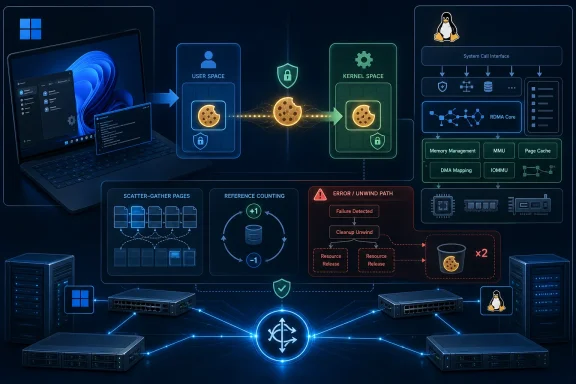
CVE-2026-46053 appears to sit in the second category. The vulnerable path occurs after the RDMA memory region has been set up successfully but before the cookie has been returned to user space. In normal operation, the application receives that cookie and uses it to refer to the registered memory region later. In the failure case, the kernel must unwind carefully because part of the operation has already succeeded.
That is the hard part of systems programming: the failure path is not always the mirror image of the success path. Once ownership crosses a boundary, cleanup obligations move with it. The kernel patch’s premise is simple: after
This is where many vulnerability programs go wrong. A missing CVSS score is not the same as a low-risk vulnerability. It is also not proof of high risk. It is a sign that the public record has not yet caught up with the engineering facts, and teams need to evaluate exposure based on component use, kernel versions, distribution backports, and reachable attack surface.
Kernel.org’s source attribution matters here. This is not a random third-party scanner invention or a speculative bug report written around an ambiguous crash. The CVE description comes from the upstream Linux kernel vulnerability process, and the fix has been carried through multiple stable-branch commits. That does not automatically make exploitation likely, but it does make the bug operationally real.
The absence of a score also leaves room for disagreement. If a local user can reliably trigger the copy-to-user failure and reach the vulnerable RDS RDMA path, the consequence may be materially different from a server where RDS RDMA is unavailable, unloaded, blocked by policy, or absent from the distribution kernel. Severity in kernel bugs is often a function of configuration as much as code.
That niche is not small in consequence. Enterprise Linux deployments frequently carry code for hardware and use cases that no consumer PC will ever exercise. HPC clusters, database fabrics, storage backends, and private-cloud nodes often depend on these specialized paths because shaving latency or CPU overhead is the point of the deployment.
This is also why Windows-centric administrators should not tune out. The modern Windows estate is rarely Windows-only. Hyper-V hosts run Linux guests. Azure and hybrid environments mix Windows Server with Linux appliances. Developers use WSL for local workflows and container images. Backup, monitoring, storage, network, and security products often embed Linux kernels somewhere below the dashboard.
The practical question is not “Do I use RDS on my Windows desktop?” The practical question is whether any Linux system under your operational umbrella has RDS RDMA available and reachable by users or workloads that should not be trusted with kernel edge cases.
Still, kernel cleanup bugs deserve respect. Copy-to-user failures are not exotic in principle. They can occur when user-space pointers are invalid, inaccessible, or otherwise fail during a kernel write-back operation. If the surrounding path has already registered memory and transferred ownership, a malicious or buggy caller may be able to drive execution into the fragile branch repeatedly.
Whether that becomes a denial of service, a use-after-free, privilege escalation, or merely a defensive cleanup correction depends on details not fully expressed in the CVE summary. The exact kernel version, allocator behavior, reference lifetime, transport implementation, and reachable syscall/socket path all matter. So does whether the RDS RDMA module is present and loadable.
The right posture is therefore measured concern. Treat the flaw as a kernel memory-lifetime bug in a privileged subsystem, not as a proven internet worm. Patch where applicable, reduce module exposure where not needed, and avoid letting “no CVSS yet” become an excuse for ignoring the asset inventory problem.
Kernel resource ownership is a contract. One function allocates, another maps, another hands ownership to a transport, and another drops the final reference. When those contracts are implicit, error paths become dangerous because they encode assumptions from an earlier version of the code. A later refactor may make the success path correct while leaving the failure path with stale cleanup logic.
That appears to be the essence of CVE-2026-46053. After
This is also why stable-branch propagation is important. Kernel users rarely run the exact upstream mainline build. They run distribution kernels, vendor kernels, cloud kernels, and long-term-support trees with backported fixes. Multiple stable commits indicate the fix is being carried across maintained branches, but administrators still need their distribution advisories to know when their actual systems are covered.
A decade ago, many Windows shops treated Linux as a separate island managed by a different team. Today the boundary runs through DevOps pipelines, container hosts, WSL developer environments, storage systems, hypervisors, network appliances, SIEM collectors, and cloud images. A vulnerability in a Linux kernel subsystem can become a Windows operations problem because the service it supports is part of the Windows business environment.
That does not mean CVE-2026-46053 is a direct Windows vulnerability. It is not. It means Windows-heavy organizations should resist the instinct to triage it out of existence solely because the string begins with “Linux kernel.”
The most relevant Windows-adjacent environments are not ordinary Windows 11 endpoints. They are mixed estates: Hyper-V clusters with Linux guests, Windows Server environments backed by Linux storage appliances, developers using WSL to build and test networked services, and enterprises whose identity, telemetry, or deployment tooling crosses operating-system lines.
The relevant Linux configuration item for RDS over RDMA depends on RDS and InfiniBand-related support. In older kernel eras it covered InfiniBand and iWARP; in newer descriptions it is commonly framed around InfiniBand support with RDMA operations. Either way, the presence of the feature is a clue that the system is intended for a more specialized networking environment than a typical VM.
Enterprise distributions may also carry downstream differences. A distribution might compile RDS as a module, omit it, include it but blacklist autoloading, or patch the issue before an administrator ever sees a CVE banner. Conversely, a vendor appliance may run an older or customized kernel where the normal distro answer does not apply.
That is why the response should start with inventory rather than theater. If you do not run RDS RDMA, the operational urgency is different. If you do run it on multi-user systems, clustered database nodes, or HPC infrastructure, the fix belongs in the next serious kernel maintenance window, subject to whatever testing your RDMA stack requires.
Good kernel code treats those failures as ordinary events, not impossibilities. That is easy when no state has changed yet. It is harder after the kernel has pinned pages, allocated structures, touched transport-specific state, and moved ownership into another subsystem.
CVE-2026-46053 lives in that uncomfortable middle. The operation has succeeded enough to create cleanup obligations, but failed enough that the user-space caller will not receive the cookie needed to proceed normally. That is exactly the kind of partial-success state where cleanup code tends to rot.
For attackers, failure paths can be attractive because they are less frequently exercised by legitimate workloads. For defenders and kernel maintainers, they are a reminder that correctness is not merely about making the happy path fast. In RDMA-heavy code, correctness is also about never losing track of who owns pinned memory at any instant.
That difference matters for prioritization. A general-purpose Linux VM with no RDMA hardware, no RDS use, and no module loading path may be lower risk than a clustered database host where RDS RDMA is part of the data plane. A kernel update may be easy on one system and disruptive on another, especially where vendor RDMA drivers, firmware, and low-latency workloads are involved.
The responsible playbook is therefore staged. First, determine whether your distributions have issued fixed kernel packages or advisories. Second, identify systems where RDS and RDMA support are present. Third, check whether the feature is actually in use or merely available. Fourth, decide whether mitigation by disabling or blacklisting unused modules is safer than waiting for a full maintenance window.
None of this is glamorous, but it is the work that keeps obscure bugs from becoming avoidable outages. The most dangerous vulnerabilities are not always the ones with the loudest names. Sometimes they are the ones everyone assumed belonged to someone else’s stack.
For administrators, the question is not simply “What kernel version am I running?” It is “Has my vendor backported the CVE-2026-46053 fix into the kernel I am running?” Enterprise kernels often retain older version numbers while carrying large sets of security patches. Conversely, custom kernels may look new while missing a specific stable commit.
The stable-branch references attached to the CVE are useful for kernel engineers and distro maintainers, but production teams should rely on vendor advisories and package changelogs before declaring victory. If the system comes from an appliance vendor, the answer may be hidden behind a support portal rather than a public package repository.
That lag is not always negligence. RDMA stacks can be finicky, and kernel updates on performance-sensitive clusters are rarely casual. But a justified testing cycle should not become indefinite deferral. A cleanup bug in a kernel networking subsystem is exactly the kind of fix that should be planned, tested, and rolled forward deliberately.
Consider the practical overlaps. A Windows developer may use WSL to compile Linux-targeted software. A Windows Server environment may rely on Linux-based storage or backup appliances. A Microsoft-centric enterprise may run Linux workloads in Azure, manage them through the same security tooling, and feed their logs into the same incident-response process. An IT pro may never type
CVE-2026-46053 also illustrates a broader lesson for Windows users watching Linux security from the outside. Open-source kernel fixes often arrive as terse commit messages that assume deep subsystem knowledge. That transparency is valuable, but it can be unforgiving. The burden shifts to operators to translate “MR cleanup on copy error” into asset impact, patch priority, and operational mitigation.
For mixed shops, this is where collaboration matters. Windows administrators do not need to become RDMA kernel developers overnight. They do need a channel to ask the Linux, storage, HPC, or cloud team whether RDS RDMA exists in the environment and how kernel fixes are tracked.
That is good news in one sense: the fix should be easier for vendors to absorb than a sprawling subsystem rewrite. It is also revealing. The kernel community considered the flaw worth assigning a CVE and pushing through stable channels, even though NVD had not yet enriched the record with a severity score.
Security teams should learn from that ordering. Upstream maintainers often know a bug is security-relevant before scoring systems finish their paperwork. If your vulnerability process waits exclusively for a CVSS number, it will lag behind the engineering reality in exactly these cases.
At the same time, stable inclusion should not be misread as proof of catastrophic exploitability. The kernel stable tree carries many fixes that matter because correctness matters. The art of triage is to take the fix seriously without inventing a worst-case exploit story unsupported by current public evidence.
For ordinary desktop users, especially those not running custom Linux kernels or RDMA workloads, this CVE is unlikely to change daily behavior. For sysadmins responsible for Linux servers, HPC clusters, database systems, or RDMA-enabled infrastructure, it belongs on the patch radar. For Windows-heavy teams, it belongs in the hybrid-infrastructure conversation.
Mitigation may be straightforward where RDS RDMA is unused. Disabling or preventing autoload of unnecessary kernel modules is a long-standing hardening measure. But production systems should not be changed blindly; if a database, storage layer, or cluster transport depends on RDS, disabling it may create the outage the security team was trying to avoid.
The boring answer is still the right one: verify exposure, consult vendor packages, test the fixed kernel, deploy in maintenance windows, and remove unused attack surface where possible.
__rds_rdma_map() where a failed copy of an RDMA memory-region cookie back to user space could trigger incorrect duplicate resource cleanup. The bug is not a headline-grabbing Windows flaw, and it is not currently scored by NVD. But it lands in exactly the sort of kernel corner that modern infrastructure increasingly depends on: high-throughput networking, memory registration, and fast paths that most users never knowingly touch. For WindowsForum readers, the story is less “panic now” than “know where Linux is hiding in your estate.”
 A Small Kernel Fix Exposes a Big Infrastructure Assumption
The Linux kernel’s RDS subsystem is not the networking stack most desktop users think about when they hear “Linux vulnerability.” Reliable Datagram Sockets, particularly when paired with RDMA transports, lives closer to clustered databases, high-performance computing, low-latency fabrics, and specialized enterprise deployments than to the everyday laptop.That is precisely why CVE-2026-46053 is easy to underestimate. Vulnerabilities in obscure kernel subsystems often appear irrelevant until an administrator remembers that a storage appliance, database node, Kubernetes worker, research cluster, or virtualized Linux guest depends on them. The risk is not that every PC is suddenly exposed. The risk is that the affected code sits in the privileged kernel boundary, where a small lifetime-management mistake can become a crash, corruption, or security primitive.
The public description is unusually technical even by kernel CVE standards.
__rds_rdma_map() hands scatter-gather pages to the transport after get_mr() succeeds. If the kernel then fails while copying the generated cookie back to user space, the error branch previously attempted cleanup that the normal memory-region teardown path would also handle. The fix removes that duplicate unpin/free behavior and leaves final cleanup to the existing reference-counted path.That sounds mundane because the best kernel fixes often do. The patch does not introduce a new mitigation framework or disable a dangerous interface. It deletes a few lines so the ownership model matches reality.
The Vulnerability Is About Ownership, Not Packets
To understand why this matters, it helps to avoid the trap of thinking about RDS as merely another socket protocol. In the RDMA path, the kernel is not just moving bytes across a network. It is pinning user memory, mapping it into a form that a transport can use, handing out a memory-region cookie, and tracking the lifetime of resources that must be released exactly once.That phrase — exactly once — is doing a lot of work. Release too early and the transport may still believe it owns memory that has been torn away. Release twice and the kernel can trip over a dangling resource, corrupt state, or turn a clean error into a stability problem. Fail to release at all and the system leaks pinned memory, which is a particularly unpleasant class of leak on busy servers.
CVE-2026-46053 appears to sit in the second category. The vulnerable path occurs after the RDMA memory region has been set up successfully but before the cookie has been returned to user space. In normal operation, the application receives that cookie and uses it to refer to the registered memory region later. In the failure case, the kernel must unwind carefully because part of the operation has already succeeded.
That is the hard part of systems programming: the failure path is not always the mirror image of the success path. Once ownership crosses a boundary, cleanup obligations move with it. The kernel patch’s premise is simple: after
get_mr() succeeds, the transport owns the pages and scatter-gather list, so the error path must not pretend it still does.NVD Has a Name, but Not Yet a Verdict
As of the May 27, 2026 publication, NVD lists CVE-2026-46053 as “Awaiting Enrichment.” That means there is a CVE entry and a description, but NVD has not yet supplied its own CVSS vector, base score, or weakness classification. For defenders, that creates the familiar awkward middle period between disclosure and risk management.This is where many vulnerability programs go wrong. A missing CVSS score is not the same as a low-risk vulnerability. It is also not proof of high risk. It is a sign that the public record has not yet caught up with the engineering facts, and teams need to evaluate exposure based on component use, kernel versions, distribution backports, and reachable attack surface.
Kernel.org’s source attribution matters here. This is not a random third-party scanner invention or a speculative bug report written around an ambiguous crash. The CVE description comes from the upstream Linux kernel vulnerability process, and the fix has been carried through multiple stable-branch commits. That does not automatically make exploitation likely, but it does make the bug operationally real.
The absence of a score also leaves room for disagreement. If a local user can reliably trigger the copy-to-user failure and reach the vulnerable RDS RDMA path, the consequence may be materially different from a server where RDS RDMA is unavailable, unloaded, blocked by policy, or absent from the distribution kernel. Severity in kernel bugs is often a function of configuration as much as code.
RDS Is Niche, but Niche Is Where Production Lives
Reliable Datagram Sockets has a long history as a specialist protocol rather than a general-purpose darling. Its Linux documentation describes a layered design with generic RDS handling above transport-specific machinery. RDMA transports, including InfiniBand-oriented deployments, push that design into environments that care deeply about throughput and latency.That niche is not small in consequence. Enterprise Linux deployments frequently carry code for hardware and use cases that no consumer PC will ever exercise. HPC clusters, database fabrics, storage backends, and private-cloud nodes often depend on these specialized paths because shaving latency or CPU overhead is the point of the deployment.
This is also why Windows-centric administrators should not tune out. The modern Windows estate is rarely Windows-only. Hyper-V hosts run Linux guests. Azure and hybrid environments mix Windows Server with Linux appliances. Developers use WSL for local workflows and container images. Backup, monitoring, storage, network, and security products often embed Linux kernels somewhere below the dashboard.
The practical question is not “Do I use RDS on my Windows desktop?” The practical question is whether any Linux system under your operational umbrella has RDS RDMA available and reachable by users or workloads that should not be trusted with kernel edge cases.
The Exploitability Story Is Still Unwritten
The public material for CVE-2026-46053 does not establish a polished exploit chain. It describes a cleanup bug in a specific failure branch. That distinction matters because responsible reporting should not inflate every kernel fix into a remote-code-execution drama.Still, kernel cleanup bugs deserve respect. Copy-to-user failures are not exotic in principle. They can occur when user-space pointers are invalid, inaccessible, or otherwise fail during a kernel write-back operation. If the surrounding path has already registered memory and transferred ownership, a malicious or buggy caller may be able to drive execution into the fragile branch repeatedly.
Whether that becomes a denial of service, a use-after-free, privilege escalation, or merely a defensive cleanup correction depends on details not fully expressed in the CVE summary. The exact kernel version, allocator behavior, reference lifetime, transport implementation, and reachable syscall/socket path all matter. So does whether the RDS RDMA module is present and loadable.
The right posture is therefore measured concern. Treat the flaw as a kernel memory-lifetime bug in a privileged subsystem, not as a proven internet worm. Patch where applicable, reduce module exposure where not needed, and avoid letting “no CVSS yet” become an excuse for ignoring the asset inventory problem.
The Patch Is Tiny Because the Bug Is Conceptual
The stable patch reportedly changes only the cleanup behavior innet/rds/rdma.c, removing duplicate unpin/free work from the put_user() failure branch. This is the kind of kernel change that can look almost trivial in a diff and still represent a serious correctness boundary.Kernel resource ownership is a contract. One function allocates, another maps, another hands ownership to a transport, and another drops the final reference. When those contracts are implicit, error paths become dangerous because they encode assumptions from an earlier version of the code. A later refactor may make the success path correct while leaving the failure path with stale cleanup logic.
That appears to be the essence of CVE-2026-46053. After
get_mr() succeeds, teardown should flow through the memory-region reference path. The error branch should not independently unpin or free resources it no longer owns. The patch restores a single cleanup authority.This is also why stable-branch propagation is important. Kernel users rarely run the exact upstream mainline build. They run distribution kernels, vendor kernels, cloud kernels, and long-term-support trees with backported fixes. Multiple stable commits indicate the fix is being carried across maintained branches, but administrators still need their distribution advisories to know when their actual systems are covered.
For Windows Administrators, the Linux Boundary Has Moved
WindowsForum’s audience does not need another reminder that Windows Update exists. The more interesting point is that Windows administrators now routinely own Linux risk whether or not their job title says so. The boundary moved quietly.A decade ago, many Windows shops treated Linux as a separate island managed by a different team. Today the boundary runs through DevOps pipelines, container hosts, WSL developer environments, storage systems, hypervisors, network appliances, SIEM collectors, and cloud images. A vulnerability in a Linux kernel subsystem can become a Windows operations problem because the service it supports is part of the Windows business environment.
That does not mean CVE-2026-46053 is a direct Windows vulnerability. It is not. It means Windows-heavy organizations should resist the instinct to triage it out of existence solely because the string begins with “Linux kernel.”
The most relevant Windows-adjacent environments are not ordinary Windows 11 endpoints. They are mixed estates: Hyper-V clusters with Linux guests, Windows Server environments backed by Linux storage appliances, developers using WSL to build and test networked services, and enterprises whose identity, telemetry, or deployment tooling crosses operating-system lines.
The Most Exposed Systems May Not Be the Most Obvious Ones
RDS RDMA is not generally exposed like a web server port. That lowers broad internet risk, but it also makes discovery less intuitive. You may not find it by scanning perimeter services. You find it by inspecting kernel modules, configuration, installed packages, workload requirements, and the policies that determine whether unprivileged users can cause modules to autoload.The relevant Linux configuration item for RDS over RDMA depends on RDS and InfiniBand-related support. In older kernel eras it covered InfiniBand and iWARP; in newer descriptions it is commonly framed around InfiniBand support with RDMA operations. Either way, the presence of the feature is a clue that the system is intended for a more specialized networking environment than a typical VM.
Enterprise distributions may also carry downstream differences. A distribution might compile RDS as a module, omit it, include it but blacklist autoloading, or patch the issue before an administrator ever sees a CVE banner. Conversely, a vendor appliance may run an older or customized kernel where the normal distro answer does not apply.
That is why the response should start with inventory rather than theater. If you do not run RDS RDMA, the operational urgency is different. If you do run it on multi-user systems, clustered database nodes, or HPC infrastructure, the fix belongs in the next serious kernel maintenance window, subject to whatever testing your RDMA stack requires.
The Copy-to-User Failure Path Is a Classic Kernel Trap
The Linux kernel constantly crosses the boundary between kernel space and user space. Every copy from user space and every copy back to user space is a place where assumptions can fail. The pointer might be invalid. The memory might not be writable. The process might be malicious, buggy, or racing with its own memory mappings.Good kernel code treats those failures as ordinary events, not impossibilities. That is easy when no state has changed yet. It is harder after the kernel has pinned pages, allocated structures, touched transport-specific state, and moved ownership into another subsystem.
CVE-2026-46053 lives in that uncomfortable middle. The operation has succeeded enough to create cleanup obligations, but failed enough that the user-space caller will not receive the cookie needed to proceed normally. That is exactly the kind of partial-success state where cleanup code tends to rot.
For attackers, failure paths can be attractive because they are less frequently exercised by legitimate workloads. For defenders and kernel maintainers, they are a reminder that correctness is not merely about making the happy path fast. In RDMA-heavy code, correctness is also about never losing track of who owns pinned memory at any instant.
Patch Management Needs More Than a CVE Dashboard
Most enterprise vulnerability dashboards are optimized for names, numbers, and deadlines. CVE-2026-46053 is a reminder that kernel risk management requires a second layer: feature awareness. A dashboard can tell you that a Linux kernel package is affected. It cannot always tell you whether the vulnerable subsystem is compiled, loaded, reachable, or used.That difference matters for prioritization. A general-purpose Linux VM with no RDMA hardware, no RDS use, and no module loading path may be lower risk than a clustered database host where RDS RDMA is part of the data plane. A kernel update may be easy on one system and disruptive on another, especially where vendor RDMA drivers, firmware, and low-latency workloads are involved.
The responsible playbook is therefore staged. First, determine whether your distributions have issued fixed kernel packages or advisories. Second, identify systems where RDS and RDMA support are present. Third, check whether the feature is actually in use or merely available. Fourth, decide whether mitigation by disabling or blacklisting unused modules is safer than waiting for a full maintenance window.
None of this is glamorous, but it is the work that keeps obscure bugs from becoming avoidable outages. The most dangerous vulnerabilities are not always the ones with the loudest names. Sometimes they are the ones everyone assumed belonged to someone else’s stack.
Vendor Timing Will Matter More Than Upstream Timing
Upstream kernel fixes are necessary, but most organizations consume kernels through vendors. Red Hat, Canonical, SUSE, Debian, Oracle, cloud providers, appliance makers, and internal platform teams all mediate the path from upstream commit to deployed system. That mediation can be a strength because vendors backport and test. It can also create ambiguity because version numbers alone may not show whether a fix is present.For administrators, the question is not simply “What kernel version am I running?” It is “Has my vendor backported the CVE-2026-46053 fix into the kernel I am running?” Enterprise kernels often retain older version numbers while carrying large sets of security patches. Conversely, custom kernels may look new while missing a specific stable commit.
The stable-branch references attached to the CVE are useful for kernel engineers and distro maintainers, but production teams should rely on vendor advisories and package changelogs before declaring victory. If the system comes from an appliance vendor, the answer may be hidden behind a support portal rather than a public package repository.
That lag is not always negligence. RDMA stacks can be finicky, and kernel updates on performance-sensitive clusters are rarely casual. But a justified testing cycle should not become indefinite deferral. A cleanup bug in a kernel networking subsystem is exactly the kind of fix that should be planned, tested, and rolled forward deliberately.
The WindowsForum Angle Is Hybrid Reality, Not Brand Confusion
It is tempting to dismiss a Linux kernel CVE as off-topic for a Windows community. That temptation belongs to a simpler era. Windows professionals increasingly administer platforms, not just operating systems.Consider the practical overlaps. A Windows developer may use WSL to compile Linux-targeted software. A Windows Server environment may rely on Linux-based storage or backup appliances. A Microsoft-centric enterprise may run Linux workloads in Azure, manage them through the same security tooling, and feed their logs into the same incident-response process. An IT pro may never type
modprobe rds_rdma and still be accountable when a Linux-backed service fails.CVE-2026-46053 also illustrates a broader lesson for Windows users watching Linux security from the outside. Open-source kernel fixes often arrive as terse commit messages that assume deep subsystem knowledge. That transparency is valuable, but it can be unforgiving. The burden shifts to operators to translate “MR cleanup on copy error” into asset impact, patch priority, and operational mitigation.
For mixed shops, this is where collaboration matters. Windows administrators do not need to become RDMA kernel developers overnight. They do need a channel to ask the Linux, storage, HPC, or cloud team whether RDS RDMA exists in the environment and how kernel fixes are tracked.
The Signal Hidden in the Stable Queue
The stable-kernel process tends to reward fixes that are narrow, reviewable, and safe to backport. CVE-2026-46053 fits that mold. The change is focused on cleanup behavior, not a large redesign. It addresses a concrete ownership mistake. It is being applied across maintained kernel lines.That is good news in one sense: the fix should be easier for vendors to absorb than a sprawling subsystem rewrite. It is also revealing. The kernel community considered the flaw worth assigning a CVE and pushing through stable channels, even though NVD had not yet enriched the record with a severity score.
Security teams should learn from that ordering. Upstream maintainers often know a bug is security-relevant before scoring systems finish their paperwork. If your vulnerability process waits exclusively for a CVSS number, it will lag behind the engineering reality in exactly these cases.
At the same time, stable inclusion should not be misread as proof of catastrophic exploitability. The kernel stable tree carries many fixes that matter because correctness matters. The art of triage is to take the fix seriously without inventing a worst-case exploit story unsupported by current public evidence.
The Sensible Response Is Boring, Which Is Usually Correct
The best response to CVE-2026-46053 is not panic, public port blocking, or a fresh round of “Linux is insecure” takes. It is disciplined maintenance. Kernel bugs in specialized subsystems reward organizations that know what they run and punish those that rely on assumptions.For ordinary desktop users, especially those not running custom Linux kernels or RDMA workloads, this CVE is unlikely to change daily behavior. For sysadmins responsible for Linux servers, HPC clusters, database systems, or RDMA-enabled infrastructure, it belongs on the patch radar. For Windows-heavy teams, it belongs in the hybrid-infrastructure conversation.
Mitigation may be straightforward where RDS RDMA is unused. Disabling or preventing autoload of unnecessary kernel modules is a long-standing hardening measure. But production systems should not be changed blindly; if a database, storage layer, or cluster transport depends on RDS, disabling it may create the outage the security team was trying to avoid.
The boring answer is still the right one: verify exposure, consult vendor packages, test the fixed kernel, deploy in maintenance windows, and remove unused attack surface where possible.
The Cookie Bug Leaves Administrators With a Short Checklist
CVE-2026-46053 is a narrow bug, but narrow bugs can still create wide operational work when they touch shared infrastructure. The useful response is to translate the kernel detail into concrete action.- Administrators should identify Linux systems where RDS, RDMA, InfiniBand, or related high-performance networking features are enabled or available.
- Security teams should not treat the lack of an NVD CVSS score on May 27, 2026 as evidence that the vulnerability is harmless.
- Distribution and appliance advisories should be considered authoritative for whether a deployed kernel has received the relevant backport.
- Systems that do not require RDS RDMA should be reviewed for module blacklisting or other hardening controls that reduce unnecessary kernel attack surface.
- RDMA-dependent clusters should receive the fix through tested maintenance rather than emergency improvisation, because the surrounding stack can be sensitive to kernel changes.
References
- Primary source: NVD / Linux Kernel
Published: 2026-05-28T01:05:23-07:00
NVD - CVE-2026-46053
 nvd.nist.gov
- Security advisory: MSRC
Published: 2026-05-28T01:05:23-07:00
Original feed URL
Security Update Guide - Microsoft Security Response Center
 msrc.microsoft.com
- Related coverage: cdn.kernel.org

RDS — The Linux Kernel documentation
cdn.kernel.org
- Related coverage: docs.huihoo.com
- Related coverage: android.googlesource.com
- Related coverage: codebrowser.dev

rds.h source code [linux/include/uapi/linux/rds.h] - Codebrowser
Source code of linux/include/uapi/linux/rds.h linux v6.19-r on KDAB Codebrowser
codebrowser.dev
- Related coverage: kernel.googlesource.com
- Related coverage: korg.docs.kernel.org
