

CVE-2026-46059 is a newly published Linux kernel KVM vulnerability, received by NVD on May 27, 2026, affecting AMD nested virtualization logic in nSVM when KVM restores an L2 guest after its first VMRUN. It is not yet scored by NVD, and the public record still sits in the frustrating “awaiting enrichment” state. But the bug is a useful warning for anyone running Linux as a hypervisor: the riskiest virtualization failures are often not spectacular escapes, but tiny state-machine mistakes in the layers that make clouds, labs, CI farms, and Windows-on-Linux test rigs feel routine.
The short version is that KVM was sometimes using the wrong instruction pointer value when resuming a nested guest under a specific AMD SVM configuration. That sounds microscopic because it is microscopic. It also lives exactly where modern infrastructure hides its sharpest edges: in the handoff between hardware virtualization, guest-visible CPU state, and the kernel’s attempt to make nested guests behave like real machines.
The vulnerability description for CVE-2026-46059 is unusually terse, even by kernel CVE standards. It says that in the Linux kernel, a KVM nSVM issue has been resolved by always using
On AMD systems, Secure Virtual Machine, or SVM, uses a Virtual Machine Control Block to describe guest state. In nested virtualization, KVM has to merge or translate control blocks so that the real processor can run an L2 guest while preserving the illusion that L1 is in charge. The
The bug involves
That logic only holds at the beginning. After L2 has run once,
That is the kind of sentence that makes non-kernel readers glaze over. It is also the kind of sentence that determines whether nested virtualization behaves deterministically after migration, suspend/resume, crash recovery, or state restoration.
For administrators, “N/A” in the NVD score field is a poor substitute for risk analysis. Kernel CVEs increasingly arrive before the familiar downstream triage artifacts: no polished advisory, no vendor severity banner, no exploitability narrative, and sometimes no obvious affected-version matrix outside the stable commits themselves. The kernel project’s CVE process intentionally errs on the side of assigning identifiers to fixes that may have security relevance, which creates a flood of records that look underexplained at first publication.
That flood has changed the job of patch management. A decade ago, a Linux kernel CVE with no score might have been ignored until a distribution advisory sorted it into high, medium, or low. In 2026, that is a dangerous habit, especially for virtualization hosts. The absence of scoring is often a timing artifact, not a technical one.
Still, this is not a reason to panic. Nothing in the public description says CVE-2026-46059 is a known guest-to-host escape, a privilege-escalation primitive, or a remotely exploitable vulnerability. The disclosed facts point to a correctness bug in nested AMD KVM state handling, especially around save/restore behavior and software interrupt injection. The practical risk depends heavily on whether your systems use KVM, AMD SVM, nested virtualization, and guest workloads capable of exercising this path.
The right reading is narrower and more disciplined: this is a kernel hypervisor bug in a sensitive boundary, fixed in stable trees, currently awaiting public severity enrichment. Treat it as patch-relevant for hosts that expose nested virtualization, not as proof that every Linux server is on fire.
For WindowsForum readers, the Linux angle should not make this feel distant. KVM is a backbone technology for countless mixed environments where Windows guests, Linux hosts, container platforms, and cloud-style automation share the same hardware. A Windows administrator may never touch
Nested virtualization also shows up in awkward operational places. A developer enables virtualization in a cloud VM to test a hypervisor feature. A security team runs malware detonation sandboxes inside an already virtualized fleet. A training platform spins up nested labs where students deploy Windows Server roles. A QA pipeline runs one virtualization layer for orchestration and another for the thing being tested.
These stacks work because the host kernel lies convincingly. It tells L1 that it has hardware control. It tells L2 that its world is coherent. When a saved and restored nested guest resumes with the wrong instruction pointer metadata, the lie can break in ways that are hard to diagnose.
That is why a bug like CVE-2026-46059 matters even if it never becomes a marquee exploit. Hypervisor correctness is security-adjacent by design. When CPU state is misrepresented across privilege boundaries, the first symptom may be a crash, a stuck VM, or corrupted guest execution. The worst-case analysis is left to maintainers and researchers, but production operators do not need a proof-of-concept to prefer the fixed code.
At the same time, the bug is not “AMD’s problem” in the simplistic sense. KVM’s job is to present a virtualized CPU model correctly, including cases where hardware features are absent, disabled, masked, or emulated for compatibility. NRIPS is one of those feature wrinkles. When it is disabled, KVM needs to emulate behavior that a guest hypervisor expects from hardware that does not provide the convenient next-instruction pointer state.
That emulation is where the defect lived. KVM used the current
The public note also says
For operators, the lesson is not to memorize NRIPS. It is to understand that virtualization feature masking and nested state restoration are complicated enough that “rare configuration” does not mean “irrelevant configuration.” Cloud and lab environments are full of rare configurations at scale.
A running VM is a river of state. A saved VM is a photograph of that river, plus a promise that the next frame will make sense when execution resumes. If the hypervisor records or reconstructs the wrong instruction pointer relationship, it may not fail immediately. It may resume into a path that only breaks under a particular interrupt injection, nested state transition, or guest hypervisor expectation.
That makes bugs like this operationally slippery. They may not appear in a straightforward boot test. They may not appear on every host. They may require AMD hardware, nested SVM, NRIPS disabled, an L2 guest, injected software interrupt behavior, and a save/restore transition. In other words, they may appear only in the exact places where automation has convinced everyone the platform is boring.
Live migration, suspend/resume, snapshotting, checkpointing, and disaster-recovery workflows all lean on similar assumptions: capture the right state, move it, and continue as though nothing happened. The more virtualization is layered, the more each layer must preserve details that ordinary users never see. A single off-by-context decision about which
This is why sysadmins often distrust “works on boot” as a validation standard. Hypervisors need to survive transitions. They need to survive guest state being paused, serialized, restored, migrated, and resumed. CVE-2026-46059 is a reminder that the transition path can be the real attack surface, or at least the real reliability surface.
There is a trade-off here. On the positive side, administrators get a machine-readable identifier tied to a real upstream fix, not a vague rumor that some kernel bug might matter. On the negative side, each record arrives with less narrative polish. NVD enrichment, distribution advisories, severity scoring, affected-package tables, and enterprise remediation guidance lag behind.
CVE-2026-46059 is a textbook example. The record has a kernel.org source, a publication date of May 27, 2026, and stable commit references. It does not yet have NVD scoring. It does not yet have a CWE classification in the provided NVD text. It does not yet tell a busy virtualization admin whether to cancel dinner.
That last part is the uncomfortable truth: no database can outsource judgment completely. The kernel team can identify a fix. NVD can eventually score it. Distributions can package it. But the operator still has to decide whether a given KVM host is exposed to the affected path, whether nested virtualization is enabled, whether AMD SVM is involved, and how quickly the fleet can be rebooted or live-patched.
The new kernel CVE world rewards teams that already know their kernel estate. It punishes teams that treat “Linux” as one asset class and “kernel CVE” as one patching queue.
A KVM bug can affect a Windows guest without being a Windows vulnerability. That distinction matters for incident response and for patch ownership. The guest operating system may be fully patched while the host hypervisor still contains the vulnerable logic. A Windows Server VM might crash, misbehave, or become part of a nested virtualization test case because the underlying Linux kernel mishandles state beneath it.
This is especially relevant for organizations using Linux-based virtualization platforms to host Windows desktops, Windows Server labs, or ephemeral CI VMs. It also matters for security teams testing virtualization-dependent Windows features in nested environments. If the stack includes AMD hosts, KVM, and nested SVM, this CVE belongs on the review list even if every guest image in the environment says “Microsoft” on the splash screen.
There is also a cultural point here. Windows and Linux administrators often think in separate patch calendars. Firmware, hypervisors, kernels, guest tools, and management planes do not respect that boundary. A Windows outage can originate in a Linux host. A Linux kernel fix can be the mitigation for a Windows workload reliability problem. The infrastructure has been converged for years; the patch conversations still lag behind.
For WindowsForum’s audience, the practical move is not to become kernel maintainers overnight. It is to ask better inventory questions: which hypervisors host our Windows assets, which of those run KVM, which are AMD-based, which expose nested virtualization, and which kernel streams are they actually running?
That restraint cuts both ways. Security teams should not inflate CVE-2026-46059 into a cinematic breakout without evidence. They also should not dismiss it because the description is technical and unsensational. Kernel hypervisor bugs often live in a gray zone before researchers, vendors, and cloud operators clarify the blast radius.
The most defensible early assessment is that the issue can cause incorrect nested guest execution state in a sensitive KVM path. Depending on surrounding conditions, such bugs may present as guest crashes, failed nested runs, unpredictable behavior after restore, or potentially more serious isolation consequences if a controllable state transition can be abused. The public record does not yet establish which of those outcomes is realistic.
That uncertainty is exactly why stable kernel fixes matter. Operators do not have to wait for a public exploit to accept a small, targeted correctness fix from the kernel tree. In virtualization infrastructure, reliability and security are intertwined enough that a state-restoration bug in nested execution deserves attention before it earns a dramatic severity label.
There is a useful discipline here: patch based on affectedness and exposure, not vibes. If you do not run KVM, this CVE is probably irrelevant. If you run KVM only on Intel hosts without AMD nSVM, it is likely not your bug. If you run AMD KVM hosts with nested virtualization enabled, it is worth treating as an operationally meaningful kernel update even while NVD catches up.
The original upstream commit identified in the public stable-review material is
Very few production teams should cherry-pick this patch by hand unless they maintain their own kernel. The better path is to take the relevant kernel update from the distribution, appliance vendor, cloud image provider, or virtualization platform maintainer. Kernel fixes are tested in context, and the Linux kernel documentation itself has long warned against treating individual fixes as isolated Lego bricks unless you know exactly what you are doing.
For rolling distributions and fast-moving virtualization hosts, the fix may already be in the next regular kernel update. For enterprise distributions, it may arrive as a vendor advisory with a different severity label, a backported patch into an older kernel version, and no obvious version-number jump that resembles upstream. That is normal. Enterprise kernels often carry fixes without changing the visible base version in the way upstream watchers expect.
The operational question is therefore not “Do I have kernel 7.0?” or any other simplistic version check. The question is whether your vendor’s kernel build includes the relevant KVM nSVM fix. Package changelogs, vendor CVE pages, and kernel source RPMs or equivalent build metadata are more reliable than guessing from the major version string.
Once the exposed set is known, maintenance planning becomes straightforward. Apply vendor kernels containing the fix. Reboot hosts where necessary. Validate nested virtualization workloads that depend on save/restore, snapshots, suspend/resume, or migration. Watch for distribution advisories that add severity scoring or affected-version clarity.
The harder work is organizational. Many companies have asset databases that know guest operating systems but not host CPU vendor. They know VM owners but not whether nested virtualization is exposed. They track Windows patch compliance more carefully than hypervisor kernel drift. A CVE like this exposes those blind spots without needing to be catastrophic.
For homelab users, the calculus is simpler. If you are running Proxmox, Fedora, Arch, Debian, Ubuntu, or another Linux-based KVM stack on AMD hardware and you experiment with nested virtualization, take kernel updates seriously and reboot into them. If your lab includes Windows guests, nested Hyper-V experiments, or saved VM states, test those workflows after updating.
For cloud customers, the answer is more contractual. If the provider manages the host, the provider owns the host kernel. Customers may still need to patch guest kernels if they run nested KVM inside their own instances, but the physical L0 layer is typically not customer-controlled. That split is why cloud vulnerability management has become an exercise in reading responsibility boundaries as much as CVE descriptions.
That is a classic virtualization failure mode. Hypervisors are full of state that is correct only in a particular phase. Before entry. After exit. While an intercept is pending. During injection. After restore. Before the CPU has updated a field. After KVM has synthesized one. Security-relevant bugs happen when those phases blur.
The fix’s wording is almost philosophical: use current
That should sound familiar to anyone who has debugged Windows driver state, Hyper-V checkpoint oddities, firmware handoff bugs, or resume-from-sleep failures. The architecture differs, but the failure pattern rhymes. A value copied at the wrong time becomes a lie. A lie preserved across restore becomes a bug. A bug in a privilege boundary becomes a CVE.
Every layer adds state. Every state transition adds edge cases. Every edge case becomes someone’s production outage when the abstraction leaks.
This is not an argument against nested virtualization. It is too useful to put back in the box. It lets teams test hypervisors without racks of hardware, build reproducible labs, and run complex workloads on commodity infrastructure. But it is an argument against pretending nested virtualization is just another checkbox.
When that checkbox is enabled, the host kernel becomes responsible for emulating not only a machine, but a machine that is itself pretending to own machines. That is a subtle contract. CVE-2026-46059 is a small breach in that contract, now patched, but it reminds us how much trust sits in code paths most administrators never read.
The Windows ecosystem has already absorbed this lesson in its own way. Hyper-V, Virtualization-Based Security, Credential Guard, Windows Sandbox, WSL, and modern emulator stacks all depend on hardware virtualization being boringly correct. Linux KVM lives in the same world. The brand names differ; the fragility of layered privilege is shared.
CVE-2026-46059 is narrow, technical, and real. It affects KVM’s AMD nested virtualization path. It concerns
That makes it ideal for calm remediation. Check whether your hosts are in scope. Track vendor kernel updates. Prioritize systems where nested virtualization is enabled for untrusted or semi-trusted tenants. Include snapshot and restore workflows in validation. Document the decision if you decide a fleet is not affected.
The worst outcome would be to let the lack of a CVSS score stall action in environments that plainly use the affected feature. The second-worst outcome would be to spend emergency cycles patching systems that cannot exercise the bug while ignoring the few lab, CI, or tenant hosts that can.
The short version is that KVM was sometimes using the wrong instruction pointer value when resuming a nested guest under a specific AMD SVM configuration. That sounds microscopic because it is microscopic. It also lives exactly where modern infrastructure hides its sharpest edges: in the handoff between hardware virtualization, guest-visible CPU state, and the kernel’s attempt to make nested guests behave like real machines.
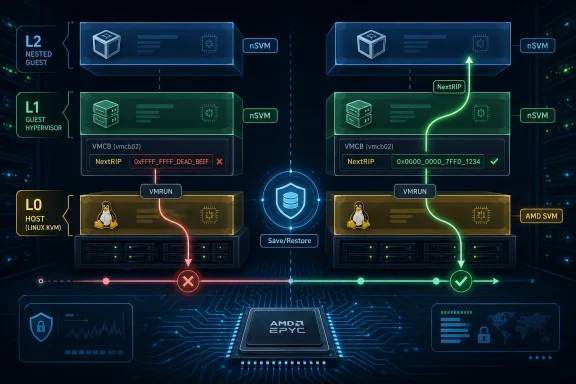 A Small Pointer Bug Lands in a Very Large Trust Boundary
The vulnerability description for CVE-2026-46059 is unusually terse, even by kernel CVE standards. It says that in the Linux kernel, a KVM nSVM issue has been resolved by always using NextRIP as vmcb02’s NextRIP after the first L2 VMRUN. Behind that sentence sits a three-level virtualization stack: L0 is the real host running KVM, L1 is a guest hypervisor, and L2 is the nested guest that L1 believes it controls.On AMD systems, Secure Virtual Machine, or SVM, uses a Virtual Machine Control Block to describe guest state. In nested virtualization, KVM has to merge or translate control blocks so that the real processor can run an L2 guest while preserving the illusion that L1 is in charge. The
vmcb02 structure is part of that machinery: it is the effective control block KVM uses to run L2 on the physical CPU.The bug involves
NextRIP, the next instruction pointer used after certain intercepts and events. When the NRIPS feature is disabled, an L1 hypervisor does not provide NextRIP in the same way while running L2 with an injected software interrupt. Instead, L1 advances the current RIP before running the nested guest. KVM tried to emulate that behavior by using the current RIP as NextRIP in vmcb02.That logic only holds at the beginning. After L2 has run once,
NextRIP can be updated by the CPU or by KVM itself, and the current RIP stops being a reliable substitute. The fix is therefore not a broad redesign but a conditional truth: after save and restore, use the current RIP only if a nested run is still pending; otherwise, use NextRIP.That is the kind of sentence that makes non-kernel readers glaze over. It is also the kind of sentence that determines whether nested virtualization behaves deterministically after migration, suspend/resume, crash recovery, or state restoration.
The Scary Part Is Not the Missing CVSS Score
NVD has not yet assigned CVSS 4.0, CVSS 3.x, or CVSS 2.0 metrics to CVE-2026-46059. That absence is not a verdict of safety. It means the public scoring pipeline has not yet caught up with the kernel.org assignment and stable-tree references.For administrators, “N/A” in the NVD score field is a poor substitute for risk analysis. Kernel CVEs increasingly arrive before the familiar downstream triage artifacts: no polished advisory, no vendor severity banner, no exploitability narrative, and sometimes no obvious affected-version matrix outside the stable commits themselves. The kernel project’s CVE process intentionally errs on the side of assigning identifiers to fixes that may have security relevance, which creates a flood of records that look underexplained at first publication.
That flood has changed the job of patch management. A decade ago, a Linux kernel CVE with no score might have been ignored until a distribution advisory sorted it into high, medium, or low. In 2026, that is a dangerous habit, especially for virtualization hosts. The absence of scoring is often a timing artifact, not a technical one.
Still, this is not a reason to panic. Nothing in the public description says CVE-2026-46059 is a known guest-to-host escape, a privilege-escalation primitive, or a remotely exploitable vulnerability. The disclosed facts point to a correctness bug in nested AMD KVM state handling, especially around save/restore behavior and software interrupt injection. The practical risk depends heavily on whether your systems use KVM, AMD SVM, nested virtualization, and guest workloads capable of exercising this path.
The right reading is narrower and more disciplined: this is a kernel hypervisor bug in a sensitive boundary, fixed in stable trees, currently awaiting public severity enrichment. Treat it as patch-relevant for hosts that expose nested virtualization, not as proof that every Linux server is on fire.
Nested Virtualization Has Become Infrastructure, Not a Lab Trick
Nested virtualization used to be a niche feature for people who wanted to run a hypervisor inside a hypervisor because they enjoyed pain. That era is over. Developer workstations, CI systems, cloud test environments, security sandboxes, Android emulators, WSL-adjacent workflows, and Windows Server labs all lean on nested virtualization more than many teams admit.For WindowsForum readers, the Linux angle should not make this feel distant. KVM is a backbone technology for countless mixed environments where Windows guests, Linux hosts, container platforms, and cloud-style automation share the same hardware. A Windows administrator may never touch
vmcb02, but they may absolutely depend on a Linux KVM host that runs Windows test VMs, domain-controller replicas, build agents, or nested Hyper-V evaluation environments.Nested virtualization also shows up in awkward operational places. A developer enables virtualization in a cloud VM to test a hypervisor feature. A security team runs malware detonation sandboxes inside an already virtualized fleet. A training platform spins up nested labs where students deploy Windows Server roles. A QA pipeline runs one virtualization layer for orchestration and another for the thing being tested.
These stacks work because the host kernel lies convincingly. It tells L1 that it has hardware control. It tells L2 that its world is coherent. When a saved and restored nested guest resumes with the wrong instruction pointer metadata, the lie can break in ways that are hard to diagnose.
That is why a bug like CVE-2026-46059 matters even if it never becomes a marquee exploit. Hypervisor correctness is security-adjacent by design. When CPU state is misrepresented across privilege boundaries, the first symptom may be a crash, a stuck VM, or corrupted guest execution. The worst-case analysis is left to maintainers and researchers, but production operators do not need a proof-of-concept to prefer the fixed code.
AMD’s SVM Path Gets the Spotlight, but KVM Owns the Abstraction
The CVE’s description is specifically about nSVM, KVM’s nested AMD SVM implementation. That matters. Intel VMX and AMD SVM have different virtualization semantics, different control structures, and different historical footguns. This is not a generic “all virtualization is broken” story, and administrators should resist the urge to flatten the details.At the same time, the bug is not “AMD’s problem” in the simplistic sense. KVM’s job is to present a virtualized CPU model correctly, including cases where hardware features are absent, disabled, masked, or emulated for compatibility. NRIPS is one of those feature wrinkles. When it is disabled, KVM needs to emulate behavior that a guest hypervisor expects from hardware that does not provide the convenient next-instruction pointer state.
That emulation is where the defect lived. KVM used the current
RIP as a stand-in for NextRIP to model a CPU without NRIPS during an injected software interrupt. But after the nested guest had already run, that shortcut stopped being valid. The fixed logic distinguishes between a pending nested run, where current RIP remains appropriate, and a restored or later state, where the saved NextRIP should be trusted.The public note also says
soft_int_next_rip received the same treatment. That phrase is easy to skip, but it is important because it suggests maintainers recognized the same pattern in a narrower code path. Good kernel fixes often look like this: not just one line changed to satisfy a reproducer, but the same state assumption corrected wherever it appears.For operators, the lesson is not to memorize NRIPS. It is to understand that virtualization feature masking and nested state restoration are complicated enough that “rare configuration” does not mean “irrelevant configuration.” Cloud and lab environments are full of rare configurations at scale.
Save and Restore Is Where State Bugs Go to Hide
The vulnerability description specifically calls out “after save/restore.” That phrase should make administrators lean forward. Save and restore is one of the places where hypervisors stop being simple schedulers and become archivists of CPU reality.A running VM is a river of state. A saved VM is a photograph of that river, plus a promise that the next frame will make sense when execution resumes. If the hypervisor records or reconstructs the wrong instruction pointer relationship, it may not fail immediately. It may resume into a path that only breaks under a particular interrupt injection, nested state transition, or guest hypervisor expectation.
That makes bugs like this operationally slippery. They may not appear in a straightforward boot test. They may not appear on every host. They may require AMD hardware, nested SVM, NRIPS disabled, an L2 guest, injected software interrupt behavior, and a save/restore transition. In other words, they may appear only in the exact places where automation has convinced everyone the platform is boring.
Live migration, suspend/resume, snapshotting, checkpointing, and disaster-recovery workflows all lean on similar assumptions: capture the right state, move it, and continue as though nothing happened. The more virtualization is layered, the more each layer must preserve details that ordinary users never see. A single off-by-context decision about which
RIP value is authoritative becomes a bug report with a CVE number.This is why sysadmins often distrust “works on boot” as a validation standard. Hypervisors need to survive transitions. They need to survive guest state being paused, serialized, restored, migrated, and resumed. CVE-2026-46059 is a reminder that the transition path can be the real attack surface, or at least the real reliability surface.
The Kernel CVE Machine Is Doing Exactly What It Said It Would Do
One reason this record feels unfinished is that the Linux kernel’s modern CVE process is intentionally different from the old external-advisory rhythm. The kernel project became more assertive about assigning CVEs to fixes that may represent security issues, especially once the fix is already present in released stable trees. That approach produces more CVEs, earlier CVEs, and many CVEs whose public descriptions read like commit messages because that is essentially what they are.There is a trade-off here. On the positive side, administrators get a machine-readable identifier tied to a real upstream fix, not a vague rumor that some kernel bug might matter. On the negative side, each record arrives with less narrative polish. NVD enrichment, distribution advisories, severity scoring, affected-package tables, and enterprise remediation guidance lag behind.
CVE-2026-46059 is a textbook example. The record has a kernel.org source, a publication date of May 27, 2026, and stable commit references. It does not yet have NVD scoring. It does not yet have a CWE classification in the provided NVD text. It does not yet tell a busy virtualization admin whether to cancel dinner.
That last part is the uncomfortable truth: no database can outsource judgment completely. The kernel team can identify a fix. NVD can eventually score it. Distributions can package it. But the operator still has to decide whether a given KVM host is exposed to the affected path, whether nested virtualization is enabled, whether AMD SVM is involved, and how quickly the fleet can be rebooted or live-patched.
The new kernel CVE world rewards teams that already know their kernel estate. It punishes teams that treat “Linux” as one asset class and “kernel CVE” as one patching queue.
Windows Shops Should Not File This Under Somebody Else’s Problem
Windows-focused administrators may be tempted to treat CVE-2026-46059 as Linux housekeeping. That would be too neat. In mixed estates, Windows workloads increasingly run on Linux virtualization layers, and Linux developer platforms increasingly host Windows VMs for testing, compatibility, and automation.A KVM bug can affect a Windows guest without being a Windows vulnerability. That distinction matters for incident response and for patch ownership. The guest operating system may be fully patched while the host hypervisor still contains the vulnerable logic. A Windows Server VM might crash, misbehave, or become part of a nested virtualization test case because the underlying Linux kernel mishandles state beneath it.
This is especially relevant for organizations using Linux-based virtualization platforms to host Windows desktops, Windows Server labs, or ephemeral CI VMs. It also matters for security teams testing virtualization-dependent Windows features in nested environments. If the stack includes AMD hosts, KVM, and nested SVM, this CVE belongs on the review list even if every guest image in the environment says “Microsoft” on the splash screen.
There is also a cultural point here. Windows and Linux administrators often think in separate patch calendars. Firmware, hypervisors, kernels, guest tools, and management planes do not respect that boundary. A Windows outage can originate in a Linux host. A Linux kernel fix can be the mitigation for a Windows workload reliability problem. The infrastructure has been converged for years; the patch conversations still lag behind.
For WindowsForum’s audience, the practical move is not to become kernel maintainers overnight. It is to ask better inventory questions: which hypervisors host our Windows assets, which of those run KVM, which are AMD-based, which expose nested virtualization, and which kernel streams are they actually running?
The Exploit Story Is Still Unwritten, and That Matters
The public CVE text does not describe an exploit. It does not claim active exploitation. It does not provide a denial-of-service label, privilege-escalation label, information-disclosure label, or VM-escape label. Any article that confidently assigns those outcomes today is getting ahead of the available record.That restraint cuts both ways. Security teams should not inflate CVE-2026-46059 into a cinematic breakout without evidence. They also should not dismiss it because the description is technical and unsensational. Kernel hypervisor bugs often live in a gray zone before researchers, vendors, and cloud operators clarify the blast radius.
The most defensible early assessment is that the issue can cause incorrect nested guest execution state in a sensitive KVM path. Depending on surrounding conditions, such bugs may present as guest crashes, failed nested runs, unpredictable behavior after restore, or potentially more serious isolation consequences if a controllable state transition can be abused. The public record does not yet establish which of those outcomes is realistic.
That uncertainty is exactly why stable kernel fixes matter. Operators do not have to wait for a public exploit to accept a small, targeted correctness fix from the kernel tree. In virtualization infrastructure, reliability and security are intertwined enough that a state-restoration bug in nested execution deserves attention before it earns a dramatic severity label.
There is a useful discipline here: patch based on affectedness and exposure, not vibes. If you do not run KVM, this CVE is probably irrelevant. If you run KVM only on Intel hosts without AMD nSVM, it is likely not your bug. If you run AMD KVM hosts with nested virtualization enabled, it is worth treating as an operationally meaningful kernel update even while NVD catches up.
The Stable Commits Are the Real Advisory
The NVD entry lists three stable kernel commit references for the fix. That is the most actionable part of the record. In kernel land, the commit trail often tells administrators more than the CVE prose does, because it shows that the fix has been carried into maintained branches rather than merely discussed upstream.The original upstream commit identified in the public stable-review material is
8d397582f6b5e9fbcf09781c7c934b4910e94a50. The NVD text also references stable commits 3428ed1529a1af4cce5aff6c5bd2fcc39ad726bb and 69fe1411a5ce678b4da6489b5d2282b4e1d13acf. That pattern suggests backports across multiple supported kernel streams, which is how most administrators will actually consume the fix.Very few production teams should cherry-pick this patch by hand unless they maintain their own kernel. The better path is to take the relevant kernel update from the distribution, appliance vendor, cloud image provider, or virtualization platform maintainer. Kernel fixes are tested in context, and the Linux kernel documentation itself has long warned against treating individual fixes as isolated Lego bricks unless you know exactly what you are doing.
For rolling distributions and fast-moving virtualization hosts, the fix may already be in the next regular kernel update. For enterprise distributions, it may arrive as a vendor advisory with a different severity label, a backported patch into an older kernel version, and no obvious version-number jump that resembles upstream. That is normal. Enterprise kernels often carry fixes without changing the visible base version in the way upstream watchers expect.
The operational question is therefore not “Do I have kernel 7.0?” or any other simplistic version check. The question is whether your vendor’s kernel build includes the relevant KVM nSVM fix. Package changelogs, vendor CVE pages, and kernel source RPMs or equivalent build metadata are more reliable than guessing from the major version string.
Inventory Beats Alarmism
The sane response to CVE-2026-46059 starts with inventory. Security teams should identify KVM hosts, then narrow that list to AMD systems, then narrow again to environments where nested virtualization is enabled or likely to be used. That last category is often broader than expected because nested virtualization can be turned on for developer convenience and then forgotten.Once the exposed set is known, maintenance planning becomes straightforward. Apply vendor kernels containing the fix. Reboot hosts where necessary. Validate nested virtualization workloads that depend on save/restore, snapshots, suspend/resume, or migration. Watch for distribution advisories that add severity scoring or affected-version clarity.
The harder work is organizational. Many companies have asset databases that know guest operating systems but not host CPU vendor. They know VM owners but not whether nested virtualization is exposed. They track Windows patch compliance more carefully than hypervisor kernel drift. A CVE like this exposes those blind spots without needing to be catastrophic.
For homelab users, the calculus is simpler. If you are running Proxmox, Fedora, Arch, Debian, Ubuntu, or another Linux-based KVM stack on AMD hardware and you experiment with nested virtualization, take kernel updates seriously and reboot into them. If your lab includes Windows guests, nested Hyper-V experiments, or saved VM states, test those workflows after updating.
For cloud customers, the answer is more contractual. If the provider manages the host, the provider owns the host kernel. Customers may still need to patch guest kernels if they run nested KVM inside their own instances, but the physical L0 layer is typically not customer-controlled. That split is why cloud vulnerability management has become an exercise in reading responsibility boundaries as much as CVE descriptions.
The Patch Teaches More Than the Scorecard
The most interesting thing about CVE-2026-46059 is not its eventual CVSS number. It is the design lesson. KVM had a conditional emulation rule that was valid before the first nested run and invalid afterward. The bug was not that the code never understoodNextRIP; it was that the code failed to respect when the source of truth changed.That is a classic virtualization failure mode. Hypervisors are full of state that is correct only in a particular phase. Before entry. After exit. While an intercept is pending. During injection. After restore. Before the CPU has updated a field. After KVM has synthesized one. Security-relevant bugs happen when those phases blur.
The fix’s wording is almost philosophical: use current
RIP if and only if a nested run is pending; otherwise use NextRIP. The phrase “if and only if” is the entire story. In low-level systems code, correctness often depends less on knowing the right value than on knowing the lifetime of that value’s authority.That should sound familiar to anyone who has debugged Windows driver state, Hyper-V checkpoint oddities, firmware handoff bugs, or resume-from-sleep failures. The architecture differs, but the failure pattern rhymes. A value copied at the wrong time becomes a lie. A lie preserved across restore becomes a bug. A bug in a privilege boundary becomes a CVE.
The Virtualization Stack Keeps Getting Deeper
CVE-2026-46059 also arrives in a world where virtualization layers are multiplying. Developers run containers inside VMs inside cloud hosts. Security products run instrumented guests inside sandbox hosts. Windows users run Linux tools through WSL while Linux users run Windows VMs for compatibility. Cloud providers expose nested virtualization because customers demand realistic test environments.Every layer adds state. Every state transition adds edge cases. Every edge case becomes someone’s production outage when the abstraction leaks.
This is not an argument against nested virtualization. It is too useful to put back in the box. It lets teams test hypervisors without racks of hardware, build reproducible labs, and run complex workloads on commodity infrastructure. But it is an argument against pretending nested virtualization is just another checkbox.
When that checkbox is enabled, the host kernel becomes responsible for emulating not only a machine, but a machine that is itself pretending to own machines. That is a subtle contract. CVE-2026-46059 is a small breach in that contract, now patched, but it reminds us how much trust sits in code paths most administrators never read.
The Windows ecosystem has already absorbed this lesson in its own way. Hyper-V, Virtualization-Based Security, Credential Guard, Windows Sandbox, WSL, and modern emulator stacks all depend on hardware virtualization being boringly correct. Linux KVM lives in the same world. The brand names differ; the fragility of layered privilege is shared.
The Practical Reading for KVM Operators
Administrators should resist two bad instincts. The first is to ignore the CVE because NVD has not scored it. The second is to overreact as though every Linux VM is exposed to a public escape. The evidence supports neither complacency nor theater.CVE-2026-46059 is narrow, technical, and real. It affects KVM’s AMD nested virtualization path. It concerns
NextRIP handling after an L2 guest has already run, especially across save/restore logic. It has upstream and stable fixes referenced by kernel.org. It remains awaiting NVD enrichment as of the provided publication window.That makes it ideal for calm remediation. Check whether your hosts are in scope. Track vendor kernel updates. Prioritize systems where nested virtualization is enabled for untrusted or semi-trusted tenants. Include snapshot and restore workflows in validation. Document the decision if you decide a fleet is not affected.
The worst outcome would be to let the lack of a CVSS score stall action in environments that plainly use the affected feature. The second-worst outcome would be to spend emergency cycles patching systems that cannot exercise the bug while ignoring the few lab, CI, or tenant hosts that can.
The Real Checklist Is Shorter Than the CVE Text
The useful response fits on one screen, even if the underlying bug does not. Treat this as a virtualization-host patching item first and a generic Linux vulnerability second.- Confirm whether any Linux KVM hosts in your environment run on AMD hardware with nested virtualization enabled.
- Check your distribution or platform kernel changelog for the KVM nSVM
NextRIPfix associated with CVE-2026-46059. - Prioritize hosts that run nested hypervisors, CI labs, security sandboxes, training environments, or customer-controlled virtualization workloads.
- Reboot into the fixed kernel where required, because hypervisor fixes do not help if the old kernel is still running.
- Test saved-state, snapshot, restore, suspend/resume, and migration workflows for nested guests after patching.
- Do not rely on the current lack of an NVD severity score as evidence that the issue is irrelevant.
References
- Primary source: NVD / Linux Kernel
Published: 2026-05-28T01:03:36-07:00
NVD - CVE-2026-46059
 nvd.nist.gov
- Security advisory: MSRC
Published: 2026-05-28T01:03:36-07:00
Original feed URL
Security Update Guide - Microsoft Security Response Center
 msrc.microsoft.com
- Related coverage: kernel.org

CVEs — The Linux Kernel documentation
kernel.org
- Related coverage: cve.org
- Related coverage: linux.oracle.com

- Related coverage: kernel.googlesource.com
