

 A Tiny KVM Patch Exposes a Big Virtualization Assumption
The headline version of CVE-2026-46071 sounds almost comically narrow: “KVM: nSVM: Avoid clearing VMCB_LBR in vmcb12.” That is the kind of kernel commit title that usually passes beneath the attention of everyone except KVM maintainers, cloud platform engineers, and the occasional virtualization hobbyist running nested labs on AMD hardware.
But narrow is not the same as trivial. Kernel virtualization code is a stack of contracts, and nested virtualization is a stack of contracts inside contracts. When one layer writes to a data structure it should treat as architecturally sensitive, the immediate outcome may be boring — a stale clean bit, a wrong optimization hint, a future refactor made harder — but the class of mistake is exactly the one security teams have learned not to wave away.
The Linux kernel project’s CVE process has become more aggressive about assigning identifiers to resolved kernel defects, including bugs that do not arrive with splashy exploit write-ups or polished severity scores. CVE-2026-46071 sits in that newer reality. The public record describes a defect, a fix, and a set of stable-tree references, while NVD enrichment and official CVSS scoring remain pending.
That gap between “assigned CVE” and “fully explained vulnerability” is where administrators have to make decisions. The right conclusion is not panic. It is also not dismissal. This is a patch-now-in-normal-maintenance issue for systems using KVM on AMD hardware with nested SVM enabled, and a reminder that virtualization bugs often become important only when they are composed with something else.
The Bug Lives Where L1 Pretends to Be a Hypervisor
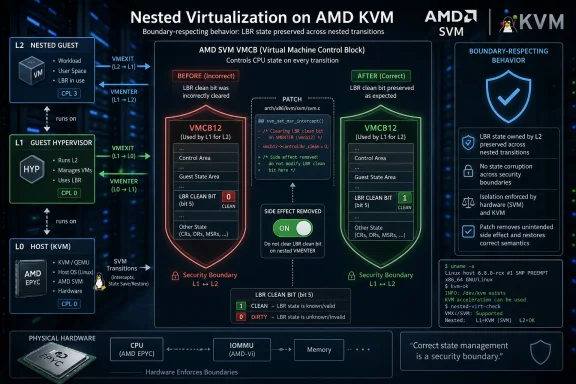
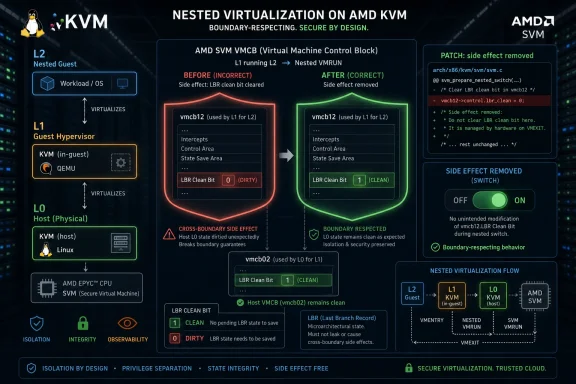
To understand the issue, you have to step into nested virtualization. In a normal VM, the host hypervisor runs a guest. In nested virtualization, that guest may itself run another guest. The host is commonly called L0, the first guest hypervisor is L1, and the nested guest is L2.
AMD’s virtualization architecture, SVM, uses a Virtual Machine Control Block, or VMCB, to describe guest state and control behavior. In nested SVM, KVM juggles multiple VMCB-like structures to represent what the real host needs, what the L1 guest thinks it controls, and what the L2 guest is actually doing. The names in this CVE matter: vmcb12 is the control block supplied by the L1 guest hypervisor for running its L2 guest, while vmcb02 is KVM’s merged internal version used by the real host to run that L2 workload.
The vulnerable logic involved Last Branch Record virtualization, or LBRV. Last Branch Records are CPU debugging and profiling facilities that track recent branch history. Hypervisors need to save, restore, and virtualize that state carefully because it is part of the CPU-visible environment presented to guests.
The function at the center of this fix, svm_copy_lbrs(), copied LBR fields from one VMCB to another. The problem was that the helper always marked the destination VMCB’s LBR area dirty. That made sense for some destinations, because KVM needs to tell hardware that a field changed. It did not make sense when the destination was vmcb12, because that structure belongs to the nested guest hypervisor’s architectural view of the world.
In plain English: KVM had a helper that did two things — copy LBR state and mark that copied state as dirty — but one caller needed only the first part. The fix separates those responsibilities.
Clean Bits Are Not Just Housekeeping
The phrase “clearing clean bits” sounds like a maintenance chore. In virtualization code, it is more than that. Clean bits are part of how the hypervisor and CPU avoid unnecessary reloads of VMCB fields; they encode whether certain portions of the control block are known to be unchanged.
In KVM’s internal VMCBs, changing those bits is expected. KVM owns those structures, and it can mark fields dirty when hardware needs to observe updates. In vmcb12, however, the clean bits belong to the contract between the L1 hypervisor and its virtualized view of AMD SVM. KVM should emulate that contract, not casually mutate it as a side effect of a helper routine.
The upstream patch does exactly what careful kernel patches often do: it moves a side effect out of a generic helper and into the callers that actually need it. svm_copy_lbrs() no longer marks the destination dirty on its own. Callers that copy LBR state into KVM-owned VMCBs explicitly call vmcb_mark_dirty(). The nested VM exit path that copies LBRs back into vmcb12 does not.
That is not a sweeping rewrite. It is a five-insertion, four-deletion kind of change. But the smallness is part of the story. Kernel security fixes often look anticlimactic because the dangerous thing is not the number of changed lines; it is the misplaced assumption those lines encoded.
The patch also notes that clearing clean bits in vmcb12 is “not architecturally defined.” That phrase should get every hypervisor engineer’s attention. Undefined behavior at a virtualization boundary is where compatibility issues, guest-visible weirdness, and occasionally security primitives begin.
Why This Became a CVE Without a Dramatic Score
At publication, NVD lists CVE-2026-46071 as awaiting enrichment, with no NIST CVSS score assigned. That does not mean the bug is harmless. It means the public vulnerability metadata has not yet caught up with the kernel record, and perhaps that the exact exploitability is not straightforward from the commit text alone.
This is increasingly normal for Linux kernel CVEs. The kernel community has moved toward assigning CVEs to many fixed bugs that meet its vulnerability criteria, often before downstream vendors have published advisories with exploit scenarios, affected package matrices, or severity ratings. Administrators used to the old rhythm — scary advisory first, patch later — now see many kernel CVEs in the reverse order.
That inversion is uncomfortable but useful. It gives defenders an identifier to track across distributions, scanners, and patch systems. It also produces noise, because not every kernel CVE is a remote-code-execution emergency or a privilege-escalation headline waiting to happen.
CVE-2026-46071 falls into the “read the subsystem before you read the score” category. The affected area is KVM’s AMD nested SVM implementation. Systems not using KVM are out of scope. Systems not using AMD SVM are likely out of the main blast radius. Systems not enabling nested virtualization may have little practical exposure. But for cloud hosts, lab environments, CI systems, security research platforms, and developer machines where nested virtualization is common, the bug is not academic.
The absence of an NVD score should not tempt organizations into inventing certainty. A pending score is not a low score. It is simply pending.
The Windows Angle Is Infrastructure, Not Desktop Patch Tuesday
Windows users might reasonably ask why this belongs on WindowsForum at all. The answer is that Windows is no longer only a desktop operating system sitting on bare metal. It is a guest, a build target, a test environment, a nested lab participant, and often a workload running on Linux infrastructure.
Plenty of Windows VMs run on KVM, whether through enterprise virtualization stacks, OpenStack, Proxmox, cloud providers, lab hosts, or developer workstations. Nested virtualization is also no longer exotic. Developers run Hyper-V inside guests, security teams run malware sandboxes inside isolated VMs, and IT pros routinely build test domains inside virtualized hosts that are themselves running on larger hypervisors.
CVE-2026-46071 does not imply that a Windows guest is uniquely vulnerable. It does not describe a Windows kernel flaw, a Microsoft hypervisor flaw, or a guest escape affecting Hyper-V. But Windows workloads can be passengers on an affected Linux/KVM host, and passengers care whether the aircraft’s control systems are being patched.
The practical Windows connection is strongest in three places. The first is Proxmox and other KVM-based home-lab or small-business deployments running Windows Server or Windows 11 guests. The second is CI and test infrastructure where Windows images are launched on Linux hosts. The third is nested virtualization labs where Windows, Linux, Hyper-V, WSL, and KVM are mixed in ways that would have seemed perverse a decade ago and ordinary today.
For administrators, the question is not “Does Windows need an update for this CVE?” It is “Are any of my Windows workloads running on Linux hosts whose KVM stack needs one?”
Nested Virtualization Is Where Clean Abstractions Go to Die
Nested virtualization exists because everyone wants the cloud to behave like a physical machine while also being cheaper, denser, and easier to automate. That demand creates one of the most difficult engineering problems in systems software: one hypervisor must convincingly emulate the hardware virtualization features needed by another hypervisor.
Every nested VM exit is a negotiation. The L2 guest does something that exits to what it thinks is its L1 hypervisor. KVM, as L0, must decide what to reflect back, what to emulate, what to merge into internal state, and what to preserve for architectural correctness. The more CPU features are virtualized — branch records, interrupts, TLB controls, event injection, performance counters — the more state must be copied between layers without smearing ownership boundaries.
That is why the vmcb12 detail matters. A nested hypervisor’s control block is not just another internal buffer. It is part of the virtual hardware interface exposed to L1. Treating it like KVM’s own scratchpad risks creating behavior that real hardware would not produce.
The patch that fixed CVE-2026-46071 was part of a broader nested SVM series described as fixes, cleanups, and hardening. That context is important. The LBR clean-bit fix was not an isolated adventure; it belonged to a larger effort to tighten how KVM handles nested SVM state, validates fields, caches VMCB12 data, and limits risky mappings.
That broader patch set suggests maintainers are not merely shaving yaks. They are reducing the surface area where L1-controlled data and L0-owned state can blur together. In a world where virtualization is a security boundary, those cleanups are not cosmetic.
The Security Story Is About Boundaries, Not Branch Records
It would be easy to overfocus on LBRs because they are the named facility in the patch. LBR state can matter for debugging, profiling, and in some side-channel contexts, but the CVE description does not claim a direct branch-history information leak or a ready-made exploit. The more durable security lesson is about state ownership.
A hypervisor is trusted because it knows which state belongs to whom. The host owns real hardware state. The guest owns its architectural view. The nested guest hypervisor owns its virtual control structures. Every time the real hypervisor copies data across those layers, it must preserve not just values but semantics.
Here, the copy helper carried an extra semantic payload: after copying LBR fields, it marked the destination dirty. That was correct when the destination was a VMCB that KVM would submit to hardware. It was wrong when the destination was vmcb12, where clearing the clean bit was not architecturally specified.
This is the kind of bug that may not obviously hand an attacker a shell. But virtualization vulnerabilities often start as “the wrong state was trusted,” “the wrong field was reflected,” or “the wrong cache was assumed valid.” The nightmare scenario in nested virtualization is not a single wrong bit; it is a chain where that bit affects emulation, which affects validation, which affects memory access, which affects isolation.
Nothing in the public record for CVE-2026-46071 proves such a chain. The responsible reading is more restrained: the bug violated an architectural boundary in a sensitive subsystem, and the kernel maintainers treated that as vulnerability-worthy.
The Patch Is Small Because the Design Fix Is Precise
The fix does not remove LBR virtualization. It does not disable nested SVM. It does not add a mitigation knob or a sweeping behavioral change. It simply stops svm_copy_lbrs() from always calling vmcb_mark_dirty() and makes the callers decide whether dirty marking is appropriate.
That is good engineering. Helpers should do what their names promise and avoid hidden side effects when the same helper is used across ownership domains. A function named like a copy operation should not silently mutate architectural bookkeeping unless every caller wants that mutation.
In the nested VM entry path, KVM still marks the internal vmcb02 LBR state dirty after copying. In the non-nested or host-owned path, KVM still marks vmcb01 dirty where needed. The difference is that copying LBRs into vmcb12 no longer clears the nested hypervisor’s clean bit.
The patch also makes future refactoring easier because the LBR-copy operation no longer needs an entire VMCB destination solely to trigger a dirty mark. That detail matters in kernel work: many hardening changes arrive as refactoring prerequisites, and many security bugs persist because code paths are too entangled to reason about safely.
This is one of those fixes that reads like cleanup until you realize cleanup is often the security fix. Kernel attack surfaces shrink when maintainers make code say what it means.
Who Should Care Before the Scanner Turns Red
The most exposed audience is not the average Windows desktop user. It is the administrator responsible for Linux hosts running KVM with AMD processors and nested virtualization enabled. If those hosts run Windows guests, the operational impact still belongs to the Linux host patch cycle.
The second audience is anyone running a lab stack where virtualization layers are deliberately stacked: Proxmox on AMD hardware, nested ESXi experiments, Windows Server guests running Hyper-V roles, cloud-init automation that spins nested test clusters, or security sandboxes that depend on L2 isolation. These environments are exactly where obscure KVM nested bugs become reproducible.
The third audience is vulnerability management teams. CVE-2026-46071 may appear in scanners before NVD has fully enriched it. That can lead to the usual dashboard confusion: a CVE with no NVD score, a kernel.org source, and a description that sounds like it was written for the KVM mailing list rather than an enterprise risk committee.
The right triage workflow is to map the CVE to kernel packages, not to argue with the wording. Check your distribution’s kernel advisories, determine whether your installed kernels include the relevant stable commits, and identify whether affected hosts actually load and use kvm_amd with nested virtualization. If the systems are internet-facing VM hosts, multi-tenant virtualization platforms, or developer machines running untrusted nested guests, prioritize them above ordinary single-tenant lab boxes.
The key is not to treat “nested” as a reason to ignore the bug. In many organizations, nested virtualization has quietly become normal because it makes testing easier. Attackers do not care whether a configuration was supposed to be rare.
Distribution Backports Will Decide the Real Patch Story
Kernel.org references are only the beginning. Most production systems do not run raw upstream stable kernels; they run distribution kernels with backports, vendor patches, and release-specific versioning. That means “fixed in upstream” does not automatically translate to “fixed in your installed package,” and “my version number looks old” does not automatically mean “vulnerable.”
This is especially true for enterprise Linux distributions. Red Hat, SUSE, Ubuntu, Debian, Oracle, and others routinely backport security fixes without changing the major kernel version in a way that resembles upstream stable. A system can report a kernel that looks ancient by upstream standards and still contain the fix. Conversely, a fast-moving distribution can expose the vulnerable code briefly and then patch it through routine updates.
Administrators should resist the temptation to manually compare only uname -r against upstream version numbers. The safer approach is to rely on vendor security trackers and package changelogs, then verify whether the specific KVM/SVM patch has landed. For self-built kernels, the answer is simpler and harsher: inspect the source or update to a stable release containing the fix.
The presence of multiple stable commit references in the CVE record indicates that the fix has been applied across more than one maintained line. That is what defenders want to see. It means this is not merely a development-tree correction waiting for the next major kernel; it has been judged suitable for stable backporting.
Still, there is lag between upstream stable, distribution packaging, cloud image refreshes, and rebooted production hosts. Kernel fixes are not real until the running kernel changes. In virtualization fleets, that last step is often the hardest because host reboots require guest migration or downtime planning.
No, This Is Not Another Reason to Turn Off Virtualization
There is a weary rhythm to vulnerability news: a complex subsystem has a bug, and someone declares the whole subsystem unsafe. That is the wrong lesson here. KVM’s nested SVM code is complicated because the hardware contract is complicated, and because users demand nested virtualization for legitimate reasons.
Turning off nested virtualization may be a reasonable short-term mitigation for hosts that do not need it, particularly where untrusted tenants can run their own hypervisors. But as a broad prescription, it misses the point. The better long-term answer is narrower privileges, faster kernel maintenance, and clear inventory of where nested virtualization is enabled.
For home-lab users, the practical advice is mundane. If you run Proxmox or another KVM-based host on AMD hardware and you update regularly, make sure your host kernel picks up the relevant stable update. If you enabled nested virtualization for experiments and no longer need it, consider disabling it. If your Windows guests are ordinary single-layer VMs, the urgency is lower, but the host should still be patched.
For enterprise administrators, the question is policy. Can ordinary tenants create nested hypervisors? Are Windows build agents running on shared KVM hosts? Do security research environments mix trusted and untrusted guests? Does the organization know which AMD hosts expose nested SVM at all?
A small CVE like this is a useful audit prompt. If answering those questions requires a week of Slack archaeology and tribal memory, the vulnerability is not the only problem.
The Quiet Kernel CVEs Are Now Part of Windows Operations
The Windows ecosystem has spent years moving outward from the PC. Windows Server runs in clouds. Windows clients run as virtual desktops. Windows developers build on WSL, containers, nested hypervisors, and Linux-based CI. The old boundary between “Windows security” and “Linux kernel security” is operationally obsolete.
CVE-2026-46071 is a good example because it will not trigger the same instinctive response as a Microsoft Patch Tuesday flaw. There is no Windows KB to install on the guest. There is no familiar CVSS headline from Microsoft. The vulnerable component may be invisible to the team that owns the Windows workload.
That invisibility is the danger. A Windows administrator may see healthy guests, current Windows patches, and clean Defender telemetry while the underlying Linux host awaits a KVM fix. A Linux administrator may see the issue as a niche nested SVM bug while the business impact is Windows build capacity or a virtual desktop pool.
Modern infrastructure does not respect organizational silos. A vulnerability in KVM can matter to Windows. A Windows workload can depend on a Linux host. A Linux kernel patch can be the security update that keeps a Windows service correctly isolated.
This is why vulnerability management needs asset relationships, not just asset lists. Knowing that a server runs Windows is not enough. Knowing where that Windows instance runs, which hypervisor backs it, whether the host is AMD or Intel, whether nested virtualization is enabled, and whether the host has rebooted into a fixed kernel is the difference between real risk management and checkbox theater.
The Useful Reading of CVE-2026-46071 Is Boring on Purpose
CVE-2026-46071 is not the kind of vulnerability that should send administrators sprinting through the data center at midnight. The public record does not describe active exploitation, remote compromise, or a known guest escape. It describes a corrected KVM nSVM behavior involving LBR state and clean-bit handling in nested virtualization.
That makes it a boring patch. Boring patches are how secure systems stay secure.
The bug is also a reminder that the Linux kernel’s CVE stream now includes many defects that will require engineering judgment rather than reflexive severity sorting. Some will be urgent. Some will be irrelevant to a given environment. Some, like this one, will sit in the middle: important for the right hosts, low-drama for everyone else, and worth fixing because virtualization correctness is a security property.
Administrators should be wary of both extremes. Do not inflate every kernel CVE into a breach scenario. Do not ignore every low-context kernel CVE because NVD has not finished enrichment. The operationally mature response is to classify by subsystem, exposure, configuration, and patch availability.
In this case, that means KVM, AMD SVM, nested virtualization, LBR virtualization, and stable kernel updates. That is a narrow funnel, but for the systems inside it, the patch belongs in the normal security queue.
The VMCB_LBR Fix Leaves a Short Checklist
For all the architectural detail, the action items are refreshingly concrete. Treat this as a host-side Linux kernel maintenance issue with relevance to Windows workloads only when those workloads sit on affected KVM infrastructure.
- Identify Linux virtualization hosts using AMD processors and the
kvm_amdmodule, especially systems where nested virtualization is enabled for tenants, labs, CI, or security testing. - Check distribution advisories and kernel changelogs for the CVE-2026-46071 fix rather than relying only on upstream version numbers.
- Prioritize shared, multi-tenant, or untrusted nested virtualization environments ahead of ordinary single-user lab machines.
- Remember that Windows guests do not receive the fix themselves; the relevant update is on the Linux/KVM host.
- Plan the reboot or live-migration step, because a patched kernel package does not protect running hosts until they boot into it.
- Disable nested virtualization where it is no longer needed, not as a substitute for patching but as a sensible reduction of attack surface.
The lesson of CVE-2026-46071 is that virtualization security often turns on code paths too small to look dramatic. A helper function copied branch-record state and dirtied a control block it should have treated differently; the fix restores the boundary. As Windows workloads keep spreading across Linux-backed virtualization platforms, these quiet kernel corrections will increasingly be part of the Windows administrator’s world, whether or not they arrive with a Microsoft logo attached.
Attachments
References
- CVE-2026-46071 KVM: nSVM: Avoid clearing VMCB_LBR in vmcb12 NVD / Linux Kernel · 2026-05-28T01:03:30-07:00