

CVE-2026-46076 is a newly published Linux kernel KVM vulnerability, disclosed by kernel.org and recorded by NVD on May 27, 2026, that fixes incorrect AMD nested-virtualization handling of VMMCALL instructions when a second-level guest runs under an L1 hypervisor. The bug is narrow, technical, and unlikely to become the next headline-grabbing cloud escape by itself. But it is exactly the sort of virtualization edge case that matters because modern infrastructure increasingly stacks hypervisors, paravirtual interfaces, and guest operating systems on top of one another until “who is allowed to handle this instruction?” becomes a security boundary. The fix says something important: in nested virtualization, correctness is not polish — it is containment.
The vulnerability sits in KVM’s AMD SVM nested virtualization path, usually abbreviated nSVM. In plain English, that means it affects Linux hosts using KVM to run a guest hypervisor, which then runs another guest beneath it. Think of a Linux KVM host running a Windows Server VM with Hyper-V enabled, and then Hyper-V running its own VM.
That three-layer stack is not exotic anymore. Developers use it for labs, security researchers use it for sandboxes, enterprises use it for cloud migrations, and Windows users increasingly encounter it indirectly through Hyper-V, WSL, Credential Guard, virtualization-based security, and nested lab environments. Nested virtualization used to be a party trick; now it is infrastructure plumbing.
CVE-2026-46076 concerns what happens when the innermost guest, known as L2, executes
The answer depends on interception rules. If L1 asked to intercept
That is the security smell. Not necessarily “instant root.” Not necessarily “guest escape.” But a lower-privileged nested guest was being given a path intended for a more privileged virtualization layer. In hypervisor code, that is not a cosmetic mistake.
That optimization makes sense. TLB flushes are expensive, virtualization makes them more complicated, and nested virtualization makes them more expensive still. If KVM can directly handle a specific Hyper-V L2 TLB flush hypercall, the system can avoid unnecessary trips through the nested stack.
But performance shortcuts in hypervisors are dangerous when their eligibility tests are too broad. In this case, KVM had a reason to intercept
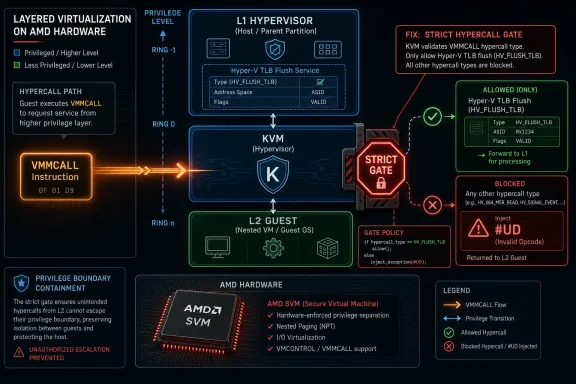
The fix introduces a stricter gate. If L2 is active and the
There is a pleasingly blunt quality to the patch. The fix does not attempt to reinterpret the Hyper-V Top-Level Functional Specification into saying something it does not say. The kernel developers effectively chose the CPU architecture over ambiguity: when in doubt, undefined means undefined.
That does not make it irrelevant. Hypervisors are authority routers. They decide which layer may execute privileged operations, which exceptions are delivered where, and which guest-visible features are emulated, trapped, ignored, accelerated, or rejected. A bug in that routing logic may be subtle, but subtle bugs at privilege boundaries are exactly the kind defenders should patch before they become incident reports.
The affected condition is also constrained. The vulnerable behavior requires L2 to be active, L1 not to request interception of
Still, those conditions map to real configurations. AMD hosts running Linux KVM, nested virtualization enabled, Hyper-V-aware guests, and advanced virtualization features are common in test labs and increasingly present in production-adjacent environments. The bug does not need to affect every machine to matter; it only needs to affect the machines where nested virtualization is part of a trust boundary.
The most practical interpretation is this: CVE-2026-46076 is a kernel-side correctness fix with security consequences. It tightens who gets to issue hypercalls under a nested AMD virtualization arrangement. That is exactly the kind of fix that should travel through stable kernels even if the exploitability story remains incomplete.
The Windows angle is especially important. Many Windows workloads now assume Hyper-V-adjacent behavior even when the user does not think of themselves as “running Hyper-V.” Virtualization-based security, Windows Sandbox, WSL 2, Android tooling, device emulation, and some enterprise endpoint controls all depend on hypervisor-aware assumptions. When Windows is itself a guest under KVM, those assumptions become a negotiation between Microsoft’s virtualization model and Linux’s.
That negotiation is what makes this bug interesting. KVM implements enough Hyper-V behavior to make Windows guests fast and functional. That includes paravirtual hints and hypercalls that Windows and Hyper-V-aware software expect. But every compatibility shim must preserve the distinction between what L2 is allowed to ask, what L1 owns, and what L0 may legitimately short-circuit.
The phrase “let L2 make hypercalls as if it were L1” is the kernel changelog’s quiet alarm bell. Even if the practical impact is bounded by which hypercalls are reachable and what KVM does with them, the conceptual violation is stark. A nested guest should not accidentally inherit the voice of its parent hypervisor.
From an administrator’s perspective, that may sound like the kernel is choosing to break something. In reality, it is choosing to break the right thing, at the right layer, in the way the architecture expects. A guest that executes an instruction it is not entitled to have handled should see a fault, not receive accidental service from the outermost hypervisor.
This distinction matters because virtualization bugs often hide behind “it works.” A nested guest doing something it should not do may not crash. It may boot faster, pass a test, or survive under load. But if the reason it works is that KVM misidentified the caller’s authority, the system is accumulating debt at the privilege boundary.
The patch also reflects a common kernel-maintenance pattern. The functional security fix arrives with minor cleanup around helper stubs and API shape. That can make the CVE description look more like internal refactoring than a security issue, but the security-relevant change is straightforward: non-eligible nested
There is a lesson here for operators who read kernel changelogs defensively. Not every security patch announces itself with dramatic language. Some of the most important ones are phrased like a correction to architectural behavior, because in kernel and hypervisor code, architecture is the security model.
Kernel CVEs have become noisier since the Linux kernel project began assigning CVEs more systematically. Many records now describe bugs that are already fixed upstream, sometimes with limited exploitability analysis in the public CVE text. This has made life harder for vulnerability managers who prefer neat buckets: critical, high, medium, low, ignore.
CVE-2026-46076 is a good example of why that approach is brittle. If you do not run AMD KVM hosts with nested virtualization and Hyper-V enlightenments, the practical urgency may be low. If you operate a virtualization platform where tenants, developers, or CI systems can run nested hypervisors, the same CVE becomes much more relevant.
The sane response is not panic. It is inventory. Find the hosts that run KVM on AMD hardware. Find the workloads that enable nested virtualization. Find Windows guests with Hyper-V features enabled inside KVM. Then map your kernel versions against the stable updates carrying the fix.
The absence of a CVSS score should push teams toward contextual risk, not complacency. CVSS is useful once available, but it cannot know whether your “lab” hypervisor is actually connected to production credentials, customer data, or a shared build network.
There was also a reported failed application to the 6.6 stable tree, meaning at least one older branch needed more careful backporting rather than a clean cherry-pick. That detail is operationally important. Administrators should not assume that every long-term kernel received the same fix at the same time merely because a CVE exists or because a patch is tagged for stable.
Distribution kernels complicate this further. Ubuntu, Debian, Fedora, Arch, SUSE, Red Hat-derived platforms, Proxmox, Unraid, TrueNAS SCALE, and custom cloud kernels all have their own patch cadence. Some carry virtualization backports far ahead of their nominal base version. Others deliberately omit features or configure KVM differently.
For Windows-heavy shops using Linux as the virtualization substrate, this is where the work lives. The relevant question is not “What does vanilla 6.x do?” The relevant question is “Has the kernel package on the host that runs my nested Windows and Hyper-V workloads picked up the KVM nSVM VMMCALL fix?”
That answer will differ by distribution. It may also differ by whether the host is using a vendor kernel, a mainline kernel, a real-time kernel, a cloud-optimized kernel, or a hypervisor appliance build. Kernel version strings can mislead; changelog inspection and vendor advisories are safer.
Windows did not cause the bug. Hyper-V did not “break” Linux. Rather, KVM implements Hyper-V interfaces so Windows guests perform well and nested Microsoft virtualization stacks can work. CVE-2026-46076 is the cost of making one hypervisor speak another hypervisor’s dialect while still preserving strict privilege boundaries.
This is why WindowsForum readers should care. A Windows 11 or Windows Server guest running on KVM may expose Hyper-V features to support WSL 2, containers, virtualization-based security, test VMs, or developer tools. Under AMD hardware, that can put the host into precisely the family of code paths where nSVM and Hyper-V enlightenments intersect.
For homelab users, the immediate takeaway is simple: if you run Windows with Hyper-V enabled inside a KVM VM on an AMD box, keep the host kernel current. That applies to VFIO gaming rigs, lab servers, and workstation setups where Windows is a guest but still runs hypervisor-backed features inside itself.
For enterprises, the implication is broader. Nested virtualization should be treated as a capability with a security profile, not merely a checkbox. If untrusted or semi-trusted users can launch nested hypervisors, the outer platform must be patched with the same seriousness as any other hypervisor boundary.
That restraint matters. Overstating this CVE would be bad security journalism and bad operations advice. The record supports a targeted patch recommendation, not a sweeping claim that every Linux KVM host is exposed to arbitrary nested guest compromise.
But the pattern is familiar enough to take seriously. Hypervisor vulnerabilities often begin as confusion over state: which mode is the CPU in, which guest owns this exit, which intercept bitmap applies, which feature bit was promised, and which layer should receive the exception. Bugs in those decisions can be low-impact in one configuration and serious in another.
Here, the relevant state confusion is about an intercepted hypercall. KVM intended to directly handle a special class of Hyper-V L2 TLB flush hypercalls, but the old path did not sufficiently separate those from other
The result is a cleaner boundary. L2 gets acceleration for the narrow thing KVM explicitly supports. L2 does not get a generalized path to KVM hypercall emulation merely because the TLB flush optimization made KVM intercept the instruction.
For vulnerability scanners, this can produce alerts that look alarming but lack enrichment, CVSS scores, or distro-specific applicability. For administrators, it creates a temptation to either patch everything blindly or ignore kernel CVEs until a vendor calls them critical. Neither response is ideal.
The better posture is to triage by subsystem and exposure. A filesystem bug may matter most to systems handling untrusted disk images. A networking bug may matter most to Internet-facing hosts. A KVM nSVM bug matters most to AMD virtualization hosts, especially those allowing nested guests or Hyper-V-related guest features.
This is where Windows and Linux administrators need a shared vocabulary. The Windows admin sees Hyper-V, WSL, VBS, and guest features. The Linux admin sees KVM, SVM, nested virtualization, and kernel backports. The vulnerability lives in the seam between those worlds.
The lesson is not that every sysadmin must become a KVM maintainer. It is that virtualization stacks are now hybrid stacks. The risk surface of a Windows VM may depend on a Linux host kernel path whose name looks meaningless unless you already know AMD SVM internals.
Where patching cannot happen immediately, administrators can reduce exposure by reviewing whether nested virtualization is needed on affected AMD KVM hosts. Disabling nested virtualization for guests that do not require it can shrink the reachable attack surface. Likewise, limiting Hyper-V enlightenments or nested Hyper-V use may reduce exposure in specific lab or multi-tenant scenarios.
But those are operational compromises, not substitutes for the patch. Many Windows guests rely on Hyper-V-adjacent features for legitimate reasons, and disabling them can cause performance regressions or break workloads. A mitigation that silently degrades guest behavior can become its own outage.
The more mature approach is staged patching. Prioritize shared virtualization hosts, CI runners, lab platforms with untrusted users, and hosts running nested Windows or Hyper-V workloads. Then move through lower-risk desktops and single-user homelabs as normal maintenance windows allow.
Testing matters, because KVM and Hyper-V enlightenments are exactly the kind of area where a fix can expose guest assumptions. A guest that previously depended on the incorrect behavior may now see
 A One-Line Kernel Fix Exposes a Three-Layer Trust Problem
The vulnerability sits in KVM’s AMD SVM nested virtualization path, usually abbreviated nSVM. In plain English, that means it affects Linux hosts using KVM to run a guest hypervisor, which then runs another guest beneath it. Think of a Linux KVM host running a Windows Server VM with Hyper-V enabled, and then Hyper-V running its own VM.That three-layer stack is not exotic anymore. Developers use it for labs, security researchers use it for sandboxes, enterprises use it for cloud migrations, and Windows users increasingly encounter it indirectly through Hyper-V, WSL, Credential Guard, virtualization-based security, and nested lab environments. Nested virtualization used to be a party trick; now it is infrastructure plumbing.
CVE-2026-46076 concerns what happens when the innermost guest, known as L2, executes
VMMCALL, an AMD virtualization instruction used to make a hypercall. The immediate question is deceptively simple: should that call be handled by the host KVM layer, passed up to the L1 hypervisor, or rejected as an undefined instruction?The answer depends on interception rules. If L1 asked to intercept
VMMCALL, then L1 should see it. If L1 did not ask to intercept it, architectural behavior says the instruction should fault with #UD, the x86 undefined-instruction exception. The kernel bug was that, under a particular Hyper-V-related TLB flush configuration, KVM could intercept the call but not forward it to L1, letting L2 make hypercalls as if it were L1.That is the security smell. Not necessarily “instant root.” Not necessarily “guest escape.” But a lower-privileged nested guest was being given a path intended for a more privileged virtualization layer. In hypervisor code, that is not a cosmetic mistake.
The Bug Lives Where Hyper-V Optimizations Meet AMD Nested Virtualization
The vulnerable path involves Hyper-V enlightenments, KVM, and AMD’s SVM virtualization model. Hyper-V enlightenments are Microsoft-defined paravirtual features that let guests and hypervisors cooperate for performance. One of the relevant features here is optimized handling of TLB flushes, where a guest can ask the hypervisor to invalidate cached address translations more efficiently than a fully emulated path would allow.That optimization makes sense. TLB flushes are expensive, virtualization makes them more complicated, and nested virtualization makes them more expensive still. If KVM can directly handle a specific Hyper-V L2 TLB flush hypercall, the system can avoid unnecessary trips through the nested stack.
But performance shortcuts in hypervisors are dangerous when their eligibility tests are too broad. In this case, KVM had a reason to intercept
VMMCALL from L2 when Hyper-V L2 TLB flush support was enabled. The trouble was what happened when the intercepted VMMCALL was not actually one of the supported Hyper-V TLB flush hypercalls.The fix introduces a stricter gate. If L2 is active and the
VMMCALL is not a recognized Hyper-V TLB flush hypercall, KVM now queues #UD rather than emulating the hypercall. That makes the behavior align with the architectural rule: if the instruction was not supposed to be intercepted and handled, it should not become a magic tunnel to L0.There is a pleasingly blunt quality to the patch. The fix does not attempt to reinterpret the Hyper-V Top-Level Functional Specification into saying something it does not say. The kernel developers effectively chose the CPU architecture over ambiguity: when in doubt, undefined means undefined.
The Vulnerability Is Less About Spectacle Than About Authority
Security readers often want every CVE to fit a familiar shape: remote code execution, privilege escalation, denial of service, information leak. CVE-2026-46076 does not neatly announce itself that way, at least not from the current public record. NVD had not assigned CVSS metrics at publication time, and the description does not claim a known exploit chain.That does not make it irrelevant. Hypervisors are authority routers. They decide which layer may execute privileged operations, which exceptions are delivered where, and which guest-visible features are emulated, trapped, ignored, accelerated, or rejected. A bug in that routing logic may be subtle, but subtle bugs at privilege boundaries are exactly the kind defenders should patch before they become incident reports.
The affected condition is also constrained. The vulnerable behavior requires L2 to be active, L1 not to request interception of
VMMCALL, Hyper-V L2 TLB flush support to be enabled, and the hypercall to be something other than the supported Hyper-V hypercalls. That is not the default desktop threat model for most WindowsForum readers.Still, those conditions map to real configurations. AMD hosts running Linux KVM, nested virtualization enabled, Hyper-V-aware guests, and advanced virtualization features are common in test labs and increasingly present in production-adjacent environments. The bug does not need to affect every machine to matter; it only needs to affect the machines where nested virtualization is part of a trust boundary.
The most practical interpretation is this: CVE-2026-46076 is a kernel-side correctness fix with security consequences. It tightens who gets to issue hypercalls under a nested AMD virtualization arrangement. That is exactly the kind of fix that should travel through stable kernels even if the exploitability story remains incomplete.
Nested Virtualization Has Become Too Normal to Treat as a Lab Oddity
For years, nested virtualization was the thing you enabled only after accepting that something would be slower, stranger, or broken. That era is over. Cloud providers expose nested virtualization for specialized workloads, security teams build malware-analysis stacks inside VMs, developers test Kubernetes and hypervisors in laptops, and Windows administrators routinely combine Linux KVM, Hyper-V, and guest virtualization features in ways vendors did not originally optimize for.The Windows angle is especially important. Many Windows workloads now assume Hyper-V-adjacent behavior even when the user does not think of themselves as “running Hyper-V.” Virtualization-based security, Windows Sandbox, WSL 2, Android tooling, device emulation, and some enterprise endpoint controls all depend on hypervisor-aware assumptions. When Windows is itself a guest under KVM, those assumptions become a negotiation between Microsoft’s virtualization model and Linux’s.
That negotiation is what makes this bug interesting. KVM implements enough Hyper-V behavior to make Windows guests fast and functional. That includes paravirtual hints and hypercalls that Windows and Hyper-V-aware software expect. But every compatibility shim must preserve the distinction between what L2 is allowed to ask, what L1 owns, and what L0 may legitimately short-circuit.
The phrase “let L2 make hypercalls as if it were L1” is the kernel changelog’s quiet alarm bell. Even if the practical impact is bounded by which hypercalls are reachable and what KVM does with them, the conceptual violation is stark. A nested guest should not accidentally inherit the voice of its parent hypervisor.
The Patch Chooses a Crash Over a Confused Contract
The fix changes theSVM_EXIT_VMMCALL handler so that KVM no longer blindly routes intercepted VMMCALL exits to generic hypercall emulation when the vCPU is in guest mode. Instead, KVM checks whether the instruction is a legitimate Hyper-V L2 TLB flush hypercall. If not, it injects #UD.From an administrator’s perspective, that may sound like the kernel is choosing to break something. In reality, it is choosing to break the right thing, at the right layer, in the way the architecture expects. A guest that executes an instruction it is not entitled to have handled should see a fault, not receive accidental service from the outermost hypervisor.
This distinction matters because virtualization bugs often hide behind “it works.” A nested guest doing something it should not do may not crash. It may boot faster, pass a test, or survive under load. But if the reason it works is that KVM misidentified the caller’s authority, the system is accumulating debt at the privilege boundary.
The patch also reflects a common kernel-maintenance pattern. The functional security fix arrives with minor cleanup around helper stubs and API shape. That can make the CVE description look more like internal refactoring than a security issue, but the security-relevant change is straightforward: non-eligible nested
VMMCALL operations now receive an undefined-instruction exception instead of being emulated.There is a lesson here for operators who read kernel changelogs defensively. Not every security patch announces itself with dramatic language. Some of the most important ones are phrased like a correction to architectural behavior, because in kernel and hypervisor code, architecture is the security model.
The Severity Vacuum Is Not a Reason to Wait
At the time the CVE record appeared, NVD marked it as awaiting enrichment and had not provided CVSS scores for CVSS 4.0, 3.x, or 2.0. That absence should not be mistaken for a severity rating of zero. It means the scoring and enrichment process had not caught up with the disclosure.Kernel CVEs have become noisier since the Linux kernel project began assigning CVEs more systematically. Many records now describe bugs that are already fixed upstream, sometimes with limited exploitability analysis in the public CVE text. This has made life harder for vulnerability managers who prefer neat buckets: critical, high, medium, low, ignore.
CVE-2026-46076 is a good example of why that approach is brittle. If you do not run AMD KVM hosts with nested virtualization and Hyper-V enlightenments, the practical urgency may be low. If you operate a virtualization platform where tenants, developers, or CI systems can run nested hypervisors, the same CVE becomes much more relevant.
The sane response is not panic. It is inventory. Find the hosts that run KVM on AMD hardware. Find the workloads that enable nested virtualization. Find Windows guests with Hyper-V features enabled inside KVM. Then map your kernel versions against the stable updates carrying the fix.
The absence of a CVSS score should push teams toward contextual risk, not complacency. CVSS is useful once available, but it cannot know whether your “lab” hypervisor is actually connected to production credentials, customer data, or a shared build network.
Stable Trees Tell the Real Operational Story
The patch was marked for stable, which is the signal that matters for most administrators. Upstream Linux may be where the fix lands first, but enterprise and community users consume security fixes through distribution kernels, long-term stable trees, and vendor backports. The CVE’s references point to several stable commits, and the patch also appeared in stable review traffic for newer kernel lines.There was also a reported failed application to the 6.6 stable tree, meaning at least one older branch needed more careful backporting rather than a clean cherry-pick. That detail is operationally important. Administrators should not assume that every long-term kernel received the same fix at the same time merely because a CVE exists or because a patch is tagged for stable.
Distribution kernels complicate this further. Ubuntu, Debian, Fedora, Arch, SUSE, Red Hat-derived platforms, Proxmox, Unraid, TrueNAS SCALE, and custom cloud kernels all have their own patch cadence. Some carry virtualization backports far ahead of their nominal base version. Others deliberately omit features or configure KVM differently.
For Windows-heavy shops using Linux as the virtualization substrate, this is where the work lives. The relevant question is not “What does vanilla 6.x do?” The relevant question is “Has the kernel package on the host that runs my nested Windows and Hyper-V workloads picked up the KVM nSVM VMMCALL fix?”
That answer will differ by distribution. It may also differ by whether the host is using a vendor kernel, a mainline kernel, a real-time kernel, a cloud-optimized kernel, or a hypervisor appliance build. Kernel version strings can mislead; changelog inspection and vendor advisories are safer.
Windows Guests Are Not the Culprit, but They Are Part of the Trigger Path
It would be easy to frame this as a Linux-only issue because the vulnerable code is in the Linux kernel. That would be too narrow. The bug is in KVM, but the relevant feature path exists because KVM is trying to behave well for Hyper-V-aware guests and nested Hyper-V scenarios.Windows did not cause the bug. Hyper-V did not “break” Linux. Rather, KVM implements Hyper-V interfaces so Windows guests perform well and nested Microsoft virtualization stacks can work. CVE-2026-46076 is the cost of making one hypervisor speak another hypervisor’s dialect while still preserving strict privilege boundaries.
This is why WindowsForum readers should care. A Windows 11 or Windows Server guest running on KVM may expose Hyper-V features to support WSL 2, containers, virtualization-based security, test VMs, or developer tools. Under AMD hardware, that can put the host into precisely the family of code paths where nSVM and Hyper-V enlightenments intersect.
For homelab users, the immediate takeaway is simple: if you run Windows with Hyper-V enabled inside a KVM VM on an AMD box, keep the host kernel current. That applies to VFIO gaming rigs, lab servers, and workstation setups where Windows is a guest but still runs hypervisor-backed features inside itself.
For enterprises, the implication is broader. Nested virtualization should be treated as a capability with a security profile, not merely a checkbox. If untrusted or semi-trusted users can launch nested hypervisors, the outer platform must be patched with the same seriousness as any other hypervisor boundary.
The Threat Model Is Narrow, but the Pattern Is Familiar
The public description does not establish a complete exploit chain. It does not say that an L2 guest can escape to L0, read host memory, or compromise L1. It says KVM could handle a nestedVMMCALL in a way that wrongly let L2 act as if it were L1 under specific conditions.That restraint matters. Overstating this CVE would be bad security journalism and bad operations advice. The record supports a targeted patch recommendation, not a sweeping claim that every Linux KVM host is exposed to arbitrary nested guest compromise.
But the pattern is familiar enough to take seriously. Hypervisor vulnerabilities often begin as confusion over state: which mode is the CPU in, which guest owns this exit, which intercept bitmap applies, which feature bit was promised, and which layer should receive the exception. Bugs in those decisions can be low-impact in one configuration and serious in another.
Here, the relevant state confusion is about an intercepted hypercall. KVM intended to directly handle a special class of Hyper-V L2 TLB flush hypercalls, but the old path did not sufficiently separate those from other
VMMCALL uses in guest mode. The fix restores that separation.The result is a cleaner boundary. L2 gets acceleration for the narrow thing KVM explicitly supports. L2 does not get a generalized path to KVM hypercall emulation merely because the TLB flush optimization made KVM intercept the instruction.
The Kernel’s CVE Machine Is Forcing Admins to Read More Carefully
CVE-2026-46076 also illustrates the new reality of Linux kernel vulnerability tracking. The kernel community’s broader CVE assignment process means many bug fixes now receive identifiers, even when the public security impact is subtle or configuration-dependent. That is good for traceability, but it raises the noise floor.For vulnerability scanners, this can produce alerts that look alarming but lack enrichment, CVSS scores, or distro-specific applicability. For administrators, it creates a temptation to either patch everything blindly or ignore kernel CVEs until a vendor calls them critical. Neither response is ideal.
The better posture is to triage by subsystem and exposure. A filesystem bug may matter most to systems handling untrusted disk images. A networking bug may matter most to Internet-facing hosts. A KVM nSVM bug matters most to AMD virtualization hosts, especially those allowing nested guests or Hyper-V-related guest features.
This is where Windows and Linux administrators need a shared vocabulary. The Windows admin sees Hyper-V, WSL, VBS, and guest features. The Linux admin sees KVM, SVM, nested virtualization, and kernel backports. The vulnerability lives in the seam between those worlds.
The lesson is not that every sysadmin must become a KVM maintainer. It is that virtualization stacks are now hybrid stacks. The risk surface of a Windows VM may depend on a Linux host kernel path whose name looks meaningless unless you already know AMD SVM internals.
Patching Is the Clean Answer, Configuration Is the Temporary One
The best mitigation is to run a kernel that contains the fix. That is boring, and boring is good. Hypervisor correctness bugs should be fixed in the hypervisor, not papered over forever with fragile guest policy.Where patching cannot happen immediately, administrators can reduce exposure by reviewing whether nested virtualization is needed on affected AMD KVM hosts. Disabling nested virtualization for guests that do not require it can shrink the reachable attack surface. Likewise, limiting Hyper-V enlightenments or nested Hyper-V use may reduce exposure in specific lab or multi-tenant scenarios.
But those are operational compromises, not substitutes for the patch. Many Windows guests rely on Hyper-V-adjacent features for legitimate reasons, and disabling them can cause performance regressions or break workloads. A mitigation that silently degrades guest behavior can become its own outage.
The more mature approach is staged patching. Prioritize shared virtualization hosts, CI runners, lab platforms with untrusted users, and hosts running nested Windows or Hyper-V workloads. Then move through lower-risk desktops and single-user homelabs as normal maintenance windows allow.
Testing matters, because KVM and Hyper-V enlightenments are exactly the kind of area where a fix can expose guest assumptions. A guest that previously depended on the incorrect behavior may now see
#UD. That is not a regression in the security sense, but it can still surprise a workload that was accidentally leaning on the bug.The Small VMMCALL Fix That Should Change Your Patch Queue
This CVE should not send administrators sprinting through the data center, but it should move affected hosts higher in the queue than a random low-context kernel bug. The issue is specific, the patch is small, and the blast radius depends heavily on whether nested virtualization is actually in use. That makes it a classic case for fast, targeted remediation.- Systems running Linux KVM on AMD hardware deserve priority review if they expose nested virtualization to guests.
- Windows guests with Hyper-V, WSL 2, Windows Sandbox, virtualization-based security, or nested lab workloads are the configurations most likely to make this issue operationally relevant.
- The missing NVD score does not mean the bug is harmless; it means administrators must judge exposure from their own virtualization topology.
- Stable-kernel status matters, but distribution backports matter more than upstream commit names on production systems.
- Disabling nested virtualization can reduce exposure temporarily, but applying the fixed kernel is the durable remediation.
- The most important security lesson is that hypercall routing is a privilege boundary, not an implementation detail.
References
- Primary source: NVD / Linux Kernel
Published: 2026-05-28T01:12:56-07:00
NVD - CVE-2026-46076
 nvd.nist.gov
- Security advisory: MSRC
Published: 2026-05-28T01:12:56-07:00
Original feed URL
Security Update Guide - Microsoft Security Response Center
 msrc.microsoft.com
- Related coverage: spinics.net
[PATCH v10 21/39] KVM: nSVM: hyper-v: Enable L2 TLB flush — Linux Kernel
Linux Kernel: [PATCH v10 21/39] KVM: nSVM: hyper-v: Enable L2 TLB flush www.spinics.net
- Related coverage: kernel.googlesource.com
- Related coverage: android.googlesource.com
- Related coverage: codebrowser.dev

svm_onhyperv.c source code [linux/arch/x86/kvm/svm/svm_onhyperv.c] - Codebrowser
Source code of linux/arch/x86/kvm/svm/svm_onhyperv.c linux v6.19-r on KDAB Codebrowser
codebrowser.dev
- Related coverage: lists.openwall.net
- Related coverage: lkml.indiana.edu
- Related coverage: events19.linuxfoundation.org
KVM Kernels within Kernels Lee Elston The Linux Foundation
PDF documentevents19.linuxfoundation.org
- Related coverage: linux-kvm.org
- Related coverage: opennet.ru
- Related coverage: gitlab.com
